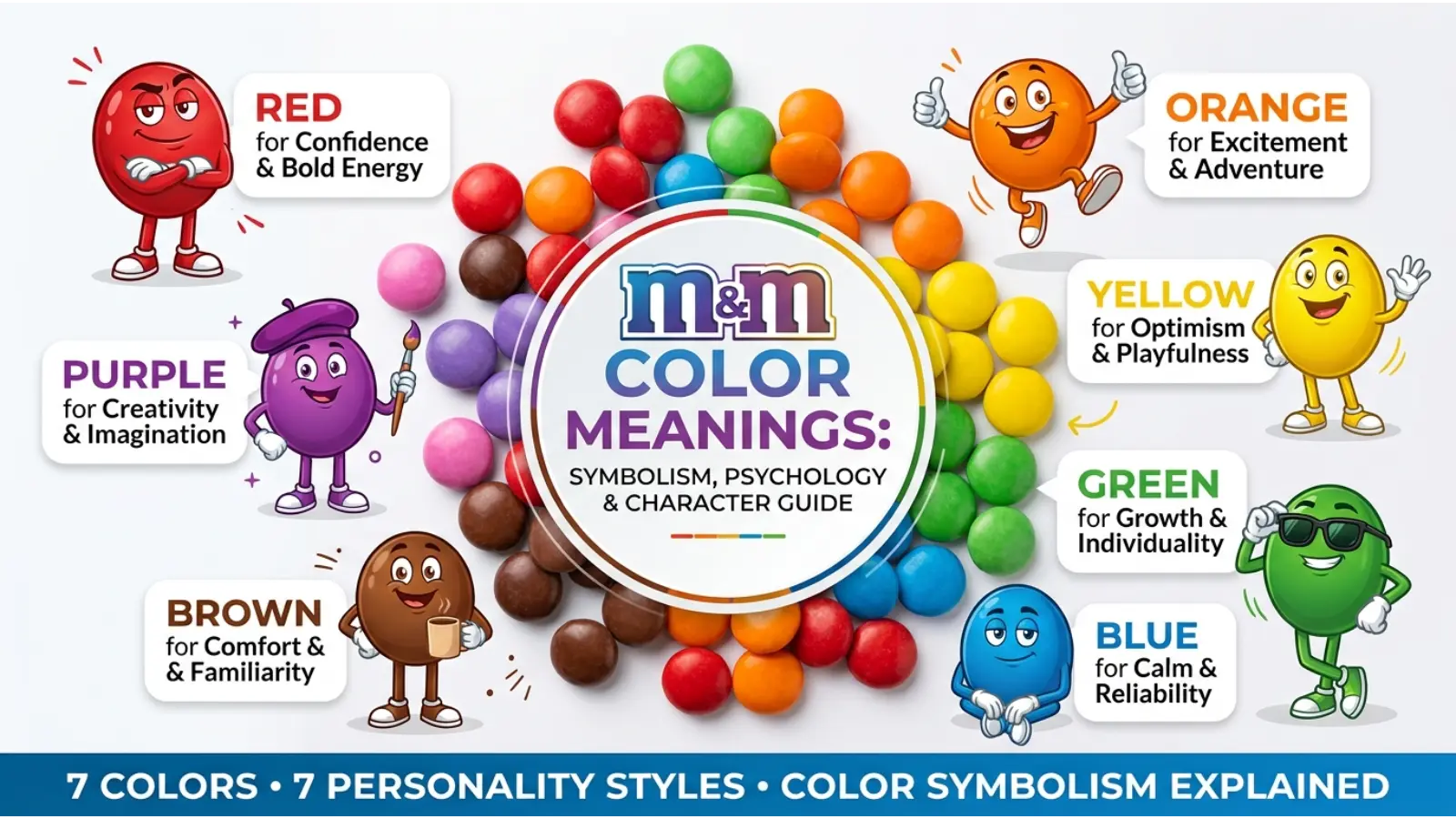
M&M’S are famous for their colorful candy shells, but the colors have become more than decoration. Over time, M&M’S has connected different colors with memorable characters, personalities, emotions, and brand messages. That makes M&M color meanings especially interesting because there are really two different layers to understand: the general symbolism of each color and the personality officially associated with its M&M’S character.
The distinction matters. Red does not automatically mean that every red M&M represents confidence, and yellow does not scientifically mean that someone is cheerful. Instead, M&M’S uses color as part of its storytelling and character design. The brand currently presents seven main characters: Red, Yellow, Orange, Purple, Green, Brown, and Blue.
At the same time, the actual candy colors can vary by product, special edition, customized order, and market. M&M’S currently sells candies in many individual colors, including purple, pink, white, aqua, black, and several shades of green and blue.
Quick Answer: What Do M&M Colors Mean?
M&M colors do not have one universal psychological meaning. The strongest meanings come from the personalities M&M’S gives its characters, combined with broader color symbolism.
| M&M Color | Character Association | Common Color Symbolism |
|---|---|---|
| 🔴 Red | Bold, self-assured, witty | Energy, passion, confidence |
| 🟡 Yellow | Warm, optimistic, easygoing | Happiness, optimism, friendliness |
| 🔵 Blue | Relaxed, confident, cool | Calm, trust, stability |
| 🟢 Green | Confident, stylish, expressive | Growth, freshness, confidence |
| 🟠 Orange | Nervous, cautious, concerned | Energy, enthusiasm, caution |
| 🟤 Brown | Poised, authoritative, composed | Stability, reliability, sophistication |
| 🟣 Purple | Authentic, self-aware, expressive | Creativity, individuality, imagination |
The character associations above come from M&M’S own current character descriptions, while the broader symbolism reflects common color associations rather than official M&M’S definitions.
What Do M&M Colors Symbolize?
M&M colors work because they combine visual color psychology with character storytelling.
A bright red character can feel energetic before the character even speaks. A yellow character may seem friendly because yellow is commonly associated with brightness and warmth. Likewise, a dark brown character can visually suggest seriousness or stability.
However, this is a storytelling device rather than a scientific personality test.
M&M’S has deliberately built recognizable personalities around its characters. The official character page describes Red as someone who trusts his instincts, Yellow as someone who finds something enjoyable in every day, Orange as highly concerned, Purple as confident and authentic, Green as confident, Brown as authoritative, and Blue as relaxed and self-assured.
The Seven Main M&M Character Colors
Red represents the bold and outspoken side of the group.
Yellow brings warmth and an easygoing attitude.
Blue has a relaxed, confident presence.
Green is associated with confidence, style, and self-expression.
Orange stands out because his character is built around nervousness and overthinking.
Brown has a more composed and authoritative personality.
Purple, the newest member of the current crew, emphasizes authenticity, self-awareness, and individuality. M&M’S introduced Purple to the character lineup in 2022.
🔴 Red M&M Color Meaning
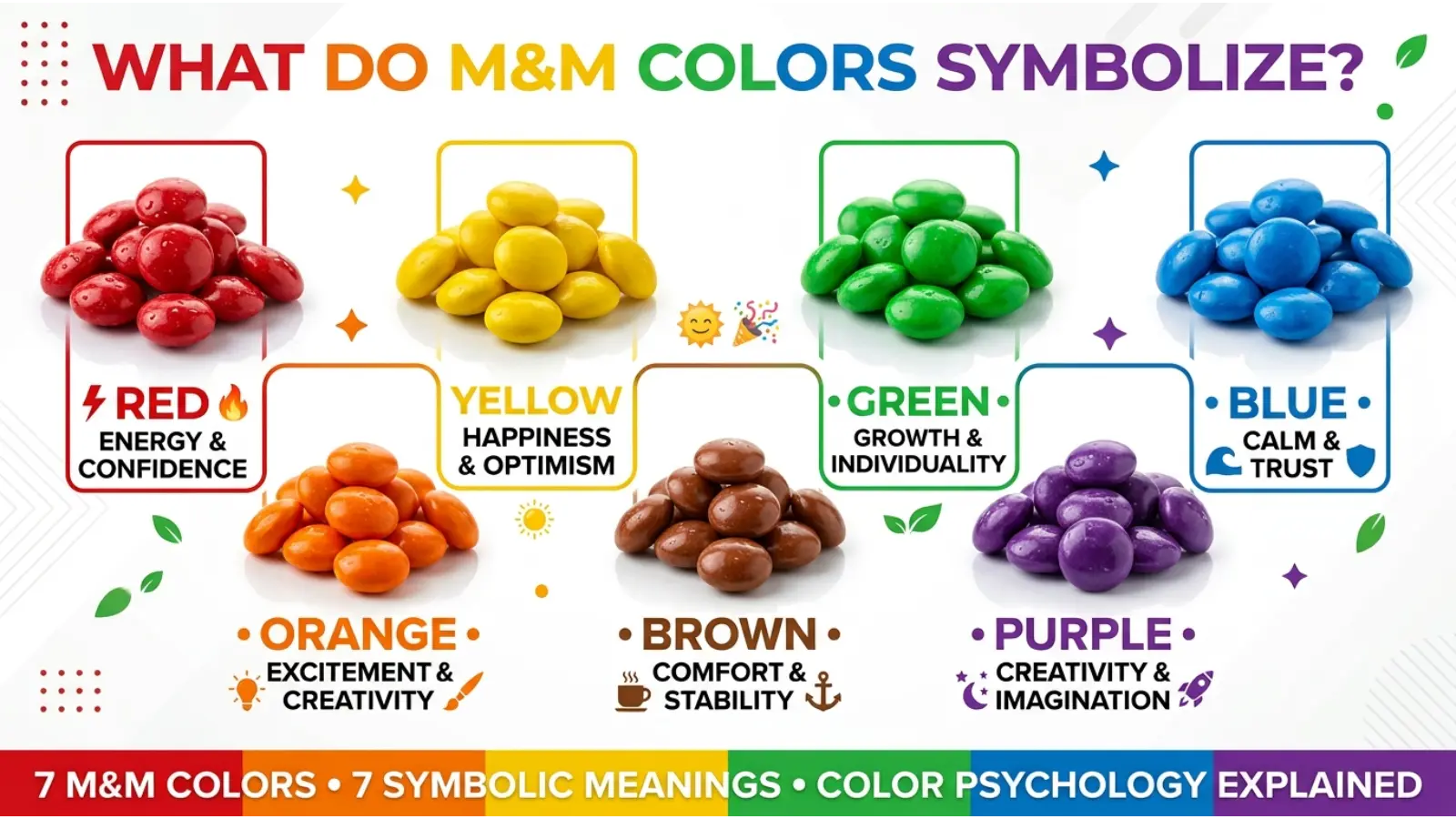
Red is one of the most recognizable M&M colors. In general color symbolism, red is often connected with energy, excitement, passion, action, and confidence.
The M&M’S character adds another layer. Officially, Red describes himself as someone who instinctively trusts his instincts. His character is therefore presented as self-assured and quick-witted rather than shy or hesitant.
Red M&M Personality
The red character can be read as:
- Confident
- Bold
- Energetic
- Assertive
- Playful
- Direct
These are character traits, not psychological conclusions about people who prefer red.
Why Red Works for the Character
Red naturally attracts visual attention because it has high visual impact. That makes it useful for a character who needs to stand out immediately.
In advertising, packaging, sports graphics, and entertainment, red can create a sense of urgency or excitement. M&M’S takes advantage of that visual energy by pairing the color with an outspoken character.
🟡 Yellow M&M Color Meaning
Yellow commonly symbolizes happiness, warmth, optimism, friendliness, and playfulness.
That makes it a natural fit for the Yellow M&M. M&M’S describes Yellow as someone who enjoys everything about the day, giving the character a warm and positive personality.
Yellow M&M Personality
The character is commonly understood as:
- Friendly
- Optimistic
- Warm
- Playful
- Good-natured
- Easygoing
Yellow also has strong visibility, especially against dark backgrounds. Consequently, it can make packaging and advertisements feel brighter and more energetic.
Yellow in Color Psychology
Yellow can attract attention, but its emotional effect depends on shade and context. A soft buttery yellow can feel gentle, while a highly saturated yellow can feel energetic or intense.
Therefore, the yellow shell should not be treated as a fixed emotional code.
🔵 Blue M&M Color Meaning
Blue is widely associated with calmness, trust, stability, confidence, and reliability.
The Blue M&M adds a cool, relaxed personality to the group. M&M’S describes Blue with the phrase “I woke up like this,” reinforcing a confident and effortless attitude.
Blue M&M Personality
Blue can suggest:
- Calm confidence
- Relaxation
- Self-assurance
- Coolness
- Composure
- Independence
This is a good example of how a brand can use color to establish a character quickly. Before viewers know the dialogue, the blue appearance already creates a cooler visual impression.
Blue in Branding
Blue is common in corporate and technology branding because it can communicate reliability and competence. However, the exact response depends on culture, shade, surrounding colors, and personal experience.
🟢 Green M&M Color Meaning
Green commonly carries associations with nature, growth, renewal, freshness, and energy. In some modern popular culture, it can also suggest confidence and individuality.
M&M’S gives its Green character a confident and stylish personality. The official character description presents Green as someone who is too busy shining to worry about criticism.
Green M&M Personality
The character can be associated with:
- Confidence
- Self-expression
- Style
- Independence
- Energy
- Charisma
The meaning is particularly interesting because green has several competing associations. Nature-based green can feel peaceful, while bright green can feel youthful and energetic.
Green in Everyday Design
Green works well when a design needs to suggest freshness or natural energy. Dark green, meanwhile, can feel more traditional or sophisticated.
So, even within one color family, changing saturation and brightness can change the impression considerably.
🟠 Orange M&M Color Meaning
Orange is often associated with energy, enthusiasm, warmth, excitement, and social activity.
Yet the Orange M&M takes a different route.
M&M’S officially portrays Orange as highly concerned and nervous. His character repeatedly worries about what might happen, creating a humorous contrast with the energetic appearance of the color.
Orange M&M Personality
Orange is commonly portrayed as:
- Nervous
- Worried
- Cautious
- Overthinking
- Highly alert
- Comedic
This contrast is one of the cleverest parts of the M&M character system.
The color looks energetic, but the character behaves cautiously. That shows why color symbolism is not a rigid formula. Designers can deliberately break expected associations to create humor or surprise.
🟤 Brown M&M Color Meaning
Brown is frequently associated with earthiness, reliability, stability, simplicity, and natural materials.
M&M’S uses Brown differently by giving the character a poised and authoritative personality. Her official description emphasizes being “the boss,” which gives the character a composed and confident role.
Brown M&M Personality
Brown can represent:
- Authority
- Confidence
- Composure
- Sophistication
- Stability
- Control
The Brown can sometimes receive less attention than brighter colors, but that can actually make it useful for creating a grounded visual identity.
Brown in Design
Brown works naturally with cream, beige, gold, dark green, orange, and other earthy colors. In interiors, it can create a grounded feeling, while in packaging it can suggest chocolate, coffee, wood, or natural materials.
🟣 Purple M&M Color Meaning
Purple has long been associated with creativity, imagination, individuality, luxury, mystery, and self-expression.
The Purple M&M is especially interesting because Purple is the newest character in the current official lineup. M&M’S introduced Purple in 2022 and describes the character as emphasizing authenticity, self-awareness, and confidence.
Purple M&M Personality
Purple can suggest:
- Individuality
- Authenticity
- Confidence
- Creativity
- Self-awareness
- Playfulness
The character also demonstrates how brands can refresh an established identity without abandoning familiar visual elements.
Purple Has a Real M&M’S History
Purple is not completely new to the brand. In 2002, M&M’S held its first global color vote, asking consumers to choose between purple, aqua, and pink. Purple won, with approximately 10 million ballots reported by M&M’S.
That history makes purple particularly important when discussing M&M color meanings.
M&M Colors and Psychology
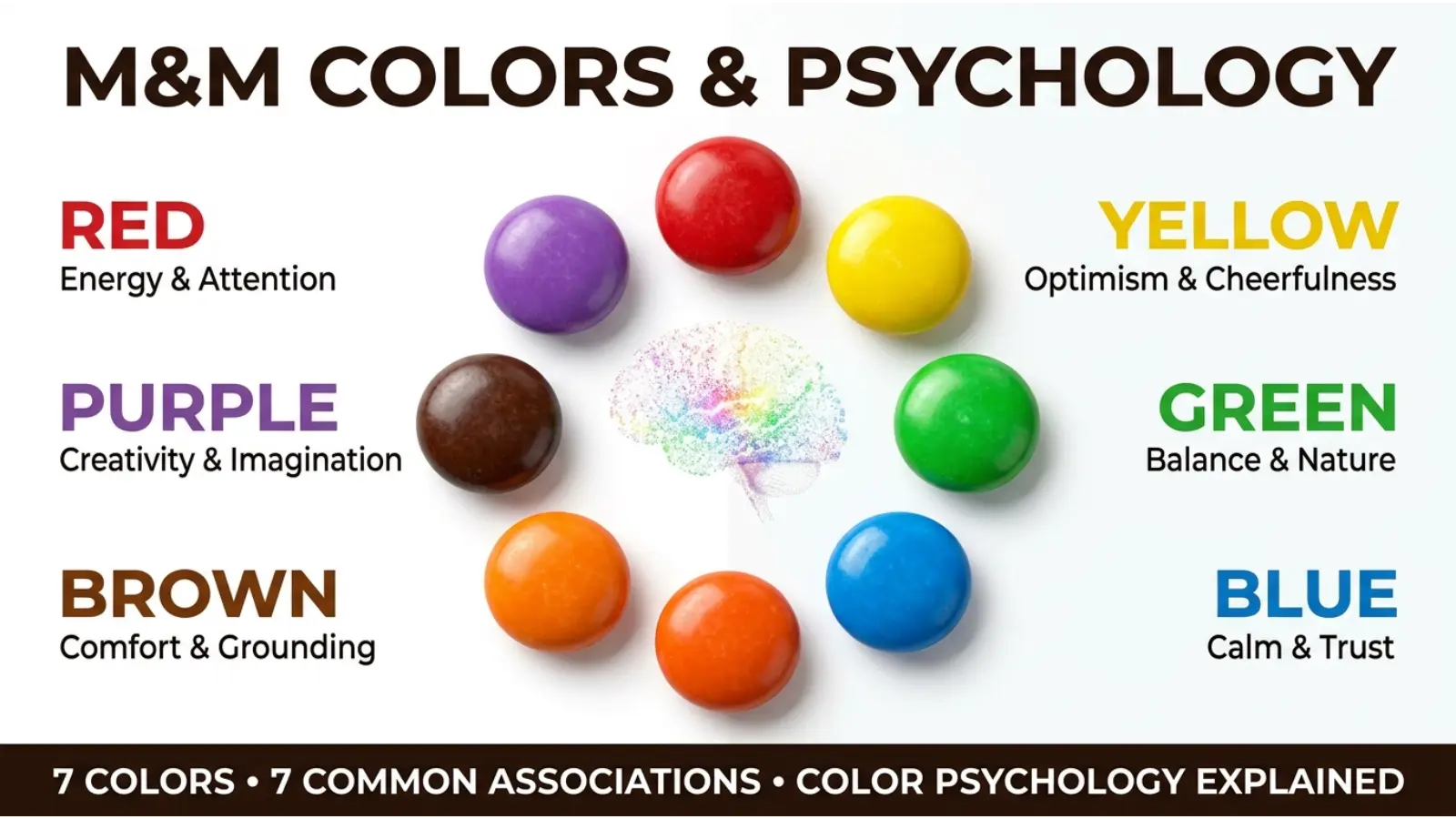
Color psychology can help explain why the M&M characters are visually memorable, but it should not be confused with a personality diagnosis.
Colors can influence perception and attention, yet responses are affected by many factors, including context, brightness, saturation, culture, previous experiences, and surrounding colors.
For example, red can communicate excitement in one design but danger or warning in another. Blue can feel peaceful in a bedroom but highly professional in a corporate logo.
The same principle applies to M&M’S.
The candy color establishes a visual cue, while the character’s behavior establishes the specific personality.
Color vs. Character Personality
| Element | What It Does |
|---|---|
| Color | Creates an immediate visual impression |
| Character design | Gives the color a recognizable identity |
| Facial expression | Adds emotion |
| Voice and dialogue | Develops personality |
| Advertising context | Changes interpretation |
| Cultural context | Can alter symbolic meaning |
This combination is more powerful than color alone.
M&M Colors and Branding
M&M’S is an excellent example of how color can become part of a larger brand identity.
The brand does not simply sell brightly colored candy. It has built a recognizable cast of characters around those colors.
That strategy gives consumers several visual shortcuts. A person can recognize Red, Yellow, Blue, or Green before reading a name.
M&M’S also describes its broader brand purpose around fun, togetherness, shared experiences, and belonging.
Why Color Characters Work
Color-based characters can help a brand:
- Create visual recognition.
- Make advertising easier to remember.
- Give different personalities distinct identities.
- Make products more appealing to children and adults.
- Support storytelling across television, packaging, digital media, and merchandise.
In other words, the colors become part of the brand’s language.
M&M Colors in Advertising and Packaging
M&M’S uses color to create visual variety and make products easy to recognize.
The brand’s current store offers single-color M&M’S in numerous shades, demonstrating that candy color is also an important customization tool.
This is where color meaning becomes practical.
A red-and-white combination might fit a Valentine’s or holiday design, while school colors can be reproduced through customized candies. The meaning comes partly from the color itself and partly from the event surrounding it.
M&M Colors and Culture
There is no universal cultural dictionary in which every M&M color has one fixed meaning.
Red, yellow, blue, green, brown, orange, and purple can carry different associations across cultures. For example, colors used in celebrations, ceremonies, clothing, religious traditions, or national symbols may gain meanings that are unrelated to M&M’S.
Therefore, it is better to separate:
M&M’S character meaning
from
general cultural color symbolism.
A red M&M character is a branded fictional personality. It should not be interpreted as representing every cultural meaning of red.
The History Behind M&M Colors
M&M’S has changed its colors and products many times during its long history.
M&M’S Plain Chocolate Candies were introduced in 1941. By 1950, the famous “m” had become an authenticity mark, and the printed “m” later changed from black to white in the 1950s.
The 1990s brought a much wider range of color customization. M&M’S Colorworks offered 21 colored milk chocolate candies through selected specialty stores and the internet.
The 2002 global color vote was another important moment because consumers selected purple from three proposed options.
Later, the brand expanded its character universe. Brown debuted as a character in 2012, while Purple joined the crew in 2022.
This history shows that M&M colors are not completely static. They have evolved with marketing, customization, product launches, and character development.
M&M Color Meanings vs. Official Character Meanings
One common mistake is assuming that M&M’S officially assigns a psychological meaning to every candy color.
It does not work that simply.
The company officially describes its characters, so those character traits are the strongest source for understanding the M&M universe. General statements such as “red means passion” or “blue means trust” belong to broader color symbolism and psychology, not necessarily to an official M&M’S personality chart.
A Better Way to Read M&M Colors
Think of the meaning in three layers:
The Layer 1 — Physical color:
The candy is red, yellow, blue, green, orange, brown, or another shade.
Layer 2 — General symbolism:
People may associate that color with emotions or ideas.
Layer 3 — M&M’S character:
The brand gives the color a specific fictional personality.
The third layer is the most directly connected to M&M’S itself.
Do M&M Colors Have Personality Meanings?
Yes, but mainly through the fictional characters rather than through a scientific personality system.
For example, M&M’S describes Orange as concerned, Brown as authoritative, and Purple as authentic and self-aware.
That does not mean someone who chooses an orange candy is anxious or someone who prefers purple is more creative.
Therefore, M&M colors can be fun personality symbols without becoming personality tests.
M&M Color Meanings Combinations
M&M colors are particularly effective when several shades appear together.
| Color Combination | Visual Impression |
|---|---|
| 🔴 Red + 🟡 Yellow | Energetic and playful |
| 🔵 Blue + 🟢 Green | Fresh and balanced |
| 🟣 Purple + 🟡 Yellow | Creative with strong contrast |
| 🔴 Red + 🔵 Blue | Bold and energetic |
| 🟠 Orange + 🟡 Yellow | Warm and cheerful |
| 🟤 Brown + 🟡 Yellow | Earthy and nostalgic |
| 🟢 Green + 🟤 Brown | Natural and grounded |
These combinations are not official M&M’S psychological codes. Instead, they demonstrate how basic color relationships can influence visual perception.
Complementary and contrasting colors often attract attention because differences in hue make individual elements easier to distinguish.
Why Do M&M Color Meanings Look So Appealing?
Part of the appeal comes from color variety.
A single-color pile creates a simple visual field. A mixture of several bright colors creates contrast, rhythm, and movement.
That effect is useful in:
- Candy displays
- Party decorations
- Photography
- Product packaging
- Dessert tables
- Social media images
- Gift arrangements
- Event favors
Lighting matters too. Warm indoor lighting can make yellow, orange, and red appear stronger, while cooler lighting can emphasize blue and green.
Consequently, the same M&M color arrangement can look different in sunlight, restaurant lighting, and photography.
M&M Color Meanings in Fashion and Design
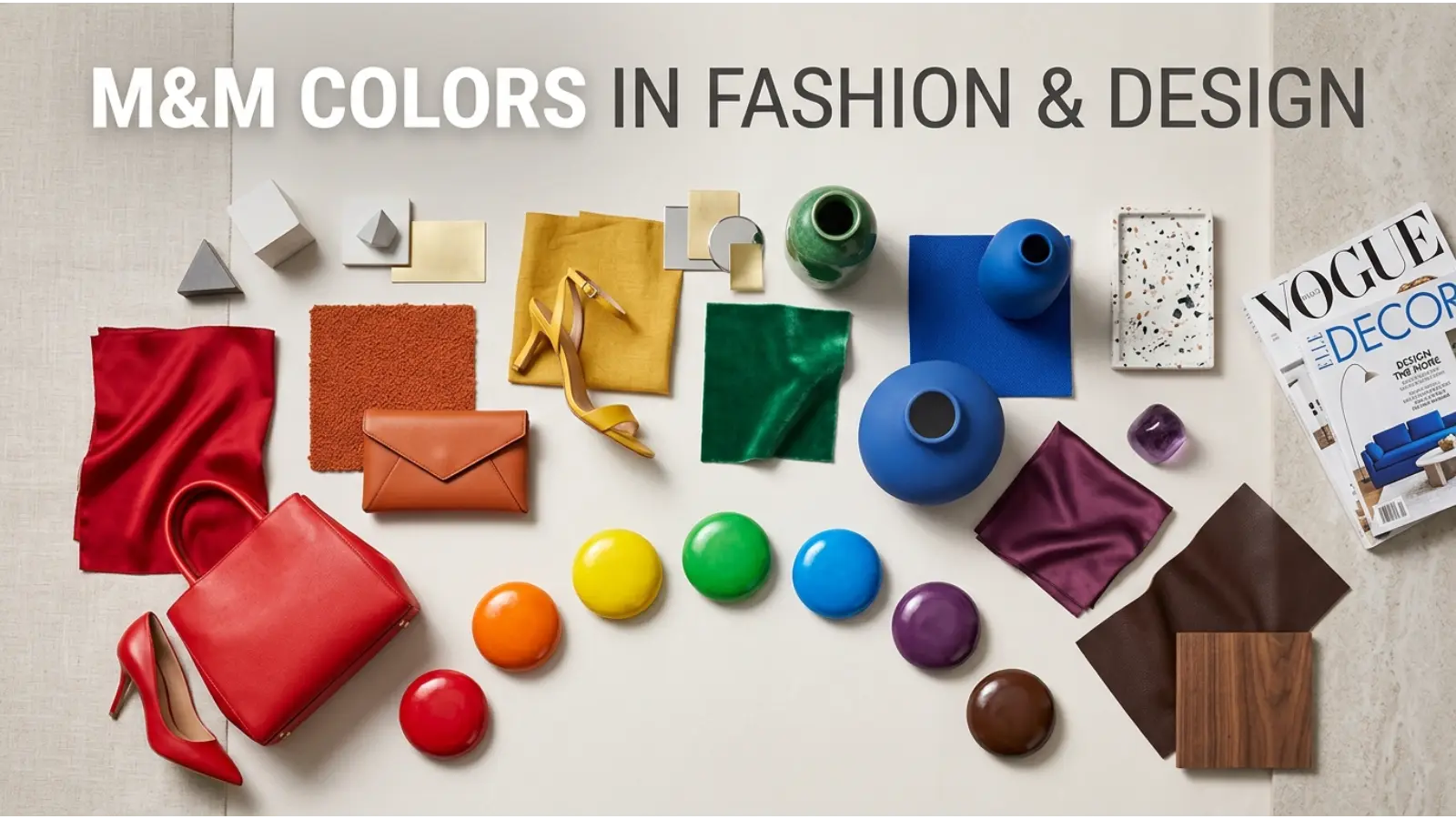
M&M colors can also inspire playful color palettes.
A red-and-yellow palette creates a lively, energetic impression. Blue and green can create a cooler combination, while purple and yellow produce stronger contrast.
For clothing or interiors, however, using every bright M&M color at full saturation can become visually intense.
A better approach is to choose one dominant color and use the others as accents.
For example:
Blue base + yellow accents + small amounts of red
can create a playful look without making every element compete for attention.
The same principle works in graphic design.
Common Misconceptions About M&M Color Meanings
Myth 1: Every M&M color has an official psychological meaning.
Not necessarily. M&M’S officially provides character personalities, while many broader color meanings come from general symbolism and cultural associations.
Myth 2: Your favorite M&M color reveals your personality.
There is no sound basis for using candy-color preference as a personality diagnosis.
Myth 3: The colors always stay the same.
No. M&M’S offers customized colors and special-edition combinations, and its current online store lists many individual shades.
Myth 4: Purple has always been one of the original character colors.
Purple became part of the current character crew in 2022. However, purple had already been selected by consumers in the 2002 global color vote.
Myth 5: The character and the color mean exactly the same thing.
Not always. Orange is a useful example: orange commonly suggests energy, but the Orange M&M is deliberately portrayed as nervous and concerned.
M&M Color Meanings in Everyday Life
The most useful way to understand M&M colors is to see them as a combination of branding, storytelling, color perception, and cultural symbolism.
For party planning, color can help establish a theme.
For photography, contrasting colors can make candy arrangements more visually interesting.
The For design, the colors demonstrate how hue, contrast, brightness, and context can change the feeling of an image.
And for entertainment, the characters show how simple colors can become personalities that audiences recognize instantly.
M&M Color Meanings Chart
| M&M | Main Character Idea | Broader Color Associations | Design Feeling |
|---|---|---|---|
| 🔴 Red | Bold and instinctive | Energy, passion, action | Strong |
| 🟡 Yellow | Warm and positive | Happiness, optimism | Cheerful |
| 🔵 Blue | Relaxed and confident | Calm, trust, stability | Cool |
| 🟢 Green | Stylish and confident | Growth, freshness, nature | Fresh |
| 🟠 Orange | Nervous and concerned | Energy, warmth, caution | Vibrant |
| 🟤 Brown | Poised and authoritative | Stability, earthiness | Grounded |
| 🟣 Purple | Authentic and expressive | Creativity, individuality | Imaginative |
The character descriptions are based on M&M’S official materials; the broader color associations are general symbolic interpretations and should not be treated as official M&M’S definitions.
Frequently Asked Questions
What do the different M&M colors mean?
The meanings depend on whether you mean general color symbolism or M&M’S characters. The current characters have distinct personalities, while general color meanings include ideas such as energy, happiness, calmness, growth, and creativity.
What does the Red M&M represent?
Red is commonly associated with energy, confidence, passion, and action. The Red M&M is officially portrayed as self-assured and someone who trusts his instincts.
What does the Yellow M&M represent?
Yellow commonly suggests happiness, warmth, and optimism. The Yellow M&M is presented as warm and positive, with an appreciation for the good things in everyday life.
What does the Blue M&M represent?
Blue is commonly associated with calmness, trust, stability, and confidence. The Blue M&M has a relaxed, self-assured personality.
What does the Green M&M represent?
Green often symbolizes nature, growth, freshness, and renewal. M&M’S presents Green as confident, stylish, and expressive.
What does the Orange M&M represent?
Orange is commonly associated with energy and enthusiasm, but the Orange M&M is intentionally characterized by nervousness and concern.
What does the Brown M&M represent?
Brown can suggest stability, earthiness, and reliability. The Brown M&M is presented as poised, confident, and authoritative.
What does the Purple M&M represent?
Purple is often associated with creativity and individuality. M&M’S describes Purple as authentic, self-aware, and confident. Purple joined the official character crew in 2022.
Is there a scientific M&M color personality test?
No. M&M color preferences should not be used as a scientific personality test. The character personalities are part of brand storytelling, while broader color psychology describes tendencies and associations rather than fixed rules.
Why are M&M candies different colors?
Different colors make the candies visually distinctive and support branding, product customization, seasonal themes, events, and marketing. M&M’S currently offers a wide range of single-color and customized candies.
Final Thoughts on M&M Color Meanings
M&M color meanings are most interesting when color and character are considered together.
Red can visually suggest energy while the Red M&M adds confidence. Yellow creates a bright, friendly impression that fits the cheerful Yellow character. Blue supports a relaxed image, while Green brings confidence and style. Orange deliberately challenges the expected meaning of its color through a nervous character. Brown creates a grounded visual presence, and Purple adds a newer message of authenticity and individuality.
The bigger lesson is that color does not have one permanent meaning. Context changes everything. A color can communicate one idea in a logo, another in clothing, another in a cultural tradition, and something completely different when attached to a fictional character.
That flexibility is exactly what makes M&M’S colors so effective. They are not simply different shades of candy. Through years of branding and storytelling, those colors have become visual identities that people can recognize almost instantly.

Emma Wilson is a dedicated comparison writer and product researcher at ColorMystiic.com. She specializes in creating unbiased product comparisons, detailed reviews, and helpful buying guides. Her goal is to help readers make smarter purchasing decisions with confidence.