Fire Hydrant Color Meanings may look like simple red, yellow, blue, or green fixtures on the side of a road, but their colors can communicate useful information to firefighters. In many places, the color of a hydrant body, bonnet, or cap helps identify water-flow capacity, ownership, or the type of water supply.
However, there is no single worldwide fire hydrant color code. A blue cap in one community may mean something different somewhere else. Local fire departments, water utilities, and municipalities can establish their own systems.
That is why people searching for fire hydrant color meanings should look beyond the color alone. The most useful interpretation depends on the location, the part of the hydrant that is colored, and the local fire-service standard.
This guide explains the common meanings behind fire hydrant colors, how firefighters use them, why some hydrants are painted differently, and how to interpret a hydrant safely without assuming that one color has the same meaning everywhere.
Quick Answer
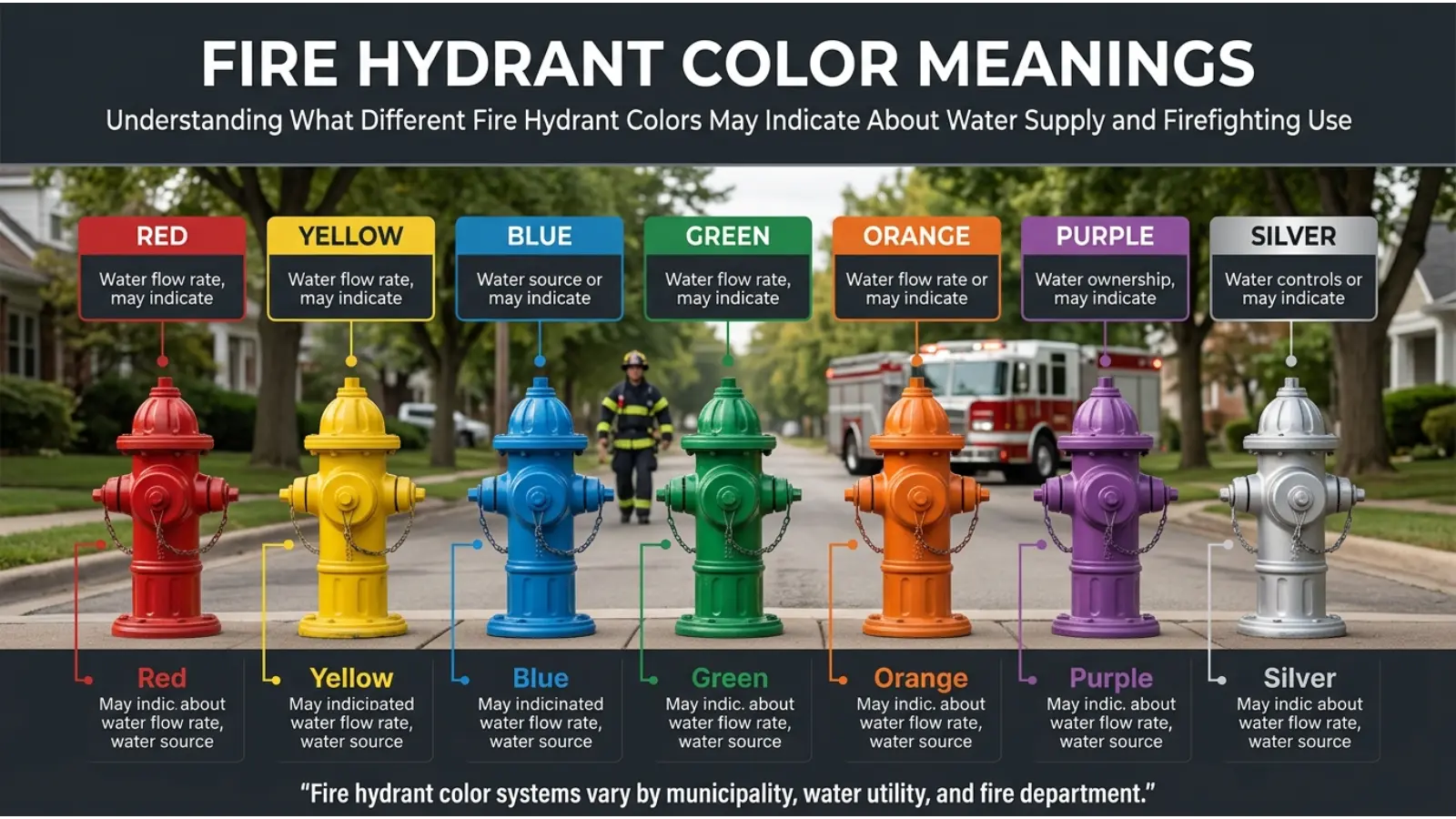
Fire hydrant colors often indicate water-flow capacity or another operational characteristic, but the exact meaning varies by jurisdiction. Under a commonly used U.S. color convention based on NFPA guidance, bonnet and nozzle colors can indicate approximate available flow:
| Color | Common Flow Classification | General Meaning |
|---|---|---|
| 🟥 Red | Under 500 GPM | Lower flow |
| 🟧 Orange | 500–999 GPM | Moderate flow |
| 🟩 Green | 1,000–1,499 GPM | Good flow |
| 🟦 Blue | 1,500+ GPM | Very good flow |
| 🟨 Yellow | Varies by system | Often hydrant body or local designation |
GPM means gallons per minute. These values are commonly associated with a U.S. fire-service color convention, but they are not a universal rule. Always follow the markings and standards used by the local fire department or water authority.
What Do Fire Hydrant Colors Mean?
Unlike decorative color symbolism, fire hydrant colors usually have a practical communication purpose.
A hydrant might use color to help emergency crews quickly identify information such as:
- Approximate water-flow capacity
- Available water supply
- Hydrant classification
- Private or public ownership
- Special water sources
- Local fire-service information
- Maintenance or operational status
Therefore, a red hydrant does not necessarily “symbolize danger,” and a blue hydrant does not necessarily symbolize “trust” or “calm.” Those are general color associations rather than the primary purpose of hydrant paint.
In emergency situations, visual information must be understood quickly. As a result, standardized or locally established colors can help firefighters make faster decisions.
Why Fire Hydrants Need Color Coding
Firefighters may need to locate a suitable water source within seconds or minutes. A visual system can make it easier to distinguish hydrants and estimate their usefulness.
For example, if a local department uses bonnet colors to represent flow capacity, a firefighter can recognize a blue bonnet as a high-flow hydrant without relying only on its physical size.
However, color is only one piece of information. Fire crews also consider water pressure, hydrant condition, pipe size, location, accessibility, and other operational factors.
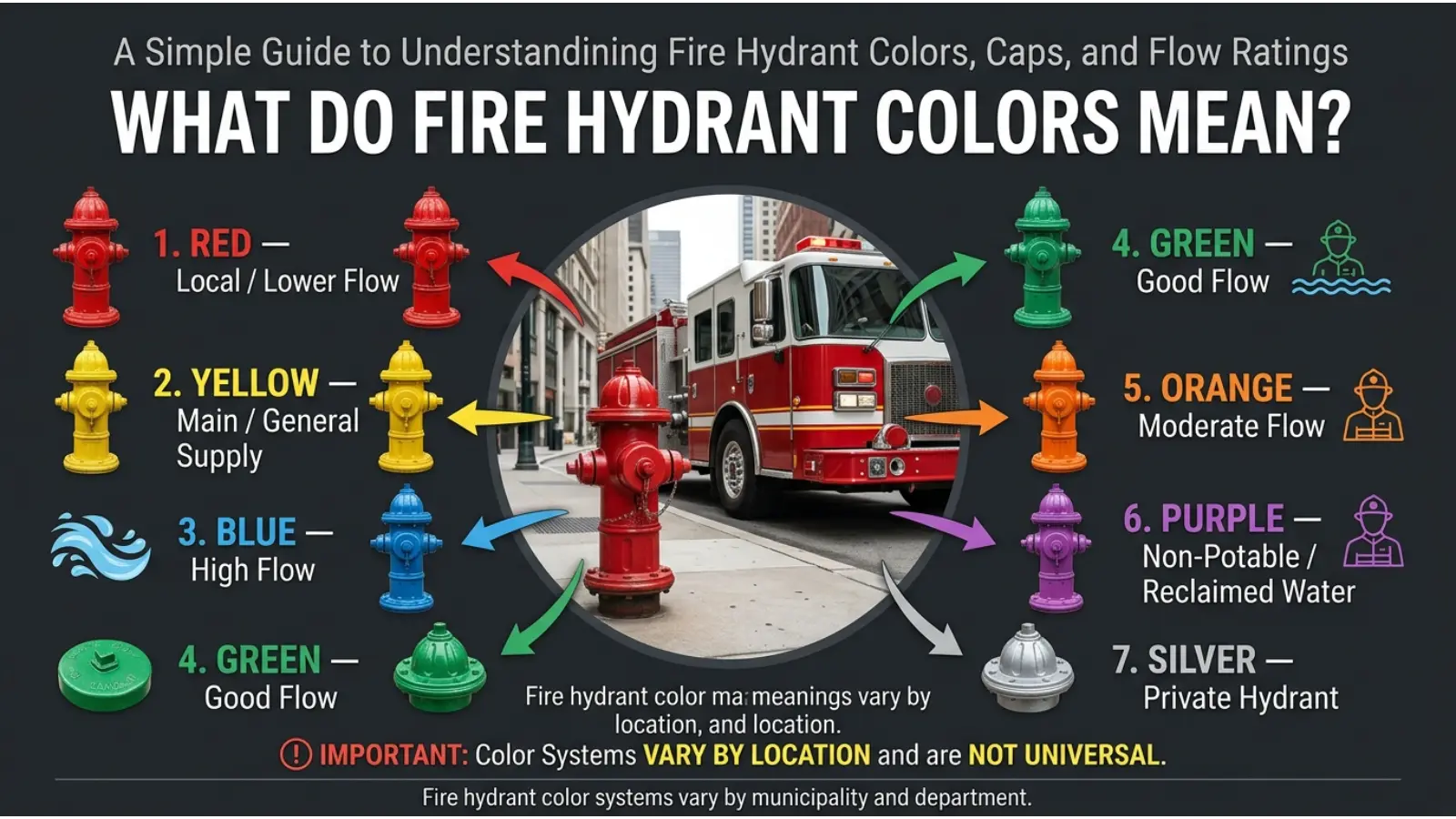
Fire Hydrant Color Meanings Chart
The following chart describes a commonly encountered U.S. flow-based color convention. It should not be treated as a universal international standard.
| 🎨 Color | 🔥 Common Meaning | 💧 Approximate Flow |
|---|---|---|
| 🟥 Red | Lower available flow | Less than 500 GPM |
| 🟧 Orange | Moderate available flow | 500–999 GPM |
| 🟩 Green | Higher available flow | 1,000–1,499 GPM |
| 🟦 Blue | Very high available flow | 1,500+ GPM |
| 🟨 Yellow | Often used for hydrant body or local identification | Depends on jurisdiction |
The important detail is that these colors generally describe operational information rather than emotional or spiritual symbolism.
Moreover, the color may appear on the bonnet, top, side nozzles, or entire hydrant. Therefore, two hydrants with different-looking paint schemes can still follow similar information systems.
Red Fire Hydrant Meaning 🟥
A red hydrant cap or bonnet commonly represents a lower-flow classification in systems that use the widely recognized U.S. color convention.
A common interpretation is:
Red = less than 500 gallons per minute
That means the hydrant may provide less water flow than hydrants classified in the higher categories.
However, this does not automatically mean that a red hydrant is unsafe or unusable. Firefighters select water sources based on the requirements of a particular incident.
A red-painted hydrant can also have a completely different local meaning. In some communities, red may be used as the standard color for the entire hydrant rather than as a flow indicator.
What Red Means Psychologically
From a general color-psychology perspective, red is often associated with urgency, attention, heat, danger, and action.
That association is useful for understanding why red is visually noticeable. Nevertheless, it should not be confused with the technical meaning assigned to a particular hydrant.
The hydrant’s operational color code comes from fire-service or municipal practice, not from general color psychology.
Orange Fire Hydrant Meaning 🟧
Orange commonly represents a moderate water-flow category when a fire hydrant uses a flow-based color system.
A frequently used classification is:
Orange = 500–999 gallons per minute
Orange sits between red and green in this system. Consequently, it can provide a quick visual indication that the hydrant has more flow capacity than the lowest category but less than higher-flow classifications.
Still, local rules can change the meaning.
An orange hydrant might therefore indicate something completely different in a municipality that uses its own paint system.
Why Orange Works as a Visual Code
Orange is highly visible and easy to distinguish from red and yellow. Therefore, it works well when several categories need to be recognized quickly.
In practical design, the value of a color system comes from consistent local use, not simply from the color itself.
Green Fire Hydrant Meaning 🟩
Green commonly identifies a higher water-flow category in the same U.S. convention.
A commonly used classification is:
Green = 1,000–1,499 gallons per minute
That places green above the red and orange categories.
The color can therefore help firefighters quickly recognize a hydrant with stronger expected flow, assuming the community uses this system.
Green also has a strong positive association in everyday color psychology. People often connect it with nature, safety, growth, and permission. Yet those associations are separate from the technical fire-hydrant meaning.
In other words:
Green hydrant color ≠ universal symbol of safety.
Its actual meaning depends on the local code.
Blue Fire Hydrant Meaning 🟦
Blue commonly represents the highest flow category in the widely used U.S. system.
A common classification is:
Blue = 1,500 gallons per minute or more
This can make blue a particularly useful visual signal for firefighters looking for a hydrant with substantial flow capacity.
Nevertheless, the actual performance of a hydrant depends on more than its color. Water pressure, pipe infrastructure, elevation, system demand, and hydrant condition can all affect available water.
Therefore, blue should be viewed as a classification indicator, not a guarantee of a specific flow rate during every emergency.
Yellow Fire Hydrant Meaning 🟨
Yellow is one of the most confusing hydrant colors because it does not have one universal meaning.
In many U.S. communities, the hydrant body may be painted chrome yellow or another yellow shade, while the bonnet or caps provide additional information.
In other areas, yellow can represent a particular water-flow category or a local designation.
Consequently, seeing a yellow hydrant alone is not enough to determine its exact meaning.
Why So Many Hydrants Are Yellow
Yellow provides strong visibility during both daytime and nighttime conditions.
A bright hydrant is easier to identify beside roads, parking areas, grass, snow, and other surroundings. Therefore, yellow can serve a practical visibility function even when it is not being used as a flow classification.
Why Fire Hydrant Color Meanings Are Different
There are several reasons hydrants look different from one city to another.
Local Standards
Municipal water departments and fire authorities may establish their own identification systems.
Therefore, a color scheme used in one state, city, or country should not automatically be applied somewhere else.
Different Hydrant Parts May Have Different Meanings
The body and the bonnet or caps can communicate different information.
For example, a municipality may use the body color to identify the water system while using cap colors to indicate flow capacity.
This is one reason simply searching for “red hydrant meaning” can produce misleading answers.
Ownership
Some communities use color to distinguish public hydrants from private hydrants.
A private hydrant may serve an industrial property, apartment complex, commercial building, campus, or other privately maintained water system.
Again, the exact color varies by local authority.
What Do Fire Hydrant Caps Mean?
Hydrant caps and bonnets are often more informative than the body color.
In systems that use a flow-based convention, the top portion can communicate the expected flow category.
| Cap Color | Common Flow Meaning |
|---|---|
| 🟥 Red | Less than 500 GPM |
| 🟧 Orange | 500–999 GPM |
| 🟩 Green | 1,000–1,499 GPM |
| 🟦 Blue | 1,500+ GPM |
This approach creates a simple visual scale:
Red → Orange → Green → Blue
As flow capacity increases, the color moves toward the higher categories.
However, firefighters do not rely on this chart blindly. Local standards always take priority.
What Does GPM Mean on a Fire Hydrant?
GPM means gallons per minute.
It describes how much water can flow through a hydrant or water system over a given period.
For example, a hydrant classified at 1,000 GPM represents a substantially greater flow capacity than one classified below 500 GPM, assuming the classifications are measured under comparable conditions.
However, GPM is not the same thing as water pressure.
GPM vs. Water Pressure
These two measurements are related but different.
Flow rate tells you how much water moves.
Pressure describes the force available within the water system.
A hydrant can have a particular static pressure but provide a different flow when water is being drawn.
For firefighting, both flow and pressure matter.
Does a Red Fire Hydrant Mean Low Water Pressure?
Not necessarily.
This is one of the most common misconceptions.
A red cap may indicate a lower flow category in a particular color system, but that does not mean the hydrant simply has “low pressure.”
Flow depends on the entire water-distribution system and the conditions under which the hydrant is tested.
Therefore, never interpret a hydrant color as a direct measurement of pressure unless the local authority specifically says so.
Does a Blue Fire Hydrant Mean Better Water?
Not necessarily.
A blue hydrant may indicate a high-flow category under a particular system, but color does not tell you that the water is cleaner, safer to drink, or chemically different.
Fire hydrants are primarily part of water-distribution and firefighting infrastructure.
So:
Blue ≠ drinking-water quality
and
Blue ≠ universally high pressure
It generally communicates a technical classification only when the local system assigns that meaning.
Fire Hydrant Body vs. Bonnet vs. Nozzle
Understanding the physical parts of a hydrant makes color codes easier to interpret.
| Hydrant Part | What It May Communicate |
|---|---|
| Body | Public/private status, water-system information, visibility, or local classification |
| Bonnet/top | Often flow classification in some U.S. systems |
| Nozzle cap | May identify flow or other local operational information |
| Markings | Manufacturer, maintenance, identification, or local information |
Because municipalities can assign these elements differently, the location of the color matters as much as the color itself.
Why Are Fire Hydrant Color Meanings Painted Red?
Red is strongly associated with fire equipment in many countries, so red hydrants are easy for the public to recognize.
The visual connection is practical. Fire trucks, emergency equipment, warning signs, and firefighting tools frequently use highly noticeable colors.
However, an all-red hydrant should not automatically be interpreted as a low-flow hydrant.
This distinction is especially important because many online color charts describe the color of a cap or bonnet, while readers assume the chart describes the entire hydrant.
Why Are Some Fire Hydrants Painted Yellow?
Yellow hydrants are common in many areas because the color provides excellent visibility.
A bright yellow body can stand out against:
- Asphalt
- Grass
- Concrete
- Snow
- Soil
- Parking lots
- Roadside vegetation
In addition, yellow can make emergency infrastructure easier to identify from a distance.
Therefore, yellow may be chosen primarily for visibility and identification, rather than symbolism.
Why Are Some Fire Hydrants Blue?
Blue may be used on hydrant bonnets or caps to identify high flow capacity in certain U.S. systems.
In other jurisdictions, blue can have a different meaning.
Some communities also use blue as part of their own local identification systems. Therefore, the color needs to be interpreted alongside local signs, markings, and published standards.
Are Fire Hydrant Color Meanings Universal?
No.
This is the most important fact to remember.
There is no worldwide fire-hydrant color language in which every red, orange, green, blue, and yellow hydrant has exactly the same meaning.
Color standards can differ by:
- Country
- State or province
- City
- Fire department
- Water utility
- Private property
- Local infrastructure
- Municipal regulations
As a result, online charts should be treated as general guidance rather than universal law.
Fire Hydrant Colors in Different Countries
Fire hydrant appearance varies considerably around the world.
United States
Many U.S. communities use color systems influenced by fire-service standards, including flow-based bonnet or cap classifications.
However, individual municipalities may modify the system.
United Kingdom
Hydrant identification can differ significantly from U.S. practice. Many British hydrants are associated with yellow “H” signs that help firefighters locate underground hydrants.
Therefore, American red-blue-green-orange charts should not automatically be applied to British hydrants.
Canada
Canadian municipalities can also use different hydrant colors and markings depending on local water systems and fire-service requirements.
Other Countries
Across Europe, Asia, Africa, Australia, and Latin America, hydrant design and identification practices vary widely.
Consequently, a color that indicates high flow in one country may simply be a visibility color somewhere else.
The History Behind Fire Hydrant Color Meanings Coding
Fire hydrants developed alongside organized municipal water systems and modern firefighting infrastructure.
As cities expanded, firefighters needed reliable ways to locate and identify water sources. Over time, municipalities developed markings, signs, numbering systems, and paint schemes to make hydrants easier to locate and operate.
Modern color systems therefore reflect a broader history of standardization and emergency communication.
The exact meaning of a particular color, however, comes from the standard adopted by the relevant authority.
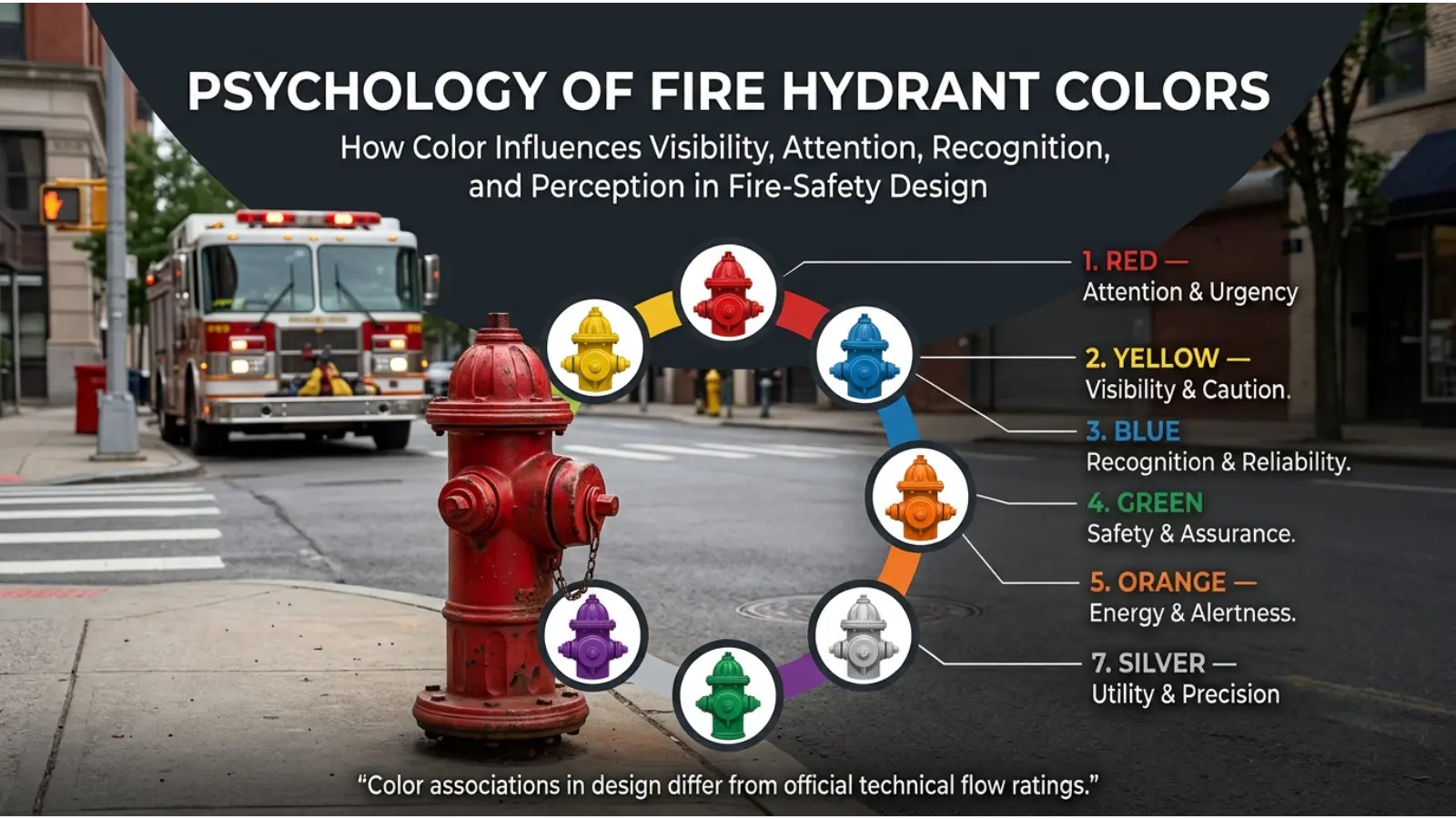
The Psychology of Fire Hydrant Color Meanings
Color psychology can explain why certain hydrant colors are visually effective, but it should not be confused with official fire-service coding.
Red
🟥 Attention • Urgency • Danger • Action
Red attracts attention and can stand out strongly against many backgrounds.
Orange
🟧 Visibility • Energy • Warning
Orange is highly noticeable and provides clear separation from red and yellow.
Green
🟩 Nature • Balance • Growth
Green often has positive associations in general visual culture. In hydrant coding, however, it may simply identify a flow category.
Blue
🟦 Calm • Clarity • Reliability
Blue is often perceived as stable and clear. On a hydrant, its technical meaning may instead relate to high flow.
Yellow
🟨 Visibility • Attention • Caution
Yellow is highly visible, making it useful for infrastructure that needs to be quickly located.
The lesson is simple: psychological associations can affect how a color feels, but technical color codes determine what it means in a fire-service context.
Do Fire Hydrant Color Meanings Have Spiritual Meanings?
Fire hydrant colors do not have widely established spiritual meanings as part of standard firefighting practice.
Someone could personally interpret red as protection, blue as peace, green as renewal, or yellow as energy. Those interpretations belong to personal symbolism, spiritual traditions, or general color symbolism, not to the technical function of hydrants.
Therefore, claims such as “a blue fire hydrant spiritually means protection” should not be presented as an official fire-service interpretation.
The safest approach is to separate:
Technical meaning = local fire or water-system code
from
Symbolic meaning = personal or cultural interpretation
Fire Hydrant Colors and Public Safety
Color coding can improve emergency response because firefighters can process visual information quickly.
A clear system can help crews identify:
- Which hydrants are available
- Which hydrants may provide higher flow
- Which hydrants belong to certain systems
- Where hydrants are located
- Which infrastructure needs attention
However, color alone is never a substitute for operational testing and local knowledge.
A hydrant that appears well painted may still have mechanical or water-supply problems.
Why Fire Hydrant Color Meanings Fade
Outdoor hydrants experience harsh conditions throughout the year.
Sunlight, rain, snow, road salt, dirt, pollution, and repeated maintenance can change their appearance.
For example, a bright red bonnet may gradually become dull or faded. A yellow body may become darker or chalky.
This matters because a faded color can make visual classification less reliable.
Consequently, firefighters use established records, markings, testing information, and local systems rather than trusting paint color alone.
How Lighting Changes Fire Hydrant Colors
Lighting can significantly affect how a hydrant appears.
Under bright sunlight:
- Yellow may appear extremely vivid.
- Orange may look closer to red.
- Blue may appear lighter.
- Green can shift toward yellow depending on surrounding colors.
At night, artificial street lighting can change color perception even further.
Photography also changes appearance through camera exposure and white balance.
Therefore, a photograph of a hydrant may not accurately reproduce the exact color used by the municipality.
Fire Hydrant Colors in Photography and Art
Photographers often use fire hydrants as strong visual subjects because their bright colors contrast with gray streets and urban environments.
A red hydrant against concrete can create a strong focal point. Likewise, a yellow hydrant can add visual warmth to an otherwise neutral scene.
Artists may also use hydrant colors symbolically.
For example:
- Red can suggest urgency.
- Yellow can suggest visibility or optimism.
- Blue can create a cooler urban mood.
- Green can contrast with industrial surroundings.
These are artistic interpretations, not official hydrant meanings.
Fire Hydrant Colors in Branding and Marketing
Fire hydrant colors can also inspire branding because they are highly recognizable visual objects.
Red may create an emergency or energetic impression.
Yellow can communicate visibility and attention.
Blue can suggest reliability and technical confidence.
Green can suggest environmental or community themes.
However, companies should avoid assuming that a hydrant color automatically communicates a universal meaning.
Brand perception depends on the complete visual identity, including typography, shape, context, culture, and surrounding colors.
Fire Hydrant Colors in Interior Design
Fire hydrant colors are rarely used literally in home interiors, but they can inspire bold accent palettes.
Red Accent
A red accent wall or chair can create energy and visual focus.
Pair it with:
- White
- Charcoal
- Gray
- Black
- Natural wood
Yellow Accent
Yellow can brighten a room and work well with neutral backgrounds.
Try:
- Yellow + gray
- Yellow + white
- Yellow + navy
- Yellow + natural wood
Blue Accent
Blue can create a cooler and calmer appearance.
It works naturally with:
- White
- Light gray
- Beige
- Wood tones
Green Accent
Green can bring a natural quality into interiors.
Combine it with:
- Cream
- Beige
- Brown
- Soft gray
- Natural wood
The strongest results usually come from using bright hydrant-inspired colors as accents rather than covering an entire room.
Fire Hydrant Colors in Fashion
Bright hydrant colors can create strong fashion statements.
🟥 Red works well for statement jackets, dresses, shoes, and accessories.
🟧 Orange creates an energetic summer or streetwear look.
🟩 Green can produce a fresh, natural, or contemporary appearance.
🟦 Blue offers a more versatile option for casual and professional clothing.
🟨 Yellow adds brightness and works especially well as an accent.
For a balanced outfit, combine one strong hydrant color with neutral shades such as black, white, gray, denim, beige, or navy.
Best Fire Hydrant Color Combinations
Color combinations can change the visual impact of a hydrant-inspired palette.
| Combination | Visual Effect | Practical Use |
|---|---|---|
| 🟥 Red + ⚪ White | Clean, high contrast | Signs, graphics |
| 🟧 Orange + ⚫ Black | Bold and energetic | Safety-style designs |
| 🟩 Green + ⚪ Cream | Natural and calm | Interiors |
| 🟦 Blue + ⚪ White | Clean and reliable | Branding |
| 🟨 Yellow + ⚫ Black | Extremely noticeable | Safety graphics |
| 🟥 Red + 🟦 Blue | Strong contrast | Posters, sports designs |
| 🟩 Green + 🟨 Yellow | Fresh and energetic | Nature-inspired designs |
The reason these combinations work is largely visual contrast. A bright color becomes more noticeable when placed against a darker or less saturated background.
Common Misconceptions About Fire Hydrant Colors
Myth 1: Every Red Hydrant Means Low Flow
False.
Red can indicate low flow in some color systems, but an entire hydrant painted red may simply follow a local color standard.
Myth 2: Blue Always Means the Highest Flow
False globally.
Blue often represents a high-flow category in a common U.S. system, but local codes can differ.
Myth 3: Yellow Always Means Private Hydrant
False.
Yellow may be used for visibility, body color, ownership identification, or another local purpose.
Myth 4: Green Means Safe Water
False.
Green can be a flow classification or local designation. It does not mean that the water is safer to drink.
Myth 5: Hydrant Colors Are the Same Everywhere
False.
Municipalities and countries use different standards.
Myth 6: Hydrant Paint Shows Current Water Pressure
Usually false.
Paint color generally provides classification or identification information. It is not a live pressure gauge.
Myth 7: Color Psychology Explains Official Hydrant Colors
Not usually.
Fire-service color coding is primarily about quick identification, visibility, and operational communication.
How to Find the Correct Meaning in Your Area
If you need to identify a real hydrant, use local information rather than relying on a general internet chart.
Check:
- The local fire department’s guidance.
- The municipal water authority’s hydrant standards.
- Fire-hydrant identification signs.
- Markings on the hydrant.
- Local fire-service maps or documentation.
- Published municipal regulations.
This is particularly important if the information will be used for emergency planning, construction, property management, or fire-safety compliance.
Fire Hydrant Colors in Everyday Life
Most people encounter hydrants without thinking about their technical purpose.
They appear beside:
- Residential streets
- Commercial buildings
- Schools
- Industrial facilities
- Shopping centers
- Parks
- Highways
- Apartment complexes
Their bright colors make them recognizable pieces of public infrastructure.
However, people should never block a hydrant with a vehicle, construction material, trash, landscaping, or other objects.
Keeping the area accessible is more important than understanding the color symbolism.
Can You Paint a Fire Hydrant Any Color?
A property owner generally should not repaint a fire hydrant simply for decoration.
Hydrants are part of water and emergency infrastructure, and their appearance may communicate information to firefighters.
Changing the color could therefore create confusion.
If a hydrant on private property needs repainting, maintenance should follow the requirements of the responsible water authority or fire department.
Why Firefighters Care About Hydrant Colors
During a fire, every decision matters.
A color-coded hydrant system can give firefighters useful information before they connect hoses.
For example, if a local system uses blue to identify the highest flow category, firefighters can quickly prioritize that hydrant when appropriate.
However, experienced crews also consider the actual incident, distance from the fire, available pressure, hose layout, traffic conditions, and other operational factors.
Thus, the color is best understood as one piece of a larger emergency-information system.
A Simple Way to Remember Common U.S. Flow Colors
For systems using the commonly encountered flow-based sequence, remember:
🟥 Red → 🟧 Orange → 🟩 Green → 🟦 Blue
Think of it as moving from lower to higher flow capacity.
| Color | Easy Memory |
|---|---|
| 🟥 Red | Lowest category |
| 🟧 Orange | Moderate |
| 🟩 Green | Higher |
| 🟦 Blue | Highest |
This memory trick is useful, but always check the local standard before treating it as an official classification.
Frequently Asked Questions
What does a red fire hydrant mean?
In a commonly used U.S. flow-based color system, a red bonnet or cap can indicate a flow rate below 500 GPM. However, an all-red hydrant may have a different local meaning.
What does a blue fire hydrant mean?
Blue can indicate a high-flow hydrant, commonly 1,500 GPM or more, in certain U.S. color systems. It is not a universal rule.
What does a green fire hydrant mean?
Green commonly represents a flow classification of about 1,000–1,499 GPM in the same type of U.S. system. Local standards may differ.
What does an orange fire hydrant mean?
Orange can commonly indicate approximately 500–999 GPM when a municipality uses a flow-based color system.
Why are fire hydrants painted yellow?
Yellow is often used because it provides strong visibility. In some locations, it may also have a specific local identification meaning.
Do fire hydrant colors have universal meanings?
No. Fire hydrant color codes vary between municipalities, fire departments, water utilities, and countries.
Does hydrant color indicate water pressure?
Not necessarily. Color may indicate flow classification or another local characteristic, but pressure requires separate information or measurement.
Does a blue hydrant mean clean drinking water?
No. Blue hydrant paint does not universally indicate drinking-water quality. It may represent a technical fire-service classification.
Can fire hydrant colors have symbolic meanings?
People can give hydrant colors personal or artistic meanings, but those interpretations should not be confused with official fire-service color codes.
What is the most important thing to remember about hydrant colors?
Always check the local code. A general color chart can provide useful background, but the responsible fire department or water authority determines the meaning in a specific area.
Final Takeaway
Fire hydrant colors are primarily about communication, identification, visibility, and firefighting operations, not traditional color symbolism.
In a commonly used U.S. flow-based system, 🟥 red can represent lower flow, 🟧 orange moderate flow, 🟩 green higher flow, and 🟦 blue very high flow. Yet that sequence should never be treated as a universal rule.
The most important detail is context. The same color can mean different things depending on the municipality, country, hydrant part, water system, and local regulations.
Color psychology can explain why red attracts attention, why yellow is highly visible, or why blue feels calm. Nevertheless, those emotional associations are separate from the technical information communicated by a fire hydrant.
So, when you see a brightly colored hydrant, think beyond the paint. Its color may be part of a carefully designed emergency communication system that helps firefighters find and evaluate a critical water source when time matters most.

Emma Wilson is a dedicated comparison writer and product researcher at ColorMystiic.com. She specializes in creating unbiased product comparisons, detailed reviews, and helpful buying guides. Her goal is to help readers make smarter purchasing decisions with confidence.