Native American Bead Color Meanings is much more than colorful decoration. For generations, Indigenous artists have used beads to create meaningful patterns, decorate clothing, tell stories, express identity, and preserve cultural traditions. Each design reflects artistic skill, personal experiences, and, in some communities, spiritual or cultural beliefs.
The colors used in Native American beadwork can carry special meanings. Red may represent life, pink can reflect the first light of morning, blue may connect with the sky, and green can represent the natural world. However, these interpretations are not universal. Different Indigenous Nations have their own histories, artistic traditions, and ways of understanding color.
People search for Native American bead color meanings because they want to understand the symbolism behind traditional necklaces, bracelets, earrings, clothing, and decorative patterns. They may also want to learn how particular colors connect with nature, community, spirituality, and cultural identity.
In this guide, we explore the meanings of traditional bead colors, the history of Indigenous beadwork, regional differences, and the importance of color combinations.
Quick Answer: What Do Native American Bead Colors Mean?
Native American bead colors can represent nature, life, the sky, the earth, spiritual beliefs, community, and cultural identity. Their meanings vary between Indigenous Nations and individual artists.
Some documented examples include:
- Red: Life and vitality in some Crow beadwork traditions.
- Pink: The early morning glow in Crow beadwork.
- Blue: The sky in some Crow designs.
- Green: Mother Earth in some Crow beadwork.
- Yellow: The East and the rising sun in some Crow traditions.
- White: Sacred significance in certain Indigenous artistic traditions.
- Black: Protection and the northern direction in Diné symbolism.
These meanings are examples from particular traditions, not a universal Native American color code.
What Do Native American Bead Color Meanings Symbolize?
Native American beadwork communicates through more than individual colors. Patterns, shapes, materials, placement, and combinations can all contribute to the meaning of a finished piece.
For some artists, a particular color represents something found in nature. For others, it may connect with a family tradition, a ceremonial object, a personal memory, or a specific cultural teaching.
Furthermore, the same color can have different meanings in different communities.
For example, a blue bead may remind one artist of the sky, while another may choose it for its beauty or because it complements the rest of a design.
Therefore, understanding beadwork requires looking at the cultural background of the artist rather than relying on a single symbolic chart.
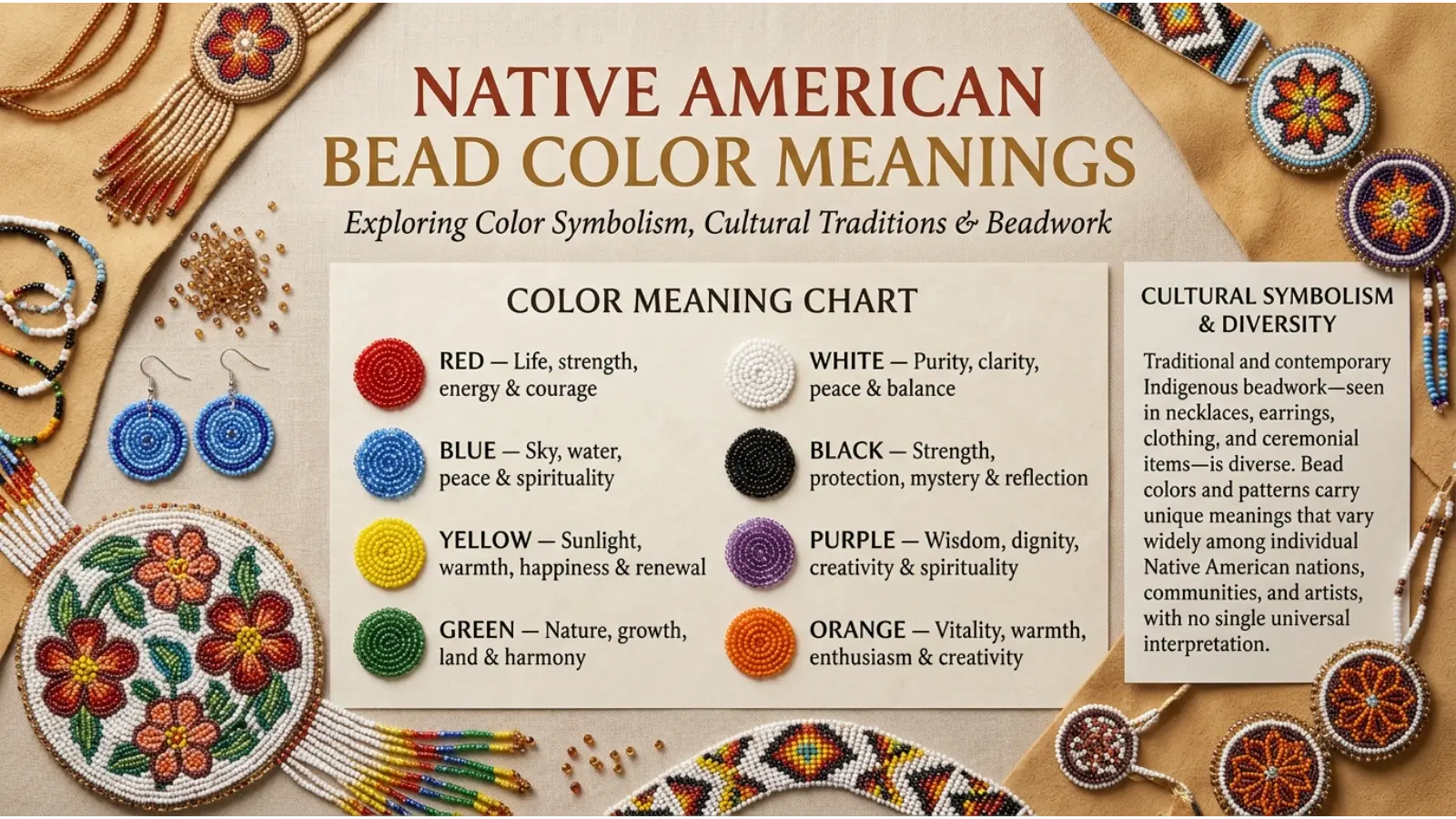
Native American Bead Color Meanings Chart
The following chart brings together documented examples from different Indigenous traditions.
| Bead Color | Documented Symbolism or Association | Cultural Context |
|---|---|---|
| 🔴 Red | Life and vitality | Crow beadwork |
| 🩷 Pink | Early morning glow | Crow beadwork |
| 🔵 Blue | Sky | Crow beadwork |
| 🟢 Green | Mother Earth | Crow beadwork |
| 🟡 Yellow | East and rising sun | Crow beadwork |
| ⚪ White | Sacred significance | Various Indigenous traditions |
| ⚫ Black | North and protection | Diné symbolism |
| 🟣 Purple | Meaning depends on the tradition and design | Varies |
This distinction matters because Indigenous cultures are not one single cultural group.
Red Native American Bead Color Meanings
Red is an important color in many Indigenous artistic traditions. Its associations can include life, vitality, strength, and the natural world.
In documented Crow beadwork traditions, red is associated with life. This connection makes red an interesting choice when studying how colors communicate ideas through traditional artwork.
However, its meaning can change depending on the design and cultural setting.
What Does Red Represent in Traditional Beadwork?
Red can create a strong visual impression because it attracts attention and contrasts beautifully with lighter colors.
In beadwork, artists may use red to:
- Add visual strength to geometric patterns.
- Highlight important decorative details.
- Create contrast with white, blue, or yellow.
- Express a particular cultural or personal association.
- Preserve a traditional color combination.
Moreover, red glass beads became valuable artistic materials as Indigenous beadworkers incorporated new trade materials into established decorative practices.
Red Beads in Modern Jewelry
Today, red beads appear in necklaces, earrings, bracelets, and contemporary Indigenous artwork.
However, modern designs may reflect individual creativity rather than an established traditional meaning. The artist’s explanation is therefore more reliable than assuming every red bead represents the same idea.
Blue Native American Bead Color Meaning
Blue is associated with the sky in documented Crow beadwork traditions. Its visual connection with the natural world makes it an important color to explore in Indigenous decorative arts.
Different shades also create different artistic effects.
Light blue can give a design a soft appearance, while darker blue can provide contrast and visual depth.
Blue Beads and the Sky
In Crow beadwork, blue represents the sky.
This association demonstrates how artists can draw inspiration from the natural environment when selecting colors.
Blue may also appear in designs featuring geometric patterns, flowers, and other decorative forms.
However, it would be inaccurate to claim that every blue bead used by every Indigenous Nation represents the sky.
Blue in Diné Symbolism
Blue has a particularly important place in Diné cultural symbolism.
This is part of a larger relationship between colors, sacred mountains, directions, and Diné cosmology.
The meaning is therefore much deeper than a simple decorative preference.
Green Native American Bead Color Meaning
Green has a documented connection with Mother Earth in Crow beadwork.
The association reflects the importance of the natural environment as a source of inspiration for Indigenous artists.
The Green beads can also create a fresh and balanced appearance in contemporary jewelry.
Green and the Natural World
Green is commonly associated with vegetation, plants, forests, and growing landscapes.
In Crow beadwork, the connection with Mother Earth provides a specific cultural example of this relationship.
Artists may combine green with blue, pink, white, or yellow to create floral and geometric designs.
Green Beads in Contemporary Jewelry
Modern Indigenous jewelry makers may use green beads to explore natural themes, personal creativity, and traditional artistic techniques.
Nevertheless, the meaning of a particular design should come from its maker or documented cultural background.
Yellow Native American Bead Color Meaning
Yellow has a specific association with the East and the rising sun in documented Crow beadwork traditions.
This connection makes yellow especially interesting because it links color with direction and the natural movement of the sun.
Yellow and the Rising Sun
The East is where the sun rises. In the Crow beadwork color associations described by the National Park Service, yellow represents this direction.
The color can therefore serve as more than a decorative choice.
Its position within a particular cultural tradition gives it additional significance.
Yellow in Beadwork Designs
Yellow beads can provide brightness and contrast.
Artists may combine them with red, blue, green, white, or darker shades to create detailed patterns.
White Native American Bead Color Meaning
White has an important place in many Indigenous artistic and cultural traditions. However, its symbolism is not identical across all Nations.
In some traditions, white can carry sacred significance. In other contexts, its meaning depends on the material, pattern, and purpose of the artwork.
White as a Sacred Color
Some Indigenous traditions connect white with important spiritual and cultural ideas.
For example, white is one of the four significant colors in Diné symbolism. It is associated with the East, dawn, and Sis Naajiní, known as White Shell Mountain.
This connection links white with direction, landscape, and the natural world.
White in Traditional Beadwork
White beads can also serve practical artistic purposes.
Artists may use them to:
- Create clear outlines.
- Separate different colored patterns.
- Highlight geometric shapes.
- Balance darker shades.
- Add contrast to floral designs.
The placement of white beads can be just as important as the color itself.
Black Native American Bead Color Meaning
Black can carry important cultural associations, although these meanings differ between Indigenous communities.
This example shows why black should not automatically be interpreted as a negative color.
Black in Diné Cultural Symbolism
The Diné color-direction system connects black with the northern direction and a sacred mountain.
It forms part of a larger cultural framework involving four directions and their corresponding colors.
This association is specific to Diné traditions and should not be generalized to every Indigenous community.
Black as an Artistic Color
Black beads can create strong outlines and emphasize the structure of a design.
They also work well with bright colors such as red, yellow, blue, and white.
Pink Native American Bead Color Meaning
Pink has a particularly interesting documented association in Crow beadwork.
It represents the early morning glow, referring to the soft color of the sky as daylight begins.
This interpretation shows how Indigenous artists can use subtle colors to express observations of nature.
Pink and the Morning Light
Unlike strong red or bright yellow, pink creates a softer visual effect.
Its connection with the first light of morning gives it a specific place in Crow artistic symbolism.
This combination demonstrates the importance of shade selection in traditional beadwork.
Pink in Modern Designs
Pink beads are now used in many forms of contemporary jewelry.
They can create gentle color transitions, highlight floral designs, or complement darker beads.
Purple Native American Bead Color Meaning
Purple is another color that requires careful cultural interpretation.
There is no single established purple meaning that applies to all Native American beadwork.
Its significance depends on the community, material, historical setting, and individual design.
Purple and Wampum Traditions
One important historical example comes from the Northeast Woodlands.
Wampum beads are traditionally made from shells, including white whelk shell and purple quahog shell.
In some Woodlands traditions, white and purple wampum carried symbolic meanings. However, their interpretation depended on the particular community and purpose.
Wampum belts could record agreements, communicate messages, and preserve important events.
Therefore, purple wampum should not be treated as simply another decorative purple glass bead.
The Four Sacred Colors in Diné Symbolism
One of the best-documented examples of color symbolism in an Indigenous tradition comes from the Diné people, also widely known as the Navajo.
Their traditional color-direction associations connect four colors with four cardinal directions and sacred mountains.
| Color | Direction | Cultural Association |
|---|---|---|
| ⚪ White | East | Dawn and White Shell Mountain |
| 🔵 Blue | South | Blue Bead Mountain |
| 🟡 Yellow | West | Pollen and Abalone Shell Mountain |
| ⚫ Black | North | Protection and Obsidian Mountain |
These associations are connected with Diné cosmology, identity, and artistic traditions.
They also appear in different forms of cultural expression, including weaving, basketmaking, and sand painting.
The four colors are not simply a decorative palette. They are part of a much larger cultural understanding of the world.
It is essential to recognize that this system belongs to Diné traditions rather than representing a universal Native American belief.
Crow Native American Bead Color Meanings
The nCrow beadwork offers another valuable example of how Indigenous artists use colors to express relationships with nature.
Crow artists developed distinctive decorative styles, particularly in geometric designs and carefully selected color combinations.
Their beadwork is known for its sophisticated visual balance.
Traditional Crow Color Associations
The following associations are documented by the National Park Service:
| Color | Crow Beadwork Meaning |
|---|---|
| 🩷 Pink | Early morning glow |
| 🔵 Blue | Sky |
| 🟢 Green | Mother Earth |
| 🟡 Yellow | East and rising sun |
| 🔴 Red | Life |
These examples demonstrate how a color can communicate a connection with the environment.
Why Crow Rose Is Special
Crow rose describes a distinctive combination of light blue and dusty pink.
The two colors work together because they create a gentle contrast without overwhelming the design.
Historically, access to colorful Italian glass beads helped Crow artists develop sophisticated combinations that became recognizable features of their beadwork.
The result was not simply colorful decoration. It was a distinctive artistic tradition built through skill, creativity, and cultural continuity.
Native American Bead Color Meanings History
Native American beadwork has a long history that began before European glass beads became widely available.
Indigenous communities used natural materials to create decorative objects, including beads made from shells, stones, seeds, bones, and other available resources.
These materials were shaped, polished, drilled, and arranged into meaningful designs.
Beadwork Before European Contact
Before glass beads became widely available, Indigenous artists already had established traditions of decorative work.
For example, porcupine quills were dyed and used to decorate clothing, containers, and other objects.
Shell beads and other natural materials also played important roles in artistic and cultural practices.
These techniques required patience, detailed knowledge, and considerable craftsmanship.
The Arrival of European Glass Beads
European traders introduced glass beads through expanding trade networks.
As these materials became available, Indigenous artists adapted them to existing artistic practices.
Small glass seed beads offered new possibilities for detailed patterns and colorful designs.
However, this did not mean that traditional techniques disappeared everywhere. Different communities continued using older materials and methods alongside newer ones.
The Growth of Distinctive Regional Styles
Over time, different Indigenous Nations developed recognizable beadwork styles.
Some artists became known for floral patterns, while others developed geometric designs and detailed decorative arrangements.
For example:
- Crow beadwork became recognized for distinctive geometric designs and carefully selected color combinations.
- Plains beadwork developed several regional styles and preferred decorative approaches.
- Haudenosaunee beadwork became known for floral designs and elaborate decorative applications.
- Ute artists incorporated glass beads into traditional clothing and decorative practices.
These differences demonstrate that Native American beadwork is not one uniform art style.
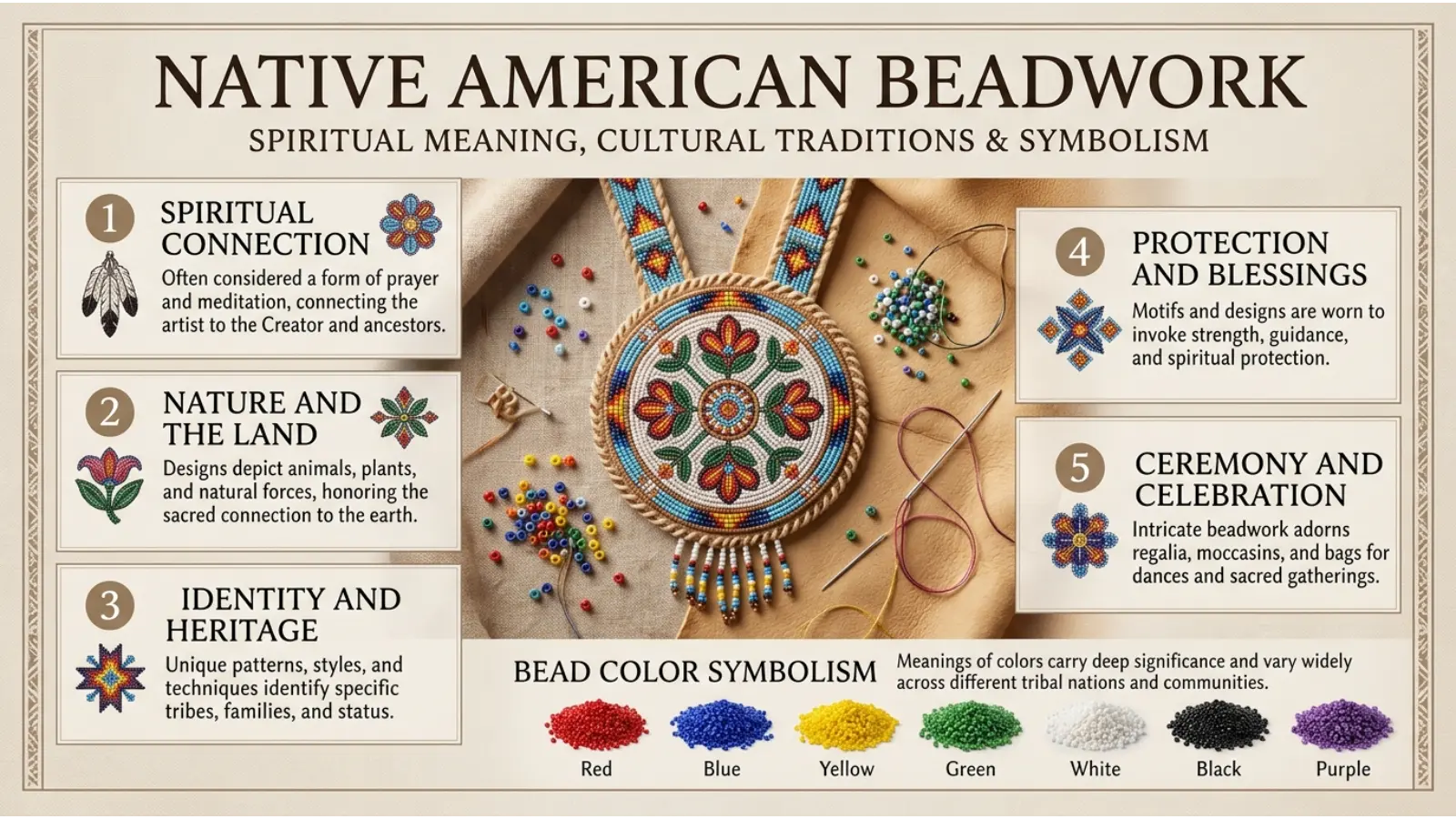
Native American Beadwork and Spiritual Meaning
Beadwork can have spiritual significance in particular Indigenous traditions.
However, not every necklace, bracelet, or decorative object is intended to communicate a spiritual message.
Some pieces are created for everyday wear, while others may be associated with ceremonies, community events, personal experiences, or cultural responsibilities.
Beads as Expressions of Cultural Identity
Traditional beadwork can help preserve cultural knowledge across generations.
An artist may learn techniques from relatives, community members, or experienced makers.
As a result, a finished object can represent much more than its physical appearance.
It may carry memories of family, artistic education, and cultural continuity.
Beadwork and Personal Meaning
Contemporary Indigenous artists also use beadwork to express their individual experiences.
For example, an artist may create a floral design inspired by their surroundings or use a color combination connected with a personal memory.
Therefore, spiritual and personal interpretations should be understood through the artist’s own explanation whenever possible.
How Native American Bead Patterns Communicate Meaning
Color is only one part of beadwork symbolism.
The shapes, lines, and arrangements of beads can also communicate ideas.
Geometric Patterns
Geometric designs are common in many Indigenous beadwork traditions.
They may include:
- Triangles.
- Diamonds.
- Straight lines.
- Zigzag patterns.
- Repeated shapes.
- Symmetrical arrangements.
However, a triangle does not always represent the same thing.
In Plains beadwork, for example, a triangle might represent a tipi or an arrow point, depending on the artist and design.
Floral Patterns
Floral beadwork is particularly associated with several Indigenous artistic traditions, including Haudenosaunee beadwork.
Artists use colorful beads to create flowers, leaves, stems, and other natural forms.
These patterns can reflect observations of the environment while also expressing artistic creativity and cultural identity.
Color Placement and Contrast
The location of a bead can influence how a pattern is understood visually.
For instance, white beads may outline a darker design, while red or blue beads may highlight a central shape.
A repeated pattern can also create movement and rhythm.
Consequently, studying the entire design provides more information than examining one bead in isolation.
Native American Bead Colors in Different Indigenous Traditions
There is no single Native American bead color dictionary.
Different Indigenous Nations have distinct histories, languages, beliefs, and artistic traditions.
The following examples help explain this diversity.
Crow Traditions
Crow beadwork includes documented color associations with nature.
Pink represents the early morning glow, blue represents the sky, green represents Mother Earth, yellow represents the East, and red represents life.
These meanings are especially useful when studying traditional Crow decorative art.
Diné Traditions
Diné symbolism connects white, blue, yellow, and black with the four cardinal directions and sacred mountains.
These colors form part of a wider cultural and spiritual framework.
Haudenosaunee Traditions
Haudenosaunee beadwork is known for detailed floral designs.
Color choices can reflect cultural teachings, artistic decisions, and individual interpretations.
For example, documented interpretations of certain Niagara hats connect white with peace and purple with mourning or tragedy. However, such interpretations should be understood in their specific historical and artistic context.
Plains Indigenous Traditions
Plains beadwork includes distinctive regional styles.
Different Nations developed their own preferred designs, materials, and decorative methods.
The meaning of a particular shape or color may depend on the artist rather than following a shared regional code.
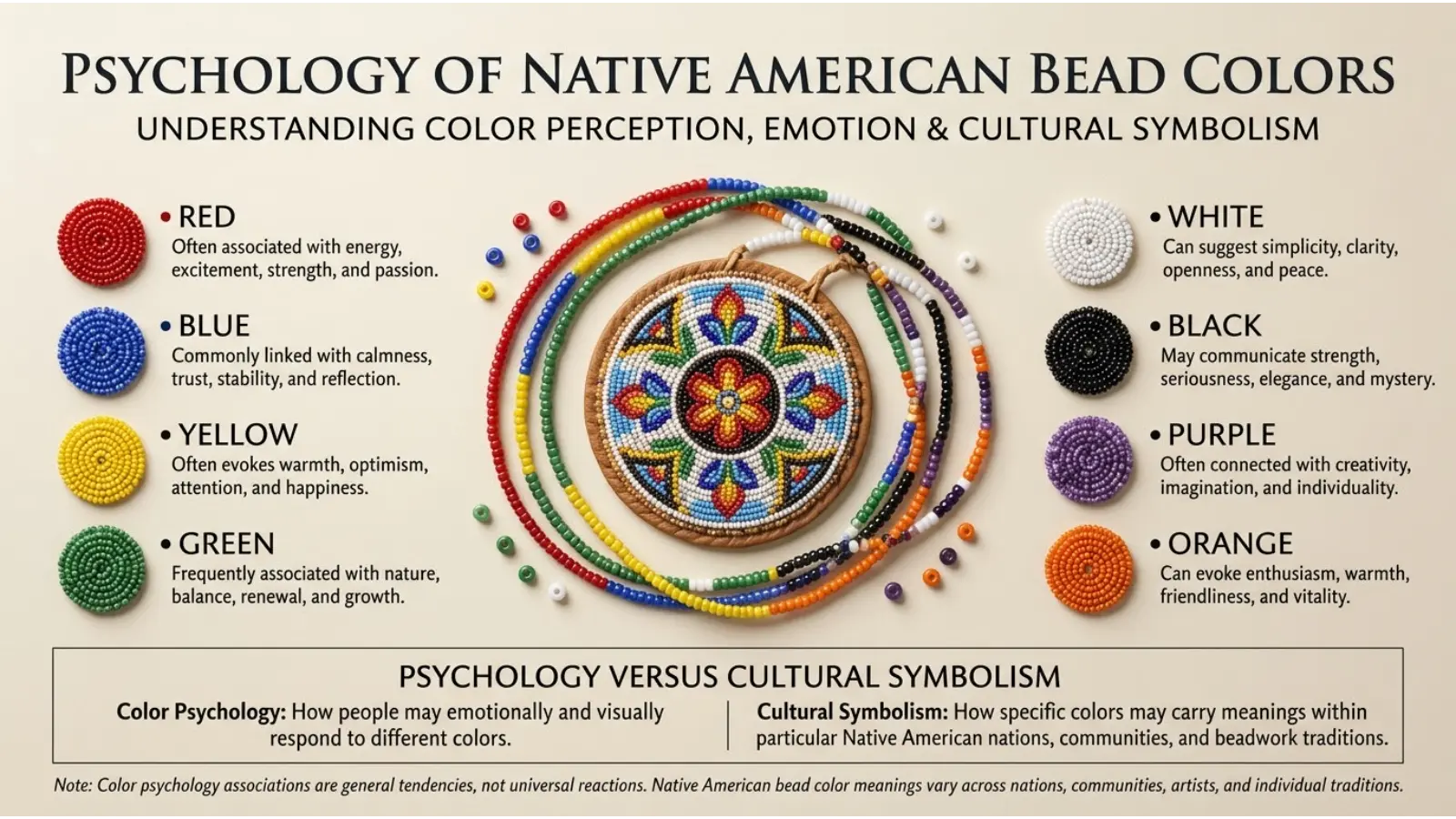
Psychology of Native American Bead Colors
Color psychology can help explain why people respond differently to colors. However, modern psychological associations should not be confused with traditional Indigenous symbolism.
For example, red often attracts visual attention because of its strong contrast and intensity. Blue is commonly associated with open skies and water in many contemporary settings.
Yet these general observations do not explain the cultural meaning of a particular beadwork design.
Why Colors Influence Perception
Three important factors influence how people perceive colors:
1. Visual intensity
Bright colors can attract attention, while softer shades may create a more subtle appearance.
2. Cultural experience
People learn color associations through family, education, traditions, media, and their surrounding environment.
3. Personal experience
An individual may connect a color with a memory, place, person, or meaningful event.
Therefore, two people can look at the same beadwork and notice different things.
Does Bead Color Reveal Personality?
No. Choosing red, blue, green, or another color does not reliably reveal someone’s personality.
A beadworker may select colors because of traditional knowledge, available materials, artistic preference, or the needs of a particular design.
Color preference alone is not a scientific personality test.
Native American Beadwork in Fashion and Jewelry
Beadwork continues to influence contemporary fashion and jewelry.
Indigenous artists create necklaces, earrings, bracelets, clothing decorations, accessories, and elaborate wearable artworks.
Some pieces preserve traditional methods, while others explore new materials and artistic approaches.
Traditional Beaded Necklaces
Beaded necklaces can feature repeated geometric patterns, floral designs, or combinations of different bead sizes.
The arrangement of colors contributes to the overall appearance.
Beaded Earrings
Earrings offer artists a small but detailed space for creative expression.
Some feature symmetrical shapes, while others use long fringe patterns or floral arrangements.
Contemporary Beaded Bracelets
Modern beaded bracelets can combine traditional techniques with contemporary designs.
However, the use of Indigenous patterns or cultural symbols should be approached respectfully, especially when a design has specific cultural or ceremonial significance.
How to Combine Native American Bead Colors
Color combinations play a major role in beadwork.
Artists often consider contrast, balance, pattern, and the appearance of different shades when selecting beads.
The following chart provides general design suggestions, not traditional symbolic formulas.
| Color Combination | Visual Effect | Suitable Design |
|---|---|---|
| 🔴 Red + ⚪ White | Strong, clear contrast | Geometric patterns |
| 🔵 Blue + 🩷 Pink | Soft and balanced | Floral beadwork |
| 🟢 Green + 🟡 Yellow | Bright and nature-inspired | Decorative patterns |
| ⚫ Black + 🔴 Red | Bold and dramatic | Detailed outlines |
| ⚪ White + 🔵 Blue | Clean and balanced | Repeated patterns |
| 🟣 Purple + ⚪ White | Gentle contrast | Contemporary jewelry |
| 🟡 Yellow + 🔴 Red | Warm and energetic | Decorative accents |
Choosing the Right Bead Colors
When creating a beadwork design, consider these practical points:
- Choose colors that complement each other.
- Use contrast to make important shapes visible.
- Consider the size and arrangement of the beads.
- Test different combinations before completing the design.
- Learn the cultural meaning of a traditional pattern before reproducing it.
Most importantly, do not assume that a visually attractive combination automatically carries a particular cultural message.
How Lighting Changes Native American Bead Colors
Lighting can significantly change how glass beads appear.
The same bead may look different in sunlight, indoor lighting, or photographs.
Natural Daylight
Natural daylight can reveal subtle details in transparent and reflective glass beads.
It is particularly useful for examining the differences between pale pink, dusty rose, light blue, and turquoise shades.
Warm Indoor Lighting
Warm lighting can make yellow, orange, and red beads appear richer.
However, it may also change the appearance of white and pale blue beads.
Photography and Color Accuracy
Camera settings, exposure, and screen brightness can affect how bead colors appear in photographs.
Therefore, a color seen in an online image may not match the actual object.
This matters when researching historical beadwork or purchasing contemporary handmade jewelry.
Native American Beadwork in Art and Everyday Life
Beadwork remains an important form of artistic expression.
It can appear in clothing, jewelry, cultural events, exhibitions, museums, and contemporary creative projects.
Clothing and Accessories
Beads have been used to decorate moccasins, shirts, leggings, dresses, bags, and other items.
Different communities developed distinctive ways of attaching beads to leather and fabric.
Museums and Cultural Education
Museum collections help preserve examples of historical beadwork.
They also allow researchers and visitors to study traditional materials, techniques, and regional artistic differences.
However, objects should be understood through their cultural background rather than treated only as decorative museum pieces.
Contemporary Indigenous Art
Many Indigenous artists continue to develop beadwork traditions.
They may combine historical techniques with modern themes, new materials, and personal artistic expression.
This demonstrates that Indigenous beadwork is a living art form rather than a practice limited to the past.
How to Appreciate Native American Beadwork Respectfully
Learning about bead color meanings also involves understanding cultural respect.
Native American beadwork belongs to living Indigenous communities, and its meaning cannot always be understood from appearance alone.
Here are several useful ways to approach it respectfully.
Learn about the specific Nation. Instead of treating all Indigenous traditions as identical, identify the community associated with a particular artwork.
Respect the artist’s explanation. The maker may have personal or cultural reasons for choosing particular colors and patterns.
Understand the difference between traditional and modern designs. Contemporary Indigenous artists can create new work without following historical color associations.
Avoid assuming spiritual meaning. Not every decorative piece is ceremonial or sacred.
Support Indigenous artists. When purchasing handmade beadwork, look for clear information about the artist and the work’s cultural background.
Avoid copying restricted designs. Some patterns or objects may have cultural responsibilities or meanings that are not intended for general reproduction.
Respectful learning begins with recognizing that Indigenous artists are active creators who continue to shape their own traditions.
Common Misconceptions About Native American Bead Color Meanings
Several misunderstandings can make Indigenous beadwork symbolism difficult to interpret.
Myth 1: Every Red Bead Represents Strength or Courage
Not necessarily.
In documented Crow beadwork, red represents life. Other meanings may appear in other cultural settings.
Myth 2: All Black Beads Represent Death or Negative Energy
This is an oversimplification.
In Diné symbolism, black is associated with the North and protection.
Myth 3: Every Beaded Pattern Has One Fixed Meaning
Patterns can represent different things depending on the artist and cultural context.
A geometric shape may have a traditional association in one community but a personal meaning in another.
Myth 5: Native American Beadwork Is Only Decorative
Beadwork can communicate cultural identity, preserve artistic knowledge, and express personal or community experiences.
Its purpose is not limited to appearance.
Myth 6: Traditional Beadwork Has Never Changed
Indigenous beadwork has continued to develop.
Artists have adapted new materials and techniques while maintaining important cultural traditions.
Frequently Asked Questions About Native American Bead Color Meanings
1. What do Native American bead colors mean?
Native American bead colors can represent nature, life, cultural identity, spirituality, and community traditions. However, meanings differ between Indigenous Nations and individual artists. There is no universal color dictionary for all Native American beadwork.
2. What does red mean in Native American beadwork?
In documented Crow beadwork, red represents life. Other Indigenous communities may have different associations. The meaning depends on the specific tradition and design.
3. What does blue represent in Native American beadwork?
Blue represents the sky in documented Crow beadwork. In Diné symbolism, it is associated with the South and Blue Bead Mountain. These are specific cultural interpretations rather than universal meanings.
4. What does green mean in Native American beadwork?
Green represents Mother Earth in documented Crow beadwork. Its meaning in other Indigenous traditions can differ according to cultural teachings and artistic context.
5. What does white mean in Native American beadwork?
White can have sacred significance in certain Indigenous traditions. In Diné symbolism, it is associated with the East, dawn, and White Shell Mountain. White beads can also serve as outlines and decorative accents.
6. What does black mean in Native American beadwork?
Black has different interpretations across Indigenous cultures. In Diné traditions, it is associated with the North and protection. Its meaning should not automatically be interpreted as negative.
7. What does pink mean in Crow beadwork?
Pink represents the early morning glow in documented Crow beadwork. It reflects the soft color of the sky as the day begins.
8. What are the four sacred colors in Navajo culture?
The four colors commonly discussed in Diné symbolism are white, blue, yellow, and black. They are associated with the East, South, West, and North, respectively, and connected with four sacred mountains.
9. What is the difference between Native American beadwork and wampum?
Native American beadwork includes many artistic traditions using different materials and techniques. Wampum specifically refers to beads traditionally made from certain shells, especially white and purple varieties, and used by Indigenous peoples of the Northeast in cultural, diplomatic, and ceremonial contexts.
Conclusion: The Deeper Meaning Behind Native American Bead Colors
Native American bead color meanings reveal the connection between art, nature, cultural identity, and generations of Indigenous knowledge.
Red, blue, green, yellow, pink, white, and black can all carry meaningful associations. However, their significance depends on the cultural tradition and the artist who creates the work.
Crow beadwork demonstrates how colors can represent the natural world, including the morning glow, sky, and Mother Earth. Diné symbolism shows how four colors can connect with sacred mountains and cardinal directions. Meanwhile, Northeast Woodlands wampum traditions demonstrate how beads can preserve important messages and relationships.
Together, these traditions show that beadwork is much more than an arrangement of colorful materials.
It is a living expression of artistic skill, cultural continuity, and individual creativity. The next time you see a traditional beaded necklace, bracelet, or decorative pattern, look beyond its colors. Consider the artist, the community, the materials, and the story behind the design. That is where a deeper understanding of Indigenous beadwork begins.

Emma Wilson is a dedicated comparison writer and product researcher at ColorMystiic.com. She specializes in creating unbiased product comparisons, detailed reviews, and helpful buying guides. Her goal is to help readers make smarter purchasing decisions with confidence.