A Rosary Color Meanings is more than a string of prayer beads. For many Catholics and other Christians, it is a meaningful object connected to faith, reflection, devotion, and personal prayer. Although its main purpose is to guide prayer, the colors of its beads can also carry special symbolic meanings.
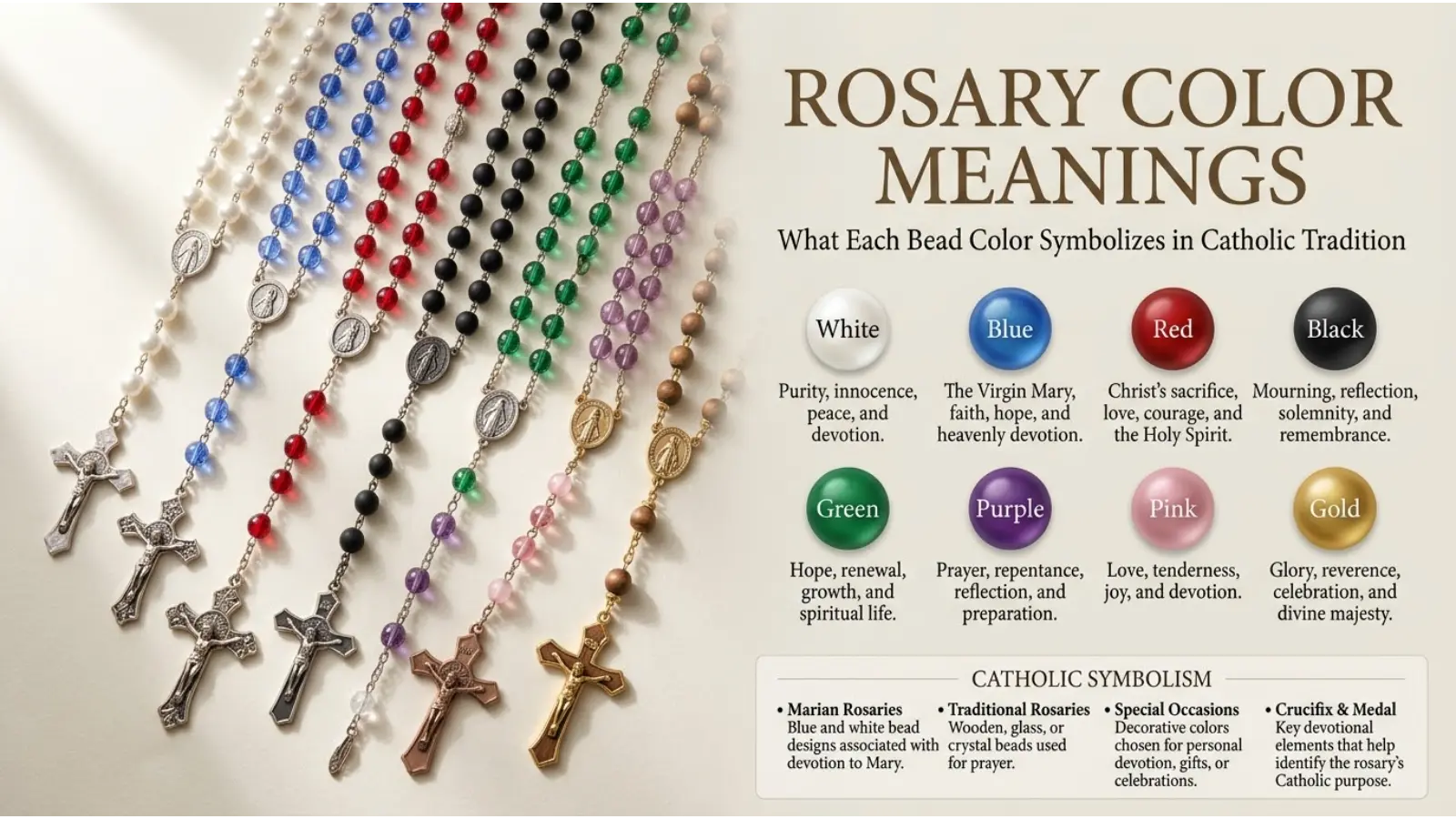
Different rosary colors often represent ideas such as love, purity, peace, hope, sacrifice, and spiritual growth.. Red can symbolize the sacrifice of Jesus Christ, and green may suggest hope and renewal.
People search for rosary color meanings for several reasons. Some want to choose a rosary for personal prayer, while others are selecting a meaningful religious gift or trying to understand the symbolism behind a rosary they already own.
However, not every color has one official or universal meaning. Catholic traditions, local customs, personal devotion, materials, and artistic choices can all influence how people understand rosary colors.
This guide explores the meanings of popular rosary colors, their religious associations, cultural interpretations, and practical uses.
Quick Answer: What Do Rosary Color Meanings?
Rosary colors commonly represent different spiritual ideas:
| Rosary Color | Common Symbolic Meaning |
|---|---|
| Blue | Virgin Mary, faith, peace, devotion |
| White | Purity, innocence, holiness, new beginnings |
| Red | Love, sacrifice, Christ’s Passion |
| Black | Mourning, remembrance, reflection |
| Green | Hope, renewal, growth, life |
| Purple | Repentance, reflection, preparation |
| Pink | Love, tenderness, joy, compassion |
| Gold | Glory, divinity, honor, celebration |
| Brown | Humility, simplicity, Franciscan devotion |
| Clear or Crystal | Light, clarity, purity, spiritual reflection |
These are common symbolic associations rather than a fixed official color code for every rosary.
What Do Rosary Color Meanings Symbolize?
Rosary colors help communicate spiritual ideas through visual symbolism. Although the beads do not change the prayers themselves, their appearance can make a rosary feel more personal and meaningful.
Furthermore, religious colors often connect with familiar Christian themes, including Mary’s devotion, Christ’s sacrifice, repentance, and the hope of eternal life.
Blue Rosary Meaning
<text color=”secondary” weight=”medium” size=”xs”>BLUE — FAITH, PEACE & MARIAN DEVOTION</text>
Blue is one of the most recognizable colors associated with the Virgin Mary. It commonly represents faith, heavenly peace, devotion, and spiritual trust.
In Christian art, Mary is frequently portrayed wearing blue garments. This visual tradition has helped establish blue as an important color in Marian devotion.
A blue rosary may be chosen by someone who wants to express:
- Devotion to the Virgin Mary.
- Trust in God’s guidance.
- Peace during difficult moments.
- Faith and spiritual commitment.
- Love and respect for Marian traditions.
Light blue often creates a gentle and peaceful appearance, while deep blue can suggest dignity and devotion.
Practical meaning: A blue rosary can make a thoughtful gift for someone with a strong devotion to Mary.
White Rosary Meaning
<text color=”secondary” weight=”medium” size=”xs”>WHITE — PURITY, HOLINESS & NEW BEGINNINGS</text>
White commonly represents purity, innocence, holiness, and spiritual renewal in Christian symbolism.
A white rosary may symbolize:
- A fresh beginning in faith.
- Purity of heart.
- Peace and spiritual hope.
- Innocence and devotion.
- A desire to live a faithful life.
Pearl-white and ivory rosaries often have an elegant appearance. Consequently, they are popular choices for religious gifts and special occasions.
Practical meaning: A white rosary can be a meaningful present for First Communion, baptism, or a wedding.
Red Rosary Meaning
<text color=”secondary” weight=”medium” size=”xs”>RED — LOVE, SACRIFICE & CHRIST’S PASSION</text>
Red is a powerful color in Christian symbolism. It is closely connected with the blood of Christ, martyrdom, sacrifice, and the fire of the Holy Spirit.
A red rosary may represent:
- Christ’s sacrifice.
- Deep love and devotion.
- Courage and spiritual commitment.
- The suffering of Christian martyrs.
- The Holy Spirit and spiritual fire.
Dark red can create a serious and traditional appearance, whereas bright red may communicate energy and passion.
Practical meaning: A red rosary can serve as a reminder of Christ’s love and the importance of faith during difficult times.
Black Rosary Meaning
<text color=”secondary” weight=”medium” size=”xs”>BLACK — REFLECTION, MOURNING & REMEMBRANCE</text>
Black rosaries are often associated with reflection, mourning, remembrance, and seriousness. It can also represent humility and a thoughtful approach to spiritual life.
A black rosary may symbolize:
- Prayer for deceased loved ones.
- Remembrance and mourning.
- Serious religious commitment.
- Reflection and repentance.
- A traditional and understated expression of faith.
However, black does not automatically represent evil or negative spiritual energy. Its meaning depends on religious and cultural context.
Practical meaning: Some people choose black rosaries because they prefer a simple design or want a personal reminder to pray for loved ones.
Green Rosary Meaning
<text color=”secondary” weight=”medium” size=”xs”>GREEN — HOPE, RENEWAL & SPIRITUAL GROWTH</text>
Green is widely associated with nature, life, growth, and renewal. In Christian symbolism, it can also suggest hope and spiritual development.
Green is the liturgical color used during Ordinary Time in the Catholic Church. It reflects the ongoing growth of Christian life and faith.
A green rosary may represent:
- Hope for the future.
- Growth in faith.
- Renewal and new beginnings.
- God’s creation and the natural world.
- Patience and spiritual development.
Light green beads often look fresh and gentle, while dark green creates a traditional and rich appearance.
Practical meaning: A green rosary may be a meaningful choice for someone beginning a new spiritual journey.
Purple Rosary Meaning
<text color=”secondary” weight=”medium” size=”xs”>PURPLE — REPENTANCE, REFLECTION & PREPARATION</text>
Purple has an important place in Catholic religious tradition. It is commonly associated with Advent and Lent, two seasons of preparation, reflection, and spiritual renewal.
It can symbolize repentance, humility, prayer, and the desire to become closer to God.
A purple rosary may represent:
- Personal reflection.
- Repentance and forgiveness.
- Spiritual preparation.
- Humility and devotion.
- A deeper commitment to prayer.
Deep purple often creates a formal and traditional appearance. Meanwhile, lavender can suggest gentleness and peaceful reflection.
sary Meaning
<text color=”secondary” weight=”medium” size=”xs”>PINK — LOVE, JOY & COMPASSION</text>
Pink is often associated with love, tenderness, kindness, and joy.
In Catholic liturgical tradition, rose-colored vestments may be worn on Gaudete Sunday during Advent and Laetare Sunday during Lent. These occasions offer a moment of joy and encouragement during seasons of preparation.
A pink rosary may symbolize:
- Love and compassion.
- Joy in faith.
- Gentleness and kindness.
- Hope and encouragement.
- Devotion expressed through love.
Pink rosaries are also popular as gifts for children, young Catholics, and people who appreciate softer colors.
Practical meaning: A pink rosary can be a lovely gift for someone celebrating a religious milestone.
Gold Rosary Meaning
<text color=”secondary” weight=”medium” size=”xs”>GOLD — GLORY, HONOR & DIVINE MAJESTY</text>
Gold is traditionally associated with glory, majesty, celebration, and heavenly splendor.
A gold rosary may represent:
- Divine glory.
- Honor and reverence.
- Celebration of faith.
- Spiritual richness.
- The beauty of sacred traditions.
Gold-colored beads and metallic details can also make a rosary look formal and luxurious.
Brown Rosary Meaning
<text color=”secondary” weight=”medium” size=”xs”>BROWN — HUMILITY, SIMPLICITY & FRANCISCAN TRADITION</text>
Brown is associated with the earth, simplicity, humility, and a modest way of life.
A brown rosary may symbolize:
- Humility and modesty.
- Simplicity in daily life.
- Connection with nature.
- A desire to live faithfully.
- Respect for traditional religious practices.
Wooden brown rosaries are particularly popular among people who appreciate natural materials.
Practical meaning: A brown wooden rosary can be a meaningful choice for someone who prefers traditional religious objects.
Clear and Crystal Rosary Meaning
<text color=”secondary” weight=”medium” size=”xs”>CLEAR — LIGHT, CLARITY & PURITY</text>
Clear and crystal rosaries often create a bright, elegant appearance. Their transparent beads allow light to pass through, producing a reflective effect.
Symbolically, clear beads are commonly associated with:
- Clarity of thought.
- Purity and innocence.
- Light and spiritual awareness.
- Peaceful reflection.
- Simplicity and elegance.
These meanings are mainly symbolic and personal rather than official Catholic teachings.
Practical meaning: Crystal rosaries are popular for religious gifts, weddings, and special celebrations.
Colorful Rosary Color Meanings Chart
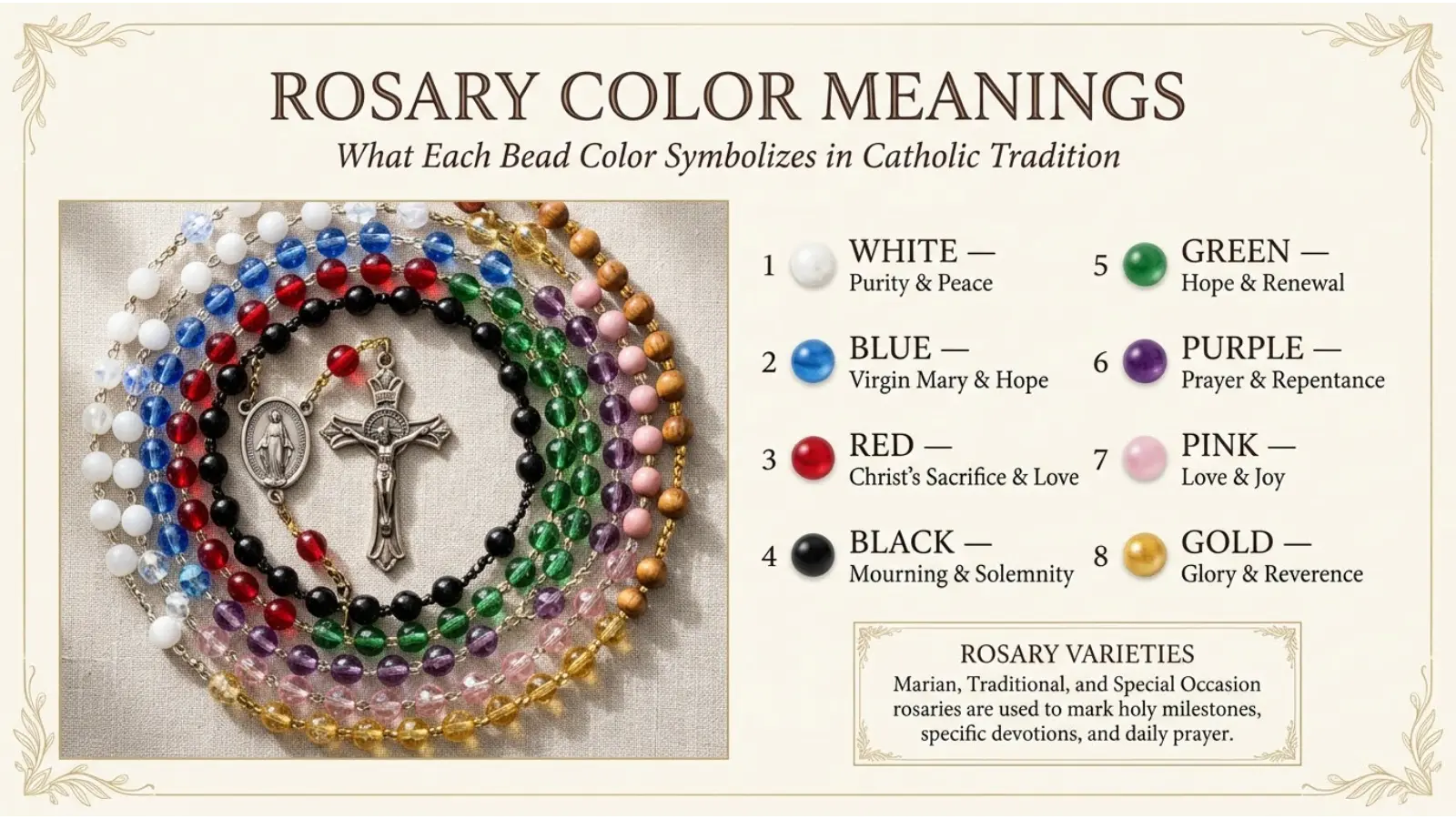
The following chart provides a quick visual comparison of popular rosary colors and their commonly understood associations.
| Color | Visual Symbol | Main Meaning | Additional Association |
|---|---|---|---|
| 🔵 Blue | Blue | Faith | Mary and peace |
| ⚪ White | White | Purity | Holiness |
| 🔴 Red | Red | Sacrifice | Love and martyrdom |
| ⚫ Black | Black | Reflection | Mourning |
| 🟢 Green | Green | Hope | Growth |
| 🟣 Purple | Purple | Repentance | Preparation |
| 🩷 Pink | Pink | Love | Joy |
| 🟡 Gold | Gold | Glory | Honor |
| 🟤 Brown | Brown | Humility | Simplicity |
| 💎 Clear | Crystal | Clarity | Light |
These associations are general interpretations. A rosary’s material, design, religious tradition, and personal meaning can influence its symbolism.
Religious Rosary Color Meanings in Catholic Tradition
The Church uses different colors during the liturgical year to express the character of particular celebrations and seasons.
However, an important distinction exists: the color of a rosary bead does not determine which prayers someone should say. Nor does the Church require Catholics to use specific bead colors for particular intentions.
Purple and Lent
Purple is used during Lent as a sign of repentance, preparation, and reflection.
Consequently, a purple rosary may remind someone to focus on prayer and personal spiritual growth during this season.
White and Easter
White is used during important celebrations, including Easter and Christmas.
It represents joy, holiness, and the celebration of Christ’s life and resurrection.
A white rosary can therefore be a meaningful choice for Easter gifts and religious milestones.
Red and Pentecost
It is also used for celebrations of martyrs and certain other important occasions.
Green and Ordinary Time
Green is the usual liturgical color for Ordinary Time.
It reflects hope, growth, and the continuing development of Christian faith.
Rose and Joyful Preparation
Rose-colored vestments may be used on Gaudete Sunday and Laetare Sunday.
These Sundays offer a joyful pause during Advent and Lent.
Spiritual Rosary Color Meanings
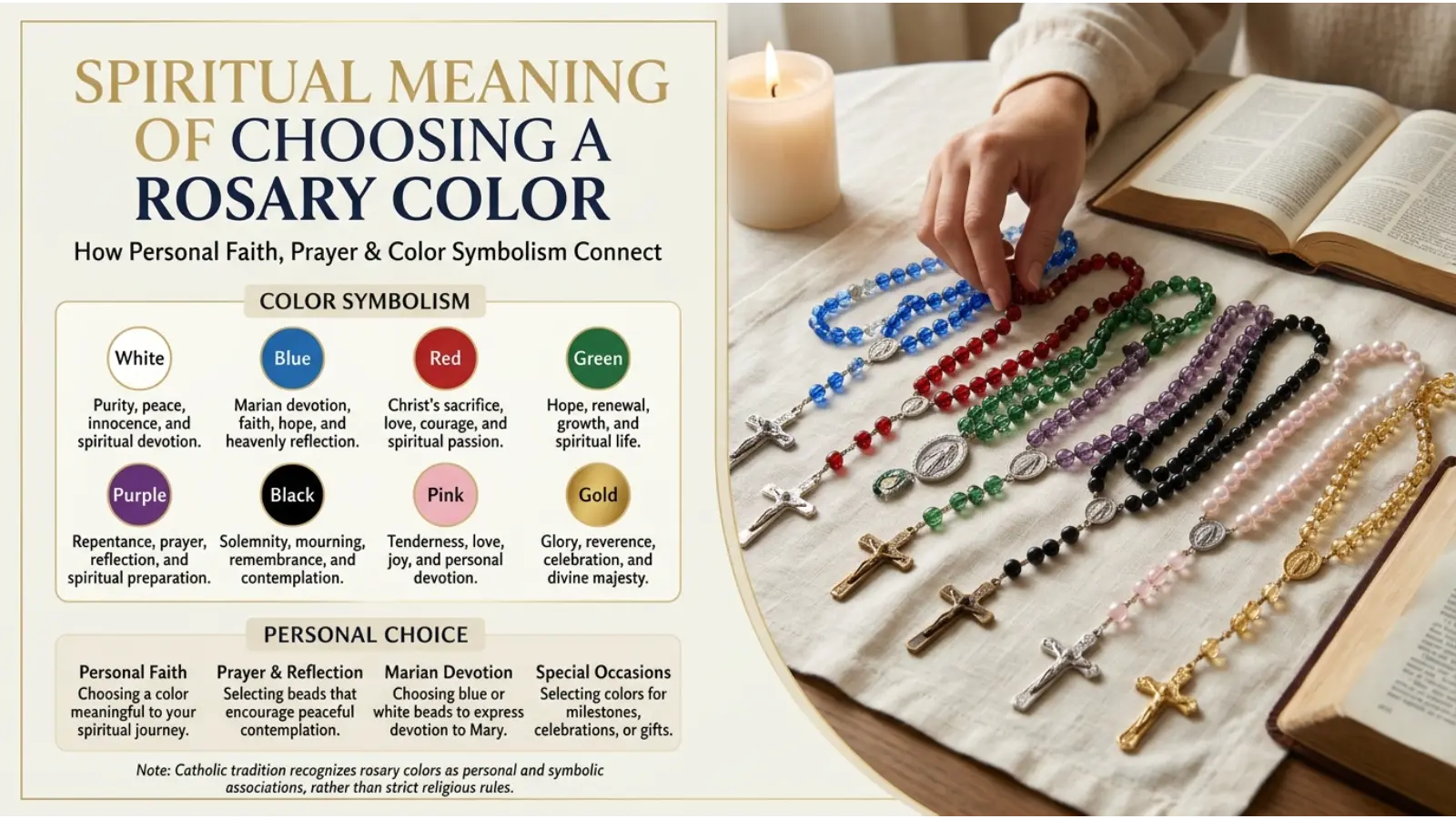
People sometimes choose rosary colors based on their spiritual intentions or the personal reminders they want to carry into prayer.
Although no color has a guaranteed spiritual power, symbolism can help make a religious object more meaningful.
For example:
- For peace: Blue or white may serve as reminders of trust and calm reflection.
- For hope: Green can represent renewal and continued faith.
- For repentance: Purple may encourage self-examination and prayer.
- For love: Red or pink can represent compassion and devotion.
- For remembrance: Black may serve as a reminder to pray for deceased loved ones.
- For humility: Brown can represent a simple and faithful way of life.
These are personal symbolic choices, not promises that a particular color will produce a spiritual result.
Cultural Interpretations of Rosary Color Meanings
Rosary colors can have different meanings across countries and communities. This happens because religious symbolism often develops alongside local traditions, art, family customs, and popular beliefs.
Rosary Colors in Western Christian Culture
In many Western Christian communities, blue is associated with Mary, white with purity, and purple with preparation and repentance.
These associations appear in religious paintings, church decorations, vestments, and devotional objects.
However, individual families may also give rosary colors their own personal meanings.
Rosary Colors in Latin American Communities
Rosaries are important devotional objects in many Latin American Catholic communities.
In addition, local traditions can influence bead materials, decorative patterns, and the way rosaries are presented.
There is no single Latin American interpretation because customs differ between countries and communities.
Rosary Colors in European Traditions
European Catholic art has helped shape many familiar color associations.
For example, blue garments in images of Mary have contributed to the color’s strong Marian connection.
Likewise, purple and white have long-standing places in Catholic liturgical practice.
Rosary Colors in Asian Christian Communities
Christian communities in Asian countries may combine Catholic devotional practices with local artistic styles and materials.
For example, rosaries may feature locally crafted wooden beads, decorative stones, or bright colors.
Rosary Colors in African Christian Communities
Many African Christian communities use colorful religious objects in worship and personal devotion.
Beadwork, locally available materials, and artistic traditions can influence rosary designs.
However, Africa contains many different cultures and religious communities. Therefore, it would be inaccurate to assign one universal meaning to every rosary color across the continent.
History of Rosary Color Meanings and Their Development
The history of the rosary is connected with the development of Christian prayer practices, Marian devotion, and the use of prayer beads.
Originally, material availability and craftsmanship played an important role in their appearance. As trade and manufacturing developed, people gained access to a wider range of colors and decorative designs.
Traditional Wooden Rosaries
Wooden rosaries have a long association with simplicity and practical religious devotion.
Their natural appearance makes them especially appealing to people who prefer traditional religious objects.
Glass and Crystal Rosaries
Glass beads allowed rosary makers to create more colorful and decorative designs.
Consequently, blue, red, green, pink, and transparent rosaries became widely available.
Modern Personalized Rosaries
Today, rosaries are available in many different colors, materials, and styles.
Some feature birthstone-inspired beads, engraved crosses, metallic details, or personalized names.
This variety allows people to choose a rosary based on personal taste while maintaining its religious purpose.
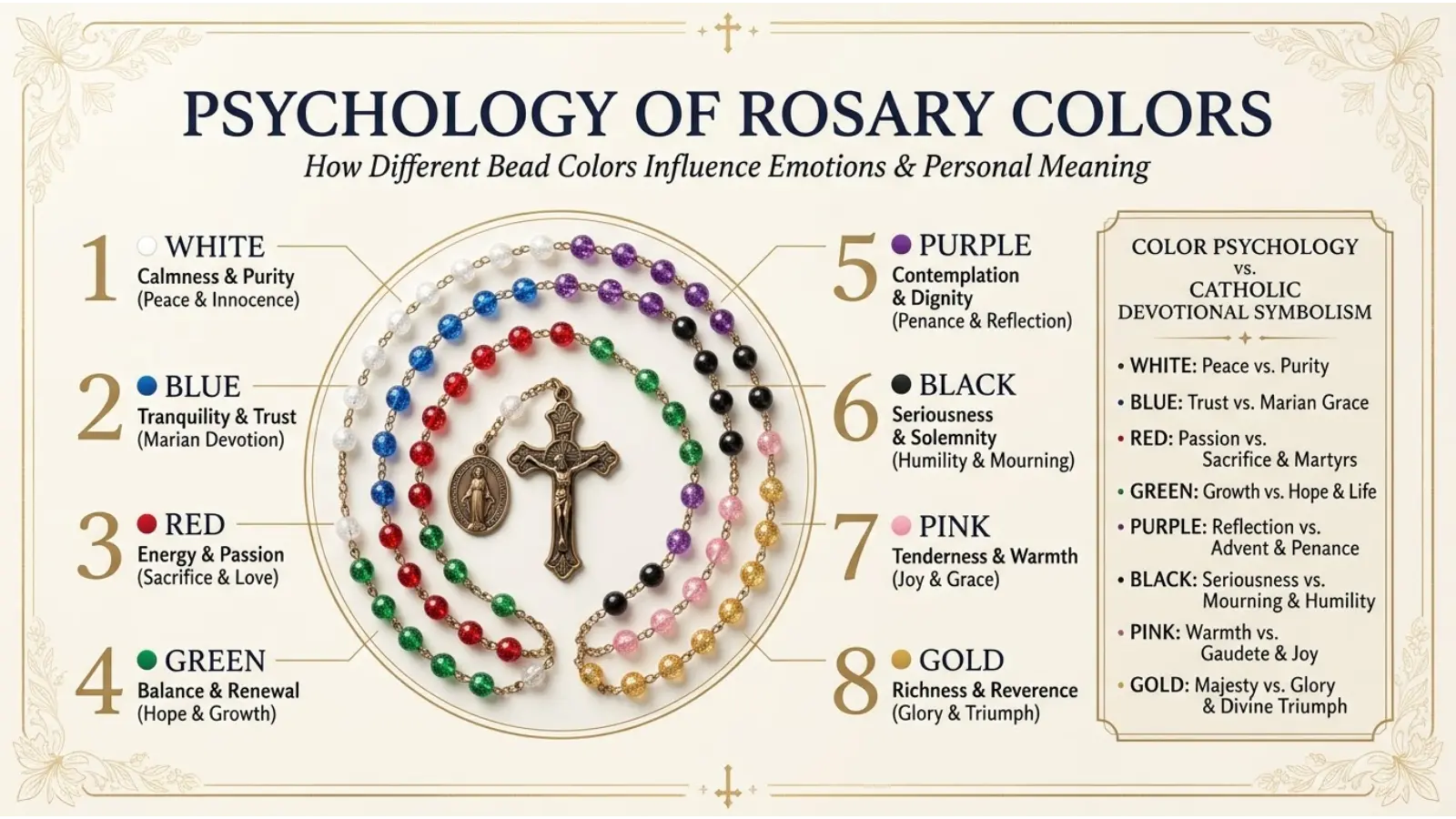
Psychology of Rosary Color Meanings
Color psychology examines how colors can influence perception, attention, and emotional associations.
However, the psychological effects of color depend on context, personal experience, culture, and individual preference.
There is no strong scientific evidence that using a particular rosary color directly changes someone’s faith, personality, or spiritual condition.
Still, colors can create different visual impressions.
Blue and Calmness
Blue is commonly associated with peaceful environments, trust, and stability.
A blue rosary may therefore create a gentle visual reminder of prayer and reflection.
White and Simplicity
White often communicates cleanliness, simplicity, and openness.
Its understated appearance can make a rosary feel peaceful and elegant.
Red and Emotional Intensity
Red attracts attention and is often linked with strong emotions.
On a rosary, its Christian associations with sacrifice and love can make the design especially meaningful.
Green and Nature
Green is strongly connected with plants, natural environments, and growth.
A green rosary may remind someone of renewal and hope.
Purple and Reflection
Purple can appear formal, thoughtful, and ceremonial.
Its association with Lent and Advent gives it additional religious significance.
Personality Associations: What Your Rosary Color May Say About Your Preferences
Some people choose rosary colors based on the qualities they personally appreciate.
These preferences can reveal something about individual taste, but they cannot accurately determine someone’s personality or religious commitment.
| Preferred Color | Possible Personal Association |
|---|---|
| Blue | Peaceful, thoughtful, devoted |
| White | Simple, organized, traditional |
| Red | Passionate, expressive, courageous |
| Black | Reserved, practical, reflective |
| Green | Hopeful, nature-loving, optimistic |
| Purple | Thoughtful, creative, reflective |
| Pink | Gentle, caring, affectionate |
| Gold | Appreciative of beauty and tradition |
| Brown | Practical, humble, simple |
For example, someone may prefer a black rosary because it matches their clothing, while another person may choose blue because of their devotion to Mary.
Neither choice reveals the full personality of the individual.
Rosary Colors for Different Occasions
A rosary can be a thoughtful gift for many religious and personal occasions.
Choosing a suitable color can make the gift feel more personal.
First Communion
White and pearl-colored rosaries are popular choices because of their associations with purity and religious celebration.
Baptism
White rosaries can symbolize new beginnings and the start of a person’s Christian journey.
Confirmation
Red, blue, and gold can make meaningful choices because of their associations with the Holy Spirit, faith, and spiritual commitment.
Wedding Gifts
White, pearl, crystal, and gold rosaries can complement the symbolism of love, unity, and celebration.
Christmas
White, gold, red, and green rosaries can reflect familiar Christmas themes and festive traditions.
Easter
White and gold rosaries can represent joy, holiness, and the celebration of the resurrection.
Funeral and Memorial Gifts
Black, dark brown, and simple wooden rosaries may be chosen for remembrance and prayer for deceased loved ones.
How to Choose the Right Rosary Color
Choosing a rosary is a personal decision. Its usefulness does not depend on its color or price.
Instead, consider its religious meaning, appearance, material, and intended purpose.
Here are a few practical points to consider:
1. Think about the symbolism. Choose a color that reminds you of a spiritual value, such as hope, peace, sacrifice, or devotion.
2. Consider the recipient. If you are buying a rosary as a gift, think about the person’s favorite colors and religious traditions.
3. Focus on its purpose. A rosary is primarily a tool for prayer. Its religious value does not come from expensive materials or a particular color.
Rosary Colors in Art, Fashion, and Everyday Life
Although rosaries are religious objects, their colors also influence how they look in art, photography, personal collections, and devotional settings.
Rosary Colors in Religious Art
Artists use color to communicate religious ideas.
Blue garments can identify Marian imagery, while gold backgrounds can suggest sacred glory.
Similarly, red can emphasize sacrifice, and white can communicate purity.
Rosary Colors in Photography
Lighting can significantly change how rosary beads appear in photographs.
For example, blue glass beads may look lighter under natural daylight but darker under warm indoor lighting.
Likewise, clear crystal beads can reflect surrounding colors.
For accurate product photography, use neutral lighting and a simple background.
Rosary Colors in Fashion
Some people wear rosaries as visible expressions of their faith, while others keep them as devotional objects.
Neutral-colored rosaries, such as brown, black, and white, can create a traditional appearance.
Meanwhile, colorful beads can reflect personal taste.
Rosary Colors in Home Decoration
Rosaries are sometimes displayed in personal prayer spaces or religious corners.
White, blue, and wooden rosaries can complement peaceful surroundings.
Gold and crystal designs may also suit traditional religious displays.
However, the purpose of a rosary should remain more important than its decorative appearance.
Common Misconceptions About Rosary Color Meanings
Several misunderstandings exist about the symbolism of rosary colors.
Understanding these differences helps people make informed choices.
Myth 1: Every Rosary Color Has an Official Catholic Meaning
Fact: Catholic liturgical colors have established meanings, but there is no universal official color code assigning a specific spiritual function to every rosary bead color.
Myth 2: Black Rosaries Are Evil or Unlucky
Fact: Black is not automatically negative. It can represent mourning, remembrance, reflection, and traditional simplicity.
Myth 3: Red Rosaries Are Only for Special Religious Occasions
Fact: A red rosary can be used for ordinary personal prayer throughout the year.
Myth 4: A Blue Rosary Has More Spiritual Power
Fact: Blue has a strong connection with Marian devotion, but the color itself does not make a rosary more spiritually powerful.
Myth 5: Expensive Rosaries Are More Sacred
Fact: A rosary’s price and material do not determine the value of someone’s prayer or faith.
Myth 6: Everyone Must Choose a Rosary Based on Its Symbolism
Fact: Some people choose colors for religious reasons, while others simply prefer a particular design.
Both approaches can be personal choices.
Frequently Asked Questions About Rosary Color Meanings
1. What is the most popular rosary color?
Blue, white, black, and brown are among the familiar rosary colors. Blue is especially recognizable because of its association with the Virgin Mary, while white is popular for religious celebrations.
2. What does a blue rosary mean?
A blue rosary commonly symbolizes faith, peace, heavenly devotion, and the Virgin Mary. It is a popular choice among people with a strong Marian devotion.
3. What does a red rosary symbolize?
Red commonly represents Christ’s sacrifice, love, martyrdom, and the Holy Spirit. Its meaning is closely connected with important Christian events and traditions.
4. Is a black rosary bad or unlucky?
No. A black rosary is not automatically associated with evil or bad luck. It may represent remembrance, mourning, reflection, humility, or personal preference.
5. What does a white rosary mean?
White commonly symbolizes purity, innocence, holiness, and new beginnings. It is a popular choice for baptism, First Communion, weddings, and Easter celebrations.
6. What does a green rosary represent?
Green commonly represents hope, renewal, growth, and life. It is also connected with Ordinary Time in the Catholic liturgical calendar.
7. What does a purple rosary mean?
Purple is associated with repentance, spiritual preparation, humility, and reflection. It has a special connection with the Catholic seasons of Lent and Advent.
8. Which rosary color is best for a gift?
The best color depends on the recipient and the occasion. White is suitable for First Communion and baptism, blue for Marian devotion, and red or gold for meaningful religious celebrations.
9. Does rosary color affect the prayers?
No. The color of the beads does not change the prayers or their meaning. A rosary of any suitable color can be used for traditional Catholic prayer.
10. Can I choose a rosary color based on my favorite color?
Yes. You can choose a rosary based on personal preference, religious symbolism, or both. The most important consideration is that it helps you maintain a meaningful connection with prayer and devotion.
Conclusion: Understanding the Meaning Behind Rosary Colors
Rosary colors offer a beautiful way to express religious symbolism, personal devotion, and individual taste. Blue reminds many Christians of the Virgin Mary and faith, white represents purity, red reflects sacrifice and love, and green suggests hope and growth.
Likewise, purple is associated with repentance and preparation, while black can communicate remembrance and reflection.
However, no single color defines the spiritual value of a rosary. Its deeper significance comes from the prayers, faith, and personal devotion connected with its use.
When choosing a rosary, consider the meaning that matters most to you. Whether you prefer traditional wooden beads, elegant white pearls, or colorful glass designs, the best rosary is one that encourages prayer and brings meaning to your spiritual life.
Replace unsupported cultural generalizationsRemove repeated symbolism sections

Emma Wilson is a dedicated comparison writer and product researcher at ColorMystiic.com. She specializes in creating unbiased product comparisons, detailed reviews, and helpful buying guides. Her goal is to help readers make smarter purchasing decisions with confidence.