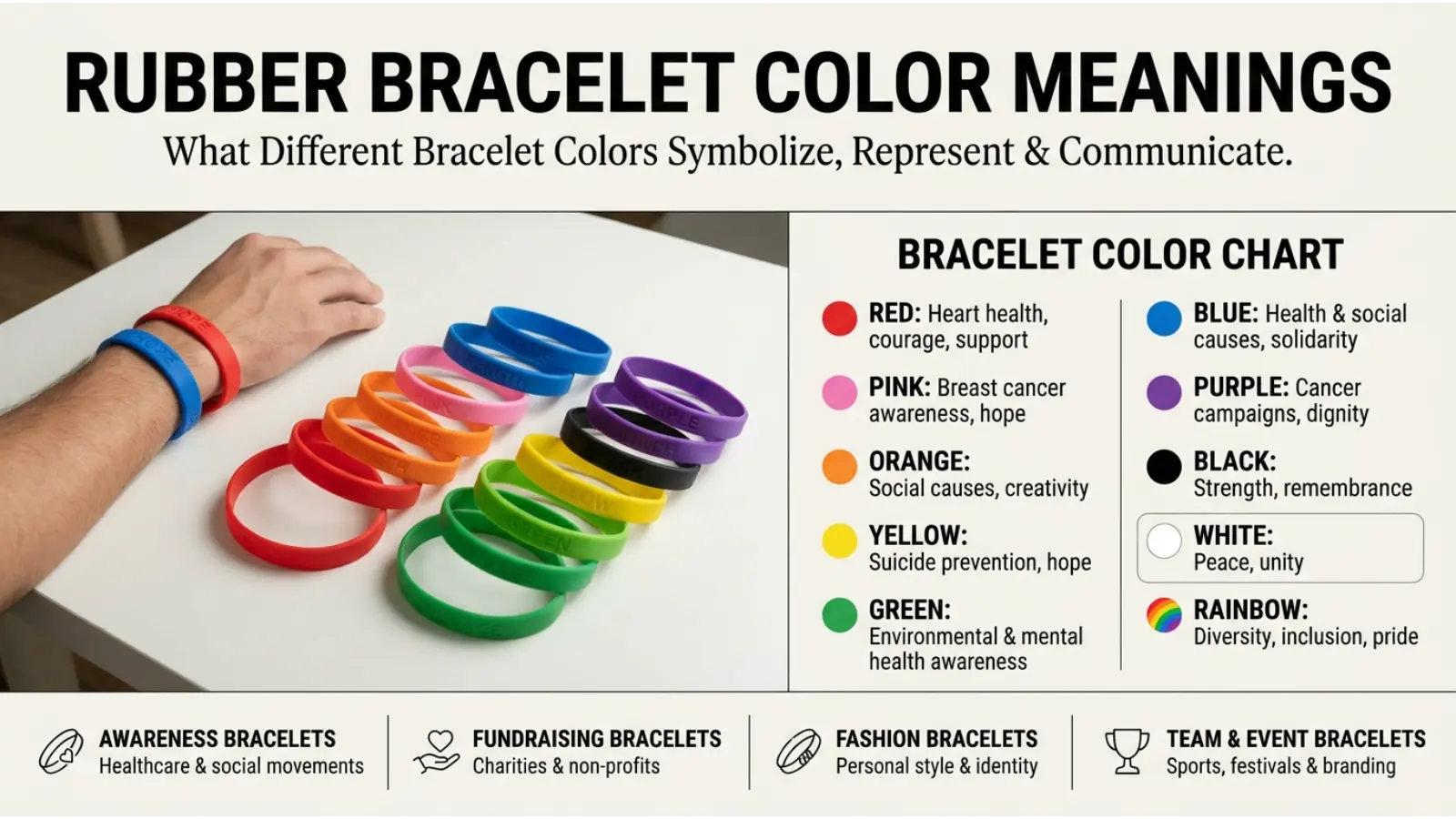
Rubber Bracelet Color Meanings are small accessories, but their colors can communicate powerful messages. From supporting health awareness campaigns to showing personal beliefs, celebrating communities, and expressing individual style, each bracelet color can carry a special meaning.
The meaning of a rubber bracelet often depends on its color, the organization behind it, and the reason someone wears it. For example, a yellow bracelet may represent cancer awareness, while a blue bracelet can support mental health awareness, autism-related campaigns, or other causes. Similarly, red bracelets may symbolize love, support, or awareness of particular health conditions.
However, there is no universal color code for every rubber bracelet. A color can represent several causes, and different organizations may use the same shade for different purposes.
Understanding rubber bracelet color meanings helps you recognize the messages behind these popular accessories. It also makes it easier to choose a bracelet that reflects your values, supports a cause, or communicates something personal.
This guide explores the meanings of popular rubber bracelet colors, their emotional associations, awareness campaigns, cultural symbolism, fashion uses, and practical ways to choose the right one.
Quick Answer: What Do Rubber Bracelet Color Meanings?
Rubber bracelet colors represent different causes, emotions, identities, and personal messages. Their meanings vary by campaign and organization.
| Bracelet Color | Common Meanings |
|---|---|
| Red | Love, heart health, HIV/AIDS awareness, courage |
| Blue | Autism awareness, mental health support, trust |
| Pink | Breast cancer awareness, compassion, femininity |
| Yellow | Hope, childhood cancer awareness, suicide prevention campaigns |
| Green | Mental health awareness, environmental protection, growth |
| Purple | Epilepsy awareness, domestic violence awareness, strength |
| Orange | Hunger awareness, leukemia awareness, energy |
| Black | Mourning, remembrance, melanoma awareness, strength |
| White | Peace, lung cancer awareness, purity |
| Teal | Ovarian cancer awareness, sexual assault awareness |
| Gray | Brain cancer awareness, support, neutrality |
| Rainbow | LGBTQ+ pride, diversity, inclusion |
Remember: These are common associations, not universal rules. Always check the message or organization printed on a bracelet before assuming what it represents.
What Do Rubber Bracelet Colors Symbolize?
Rubber bracelets are commonly made from silicone, which makes them flexible, lightweight, and suitable for everyday wear. Their popularity grew because organizations could produce colorful bracelets with short printed messages at relatively low cost.
However, their importance goes beyond fashion.
A simple colored bracelet can help someone show support for a friend, raise awareness about an illness, remember a loved one, or express membership in a community.
The meaning usually comes from three things:
- Color: The visual association creates an emotional or symbolic message.
- Printed words: Names, slogans, and campaign messages explain the purpose.
- Organization or context: The group distributing the bracelet may establish its specific meaning.
For example, a purple bracelet with an epilepsy awareness message has a more specific meaning than a plain purple bracelet worn as a fashion accessory.
Therefore, the color provides a starting point, while the surrounding context explains the complete message.
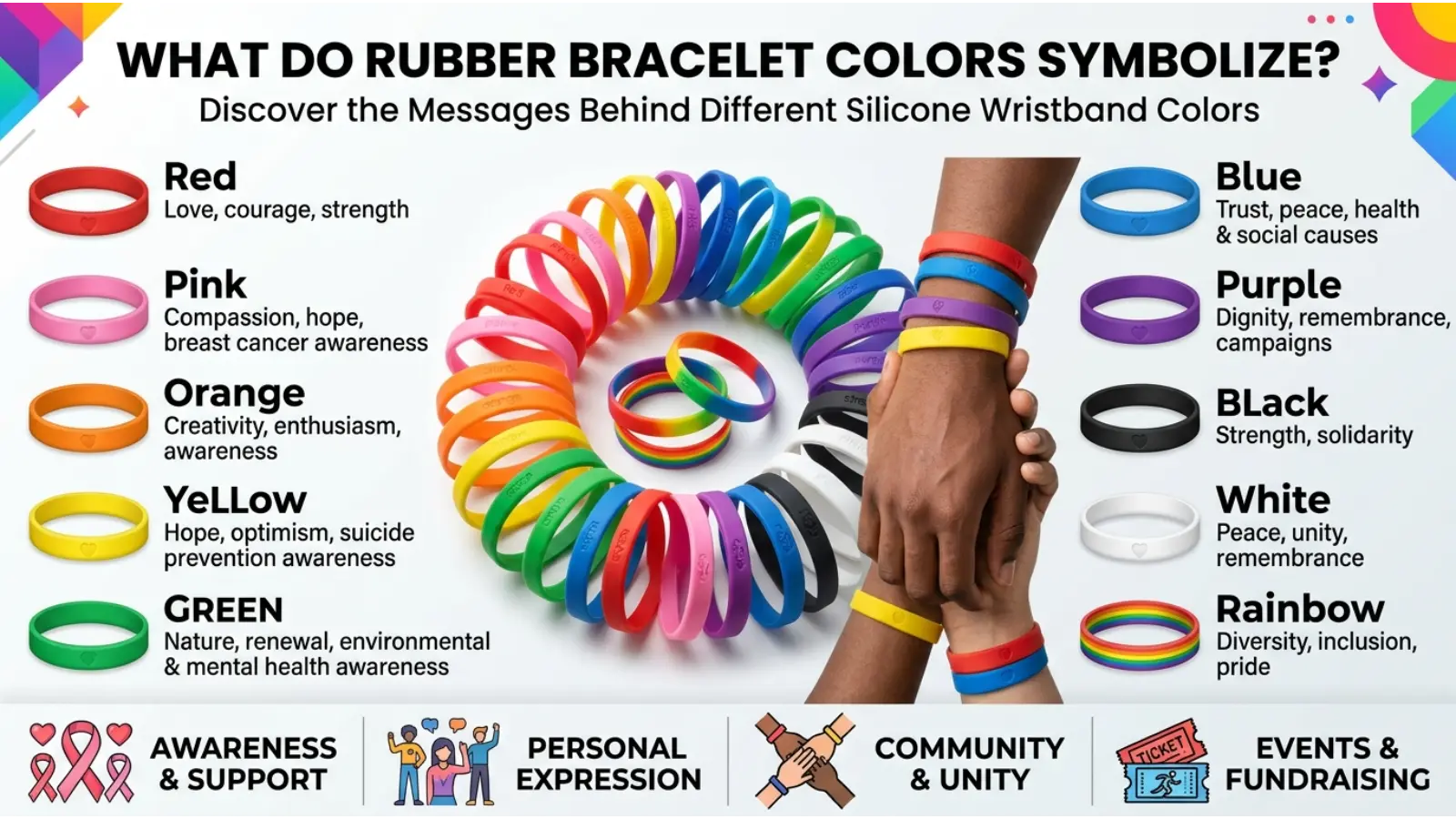
Rubber Bracelet Color Meanings: A Complete Color Guide
Each bracelet color has its own common associations. Nevertheless, the same color may represent different causes depending on the campaign.
Red Rubber Bracelet Meaning
Red rubber bracelets commonly represent love, courage, passion, strength, and support.
In awareness campaigns, red is strongly associated with heart health and HIV/AIDS awareness. However, the exact meaning depends on the organization using it.
Red is also an emotionally powerful color. Its strong visual appearance makes it easy to notice, which is one reason organizations choose it for public awareness campaigns.
Common meanings of red bracelets:
- Heart disease awareness
- HIV/AIDS awareness
- Love and romantic connection
- Courage and determination
- Blood-related health campaigns
- Emotional strength
In everyday fashion, red bracelets can create a bold appearance. They also work well with black, white, gray, and neutral clothing.
Blue Rubber Bracelet Meaning
Blue rubber bracelets often symbolize trust, peace, loyalty, communication, and support.
Different shades of blue are used by various awareness organizations. Light blue, dark blue, and royal blue may represent different causes.
For example, blue is widely used in some autism awareness initiatives, although the puzzle-piece symbol and other campaign designs have their own histories and interpretations.
Blue is also associated with mental health awareness and support campaigns.
Common meanings of blue bracelets:
- Autism awareness
- Mental health support
- Child abuse prevention
- Prostate cancer awareness
- Trust and friendship
- Peace and stability
Because blue is visually calm, it is also popular in sports teams, schools, businesses, and community events.
Pink Rubber Bracelet Meaning
Pink rubber bracelets are especially recognized for breast cancer awareness.
The pink ribbon has become a widely recognized symbol of breast cancer awareness, and pink bracelets often extend that message into everyday accessories.
Beyond health campaigns, pink can represent kindness, compassion, affection, hope, and femininity.
Common meanings include:
- Breast cancer awareness
- Support for patients and survivors
- Compassion and kindness
- Love and friendship
- Women’s health awareness
- Hope and encouragement
Pink bracelets are also popular at fundraising events, charity walks, and community campaigns.
Yellow Rubber Bracelet Meaning
Yellow rubber bracelets can symbolize hope, optimism, remembrance, and support.
One particularly recognizable use is childhood cancer awareness, where gold is the established awareness color. Yellow and gold are sometimes confused in merchandise, so checking the specific campaign is helpful.
Yellow is also used in suicide prevention initiatives, including campaigns that use yellow wristbands to communicate messages of hope and support.
Common associations include:
- Childhood cancer awareness (gold)
- Suicide prevention campaigns
- Hope and encouragement
- Missing children awareness in certain campaigns
- Optimism and positivity
- Support for loved ones
Yellow stands out visually, making it useful for events where organizers want participants to recognize a shared message.
Green Rubber Bracelet Meaning
The Green bracelets can represent mental health awareness, environmental protection, renewal, balance, and personal growth.
Green is particularly associated with mental health awareness in many campaigns. It can communicate encouragement, understanding, and solidarity with people experiencing mental health challenges.
Different shades also create different impressions. Dark green often feels connected to nature and stability, while light green suggests freshness and renewal.
Common meanings include:
- Mental health awareness
- Environmental protection
- Organ donation awareness in some campaigns
- Hope and recovery
- Growth and renewal
- Nature conservation
Green bracelets are also popular among environmental organizations and sustainability campaigns.
Purple Rubber Bracelet Meaning
Purple rubber bracelets are commonly connected with strength, dignity, awareness, and remembrance.
The Purple is used in several health and social awareness campaigns, including epilepsy awareness and domestic violence awareness.
Its rich appearance also gives it associations with wisdom, creativity, individuality, and dignity.
Common meanings include:
- Epilepsy awareness
- Domestic violence awareness
- Alzheimer’s awareness in some campaigns
- Fibromyalgia awareness
- Strength and courage
- Support for survivors
Purple bracelets are often worn to show solidarity with individuals and families affected by difficult experiences.
Orange Rubber Bracelet Meaning
Orange rubber bracelets communicate energy, enthusiasm, encouragement, and awareness.
The Orange is used in several health campaigns, including leukemia awareness and multiple sclerosis awareness. However, awareness colors can overlap, so the specific campaign should always be considered.
Common meanings include:
- Leukemia awareness
- Multiple sclerosis awareness
- Hunger awareness
- Kidney cancer awareness in certain campaigns
- Energy and enthusiasm
- Creativity and confidence
Orange is particularly useful for fundraising events because its bright appearance attracts attention.
Black Rubber Bracelet Meaning
Black rubber bracelets can symbolize strength, remembrance, mourning, solidarity, and determination.
They are also used in melanoma awareness campaigns.
In fashion, black is associated with simplicity, confidence, sophistication, and individuality.
Common meanings include:
- Melanoma awareness
- Mourning and remembrance
- Support for a loved one
- Strength and resilience
- Solidarity with a community
- Personal identity
A black bracelet can also carry a completely personal message, especially when it includes a name, date, or meaningful phrase.
White Rubber Bracelet Meaning
The White rubber bracelets commonly represent peace, hope, purity, remembrance, and unity.
White is also associated with lung cancer awareness, although specific campaign materials should be checked to confirm the intended meaning.
In everyday fashion, white bracelets create a clean and simple appearance.
Common meanings include:
- Lung cancer awareness
- Peace and unity
- Hope and new beginnings
- Remembrance
- Innocence and purity
- Support and solidarity
White bracelets are particularly popular in campaigns that want to communicate a message of peace or collective support.
Teal Rubber Bracelet Meaning
Teal rubber bracelets are often used in campaigns related to ovarian cancer awareness and sexual assault awareness.
The color combines elements of blue and green, creating associations with calmness, healing, balance, and emotional support.
Common meanings include:
- Ovarian cancer awareness
- Sexual assault awareness
- Support for survivors
- Healing and recovery
- Emotional balance
- Compassion
Teal is a useful choice for campaigns that focus on support, education, and personal well-being.
Gray Rubber Bracelet Meaning
Gray rubber bracelets are associated with brain cancer awareness in many campaigns.
The Gray can also represent neutrality, maturity, remembrance, and solidarity.
Its understated appearance makes it suitable for people who prefer a simple accessory that communicates a meaningful message without attracting too much attention.
Common meanings include:
- Brain cancer awareness
- Support for patients and families
- Remembrance
- Balance and neutrality
- Strength during difficult experiences
Rainbow Rubber Bracelet Meaning
Rainbow rubber bracelets are widely associated with LGBTQ+ pride, diversity, equality, and inclusion.
The rainbow flag is an internationally recognized symbol of LGBTQ+ communities, although individual rainbow designs may have different meanings.
A rainbow bracelet can communicate acceptance, support, friendship, and respect for different identities.
Common meanings include:
- LGBTQ+ pride
- Diversity and inclusion
- Equality
- Acceptance
- Unity
- Individual freedom
Rainbow bracelets are popular at pride events, community celebrations, schools, and inclusion campaigns.
Color Psychology Behind Rubber Bracelet Color Meanings
The psychology of bracelet colors helps explain why certain shades are chosen for particular messages.
Color perception involves both visual and emotional responses. However, people do not respond to colors in exactly the same way.
Personal experiences, culture, age, surroundings, and individual preferences all influence color interpretation.
For example, red may communicate courage to one person but danger or urgency to another.
Here is a simplified overview of common emotional associations.
| Color | Emotional Association | Possible Impression |
|---|---|---|
| Red | Passion and energy | Bold and powerful |
| Blue | Calmness and trust | Reliable and peaceful |
| Pink | Warmth and affection | Gentle and caring |
| Yellow | Optimism | Cheerful and hopeful |
| Green | Renewal and balance | Natural and refreshing |
| Purple | Creativity and dignity | Thoughtful and expressive |
| Orange | Enthusiasm | Energetic and friendly |
| Black | Strength and seriousness | Confident and elegant |
| White | Simplicity and peace | Clean and balanced |
| Teal | Calmness and healing | Supportive and refreshing |
| Gray | Neutrality | Subtle and mature |
| Rainbow | Diversity and unity | Inclusive and expressive |
Why Do Some Bracelet Colors Attract More Attention?
Bright colors such as red, yellow, and orange are often easier to notice against neutral backgrounds.
Meanwhile, darker colors such as navy, black, and deep purple may create a more serious or formal appearance.
Contrast also matters. A yellow message printed on a black bracelet can be easier to read than the same message printed in a similar shade of yellow.
Therefore, organizations consider both symbolism and visibility when choosing bracelet colors.
Spiritual Rubber Bracelet Color Meanings
Some people connect bracelet colors with spiritual beliefs, personal intentions, and emotional energy.
These interpretations are personal and vary across traditions. They should not be confused with established medical or scientific facts.
Here are some common symbolic interpretations:
| Color | Spiritual Association |
|---|---|
| Red | Courage, vitality, and grounding |
| Blue | Peace, communication, and clarity |
| Pink | Love, compassion, and kindness |
| Yellow | Confidence, optimism, and personal power |
| Green | Growth, renewal, and balance |
| Purple | Wisdom, intuition, and reflection |
| Orange | Creativity, enthusiasm, and motivation |
| Black | Protection, boundaries, and strength |
| White | Peace, purity, and spiritual clarity |
| Teal | Emotional healing and balance |
For example, someone may wear a green bracelet as a reminder to focus on personal growth. Another person may choose blue to represent calm communication.
The value of these associations often comes from the personal intention attached to the accessory rather than any proven effect of the material or color.
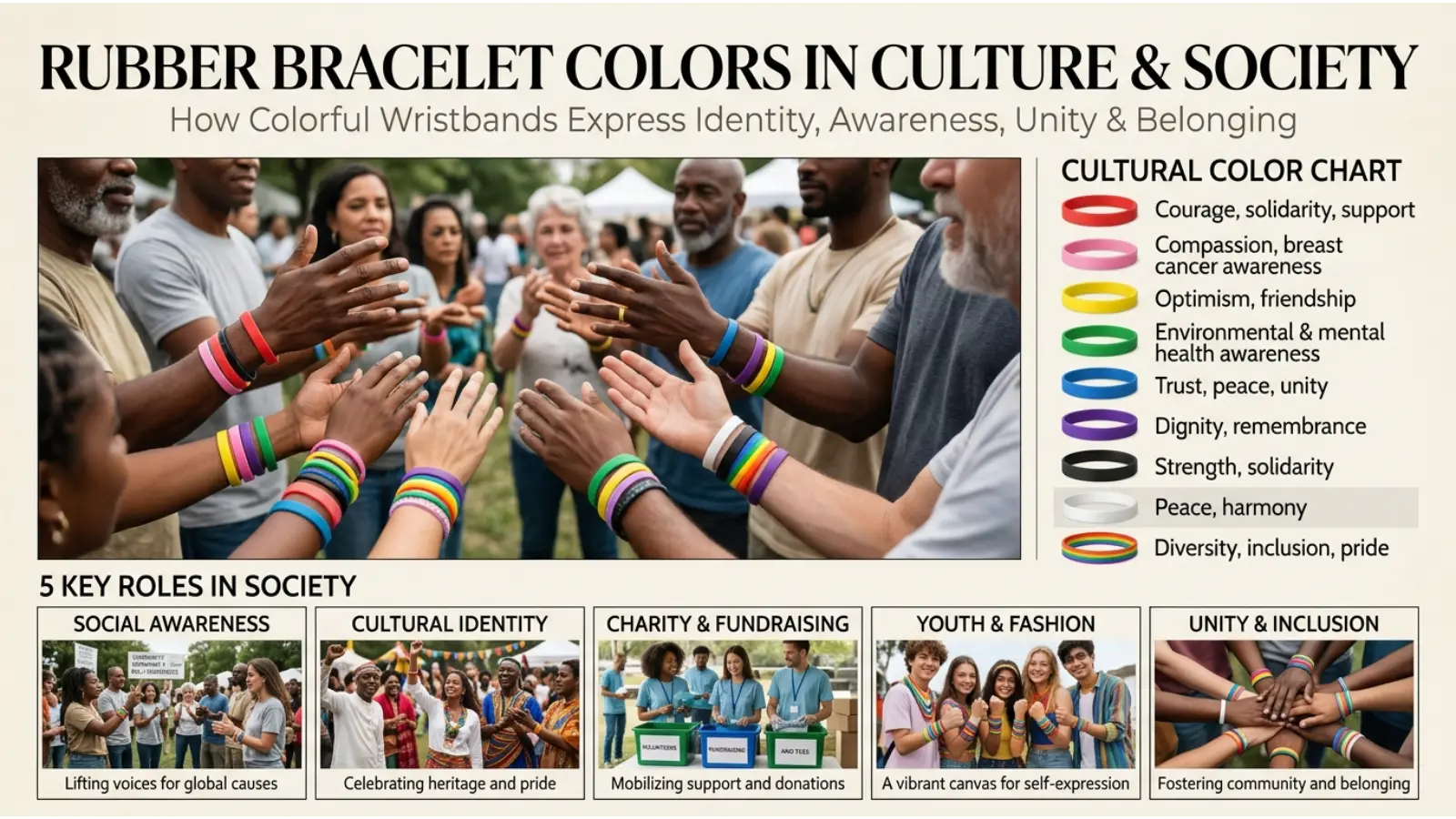
Rubber Bracelet Color Meanings in Culture and Society
Rubber bracelets have become part of modern social communication.
Unlike traditional jewelry, they are usually inexpensive and easy to distribute. Consequently, schools, charities, sports organizations, businesses, and community groups use them to create a visible sense of connection.
Western Countries
In the United States, Canada, and parts of Europe, colored silicone bracelets became especially popular through awareness campaigns and charitable fundraising.
They are often used to promote health education, support research, and recognize community causes.
Pink breast cancer awareness bracelets and rainbow pride accessories are familiar examples.
Asian Countries
In Asian communities, bracelet meanings can vary depending on religion, local customs, and fashion trends.
Red often has positive associations with celebration, good fortune, and happiness in several East Asian cultural traditions.
However, these traditional associations do not automatically apply to every modern red silicone bracelet.
African Communities
Across African countries, colors can carry different meanings in clothing, ceremonies, flags, and community identity.
Therefore, a green, red, yellow, or black bracelet may have a cultural meaning connected to a particular nation or group.
There is no single interpretation that represents the entire continent.
Latin American Communities
In Latin America, colored bracelets are used in fashion, sports, religious events, charitable activities, and community celebrations.
Their meaning often depends on the local campaign or organization.
Modern Global Culture
Social media has helped make colored bracelets popular symbols of identity and solidarity.
People wear them to support causes, show friendship, remember important events, and communicate personal values.
As a result, a bracelet can become meaningful even when its color has no official awareness association.
History of Rubber Awareness Bracelets
The modern popularity of rubber and silicone bracelets is closely connected to awareness campaigns and charitable fundraising.
During the 2000s, silicone wristbands became especially visible as inexpensive accessories that could carry short messages.
One major example was the yellow Livestrong wristband, introduced in 2004 by the Lance Armstrong Foundation, now known as the Livestrong Foundation.
The bracelet became a widely recognized fundraising and awareness accessory. Its popularity helped establish the silicone wristband as a way to show support for a cause.
Over time, schools, sports teams, charities, businesses, and community organizations adopted similar designs.
Today, rubber bracelets are used for much more than health campaigns. They can represent:
- Friendship and team membership
- School and university identity
- Charity fundraising
- Religious and community events
- Music festivals and entertainment
- Personal messages
- Business promotion
Their history shows how an inexpensive accessory can become a recognizable symbol of collective identity.
What Do Rubber Bracelet Color Meanings Say About Personality?
Some people choose bracelet colors because they reflect their personal style or emotional preferences.
Although color preferences cannot reliably determine personality, they can provide a way to express identity.
Here are some common symbolic impressions:
- Red bracelet: May communicate confidence, energy, and boldness.
- Blue bracelet: May reflect a preference for calm, trust, and simplicity.
- Pink bracelet: May express warmth, affection, and kindness.
- Yellow bracelet: May communicate optimism and enthusiasm.
- Green bracelet: May reflect an interest in nature, balance, and growth.
- Purple bracelet: May suggest creativity and individuality.
- Black bracelet: May communicate confidence and a minimalist style.
- White bracelet: May express simplicity and a preference for clean designs.
- Rainbow bracelet: May communicate inclusion and celebration of diversity.
These are cultural and stylistic associations, not personality tests.
A person wearing a black bracelet is not necessarily serious, just as someone wearing yellow is not automatically cheerful.
Rubber Bracelet Color Meanings in Branding and Marketing
Businesses use colored rubber bracelets as affordable promotional products and communication tools.
They are particularly useful because customers can wear them repeatedly, giving a brand more opportunities to be noticed.
However, selecting a bracelet color requires more thought than simply choosing an attractive shade.
Red for Energy and Action
Red works well for sports events, energetic campaigns, and promotional activities.
It can help a brand communicate excitement and urgency.
Blue for Trust and Professionalism
Blue is popular for educational institutions, technology events, and organizations that want a reliable appearance.
It can create a sense of consistency and professionalism.
Green for Sustainability
Green is a natural choice for environmental campaigns, recycling programs, and sustainability events.
Nevertheless, a business should support its environmental message with real actions rather than relying on color alone.
Pink for Compassion and Support
Pink bracelets work well for charity events, women’s health campaigns, and fundraising activities.
They create a recognizable visual connection with certain awareness movements.
Black for Premium Branding
Black silicone bracelets can create a modern and minimalist appearance.
They are suitable for fashion brands, sports organizations, and promotional merchandise.
Choosing the Right Bracelet Color for a Business
A successful promotional bracelet should combine three elements:
- A color that matches the campaign’s message.
- Clear lettering that remains readable.
- A simple design that people enjoy wearing.
For instance, a charity supporting mental health may choose green, while a sports organization may prefer red or black.
The most effective color is the one that communicates the intended message clearly.
Rubber Bracelet Color Meanings in Fashion and Everyday Style
Rubber bracelets are popular because they are lightweight, casual, and easy to combine with other accessories.
Their appearance can change significantly depending on the color, clothing, and occasion.
Casual Clothing
Bright bracelets in red, orange, yellow, or blue can add a small splash of color to everyday outfits.
For example, a yellow silicone bracelet can look attractive with a white T-shirt and blue jeans.
Professional Clothing
For workplaces with relaxed dress codes, black, navy, gray, and dark green bracelets can provide a subtle accessory.
However, highly visible promotional messages may not suit every professional setting.
Sports and Fitness
Athletes often wear silicone bracelets because they are flexible and lightweight.
Black, red, blue, and team-colored bracelets are common choices for sports-related accessories.
Matching Bracelets With Other Accessories
You can create a balanced appearance by pairing:
- Black bracelets with silver watches.
- Blue bracelets with denim clothing.
- Pink bracelets with neutral outfits.
- Green bracelets with earthy colors.
- White bracelets with minimalist accessories.
- Red bracelets with black or white clothing.
The best combination depends on personal taste rather than strict fashion rules.
Best Color Combinations for Rubber Bracelet Color Meanings
Combining two or more colors can make a bracelet more attractive and improve its message.
A good combination should provide enough contrast for the printed text to remain readable.
| Bracelet Combination | Visual Effect | Suitable Use |
|---|---|---|
| Red and White | Bold and clean | Sports and charity |
| Blue and White | Calm and professional | Schools and organizations |
| Black and Yellow | Strong contrast | Safety and awareness |
| Pink and White | Soft and friendly | Health campaigns |
| Green and White | Fresh and natural | Environmental causes |
| Purple and Silver | Elegant and modern | Special events |
| Orange and Black | Energetic and bold | Sports and fundraising |
| Rainbow and White | Bright and inclusive | Pride celebrations |
How to Choose a Readable Bracelet Design
Color contrast is especially important when a bracelet includes a slogan, organization name, or awareness message.
For example, white lettering on a dark blue bracelet is usually easier to read than pale blue lettering on a similar blue background.
Likewise, black lettering on a yellow bracelet provides strong visual contrast.
Designers should also consider the bracelet’s size, printing method, and material finish.
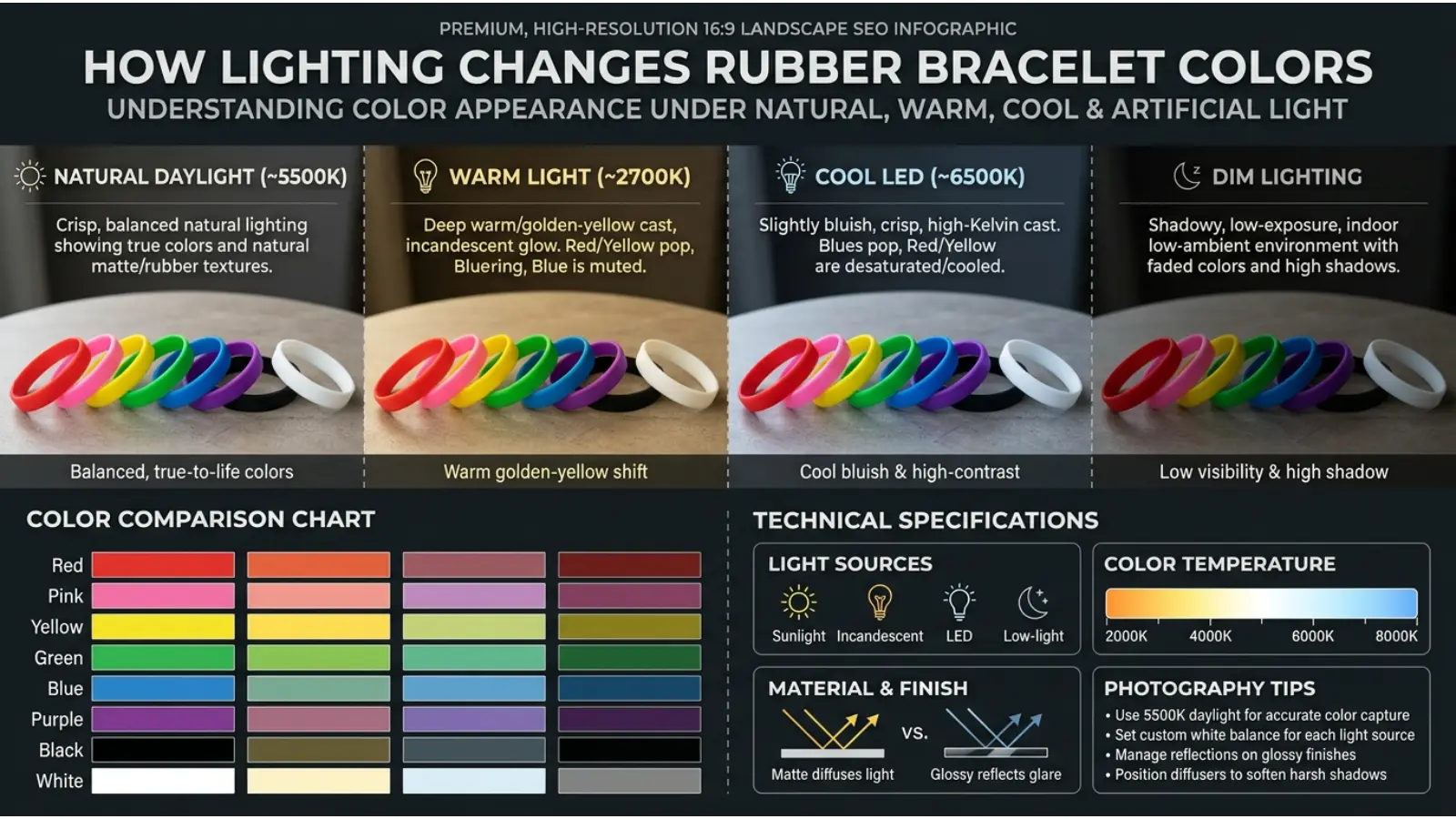
How Lighting Changes Rubber Bracelet Color Meanings
A bracelet may look different under sunlight, indoor lighting, and artificial photography lights.
For example, a bright red bracelet may appear warmer in sunlight but darker under weak indoor lighting.
Similarly, fluorescent lighting can make some green and blue shades look different from their original appearance.
This matters when purchasing bracelets online or selecting colors for a large event.
For accurate color matching, compare physical samples under the lighting conditions where the bracelets will usually be worn or displayed.
How Age and Personal Experience Influence Bracelet Color Meanings
People do not always interpret colors in the same way.
Children may choose bracelets because they like bright colors, while adults may select them to support a cause or express a personal belief.
Similarly, someone who has participated in a cancer awareness campaign may connect a particular color with a family member or personal experience.
A color can therefore become meaningful through memory rather than tradition.
This explains why the same bracelet may represent fashion to one person and an emotional commitment to another.
Common Misconceptions About Rubber Bracelet Colors
Several misunderstandings can make bracelet symbolism confusing.
Every Bracelet Color Has One Official Meaning
This is incorrect. A single color can represent several causes, and different organizations may use it differently.
A Bracelet Color Reveals Someone’s Personality
A bracelet may express personal taste, but it cannot reliably identify someone’s character or emotional condition.
All Awareness Bracelets Follow the Same Color System
Awareness campaigns do not share one universal color chart. Organizations may use different colors, symbols, and designs.
Spiritual Meanings Are Scientifically Proven
Spiritual interpretations are based on beliefs and traditions. They should not be presented as scientific evidence.
Rubber Bracelets Are Only Used for Charity
They are also used for fashion, sports, friendship, business promotion, school activities, and personal expression.
How to Choose the Right Rubber Bracelet Color
Choosing a bracelet becomes easier when you understand the message you want to communicate.
For health awareness: Select the color officially associated with the campaign.
For friendship: Choose matching colors that represent a shared memory or connection.
Personal style: Consider your clothing, favorite shades, and preferred accessory design.
For business promotion: Use a color that supports your brand identity and remains readable.
For sports teams: Choose team colors to create a recognizable group identity.
Remembrance: Select a color connected to the person, event, or cause you want to honor.
If the bracelet represents a specific campaign, include its name or message. This helps prevent misunderstandings when the same color has several meanings.
Real-World Uses of Rubber Bracelet Colors
Rubber bracelets have practical uses across different parts of everyday life.
| Area | How Colored Bracelets Are Used |
|---|---|
| Healthcare | Awareness and fundraising campaigns |
| Schools | Student groups and event identification |
| Sports | Team identity and motivation |
| Businesses | Promotional merchandise |
| Fashion | Everyday personal accessories |
| Charity | Fundraising and public support |
| Entertainment | Concerts and festival identification |
| Community events | Group participation and unity |
| Personal life | Friendship and remembrance |
In Healthcare
Hospitals, charities, and awareness organizations sometimes distribute bracelets to encourage public participation.
However, a colored bracelet should not be treated as a medical identification device unless it is specifically designed and used for that purpose.
In Sports
Teams may distribute matching bracelets to players and supporters.
This creates a simple visual connection between team members and fans.
In Business
Companies can print their logos, slogans, or event names on silicone bracelets.
Because they are reusable and portable, they can continue promoting a message long after an event ends.
In Personal Life
People sometimes wear bracelets to remember someone, celebrate a relationship, or maintain a connection with a meaningful experience.
In these situations, the emotional value can be more important than any recognized color symbolism.
Frequently Asked Questions About Rubber Bracelet Color Meanings
1. What does a red rubber bracelet mean?
A red rubber bracelet can symbolize love, courage, heart health awareness, or HIV/AIDS awareness. Its specific meaning depends on the campaign or message printed on it.
2. What does a blue rubber bracelet mean?
Blue bracelets commonly represent trust, peace, autism awareness initiatives, mental health support, and other awareness causes. Different shades may have different campaign meanings.
3. What does a black rubber bracelet mean?
A black bracelet can symbolize strength, remembrance, mourning, and solidarity. It is also used in melanoma awareness campaigns.
4. What does a green rubber bracelet mean?
Green rubber bracelets commonly represent mental health awareness, environmental protection, personal growth, and renewal.
5. What does a purple rubber bracelet mean?
Purple bracelets are commonly associated with epilepsy awareness, domestic violence awareness, strength, dignity, and support for affected communities.
6. What does a yellow rubber bracelet mean?
Yellow bracelets can symbolize hope, optimism, and suicide prevention awareness. Gold is the established color for childhood cancer awareness, although some merchandise uses yellow shades.
7. What does a pink rubber bracelet represent?
Pink bracelets are widely associated with breast cancer awareness, compassion, support for survivors, and women’s health campaigns.
8. What does a rainbow rubber bracelet mean?
A rainbow bracelet commonly represents LGBTQ+ pride, diversity, inclusion, equality, and acceptance.
9. Can rubber bracelet colors have personal meanings?
Yes. People can choose colors to represent memories, friendships, relationships, personal goals, or important experiences. Personal meanings do not need to follow official awareness color systems.
10. Do rubber bracelet colors have universal meanings?
No. Bracelet colors do not have one universal meaning. Their interpretation depends on the culture, campaign, organization, printed message, and personal experiences of the wearer.
Conclusion: The Meaning Behind Every Rubber Bracelet Color
Rubber bracelets may be simple accessories, but their colors can communicate meaningful messages about health, identity, friendship, awareness, and personal values.
Red can express courage, blue can suggest trust, pink can represent compassion, and green can communicate growth. Meanwhile, purple, orange, black, white, teal, and rainbow designs can carry their own associations across different communities and campaigns.
However, the most important detail is context. A color alone does not always reveal the exact message behind a bracelet.
Whether you wear one to support a cause, remember someone, promote a business, or express your personal style, choosing a meaningful color can turn a small accessory into a powerful form of communication.
Ultimately, the meaning of a rubber bracelet comes from the message behind it and the person who chooses to wear it.
Tighten repetitive sections and improve scanability

Emma Wilson is a dedicated comparison writer and product researcher at ColorMystiic.com. She specializes in creating unbiased product comparisons, detailed reviews, and helpful buying guides. Her goal is to help readers make smarter purchasing decisions with confidence.