Flag Marker Color Meanings help people identify locations, communicate warnings, organize activities, and highlight important information. From construction sites and hiking trails to sports fields and digital maps, these small flags make information easier to recognize at a glance. However, their meanings are not always the same. A red marker may indicate danger in one setting but identify a particular point in another.
Understanding flag marker color meanings helps you interpret these signals more accurately. Red, yellow, green, blue, orange, white, and black each have common visual associations. Nevertheless, the exact meaning depends on the activity, location, and rules used by the organization displaying the flags.
Quick Answer: Flag marker colors communicate information through visual conventions. Red commonly signals danger or attention, yellow suggests caution, green may indicate safety or a designated area, blue can identify information or services, and orange often provides high visibility. White and black may distinguish reference points or categories. Always check the legend or instructions because flag marker colors do not have one universal meaning.
What AreFlag Marker Color Meanings?
Flag markers are colored flags, small fabric indicators, plastic flags, or flag-shaped symbols used to identify a place, object, boundary, or condition. They allow people to recognize information quickly without relying entirely on written instructions.
For example, a surveyor might use a small flag to mark a point on the ground. Meanwhile, a sports official may use flags to identify boundaries, and a hiking organization may use colored markers to distinguish routes.
Although these examples share a similar design, their color systems may follow different rules.
Three factors usually determine what a flag marker means:
- Color: Provides a visual clue or category.
- Placement: Shows which object, area, or location the flag identifies.
- Context: Explains how the color should be interpreted within a particular activity.
Therefore, the safest approach is to understand the setting before assigning a meaning to a marker.
Flag Marker Color Meanings Chart
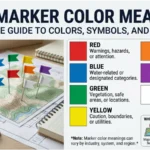
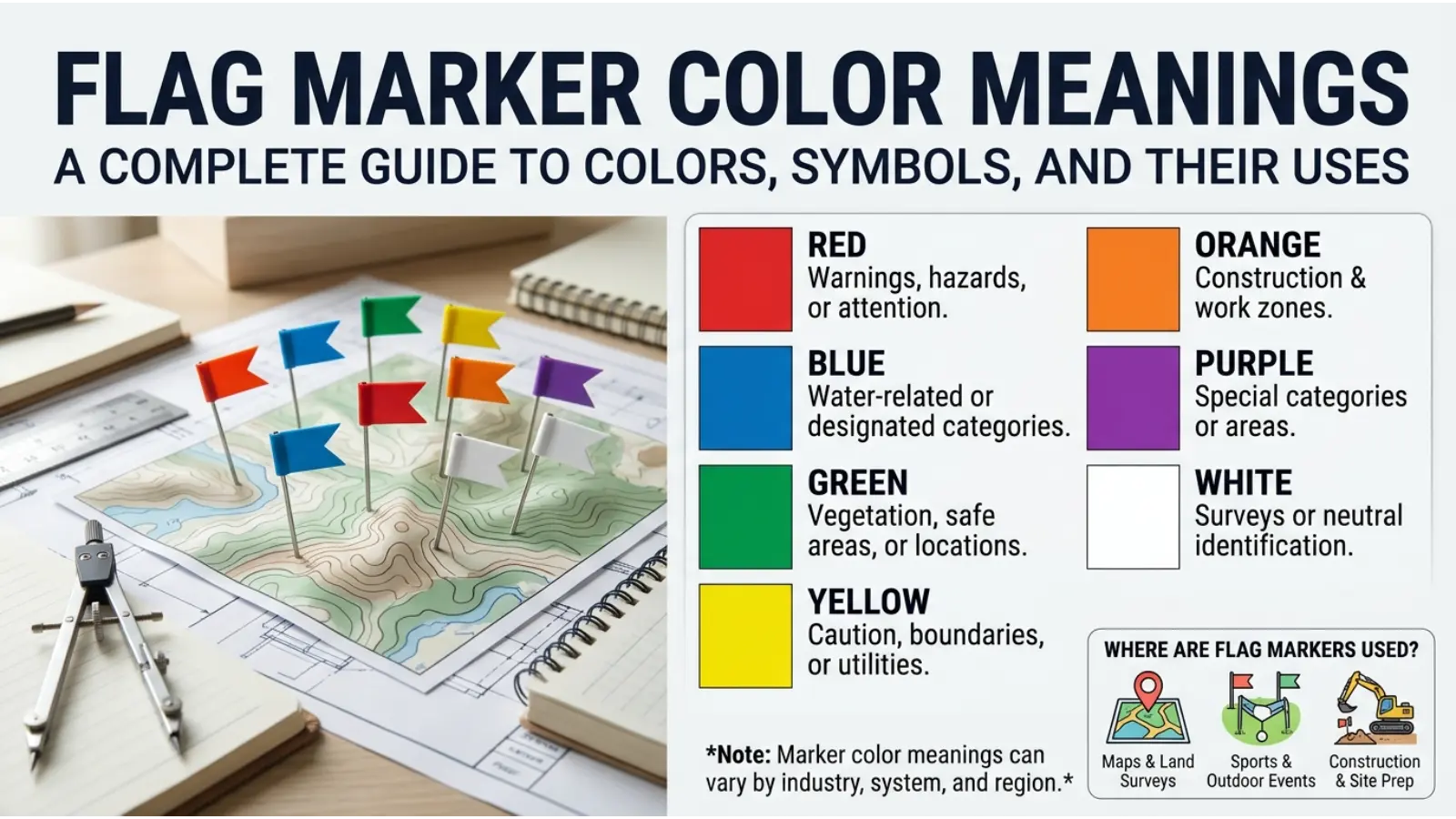
The following chart summarizes common associations between marker colors and their possible meanings. These associations are general guidance rather than a universal code.
| Flag marker color | Common association | Possible application |
|---|---|---|
| 🔴 Red | Warning, danger, attention | Hazard marking or urgent information |
| 🟡 Yellow | Caution, awareness | Areas requiring extra care |
| 🟢 Green | Safety, permission, designation | Approved areas or identified routes |
| 🔵 Blue | Information, identification | Services or designated locations |
| 🟠 Orange | Visibility, attention | Outdoor marking and work zones |
| ⚪ White | Contrast, reference | Survey points or location identification |
| ⚫ Black | Distinction, category | Special classifications or boundaries |
| 🟣 Purple | Special identification | Categories defined by a local system |
| 🩷 Pink | Visibility, distinction | Temporary marking or custom identification |
Remember: The color alone does not prove what a flag means. In some settings, a specific color has a formally defined meaning; in others, the organizer chooses the colors. Always follow the relevant legend, safety instructions, or local marking rules.
Red Flag Marker Color Meanings
Red is one of the most noticeable colors used in warning systems. It often represents danger, urgency, prohibition, or a condition that requires immediate attention.
Because red contrasts strongly with many natural backgrounds, it can help people notice a marker quickly. However, its exact meaning still depends on the system in which it appears.
What Does a Red Marker Usually Represent?
Red markers may identify a hazard, a restricted area, a boundary, or an important point. In recreational settings, a red flag may also communicate a specific status defined by the organizer.
For example, a red flag near a work area may direct attention to a potential risk. In a game, the same color could simply distinguish one team from another.
Psychological Associations of Red
People commonly associate red with urgency, energy, excitement, and strong emotion. These associations can make red useful when a message needs to stand out.
However, red does not automatically make every person feel afraid or alert. Lighting, surrounding colors, familiarity, and personal experience influence how people respond.
Practical tip: Use red when your marking system requires strong visual emphasis, but pair it with a clear label or symbol whenever misunderstanding could create a safety risk.
Yellow Flag Marker Color Meanings
Yellow commonly represents caution, awareness, and the need to pay attention. Its brightness can make it easy to see in many outdoor environments.
Unlike a color used exclusively for prohibition, yellow often suggests that people should examine a situation before proceeding.
Where Are Yellow Markers Used?
Yellow markers may identify areas requiring care, temporary work locations, or categories defined by a particular organization. On a sports field or recreational route, however, yellow may have a different meaning established by the activity’s rules.
The surrounding environment also matters. A yellow marker may be highly visible against dark soil but harder to distinguish against dry grass or bright sunlight.
Yellow in Color Psychology
Yellow is frequently associated with optimism, warmth, energy, and attention. These associations help explain why designers often use it for notices and visual highlights.
Nevertheless, very bright yellow can be uncomfortable to view for long periods, especially when used in large areas or under intense lighting.
Practical tip: Choose yellow when you want a marker to attract attention without necessarily communicating an immediate emergency. Add text or a symbol to clarify the intended message.
Green Flag Marker Color Meanings
Green often represents safety, permission, progress, nature, or an approved condition. In a marker system, it may identify a designated route, a particular zone, or a location selected for a specific purpose.
However, green should not automatically be interpreted as proof that an area is safe. Its meaning must come from the relevant instructions.
Common Uses of Green Markers
Green flags can distinguish locations in landscaping projects, recreational activities, or organizational systems.
For example, a trail organization could assign green to a particular route. That interpretation would be valid within its own system, even if another organization uses green for something else.
Why Green Feels Reassuring
Green is closely associated with plants, forests, growth, and renewal. Consequently, it often creates impressions of balance and natural surroundings.
Still, these are common associations rather than guaranteed psychological effects. A green flag used to mark a restricted location would communicate that restriction through its established context.
Practical tip: Use green for a positive category only when your audience understands the code. Never rely on color alone to communicate permission in a safety-critical situation.
Blue Flag Marker Color Meanings
Blue commonly suggests calmness, reliability, information, and order. In practical marking systems, it can identify a particular service, category, or location.
Nevertheless, blue has no single universal meaning across all marker applications.
Practical Applications of Blue Flags
An organization might use blue markers to distinguish one group of locations from another. Similarly, a digital map may display blue flags for saved places or selected destinations.
In these cases, the color helps organize information rather than communicating a universal warning or instruction.
Blue in Psychology and Design
Blue is often associated with stability, trust, water, and open skies. Businesses may use blue in branding because it can create a visual impression of professionalism.
Its appearance changes with brightness and saturation. A pale blue may feel softer, while a deep navy blue can look more formal.
Practical tip: Blue can work well for information categories, but ensure it remains visible against the background. A dark blue marker may be difficult to distinguish from deep shadows.
Orange Flag Marker Color Meanings
Orange is frequently used when high visibility is important. Its bright appearance helps distinguish markers from many natural and built environments.
For this reason, orange is common in outdoor marking, temporary work areas, and situations where a colored indicator needs to attract attention.
Why Is Orange Used for Marking?
Orange stands out against many green and brown backgrounds. It can therefore be useful in fields, construction areas, landscaping projects, and outdoor activities.
However, orange does not automatically mean danger, and its precise interpretation varies by marking system.
Orange in Color Psychology
Orange is commonly associated with energy, activity, warmth, and enthusiasm. Its combination of red-like intensity and yellow-like brightness makes it visually prominent.
Even so, visibility depends on the environment. Orange may be less noticeable against certain autumn leaves, brightly colored equipment, or similar backgrounds.
White Flag Marker Color Meanings
White can represent neutrality, clarity, simplicity, or a reference point. In practical marking, it may be used to identify locations or create a clear contrast with darker surroundings.
Common Uses of White Markers
White flags may be used in surveying, temporary marking, or custom organizational systems. Their meaning depends on the instructions provided by the people who placed them.
White also has a practical limitation: it may blend into snow, pale sand, concrete, or bright backgrounds.
White in Symbolism
In many contexts, white is associated with peace, cleanliness, simplicity, and new beginnings. However, cultural meanings vary, particularly in ceremonies and mourning traditions.
Practical tip: Use white when it provides sufficient contrast, and consider a darker outline or additional symbol if the background is pale.
Black Flag Marker Color Meanings
Black often creates impressions of seriousness, authority, formality, or distinction. As a marker color, it may identify a category or boundary selected by a particular system.
Its meaning cannot be determined from color alone.
Where Can Black Markers Be Useful?
Black markers can stand out against light-colored surfaces and backgrounds. However, they may become difficult to see in dark soil, shadows, or poorly lit environments.
In sports, military-themed activities, and games, a black flag may carry a specialized meaning established by the rules.
Black in Color Psychology
Black is often associated with power, sophistication, mystery, and seriousness. These associations explain its popularity in formal clothing, luxury branding, and graphic design.
At the same time, black can appear heavy or difficult to distinguish when used without sufficient contrast.
Practical tip: Use black to distinguish a category on light backgrounds, but confirm that the marker remains visible from the distance at which people need to read it.
Purple Flag Marker Color Meanings
Purple is often linked with creativity, individuality, luxury, and special distinction. In flag marker systems, it may be assigned to a particular group, location, or category.
However, purple does not have a generally accepted meaning across all marking systems.
Why Use Purple Markers?
It is especially useful in custom systems that need several clearly different visual labels.
Its visibility depends on the shade. A bright violet may be easy to recognize, while a dark purple may blend into shadows.
Purple in Symbolism
Historically, certain purple dyes were expensive to produce, which helped associate some purple garments with wealth and status in particular societies. Today, purple is also common in creative and entertainment-related designs.
These cultural associations do not establish the meaning of a purple marker in a technical setting.
Practical tip: Use purple as an additional category only after confirming that everyone who needs to read the system understands its meaning.
Pink Flag Marker Color Meanings
Pink is often associated with softness, compassion, playfulness, and individuality. In marker systems, it may distinguish a temporary location, special category, or organizational group.
There is no universal interpretation for a pink marker.
Practical Uses of Pink Markers
Pink can be helpful when an organization needs a color that is visually different from its existing palette.
Pale pink may blend into light surfaces, while brighter shades may be easier to recognize.
Flag Marker Color Meanings in Different Settings
The same color may have several meanings because different activities use colors to solve different problems. The following examples show why context matters.
1. Construction and Ground Marking
Workers and contractors may use colored flags or paint to identify underground utilities, planned work, or other important locations.
In the United States, commonly used underground utility marking conventions assign specific colors to categories such as electric power, gas, communications, water, and sewer systems. These conventions are more precise than general color symbolism.
For example, red is commonly associated with electric power lines, while yellow is commonly associated with gas, oil, steam, petroleum, or gaseous materials.
The exact application depends on the relevant utility-marking standard and local requirements. Therefore, never interpret an unfamiliar construction marker using a general color chart alone.
2. Hiking Trails and Outdoor Activities
Trail organizations may use colored markers to distinguish routes, identify intersections, or guide visitors. However, trail colors are not standardized worldwide.
A green trail marker in one park may indicate a route, while the same color elsewhere could represent a different trail category.
Consequently, hikers should check trail maps, posted signs, and local guidance before following a colored marker.
3. Sports and Recreational Games
Sports officials may use flags to communicate boundaries, decisions, or game conditions. In other activities, colored flags may identify teams, targets, or designated zones.
The rules of the sport determine the meaning. A red flag in one competition may have a different interpretation from a red flag in another.
4. Maps and Navigation
Digital maps often use flag icons to mark saved locations, destinations, planned stops, or points of interest.
Here, color is frequently a design choice rather than a standardized signal. A user might select red for urgent tasks and green for completed tasks, while another person uses the same colors differently.
The map’s legend and settings provide the most reliable explanation.
5. Education and Workplace Organization
Teachers, event organizers, and workplace teams may use colored flags to group tasks or identify stations.
For example, a teacher could use blue flags for reading activities and yellow flags for mathematics stations. These meanings are valid because the teacher defined them.
In this situation, consistency matters more than traditional symbolism.
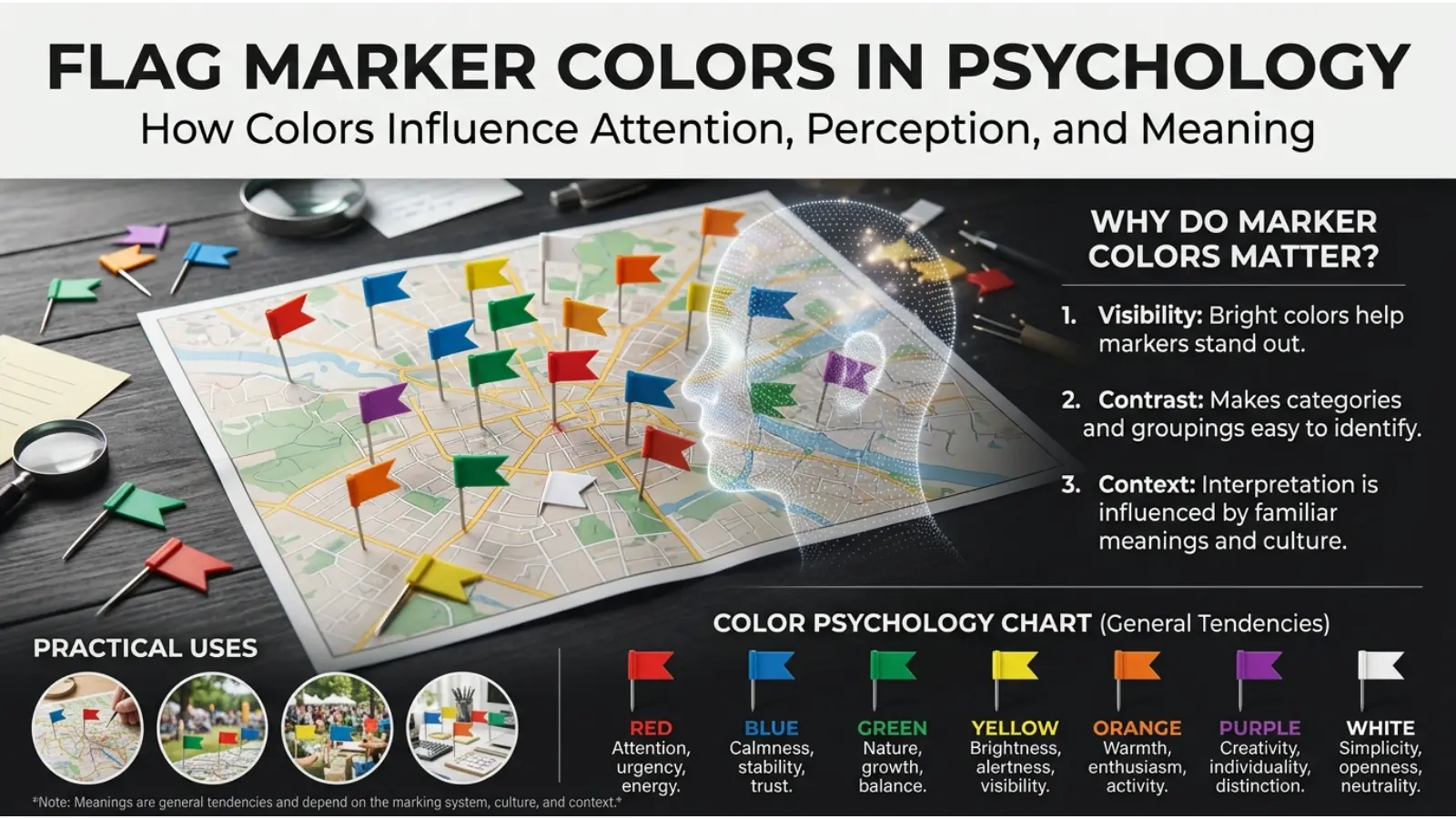
Flag Marker Colors in Psychology
Color psychology explores how colors influence perception, attention, emotion, and judgment. However, the effects are not identical for every person or situation.
Color can influence what people notice first, especially when a marker contrasts strongly with its surroundings. This is one reason designers use bright colors for signs and visual indicators.
How Color Attracts Attention
A marker that contrasts with its background is often easier to notice than one that blends in.
For instance, an orange flag may be highly visible against green grass. By comparison, a white flag may be difficult to spot against snow.
Brightness, size, distance, lighting, and surrounding objects all affect visibility. Therefore, choosing a color requires more than considering its symbolic meaning.
How Emotion Influences Interpretation
People learn color associations through culture, experience, and repeated exposure. Red may remind one person of danger, while another may associate it with celebration or a sports team.
Similarly, green may suggest nature to one person but represent a familiar brand or organization to someone else.
These differences explain why designers should test color systems with their intended audience rather than assuming that everyone interprets colors identically.
Does Color Change Human Behavior?
Color can influence attention and contribute to a person’s impression of a situation. However, it does not control behavior by itself.
A red flag may attract attention, but people also consider its location, shape, wording, and perceived importance. In safety-related situations, clear instructions and recognizable symbols are more dependable than color alone.
Cultural and Symbolic Meanings of Flag Marker Colors
Color symbolism differs across societies, traditions, and historical periods. As a result, a color that communicates one idea in a particular setting may suggest something different elsewhere.
Red Across Cultures
Red is associated with celebration, love, energy, and good fortune in some cultural settings. It can also represent danger, conflict, or warning.
White Across Cultures
White may symbolize peace, cleanliness, simplicity, or purity in some settings. In other traditions, it has important associations with mourning and funerary practices.
Therefore, the meaning of white depends on cultural context and the purpose of the symbol.
Green Across Cultures
Green often evokes nature, vegetation, growth, and renewal. In some societies, it also carries religious, national, or political associations.
Blue Across Cultures
Blue is frequently associated with water, the sky, calmness, or reliability. Nevertheless, its symbolic meaning changes with local traditions and personal experiences.
Key lesson: Cultural symbolism helps explain how people may perceive a color, but the official rules of a marker system determine its practical meaning.
Historical Development of Color Markers
People have used visible colors and symbols to communicate information for centuries. Flags have served as signals in warfare, navigation, ceremonies, and public events.
Over time, modern organizations developed more specialized systems for identifying locations, boundaries, hazards, and routes.
Digital applications have extended the same principle to virtual maps and task-management tools.
Although the basic idea remains simple, modern marking systems often rely on defined standards rather than traditional color symbolism.
It is also important to distinguish the history of national flags from the history of technical markers. A national flag may carry centuries of political and cultural meaning, while a temporary marker may simply follow a current organizational code.
How to Choose the Right Flag Marker Color
Choosing a useful marker color requires considering visibility, meaning, and the needs of the people who will see it.
Start With the Purpose
First, decide what the flag needs to communicate.
Once the purpose is clear, select a color that fits the established system.
Consider the Background
Orange may work well in a green field, while a dark marker may stand out against a pale wall. However, no color is equally visible in every environment.
Test the marker at the expected viewing distance and under realistic lighting.
Use Clear Labels and Symbols
Color should support communication, not carry the entire message.
For example, a warning marker can include a recognizable symbol or a short written instruction. This helps people who are unfamiliar with the color code and those who have difficulty distinguishing certain colors.
Maintain Consistency
Once a system assigns a meaning to a color, keep that meaning consistent throughout the project.
If green identifies one type of location in one area but a different type nearby, people may become confused. A simple legend can reduce this risk.
Plan for Accessibility
Some people have color vision deficiencies that make certain color combinations difficult to distinguish.
Therefore, avoid relying only on red and green to communicate opposing conditions. Add labels, shapes, symbols, or patterns to make the information easier to recognize.
Common Misconceptions About Flag Marker Color Meanings
Several misunderstandings can lead people to interpret markers incorrectly.
Misconception 1: Every red flag means danger.
Red often signals danger or urgency, but it can also identify a team, location, or category. The context determines the meaning.
Misconception 2: Green always means safe.
Always follow the applicable instructions.
Misconception 3: Every organization uses the same colors.
Different industries, countries, and organizations may use different color codes. Some follow formal standards, while others create their own systems.
Misconception 4: Color psychology explains every marker.
Psychological associations can help explain why a color attracts attention or creates a particular impression. However, they do not replace technical definitions or local rules.
Misconception 5: A color’s meaning never changes.
Meaning can change with culture, setting, and purpose. A color used for celebration in one situation may serve as a warning in another.
Misconception 6: Color alone is enough to communicate important information.
Color can be difficult to see under poor lighting or against similar backgrounds. Text, symbols, placement, and consistent instructions improve understanding.
Real-World Applications of Flag Marker Colors
Flag marker colors are useful in many everyday situations because they make visual organization easier.
In Business and Project Management
Teams can use colored markers to identify task locations, work stages, or project categories. For example, red might identify unresolved issues and green might identify completed work.
However, these meanings should be agreed upon before the system is introduced.
In Art and Photography
Artists and photographers use colored flags and visual indicators to organize equipment, mark positions, or identify areas during a shoot.
Color also affects the visual balance of an image. A bright orange marker against a cool blue background can create a strong contrast, drawing attention toward the marked area.
In Home Decoration
Colored flags can identify storage zones, garden sections, or temporary project locations. Gardeners may use markers to distinguish plant varieties, while homeowners may use different colors to organize renovation tasks.
For a practical system, choose colors that remain visible among plants, furniture, tools, and other objects.
In Sports and Entertainment
Colored flags help distinguish teams, designate locations, and support event organization. In entertainment, flag colors may also represent fictional groups, characters, or symbolic affiliations.
These cases, the organizer or fictional world defines the meaning rather than a universal color code.
In Education
Teachers can assign colors to classroom stations, learning groups, or activities. This makes it easier for students to recognize where they should go next.
For younger students, pairing each color with a symbol or word helps reinforce the intended meaning.
Frequently Asked Questions About Flag Marker Color Meanings
1. What do flag marker colors mean?
Flag marker colors help identify locations, communicate warnings, organize activities, or distinguish categories. Their meanings depend on the system in which they are used.
2. What does a red flag marker mean?
Red commonly represents danger, warning, urgency, or attention. However, it can also identify a boundary, team, or specific location under a local marking system.
3. What does a yellow flag marker mean?
Yellow often indicates caution or a need for awareness. In some settings, it identifies a specific route, location, or category defined by the organization.
4. What does a green flag marker mean?
Green is commonly associated with safety, permission, nature, and progress. Nevertheless, a green marker does not automatically mean that an area is safe or accessible.
5. What does an orange flag marker mean?
Orange is often used for high visibility, particularly in outdoor and work environments. Its precise meaning depends on the marking rules and the purpose of the flag.
6. What does a blue flag marker mean?
Blue may identify information, services, locations, or organizational categories. There is no universal meaning for blue across all flag marker systems.
7. Do flag marker colors have universal meanings?
No. Some industries use standardized color codes, but other systems use locally defined meanings. Always consult the relevant instructions or legend.
8. Why are bright colors used for flag markers?
Bright colors can stand out against their surroundings, making markers easier to notice. However, visibility depends on lighting, distance, background, and color contrast.
9. How do I identify an unfamiliar flag marker?
Check its location, nearby signs, labels, and the instructions provided by the responsible organization. If it may mark an underground utility, hazard, or restricted area, do not disturb it until its meaning has been confirmed.
10. Can flag marker colors affect how people respond?
Yes, color can influence attention and shape initial impressions. However, responses vary between people, and color should be combined with clear instructions and recognizable symbols when accurate communication matters.
Conclusion: Understanding Flag Marker Colors
Flag marker colors provide a simple way to organize information, identify locations, and attract attention. Red often signals warning, yellow suggests caution, green may indicate a designated area, blue can identify information, and orange is frequently chosen for visibility. Meanwhile, white, black, purple, and pink can serve as useful reference or identification colors.
However, these associations are only starting points. A flag’s true meaning depends on the system, location, and purpose for which it was placed.
The most reliable way to interpret a marker is to consider its surroundings, consult the relevant legend, and follow established instructions. By combining color with clear labels, recognizable symbols, and consistent rules, people can communicate information more effectively and reduce misunderstandings.

Emma Wilson is a dedicated comparison writer and product researcher at ColorMystiic.com. She specializes in creating unbiased product comparisons, detailed reviews, and helpful buying guides. Her goal is to help readers make smarter purchasing decisions with confidence.