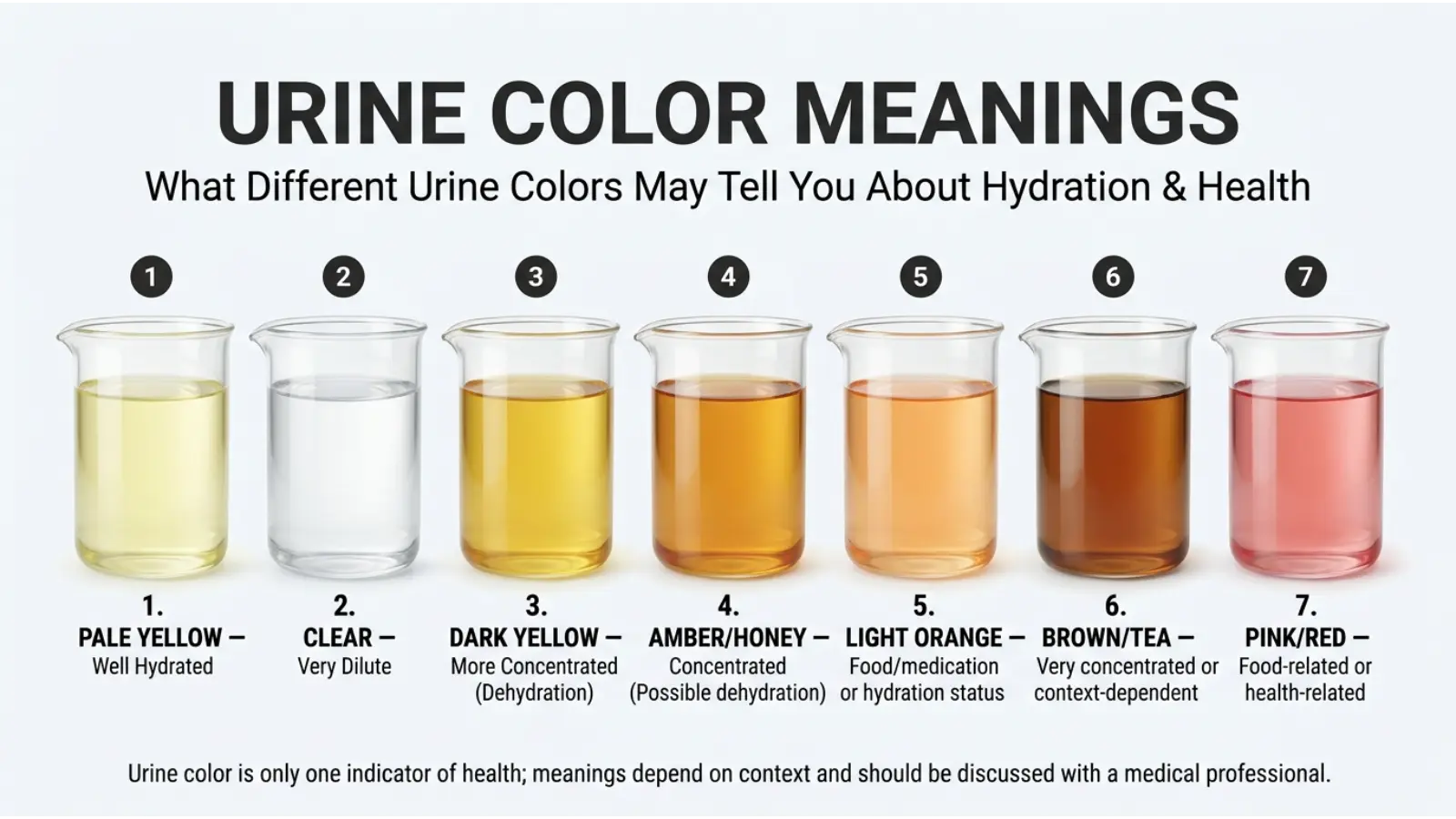
Urine Color Meanings can range from almost clear to pale yellow, amber, orange, pink, red, brown, green, blue, or cloudy white. Most changes are harmless and may happen because of hydration, food, vitamins, or medicines. However, some colors can point to blood, infection, liver problems, kidney problems, or other conditions.
That is why people search for urine color meanings when they notice a sudden change in the toilet bowl. Color can provide a useful clue, but it cannot diagnose a medical condition by itself. A urine test is much more reliable because it can detect substances such as blood, protein, glucose, ketones, bilirubin, and signs of infection.
The most useful way to read urine color is to consider the shade, how long it lasts, your fluid intake, recent foods or supplements, medicines, and any other symptoms.
Quick Answer: What Do Urine Colors Mean?
Pale yellow to light straw urine is generally considered a normal color, while darker yellow or amber urine often means the urine is more concentrated. Clear urine can occur after drinking a lot of fluid. Pink or red urine may come from foods or medicines, but it can also indicate blood.
Orange or dark brown urine can sometimes be linked with dehydration or liver and bile-duct problems. Blue or green urine is uncommon and may result from dyes, medicines, or, rarely, certain medical conditions. Cloudy or milky urine can occur with urinary infections or kidney stones.
🌈 Urine Color Meanings Chart
| Color | What It May Mean | Common Causes | When to Pay Attention |
|---|---|---|---|
| 🟨 Pale yellow | Usually normal | Good hydration | Usually no concern |
| 🟡 Dark yellow | More concentrated urine | Not drinking enough fluids | Improve hydration and monitor |
| 🟠 Orange | Concentrated urine or pigment change | Dehydration, vitamins, medicines | Persistent orange urine deserves medical advice |
| 🩷 Pink | Food pigment or possible blood | Beets, rhubarb, medicines, bleeding | Get checked if unexplained |
| 🔴 Red | Food, medicine, or blood | Beets, medicines, urinary bleeding | Blood-like urine should be evaluated |
| 🟤 Brown | Very concentrated or pigment-related | Dehydration, medicines, liver problems, muscle injury | Seek medical advice if unexplained |
| 🟢 Green | Unusual color change | Dyes, medicines, some infections | Check with a clinician if persistent |
| 🔵 Blue | Rare color change | Dyes, medicines, rare conditions | Medical evaluation if unexplained |
| ⚪ Cloudy/milky | Altered urine appearance | Infection, crystals, kidney stones | Especially important with pain or fever |
| 💧 Very clear | Highly diluted urine | High fluid intake | Persistent excessive clarity may need evaluation |
This chart is a guide, not a diagnostic test. Urine can look different under different bathroom lighting, and two people may describe the same shade differently.
🟨 Pale Yellow Urine: Usually a Normal Sign
Pale yellow or light straw-colored urine is commonly associated with normal hydration. The yellow appearance comes from pigments in urine, while the amount of water affects how concentrated those pigments appear.
When you drink more fluids, urine becomes more diluted and lighter. When you drink less, the same pigments become more concentrated and the urine becomes darker.
So, pale yellow urine generally does not need to have a deeper symbolic or spiritual meaning. From a medical perspective, it is mainly useful as an everyday visual clue about hydration.
🟡 Dark Yellow or Amber Urine
Dark yellow or amber urine often means the urine is more concentrated.
This commonly happens after sweating, exercising, spending time in hot weather, or simply not drinking enough fluids. Morning urine may also appear darker because you have gone several hours without drinking.
If darker urine becomes lighter after normal fluid intake, dehydration may have been the simple explanation.
However, color alone cannot confirm dehydration. Your overall symptoms, fluid intake, medications, and health history matter too.
When Dark Yellow Urine Needs More Attention
If urine remains unusually dark despite normal hydration, consider other possible causes. Vitamins, medications, food pigments, and certain health problems can affect urine color.
🟠 Orange Urine
Orange urine can have several explanations.
Dehydration can make urine highly concentrated and give it an orange or deep yellow appearance. Certain vitamins can also change urine color. In addition, medicines such as phenazopyridine and rifampin can produce orange or reddish-orange urine.
There is another reason orange urine deserves attention: liver or bile-duct problems can sometimes cause orange or dark urine, especially when it occurs with yellow skin or eyes or unusually pale stools.
What to Do
Think about what changed recently:
- Have you been drinking less?
- Did you start a new medicine?
- Did you take vitamins or supplements?
- Did you eat strongly colored foods?
- Do you have yellowing of the skin or eyes?
- Has the color continued?
If there is no obvious explanation or the color persists, medical advice is appropriate.
🩷 Pink Urine
Pink urine can be caused by something as simple as food pigment, but it can also indicate blood.
Beets, blackberries, rhubarb, and some food colorings can make urine appear pink or reddish. Certain medicines can do the same.
On the other hand, blood in urine can occur with urinary tract infections, kidney stones, prostate problems, kidney conditions, and other urinary-tract disorders.
Because it can be difficult to tell food pigment from blood just by looking, unexplained pink urine should not be automatically dismissed.
🔴 Red Urine
Red urine is one of the colors that deserves particular attention.
Possible harmless causes
Food and medicines can sometimes create a red appearance. Beets and rhubarb are well-known examples, while medicines such as phenazopyridine and rifampin can change urine toward red or reddish-orange.
Possible blood in the urine
Blood can make urine look pink, red, or brown. Possible causes include urinary infections, kidney stones, kidney or bladder conditions, prostate problems, and some cancers. Hard exercise can also sometimes cause blood in urine.
The important point is simple: you cannot reliably determine from appearance alone whether red urine contains blood.
For that reason, medical sources recommend getting unexplained blood-like urine evaluated, even when there is no pain.
🟤 Brown or Cola-Colored Urine
Brown urine has a wider range of possible explanations.
Severe dehydration can make urine very dark. Certain foods and medicines can also produce brown urine. However, dark brown urine may sometimes occur with liver or kidney disorders.
Very intense exercise can cause muscle injury, and the resulting breakdown of muscle tissue can produce tea- or cola-colored urine. This situation can be serious because it may affect the kidneys.
Brown Urine and Liver Problems
Dark urine can occur when excess bilirubin enters the urine. A liver or bile-duct problem becomes more concerning when dark urine appears alongside yellow skin or eyes or pale stools.
🟢 Green Urine
Green urine is unusual, but it has several recognized causes.
Food dyes can temporarily create green urine. Some medicines can also produce green or greenish-blue urine. Certain urinary tract infections can cause green urine as well.
Green urine after a medication or strongly colored food may have a straightforward explanation. However, if the color continues without an obvious cause, a healthcare professional can help determine whether testing is needed.
🔵 Blue Urine
Blue urine is rare.
Certain dyes used in medical testing and some medicines can turn urine blue or blue-green. Rare medical conditions can also produce unusual blue urine.
Because blue urine is not a typical everyday color, unexplained blue urine should be discussed with a healthcare professional, particularly when other symptoms are present.
⚪ Cloudy, Milky, or Murky Urine
Urine does not have to change color to signal a problem. Its clarity can change too.
Cloudy or milky urine can occur because of bacteria, crystals, mucus, white blood cells, red blood cells, or other substances. Urinary tract infections and kidney stones are among the possible causes.
However, cloudy urine by itself does not prove that you have a urinary tract infection. Symptoms such as burning during urination, frequent urination, pain, fever, or an unusual smell can provide additional clues.
💧 Very Clear Urine
Completely clear urine often means it is highly diluted.
This can happen after drinking a large amount of fluid. Occasional clear urine is usually not a reason for concern. However, persistently clear urine without a high fluid intake can sometimes warrant medical evaluation, particularly when accompanied by excessive thirst or frequent urination.
The goal is not to make urine completely colorless. A pale-yellow appearance is commonly a more useful general target than constantly trying to produce clear urine.
Why Does Urine Change Color?
Urine is mostly water, but it also contains dissolved waste products, pigments, salts, and other substances filtered by the kidneys.
Several factors can change its appearance:
1. Hydration
More water generally makes urine lighter. Less fluid makes urine more concentrated and darker.
2. Food
Foods such as beets, blackberries, rhubarb, and fava beans can alter urine color. Strong food dyes can also create surprising colors.
3. Vitamins
Some vitamins, particularly B vitamins, can make urine look much brighter yellow or sometimes greenish.
4. Medicines
A surprisingly long list of medicines can affect urine color. Examples include phenazopyridine, rifampin, certain antibiotics, some antidepressants, and other medicines.
5. Medical conditions
Infections, bleeding, liver disorders, kidney problems, and muscle injury can all affect urine appearance.
Does Urine Color Tell You How Healthy You Are?
Only partly.
Urine color can provide a quick visual clue, especially about concentration and possible exposure to foods, dyes, or medicines. However, it cannot provide a complete picture of kidney, liver, bladder, or metabolic health.
A urine test is much more informative because laboratory testing can measure substances that cannot be reliably identified by looking at color. A urinalysis may assess blood, glucose, protein, ketones, bilirubin, pH, concentration, and other markers.
Think of urine color as a signal, not a diagnosis.
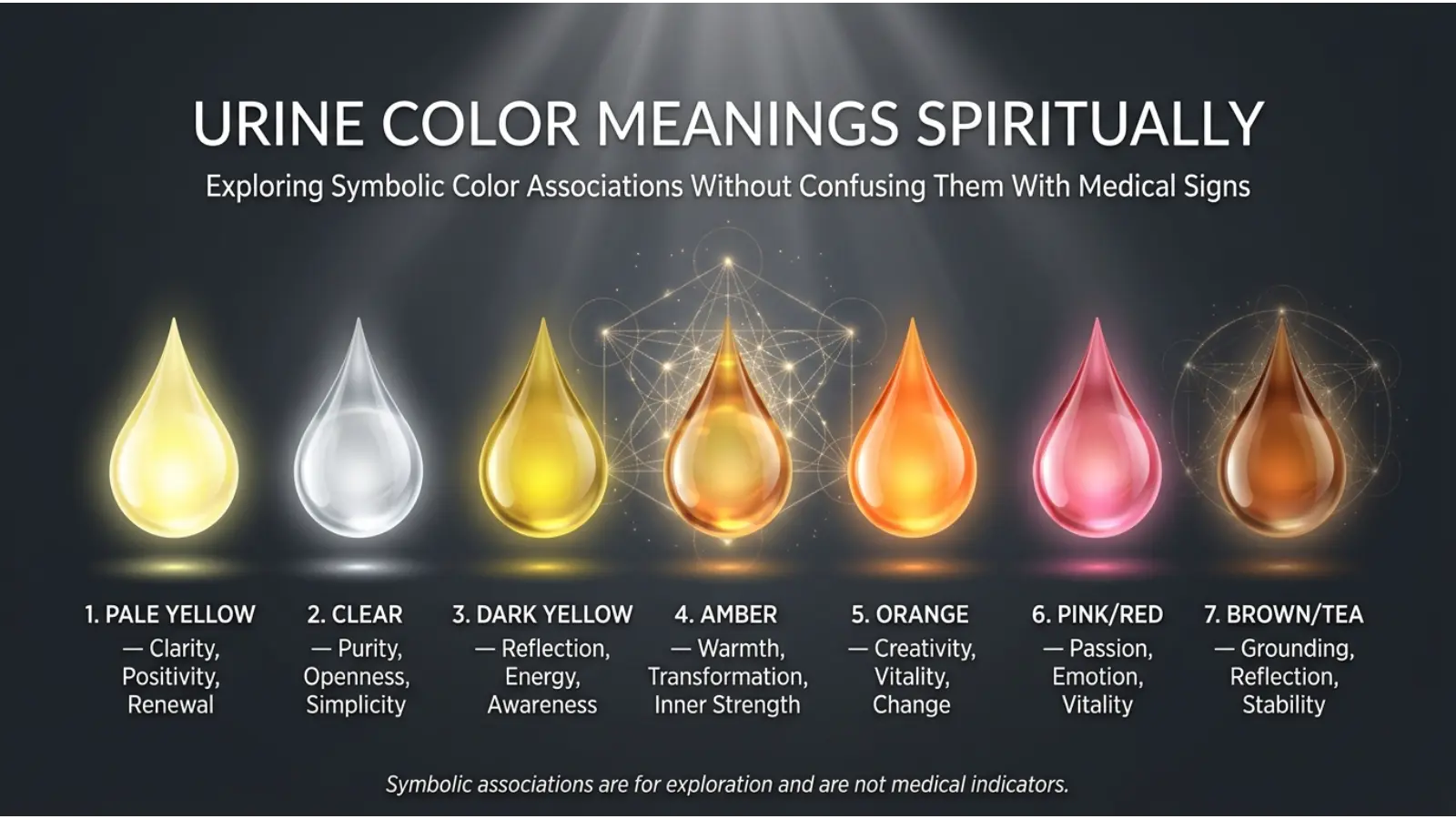
What Does Urine Color Meanings Spiritually?
Unlike traditional color symbolism, urine color does not have an established universal spiritual meaning.
Some people may personally interpret colors such as yellow, red, green, or blue through broader spiritual color symbolism. For example, yellow may be associated with energy or clarity in some modern spiritual systems, while green may be connected with growth or renewal.
Those are symbolic interpretations, not medical facts.
A change in urine color should first be understood through hydration, food, medicines, and health factors. There is no reliable scientific basis for claiming that a particular urine color universally represents spiritual energy, emotional healing, chakras, protection, or transformation.
Does Urine Color Meanings Have a Psychological Meaning?
Not in the same way that colors in clothing, advertising, interiors, or art can influence visual perception.
Urine color is primarily a biological observation. The psychological reaction comes from what the color may make you think about. For example, someone who sees red urine may immediately worry about blood because red is visually associated with injury and danger.
That reaction is understandable, but it does not mean that red urine itself has a psychological message.
This distinction matters: color psychology explains human responses to visual colors; urine color primarily reflects physical substances and concentration.
Urine Color Meanings and Personality
Urine color does not reveal personality.
Popular color symbolism sometimes links yellow with optimism, red with confidence, green with balance, or blue with calmness. Those associations can be useful in art, branding, and cultural discussions, but they should not be used to diagnose someone’s character.
Likewise, having unusually colored urine does not mean that someone is energetic, stressed, spiritually awakened, emotionally blocked, or any other personality type.
Medical explanations should come first.
When Should You Worry About Urine Color?
A temporary change caused by food or medication is often different from an unexplained change that continues.
Consider contacting a healthcare professional if:
- 🔴 Your urine appears to contain blood.
- 🟤 Your urine becomes dark brown or cola-colored without an obvious reason.
- 🟠 Orange urine persists, especially with yellow skin or eyes.
- 🟢 Green or 🔵 blue urine continues without an obvious food, dye, or medication explanation.
- ⚪ Cloudy urine persists or occurs with urinary symptoms.
- You have pain when urinating.
- You develop fever or significant abdominal, side, or back pain.
- The color change does not go away.
MedlinePlus advises contacting a healthcare professional for unexplained abnormal urine color, blood in urine, clear dark-brown urine, or unexplained pink, red, or smoky-brown urine.
🚨 Red Flags: When Urine Color Should Not Be Ignored
| 🚦 Urine Finding | Why It Matters |
|---|---|
| 🔴 Red or bloody-looking urine | May represent blood and needs evaluation |
| 🟤 Cola-colored urine | Can occur with severe dehydration, liver problems, or muscle injury |
| 🟠 Orange + yellow skin/eyes | May suggest a liver or bile-duct problem |
| ⚪ Cloudy + fever/pain | May occur with infection or another urinary problem |
| 🟢 Green + urinary symptoms | Some infections can produce green urine |
| 🔵 Unexplained blue urine | Rare and worth medical assessment |
These signs do not automatically mean you have a serious disease. They mean that color alone is not enough to safely explain the change.
How Lighting Can Change the Way Urine Looks
Bathroom lighting can make a subtle color difference look much stronger.
Warm yellow lighting may make pale urine look more golden. Cool white or blue-toned lighting can make the same urine appear lighter or slightly greenish.
The toilet bowl, cleaning products, water color, and surrounding surfaces can also affect visual perception.
For that reason, do not judge a tiny shade difference too precisely. Look for a clear change that persists under ordinary lighting.
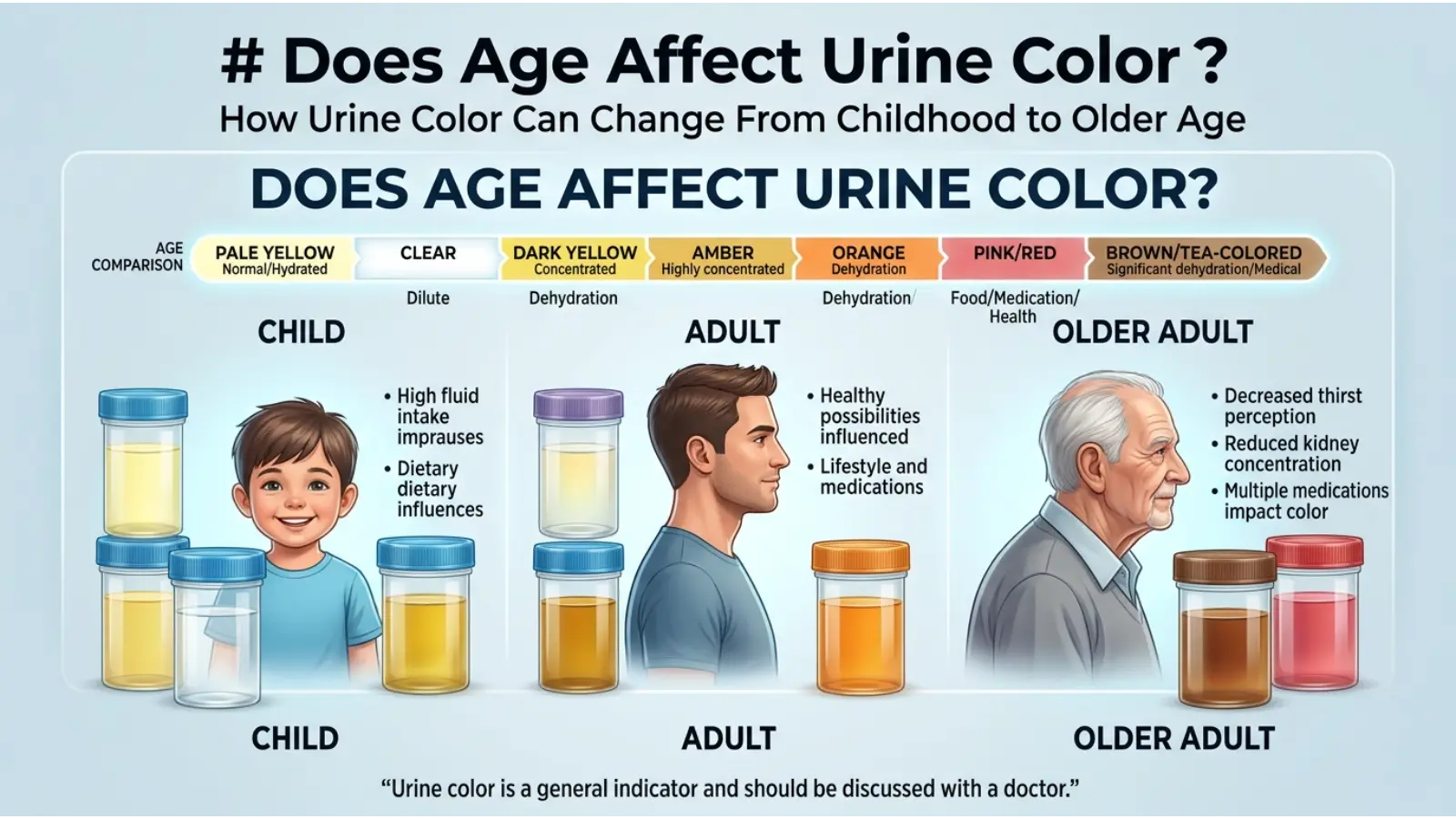
Does Age Affect Urine Color Meanings?
Age itself does not create a single “normal” urine color.
However, health conditions, medicines, hydration habits, diet, and kidney or urinary problems can vary with age. Older adults may also take more medicines, increasing the number of possible medication-related color changes.
A new persistent change should therefore be considered in the context of the person’s health and medications rather than age alone.
Urine Color Meanings in Daily Life
Urine color can be useful as a simple observation during everyday routines.
For example, after exercise or spending time outdoors in hot weather, darker urine may remind you to consider whether you have replaced lost fluids. After starting a new medicine, a surprising color change may be a known side effect.
Keeping track of when the change started can also be useful. A healthcare professional may ask about recent foods, medicines, supplements, exercise, fluid intake, and other symptoms.
What Should You Do If Your Urine Changes Color?
Use a simple three-step approach:
Step 1: Look at the shade
Ask whether it is pale yellow, dark yellow, orange, pink, red, brown, green, blue, or cloudy.
Step 2: Think about recent changes
Consider:
- Water and other fluids
- Exercise
- Foods
- Food coloring
- Vitamins
- Supplements
- Prescription medicines
- Over-the-counter medicines
Step 3: Check for symptoms
Pay attention to pain, burning, fever, frequent urination, unusual thirst, yellow skin or eyes, or other new symptoms.
If you cannot explain the change or it persists, speak with a healthcare professional.
Common Misconceptions About Urine Color
Myth 1: Clear urine is always healthier
Not necessarily. Very clear urine can simply mean that the urine is highly diluted. Constantly trying to make urine completely clear is not a useful health goal.
Myth 2: Dark urine always means dehydration
Dehydration is common, but food, vitamins, medicines, and medical conditions can also darken urine.
Myth 3: Red urine always means blood
Not always. Beets, rhubarb, food dyes, and certain medicines can make urine appear red or pink. However, because blood can look the same, unexplained red urine should be evaluated.
Myth 4: Green urine means something supernatural
There is no medical evidence for that idea. Green urine has recognized physical explanations, including dyes, medicines, and certain infections.
Myth 5: Urine color can diagnose a disease
Color alone cannot make a diagnosis. Healthcare professionals may use urinalysis, blood tests, cultures, imaging, or other tests depending on the situation.
Frequently Asked Questions About Urine Color Meanings
What is the healthiest urine color?
Pale yellow or light straw-colored urine is generally considered a normal appearance. Urine becomes lighter when more diluted and darker when more concentrated.
What does dark yellow urine mean?
Dark yellow urine often means it is more concentrated, commonly because of lower fluid intake. However, vitamins, medicines, and other factors can also influence color.
What does orange urine mean?
Orange urine may result from dehydration, vitamins, food pigments, or medicines. It can also occur with liver or bile-duct problems, particularly when accompanied by yellow skin or eyes or pale stools.
What does red urine mean?
Red urine may be caused by foods or medicines, but it can also represent blood. Because appearance alone cannot reliably distinguish the causes, unexplained red urine should be checked by a healthcare professional.
What does brown urine mean?
Brown urine can occur with dehydration, certain foods and medicines, liver or kidney problems, and sometimes severe muscle injury after extreme exercise. Persistent dark brown urine deserves medical attention.
Why is my urine green?
Food dyes, medicines, and some urinary tract infections can cause green urine. If the color persists and you cannot identify an obvious cause, seek medical advice.
Why is my urine cloudy?
Cloudy urine can occur with dehydration, urinary tract infections, kidney stones, crystals, mucus, or blood cells. Cloudiness alone does not prove that an infection is present.
Can vitamins change urine color?
Yes. Some vitamins, especially B vitamins, can make urine noticeably brighter yellow and may sometimes contribute to a greenish appearance.
Can food change urine color?
Yes. Beets, blackberries, rhubarb, fava beans, and strongly colored foods or dyes can change urine color.
When should I see a doctor about urine color?
Seek medical advice for unexplained or persistent abnormal urine color, especially red or bloody-looking urine, dark brown urine, or orange urine accompanied by yellow skin or eyes. Other symptoms such as pain or fever make medical evaluation more important.
Final Thoughts on Urine Color Meanings
Urine color can provide a useful snapshot, but it is not a complete health report.
Pale yellow is generally ordinary. Darker yellow often reflects concentrated urine. Foods, vitamins, dyes, and medicines can create surprising colors, while red, brown, orange, green, blue, or cloudy urine may sometimes require closer attention.
The most helpful approach is to look at the color together with context. Think about hydration, recent foods, medicines, supplements, exercise, and other symptoms. If the change is unexplained or persistent, a healthcare professional can determine whether a urine test or another examination is appropriate.
Most importantly, urine color should be treated as a clue rather than a diagnosis. Paying attention to changes can be useful, but proper medical testing provides the clearer answer when something does not look right.

Emma Wilson is a dedicated comparison writer and product researcher at ColorMystiic.com. She specializes in creating unbiased product comparisons, detailed reviews, and helpful buying guides. Her goal is to help readers make smarter purchasing decisions with confidence.