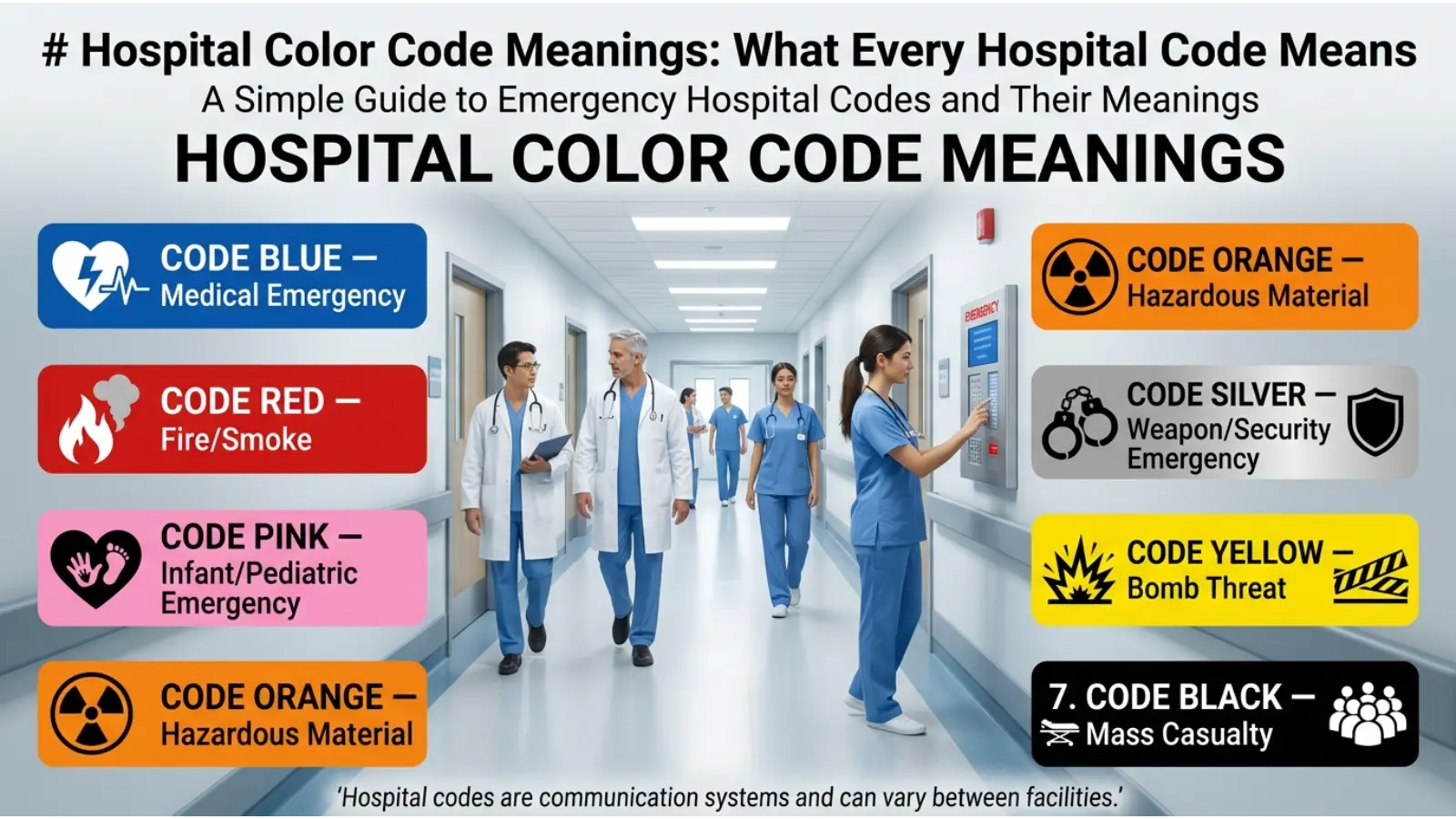
Hospital Color Code Meanings are short emergency signals used to communicate serious situations quickly inside medical facilities. You may hear a hospital announce Code Blue, Code Red, Code Pink, or another color and wonder what it means. The answer, however, is not always the same everywhere.
Hospital color codes are primarily operational emergency signals, not ordinary color symbolism. Their meanings are created by individual hospitals, health systems, or local standards to help staff recognize an event and respond quickly. For example, Code Blue commonly refers to a medical emergency involving cardiac or respiratory arrest, while Code Red commonly refers to fire. Yet other colors can have different meanings from one facility to another. Johns Hopkins, for example, lists Code Yellow for disaster activation and Code Silver for a person with a weapon, while another hospital may assign colors differently.
That difference is the key to understanding hospital color code meanings. The color itself does not have a universal medical meaning. Instead, the hospital’s emergency plan gives the color its specific meaning.
In this guide, you will learn the most commonly encountered hospital emergency codes, what the colors generally communicate, why hospitals use them, how meanings vary, and why some organizations are moving toward plain-language emergency announcements. The Joint Commission currently provides examples of emergency codes but also recommends plain-language alternatives for several events.
Quick Answer: What Do Hospital Color Codes Mean?
Hospital color codes are emergency communication signals used to alert trained staff to a specific situation.
| Color Code | Common Meaning | Important Note |
|---|---|---|
| 🔵 Code Blue | Medical emergency, often cardiac or respiratory arrest | One of the most widely recognized codes |
| 🔴 Code Red | Fire | Common across many hospitals |
| 🟠 Code Orange | Hazardous material, chemical spill, or decontamination | Exact meaning varies |
| 🟢 Code Green | Emergency operations, security, or other emergency | Meaning varies significantly |
| 🩷 Code Pink | Infant or child abduction | Common in many U.S. facilities |
| 🩶 Code Gray | Security assistance or combative person | Local definitions vary |
| ⚫ Code Black | Bomb threat | Not universal |
| 🟡 Code Yellow | Disaster or emergency activation | Some hospitals use it for other situations |
| 🟣 Code Purple | Security emergency or shelter-related response | Meaning varies |
| ⚪ Code White | Severe weather or other emergency | Not universal |
| 🩶 Code Silver | Weapon, armed person, or security threat | Some facilities use it for active threats |
The safest rule: never assume that a hospital color code means the same thing everywhere. Staff should follow the code definitions and emergency procedures established by their own facility. The Joint Commission’s current emergency-code guidance specifically illustrates both color-code and plain-language approaches.
Why Do Hospitals Use Color Codes?
Hospitals are busy environments where seconds can matter. An emergency announcement needs to communicate enough information for trained staff to begin the correct response without creating unnecessary confusion.
A short phrase such as “Code Blue, third floor” can immediately alert a trained response team to a medical emergency and provide its location.
Color codes can also reduce the need to describe a sensitive event in detail over a public announcement. However, this advantage has to be balanced against the possibility that patients, visitors, new employees, or staff from another facility may not understand the code.
That is one reason emergency communication practices continue to evolve. The Joint Commission’s emergency-management material includes plain-language alternatives such as announcing a medical alert, fire, security alert, or active shooter rather than relying exclusively on color terminology.
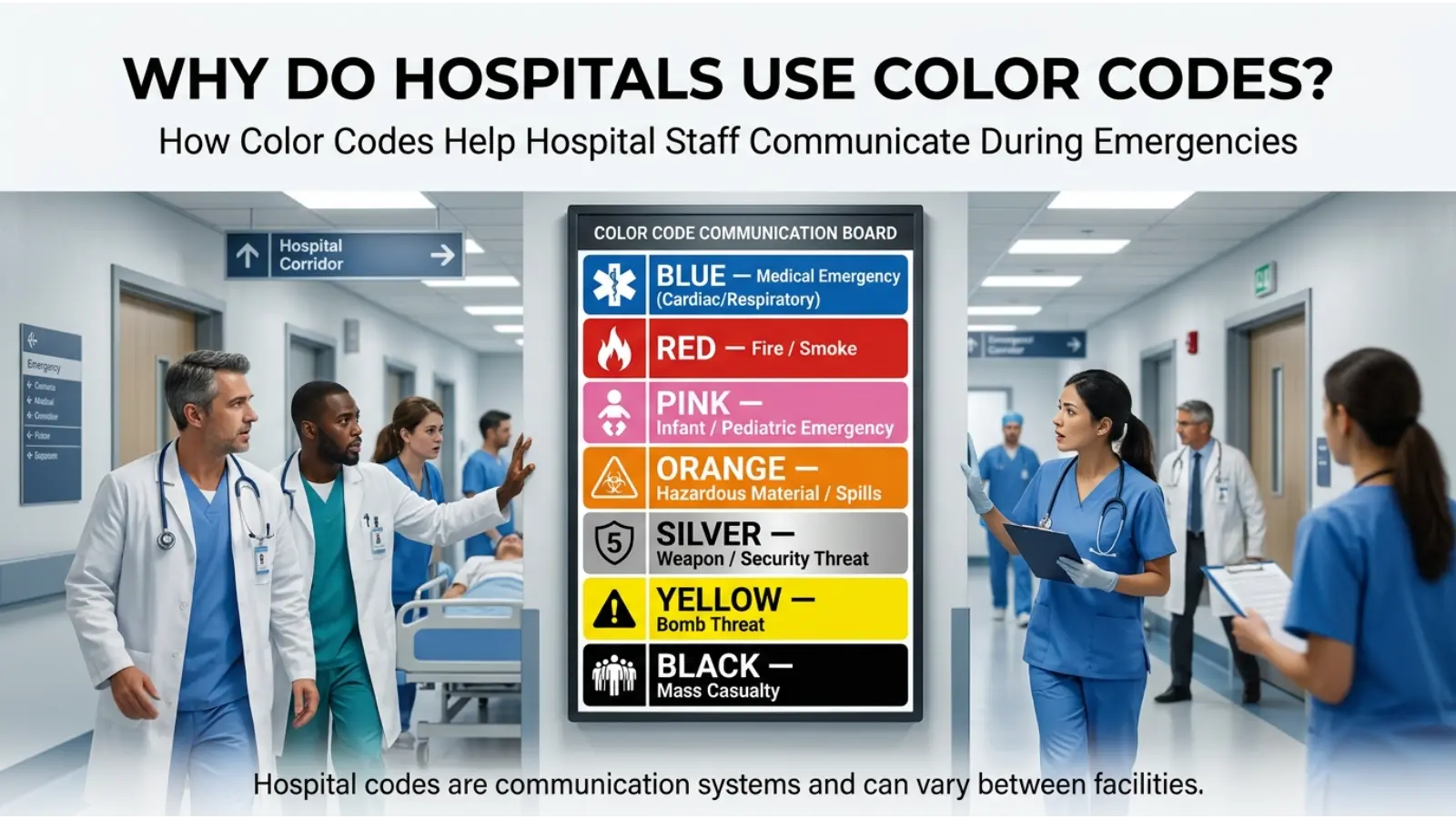
Hospital Color Code Meanings Chart
The following chart gives a general reference, not a universal hospital dictionary.
| 🌈 Color | Typical Emergency Meaning | What It Usually Signals |
|---|---|---|
| 🔵 Blue | Medical emergency | Cardiac or respiratory arrest and urgent medical response |
| 🔴 Red | Fire | Fire or smoke emergency |
| 🟠 Orange | Hazardous materials | Chemical spill, contamination, or decontamination |
| 🟢 Green | Emergency/disaster or security | Depends heavily on facility policy |
| 🩷 Pink | Child/infant abduction | Security response involving a missing child |
| 🩶 Gray | Security assistance | Combative person or need for security personnel |
| ⚫ Black | Bomb threat | Suspected explosive threat |
| 🟡 Yellow | Disaster/emergency | Disaster plan or emergency operations activation |
| 🟣 Purple | Security-related emergency | Facility-specific security response |
| ⚪ White | Severe weather or emergency | Often weather-related, but not universal |
| 🩶 Silver | Weapon/security threat | Armed person or weapon-related emergency |
These examples are supported by real hospital emergency-code systems, but they should not be treated as a universal standard. For example, Johns Hopkins documents Code Blue for cardiac/respiratory arrest, Code Red for fire, Code Pink for pediatric abduction, Code Orange for hazardous-material incidents, and Code Silver for an active shooter in one of its emergency-code systems.
🔵 Code Blue Meaning
Code Blue commonly means a medical emergency requiring immediate intervention, especially cardiac or respiratory arrest.
This is one of the most recognizable hospital codes. A Code Blue can activate a specialized response team equipped to provide emergency resuscitation and advanced medical treatment.
The word blue does not mean that the patient’s body is literally blue, nor does it represent a psychological emotion in this context. It is an operational label.
The exact response depends on the hospital. Some facilities specify whether the emergency involves an adult, child, or infant, while others simply use Code Blue for a medical emergency.
A Johns Hopkins emergency-code document, for example, defines Code Blue as cardiac/respiratory arrest for adults or pediatric patients.
Why Is Blue Associated With Medical Emergencies?
There is no universal scientific rule stating that blue must mean cardiac arrest. Its meaning comes from established hospital communication practices.
Therefore, Code Blue should not be confused with the general psychology of the color blue. In color psychology, blue can be associated with calmness, trust, or coolness. In a hospital emergency announcement, however, blue is simply part of a coded communication system.
🔴 Code Red Meaning
Code Red commonly means fire or a fire-related emergency.
When Code Red is announced, trained staff may begin procedures involving fire response, evacuation, containment, patient protection, or communication with emergency personnel.
The Joint Commission’s emergency-code guidance identifies Code Red as an alternative code for fire and recommends pairing the announcement with a location descriptor when color codes are used.
The red color makes intuitive sense because red is widely associated with danger, heat, warning, and urgency. Still, its hospital meaning is operational rather than purely psychological.
What Should Visitors Do During Code Red?
Visitors should follow instructions from hospital staff, remain calm, and avoid entering restricted areas. If staff direct people to evacuate or move to another location, those instructions take priority over personal assumptions about the code.
🟠 Code Orange Meaning
Code Orange often relates to hazardous materials, chemical incidents, contamination, or decontamination.
For example, the Joint Commission’s emergency-code material lists Code Orange for hazardous spills and medical decontamination.
A hospital may activate this type of response after a chemical exposure or another incident requiring specialized protective equipment and contamination-control procedures.
Orange is useful visually because it can stand out from common medical colors, but there is no universal medical law that makes orange the official color for hazardous materials.
🟢 Code Green Meaning
Code Green has one of the more variable meanings in hospital emergency systems.
Some facilities use it for emergency operations or disaster activation. Others use green for a security-related situation or another response category.
The Joint Commission’s current emergency-code poster lists Code Green as an alternative for emergency operations plan activation or a mass-casualty/disaster scenario.
However, Johns Hopkins has also used Code Green for a security restraint situation in one documented emergency-code system.
This difference shows exactly why memorizing a universal color chart can be misleading.
🩷 Code Pink Meaning
Code Pink commonly means an infant or child abduction emergency.
When this type of code is activated, hospital security and other designated personnel may respond according to procedures designed to protect children and control exits or other areas.
The Joint Commission lists Code Pink as an alternative code for infant or child abduction.
The pink color is therefore a hospital communication label. It should not be interpreted as a universal psychological symbol of childhood or femininity.
🩶 Code Gray Meaning
Code Gray commonly involves a security response, such as assistance with a combative or threatening person.
The exact definition varies by hospital.
The Joint Commission lists Code Gray as an alternative for a need for security personnel or security assistance.
Johns Hopkins also provides examples where Code Gray is connected with a security situation.
Because aggressive behavior can develop quickly, these alerts allow trained security and clinical personnel to respond according to established procedures.
🩶 Code Silver Meaning
Code Silver is often associated with an armed person, weapon, or serious security threat.
However, terminology varies between institutions.
For example, one Johns Hopkins emergency-code system identifies Code Silver with an active-shooter situation.
The Joint Commission’s current guidance takes a different communication approach for active-shooter situations, recommending a plain-language security alert rather than relying on a color code.
That change highlights an important safety principle: clarity can be more important than memorization.
⚫ Code Black Meaning
Code Black is commonly used for a bomb threat or suspected explosive threat in some hospitals.
The Joint Commission lists Code Black as an alternative code for a bomb threat.
It is not universal, however. Another hospital may use a different code or plain-language announcement.
Because bomb threats require specialized emergency procedures, patients and visitors should never attempt to investigate the situation themselves.
🟡 Code Yellow Meaning
Code Yellow can refer to a disaster, emergency, or emergency operations activation in some facilities.
For example, Johns Hopkins Bayview’s documented emergency codes use Code Yellow for an emergency or disaster.
Other hospitals may assign yellow to another type of event.
This is one of the clearest examples of why the phrase “hospital color code meanings” should be understood as a collection of local systems rather than one universal dictionary.
🟣 Code Purple Meaning
Code Purple may identify a security emergency, shelter-related response, or another facility-specific situation.
Johns Hopkins documents one use of Code Purple for a security response involving barricade or shelter-in-place procedures.
Because purple has multiple meanings across hospitals, always check the facility’s own emergency communication guide.
⚪ Code White Meaning
Code White may refer to severe weather or another emergency depending on the hospital.
One Johns Hopkins emergency-code document uses Code White for severe weather.
However, another hospital may assign white to a different event. The color alone should therefore never be treated as sufficient information.
Why Hospital Color Code Meanings Are Not Universal
One of the biggest misconceptions is that every hospital uses exactly the same color system.
They do not.
A hospital may choose colors based on its emergency-management plan, local requirements, organizational history, communication strategy, and the needs of its staff.
Consider Code Green. One documented system uses it for security restraint, while current Joint Commission guidance provides Code Green as an alternative for emergency operations plan activation or mass-casualty/disaster response.
Likewise, Code Silver may mean an active-shooter situation in one system, while another facility may use a different security code.
Why This Matters
If you are a patient or visitor, do not rely on an internet chart to interpret an announcement during an actual emergency.
Instead, follow the instructions of hospital personnel.
If you work in a hospital, learn the codes used by your specific facility and review updates when policies change.
Are Hospital Color Code Meanings Standardized?
Not completely.
Some codes have become widely recognized, particularly Code Blue for serious medical emergencies and Code Red for fire. However, the complete collection of colors and meanings is not universal.
The Joint Commission’s current emergency-management guidance itself demonstrates this complexity by presenting both color-code options and plain-language alternatives.
Hospitals also have different emergency-management plans because they face different risks.
A large urban trauma center, children’s hospital, rural hospital, and psychiatric facility may need different emergency-response systems.
Why Are Some Hospitals Moving Toward Plain Language?
Plain language can make an emergency message easier to understand.
Imagine a visitor hearing:
“Code Silver.”
A trained employee may immediately understand the response. A visitor may not.
Now compare it with:
“Security Alert: Armed, violent intruder, Emergency Department.”
The second message communicates the event and location directly.
The Joint Commission’s emergency-code guidance recommends plain-language descriptions for several situations, including active shooters, armed or violent intruders, hostage situations, and evacuation.
This approach can reduce ambiguity, particularly in large facilities with patients, visitors, contractors, temporary workers, and staff from different backgrounds.
The Psychology of Hospital Color Code Meaningss
Hospital color codes have a psychological layer, but their primary purpose is operational.
Colors attract attention quickly because humans can distinguish visual differences rapidly. Bright or strongly contrasting colors can also make signs, alarms, buttons, and emergency information easier to notice.
However, color psychology does not determine what a hospital code means.
For example:
🔴 Red often feels urgent or dangerous.
🔵 Blue can feel calm and trustworthy.
🟡 Yellow can attract attention and suggest caution.
🟠 Orange can communicate warning and visibility.
🟢 Green can suggest safety or continuation in everyday visual systems.
Those associations may influence why colors feel intuitive, but the hospital’s emergency policy—not general psychology—determines the actual code meaning.
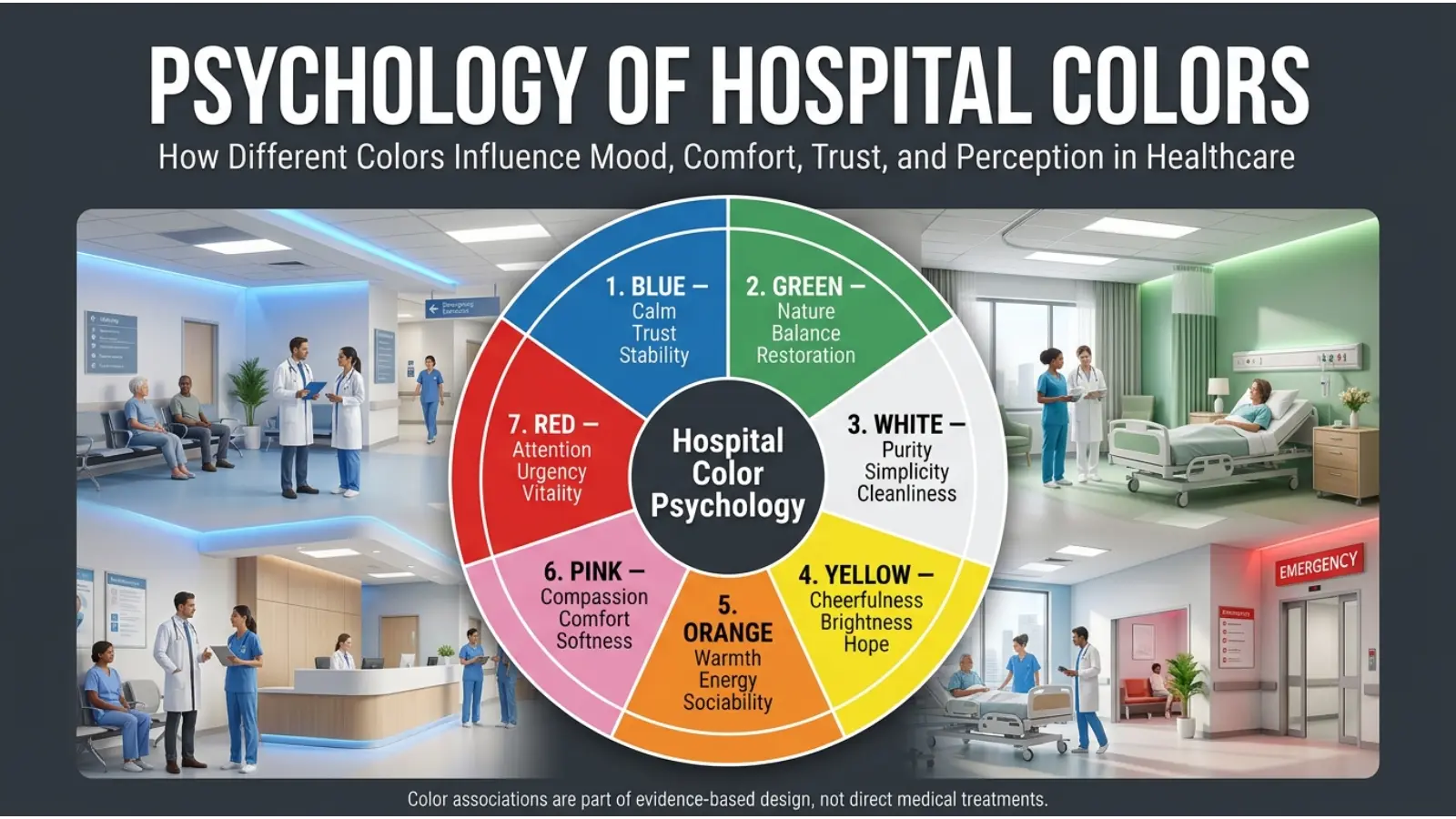
Hospital Colors vs. Color Psychology
This distinction is especially important for SEO searches about hospital color meanings.
| Color | General Color Psychology | Possible Hospital Code Meaning |
|---|---|---|
| 🔴 Red | Danger, urgency, heat | Fire |
| 🔵 Blue | Calm, trust, stability | Medical emergency |
| 🟡 Yellow | Attention, caution | Disaster/emergency |
| 🟠 Orange | Warning, visibility | Hazardous material |
| 🟢 Green | Safety, growth, permission | Disaster or security, depending on facility |
| 🩷 Pink | Care, softness, childhood associations | Infant/child abduction |
| ⚫ Black | Seriousness, threat, authority | Bomb threat in some systems |
| 🟣 Purple | Unusual, alerting, distinction | Security emergency in some systems |
| ⚪ White | Cleanliness, neutrality | Severe weather in some systems |
This table demonstrates an important point: symbolic associations and operational meanings can overlap without being the same thing.
Do Hospital Color Code Meanings Have Spiritual Meanings?
Generally, hospital emergency codes should not be treated as spiritual color systems.
Someone may personally associate blue with healing, red with life force, green with renewal, or white with purity. Those are symbolic or spiritual interpretations found in various cultural and personal traditions.
However, there is no general medical rule stating that a hospital’s emergency code color has an official spiritual meaning.
For example, if a hospital uses blue for cardiac arrest, that does not mean the hospital has assigned blue a spiritual meaning related to death, healing, or the soul.
The practical meaning comes from hospital policy.
Cultural Differences in Hospital Color Code Meanings
Color meanings can change between cultures.
In everyday life, colors can carry different emotional, religious, historical, and social associations. A color associated with celebration in one culture may be associated with mourning in another.
Hospitals must therefore consider communication across diverse populations.
Still, emergency codes are different from cultural symbolism because they are institutional conventions.
A patient may culturally associate white with mourning, while the hospital may use white for severe weather. Neither interpretation changes the official emergency procedure.
This is why hospitals increasingly value clear communication rather than relying only on symbolic assumptions.
Historical Development of Hospital Emergency Codes
Color-coded emergency communication developed as hospitals sought faster and more discreet ways to communicate urgent situations.
Over time, different institutions adopted different systems. As hospital networks expanded, employees could encounter unfamiliar code systems when changing facilities.
That created a communication challenge: a person trained to interpret one hospital’s Code Green might encounter a completely different meaning elsewhere.
Modern emergency-management guidance increasingly emphasizes clear, standardized communication and plain-language descriptions where appropriate. The Joint Commission’s current material reflects this shift.
Why Do Hospitals Use Colors Instead of Full Sentences?
There are several practical reasons.
Speed
A short code can be announced quickly.
Recognition
Trained employees can associate a particular code with a response protocol.
Privacy
Some codes can communicate sensitive information without describing the event in detail over a public address system.
Organization
Different emergency categories can have separate response plans.
Training
Staff can learn the correct procedures associated with each alert.
However, these advantages only work when everyone who needs to respond understands the system.
Hospital Color Codes and Patient Safety
Emergency codes are one part of a much larger hospital emergency-management system.
Hospitals need trained staff, communication procedures, equipment, emergency plans, drills, and clearly defined responsibilities.
The Joint Commission describes emergency readiness as a major patient-safety responsibility and emphasizes preparedness, response, recovery, continuity of care, and resource management.
Therefore, a color code should never be viewed as the emergency response itself. It is a communication trigger within a larger system.
How Lighting Changes Hospital Color Perception
Color can look different depending on lighting.
Hospitals often use bright artificial lighting, daylight from windows, screens, reflective surfaces, and colored signage. These conditions can alter how a color appears.
For example, a yellow sign may appear warmer under some lighting and paler under others. Blue can also shift toward cyan or gray depending on the surrounding light.
For emergency signage, the most important issue is not artistic color beauty. It is visibility, contrast, consistency, and recognition.
That is why professional emergency signage should be designed around usability rather than relying only on color.
Why Symbols and Words Matter
Color should not be the only way to communicate an emergency.
A person may have color-vision deficiency, poor lighting, limited visibility, language barriers, or simply no knowledge of the hospital’s code system.
For this reason, effective emergency communication can combine:
- Color
- Words
- Symbols
- Location
- Audible announcements
- Staff instructions
- Digital alerts
This creates multiple ways to understand the same message.
Hospital Color Codes in Branding and Design
Hospital branding uses color differently from emergency codes.
Healthcare brands often choose colors that communicate qualities such as cleanliness, calmness, trust, compassion, professionalism, or modern technology.
Blue and green are common choices because they can create a calm and health-related visual identity. However, branding colors should not be confused with emergency-code colors.
A hospital might use blue throughout its logo and walls while using Code Blue for a completely separate operational purpose.
The same color can therefore have multiple meanings inside one building.
Hospital Colors in Interior Design
Healthcare interiors require more than attractive color combinations.
Designers consider:
- Patient comfort
- Wayfinding
- Visibility
- Accessibility
- Staff workflow
- Lighting
- Stress reduction
- Cleanability
- Contrast
- Department identification
A soft green wall may create a calmer environment, while strong contrast around doors or signs can improve navigation.
However, emergency colors should remain visually distinguishable from ordinary decorative colors when possible.

Hospital Colors and Fashion
Color also appears in medical clothing, uniforms, scrubs, and accessories.
Different departments may use different scrub colors to make roles easier to recognize. Yet, just like emergency codes, these clothing colors are not universal.
One hospital may use a particular color for nurses, while another may use it for respiratory therapists, surgical staff, or another department.
Therefore, scrub color meanings should always be checked against the hospital’s own uniform policy.
Common Misconceptions About Hospital Color Codes
Myth 1: Every hospital uses the same codes
False. Hospital emergency codes can vary between facilities.
Myth 2: Code Blue always means exactly the same thing everywhere
Not necessarily. It commonly indicates a serious medical emergency, especially cardiac or respiratory arrest, but local policies define the response.
Myth 3: Red always means danger
In general color psychology, red can suggest danger or urgency. In hospital systems, however, Code Red commonly means fire because that is how the facility defines it.
Myth 4: Hospital codes have official spiritual meanings
There is no general basis for treating hospital emergency codes as spiritual color symbolism.
Myth 5: Visitors should memorize every hospital code
Not usually. Visitors should follow staff instructions and the facility’s posted emergency guidance.
Myth 6: A color alone is enough to understand an emergency
Not always. The location, announcement wording, hospital policy, and staff instructions provide important context.
A Simple Way to Remember Common Hospital Codes
For general educational purposes, you can remember several widely encountered associations:
🔵 Blue = medical emergency
🔴 Red = fire
🟠 Orange = hazardous materials
🩷 Pink = child/infant abduction
⚫ Black = bomb threat
🩶 Gray = security assistance
🩶 Silver = serious weapon/security threat
But treat this as a memory aid, not a universal hospital rulebook.
The meaning of green, yellow, purple, white, and other codes can vary substantially.
What Should You Do If You Hear a Hospital Code?
If you are a patient or visitor, stay calm.
Do not enter restricted areas to investigate.
Follow instructions from nurses, doctors, security officers, or other hospital personnel.
If staff ask you to remain in a room, move to another location, or evacuate, follow those directions promptly.
Most importantly, do not assume that an unfamiliar code automatically means you are personally in danger. Hospitals use emergency codes for many different events, including situations that may be limited to one area of the facility.
Hospital Color Code Meanings in Different Real-World Settings
Hospital color codes can affect many parts of healthcare operations.
Emergency Departments
Emergency departments may use rapid alerts for cardiac arrest, trauma, security incidents, or mass-casualty events.
Children’s Hospitals
Pediatric facilities may have specialized alerts for missing or abducted children.
Surgical Areas
Operating rooms may use rapid-response systems for medical deterioration or other urgent events.
Mental Health Facilities
Security-related alerts can be especially important where patients or staff may face behavioral emergencies.
Large Medical Campuses
Large campuses may require location-specific announcements so responders can reach the correct building or department.
The more complex the facility, the more important precise location information becomes.
Hospital Color Codes and Accessibility
Emergency communication should work for as many people as possible.
Color alone can create problems for people with color-vision differences. A red-green distinction, for example, may not be equally obvious to everyone.
Hospitals can improve accessibility by combining color with:
- Text labels
- Icons
- Audible announcements
- High contrast
- Clear locations
- Staff assistance
This is also good design practice outside healthcare. A color should reinforce information rather than carry the entire message by itself.
Why Context Changes the Meaning of a Hospital Color
The same color can communicate very different ideas depending on where it appears.
Consider blue:
Blue hospital wall: may suggest calmness and cleanliness.
The Blue hospital logo: may suggest trust and professionalism.
Blue clothing: may identify a staff group.
Code Blue announcement: may signal a medical emergency.
The color has not changed. The context has.
This is one of the most useful lessons in color psychology: color meaning is rarely created by hue alone.
FAQ About Hospital Color Code Meanings
What is the most common hospital color code?
Code Blue is among the most widely recognized hospital emergency codes and commonly refers to a serious medical emergency, particularly cardiac or respiratory arrest.
What does Code Red mean in a hospital?
Code Red commonly means fire. The Joint Commission lists Code Red as an alternative code for fire, although hospitals may use additional wording and location information.
What does Code Blue mean?
Code Blue commonly indicates a medical emergency requiring immediate response, often cardiac or respiratory arrest.
What does Code Pink mean in a hospital?
Code Pink commonly refers to an infant or child abduction emergency. The Joint Commission includes Code Pink as an alternative code for infant or child abduction.
What does Code Silver mean?
Code Silver can refer to an armed person, weapon, or active-shooter situation. However, the exact meaning depends on the hospital. Some current emergency-management guidance favors plain-language security alerts for these situations.
What does Code Orange mean?
Code Orange commonly relates to hazardous materials, chemical incidents, or medical decontamination. Its exact definition depends on the facility.
What does Code Green mean?
Code Green has no single universal meaning. It may refer to emergency operations, disaster activation, or a security-related response depending on the hospital.
What does Code Yellow mean?
Code Yellow may indicate a disaster or emergency activation at some hospitals. Johns Hopkins Bayview, for example, has used Code Yellow for an emergency or disaster.
Are hospital color codes the same everywhere?
No. Some colors have widely recognized meanings, but hospitals can define their own systems. Always follow the emergency procedures used by the specific facility.
Do hospital colors have psychological meanings?
They can have general psychological associations, but emergency-code meanings are primarily operational. A hospital assigns the meaning through its emergency-management policy.
Conclusion
Hospital color codes are best understood as communication tools rather than universal color symbols. Blue may signal a medical emergency, red commonly indicates fire, pink often identifies a child-abduction emergency, and orange can relate to hazardous materials. Yet the meaning of many colors changes between hospitals.
That variation matters. A color chart found online can help you understand common terminology, but it should never replace the emergency instructions of a specific hospital.
The deeper lesson is that context creates meaning. The same blue that suggests calmness in hospital interior design can signal an urgent medical response when announced as Code Blue. Red can represent energy in branding but fire in an emergency system.
For patients, visitors, designers, healthcare workers, and anyone researching hospital color code meanings, the safest approach is simple: learn the local system, look for words and location details, and follow trained staff during an emergency. Modern emergency guidance increasingly recognizes that clear, plain-language communication can be just as important as the color itself.

Emma Wilson is a dedicated comparison writer and product researcher at ColorMystiic.com. She specializes in creating unbiased product comparisons, detailed reviews, and helpful buying guides. Her goal is to help readers make smarter purchasing decisions with confidence.