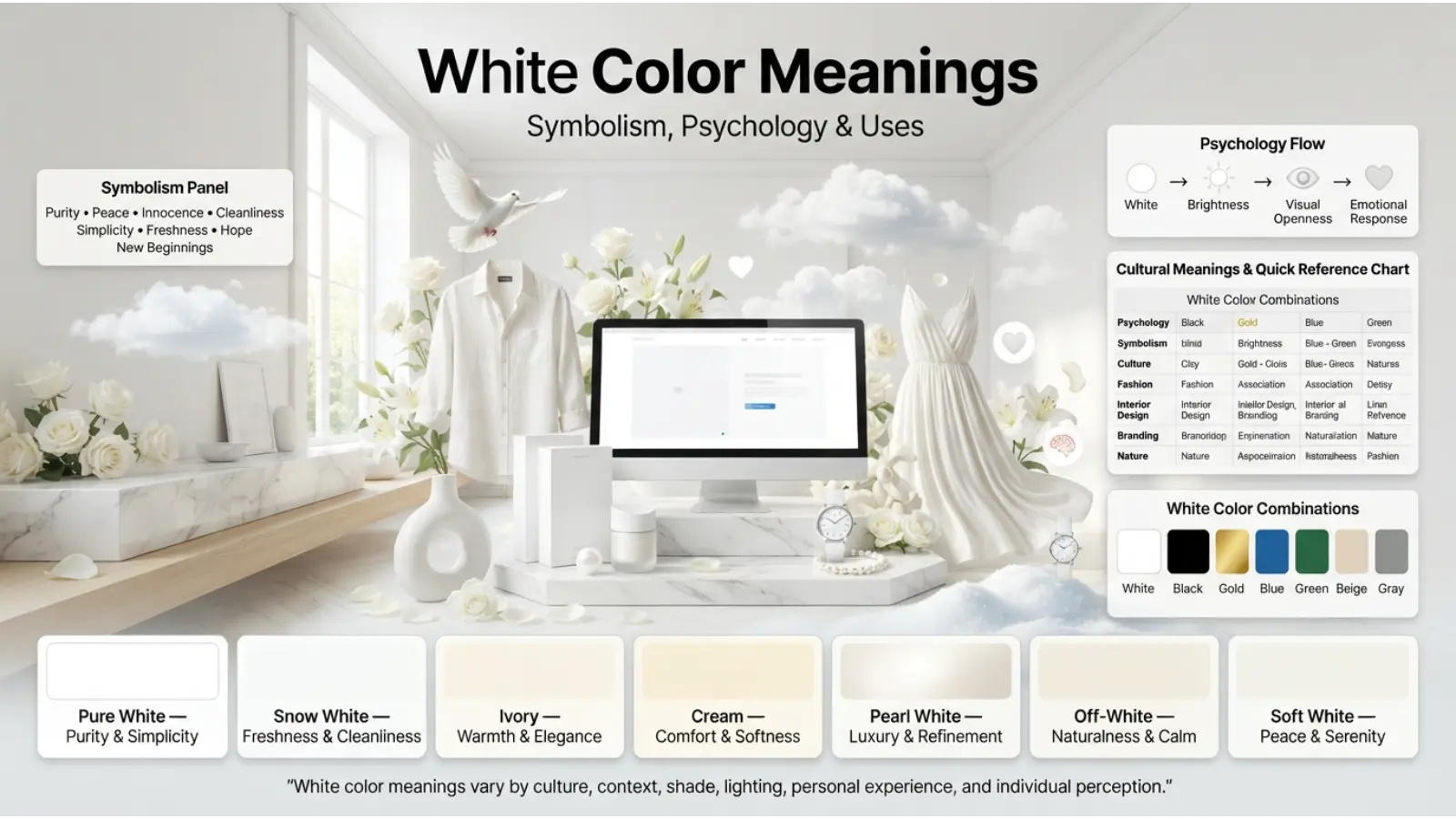
White is one of the most visually familiar colors, yet its meaning can change dramatically depending on where, how, and why it is used. It can suggest purity, peace, cleanliness, simplicity, innocence, freshness, and new beginnings, but it can also feel cold, distant, empty, or sterile in the wrong setting.That is why understanding white color meanings requires more than assigning one definition to the color. White appears in weddings, religious traditions, hospitals, technology, architecture, clothing, advertising, art, and everyday objects. Each context can give it a different emotional message.
Psychology can help explain why people often associate white with cleanliness and openness, while culture and tradition explain why its symbolism differs around the world. In this guide, we will explore the symbolism, emotional associations, cultural meanings, history, personality connections, branding uses, interior design, fashion, color combinations, and practical applications of white.
Quick Answer: White commonly represents purity, cleanliness, peace, innocence, simplicity, openness, and new beginnings. Depending on culture and context, it can also symbolize mourning, spirituality, emptiness, sterility, or emotional distance.
White Color Meanings at a Glance
| Aspect | Common Meaning of White |
|---|---|
| Core symbolism | Purity, peace, simplicity |
| Positive emotions | Calmness, freshness, safety, innocence |
| Negative associations | Emptiness, coldness, sterility, isolation |
| Psychology | Openness, cleanliness, visual simplicity |
| Spiritual symbolism | Light, transcendence, purity, renewal |
| Fashion | Elegance, freshness, formality, simplicity |
| Branding | Cleanliness, clarity, modernity, minimalism |
| Interior design | Space, brightness, calm, openness |
| Nature | Snow, clouds, moonlight, flowers, light |
| Common cultural meanings | Purity, celebration, spirituality, mourning in some traditions |
What Does White Symbolize?
White is often connected with ideas that feel clean, untouched, or uncomplicated. A blank sheet of paper, fresh snow, white clothing, and a bright room can all create different versions of the same basic impression: a sense of openness and absence of visual clutter.
The most common symbolic meanings include:
- Purity
- Innocence
- Peace
- Cleanliness
- Simplicity
- Freshness
- New beginnings
- Honesty
- Spirituality
- Clarity
- Order
- Calmness
However, white is not automatically positive. A completely white room can feel peaceful and spacious, but it may also feel impersonal if it lacks texture or warmer elements. Similarly, white clothing can communicate elegance in one setting and mourning in another.
This makes white a highly context-dependent color.
Positive Meanings of White
White can create an impression of freshness and order. It is often chosen when people want something to look clean, simple, modern, or peaceful.
Its positive associations include:
Purity: White is frequently connected with things considered clean or untouched.
Peace: White is widely used as a visual symbol of peace and nonviolence.
Innocence: In many Western contexts, white clothing can represent innocence or simplicity.
Freshness: White can make an object or environment appear new and clean.
Simplicity: Minimalist design often uses white because it reduces visual distraction.
Clarity: White space can separate information and make a design easier to understand.
Negative Meanings of White
White can also communicate the opposite of warmth.
Depending on its surroundings, it may suggest:
- Emptiness
- Sterility
- Coldness
- Detachment
- Isolation
- Fragility
- Perfectionism
- Lack of personality
For example, a white medical environment can communicate hygiene and safety, but excessive white may also make the space feel clinical.
Psychology of White Color Meanings
Color psychology examines how colors can influence perception, emotion, attention, and behavior. However, color does not produce exactly the same psychological response in every person.
White is especially interesting because it is strongly affected by context, lighting, surrounding colors, culture, and personal experience.
White and Emotional Response
Bright white environments can appear clean and open. They may also make a space feel larger because white surfaces reflect substantial amounts of visible light.
Soft whites, such as ivory or cream, usually create a warmer impression than stark, cool whites.
Therefore, even small changes in the temperature of white can affect how a room, product, or outfit feels.
White and Mental Associations
People often connect white with:
- Clean surfaces
- Fresh paper
- Snow
- Clouds
- Hospitals
- Weddings
- Religious garments
- Modern technology
- Minimalist interiors
These associations are learned through repeated exposure. This is one reason the meaning of white is not simply biological. Culture and experience play a major role.
Does White Make You Feel Calm?
White can contribute to a calm visual environment when it is combined with natural textures, balanced lighting, and softer colors. However, an environment that is overwhelmingly bright white can feel harsh or sterile to some people.
For relaxation, warm white shades often work better than extremely cool, high-brightness whites.
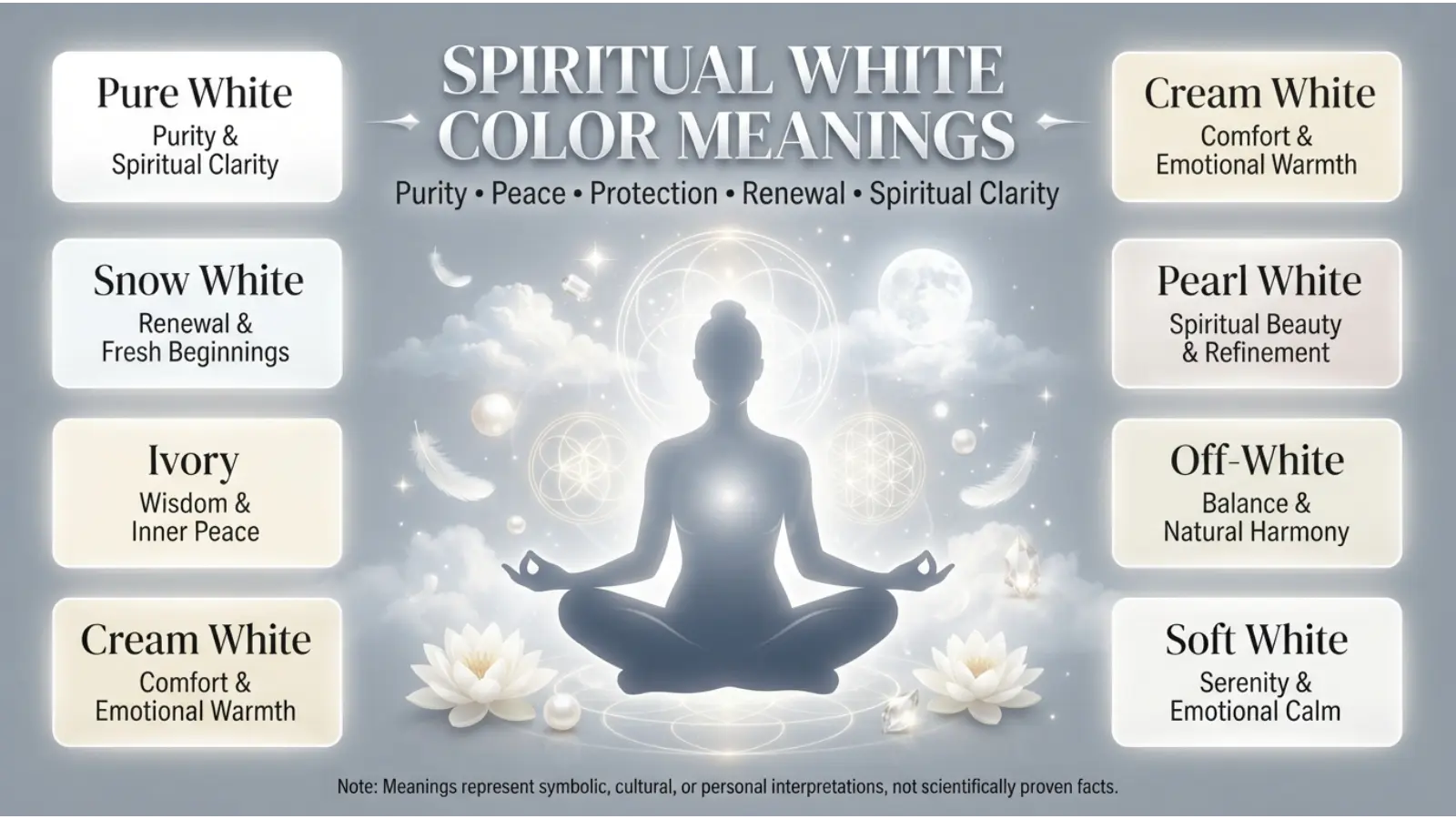
Spiritual White Color Meanings
White has strong spiritual symbolism in many traditions, although its exact meaning differs between religions, cultures, and communities.
Common spiritual associations include:
- Purity
- Light
- Peace
- Renewal
- Transcendence
- Innocence
- Spiritual clarity
- Sacredness
White is sometimes used to represent a movement away from darkness toward light. In this symbolic sense, it can suggest renewal or transformation.
However, there is no single universal spiritual meaning of white. Religious symbolism must be understood within its specific tradition rather than treated as a universal rule.
White and Spiritual Purity
White clothing or objects may be used in ceremonies to communicate purity or sacred intention. This symbolism can be especially powerful because white visually removes competing colors and creates a sense of simplicity.
White and Peace
White is widely recognized as a peace-related symbol, particularly through the white flag. Here, the color communicates a desire to stop conflict rather than victory over an opponent.
White and New Beginnings
Because white is associated with blank pages, clean surfaces, and fresh starts, it can represent the beginning of a new phase.
This symbolism appears frequently in ceremonies, art, personal development, and spiritual practices.
Cultural White Color Meanings
White does not mean exactly the same thing everywhere.
White in Western Cultures
In many Western societies, white is strongly associated with weddings, purity, cleanliness, simplicity, and peace.
The white wedding dress became particularly influential in Western fashion and wedding traditions, helping strengthen the color’s connection with bridal imagery.
White is also common in modern architecture and minimalist design because it can create an impression of brightness and spaciousness.
White in East Asian Cultures
In several East Asian cultural traditions, white has historically been associated with mourning and death. This is particularly important when discussing white symbolism because the Western association between white and weddings is not universal.
In some contexts, white garments or objects may therefore carry meanings very different from those expected by Western audiences.
White in Middle Eastern Cultures
White can have positive associations with purity, cleanliness, peace, and religious devotion in various Middle Eastern contexts. However, interpretations differ between countries, religious communities, and situations.
It is better to understand white symbolism within a specific cultural setting rather than treating the entire region as having one shared interpretation.
White in African Cultures
Across African societies, white can appear in ceremonial, spiritual, social, and artistic contexts. Its symbolism varies considerably between communities.
In some traditions, white may be connected with spirituality, ancestors, purity, or ceremonial importance. These meanings should be attributed to particular traditions rather than generalized to the whole continent.
White in Latin American Cultures
White can represent purity, peace, faith, and celebration in many Latin American contexts. Religious traditions have also influenced how white appears in clothing, ceremonies, and visual art.
At the same time, local customs can create meanings that differ from broader Western symbolism.
Historical White Color Meanings
White has been important throughout human history because naturally occurring white materials were relatively accessible. Chalk, limestone, shells, clay, minerals, and animal-derived materials were used to create pale pigments and surfaces.
White became especially important in architecture because it could make buildings appear bright and monumental. Classical architecture also influenced later European ideas about white stone, columns, and ideals of order.
The history of white is therefore not simply a story about color. It is also a story about materials, technology, architecture, religion, clothing, and social status.
White in Art
Artists have used white to create highlights, contrast, light, space, and visual focus.
A white area can appear extremely bright when placed beside dark colors. This makes white valuable for creating visual hierarchy.
In painting, white also plays a technical role. Artists can mix white with other pigments to create lighter tints, changing both brightness and perceived intensity.
White Personality Associations
People sometimes associate a preference for white with traits such as:
- Organized
- Clean
- Independent
- Calm
- Practical
- Minimalist
- Detail-oriented
- Peace-seeking
- Sophisticated
However, these are associations, not personality tests.
Choosing white clothing or decorating with white does not prove that someone has a particular personality. Preferences can be influenced by fashion, culture, occupation, climate, trends, upbringing, and practical needs.
A person may prefer white simply because it matches many other colors.
White Color Meanings in Branding and Marketing
White is especially useful in branding because it can communicate a visual idea without demanding much attention.
Brands often use white to create impressions of:
- Simplicity
- Cleanliness
- Modernity
- Precision
- Luxury
- Technology
- Openness
- Minimalism
White is particularly effective when the product itself provides the main visual focus.
Why Companies Use White
A white background can make photographs, products, and typography stand out. It also provides strong negative space, allowing important elements to breathe.
Technology companies and minimalist brands often use white because it supports a clean interface and uncluttered identity.
Luxury brands may also use white with black, metallic tones, or restrained typography to create an elegant appearance.
White Packaging
White packaging can suggest cleanliness and simplicity, particularly for products related to skincare, healthcare, household cleaning, and personal care.
Yet white packaging can also appear generic if it lacks strong typography, imagery, texture, or distinctive branding.
The lesson for marketers is simple: white works best when its surrounding design gives it meaning.
White Color Meanings in Interior Design
White is one of the most flexible colors for interiors.
It can make walls appear brighter and can visually expand a small room. However, using one flat white everywhere may make a space feel cold.
White Living Room
White walls can create a spacious foundation for furniture and artwork.
Add wood, plants, woven materials, or warm lighting if you want the room to feel more comfortable.
White Bedroom
White bedrooms often feel fresh and uncluttered. Bedding, curtains, and walls can all use white, but different textures prevent the room from looking visually flat.
Layer cotton, linen, wool, wood, or soft rugs to introduce depth.
White Office
White can support a clean and organized workspace. It works especially well with natural light and simple furniture.
However, adding another neutral color can prevent the office from feeling overly clinical.
White Kitchen
White kitchens are popular because white surfaces can create a clean and bright appearance.
The practical challenge is maintenance. White surfaces can show stains, dust, and wear more easily than some darker finishes.
White Lighting
Lighting dramatically changes how white looks.
Cool lighting can make white appear crisp or slightly bluish, while warm lighting can make it appear creamy or yellow.
For this reason, always evaluate paint samples under the lighting that will actually be used in the room.

White Color Meanings in Fashion
White clothing is closely associated with simplicity, freshness, elegance, and versatility.
A white shirt, for example, can work in professional clothing, casual outfits, formal events, and minimalist streetwear.
White Formal Wear
White can create a polished and sophisticated appearance. In some settings, however, wearing all white may appear more formal or attention-grabbing than intended.
White Casual Clothing
White T-shirts, sneakers, trousers, and jackets are popular because they combine easily with many other colors.
The downside is practical: white fabric can show stains and discoloration more clearly.
White Accessories
White handbags, shoes, watches, belts, scarves, and jewelry can create a clean accent without dominating an outfit.
Seasonal Meaning
White is strongly associated with summer because of its bright, lightweight visual character. It is also connected with winter through snow and frost.
That makes white unusual: it can represent both warm-weather freshness and cold-weather imagery, depending on the surrounding colors and materials.
White Color Combinations
The White works with almost every color, but the emotional effect changes depending on the combination.
| White With | Overall Impression |
|---|---|
| Black | Elegant, dramatic, modern |
| Blue | Calm, clean, trustworthy |
| Green | Natural, fresh, balanced |
| Gray | Sophisticated, restrained |
| Beige | Warm, soft, comfortable |
| Gold | Luxurious, refined |
| Silver | Futuristic, sleek |
| Pink | Gentle, delicate, romantic |
| Purple | Creative, elegant, expressive |
| Red | Bold, energetic, high contrast |
| Brown | Natural, warm, grounded |
| Yellow | Bright, cheerful, youthful |
White and Black
Black and white create one of the strongest classic contrasts. The combination is useful when you want clarity and visual authority.
White and Blue
White and blue often feel clean and calm. This pairing works well in interiors, healthcare-related design, fashion, and corporate communication.
White and Green
Green introduces a natural element to white. Plants against white walls are a simple example of how the combination can create freshness without becoming visually overwhelming.
White and Gold
Gold changes white from simple to more luxurious. This combination works particularly well for invitations, packaging, interiors, and formal visual identities.
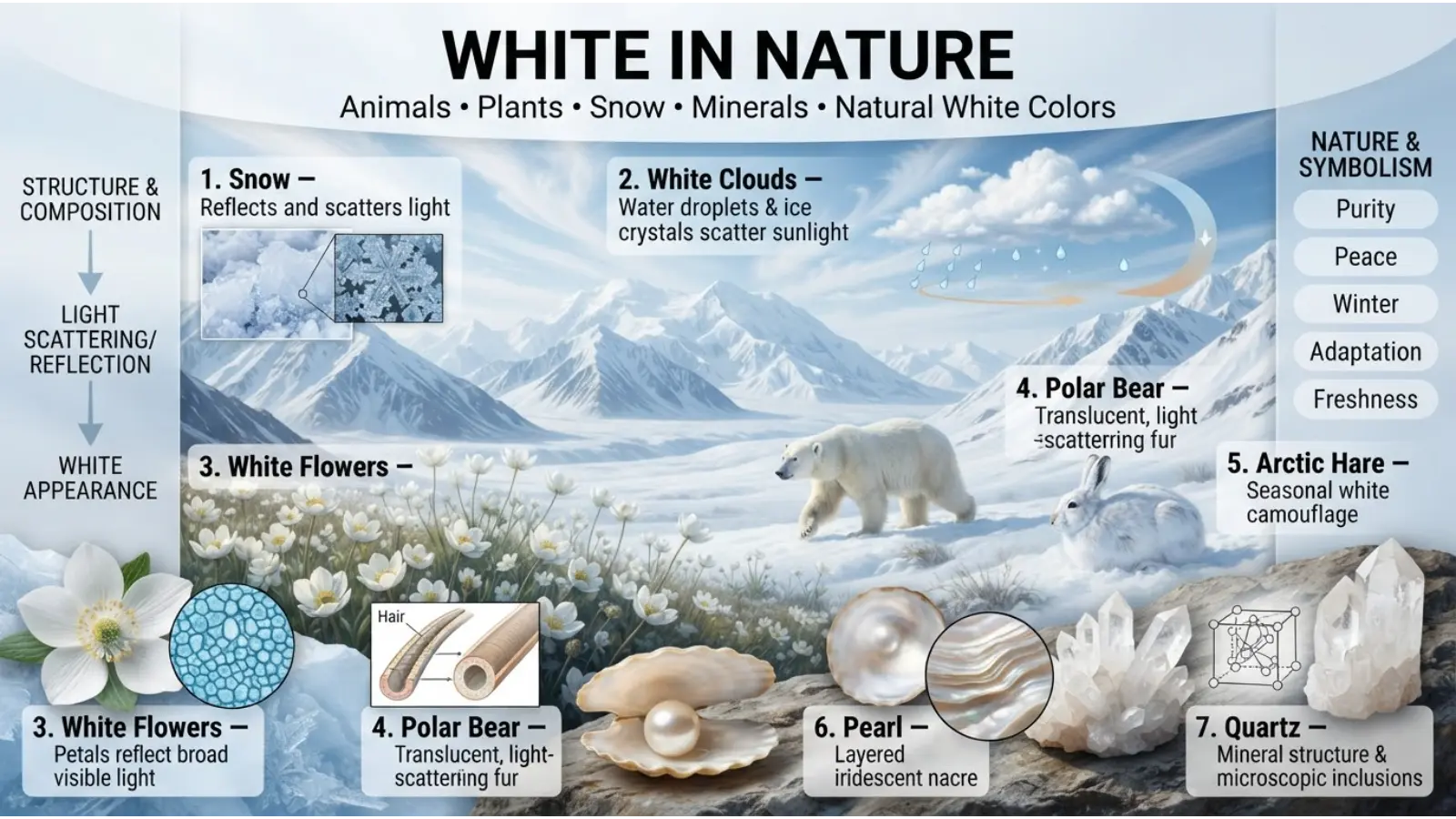
White in Nature
Nature provides many powerful examples of white symbolism.
Snow can make white appear peaceful and pure, while clouds can make it feel soft and weightless. White flowers often appear delicate or elegant, although the symbolic meaning varies by species and culture.
Animals such as polar bears, swans, doves, and white horses have also influenced cultural associations with purity, grace, peace, or rarity.
Nature therefore contributes strongly to the emotional vocabulary surrounding white.
White in Art and Photography
White is not merely a background color in art. It can become the main subject.
Artists may use large white areas to communicate silence, emptiness, light, simplicity, isolation, or space.
Photographers also use white backgrounds to create a clean commercial appearance. Product photography frequently relies on white because it minimizes distractions and makes objects easier to isolate visually.
In portrait photography, white clothing and backgrounds can create a soft, high-key appearance. However, excessive brightness can reduce detail, so exposure and lighting need careful control.
White in Everyday Life
White appears in many practical situations:
- Medical clothing
- Household products
- Office paper
- Wedding clothing
- Religious garments
- Sports uniforms
- Appliances
- Packaging
- Architecture
- Websites
- Mobile interfaces
- Road and safety markings
- School materials
- Photography backgrounds
Its popularity comes partly from its ability to work as a visual neutral.
White can support another color rather than compete with it.
Why Does White Look Different Under Different Lighting?
White is highly sensitive to surrounding light.
Under warm yellow lighting, a white wall may appear cream or beige. Under cool daylight, the same wall may look crisp and slightly blue.
Surrounding colors also affect perception. A white object placed next to a strong blue may appear warmer, while the same white object beside yellow may appear cooler.
This is known as simultaneous color contrast, where surrounding colors influence how we perceive a neighboring color.
Therefore, choosing white paint, clothing, or digital backgrounds based only on a color swatch can be misleading.
Common Misconceptions About White
“White Always Means Purity”
Not everywhere. White can symbolize purity in some cultures and contexts, while it can represent mourning or death in others.
“White Has No Color Meaning”
The White can be treated as an achromatic color in color science, but that does not mean it lacks cultural or psychological meaning.
Its visual neutrality can actually make its symbolic role more powerful.
“White Always Makes a Room Feel Better”
Not necessarily. Excessive white can make a room feel stark, cold, or unfinished.
Texture, lighting, furniture, and warmer accents can dramatically change the result.
“People Who Like White Are Always Clean and Organized”
There is no reliable basis for using color preference alone to determine personality.
A preference for white may reflect aesthetics, practicality, fashion, culture, or simple personal taste.
White in Different Areas of Life
| Area | Why White Is Used |
|---|---|
| Healthcare | Cleanliness and clinical appearance |
| Weddings | Purity, tradition, elegance |
| Technology | Minimalism and modernity |
| Architecture | Light and spaciousness |
| Fashion | Simplicity and versatility |
| Branding | Clarity and clean visual identity |
| Photography | Neutral background |
| Art | Light, contrast, space |
| Interior design | Brightness and openness |
| Packaging | Clean and simple appearance |
| Spiritual settings | Purity and sacred symbolism |
| Peace symbolism | Nonviolence and surrender |
How Context Changes White’s Meaning
The same white object can communicate very different messages.
A white wedding dress may suggest celebration and tradition.
The white hospital coat may suggest professionalism and cleanliness.
A white flag may communicate surrender or a request to stop fighting.
A completely white gallery may feel modern and artistic.
A white mourning garment may carry a completely different cultural meaning.
The color has not changed. The context has.
This is one of the most important principles in understanding color symbolism.
White vs. Cream: What Is the Difference?
Pure white tends to feel sharper, brighter, and more modern.
Cream contains warm undertones, giving it a softer and more traditional appearance.
Choose pure white when you want:
- Crispness
- Modernity
- High contrast
- Visual simplicity
Choose cream when you want:
- Warmth
- Comfort
- Softness
- Traditional elegance
The difference can be subtle, but it becomes noticeable across large surfaces such as walls, curtains, and furniture.
White vs. Silver
The White is usually softer and more neutral, while silver has a reflective metallic quality.
White often communicates simplicity and purity.
Silver can suggest technology, sophistication, modernity, or luxury.
Using the two together can create a futuristic visual style, especially when combined with clean typography and minimal design.
Frequently Asked Questions
What does the white color mean?
White commonly represents purity, peace, cleanliness, simplicity, innocence, clarity, and new beginnings. Its meaning changes according to culture and context.
What does white symbolize spiritually?
White can symbolize purity, light, peace, renewal, sacredness, and spiritual clarity. Specific meanings vary between religious and spiritual traditions.
What does white mean psychologically?
White is often associated with cleanliness, openness, simplicity, and order. However, large amounts of stark white can sometimes feel cold, empty, or sterile.
What does white represent in different cultures?
White has different meanings across cultures. It can represent weddings and purity in many Western settings, while it has historically been associated with mourning in several East Asian traditions.
Is white a positive color?
White can have strongly positive associations such as peace, cleanliness, and freshness. However, it can also suggest emptiness, coldness, or sterility depending on how it is used.
What personality does white represent?
White is sometimes associated with simplicity, organization, independence, calmness, and cleanliness. These are symbolic associations, not reliable ways to determine someone’s personality.
Why is white used in branding?
White creates visual space and can communicate simplicity, cleanliness, modernity, precision, and minimalism. It also allows other brand elements to receive more attention.
Why does white look different in different rooms?
Lighting, surrounding colors, surface materials, and the white’s undertones can change its appearance. Warm lighting makes white appear warmer, while cool lighting can make it look crisper.
What colors go well with white?
White pairs naturally with black, blue, green, gray, beige, gold, silver, pink, purple, red, brown, and yellow. The best choice depends on the mood you want to create.
Does white make a room look bigger?
White can make a room appear brighter and more open because it reflects light and reduces visual boundaries. The effect also depends on lighting, furniture, ceiling height, and layout.
Final Thoughts on White Color Meanings
White is far more complex than a simple symbol of purity. It can represent peace, cleanliness, innocence, simplicity, spirituality, freshness, elegance, and new beginnings, while also suggesting emptiness, sterility, distance, or mourning in certain contexts.
Its power comes from its flexibility. White can disappear into the background or become the most noticeable element in a design. It can make a room feel larger, allow a product to stand out, create a formal fashion statement, or provide a quiet visual space.
Most importantly, white does not carry one permanent message. Culture, history, lighting, surrounding colors, personal experience, and purpose all influence what people see and feel.
Understanding those differences makes white more useful—not only as a color, but as a tool for communication, design, fashion, art, branding, and everyday life.

Emma Wilson is a dedicated comparison writer and product researcher at ColorMystiic.com. She specializes in creating unbiased product comparisons, detailed reviews, and helpful buying guides. Her goal is to help readers make smarter purchasing decisions with confidence.