Black is one of the most powerful and visually distinctive colors. It can suggest elegance, authority, mystery, strength, grief, rebellion, or simplicity depending on where and how it appears. A Black Color Meanings suit may communicate professionalism, while a black flag can carry a very different message. Likewise, black in a bedroom can feel sophisticated and calm, yet too much of it may make a room feel smaller or heavier.
That range is what makes black color meanings so interesting. Unlike a fixed code, color symbolism changes with culture, history, personal experience, lighting, surrounding colors, and context Therefore, black does not have one universal meaning.
In this guide, you will explore the symbolism and psychology of black, its spiritual and cultural associations, historical meanings, personality connections, uses in branding and design, fashion, color combinations, and everyday applications.
Quick Answer: Black commonly represents power, sophistication, mystery, authority, protection, elegance, seriousness, mourning, and the unknown. Its meaning depends strongly on cultural and social context. In design and branding, black often creates a sense of strength, luxury, simplicity, or exclusivity, while in some traditions it is associated with death or mourning.
What Does Black Symbolize?
Black is often associated with ideas that feel strong, serious, or difficult to define. Because it absorbs rather than reflects most visible light, it can create a visual sense of depth and weight.
Some of the most common black color meanings include:
| Meaning | What Black Can Suggest |
|---|---|
| Power | Authority, control, confidence, influence |
| Elegance | Sophistication, refinement, timeless style |
| Mystery | The unknown, secrecy, curiosity |
| Strength | Resilience, seriousness, determination |
| Protection | Boundaries, privacy, security |
| Formality | Professionalism, discipline, seriousness |
| Mourning | Loss, grief, remembrance |
| Rebellion | Independence, resistance, nonconformity |
| Luxury | Exclusivity, premium quality, prestige |
| Simplicity | Minimalism, clarity, visual restraint |
However, these associations are not universal rules. For example, black may communicate sophistication in one setting but mourning in another. Consequently, the object, setting, culture, and surrounding colors all matter.
Black can also create a strong contrast with lighter colors. As a result, white text on a black background often feels crisp and dramatic, while gold combined with black can create a luxurious impression.
The Psychology of Black
Color psychology examines how colors can influence perception, emotion, attention, and behavior. However, color psychology should not be treated as a system that predicts exactly how every person will react.
Black is especially interesting because it has both positive and negative associations.
On the positive side, people may connect black with confidence, sophistication, independence, and control. On the other hand, it can also evoke darkness, fear, isolation, sadness, or uncertainty.
Black and Emotion
Black can feel emotionally intense because of its visual weight. In clothing, it can create a polished and controlled appearance. The photography, it can add drama and depth. In graphic design, it can make other colors appear brighter and more noticeable.
At the same time, large areas of black may feel heavy or somber. Therefore, designers often balance it with white, gray, metallic shades, or brighter accent colors.
Black and Attention
Black is not always the first color to attract attention. Instead, it can help organize attention by creating strong contrast.
For example, a black background can make a bright red button stand out. Similarly, black lettering on a pale background can provide strong visual definition.
Black and Perception
Black objects can appear visually heavier than lighter objects of similar size. This effect is one reason black clothing can create a sleek appearance, while black furniture may feel substantial or dominant within a room.
Nevertheless, perception depends on shape, lighting, material, texture, and surrounding colors. Matte black and glossy black, for example, can produce very different impressions.
Positive Meanings of Black
Black has many positive associations in modern design and everyday life.
Elegance is one of the strongest. A simple black dress, black suit, or black accessory can appear refined without relying on bright decoration.
Authority is another common association. Black uniforms, formal clothing, and professional designs can create a serious visual presence.
Strength also fits naturally with black because the color often appears bold and visually solid.
Furthermore, black works well with minimalist design. Instead of adding many visual elements, designers can use black to create structure and contrast.
Black can therefore communicate:
- Confidence
- Independence
- Sophistication
- Discipline
- Authority
- Seriousness
- Stability
- Luxury
- Simplicity
- Individuality
Negative Meanings of Black
Black can also carry darker associations.
Across different contexts, it may symbolize death, grief, fear, secrecy, emptiness, isolation, or the unknown. These meanings are particularly common when black appears alongside themes involving loss or danger.
However, a negative association does not make black a negative color. In many cases, darkness itself represents something unknown rather than something inherently evil.
For example, black may symbolize the mystery of the night, the depth of space, or an unexplored possibility.
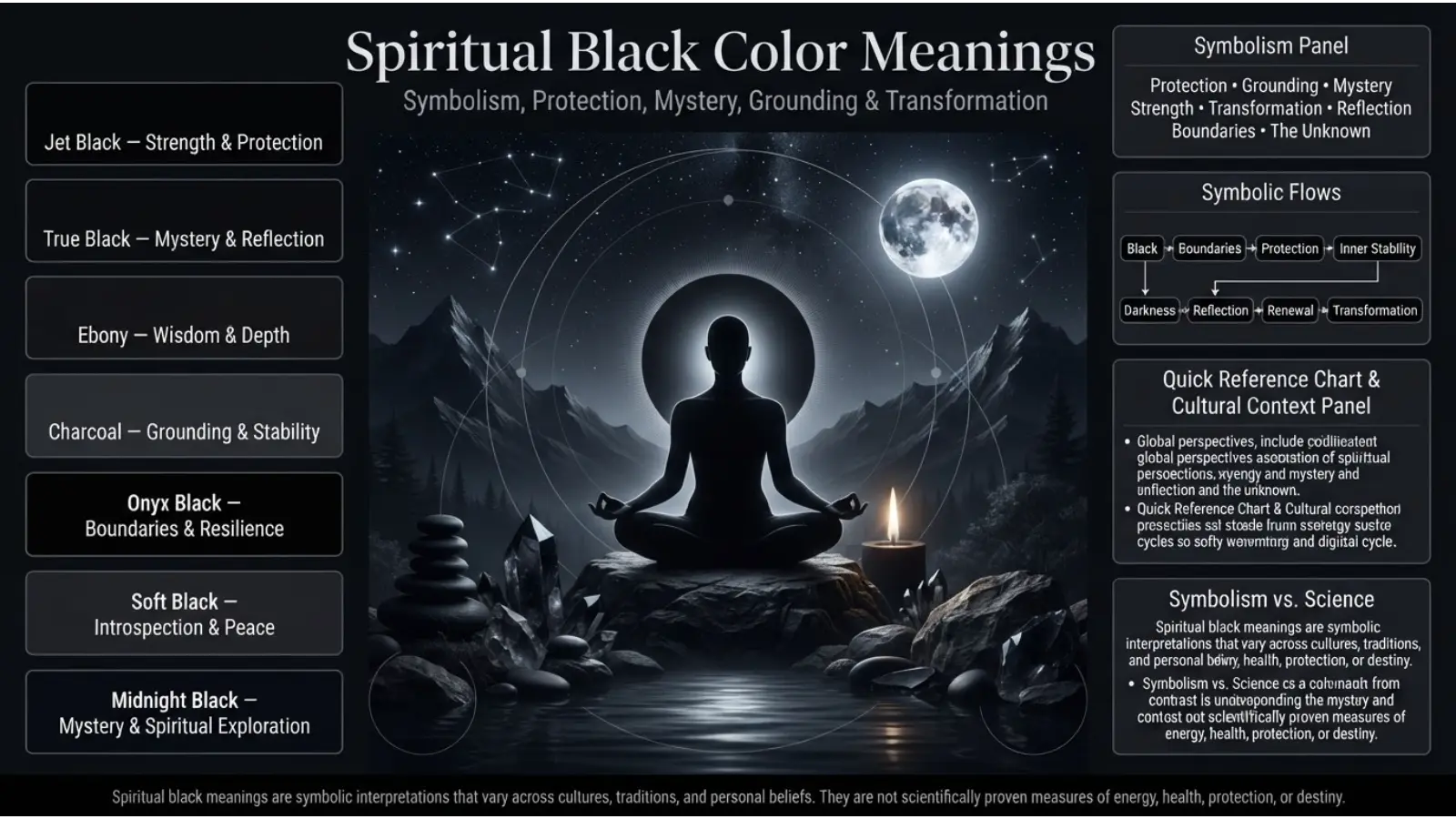
Spiritual Black Color Meanings
Black has spiritual and symbolic meanings in many traditions, but these interpretations are not universal. They should not be presented as one shared religious definition.
Depending on the tradition and context, black can represent protection, mystery, transformation, authority, the unknown, endings, or spiritual depth.
Black as Protection
Some spiritual and symbolic traditions use dark colors to represent protection, boundaries, or the ability to keep unwanted influences away.
This interpretation is symbolic rather than a scientifically established property of the color.
Black and Transformation
Because black is often connected with endings, darkness, and transitions, it can symbolize a period before change or renewal.
In this sense, black does not necessarily represent an ending without hope. Instead, it can represent the closing of one stage before another begins.
Black and Mystery
Black naturally connects with what cannot be seen. Consequently, it can represent hidden knowledge, the unknown, contemplation, and mystery.
Different spiritual systems interpret these ideas differently, so readers should consider the specific tradition rather than assuming that one interpretation applies everywhere.
Cultural Meaning of Black
Culture has a major influence on black color meanings.
In many Western societies, black is strongly associated with mourning and funerals. It can also represent formal clothing, authority, professionalism, and elegance.
In other cultural settings, however, the meaning may be different. Some East Asian traditions have historically connected black with ideas such as water, winter, north, seriousness, or authority within traditional color systems. These meanings vary by country, historical period, and philosophical tradition.
In parts of Africa, black can have rich symbolic meanings connected with maturity, identity, ancestry, strength, or cultural expression, although interpretations differ widely between communities.
In Latin American cultures, black may be connected with mourning and religious observance in some contexts, while modern fashion and popular culture also give it meanings of elegance and sophistication.
Therefore, phrases such as “black always means death” or “black always means power” are too simplistic. Color symbolism is shaped by history, religion, geography, social customs, and personal experience.
Historical Meaning of Black
Black has played an important role throughout human history.
Early humans created dark pigments from natural materials such as charcoal and other carbon-based substances. Black pigments became important in art, writing, decoration, and later printing.
In European history, black clothing became associated with seriousness, status, religious life, and mourning at different periods. Its use was influenced partly by the availability and cost of dyes as well as social customs.
The meaning of black also changed with technology. Industrial manufacturing, modern printing, photography, cinema, and digital screens expanded the ways black could be used.
In modern culture, black moved beyond traditional associations with mourning and became strongly connected with fashion, minimalism, luxury, music, technology, and contemporary graphic design.
Black and Personality Associations
People sometimes associate a preference for black with personality traits such as independence, confidence, sophistication, privacy, or seriousness.
However, color preference does not determine personality.
Someone may choose black simply because it is easy to coordinate with other clothing. Another person may prefer it because they enjoy minimalist design. Someone else may associate it with a meaningful memory or cultural tradition.
Therefore, personality claims about black should be treated as possibilities rather than psychological diagnoses.
A person who frequently chooses black might value:
- Simplicity
- Personal independence
- Practicality
- Privacy
- Strong visual style
- Classic fashion
- Minimalism
Yet these traits cannot be assumed from color preference alone.
Black in Branding and Marketing
Black is especially powerful in branding because it can create a strong visual identity without requiring many colors.
Luxury, fashion, automotive, technology, entertainment, and premium-product brands often use black to create impressions of sophistication or exclusivity.
Black and Luxury
Black can make packaging feel premium when combined with high-quality typography, controlled spacing, and materials such as metallic foil or textured paper.
For example, black packaging with restrained gold details can create a very different impression from bright, playful packaging.
Black and Authority
Black can communicate seriousness and confidence. That makes it useful for brands that want a strong, established, or professional appearance.
However, excessive use may make a brand feel distant. Consequently, companies often combine black with a secondary color to introduce personality.
Black and Minimalism
Modern design frequently uses black because it works well with simple layouts.
A black logo can remain recognizable across websites, packaging, clothing labels, signs, and printed materials. Its versatility is one reason designers continue to use it.
Black in Advertising
Black backgrounds can create dramatic contrast, especially when products are photographed with controlled lighting.
However, contrast should remain readable. A beautiful black design can still fail if its text is too dark or too small to read.
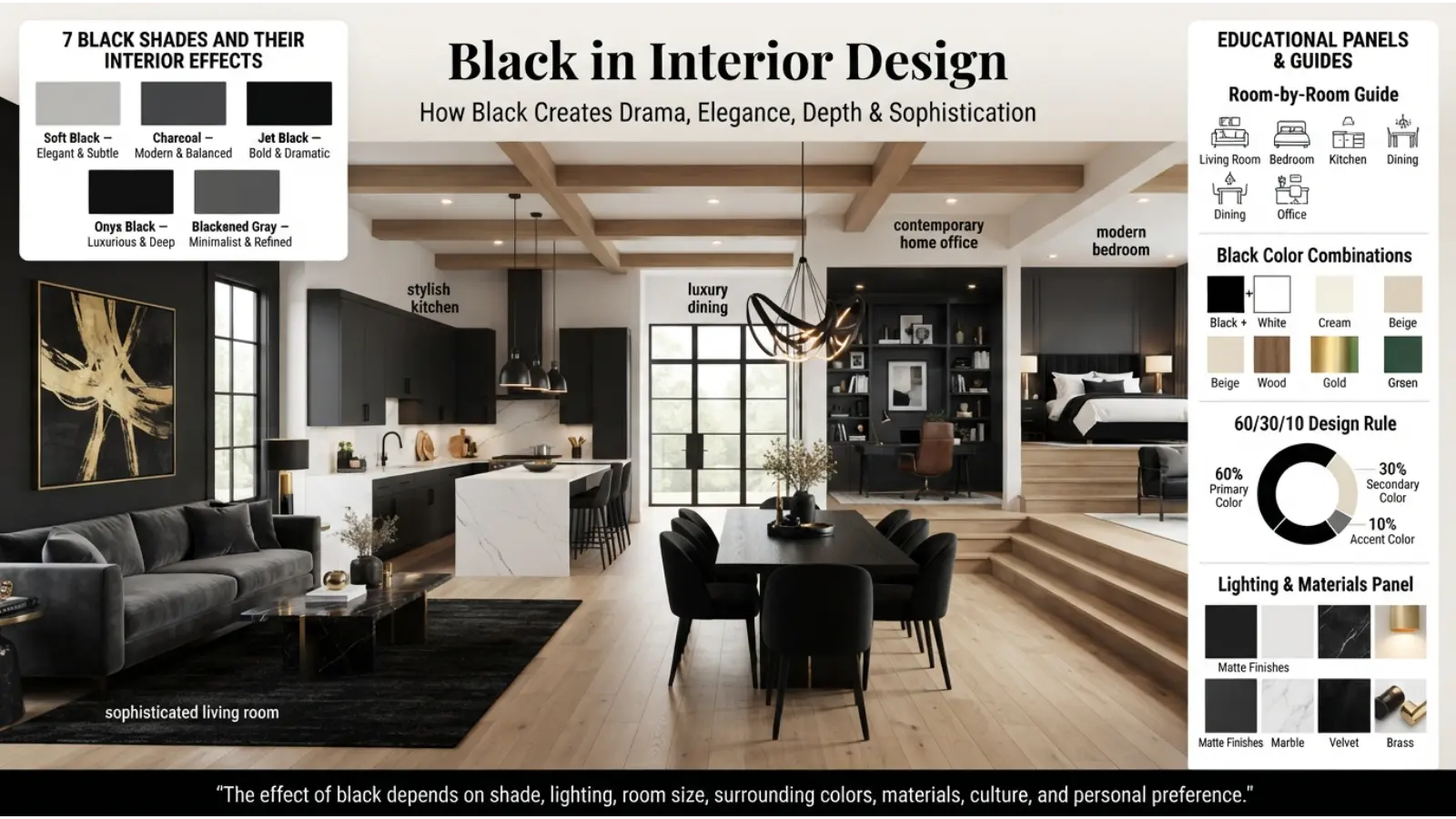
Black in Interior Design
Black can transform an interior, but it works best when its visual weight is considered carefully.
Living Room
Black furniture can anchor a living room and create a modern appearance. A black sofa, coffee table, or shelving unit can work particularly well with lighter walls and natural materials.
Wood, cream, beige, and warm white can soften the intensity of black.
Bedroom
Black can create an intimate and sophisticated bedroom. Rather than covering every surface in black, consider using it through bedding, curtains, furniture, artwork, or lighting fixtures.
Soft textures are especially useful because they prevent the room from feeling overly harsh.
Office
Black desks, shelving, chairs, or accent walls can give an office a focused and professional appearance.
Because black absorbs light visually, good lighting becomes more important. Natural light, task lighting, and lighter surfaces can maintain balance.
Kitchen
Black cabinets and countertops can create a contemporary look. They also pair naturally with wood, stone, white, stainless steel, and warm metallic finishes.
However, fingerprints, dust, and scratches may be more noticeable on some black finishes.
Lighting Matters
Lighting can dramatically change how black appears.
Under warm lighting, black surfaces may feel softer and warmer. Under cool lighting, they can appear sharper and more industrial.
Glossy black reflects surrounding light and colors, while matte black absorbs more light and usually looks quieter.
Black in Fashion
Black remains one of the most versatile colors in fashion.
A black outfit can appear formal, casual, dramatic, minimalist, rebellious, or elegant depending on its cut, fabric, accessories, and styling.
Formal Wear
Black suits, dresses, coats, and formal shoes are widely used because they create a polished appearance.
Casual Wear
Black jeans, T-shirts, jackets, hoodies, and sneakers offer easy combinations with many other colors.
Professional Appearance
Black can create a serious and structured appearance in workplaces where dark clothing is appropriate.
Nevertheless, professional dress codes vary. The meaning of black depends on the industry, workplace culture, and clothing style.
Accessories
Black bags, belts, watches, sunglasses, and shoes can add structure without competing with brighter colors.
This versatility makes black particularly useful when building a smaller wardrobe.
Black Color Combinations
Black works with almost every major color family, but each combination creates a different mood.
| Black + Color | Overall Impression |
|---|---|
| Black + White | Clean, classic, high contrast |
| Black + Red | Bold, dramatic, energetic |
| Black + Gold | Luxury, prestige, sophistication |
| Black + Silver | Modern, sleek, technological |
| Black + Blue | Calm, serious, contemporary |
| Black + Green | Natural, grounded, dramatic |
| Black + Purple | Mysterious, creative, luxurious |
| Black + Pink | Modern, playful, expressive |
| Black + Beige | Warm, elegant, understated |
| Black + Orange | Energetic, adventurous, striking |
The proportions matter just as much as the colors themselves. A small black accent beside a bright color creates a different effect from a mostly black design with a tiny colored detail.
Black in Art and Photography
Artists often use black to create contrast, depth, boundaries, and emotional tension.
In painting, black can define shapes and deepen shadows. However, many artists also create dark tones by mixing colors rather than relying entirely on pure black.
Photography uses black in a similar way. Deep shadows can hide details, direct attention toward illuminated subjects, and create a sense of mystery.
Black-and-white photography is especially powerful because removing color places greater attention on light, texture, expression, shape, and composition.
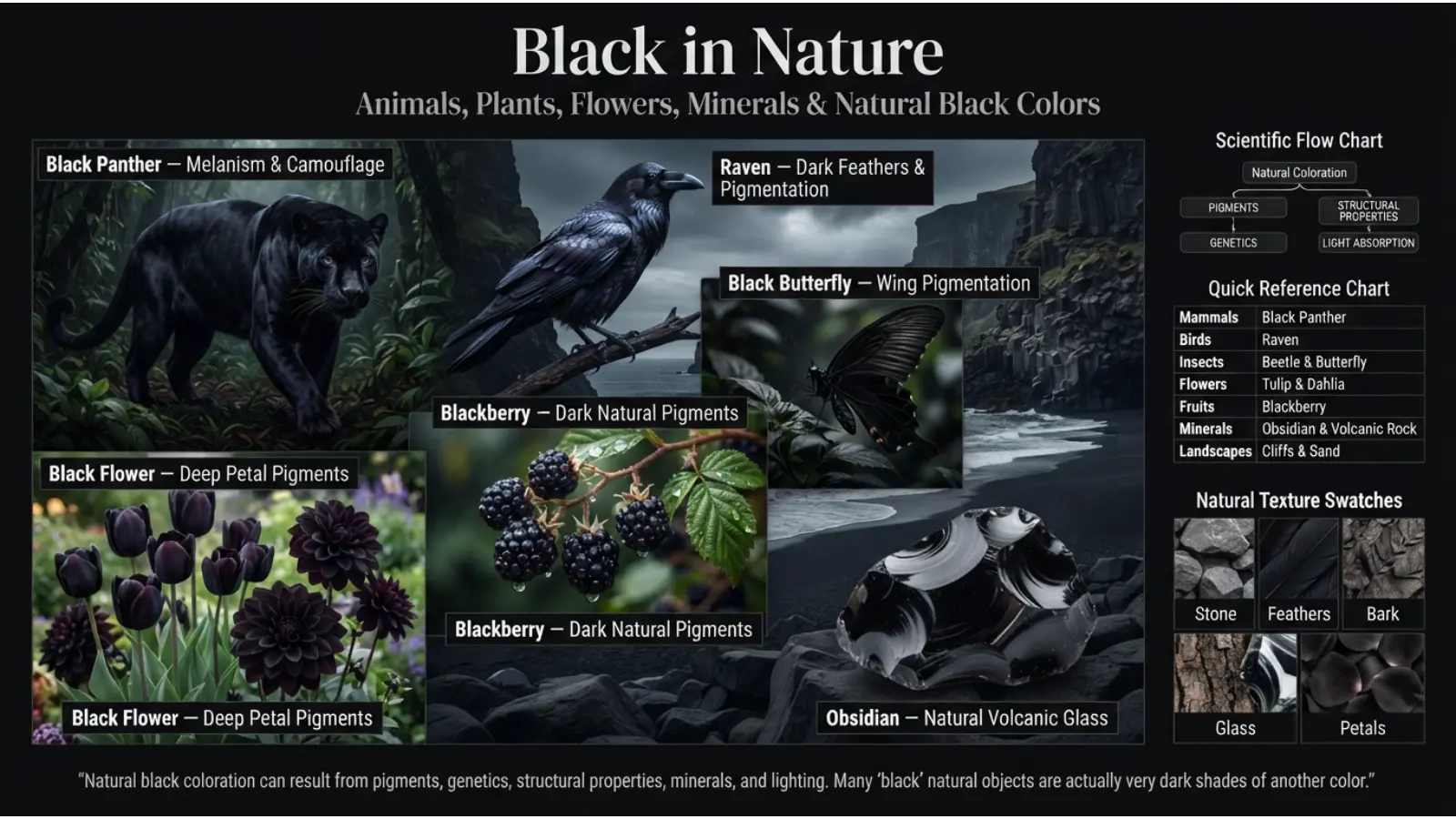
Black in Nature
Black appears throughout the natural world.
Night skies, volcanic rocks, dark soil, feathers, animal markings, tree bark, and deep water can all appear black or nearly black.
In nature, dark coloration may serve practical biological purposes such as camouflage, heat absorption, signaling, or protection, depending on the species and environment.
Therefore, the symbolic meaning humans attach to black should not be confused with the biological purpose of black coloration in nature.
Black in Entertainment and Popular Culture
Black frequently appears in movies, games, music, fantasy, and visual storytelling.
Characters dressed in black may be designed to look mysterious, powerful, dangerous, independent, or emotionally complex.
However, modern storytelling increasingly avoids treating black as automatically “evil.” A black costume can just as easily represent discipline, elegance, rebellion, or a character who operates outside conventional expectations.
In fictional worlds, black may also represent magic, technology, darkness, transformation, or hidden power. These meanings belong to the fictional setting rather than to a universal color code.
Black and Minimalist Design
Black is one of the strongest tools for minimalist design because it can communicate a lot without visual clutter.
A simple black logo, black text, or black geometric shape can provide structure while allowing surrounding negative space to remain important.
Minimalism does not mean using black everywhere. Instead, it often means using black deliberately.
For example, a mostly white page with carefully placed black typography can feel more sophisticated than a page filled with many competing colors.
Black and Accessibility
Color should never be chosen only for appearance when information needs to be understood.
Black text on a light background can provide strong contrast, but designers should also consider font size, weight, spacing, and the overall visual environment.
Likewise, black should not be the only visual signal used to communicate important information. People with different forms of color vision deficiency may not distinguish some color combinations in the same way.
Using text labels, icons, patterns, or shapes alongside color can make designs more understandable.
How Lighting Changes Black
Black is not visually identical under every light source.
A black fabric may appear slightly blue, brown, gray, or green depending on nearby colors and illumination. Glossy surfaces also reflect their surroundings, meaning that the “black” object may visually contain colors from the room.
This is especially important in interior design, photography, fashion, and product photography.
Consequently, always evaluate black under the lighting conditions where it will actually be used.
Common Misconceptions About Black
Does black always mean death?
No. Black is associated with mourning and death in many contexts, but it also represents elegance, authority, minimalism, strength, and luxury.
Is black a negative color?
Not necessarily. Its emotional effect depends on context. A black luxury package and a black mourning outfit communicate very different ideas.
Does wearing black mean someone is depressed?
No. Clothing color cannot diagnose someone’s emotional or mental state.
Does black always represent evil?
No. Fiction sometimes uses black to represent villains or darkness, but black also represents heroes, elegance, independence, mystery, and strength.
Is black scientifically proven to make people powerful?
There is no simple scientific rule saying that wearing black makes someone powerful. Clothing and color can influence impressions, but reactions depend on context, culture, expectations, and individual experience.
Real-World Uses of Black
Black is useful because it can adapt to many environments.
In daily life, it appears in clothing, electronics, vehicles, furniture, appliances, and accessories.
Business, it can create a professional and controlled visual identity.
In marketing, it can make products feel premium or dramatic.
In art, it can create depth, contrast, and emotional intensity.
Photography, it can strengthen shadows and focus attention.
In home decoration, it can anchor a room and add contrast.
Fashion, it provides one of the easiest bases for combining different styles.
In sports, black uniforms can create a strong team identity, although practical factors such as heat absorption and visibility may also matter.
In entertainment, black often supports themes involving mystery, power, sophistication, rebellion, or the unknown.
Why Context Changes Black Color Meanings
The same black object can communicate completely different ideas in different circumstances.
Consider a black dress. At a formal event, it may communicate elegance. At a funeral, it can communicate mourning. In a rock concert, it may suggest rebellion. In a luxury advertisement, it may suggest exclusivity.
The color has not changed. The context has.
This is one of the most important ideas in understanding color symbolism: meaning comes from the relationship between color, object, environment, culture, and viewer.
Black Color Meanings at a Glance
| Context | Common Black Association |
|---|---|
| Psychology | Seriousness, control, mystery |
| Fashion | Elegance, sophistication, versatility |
| Branding | Luxury, authority, premium quality |
| Interior design | Drama, depth, modernity |
| Spiritual symbolism | Mystery, protection, transformation |
| Mourning | Grief, remembrance |
| Art | Contrast, depth, shadow |
| Photography | Drama, focus, atmosphere |
| Technology | Modernity, precision, power |
| Minimalism | Simplicity, structure, restraint |
| Popular culture | Mystery, rebellion, power |
| Nature | Darkness, camouflage, strength |
Frequently Asked Questions
What is the main meaning of black?
Black commonly represents power, sophistication, mystery, authority, elegance, seriousness, protection, mourning, and the unknown. The specific meaning depends on context and culture.
What does black symbolize spiritually?
Spiritually, black may symbolize mystery, protection, transformation, endings, depth, or the unknown in some traditions. These meanings vary considerably between spiritual and cultural systems.
What does black mean in psychology?
Black can be associated with seriousness, control, independence, sophistication, mystery, and sometimes sadness or isolation. However, color responses vary between individuals and situations.
What personality does black represent?
Black is sometimes associated with independence, confidence, privacy, sophistication, and practicality. However, liking black does not reliably determine someone’s personality.
Why is black associated with luxury?
Black can look refined and restrained, especially when paired with clean typography, high-quality materials, metallic accents, or minimalist layouts. These visual cues can create a premium impression.
Why is black associated with mourning?
In many Western societies, black clothing became strongly associated with funerals and mourning. However, mourning colors differ across cultures and historical periods.
What colors go well with black?
Black pairs well with white, red, gold, silver, blue, green, purple, pink, beige, and many other colors. The best combination depends on the mood and purpose of the design.
Is black a warm or cool color?
Black is generally treated as a neutral rather than simply warm or cool. Its perceived temperature can shift depending on nearby colors, lighting, and undertones.
Why does black look different in different lighting?
Black surfaces reflect some surrounding light and color, while their material and texture also affect appearance. Consequently, black can look warmer, cooler, softer, or more reflective in different environments.
Does black always represent power?
No. Power is one possible association, but black can also represent elegance, grief, mystery, simplicity, rebellion, formality, or the unknown.
Final Thoughts on Black Color Meanings
Black is powerful precisely because it does not have one fixed message. It can make a design feel luxurious, a room feel dramatic, clothing look sophisticated, or a photograph feel mysterious. At the same time, it can communicate mourning, seriousness, or uncertainty when the surrounding context calls for those meanings.
The most useful way to understand black color meanings is to look beyond the color itself. Consider the culture, object, setting, lighting, surrounding colors, historical background, and personal experience.
For designers and marketers, black can provide structure and visual authority.Artists, it can create depth and contrast.Fashion, it offers remarkable versatility. For everyday life, it remains one of the easiest colors to combine and adapt.
Ultimately, black is less about a single emotion and more about contrast, context, and interpretation. Its strength comes from the many different stories people can see in the same dark shade.

Emma Wilson is a dedicated comparison writer and product researcher at ColorMystiic.com. She specializes in creating unbiased product comparisons, detailed reviews, and helpful buying guides. Her goal is to help readers make smarter purchasing decisions with confidence.