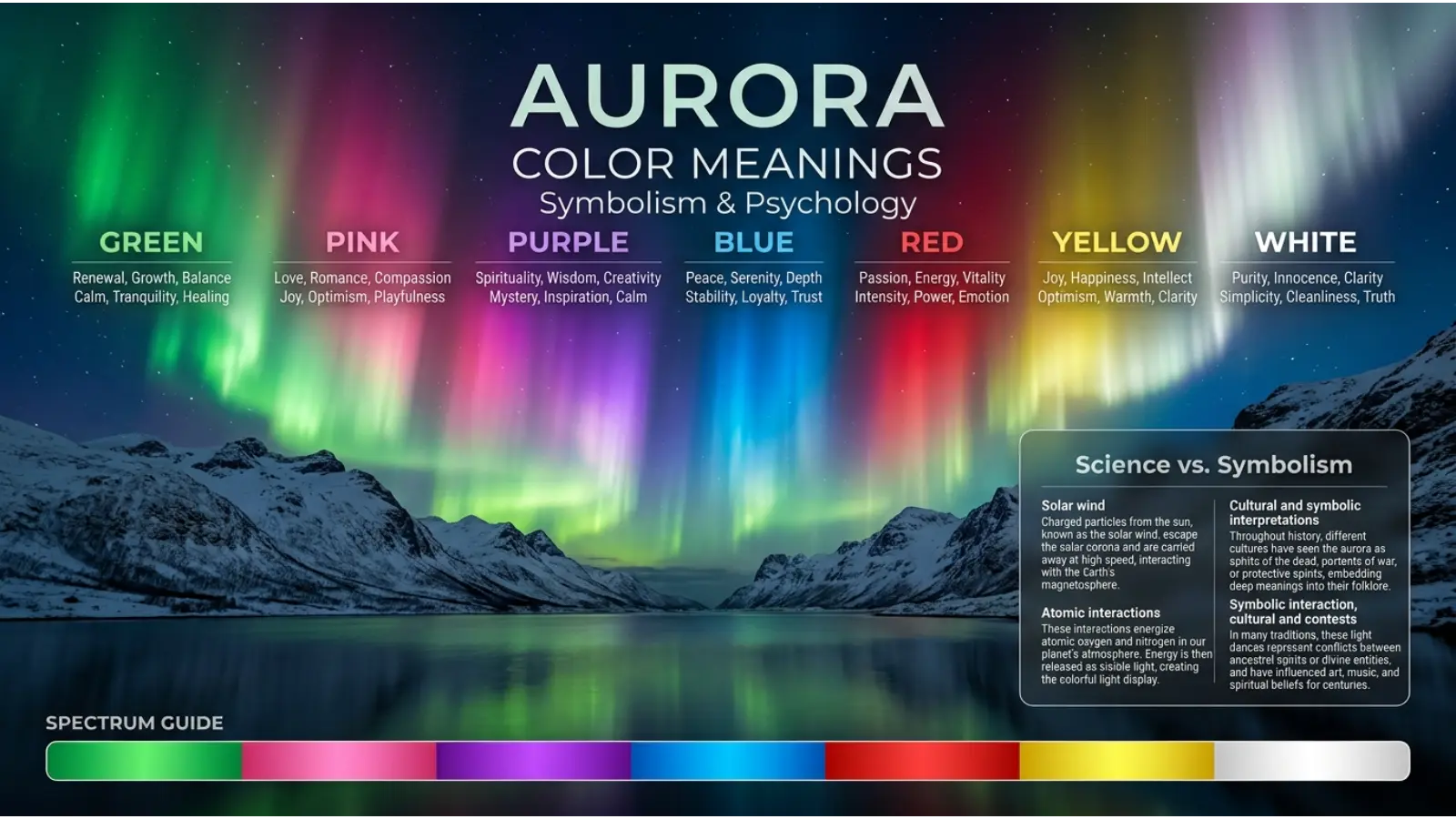
Auroras are among nature’s most striking displays. Green curtains of light, red glows, violet edges, and blue tones can transform the night sky into something that feels almost unreal. Because of this unusual beauty, people often search for aurora color meanings to understand what different aurora colors represent scientifically, emotionally, spiritually, and symbolically.
However, there is an important distinction. An aurora does not choose a color because it has a human emotion or spiritual message. Its visible colors are produced by energetic particles interacting with gases in Earth’s upper atmosphere. In other words, aurora colors have a physical cause, while their symbolic meanings come from human interpretation.
That distinction makes auroras especially interesting. Scientifically, color can reveal information about atmospheric gases and altitude. Artistically, the same colors can suggest mystery, hope, transformation, energy, peace, or wonder.
Meanings also change with context. A green aurora in a photograph may suggest nature and renewal, while the same green in a brand can communicate freshness or environmental awareness. Likewise, a red aurora can represent energy and passion in symbolism, even though its scientific cause is very different.
This guide explores the science behind aurora colors, their common symbolic associations, psychological impressions, cultural interpretations, design applications, photography, fashion, and practical ways to use aurora-inspired colors.
Quick Answer
Aurora color meanings depend on both science and symbolism. Green is commonly associated with nature, renewal, balance, and hope; red with energy, intensity, and transformation; blue with calm, depth, and mystery; purple or violet with imagination and spirituality; while pink can suggest creativity and wonder. Scientifically, however, aurora colors are produced by excited atmospheric gases emitting light at different wavelengths.
Aurora Color Meanings at a Glance
| Aurora Color | 🌈 Common Symbolism | 🔬 Main Scientific Association | 🎨 Overall Impression |
|---|---|---|---|
| 🟢 Green | Growth, hope, renewal, balance | Oxygen | Fresh, peaceful, natural |
| 🔴 Red | Energy, power, passion, transformation | Oxygen at higher altitude | Dramatic, intense |
| 🔵 Blue | Calm, depth, mystery, trust | Nitrogen | Cool, mysterious |
| 🟣 Purple/Violet | Imagination, spirituality, creativity | Nitrogen and mixed emissions | Magical, expressive |
| 🩷 Pink | Joy, creativity, excitement | Strong auroral activity and mixed emissions | Vibrant, playful |
| ⚪ White | Purity, wonder, clarity | Multiple colors blending visually | Ethereal, luminous |
| 🟡 Yellow/Gold | Warmth, optimism, discovery | Usually mixed optical effects | Warm, energetic |
Key point: The scientific color of an aurora does not have a fixed spiritual or emotional meaning. Symbolic meanings are human interpretations that vary by culture and context.
What Does an Aurora Symbolize?
An aurora often symbolizes wonder, transformation, mystery, hope, and connection with nature. Unlike an ordinary colored object, an aurora appears to move, change shape, and disappear. As a result, people frequently connect it with experiences that feel temporary, rare, and powerful.
The idea of transformation is especially strong. An ordinary dark sky can suddenly become filled with moving light. Therefore, auroras can work as a visual metaphor for change, personal growth, new beginnings, or unexpected beauty.
They can also represent hope. Light appearing in darkness is a powerful visual contrast, so aurora imagery is often used when a message needs to feel optimistic without becoming overly cheerful.
At the same time, auroras can symbolize mystery. Their shifting forms are difficult to predict with the naked eye, which gives them a dreamlike quality.
Positive Aurora Symbolism
Common positive associations include:
- Hope
- Renewal
- Natural beauty
- Discovery
- Transformation
- Wonder
- Freedom
- Creativity
- Spiritual reflection
- Balance
- Inspiration
- New beginnings
More Complex Meanings
Aurora imagery does not always need to feel peaceful. Dark skies combined with intense red, violet, or blue light can create associations with:
- Mystery
- The unknown
- Emotional intensity
- Change
- Uncertainty
- Isolation
- Powerful natural forces
Consequently, the meaning depends heavily on the surrounding colors, composition, and situation.
Why Are Auroras Different Colors?
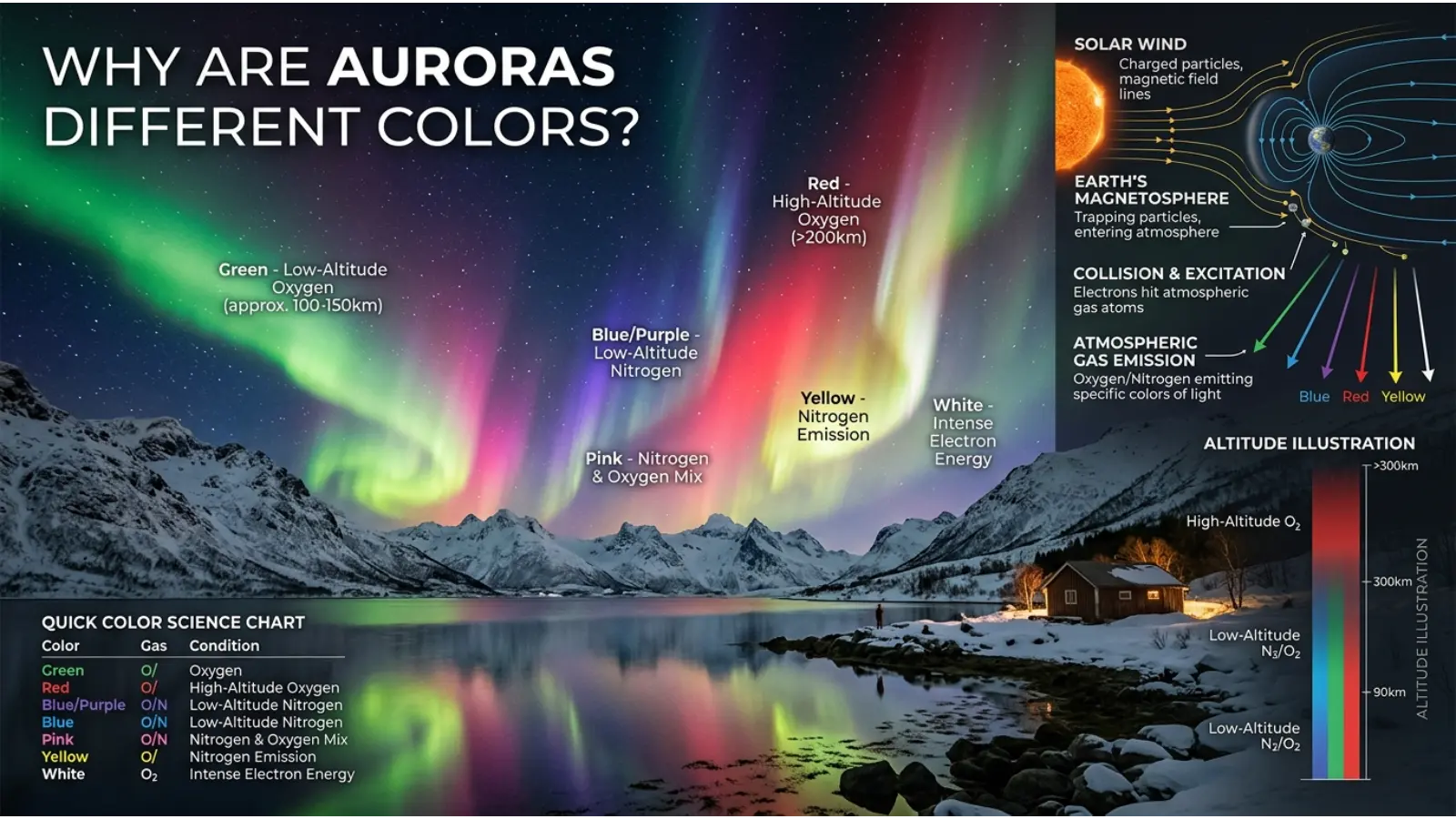
Aurora colors are created when energetic particles associated with solar activity interact with gases in Earth’s upper atmosphere.
When these particles collide with atmospheric atoms and molecules, they transfer energy to them. The excited particles then release some of that energy as light.
The color depends largely on which atmospheric gas is involved, the altitude of the emission, and the energy involved.
Green Aurora Meaning Scientifically
🟢 Green is the most familiar aurora color.
Much of the classic green aurora comes from oxygen emissions at altitudes where auroral activity commonly occurs. The green glow can form large curtains, arcs, rays, and waves across the sky.
Symbolically, green naturally connects the aurora with:
Nature → Growth → Renewal → Balance → Hope
That association is particularly strong because green already has powerful connections with vegetation and living systems.
Red Aurora Meaning Scientifically
🔴 Red auroras can occur when oxygen emits light at higher altitudes than the emissions responsible for the familiar green glow.
Because red is visually powerful, a red aurora often appears more dramatic than a green one. However, its scientific cause should not be confused with symbolic interpretations.
Symbolically, red can suggest:
- Energy
- Power
- Passion
- Courage
- Intensity
- Transformation
- Urgency
Therefore, red aurora imagery often feels more dramatic and emotionally charged.
Blue Aurora Meaning Scientifically
🔵 Blue auroral light is commonly associated with emissions from nitrogen molecules and ions.
Blue is less visually dominant in many typical auroral displays than green, but when it appears clearly, it can create a colder and more mysterious atmosphere.
Symbolically, blue is often connected with:
- Calm
- Trust
- Depth
- Peace
- Intelligence
- Mystery
- Reflection
As a result, blue aurora imagery works particularly well for designs that need to feel quiet, futuristic, or otherworldly.
Purple and Violet Aurora Meaning
🟣 Purple and violet tones can appear when different auroral emissions combine, particularly when blue or violet nitrogen emissions interact visually with other auroral colors.
Because purple is often associated with imagination and the unusual, violet auroras have a particularly strong fantasy-like quality.
Common symbolic associations include:
- Imagination
- Spiritual reflection
- Creativity
- Mystery
- Individuality
- Transformation
- Magic
However, these are symbolic interpretations rather than scientific properties of violet auroras.
Pink Aurora Meaning
🩷 Pink can appear in intense auroral displays when different emissions overlap or when the lower edges of auroral structures become strongly colored.
Pink tends to create a softer emotional impression than red while remaining energetic.
It can therefore symbolize:
- Creativity
- Joy
- Excitement
- Playfulness
- Romance
- Curiosity
- Emotional warmth
Pink aurora imagery is particularly popular in modern digital art because it combines the dreamlike quality of purple with the energy of red.
White Aurora Meaning
⚪ Auroras can sometimes appear white or pale to human observers, especially when several colors blend or when the light is relatively faint.
White symbolism adds another layer to the aurora concept:
- Purity
- Clarity
- Wonder
- Peace
- Openness
- Spiritual reflection
Because white light can make an aurora look almost cloudlike, it is often used in artistic representations that emphasize softness rather than dramatic color.
Aurora Color Meanings Psychology
Aurora colors can influence perception, but their psychological effects should not be treated as universal rules.
Color psychology depends on context, personal experience, culture, saturation, brightness, surrounding colors, and even lighting conditions. Therefore, saying that one aurora color automatically creates one emotion would be too simplistic.
Instead, think of aurora colors as visual cues.
Green: Calm Growth
Green often feels balanced because it sits between warm and cool color families.
In an aurora scene, green can suggest:
- Renewal
- Nature
- Peace
- Stability
- Hope
- Freshness
Its effect becomes stronger when surrounded by a dark blue or black sky.
Red: Emotional Intensity
Red attracts attention strongly and can create a sense of energy.
A red aurora can therefore feel:
- Powerful
- Dramatic
- Exciting
- Mysterious
- Intense
For artwork, red works best when the goal is to make the aurora feel extraordinary rather than gentle.
Blue: Quiet Mystery
Blue generally produces a cooler visual impression.
When used in an aurora scene, it can make the sky feel:
- Vast
- Quiet
- Cold
- Peaceful
- Mysterious
- Futuristic
Consequently, blue is useful for technology brands, meditation visuals, night photography, and atmospheric artwork.
Purple: Imagination and Wonder
Purple occupies an unusual position between red and blue.
It combines some of the visual warmth of red with the coolness of blue. Therefore, purple aurora imagery often feels imaginative, luxurious, mystical, or creative.
Pink: Playful Energy
Pink can soften the intensity of red while maintaining visual energy.
That makes pink aurora palettes useful for:
- Youthful branding
- Digital artwork
- Creative projects
- Lifestyle graphics
- Fantasy themes
- Social media visuals
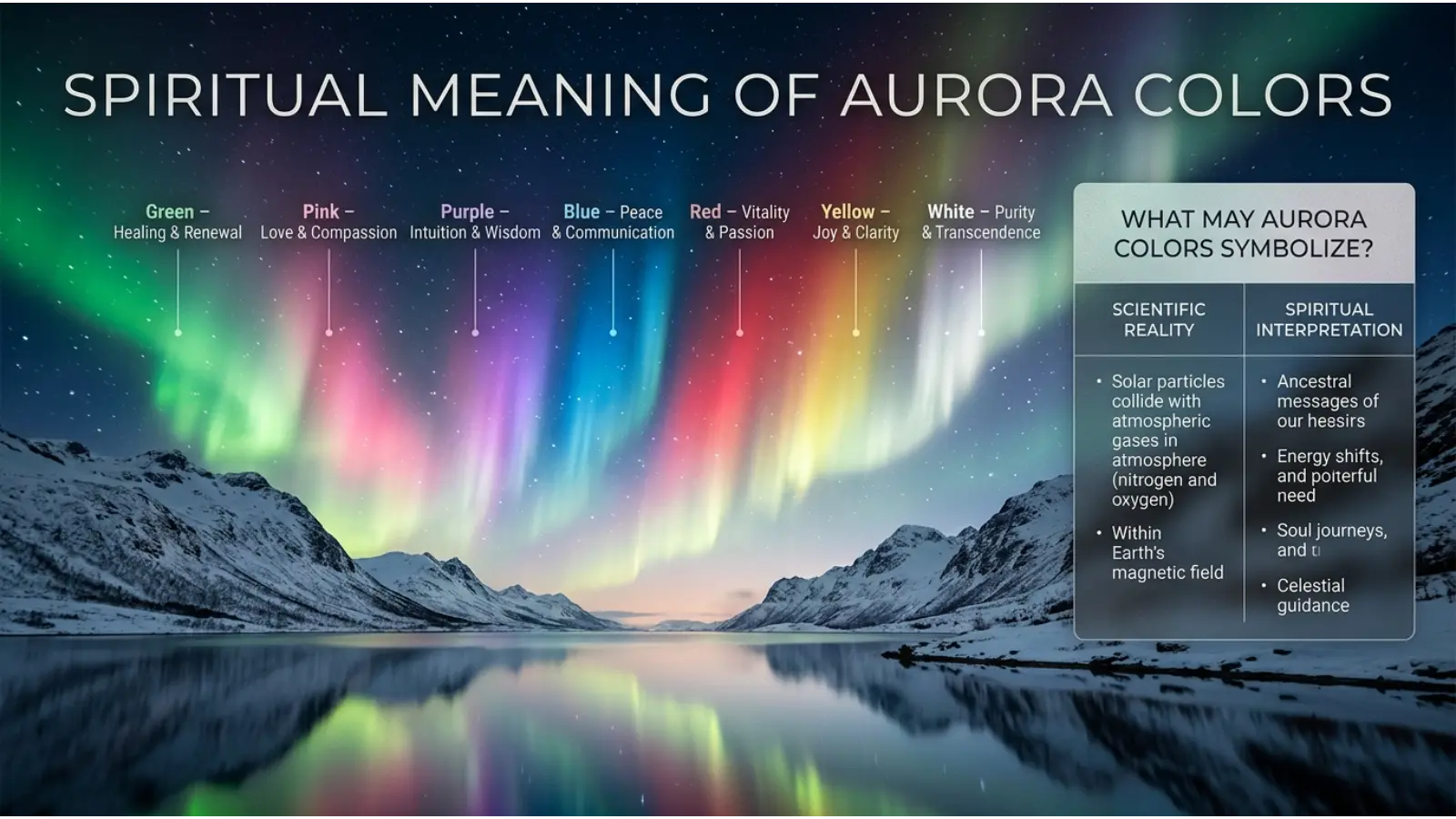
Spiritual Aurora Color Meanings
Auroras have inspired spiritual reflection in many parts of the world because they appear as enormous lights moving through the night sky.
However, there is no universal spiritual code that says a particular aurora color always carries one supernatural message.
Spiritual interpretations depend on individual beliefs, cultural traditions, and personal experiences.
🟢 Green Aurora Spiritual Meaning
Green may be interpreted symbolically as:
Healing • Renewal • Growth • Balance • Hope
Because green is strongly associated with life and nature, a green aurora can be used as a metaphor for personal renewal or emotional recovery.
🔴 Red Aurora Spiritual Meaning
Red can symbolize:
Strength • Courage • Passion • Energy • Transformation
A red aurora may therefore be interpreted as a powerful sign of change in symbolic or artistic contexts.
🔵 Blue Aurora Spiritual Meaning
Blue commonly represents:
Peace • Reflection • Wisdom • Trust • Emotional calm
A blue aurora can create a contemplative visual suitable for meditation and spiritual artwork.
🟣 Purple Aurora Spiritual Meaning
Purple often suggests:
Mystery • Imagination • Spirituality • Intuition • Transformation
Its unusual appearance makes it particularly effective in artwork focused on the unknown or transcendent.
🩷 Pink Aurora Spiritual Meaning
Pink can represent:
Love • Compassion • Joy • Creativity • Emotional openness
These associations are symbolic rather than scientifically established.
Cultural Aurora Color Meanings
Auroras do not have one universal cultural interpretation.
Different communities have developed their own stories and explanations for unusual lights in the sky. Historically, people often interpreted dramatic natural phenomena through the religious, mythological, or cultural frameworks available to them.
In some Northern and Arctic traditions, auroras became part of rich storytelling and spiritual worldviews. These traditions are diverse, however, and should not be reduced to a single “Indigenous meaning.”
European historical interpretations also varied. At different times, unusual sky lights could be regarded as warnings, signs, supernatural events, or simply remarkable natural phenomena.
Modern global culture has shifted strongly toward scientific explanation. Today, auroras are widely associated with:
- Adventure
- Travel
- Photography
- Natural beauty
- Exploration
- Astronomy
- Climate and space science
- Luxury travel experiences
This change demonstrates an important principle of color symbolism: meaning evolves as culture changes.
Historical Aurora Color Meanings
Before modern atmospheric science, people could not explain auroras in terms of solar particles, atmospheric gases, and magnetic fields.
As a result, unusual sky lights often generated stories and interpretations.
Over time, scientific investigation changed the way people understood the phenomenon. Today, the aurora is recognized as a natural consequence of interactions between Earth’s magnetosphere, solar activity, and the upper atmosphere.
The historical shift is significant because it shows that a natural color display can have two very different layers of meaning:
Physical explanation + cultural interpretation
Both can be studied without confusing one for the other.
Aurora Color Meanings and Personality Associations
People sometimes use color preference to describe personality. For example, someone who loves green auroras might be described as peaceful or nature-loving, while someone drawn to purple auroras might be considered creative.
These descriptions can be fun, but they should not be treated as personality tests.
A preference for an aurora color may reflect:
- Personal memories
- Favorite environments
- Cultural associations
- Fashion preferences
- Art style
- Mood
- Previous experiences
- Aesthetic taste
For example, someone may prefer blue simply because it reminds them of the ocean or nighttime skies.
So, color preference can reveal something about taste and associations, but it does not reliably determine personality.
Aurora Color Meanings in Branding & Marketing
Aurora-inspired palettes have become useful in branding because they combine natural beauty with a futuristic appearance.
The effect is especially strong when several colors blend gradually rather than appearing as separate blocks.
Why Brands Use Aurora-Inspired Colors
Aurora palettes can communicate:
- Innovation
- Imagination
- Technology
- Discovery
- Premium quality
- Creativity
- Nature
- Energy
- Wonder
A green-and-blue aurora palette can feel environmentally friendly and technologically advanced at the same time.
Meanwhile, purple, pink, and blue combinations can feel more creative and digital.
Aurora Branding Color Chart
| Color | Brand Impression | Useful Applications |
|---|---|---|
| 🟢 Green | Natural, fresh, balanced | Eco brands, wellness |
| 🔵 Blue | Trustworthy, modern, calm | Technology, finance |
| 🟣 Purple | Creative, premium, imaginative | Beauty, entertainment |
| 🩷 Pink | Friendly, expressive, youthful | Lifestyle, creative brands |
| 🔴 Red | Energetic, bold, powerful | Entertainment, sports |
| ⚪ White | Clean, simple, premium | Luxury, minimalist brands |
| 🌌 Navy | Deep, reliable, sophisticated | Corporate and technology |
Why Aurora Gradients Work
A traditional solid color communicates a fairly clear visual identity.
An aurora gradient does something different. It creates movement between colors.
Consequently, the viewer can perceive:
Change → Flow → Energy → Possibility
That makes aurora-style gradients especially useful for digital interfaces, technology products, gaming graphics, and creative services.
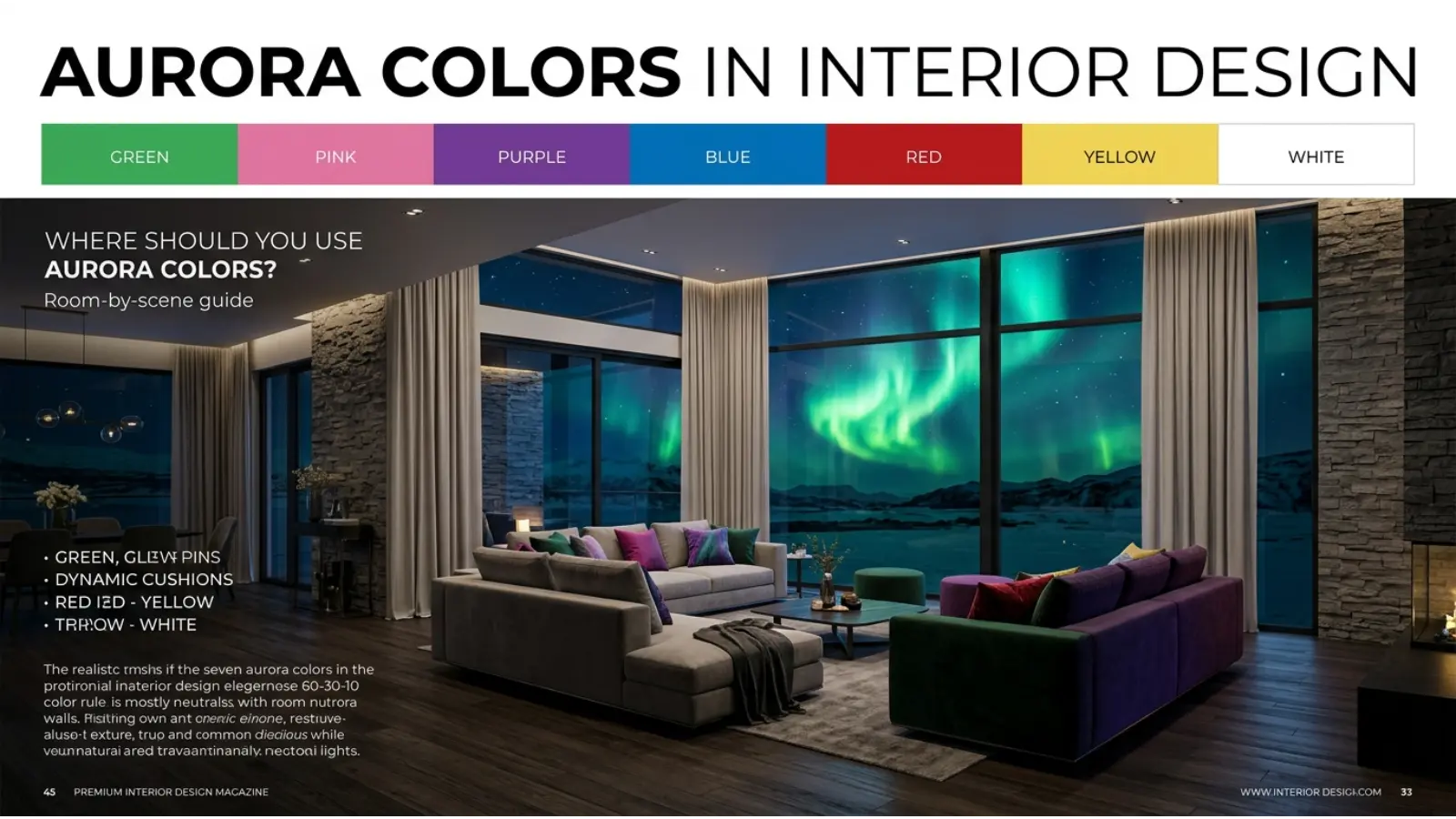
Aurora Color Meanings in Interior Design
Aurora colors can bring a dramatic night-sky atmosphere into a room without requiring every wall to become brightly colored.
The easiest approach is to use one dominant dark color with smaller glowing accents.
Living Room
Try:
- Deep navy walls
- Green or purple accent lighting
- Neutral furniture
- Soft white lighting
- Glass or metallic accessories
The result can feel modern while still maintaining a natural connection to the night sky.
Bedroom
Blue, violet, and muted green are especially useful when creating a quiet atmosphere.
Rather than using highly saturated colors everywhere, consider:
Dark blue + soft violet + warm white
This combination creates depth without making the room visually overwhelming.
Office
Aurora-inspired colors can make a workspace feel creative and modern.
A practical palette is:
Navy + teal + soft green + white
Use stronger colors in small areas, such as desk accessories, wall art, LED lighting, or a feature wall.
Lighting Matters
The same paint color can look completely different under different bulbs.
Cool lighting can make blue and violet appear stronger, while warm lighting can soften them and push some colors toward warmer tones.
Therefore, always test an aurora-inspired color palette under the actual lighting used in the room.
Aurora Color Meanings in Fashion
Aurora-inspired fashion works particularly well when colors are blended rather than sharply separated.
For example:
Emerald green + teal + violet
creates a sophisticated cosmic effect.
Meanwhile:
Purple + pink + blue
creates a more playful and expressive appearance.
Casual Style
Aurora colors work well in:
- Hoodies
- Sneakers
- T-shirts
- Jackets
- Bags
- Scarves
- Phone accessories
Formal Style
For formal clothing, use aurora colors more subtly.
A dark navy suit with a violet pocket square or green accessory can create an unusual accent without becoming too bright.
Accessories
Accessories are one of the easiest ways to use aurora symbolism.
Consider:
- Aurora-inspired jewelry
- Gradient handbags
- Multicolor watches
- Nail designs
- Scarves
- Shoes
- Hair accessories
Because the palette already contains several colors, keeping the rest of the outfit neutral usually creates a cleaner appearance.
Best Aurora Color Combinations
Aurora palettes work because neighboring and contrasting colors can blend into one another.
🟢 Green + 🔵 Blue
Meaning: Nature, peace, freshness, balance
This is one of the most natural aurora combinations because green and blue create a cool atmospheric effect.
🔵 Blue + 🟣 Purple
Meaning: Mystery, imagination, depth
This pairing works especially well for technology, fantasy, gaming, and night-sky designs.
🟣 Purple + 🩷 Pink
Meaning: Creativity, emotion, playfulness
Use this combination when the design needs more energy and personality.
🟢 Green + 🟣 Purple
Meaning: Transformation, fantasy, individuality
The contrast makes both colors more noticeable.
🔴 Red + 🟣 Purple
Meaning: Power, passion, intensity
This is a dramatic combination best used as an accent rather than a dominant room palette.
🌌 Aurora Gradient
Green → Teal → Blue → Purple → Pink
This is one of the most recognizable aurora-inspired sequences.
It creates a sense of movement because the eye naturally travels across the changing hues.
Aurora Colors in Art and Photography
Auroras are naturally suited to visual storytelling.
Photographers often use the dark landscape beneath the sky to create contrast. Mountains, lakes, forests, buildings, and people can provide scale.
The strongest compositions often include both sky and foreground.
Without a foreground object, an aurora can look beautiful but difficult to judge in terms of size. A mountain, tree, cabin, or person gives the viewer a visual reference.
Photography Color Choices
A camera can capture aurora colors differently from the human eye.
Long exposures may reveal colors that appear faint to the naked eye. Camera settings, white balance, lens characteristics, atmospheric conditions, and image processing can also change the final appearance.
Therefore, an intensely purple photograph does not necessarily mean the sky looked exactly that purple in person.
Aurora Colors in Digital Design
Aurora gradients have become popular in websites, apps, wallpapers, gaming graphics, and social media visuals.
They are especially effective when used as a background behind simple text.
For example:
Dark navy background + green-blue glow + white typography
creates strong contrast.
For a more creative design:
Deep purple + pink + blue gradient + white typography
can create a futuristic appearance.
However, accessibility still matters. Decorative gradients should not reduce text readability.
How Lighting Changes Aurora Color Meaning
Lighting can dramatically change how a color is perceived.
A green aurora displayed against a pure black sky can appear highly saturated. Against a lighter blue background, the same green may look softer.
Similarly, purple can appear:
- More blue under cool lighting
- More red under warm lighting
- More vivid against black
- More muted against gray
Therefore, color meaning cannot be separated completely from the environment surrounding it.
How Age and Culture Affect Color Interpretation
Color preferences and associations can change across age groups and cultures.
A younger audience may associate neon aurora gradients with gaming, technology, and digital art. Another audience may connect the same colors with nature, travel, astronomy, or photography.
Likewise, a color that feels luxurious in one cultural setting may have a different association elsewhere.
That is why global branding should never assume that one symbolic interpretation works everywhere.
Aurora Colors in Everyday Life
Aurora-inspired colors can be used in many practical settings.
Home Decoration
Use green, blue, and purple as accent colors rather than covering an entire room.
Digital Wallpapers
Dark backgrounds allow bright aurora gradients to stand out while remaining comfortable for nighttime viewing.
Graphic Design
Aurora gradients can add depth to posters, thumbnails, presentations, and social media graphics.
Fashion
Gradient fabrics and accessories can create an expressive appearance without requiring complicated patterns.
Photography
Aurora colors can guide editing decisions, although natural-looking results usually benefit from preserving the relationship between sky, landscape, and ambient light.
Entertainment
Games, films, fantasy artwork, and album covers often use aurora-like colors to suggest another world or an extraordinary environment.
Common Misconceptions About Aurora Colors
Myth 1: Every Aurora Color Has a Spiritual Message
There is no universal scientific system assigning spiritual meanings to aurora colors.
Spiritual meanings are interpretations, not established properties of light.
Myth 2: Green Is the Only Real Aurora Color
Green is common, but auroras can also display red, blue, violet, pink, and combinations of these colors.
Myth 3: A Red Aurora Always Means Something Dangerous
Red can look dramatic, but its color is explained by atmospheric emissions rather than a warning or supernatural message.
Myth 4: Aurora Colors Always Look the Same to the Human Eye
They do not.
Brightness, darkness, atmospheric conditions, vision, location, and camera exposure can all affect how the display appears.
Myth 5: Color Preference Reveals Your Personality
Color preferences may reflect personal associations and taste, but they cannot reliably diagnose personality.
Aurora Color Meaning Chart
| 🌈 Color | 🔬 Scientific Context | 💭 Symbolic Meaning | 🎨 Design Mood |
|---|---|---|---|
| 🟢 Green | Oxygen emission | Growth, renewal, hope | Natural, balanced |
| 🔴 Red | Higher-altitude oxygen emission | Power, passion, transformation | Dramatic |
| 🔵 Blue | Nitrogen-related emissions | Calm, trust, depth | Cool, modern |
| 🟣 Violet | Nitrogen/mixed emissions | Creativity, mystery, spirituality | Magical |
| 🩷 Pink | Mixed/intense auroral emissions | Joy, creativity, emotion | Playful |
| ⚪ White | Combined/faint colors | Purity, clarity, wonder | Minimal |
| 🟡 Gold | Mixed visual effect | Optimism, warmth, discovery | Warm |
Frequently Asked Questions
What do aurora colors mean?
Aurora colors have scientific and symbolic meanings. Scientifically, they result from different atmospheric emissions. Symbolically, green often suggests renewal, red energy, blue calm, and purple creativity or mystery.
What does a green aurora symbolize?
A green aurora commonly symbolizes growth, renewal, hope, balance, nature, and peace. These are symbolic associations rather than scientific meanings.
What does a red aurora symbolize?
Red auroras can symbolize energy, passion, courage, power, intensity, and transformation. Scientifically, red auroral emissions are associated with oxygen at higher altitudes.
What does a blue aurora mean spiritually?
In symbolic or spiritual interpretations, blue may represent peace, reflection, wisdom, trust, and emotional calm. There is no universal spiritual rule assigning this meaning to blue auroras.
What does a purple aurora represent?
Purple or violet auroras are often associated symbolically with imagination, creativity, mystery, individuality, and spiritual reflection.
Why are auroras usually green?
Green is common because oxygen in the upper atmosphere produces a strong visible green emission under conditions frequently associated with auroral displays.
Can auroras be red, blue, and purple?
Yes. Auroras can display several colors, including green, red, blue, violet, and pink. Different atmospheric emissions and altitudes contribute to the range of colors.
Are aurora colors connected to emotions?
Not scientifically in a direct sense. However, people naturally associate colors with emotions based on psychology, culture, experience, and symbolism.
What is the most peaceful aurora color?
Blue and green are commonly perceived as the most peaceful because both are generally associated with calmness, nature, balance, and quiet environments.
Why are aurora colors popular in design?
Aurora colors combine natural beauty with futuristic gradients. Therefore, they work especially well for technology, gaming, entertainment, photography, wellness, and creative branding.
Final Thoughts on Aurora Color Meanings
Auroras show how closely science, perception, culture, and symbolism can interact.
A green aurora is physically produced by atmospheric emissions, yet humans may see it as a symbol of renewal. A red aurora can be explained through atmospheric physics while also suggesting passion or power in artwork. Purple can be scientifically understood while still feeling mysterious and imaginative.
That contrast is what makes aurora color meanings so interesting.
The most useful way to understand these colors is to keep the two layers separate: science explains why the aurora has its color, while culture, psychology, art, and personal experience influence what that color means to us.
Whether you encounter an aurora in the night sky, a photograph, a fashion palette, a home interior, or a digital design, pay attention to the entire combination rather than one color alone. The background, lighting, neighboring colors, cultural context, and personal associations can completely change the impression.
In that sense, an aurora is more than a collection of colors. It is a moving example of how light can create both a physical phenomenon and a powerful human story.

Emma Wilson is a dedicated comparison writer and product researcher at ColorMystiic.com. She specializes in creating unbiased product comparisons, detailed reviews, and helpful buying guides. Her goal is to help readers make smarter purchasing decisions with confidence.