The northern lights are famous for their shifting ribbons of green, pink, purple, blue, yellow, and sometimes deep red. Scientifically, these colors are not random. They are produced when energetic particles from the Sun interact with gases in Earth’s upper atmosphere. The type of gas, altitude, and energy involved help determine which color appears.But people also search for northern lights color meanings because auroras feel deeply symbolic. A green aurora may suggest renewal and hope, while red can feel powerful, mysterious, or dramatic. Those symbolic meanings come from human associations with color rather than from the aurora itself.
That distinction matters. The colors have real scientific causes, while their emotional, spiritual, cultural, and artistic meanings depend on context. The same aurora can therefore be understood as a natural atmospheric event, a spiritual image, an artistic subject, or a symbol of wonder.
This guide explains what each northern lights color actually means scientifically, what people commonly associate with it emotionally and symbolically, how culture can influence interpretation, and how photographers, designers, artists, and marketers use aurora colors.
Quick Answer
Northern lights colors have two different kinds of meaning. Scientifically, green, red, blue, purple, pink, and yellow auroras result from different atmospheric gases, altitudes, and particle energies.
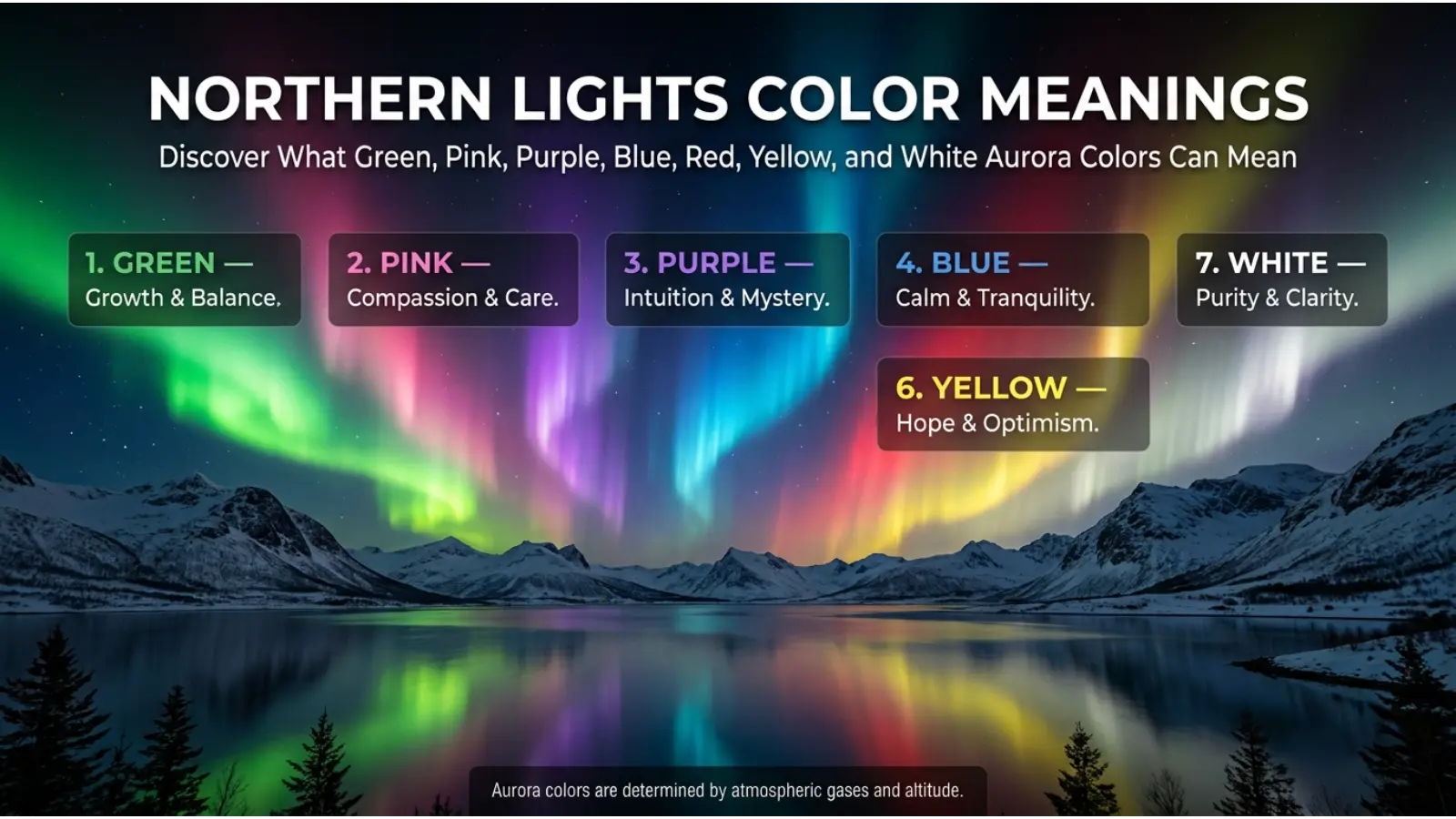
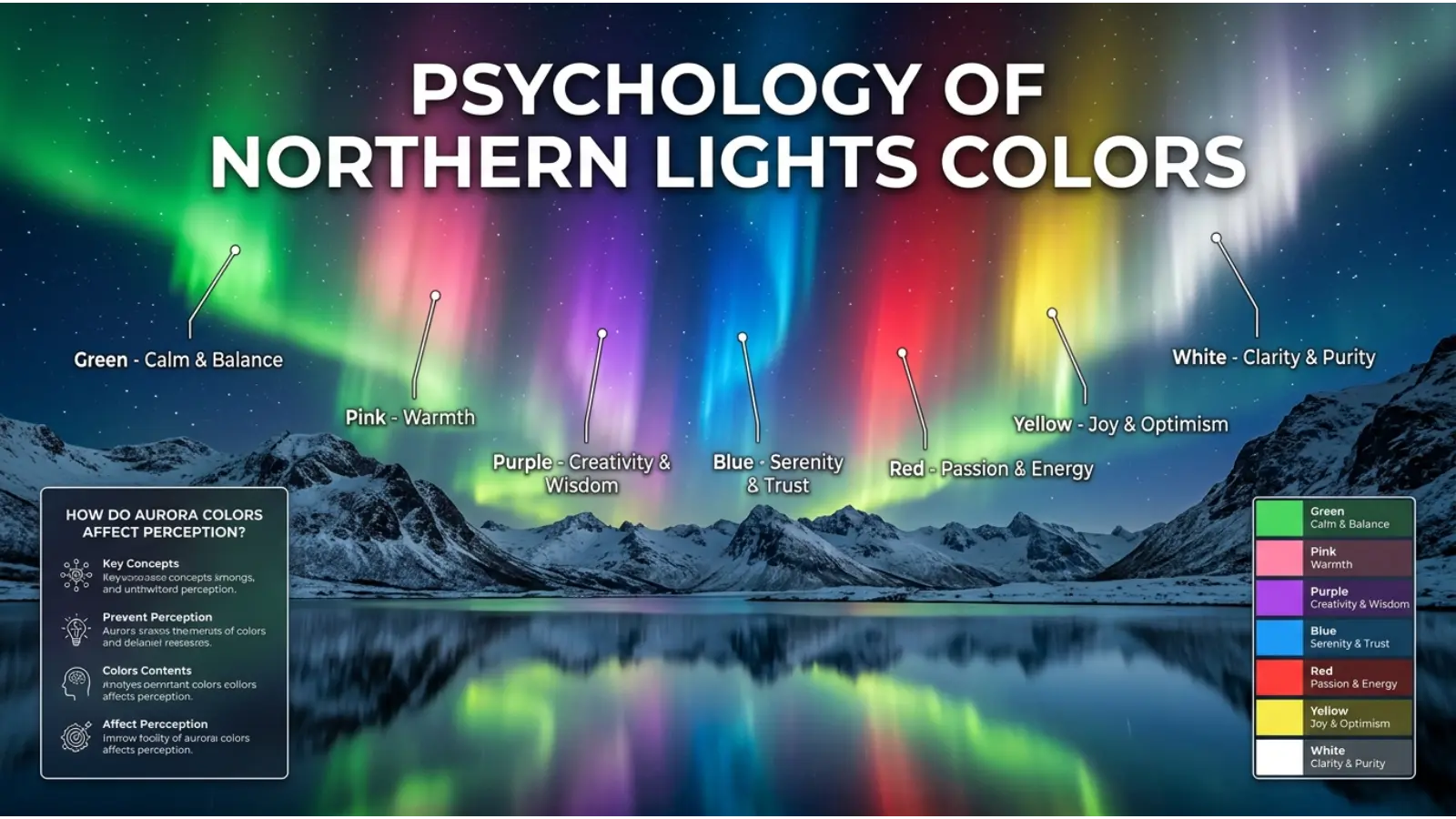
Symbolically, people often associate green with renewal and balance, red with power and intensity, blue with calm and mystery, purple with imagination and transformation, and pink with emotion and wonder. These symbolic meanings are cultural or personal interpretations, not scientific properties of an aurora.
Northern Lights Color Meanings at a Glance
| Aurora Color | Main Scientific Cause | Common Symbolic Association | Visual Impression |
|---|---|---|---|
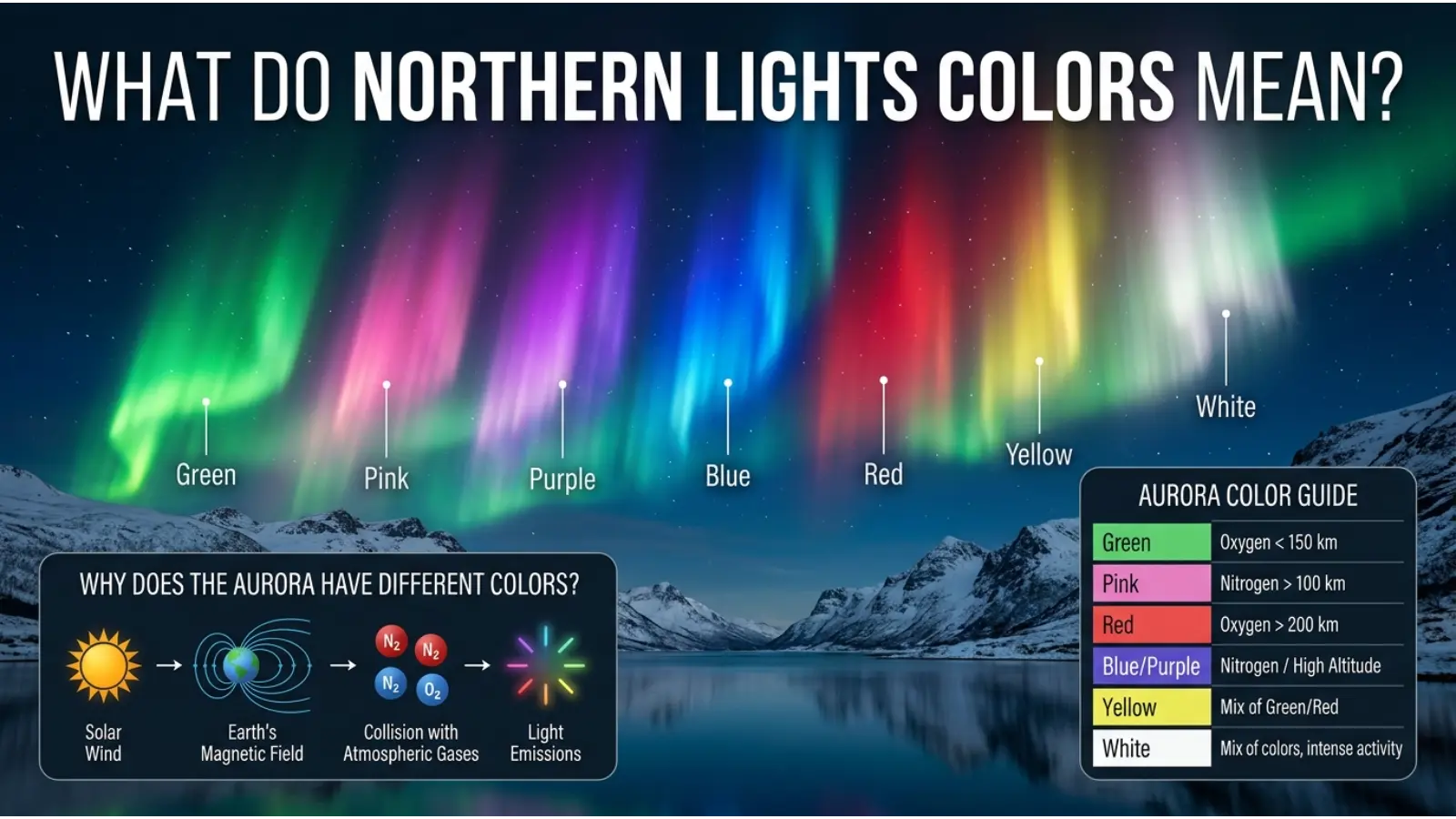
| 🟢 Green | Oxygen, commonly around 100–150 km altitude | Hope, renewal, balance | Bright, energetic, natural |
| 🔴 Red | Oxygen at higher altitudes | Power, passion, mystery | Dramatic, intense |
| 🔵 Blue | Nitrogen molecules/ions | Calm, mystery, depth | Cool, peaceful |
| 🟣 Purple | Nitrogen combined with red/blue emissions | Transformation, imagination | Magical, otherworldly |
| 🩷 Pink | Often a mixture of red and blue/purple emissions | Emotion, beauty, excitement | Vibrant, romantic |
| 🟡 Yellow | Often a visual blend of colors rather than a common pure auroral emission | Warmth, optimism, energy | Golden, glowing |
| ⚪ White | Multiple colors blending or appearing bright to human vision | Purity, wonder, openness | Soft, luminous |
What Do Northern Lights Color Meanings?
The most important thing to understand is that an aurora’s physical color and symbolic meaning are different things.
When solar particles reach Earth’s magnetosphere, some are guided toward the polar regions. They can collide with oxygen and nitrogen in the upper atmosphere. These collisions give atmospheric atoms and molecules extra energy. When that energy is released, light is produced.
The resulting color depends partly on which atmospheric particle is involved and where the emission occurs.
For example, green is strongly associated with oxygen emissions at altitudes where the conditions allow the characteristic green light to become visible. Red oxygen emissions generally occur higher in the atmosphere. Nitrogen contributes blue and violet tones.
Symbolically, however, there is no scientific rule saying that a green aurora “means” hope or that a red aurora “means” danger. Those interpretations come from broader human associations with colors.
This makes the northern lights unusual as a color-symbolism subject: the science explains why the color exists, while culture and psychology help explain why people feel differently when they see it.
Northern Lights Green Meaning 🟢
Green is by far the color most people associate with the northern lights.
Scientifically, the familiar green glow is primarily produced by excited oxygen atoms. It is especially common in auroras visible to the human eye.
What Does Green Aurora Symbolize?
Green commonly represents:
- Renewal
- Nature
- Hope
- Growth
- Balance
- Freshness
- Energy
- Harmony
These associations make green auroras feel alive and restorative. The connection becomes even stronger because the aurora appears in a natural environment, often above forests, mountains, snow, or open water.
Green can also symbolize change without destruction. A glowing green sky may suggest that something is transforming while remaining connected to nature.
Psychology of Green Aurora
Green often sits between the visual warmth of yellow and the coolness of blue. As a result, it can feel both energetic and calming.
In an aurora photograph, green can become especially powerful when surrounded by a dark sky. The contrast makes the color appear brighter and more active.
However, people do not respond identically to green. Personal experiences, culture, lighting, and surrounding colors can change the emotional response.
Northern Lights Red Meaning 🔴
Red auroras are less common in ordinary viewing conditions than green ones, which can make them seem especially dramatic.
Red auroral light is generally associated with oxygen emissions at greater altitudes than the green emission. Because the human eye is less sensitive to deep red light in low-light conditions, faint red auroras may be difficult to see without photographic equipment.
What Does a Red Aurora Symbolize?
Red is commonly associated with:
- Power
- Passion
- Energy
- Courage
- Intensity
- Warning
- Mystery
- Transformation
A red aurora can therefore produce a very different emotional impression from a green one.
Green may feel peaceful and natural, while red can make the sky seem intense or almost unreal.
Why Does Red Feel So Powerful?
Red is visually attention-grabbing in many contexts. It is widely used in warning signs, sports branding, advertising, and entertainment because it can create a strong sense of urgency or energy.
When red appears naturally across a night sky, that familiar visual intensity can be amplified by the unusual setting.
Still, a red aurora does not scientifically indicate danger or a supernatural event. Its color has an atmospheric explanation.
Northern Lights Blue Meaning 🔵
Blue auroras can occur through emissions involving nitrogen. Blue is often more difficult to observe clearly than the famous green aurora, particularly because human night vision is less sensitive to color under very dim conditions.
What Does a Blue Aurora Symbolize?
Blue commonly suggests:
- Calm
- Peace
- Depth
- Trust
- Mystery
- Reflection
- Stability
- Freedom
A blue aurora can therefore feel quieter and more distant than a bright green display.
Blue also has a strong connection with the night sky, oceans, and vast spaces. When it appears in an aurora, it can reinforce feelings of distance and wonder.
Blue Aurora Psychology
Blue is frequently perceived as cool and calming, although color psychology is highly dependent on context.
A blue aurora photographed above snow may feel peaceful. The same blue light combined with dark clouds, sharp mountain peaks, and high contrast could feel mysterious instead.
The surrounding visual environment matters just as much as the color itself.
Northern Lights Purple Meaning 🟣
Purple and violet auroras are often associated with nitrogen-related emissions and mixtures of different auroral colors.
In photographs, purple can appear particularly vivid because modern cameras can capture wavelengths and color combinations that are difficult for the human eye to distinguish clearly in dark conditions.
What Does a Purple Aurora Symbolize?
Purple is often connected with:
- Imagination
- Mystery
- Transformation
- Creativity
- Spirituality
- Individuality
- Fantasy
- The unknown
That makes purple especially popular in artwork and fantasy-inspired representations of the northern lights.
The color already has a long history of associations with unusual, luxurious, mystical, or imaginative themes. When it appears in the sky, those associations can become even stronger.
Northern Lights Pink Meaning 🩷
Pink auroras can occur when red and blue or purple components combine visually. Pink may also appear along the lower edges of strong auroral displays.
What Does a Pink Aurora Symbolize?
Pink commonly suggests:
- Emotion
- Beauty
- Affection
- Excitement
- Playfulness
- Wonder
- Creativity
Because pink is visually softer than red but warmer than blue, it can create a more emotional impression.
In photography, pink auroras can also make a scene feel more dramatic and colorful than a traditional green display.
Northern Lights Yellow Meaning 🟡
Yellow is not usually the main pure emission people think of when discussing auroras. Instead, yellow-looking areas may result from combinations of other colors, particularly when bright green, red, or other emissions blend visually.
What Does a Yellow Aurora Symbolize?
Yellow is commonly associated with:
- Optimism
- Warmth
- Happiness
- Energy
- Curiosity
- Creativity
- Light
A yellow or golden-looking aurora can therefore create a warmer emotional atmosphere.
Photographers may emphasize these golden tones by combining the aurora with warm foreground lighting, buildings, cabins, or reflections.
White Northern Lights Meaning ⚪
Auroras can sometimes appear white or pale when several colors blend together or when the light is bright enough to stimulate the visual system in a way that reduces obvious color separation.
This is an important reminder that what a camera records and what the human eye perceives are not always identical.
What Does White Aurora Symbolize?
White is often associated with:
- Purity
- Peace
- Openness
- Simplicity
- Wonder
- Spiritual reflection
Because white auroral light can look almost ethereal against a dark sky, artists sometimes use it to represent something mysterious, peaceful, or beyond ordinary experience.
Why Are the Northern Lights Different Colors?
The colors are primarily controlled by atmospheric chemistry, altitude, particle energy, and the way the resulting light reaches an observer.
Oxygen and Green Light
Excited oxygen atoms are responsible for the characteristic green emission seen in many auroras.
Oxygen and Red Light
At higher altitudes, oxygen can produce red auroral emissions. These emissions may be harder for the unaided human eye to see than bright green light.
Nitrogen and Blue or Purple Light
Nitrogen can contribute blue and violet emissions. When these combine with other auroral colors, pink and purple shades may appear.
Why Does Altitude Matter?
Different atmospheric particles and emission processes operate under different conditions. Therefore, color can provide clues about what is happening at different levels of the upper atmosphere.
So, an aurora is not simply “painted” one color. Its changing palette is a visible result of atmospheric physics.
Northern Lights Color Meanings Chart: Science vs. Symbolism
| 🌌 Color | 🔬 Scientific Interpretation | 💭 Common Human Association |
|---|---|---|
| 🟢 Green | Oxygen emission | Nature, renewal, hope |
| 🔴 Red | Higher-altitude oxygen emission | Power, passion, intensity |
| 🔵 Blue | Nitrogen-related emission | Calm, depth, mystery |
| 🟣 Purple | Nitrogen plus mixed emissions | Creativity, transformation |
| 🩷 Pink | Mixed red and blue/purple tones | Emotion, beauty, excitement |
| 🟡 Yellow | Often a visual mixture | Warmth, optimism |
| ⚪ White | Bright or blended emissions | Peace, purity, wonder |
The left side describes physical processes. The right side describes symbolic associations. They should not be treated as the same type of evidence.
Psychology of Northern Lights Color Meanings
Color psychology can help explain why different aurora photographs create different emotional responses, but it should not be overstated.
There is no established scientific rule that every person will experience a particular aurora color in exactly the same emotional way.
Instead, several factors interact.
Brightness Changes Emotional Impact
A bright green aurora can feel energetic because it strongly contrasts with a dark sky.
A faint green glow may feel much more peaceful.
Therefore, color alone does not determine mood. Brightness, contrast, movement, surrounding scenery, and personal expectations all matter.
Context Changes Meaning
A purple aurora above a quiet lake may feel mystical.
The same purple color in a commercial advertisement could suggest creativity or luxury.
Likewise, red can represent passion in one setting and danger in another.
This is why color symbolism should always be interpreted within context.
Movement Adds Another Layer
Unlike a painted color, an aurora moves.
Curtains can ripple, arcs can expand, and rays can shift across the sky. That movement can make the color feel more alive.
A static green object may communicate nature. A moving green aurora can communicate energy, transformation, and wonder.
Spiritual Meaning of Northern Lights Color Meanings
Auroras have inspired spiritual and supernatural interpretations in many societies, but these beliefs are not universal.
Some traditional stories and modern spiritual interpretations connect unusual lights in the sky with ancestors, spirits, messages, protection, or other supernatural ideas. However, specific beliefs vary greatly by community and historical period.
It is therefore misleading to claim that every Indigenous or northern culture had one single belief about the aurora.
Modern spiritual interpretations often use broader color symbolism:
| Color | Common Spiritual Association |
|---|---|
| 🟢 Green | Healing, growth, renewal |
| 🔴 Red | Strength, passion, life energy |
| 🔵 Blue | Peace, intuition, reflection |
| 🟣 Purple | Transformation, mystery, spiritual awareness |
| 🩷 Pink | Love, compassion, emotional openness |
| 🟡 Yellow | Joy, optimism, confidence |
| ⚪ White | Peace, clarity, purity |
These are symbolic interpretations, not scientific meanings or universal religious teachings.
Cultural Meaning of the Northern Lights Color Meanings
The northern lights have been observed by communities living in northern regions for thousands of years.
Their meanings have not been identical across cultures.
Indigenous and Northern Traditions
Different Indigenous peoples of the Arctic and sub-Arctic regions have developed their own stories, explanations, and relationships with the aurora.
Some traditional accounts describe the lights in connection with spirits, ancestors, games, signs, or supernatural beings. However, these traditions belong to specific communities and should not be combined into one generic “Indigenous belief.”
That distinction is especially important when writing about Indigenous cultures because a single symbolic explanation can erase major differences between nations and communities.
Scandinavian and European Folklore
Northern European folklore has also produced many interpretations of auroral lights. Historical explanations ranged from supernatural ideas to natural phenomena.
Over time, scientific understanding gradually replaced many supernatural explanations for the physical cause of the aurora.
Yet the emotional sense of mystery has remained.
Modern Global Culture
Today, the northern lights are strongly associated with:
- Arctic travel
- Adventure
- Natural beauty
- Photography
- Winter landscapes
- Environmental awareness
- Exploration
- Wonder
Social media has also transformed aurora imagery into a global visual symbol. A person who has never seen an aurora in person may still recognize its green and purple colors immediately.
Historical Meaning of the Northern Lights Color Meanings
Before modern atmospheric science, people naturally tried to explain unusual lights in the sky using the knowledge available to them.
Auroras were sometimes interpreted through religious, spiritual, supernatural, or natural frameworks depending on the society observing them.
Scientific understanding developed gradually. Today, researchers explain auroras through interactions between solar activity, Earth’s magnetic environment, and gases in the upper atmosphere.
This historical shift is useful because it shows how the meaning of a natural phenomenon can change without the phenomenon itself changing.
The same green light could once be interpreted as an omen and today be understood through space physics.
Do Northern Lights Colors Have Personality Meanings?
People sometimes use color preferences to describe personality. For example, someone attracted to green may be described as balanced or nature-loving, while someone drawn to purple may be called creative.
These descriptions can be fun, but they should not be treated as personality tests.
Green Aurora Personality
People who strongly prefer green aurora imagery may associate it with:
- Nature
- Peace
- Growth
- Fresh beginnings
- Stability
Purple Aurora Personality
Purple may appeal to people who enjoy:
- Creativity
- Fantasy
- Mystery
- Individual expression
- Unusual visual experiences
Red Aurora Personality
Red may attract people who enjoy:
- Energy
- Drama
- Boldness
- Adventure
- Strong visual contrast
These are associations, not psychological diagnoses. A color preference does not reliably determine someone’s personality.
Northern Lights Color Meanings in Branding and Marketing
Aurora colors have become useful in branding because they combine natural beauty with a sense of rarity.
Green can communicate nature and renewal. Blue can suggest calm and technology. Purple can create a more imaginative or premium feeling.
An aurora-inspired gradient can also communicate movement because several colors transition smoothly into one another.
Why Brands Use Aurora Gradients
Aurora-style gradients work well for:
- Travel companies
- Photography brands
- Outdoor products
- Technology
- Tourism campaigns
- Wellness concepts
- Creative businesses
- Entertainment
The visual effect is especially useful when a brand wants to appear modern without relying on a single flat color.
However, an aurora gradient can become visually confusing if too many saturated colors compete for attention. Strong branding usually needs a clear dominant color and supporting tones.
Northern Lights Colors in Interior Design
Aurora-inspired interiors can bring the feeling of a night landscape indoors without literally painting an entire room green.
Living Room
Use deep blue, charcoal, soft green, and small purple accents for a calm aurora-inspired space.
A dark wall can make lighter decorative colors appear brighter.
Bedroom
Blue and muted green work particularly well when the goal is a restful atmosphere.
Use purple as an accent rather than covering the entire room if you want to keep the design calm.
Office
A combination of deep navy, green, and restrained violet can create a creative environment without becoming visually overwhelming.
Lighting
Lighting changes color dramatically.
A green wall under warm yellow lighting may appear less green than it does under cool lighting. Likewise, purple can shift toward blue or red depending on the light source.
Therefore, always test paint, fabric, and lighting together before making a final design decision.

Northern Lights Colors in Fashion
Aurora-inspired fashion works especially well because the palette can range from subtle neutrals to highly dramatic gradients.
Everyday Style
Try:
- Navy + green
- Black + emerald
- Dark blue + purple
- Charcoal + violet
These combinations capture the aurora mood without looking like a costume.
Formal Fashion
Deep emerald, midnight blue, violet, and subtle metallic accents can create an elegant appearance.
Accessories
Aurora colors work especially well in:
- Scarves
- Jewelry
- Bags
- Shoes
- Nail designs
- Hair accessories
Seasonal Use
Deep green, navy, violet, and purple naturally fit winter-inspired styling. Brighter pink and turquoise accents can make the palette feel more contemporary.
Best Northern Lights Color Combinations
| Combination | Mood | Best Use |
|---|---|---|
| 🟢 Green + 🔵 Navy | Natural and calm | Interior design |
| 🟣 Purple + 🔵 Blue | Mysterious and creative | Digital design |
| 🟢 Emerald + ⚫ Black | Dramatic and premium | Fashion |
| 🩷 Pink + 🟣 Purple | Romantic and imaginative | Beauty |
| 🟢 Green + 🟡 Gold | Warm and luxurious | Branding |
| 🔵 Blue + ⚪ White | Clean and peaceful | Home design |
| 🟣 Purple + ⚫ Charcoal | Deep and sophisticated | Fashion and graphics |
The strongest combinations usually include one dominant color, one supporting color, and a neutral background.
How Lighting Changes Northern Lights Colors
A major mistake in color interpretation is assuming that a color always looks the same.
It does not.
The apparent color of an aurora can change because of:
- Brightness
- Camera exposure
- White balance
- Atmospheric conditions
- Moonlight
- Surrounding landscape
- Human night vision
Why Cameras See More Color
Human vision becomes less sensitive to color in very low light. Cameras can collect light over longer exposures, which may reveal red, purple, or blue tones that were difficult to see clearly in person.
This is one reason online aurora photographs can look much more intensely colored than a real-life viewing experience.
That does not necessarily mean the photographs are fake. It means cameras and human eyes process low-light scenes differently.
Northern Lights Colors in Photography
Aurora photography depends heavily on contrast.
A dark foreground can make green or purple light appear more vivid. Snow can reflect the aurora and add another layer of color to the scene.
For Green Auroras
Use dark trees, mountains, or buildings to create contrast.
For Purple and Pink Auroras
A dark blue sky can help these colors stand out.
For Red Auroras
Avoid excessive artificial foreground lighting because it can compete with subtle red atmospheric emissions.
Photography also changes the symbolic impression. A long-exposure image can make an aurora look smooth and dreamlike, while a shorter exposure can preserve more of its movement and structure.
Real-World Uses of Northern Lights Colors
Aurora-inspired color palettes appear far beyond astronomy photography.
Travel
Tourism campaigns often use green, blue, and purple gradients to represent northern landscapes and nighttime adventure.
Art
Artists can use exaggerated aurora colors to communicate emotions that are stronger than the natural scene.
Digital Design
Aurora gradients are popular in websites, wallpapers, apps, and promotional graphics because smooth color transitions create depth.
Fashion
Aurora palettes provide a way to combine multiple bold colors while maintaining a connection to nature.
Entertainment
Fantasy and science-fiction productions often use aurora-like colors to represent magical, futuristic, or mysterious environments.
Home Decoration
Deep blues and greens combined with violet accents can recreate the feeling of a night sky without copying an actual aurora.
Common Misconceptions About Northern Lights Colors
Myth 1: Every aurora is green
Not true. Green is common and highly recognizable, but auroras can also contain red, blue, violet, pink, and other blended tones.
Myth 2: Red auroras mean danger
There is no scientific basis for this idea. Red is produced by atmospheric processes, not because the aurora is warning observers about danger.
Myth 3: Purple means a spiritual message
Purple may have spiritual symbolism in some personal or cultural interpretations, but the color itself does not provide evidence of a supernatural message.
Myth 4: Cameras create fake auroras
Not necessarily. Cameras can capture colors that are difficult for human eyes to see in darkness. However, heavy saturation and editing can also make colors much stronger than they appeared naturally.
Myth 5: Each aurora color has one universal meaning
Color meanings depend on culture, context, personal experience, and the visual environment.
How to Remember Northern Lights Color Meanings
A simple way to remember the symbolic associations is:
🟢 Green = Growth
🔴 Red = Power
🔵 Blue = Calm
🟣 Purple = Mystery
🩷 Pink = Emotion
🟡 Yellow = Optimism
⚪ White = Wonder
For the scientific side, remember:
Oxygen → Green and Red
Nitrogen → Blue and Violet
This is a useful shortcut, but real auroral displays can contain mixtures and overlapping emissions.
Why Northern Lights Colors Feel Magical
The northern lights combine several features that humans naturally find visually powerful: darkness, movement, unusual color, scale, and rarity.
A green ribbon moving across a black sky is very different from seeing green paint on a wall.
The color gains meaning from its surroundings.
That is why the northern lights can represent wonder, transformation, freedom, mystery, and connection with nature even though none of those concepts are physical properties of green, purple, or red auroral light.
The science explains the event. Human perception gives the event emotional meaning.
Frequently Asked Questions
What is the most common northern lights color?
Green is the color most commonly associated with visible auroras. It is produced mainly by excited oxygen atoms in the upper atmosphere.
What does a green northern lights symbolize?
Symbolically, green auroras are often associated with nature, renewal, hope, growth, balance, and energy. These are human color associations rather than scientific meanings.
What does a red northern lights mean?
Scientifically, red auroral light is associated with oxygen emissions at higher altitudes. Symbolically, red is often connected with power, passion, intensity, and transformation.
What does a purple aurora mean spiritually?
Purple is often associated with mystery, imagination, transformation, and spiritual reflection. However, these are symbolic interpretations and are not universal religious meanings.
Why are the northern lights different colors?
Auroral colors depend on atmospheric gases, altitude, particle energy, and the way light is produced and observed. Oxygen commonly produces green and red emissions, while nitrogen contributes blue and violet tones.
Can northern lights be blue?
Yes. Blue auroral emissions can occur through interactions involving nitrogen. Blue can also appear alongside other colors, producing purple or pink visual effects.
Why do northern lights look more colorful in photos?
Cameras can collect more light during long exposures and may capture colors that are difficult for human eyes to see in darkness. Camera settings and image processing can also increase color intensity.
Do northern lights have spiritual meanings?
Different cultures and individuals have developed spiritual or supernatural interpretations of auroras. These beliefs vary, so there is no single universal spiritual meaning for the northern lights.
What color northern lights are rarest?
The rarity of a particular color depends on the atmospheric conditions and how the aurora is observed. Red and strongly blue or violet displays are generally less commonly seen by the unaided eye than the familiar green glow.
Can northern lights colors predict personality?
No. People may associate certain colors with personality traits, but choosing or liking an aurora color does not scientifically determine someone’s personality.
Conclusion
Northern lights colors are fascinating because they combine real atmospheric science with powerful human symbolism.
Green comes from a common oxygen emission and has become the visual signature of the aurora. Red can appear at higher altitudes, while nitrogen-related emissions contribute blue and violet tones. Pink, yellow, and white can emerge through combinations, brightness, and visual perception.
Beyond science, these colors can represent renewal, power, calm, mystery, creativity, emotion, and wonder. Yet those meanings are not universal rules. Culture, personal experience, lighting, surroundings, and expectations all shape how an aurora is perceived.
The best way to understand northern lights color meanings is to keep both perspectives in view: science explains why the sky shines, while symbolism explains what that sight can mean to us.

Emma Wilson is a dedicated comparison writer and product researcher at ColorMystiic.com. She specializes in creating unbiased product comparisons, detailed reviews, and helpful buying guides. Her goal is to help readers make smarter purchasing decisions with confidence.