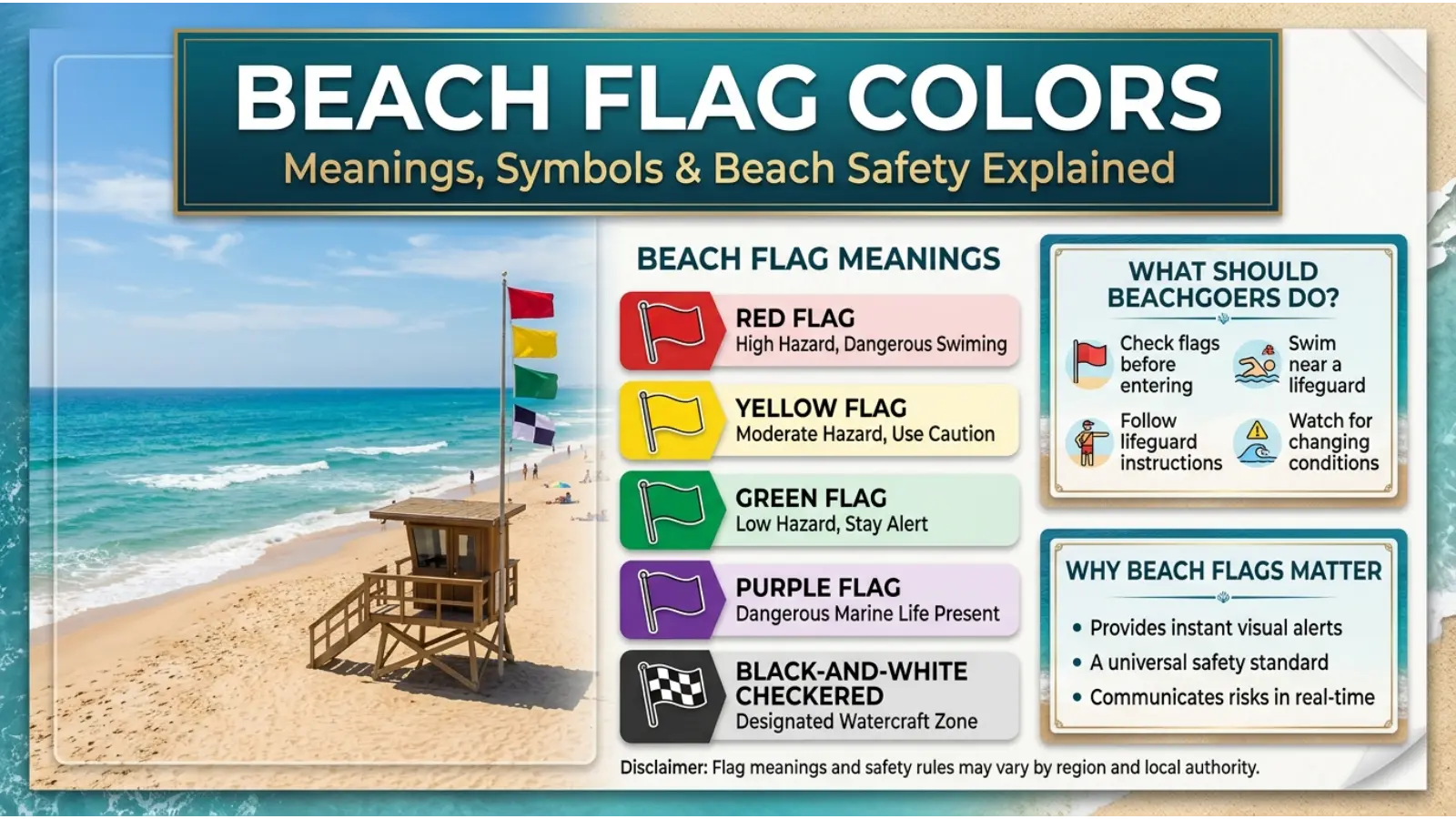
A day at the Beach Flag Colors can be relaxing, but the ocean can change quickly. Calm-looking water may hide strong currents, dangerous waves, or marine life. That’s why beaches use colored flags to communicate important safety information to visitors.
Understanding color flag meanings at beach locations helps swimmers, surfers, families, and tourists make safer decisions before entering the water. Each flag communicates a different warning or condition. For example, green often indicates lower hazard, yellow warns of moderate danger, and red signals serious swimming risks. However, flag systems can differ between countries and beaches.
Beach flags also have visual and psychological meanings. Their bright colors attract attention, communicate urgency, and help people recognize warnings from a distance. In this guide, you’ll learn what the most common beach flag colors mean, how to interpret them, why their colors are used, and how to respond to different warnings.
Quick Answer: What Do Beach Flag Colors Mean?
Beach safety flags communicate water conditions, swimming hazards, and other warnings.
| Flag Color | Common Meaning | Safety Message |
|---|---|---|
| 🟢 Green | Low hazard | Conditions are generally safer |
| 🟡 Yellow | Moderate hazard | Use caution |
| 🔴 Red | High hazard | Dangerous water conditions |
| 🟣 Purple | Dangerous marine life | Watch for jellyfish or other marine animals |
| 🔵 Blue | Varies by beach | May indicate marine hazards or a local warning |
| ⚫ Black | Varies by beach | May indicate a beach closure or other serious warning |
| 🟠 Orange | Varies by beach | May indicate dangerous conditions or a specific local warning |
| 🔴🔴 Double Red | Water closed | Do not enter the water |
Important: These are common interpretations, not a universal international standard. Always read the beach’s posted safety information and follow lifeguard instructions.
Understanding the Most Common Beach Flag Colors
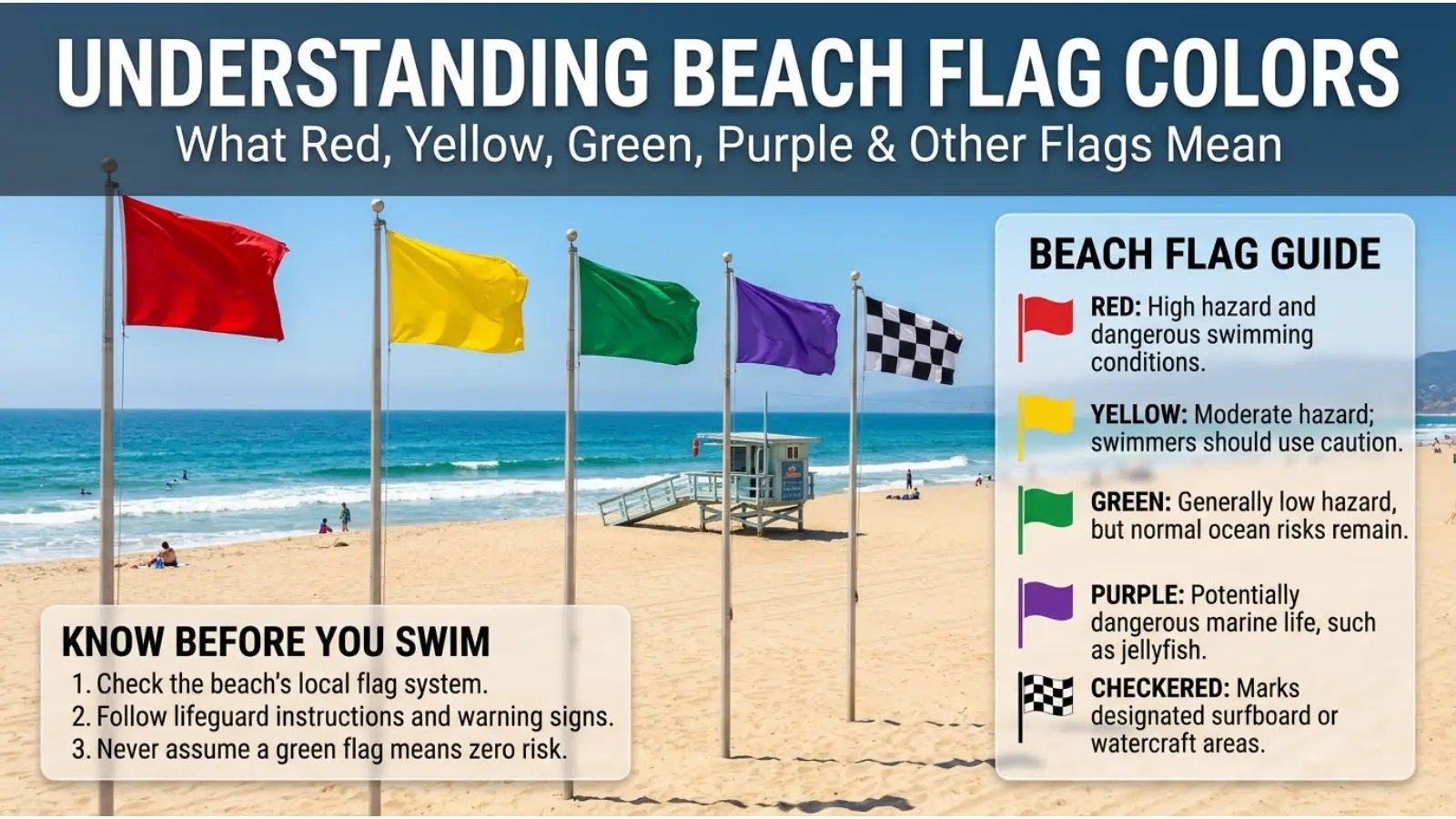
Green Beach Flag: Low Hazard
Low hazard
Generally calmer water conditions
A green beach flag usually indicates relatively calm water and a lower level of danger. Therefore, it is generally a positive signal for beach visitors who want to swim.
However, green does not mean completely safe. Ocean conditions can change without warning, and rip currents may still occur.
What green means for swimmers:
- Surf and currents are relatively mild.
- Swimming conditions are generally favorable.
- Visitors should continue following lifeguard instructions.
- Children and inexperienced swimmers still need supervision.
Color psychology and symbolism
Green is commonly associated with nature, balance, renewal, and safety. Its connection with plants and healthy landscapes makes it a familiar visual signal for lower risk.
In beach safety systems, however, its meaning comes from the official warning code rather than psychology alone.
Yellow Beach Flag: Moderate Hazard
Yellow flag
Medium hazard
Caution is required
A yellow beach flag warns visitors that swimming conditions may be challenging. Moderate waves, stronger currents, or other hazards may be present.
Although swimming may still be permitted, visitors should be more careful than they would be under a green flag.
What yellow means for swimmers:
- Moderate surf may be present.
- Currents can make swimming difficult.
- Weak swimmers should avoid entering challenging water.
- Children need close adult supervision.
- Lifeguard advice should be followed.
Color psychology and symbolism
Yellow naturally attracts attention because it is bright and highly visible in daylight. People often associate it with caution, warning signs, and alertness.
Consequently, beach authorities use yellow to communicate that visitors should slow down, assess the conditions, and make careful decisions.
ReadRed Beach Flag: High Hazard
Red flag
High hazard
Dangerous swimming conditions
A red beach flag communicates a serious warning. It commonly indicates strong currents, high surf, or other dangerous water conditions.
In many beach systems, visitors are strongly discouraged from entering the water. In some countries, a red flag means swimming is prohibited altogether.
What red means for swimmers:
- Strong currents may pull swimmers away from shore.
- Large waves can cause injuries.
- Swimming can become difficult even for experienced people.
- Visitors should follow local restrictions.
- When the flag means swimming is prohibited, stay out of the water.
Color psychology and symbolism
Red is one of the most recognizable warning colors. It is associated with danger, urgency, heat, and emergency signals.
Its strong contrast against sand, sky, and water helps attract attention. As a result, red is useful when a warning needs to be understood quickly.
Double Red Beach Flags: Water Closed
Double red flags
Water closed
Do not enter the water
Two red flags, often displayed one above the other, indicate that the water is closed to public use in systems that follow this convention.
This is more serious than an ordinary high-hazard warning. The closure may be related to dangerous surf, strong currents, contamination, marine animals, or another emergency.
What visitors should do:
- Do not enter the water.
- Keep children away from the shoreline if conditions are dangerous.
- Follow instructions from lifeguards and beach authorities.
- Wait for an official announcement before returning to the water.
Why two red flags?
Using two red flags makes the closure signal visually distinct from a single red warning. It communicates a clear restriction rather than simply suggesting extra caution.
Purple Beach Flag: Dangerous Marine Life
Purple flag
Marine life warning
Potentially harmful sea animals
A purple beach flag commonly warns visitors about potentially dangerous marine life in the water.
Depending on the location, this may include jellyfish, stingrays, Portuguese man-of-war, or other marine animals that can cause painful injuries.
What purple means for swimmers:
- Marine animals may be present.
- Jellyfish or stinging organisms may cause painful reactions.
- Visitors should avoid touching unfamiliar sea creatures.
- Lifeguards can explain the specific local warning.
An important distinction is that the standard purple flag does not automatically mean sharks are present. In the USLA warning system, purple is intended for marine pests, not shark warnings.
Color psychology and symbolism
Purple is traditionally associated with mystery, rarity, and the unknown. Its use for marine-life warnings creates a separate category from the familiar green, yellow, and red hazard levels.
Therefore, purple helps communicate a different type of danger rather than simply indicating stronger waves.
Blue Beach Flag: Water Sports or Local Information
Blue flag
Location-dependent
Check the local beach system
Blue beach flags do not have one universal swimming-safety meaning.
For example, some beach systems use blue flags or blue signs to identify areas reserved for surfing or other water activities. In other locations, blue may appear in environmental or beach-quality certification programs.
Visitors should never assume that a blue flag means the water is safe for swimming.
Why blue is used
Blue is strongly connected with the ocean, sky, cleanliness, and freshness. It is also a common information color in public signs.
However, the meaning of a blue beach flag depends on the authority that displays it.
Black Beach Flag: A Special Warning or Activity Signal
Black flag
Location-dependent
Check the displayed instructions
A plain black beach flag does not have a consistent meaning across all countries and beaches.
It may be used in a local warning system, an event, or a specific beach-management program. In addition, black-and-white checkered flags have a recognized water-sports meaning in several major beach safety systems.
Never assume that a plain black flag automatically means the beach is closed.
Orange Windsock: Dangerous Wind Conditions
Orange windsock
Wind warning
Inflatables may be unsafe
An orange windsock is not an ordinary rectangular beach flag. It is a cone-shaped fabric signal that shows wind direction and warns about potentially dangerous wind conditions.
In particular, offshore winds can carry inflatable toys, air mattresses, and small floating objects away from the beach.
What visitors should do:
- Avoid inflatable swimming toys.
- Keep children close to adults.
- Pay attention to wind direction.
- Follow lifeguard instructions.
Its bright orange color is useful because it stands out against the sky and surrounding beach environment.
Red and Yellow Beach Flags: Lifeguard-Supervised Swimming Area
Red and yellow flags
Lifeguard-supervised area
Swim between the designated flags
Red-and-yellow flags have a different purpose from ordinary warning flags. They identify an area supervised by lifeguards.
At many beaches, two sets of these flags mark the recommended swimming zone. Therefore, visitors should swim between them rather than choosing an unpatrolled section of the beach.
This system helps lifeguards monitor swimmers and respond more quickly when someone needs assistance.
Black and White Checkered Flags: Water Sports Area
Black-and-white checkered flag
Watercraft zone
Surfboards and other watercraft
A black-and-white checkered flag commonly marks a designated area for surfboards and other watercraft.
It separates people using boards or similar equipment from ordinary swimming areas.
For this reason, swimmers should avoid entering a marked watercraft zone unless local instructions specifically allow it.
The contrast between black and white makes the pattern easy to recognize from a distance.
These meanings are based on established lifesaving guidance and examples from national and local beach authorities. United States Lifesaving Association+3
Color Chart: All Beach Flag Meanings at a Glance
The following chart brings the main signals together in one simple reference.
| Color or Pattern | Common Meaning | Recommended Action |
|---|---|---|
| 🟢 Green | Low hazard | Swim cautiously |
| 🟡 Yellow | Moderate hazard | Use extra care |
| 🔴 Red | High hazard | Avoid entering |
| 🔴🔴 Double red | Water closed | Stay out |
| 🟣 Purple | Dangerous marine life | Watch for marine animals |
| 🔵 Blue | Local activity or information | Check local signs |
| ⚫ Black | Local meaning | Ask a lifeguard |
| 🟠 Orange windsock | Offshore wind warning | Avoid inflatables |
| 🔴🟡 Red and yellow | Lifeguard-supervised zone | Swim between flags |
| ◼️◻️ Black and white | Watercraft zone | Keep swimming separate |
This is a general reference, not a replacement for the official flag guide at your beach.
Why Do Beaches Use Different Flag Colors?
Beach flags are designed to communicate safety information quickly. A visitor may not have time to read a long notice before entering the water. Therefore, a simple visual signal can help people recognize a warning immediately.
Several factors explain why colors are used.
Fast Visual Recognition
Bright colors stand out against the natural background of sand, water, and sky. Red and yellow are especially useful because they attract attention and are commonly associated with warnings.
Easy Communication
A color-based system can communicate basic information even when visitors speak different languages.
For example, an international tourist may not understand a local warning notice, but familiar warning colors can help them recognize a potential danger.
Different Levels of Risk
Some flag systems use a sequence of colors to communicate increasing hazards.
Beach hazard color scale
Green
Lower hazard
Yellow
Moderate hazard
Red
High hazard
Double red
Water closed
Purple, blue, and checkered flags communicate different types of information rather than simply representing higher or lower danger.
Visibility in Different Weather Conditions
Beach authorities choose bright, contrasting colors because flags must remain visible from a distance.
However, fog, heavy rain, poor lighting, and large crowds can make any flag harder to see. Therefore, beachgoers should also check warning boards and ask lifeguards for information.
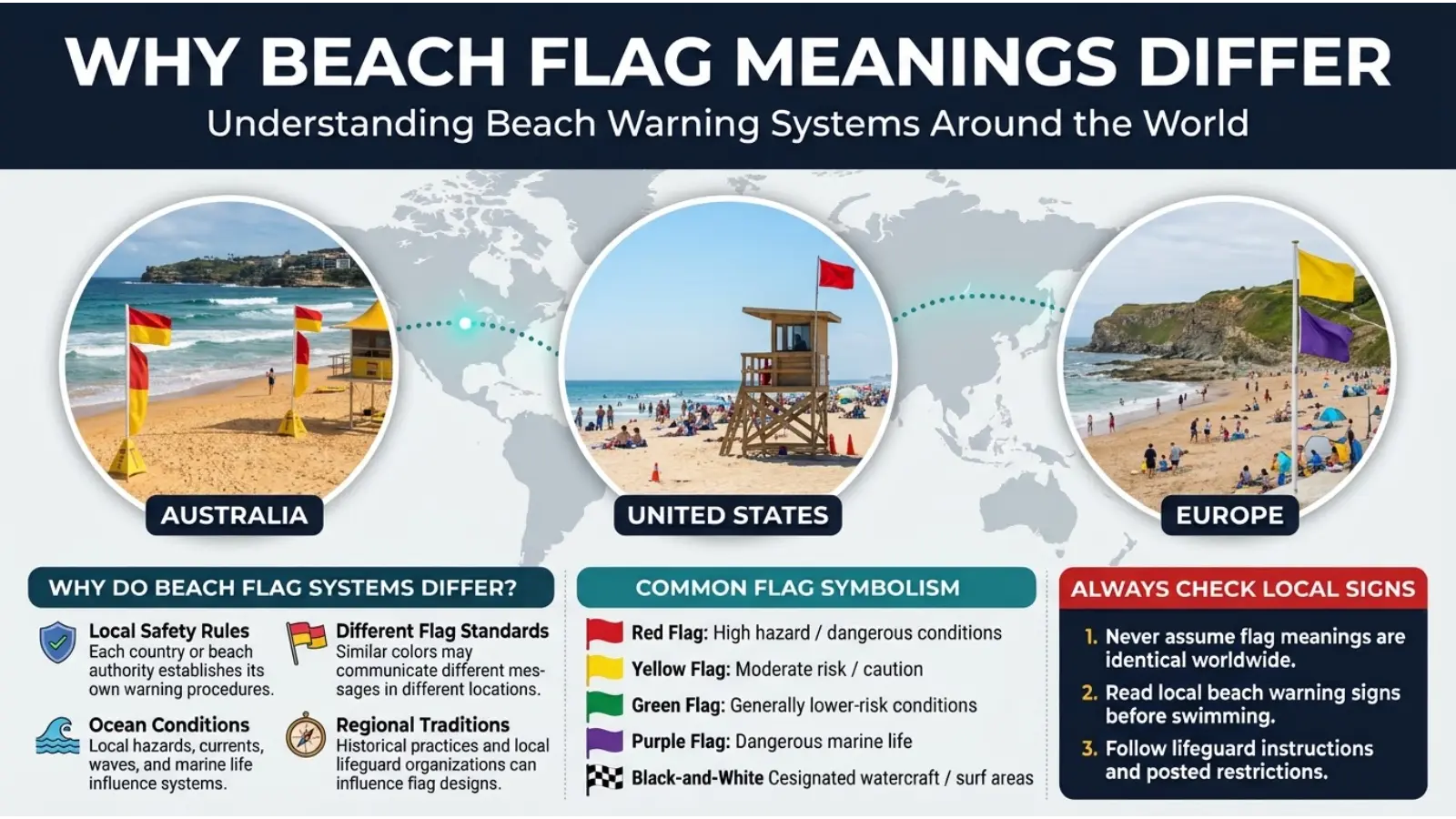
Why Beach Flag Meanings Differ Between Countries
There is no single flag system used in exactly the same way at every beach around the world.
Although several countries use similar colors, their local rules and additional signals may differ.
Beach Flags in the United States
Many American beaches use a warning system based on green, yellow, red, double red, and purple flags.
For example:
- Green indicates low hazard.
- Yellow indicates moderate hazard.
- Red indicates high hazard.
- Double red means the water is closed.
- Purple warns about dangerous marine life.
Florida beaches commonly use this system.
Beach Flags in the United Kingdom
British beaches often use a different arrangement of flags.
For example:
- Red means do not enter the water.
- Red and yellow identify lifeguard-supervised swimming areas.
- Black and white checkered flags mark water-sports zones.
- Orange windsocks warn about dangerous wind conditions and inflatables.
Consequently, a visitor familiar with American beach flags should not assume that every British beach uses the same color meanings.
Beach Flags in Australia
Australian beaches commonly use red-and-yellow flags to identify the safest lifeguard-patrolled swimming area.
A red flag indicates that the water is closed, while yellow communicates potential hazards.
Black-and-white checkered flags identify watercraft areas, and orange windsocks warn against using inflatables in dangerous wind conditions.
Beach Flags in Other Coastal Regions
In parts of Europe, Asia, the Caribbean, and other coastal regions, visitors may encounter green, yellow, red, and purple flags.
Nevertheless, local authorities can use different rules, especially for environmental warnings, water quality, and beach closures.
The safest approach is to check the official sign at the beach rather than relying on a color guide from another country. Royal Life Saving Society UK ( RLSS UK )+4
The Psychology Behind Beach Flag Colors
Color psychology helps explain why certain colors work well in safety communication. However, beach flags are primarily practical warning tools, not psychological tests.
Why Red Creates a Sense of Urgency
Red is strongly associated with danger, emergency signals, and restrictions.
Because it is visually prominent, it is useful when authorities need people to notice a serious warning.
Why Yellow Attracts Attention
Yellow is bright and noticeable in daylight. It is widely used in warning signs because it communicates the need for attention without always indicating an immediate prohibition.
Why Green Suggests a Lower Risk
Green is commonly connected with nature, healthy environments, and permission. Traffic lights and public signs have also helped establish green as a familiar positive signal.
Why Purple Creates a Distinct Warning
Purple is less commonly used than red or yellow in everyday safety signals. Therefore, it can help separate marine-life warnings from ordinary surf and current warnings.
Why Blue Communicates Information
Blue often suggests water, openness, and calmness. In public signs, it can also serve as an information color.
However, these are common associations, not fixed emotional responses. A person’s experience, culture, and surroundings can change how a color is interpreted.
Historical Development of Beach Safety Flags
Beach flags developed as part of wider efforts to make swimming and coastal recreation safer.
As more people began visiting beaches for swimming, surfing, and holidays, lifeguards needed simple ways to communicate changing water conditions.
Initially, local authorities and lifesaving organizations developed their own warning methods. Over time, organizations such as the International Life Saving Federation helped establish more consistent beach-warning guidance.
Today, many beaches use recognizable colors and patterns to communicate hazards. However, local authorities still adapt their systems to match regional conditions and regulations.
This development shows how color symbolism can move beyond decoration and become a practical communication system.
Do Beach Flag Colors Affect Human Behavior?
Beach flags are designed to influence decisions by making important information easy to recognize.
For example, someone who sees a red flag may decide not to swim. Similarly, a yellow flag may encourage a visitor to ask a lifeguard about the water conditions.
Three factors help explain how these signals influence behavior.
1. Familiarity: People who recognize warning colors can understand basic messages more quickly.
2. Contrast: Bright flags are easier to notice against natural backgrounds.
3. Experience: Someone who has previously encountered dangerous currents may take a yellow or red warning more seriously.
Nevertheless, a flag cannot guarantee that everyone will respond correctly. Clear signs, public education, and lifeguard supervision remain essential.
Beach Flag Colors in Art, Photography, and Design
Beach flag colors are also useful outside safety communication. Artists, photographers, and designers use them to create visual messages.
In Photography
Photographers use colorful beach flags to add contrast to coastal images.
For example:
- Red flags create a dramatic warning-focused image.
- Yellow flags add brightness and energy.
- Green flags suggest a calmer beach environment.
- Purple flags create an unusual visual contrast.
In Graphic Design
Travel companies, beach resorts, and educational organizations can use beach flag colors in safety posters and visitor guides.
However, they should preserve the recognized meaning of official warning colors rather than changing them for decoration.
In Educational Materials
Teachers and parents can use colorful flag charts to help children understand basic beach safety.
A simple green-yellow-red chart is particularly useful because children can learn the difference between lower, moderate, and high hazards.

How to Stay Safe When You See Beach Warning Flags
Understanding flag meanings is only the first step. Knowing what to do next is equally important.
Follow these practical safety rules:
- Check the beach warning flags before entering the water.
- Read the information board near the beach entrance.
- Swim in lifeguard-supervised areas.
- Never ignore a red or double-red warning.
- Avoid swimming when strong currents or dangerous waves are present.
- Stay away from unfamiliar marine animals.
- Never allow children to swim without adult supervision.
- Avoid inflatable toys when offshore winds are present.
- Check the flags again if you return to the water later.
- Ask a lifeguard if you do not understand a flag.
What If There Are No Flags?
No flags does not mean the water is safe.
It may simply mean that lifeguards are not monitoring the beach or that no warning system is currently operating.
Therefore, check local safety information before swimming. If conditions are unclear, stay out of the water.
What If the Flag Changes While You Are Swimming?
Beach conditions can change quickly. If a lifeguard raises a more serious warning, leave the water and follow their instructions.
Never wait until the waves become dangerous to take action.
Common Misconceptions About Beach Flag Colors
Several misunderstandings can make beach visitors less careful.
| Misconception | Actual Meaning |
|---|---|
| Green means completely safe. | It generally indicates lower hazard, not zero risk. |
| Yellow means swimming is forbidden everywhere. | It usually indicates moderate hazards. |
| Red always has the same legal meaning. | Local systems determine whether swimming is prohibited. |
| Purple means sharks are present. | It commonly warns about potentially harmful marine life, not specifically sharks. |
| Blue always means clean water. | Its meaning depends on the local system. |
| Black always means the beach is closed. | A plain black flag has no universal meaning. |
| No flag means safe swimming. | There may be no active lifeguard supervision or warning system. |
| Calm-looking water cannot contain strong currents. | Dangerous currents can be difficult to see from shore. |
Understanding these differences helps prevent visitors from making unsafe assumptions.
Real-World Applications of Beach Flag Colors
Beach flag systems have practical uses in many coastal activities.
| Application | How Flags Help |
|---|---|
| Swimming | Communicate water hazards |
| Surfing | Separate surfing and swimming zones |
| Family holidays | Help parents recognize warnings |
| Beach tourism | Improve visitor awareness |
| Lifeguard services | Communicate changing conditions |
| Water sports | Identify restricted or designated areas |
| Photography | Create recognizable visual signals |
| Public education | Teach basic water safety |
Furthermore, hotels, resorts, and tourism organizations can include beach flag explanations in visitor information. This is particularly useful for international tourists who may be unfamiliar with local warning systems.
FAQ: Color Flag Meanings at the Beach
1. What do the different color flags mean at the beach?
Common beach flag meanings include green for low hazard, yellow for moderate hazard, red for high hazard, double red for closed water, and purple for potentially dangerous marine life. However, meanings vary by location.
2. What does a green flag mean at the beach?
A green flag usually indicates relatively calm conditions and a lower level of swimming risk. However, it does not guarantee complete safety. Always follow lifeguard instructions.
3. What does a yellow flag mean at the beach?
A yellow flag warns about moderate hazards, such as waves or currents. Swimming may be permitted, but visitors should exercise extra caution, especially inexperienced swimmers.
4. What does a red flag mean at the beach?
A red flag indicates dangerous water conditions, such as strong currents or high waves. In some countries, it means swimming is prohibited. Always follow local instructions.
5. What does a purple flag mean at the beach?
A purple flag generally warns about potentially harmful marine life, including jellyfish, stingrays, and other dangerous sea creatures. It does not automatically indicate sharks.
6. What does a double red flag mean at the beach?
Double red flags commonly mean that the water is closed to public use. Visitors should not enter the water until authorities remove the restriction.
7. What does a blue flag mean at the beach?
A blue flag can have different meanings depending on the location. It may identify a surfing area, provide local information, or represent a beach-quality certification. Check the local signs.
8. What does a black and white checkered flag mean at the beach?
A black-and-white checkered flag commonly identifies an area reserved for surfboards and other watercraft. Swimmers should stay out of this designated area.
9. What does an orange windsock mean at the beach?
An orange windsock warns about potentially dangerous wind conditions. In particular, offshore winds can carry inflatable toys and floating objects away from shore. Avoid using inflatables when this warning is displayed.
10. Can beach flag colors have different meanings in different countries?
Yes. Beach warning systems vary between countries and even between individual beaches. For example, American beaches commonly use purple for marine-life warnings, while British and Australian beaches use red-and-yellow flags to identify lifeguard-supervised swimming areas.
Conclusion: Why Understanding Beach Flag Colors Matters
Beach flag colors are more than bright decorations along the shoreline. They are practical communication tools that help visitors recognize changing water conditions and potential dangers.
Green, yellow, and red commonly communicate different levels of water hazards. Meanwhile, purple can warn about marine life, and red-and-yellow flags can identify lifeguard-supervised swimming areas. Other colors and patterns may have special meanings depending on the beach.
Most importantly, never assume that a familiar color has exactly the same meaning everywhere. Check the local warning chart, listen to lifeguards, and respect swimming restrictions.
Once you understand beach flag colors, you can make better decisions, protect your family, and enjoy coastal activities with greater awareness.
Editorial safety note: Beach flag meanings in this guide are based on established lifesaving guidance and examples from official beach authorities. Local rules take priority over general interpretations.

Emma Wilson is a dedicated comparison writer and product researcher at ColorMystiic.com. She specializes in creating unbiased product comparisons, detailed reviews, and helpful buying guides. Her goal is to help readers make smarter purchasing decisions with confidence.