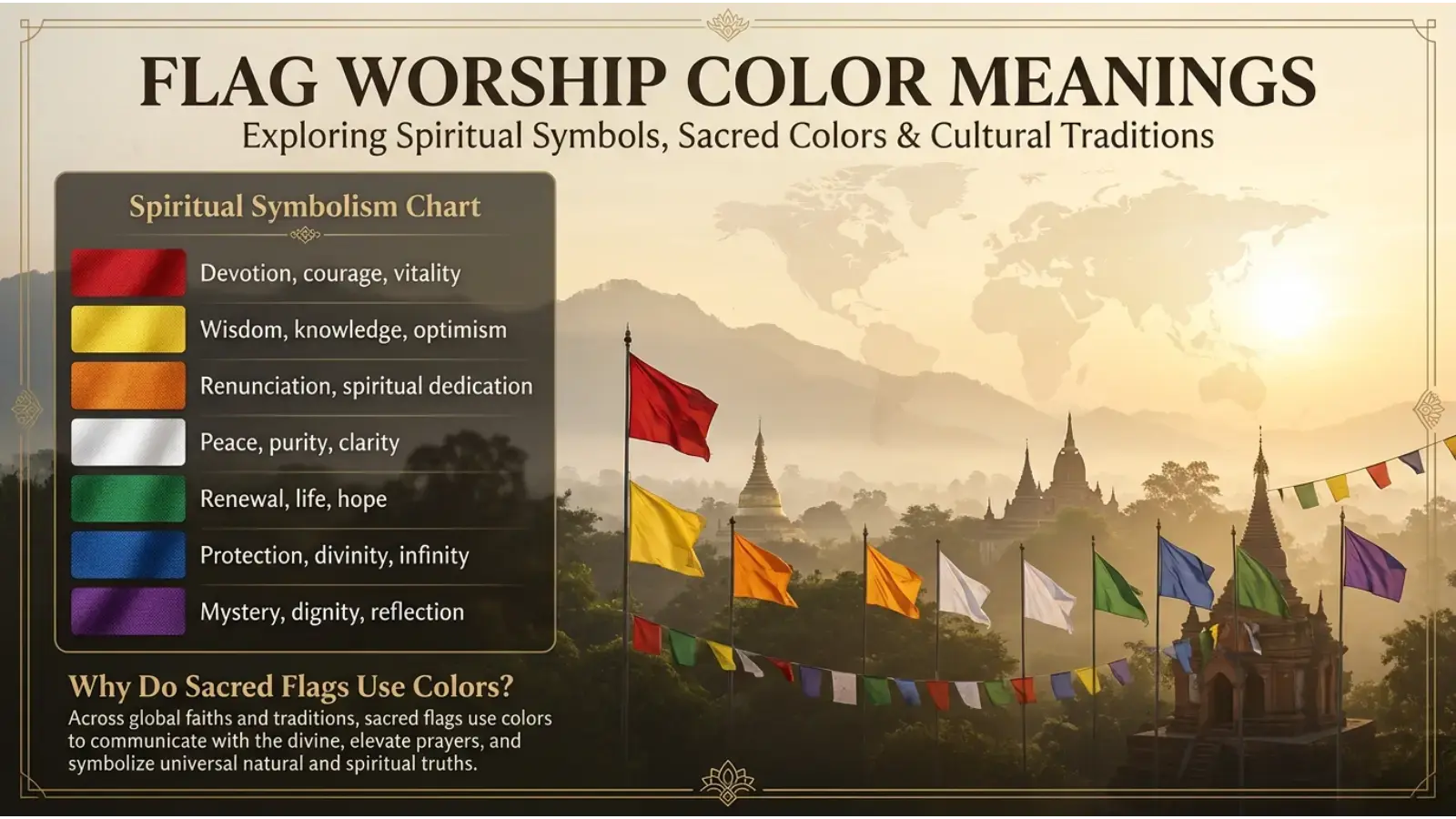
Worship flags are colorful pieces of fabric used during praise, prayer, dance, and Christian worship. Their movements and colors can express feelings, faith, hope, celebration, and devotion. Each color may carry a different spiritual message, which is why people search for flag worship color meanings to understand the symbolism behind these beautiful flags.
In many Christian worship communities, colors represent ideas such as God’s love, forgiveness, purity, healing, authority, and spiritual growth. However, their meanings are not universal. Different churches, worship ministries, and Christian traditions may interpret the same color differently.
Understanding these differences helps worshippers choose flags with greater purpose and meaning.
Quick Answer: What Do Flag Worship Color Meanings?
Worship flag colors commonly represent different spiritual themes:
- 🔴 Red: Love, sacrifice, the blood of Jesus, and redemption.
- 🔵 Blue: Heaven, grace, truth, and revelation.
- 🟣 Purple: Royalty, authority, and kingship.
- 🟡 Yellow: Light, joy, hope, and glory.
- 🟢 Green: Growth, restoration, healing, and new life.
- ⚪ White: Purity, holiness, peace, and surrender.
- 🟠 Orange: Fire, passion, praise, and spiritual energy.
- 🩷 Pink: Love, compassion, tenderness, and intimacy.
- 🟤 Gold: Glory, majesty, holiness, and honor.
- ⚫ Black: Darkness, repentance, and the contrast between sin and redemption.
These are common interpretations in some Christian worship-flag ministries, not a universal biblical color code.
What Are Worship Flags and Why Are They Used?
Worship flags are decorative fabric banners attached to lightweight poles or handles. Worshippers move them through the air during songs, prayers, celebrations, and other forms of spiritual expression.
They are especially common in some Pentecostal and charismatic Christian communities. In these settings, flag dancing may accompany music and other forms of expressive worship.
However, worship flags are not simply decorations. Many participants use them as visual expressions of faith and devotion.
The Purpose of Worship Flags
Worship flags can serve several purposes:
- Praise: Expressing joy and gratitude during worship.
- Prayer: Creating a visual expression of personal prayer.
- Celebration: Marking important religious occasions.
- Faith: Representing spiritual beliefs through colors and movement.
- Unity: Bringing worship teams together through coordinated performances.
- Expression: Communicating emotions that may be difficult to express through words.
Furthermore, different flag colors can help communicate the theme of a particular worship song or presentation.
What Do Different Flag Worship Colors Symbolize?
The meaning of a worship flag depends on its color, the message of the worship service, and the tradition of the church using it.
The following guide explains commonly used interpretations.
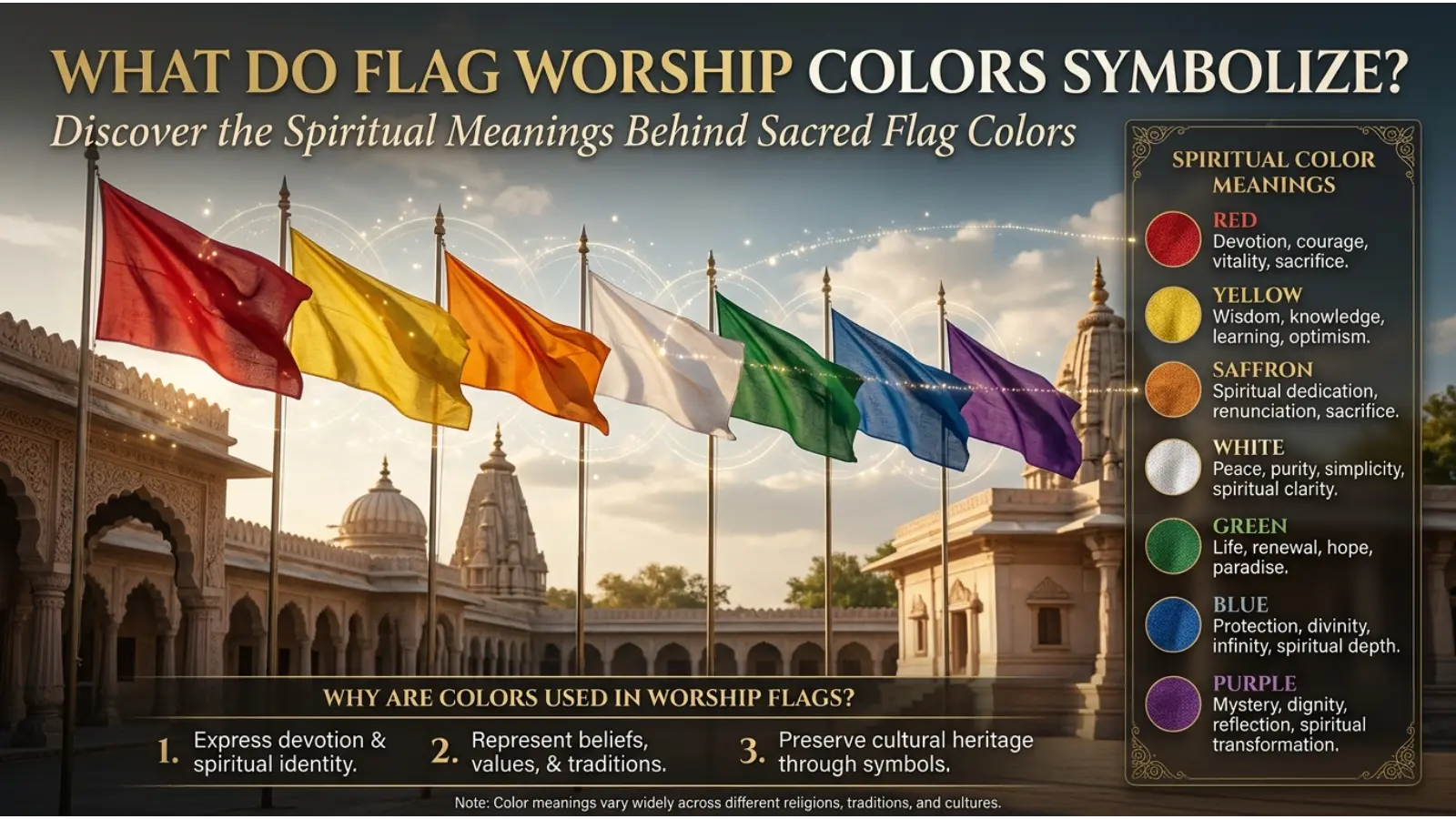
🔴 Red Worship Flag Color Meaning: Love, Sacrifice, and Redemption
Red is one of the most recognizable colors in Christian symbolism. It is frequently connected with the blood of Jesus Christ, sacrifice, love, and redemption.
In Christian worship, red can remind believers of the sacrifice associated with the crucifixion and the message of forgiveness.
Common spiritual associations:
- The blood of Jesus Christ
- Sacrifice and redemption
- God’s love
- Forgiveness
- Courage and spiritual strength
- Fire and purification
Biblical context: Ephesians 1:7 discusses redemption through the blood of Christ and forgiveness of sins.
When red worship flags are used:
The color also creates a strong visual impression because of its intensity. Therefore, it can communicate passion and deep emotion during a worship performance.
🔵 Blue Worship Flag Color Meaning: Heaven, Grace, and Revelation
Blue is often associated with the sky, water, peace, and spiritual understanding.
In some Christian worship ministries, blue flags represent heaven, God’s truth, grace, revelation, and the Holy Spirit.
Common spiritual associations:
- Heaven and the heavenly realm
- Divine revelation
- Truth and wisdom
- Grace and mercy
- Peace and calmness
- Living water
Biblical context: Numbers 15:38 mentions blue cords in the tassels of the Israelites’ garments as a reminder of God’s commandments.
When blue worship flags are used:
Blue flags may accompany worship songs about God’s promises, faith, spiritual understanding, and peace.
Light blue often creates a gentle impression, while royal blue can communicate strength and authority.
🟣 Purple Worship Flag Color Meaning: Royalty, Power, and Authority
Purple has a long history of association with royalty and high status.
Common spiritual associations:
- Royalty and kingship
- Divine authority
- Majesty and honor
- Spiritual inheritance
- Leadership
- Sovereignty
Biblical context: Mark 15:17 describes Jesus being dressed in a purple robe during the events leading to his crucifixion. Purple also appears in descriptions of the tabernacle and priestly materials in the Old Testament.
When purple worship flags are used:
Dark purple often communicates dignity and royalty, whereas lavender creates a softer impression.
🟡 Yellow Worship Flag Color Meaning: Joy, Light, and Hope
Yellow is commonly connected with sunlight, brightness, happiness, and celebration.
In some worship traditions, yellow flags represent God’s glory, spiritual light, joy, and hope.
Common spiritual associations:
- Joy and happiness
- Light and brightness
- Hope
- God’s promises
- Celebration
- Faith and encouragement
Biblical context: Psalm 27:1 describes the Lord as light and salvation. This provides a biblical theme that worship communities may connect with the brightness of yellow.
When yellow worship flags are used:
The color is especially useful in performances where worshippers want to create a bright and uplifting atmosphere.
🟢 Green Worship Flag Color Meaning: Growth, Healing, and Restoration
Green is strongly connected with nature, plants, fresh beginnings, and new life.
Common spiritual associations:
- New beginnings
- Spiritual growth
- Restoration
- Healing
- Hope
- Fruitfulness
- Renewal
Biblical context: Psalm 23:2 describes green pastures as part of the image of God’s care and guidance.
When green worship flags are used:
Green flags may accompany worship songs about spiritual growth, renewal, healing, and God’s provision.
Different shades can also create different impressions. Light green feels fresh and gentle, while dark green communicates stability and maturity.
⚪ White Worship Flag Color Meaning: Purity, Holiness, and Surrender
White is one of the most widely recognized colors in Christian worship.
It commonly symbolizes purity, holiness, righteousness, peace, and new life.
Common spiritual associations:
- Purity and innocence
- Holiness
- Righteousness
- Peace
- Surrender to God
- Salvation
- Victory
Biblical context: Revelation 19:8 uses fine, clean linen as an image associated with the righteous acts of the saints.
When white worship flags are used:
They also work beautifully in celebrations where the central message is peace and spiritual renewal.
🟠 Orange Worship Flag Color Meaning: Fire, Passion, and Praise
Orange combines the visual warmth of red and the brightness of yellow.
In some Christian worship communities, orange represents spiritual fire, passionate praise, harvest, and the power associated with the presence of God.
Common spiritual associations:
- Fire and passion
- Spiritual energy
- Joyful praise
- Harvest and fruitfulness
- Courage
- Celebration
Biblical context: Acts 2 describes the coming of the Holy Spirit at Pentecost, including the appearance of tongues like fire.
When orange worship flags are used:
🩷 Pink Worship Flag Color Meaning: Love, Compassion, and Tenderness
Pink is generally associated with gentle affection, kindness, and emotional warmth.
In some worship-flag traditions, it represents God’s love, compassion, intimacy, and the relationship between believers and God.
Common spiritual associations:
- Love and affection
- Compassion
- Gentleness
- Kindness
- Tenderness
- Joy
When pink worship flags are used:
Pink flags may accompany songs about God’s love, gratitude, compassion, and personal devotion.
Light pink creates a soft impression, while brighter pink can communicate joyful celebration.
🟤 Gold Worship Flag Color Meaning: Glory, Majesty, and Holiness
Gold is often associated with preciousness, kingship, honor, and celebration.
In Christian worship symbolism, it can represent God’s glory, majesty, holiness, and divine authority.
Common spiritual associations:
- God’s glory
- Majesty
- Holiness
- Honor
- Kingship
- Preciousness
- Celebration
Biblical context: Gold appears in descriptions of the tabernacle and its sacred furnishings in Exodus 25.
When gold worship flags are used:
Metallic gold also reflects light, making it visually striking during stage performances.
⚫ Black Worship Flag Color Meaning: Darkness, Repentance, and Redemption
Black has a more complex meaning in worship symbolism.
Some ministries connect it with darkness, sin, mourning, spiritual struggles, or the condition from which redemption offers freedom.
However, black does not always carry a negative meaning. In some artistic settings, it represents humility, solemn reflection, and the contrast between darkness and light.
Common spiritual associations:
- Darkness
- Sin and separation
- Repentance
- Mourning
- Spiritual struggles
- Transformation
When black worship flags are used:
Its meaning depends strongly on the message being expressed.
Silver Worship Flag Color Meaning: Redemption, Refinement, and Wisdom
Silver is often used alongside white and gold in worship flags.
Some ministries connect it with redemption, purity, wisdom, and spiritual refinement.
Common spiritual associations:
- Redemption
- Refinement
- Wisdom
- Purification
- Value and honor
- Transformation
Silver is especially effective when paired with white or blue because the combination creates a clean and peaceful visual effect.
Colorful Chart: Flag Worship Color Meanings
The following chart provides a quick reference to common worship-flag interpretations.
| Flag Color | Common Spiritual Meaning | Main Theme |
|---|---|---|
| 🔴 Red | Love, sacrifice, redemption | Salvation |
| 🔵 Blue | Heaven, grace, revelation | Faith |
| 🟣 Purple | Royalty, kingship, authority | Majesty |
| 🟡 Yellow | Light, joy, hope | Celebration |
| 🟢 Green | Growth, healing, restoration | Renewal |
| ⚪ White | Purity, holiness, surrender | Peace |
| 🟠 Orange | Fire, passion, praise | Energy |
| 🩷 Pink | Love, compassion, tenderness | Affection |
| 🟤 Gold | Glory, honor, holiness | Majesty |
| ⚫ Black | Darkness, repentance, reflection | Transformation |
| 🩶 Silver | Redemption, wisdom, refinement | Purification |
These meanings describe common ministry interpretations rather than fixed rules for every Christian church.
Spiritual Flag Worship Color Meanings Combinations
Single colors can express individual themes. However, combining colors can create a more detailed visual message.
For example, a flag containing red, white, and purple may bring together ideas of sacrifice, purity, and kingship.
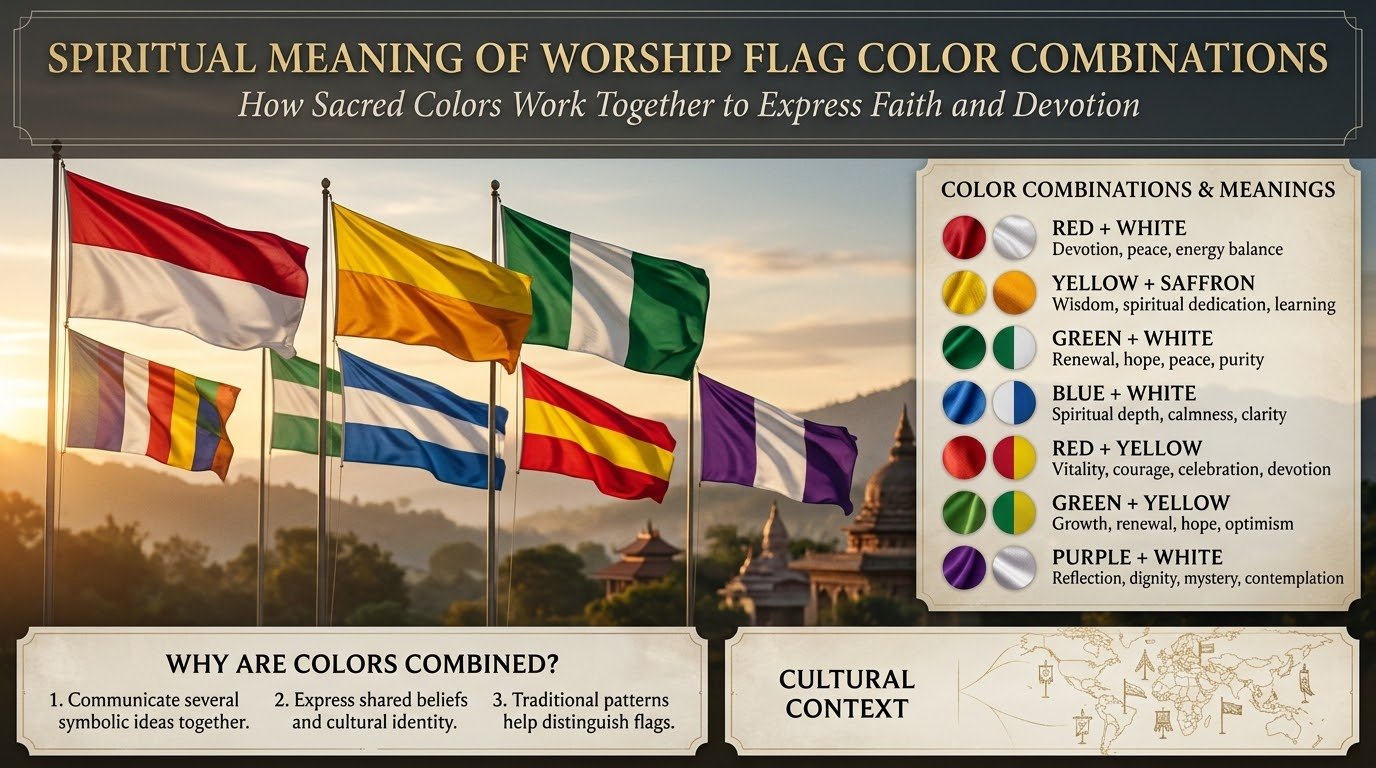
🔴⚪ Black, Red, and White: Repentance and Redemption
This combination can represent the journey from sin toward forgiveness and spiritual renewal.
- ⚫ Black: Darkness and sin.
- 🔴 Red: The sacrifice of Jesus.
- ⚪ White: Purity and righteousness.
Together, these colors create a visual representation of redemption.
🟡🟠🔴 Yellow, Orange, and Red: Fire and Praise
- 🟡 Yellow: Light and glory.
- 🟠 Orange: Passion and spiritual fire.
- 🔴 Red: Sacrifice and powerful love.
This combination is suitable for energetic praise performances.
🟡🟢🔵 Yellow, Green, and Blue: Faith and Growth
This combination brings together themes of hope, new life, and spiritual understanding.
- 🟡 Yellow: Light and hope.
- 🟢 Green: Growth and renewal.
- 🔵 Blue: Truth and grace.
Together, they can represent a journey of faith and spiritual maturity.
🔵🟣🔴 Blue, Purple, and Red: Worship and Divine Majesty
These colors are often used to express themes associated with God’s kingdom and the Christian faith.
- 🔵 Blue: Heaven and revelation.
- 🟣 Purple: Kingship and authority.
- 🔴 Red: Sacrifice and redemption.
The combination creates a rich visual expression of Christian worship.
⚪🟡🟤 White, Yellow, and Gold: Purity and Glory
- ⚪ White: Purity and righteousness.
- 🟡 Yellow: Light and joy.
- 🟤 Gold: Glory and majesty.
It works especially well for celebratory worship themes.
Colorful Chart: Popular Worship Flag Combinations
| Color Combination | Common Interpretation | Worship Theme |
|---|---|---|
| ⚫🔴⚪ | Repentance and redemption | Forgiveness |
| 🟡🟠🔴 | Fire and passion | Praise |
| 🟡🟢🔵 | Faith and spiritual growth | Renewal |
| 🔵🟣🔴 | Heaven, authority, sacrifice | Worship |
| ⚪🟡🟤 | Purity and glory | Celebration |
| 🟣🩷 | Royalty and love | Devotion |
| 🔵🩵 | Peace and living water | Healing |
| 🩶⚪ | Purification and righteousness | Surrender |
Biblical Meaning of Colors Used in Worship Flags
Color symbolism appears throughout the Bible.
The Bible does not provide one universal dictionary explaining what every worship-flag color must mean.
Instead, Christians often connect colors with biblical passages, images, objects, and events.
Here are several examples.
| Color | Biblical Connection | Related Theme |
|---|---|---|
| 🔴 Red | Ephesians 1:7 | Redemption |
| 🔵 Blue | Numbers 15:38 | God’s commandments |
| 🟣 Purple | Mark 15:17 | Jesus’ kingship |
| 🟢 Green | Psalm 23:2 | God’s provision |
| ⚪ White | Revelation 19:8 | Righteousness |
| 🟡 Yellow | Psalm 27:1 | Light and salvation |
| 🟠 Orange | Acts 2 | The Holy Spirit and fire |
| 🟤 Gold | Exodus 25 | Sacred worship objects |
These passages provide biblical themes that worshippers may use when developing personal or ministry interpretations.
Historical Flag Worship Color Meanings in Christian Worship
However, modern worship flags and traditional church colors are not exactly the same practice.
Purple in Church History
Purple became associated with royalty and high status because purple dyes were historically expensive and difficult to produce.
Christian communities also connected it with the authority of Christ and seasons of preparation and repentance.
Red in Christian Worship
Red has long been connected with blood, sacrifice, and fire.
In traditional church calendars, it is commonly used on Pentecost and for certain celebrations involving martyrs.
White and Gold in Religious Celebrations
White and gold are frequently used during Christmas and Easter celebrations.
They communicate joy, holiness, celebration, and the importance of major events in the Christian calendar.
Green and the Christian Year
Green represents growth and new life in many Christian traditions.
These historical practices help explain why similar color associations appear in modern worship-flag ministries.
Psychology of Flag Worship Color Meanings
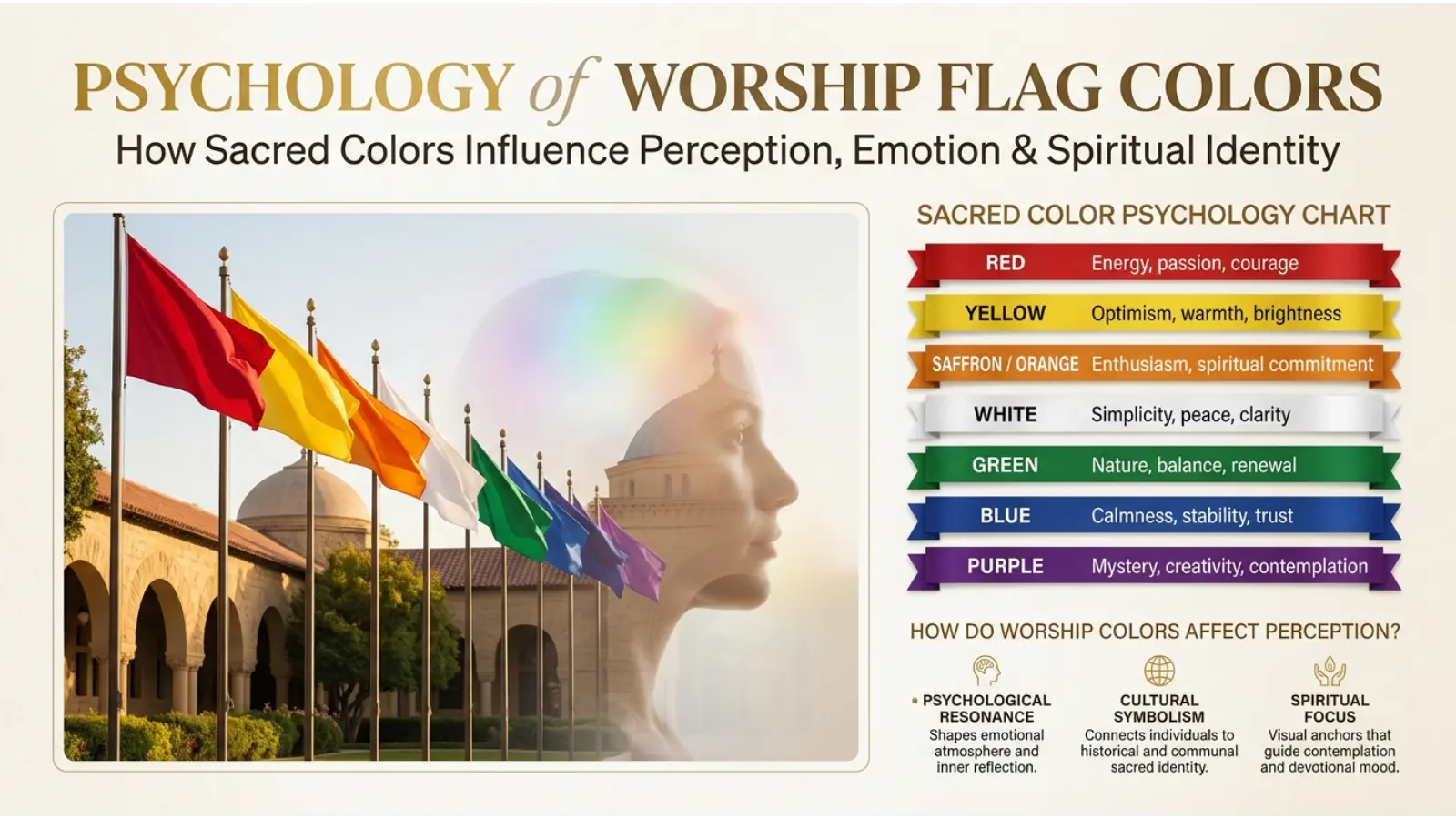
Although worship flags are often selected for spiritual reasons, color psychology also helps explain their visual impact.
Colors can influence attention, emotional impressions, and the overall appearance of a performance. However, they do not produce identical emotional responses in every person.
Personal experiences, culture, lighting, and context all matter.
How Warm Colors Affect Visual Perception
Red, orange, and yellow are warm colors.
They often create impressions of brightness, energy, movement, and excitement.
Consequently, worship teams may choose these colors for joyful or energetic performances.
How Cool Colors Affect Visual Perception
They can create impressions of calmness, depth, freshness, and dignity.
Therefore, they may suit slower worship songs or performances focused on reflection.
How Neutral Colors Create Balance
White, black, silver, and gold can provide contrast and visual balance.
For example, a white flag can stand out against a dark stage, while gold can reflect stage lighting and create a sense of celebration.
Cultural Differences in Worship Flag Color Meanings
Not every Christian community interprets colors in exactly the same way.
Some meanings are shared across many traditions, while others come from local practices or individual ministries.
Western Christian Communities
In many Western churches, traditional colors follow the Christian calendar.
African Christian Communities
Some African Christian churches and worship ministries use colorful banners, fabrics, and expressive movement during praise and celebration.
However, Africa contains many different cultures and Christian traditions, so there is no single African interpretation of worship-flag colors.
Middle Eastern Christian Traditions
Christian communities in the Middle East have diverse liturgical histories and artistic traditions.
Their use of colors may reflect their particular church calendars, religious art, and local customs.
Asian Christian Communities
Churches across Asia also have varied approaches to worship decoration and color symbolism.
Local cultural associations can influence how worshippers understand particular colors.
Modern Global Worship Culture
Online worship ministries and international Christian music have helped spread different approaches to flag dancing.
As a result, a color meaning popular in one ministry may become familiar to worshippers elsewhere.
Nevertheless, familiarity does not make that meaning a universal Christian rule.
Personality Associations of Flag Worship Color Meanings
Some people naturally prefer particular colors. Their choices may reflect personal taste, memories, artistic interests, or emotional associations.
In worship settings, participants may also select flags that match their preferred way of expressing faith.
| Favorite Color | Common Personality Associations |
|---|---|
| 🔴 Red | Passionate, energetic, confident |
| 🔵 Blue | Calm, thoughtful, peaceful |
| 🟣 Purple | Creative, expressive, imaginative |
| 🟢 Green | Balanced, nature-loving, hopeful |
| 🟡 Yellow | Cheerful, optimistic, lively |
| ⚪ White | Simple, peaceful, organized |
| 🟠 Orange | Adventurous, enthusiastic, expressive |
| 🩷 Pink | Caring, gentle, compassionate |
| ⚫ Black | Independent, serious, reflective |
These are general cultural associations, not scientific personality assessments. A person’s favorite color cannot reliably determine their character, faith, or behavior.
How to Choose the Right Flag Worship Color Meanings
Choosing a worship flag involves more than selecting an attractive shade.
The flag should support the message, movement, and atmosphere of the worship performance.
1. Understand the Worship Theme
First, consider the message of the song or prayer.
For example, a song about forgiveness may suit a red-and-white combination, while a joyful celebration may work well with yellow, orange, and gold.
2. Consider the Emotional Atmosphere
Next, think about the atmosphere you want to create.
- Energetic praise: 🔴 Red and 🟠 orange.
- Peaceful worship: 🔵 Blue and ⚪ white.
- Celebration: 🟡 Yellow and 🟤 gold.
- Spiritual growth: 🟢 Green and 🔵 blue.
- Royalty and majesty: 🟣 Purple and 🟤 gold.
3. Think About the Church’s Traditions
Some churches have established guidelines for worship flags.
Therefore, it is helpful to understand the ministry’s approach before introducing new colors or combinations.
4. Choose Suitable Fabric and Movement
The fabric also affects the performance.
Lightweight materials can move easily through the air, while heavier fabrics may create slower, more dramatic movements.
5. Keep the Message Clear
Finally, avoid using too many unrelated colors without a clear purpose.
A thoughtful combination can communicate a stronger visual message than a collection of colors chosen only for appearance.
Worship Flags in Art, Design, and Church Decoration
Worship flags are also visual design elements.
Their colors, shapes, textures, and movement can change how a stage or worship space looks.
Stage Decoration
Bright flags can add movement and visual interest to a worship stage.
For example, gold and white create a bright appearance, while blue and purple offer a more dramatic combination.
Photography and Video
Color selection matters when recording worship performances.
Bright yellow and white can appear especially intense under strong lighting. Meanwhile, dark purple and blue may lose some detail in poorly lit spaces.
Fabric and Lighting
Different fabrics reflect light differently.
Metallic gold and silver can produce noticeable reflections, while matte fabrics generally create a softer appearance.
As a result, worship teams should test their flags under the actual stage lighting before a performance.
Common Misconceptions About Flag Worship Color Meanings
Several misunderstandings can arise when people study worship-flag symbolism.
Misconception 1: Every Color Has One Fixed Biblical Meaning
There is no universal biblical chart assigning a specific spiritual meaning to every color.
Different ministries interpret colors differently.
Misconception 2: A Certain Flag Color Always Represents a Message From God
A colored flag does not automatically communicate a divine message.
Misconception 3: Every Christian Church Uses Worship Flags
Worship flags are not used in every Christian denomination or congregation.
Some churches welcome flag dancing, while others prefer more traditional forms of worship.
Misconception 4: Color Psychology and Spiritual Symbolism Are the Same
They are different subjects.
Color psychology examines how people perceive and respond to colors. Spiritual symbolism explores meanings assigned to colors through religious beliefs, traditions, and personal interpretations.
Misconception 5: More Colors Always Make a Better Worship Flag
A flag does not need many colors to communicate a meaningful theme.
A simple combination can be visually effective when its colors complement the message and movement.
Real-World Applications of Flag Worship Color Meanings
Worship colors are used in different settings beyond flag dancing.
Church Worship Services
Churches may use colorful banners, flags, altar decorations, and clothing to support worship themes.
Christian Dance Ministries
Dance ministries may coordinate flag colors with music, choreography, and the message of a performance.
Religious Celebrations
Gold, white, red, and other colors may be selected for special services and celebrations.
Christian Art
Artists may use purple, blue, gold, and red to communicate themes of royalty, faith, sacrifice, and divine glory.
Worship Photography
Photographers can use the movement and color of flags to capture the energy and emotion of a worship service.
Personal Prayer and Reflection
Some worshippers choose particular flag colors based on the message they want to express during personal prayer.
However, personal associations should remain distinct from established church teachings.
How Lighting Changes Worship Flag Colors
Lighting can significantly affect the appearance of worship flags.
A flag that looks bright in natural daylight may appear darker or more saturated under indoor lighting.
| Lighting Type | Visual Effect |
|---|---|
| ☀️ Natural daylight | Shows colors more clearly |
| 🟡 Warm lighting | Makes reds, oranges, and golds appear warmer |
| 🔵 Cool lighting | Makes blues and whites appear cooler |
| 🟣 Purple stage lighting | Can change how red and blue fabrics appear |
| ⚪ Bright white lighting | Helps reveal fabric details and true shades |
| 🌑 Low lighting | Reduces visible detail in darker fabrics |
For this reason, selecting colors under the same lighting conditions used during the worship service is a practical choice.
Frequently Asked Questions About Flag Worship Color Meanings
1. What do worship flag colors mean?
Worship flag colors represent different spiritual themes in some Christian ministries. Red often symbolizes sacrifice, blue represents heaven or grace, purple represents royalty, green represents growth, and white represents purity.
However, interpretations differ between churches and worship traditions.
2. What does a red worship flag mean?
A red worship flag commonly represents the blood of Jesus, sacrifice, love, forgiveness, and redemption. Some ministries also connect red with spiritual fire and passionate praise.
3. What does a blue worship flag represent?
Blue worship flags are commonly associated with heaven, grace, truth, revelation, peace, and living water. Their interpretation depends on the worship ministry using them.
4. What does purple mean in worship flags?
Purple generally represents royalty, kingship, authority, and majesty. In Christian symbolism, it is also associated with the sovereignty of Jesus Christ.
5. What does a white worship flag symbolize?
White commonly symbolizes purity, holiness, righteousness, surrender, peace, and spiritual renewal. It is often used in worship focused on forgiveness and devotion.
6. What does a green worship flag mean?
Green worship flags commonly represent growth, restoration, healing, hope, and new beginnings. The color is also associated with nature and fresh life.
7. What does a gold worship flag represent?
Gold is often associated with God’s glory, holiness, kingship, majesty, honor, and celebration. Its reflective appearance also makes it popular for special worship performances.
8. What does a yellow worship flag mean?
Yellow commonly symbolizes light, joy, hope, celebration, and God’s promises. Some worship ministries also associate it with glory and spiritual encouragement.
9. What do multiple colors on a worship flag mean?
Multiple colors can combine different spiritual themes. For example, red, white, and black may represent sacrifice, purity, and repentance, while yellow, green, and blue may communicate hope, growth, and faith.
The meaning depends on the ministry’s interpretation.
10. Are worship flag color meanings found directly in the Bible?
Some color associations are connected to biblical passages, such as blue in Numbers 15:38 and purple in Mark 15:17. However, the Bible does not establish one complete or universally accepted color dictionary for modern worship flags.
Conclusion
Flag worship color meanings offer an interesting way to understand how visual expression and Christian faith can come together. Each color can communicate a different theme, from the sacrifice represented by red to the purity associated with white and the hope connected with green.
Furthermore, combinations of colors can create more detailed visual messages during praise, prayer, and worship performances.
However, the meaning of a flag should always be understood within its church tradition and the message it is intended to express. Colors can support worship, but their significance does not depend on a universal set of rules.
The next time you see a worship flag moving during a song or prayer, look beyond its appearance. Consider its colors, the message of the music, and the meaning that the worshipper intends to communicate.

Emma Wilson is a dedicated comparison writer and product researcher at ColorMystiic.com. She specializes in creating unbiased product comparisons, detailed reviews, and helpful buying guides. Her goal is to help readers make smarter purchasing decisions with confidence.