Teal is a blue-green color that sits between the calm character of blue and the natural energy of green. It can feel peaceful, refreshing, sophisticated, modern, and slightly mysterious at the same time. Because it combines two strong color families, teal color meanings can change depending on its shade, setting, culture, and surrounding colors.
People often search for teal because they want to understand what it represents in clothing, home design, branding, art, spirituality, or everyday life. Yet teal does not have one universal meaning. A dark blue-leaning teal can appear serious and elegant, while a brighter green-leaning teal may feel energetic and tropical.
This guide explores the symbolism, psychology, emotional associations, spiritual interpretations, cultural context, history, personality connections, branding uses, interior design, fashion, color combinations, and practical applications of teal.
Quick Answer: Teal commonly represents calmness, balance, renewal, communication, clarity, sophistication, emotional stability, and connection with nature. Its meaning changes with shade and context. Blue-heavy teal often feels peaceful and trustworthy, while green-heavy teal can suggest growth, freshness, and vitality.
What Does Teal Symbolize?
Teal is often associated with balance because it combines blue and green rather than belonging completely to either color family. Blue is commonly connected with calmness, stability, and communication, while green is frequently associated with nature, growth, and renewal.
Together, these qualities can give teal a balanced visual personality.
| Teal Association | Common Impression |
|---|---|
| Calm | Peaceful and composed |
| Balance | Harmony between different qualities |
| Renewal | Freshness and new beginnings |
| Communication | Clear, thoughtful expression |
| Nature | Water, plants, and natural environments |
| Sophistication | Refined and mature |
| Creativity | Originality and individuality |
| Emotional stability | Controlled and steady |
| Clarity | Clean, refreshing appearance |
| Mystery | Deeper, darker teal can feel intriguing |
Teal can also carry negative associations when used poorly. Extremely dark teal may feel heavy or distant, while an overly saturated teal can become visually intense. In some situations, the color may also appear cold if it is surrounded by gray, silver, or other cool tones.
Therefore, teal symbolism is best understood as context-dependent rather than fixed.
Psychology of Teal Color Meanings
Color psychology examines how colors can influence perception, emotion, attention, and associations. However, color does not produce exactly the same psychological response in every person. Personal experience, culture, lighting, surroundings, and individual preference all matter.
Teal benefits from the psychological associations of both blue and green.
Teal and Calmness
Blue is widely associated with calm and quiet environments, while teal adds the freshness of green. As a result, teal can create a feeling that is calmer than many bright colors without becoming as neutral as gray.
This makes teal useful when a design needs to feel peaceful but still distinctive.
Teal and Emotional Balance
Because teal occupies a middle position between blue and green, people often perceive it as balanced. It can visually bridge warm and cool palettes and can soften stronger colors.
That makes it particularly useful in spaces where designers want a controlled, relaxed atmosphere.
Teal and Creativity
Teal is less traditional than navy, beige, or basic green. Consequently, it can communicate individuality without becoming as aggressive as highly saturated red or orange.
Creative businesses may use teal when they want their visual identity to feel modern, intelligent, fresh, and approachable.
Teal and Communication
The blue component of teal can create associations with communication, reliability, and clarity. However, these are associations rather than guaranteed psychological effects.
A teal interface, for example, may feel more distinctive than a standard blue interface while retaining some of blue’s familiar visual qualities.
Emotional Teal Color Meanings
Teal can evoke different emotions depending on its shade.
Soft teal often feels gentle, airy, and peaceful.
Medium teal can appear fresh, balanced, confident, and friendly.
Dark teal tends to feel sophisticated, serious, luxurious, and dramatic.
Bright teal can feel energetic, youthful, playful, and tropical.
Blue teal usually emphasizes calmness, trust, and coolness.
Green teal tends to emphasize nature, freshness, growth, and vitality.
This range is one reason teal works across many industries and design styles.
Spiritual Teal Color Meanings
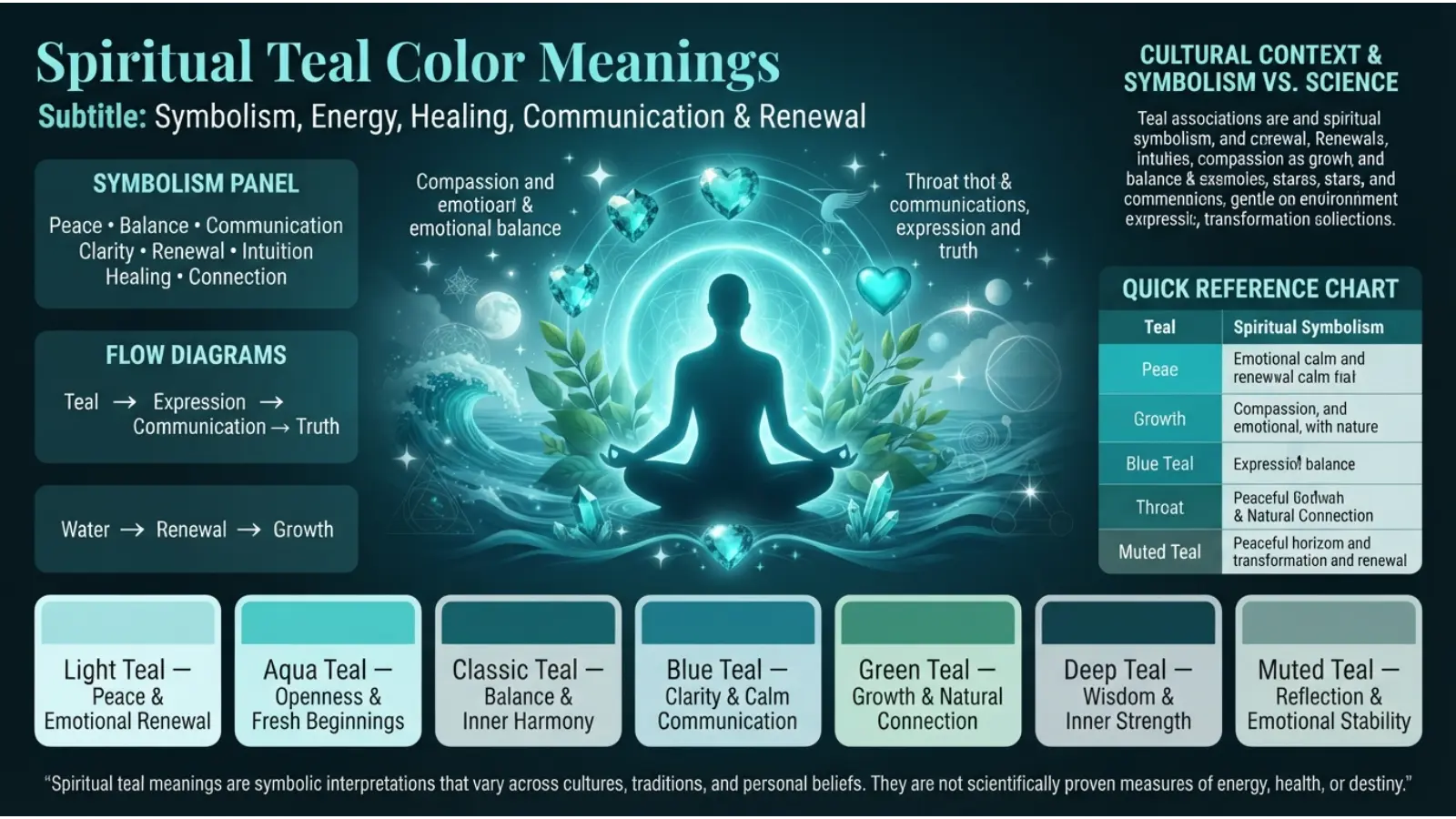
Spiritual interpretations of teal are symbolic rather than scientifically established. Different spiritual communities may assign different meanings to the color, so these interpretations should not be treated as universal religious teachings.
Teal is sometimes associated with healing, emotional balance, communication, transformation, renewal, protection, and inner calm.
Because it combines blue and green, spiritual interpretations may connect it with both peaceful communication and natural growth.
Teal and Healing
Some modern spiritual practices use teal as a symbolic color for emotional restoration and calm. The association may come from teal’s resemblance to clear water, natural landscapes, and tranquil environments.
Teal and Communication
The blue side of teal can symbolize speaking, listening, honesty, and thoughtful expression. In symbolic settings, teal may therefore represent the desire to communicate with greater clarity.
Teal and Transformation
Green is commonly associated with growth, while blue can represent stability. Combining them can create a symbolic image of change that remains grounded.
Teal and Balance
Teal’s position between blue and green makes it a natural symbolic choice for harmony and balance.
These meanings are best viewed as personal or cultural interpretations rather than proven spiritual properties.
Cultural Teal Color Meanings
Unlike colors such as red, white, black, or yellow, teal does not have one deeply established symbolic meaning shared across all cultures.
Its modern meaning is strongly influenced by design, fashion, advertising, environmental imagery, and popular culture.
In many contemporary Western settings, teal can suggest freshness, calmness, modernity, and sophistication. In global design, it is also frequently connected with water, tropical environments, technology, wellness, and creativity.
However, cultural interpretation depends heavily on the object and situation. A teal garment, logo, wall, flower arrangement, or ceremonial object can communicate different ideas.
That is why designers should avoid assuming that a color has exactly the same meaning everywhere.
Historical Teal Color Meanings
The word teal is connected to the common teal, a small freshwater duck whose coloring helped inspire the modern color name.
Teal became especially recognizable as a named design color during the development of modern printing, textiles, interiors, and digital color systems. Its popularity increased because it provides a practical middle ground between traditional blue and green.
The color also became prominent in late-20th-century and contemporary design, where blue-green palettes were increasingly used in graphics, interiors, fashion, and digital interfaces.
Its history is therefore less about one ancient symbolic tradition and more about the gradual development of a recognizable color category in modern visual culture.
Teal Personality Associations
People sometimes use color preferences to describe personality. Teal is commonly associated with qualities such as:
- Calmness
- Independence
- Creativity
- Emotional awareness
- Open-mindedness
- Balance
- Sophistication
- Curiosity
- Thoughtfulness
- Individuality
However, liking teal does not scientifically determine someone’s personality.
A person may choose teal simply because it matches their clothes, home, favorite design style, or memories. Personality is much more complex than color preference.
Still, teal can be an appealing choice for someone who wants an appearance that feels distinctive without being excessively loud.
Teal in Branding and Marketing
Teal has become a useful branding color because it can occupy a space between traditional blue and natural green.
Blue can sometimes feel corporate and familiar. Green can suggest health, nature, or sustainability. Teal can combine elements of both while appearing more distinctive.
Teal and Brand Identity
Brands may choose teal when they want to communicate:
- Modernity
- Trust
- Creativity
- Freshness
- Technology
- Wellness
- Intelligence
- Accessibility
- Clean design
The exact impression depends on the shade and the rest of the visual identity.
Teal in Packaging
Teal packaging can stand out particularly well beside white, cream, black, coral, orange, or metallic accents.
For example, a wellness product might use soft teal with white to create a clean appearance, while a premium product could use dark teal with gold for a richer visual effect.
Teal and Consumer Perception
Color can influence first impressions, but it does not work independently. Typography, photography, layout, product quality, messaging, and cultural expectations all affect how a brand is perceived.
Consequently, teal should support a brand’s identity rather than replace a clear brand strategy.
Teal Color Meanings in Interior Design
Teal is versatile in interior design because it can feel both natural and refined.
It works particularly well when used as an accent rather than automatically covering every surface.
Teal Living Room
A teal sofa can become the visual focal point of a living room. Pairing it with cream, warm white, natural wood, or beige can keep the room balanced.
For a dramatic room, dark teal can work with charcoal, brass, or walnut tones.
Teal Bedroom
Soft teal can create a restful atmosphere, especially when combined with neutral bedding and natural textures.
Instead of using intense teal on every wall, consider one accent wall, cushions, curtains, or artwork.
Teal Office
Teal can bring personality to a workspace without being as visually aggressive as bright red or neon colors.
Medium or dark teal works particularly well with white, gray, natural wood, and black accents.
Teal Kitchen
Teal cabinets can create a distinctive kitchen style. Light countertops and warm wood can prevent the space from becoming too dark.
For smaller kitchens, using teal on a lower cabinet section or island can provide color without overwhelming the room.
Lighting and Teal
Lighting can dramatically change how teal appears.
Warm lighting can make teal appear softer and greener, while cool lighting may emphasize its blue side. Natural daylight can reveal undertones that are difficult to see under artificial bulbs.
Therefore, always test paint, fabric, or furniture samples under the actual lighting of the room.
Teal Color Meanings in Fashion
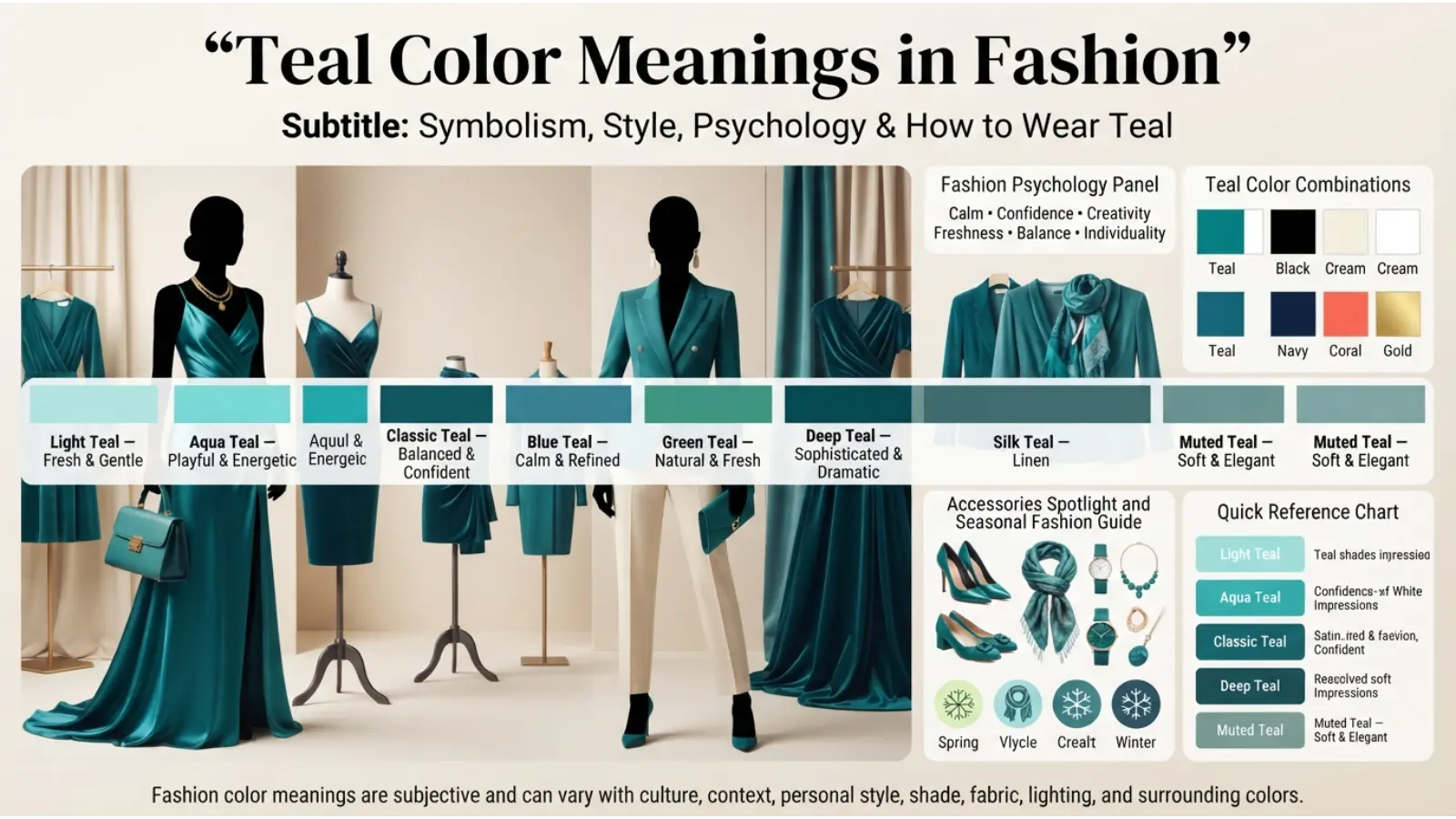
Teal is useful in fashion because it can feel more distinctive than standard navy while remaining relatively easy to coordinate.
A teal shirt, dress, jacket, scarf, or accessory can add color without requiring a highly saturated neon palette.
Teal for Professional Clothing
Dark teal can provide an alternative to navy or charcoal. It can look polished in suits, blazers, dresses, shirts, and accessories.
For a professional appearance, darker and less saturated teal usually feels more restrained.
Teal for Casual Wear
Brighter teal can work well in summer clothing, sportswear, casual shirts, sneakers, and accessories.
It pairs especially well with white, denim, beige, gray, and black.
Teal for Formal Wear
Deep teal can look elegant in evening dresses, formal shirts, ties, suits, and accessories.
Adding metallic details such as gold or silver can change the overall character from modern to luxurious.
Best Teal Color Combinations
Teal can work with both neutral and contrasting colors.
Teal and White
This combination feels clean, bright, and refreshing. It works especially well for websites, bathrooms, packaging, and modern interiors.
Teal and Black
Black creates a dramatic contrast with teal. Dark teal and black can produce a sophisticated, modern appearance.
Teal and Gold
Gold adds warmth and luxury. This pairing works particularly well for premium branding, event design, jewelry, and elegant interiors.
Teal and Coral
Coral provides a warm contrast against cool teal. The result can feel energetic, cheerful, and contemporary.
Teal and Beige
Beige softens teal and gives it a natural, comfortable quality. This is an excellent combination for home interiors and everyday fashion.
Teal and Gray
Gray creates a restrained and professional palette. Light gray keeps teal fresh, while charcoal produces a more dramatic effect.
Teal and Orange
Orange sits close to teal’s complementary relationship on traditional color wheels, creating strong visual contrast. Use orange as an accent when you want energy without allowing it to dominate.
A Simple Teal Color Chart
| Shade | General Character | Useful For |
|---|---|---|
| Light Teal | Soft and refreshing | Bedrooms, wellness, websites |
| Aqua Teal | Bright and energetic | Summer designs, graphics |
| Classic Teal | Balanced and versatile | Branding, fashion, interiors |
| Blue Teal | Calm and sophisticated | Offices, technology, clothing |
| Green Teal | Fresh and natural | Wellness, nature themes |
| Dark Teal | Rich and elegant | Luxury branding, formal spaces |
| Deep Teal | Dramatic and mature | Fashion, interiors, premium design |
Why Teal Looks Different in Different Situations
Teal is especially sensitive to its surroundings.
Place teal beside orange and it can appear cooler and more blue-green. Put it beside blue and its green component may become more noticeable.
The same teal can also look lighter against black and darker against white.
This phenomenon is part of a broader principle in color perception: we do not see colors in isolation. Surrounding colors, brightness, contrast, material, and lighting all influence what the eye perceives.
Common Misconceptions About Teal
Teal Does Not Have One Universal Meaning
There is no single definition that applies to every person, culture, or situation.
Teal Is Not Simply Blue
Although teal contains a strong blue component, its green component gives it a different visual identity.
Teal Does Not Always Mean Healing
Healing is one symbolic interpretation, particularly in modern wellness and spiritual contexts. It is not a universal or scientifically proven meaning.
Teal Does Not Determine Personality
A preference for teal may reveal something about personal taste, but it cannot accurately define someone’s character.
Dark Teal Is Not Automatically Sad
Dark colors can appear serious or dramatic, but context matters. The Dark teal can also look luxurious, confident, calm, and sophisticated.
Real-World Uses of Teal
Teal appears in many areas of everyday life because it can balance calmness with visual energy.
Business, it can create a modern and approachable identity.
In marketing, it can help a product stand apart from conventional blue and green palettes.
In art, teal can represent water, atmosphere, distance, emotion, or contrast.
Photography, teal is often useful for creating cool shadows, cinematic contrast, and environmental moods.
In home decoration, it works as both a statement color and an accent.
In fashion, it offers a flexible alternative to standard blue or green.
Sports, bright teal can create an energetic team identity, while darker teal can produce a more serious appearance.
In entertainment and visual media, teal can contribute to futuristic, aquatic, mysterious, or modern visual themes.
Teal, Nature, and the Environment
One reason teal feels refreshing is its connection to natural scenes.
It can resemble tropical water, shallow seas, mineral-rich pools, blue-green feathers, and vegetation reflected in water.
These associations can make teal especially effective in environmental, travel, wellness, and outdoor-themed designs.
However, teal should not automatically be treated as a symbol of environmental responsibility. Green and blue-green colors may suggest nature, but genuine sustainability depends on a company’s actions rather than its color palette.
How Age and Culture Can Change Teal’s Meaning
Color perception is not identical across generations.
Younger audiences may encounter teal through digital interfaces, social media graphics, gaming, fashion, and contemporary branding. Older audiences may associate particular teal shades with historical interiors, household products, or design trends from earlier decades.
Culture adds another layer.
A color used for clothing may have a different meaning from the same color used in a logo or ceremonial object. Consequently, successful color choices require attention to audience, context, and purpose.
How to Choose the Right Teal
Choose light teal when you want softness and freshness.
Choose medium teal when you want versatility and balance.
The Choose blue teal when calmness and sophistication are important.
Choose green teal when you want a stronger connection with nature.
Choose dark teal when you want elegance, depth, or authority.
The Choose bright teal when energy and youthfulness are more important.
The most effective shade is not necessarily the most attractive one. It is the shade that supports the message you want people to receive.
Frequently Asked Questions About Teal Color Meanings
What does the color teal mean?
Teal commonly represents calmness, balance, renewal, communication, sophistication, and connection with nature. Its exact meaning depends on shade, context, culture, and surrounding colors.
Is teal a positive color?
Teal is often perceived positively because it combines calming blue with refreshing green. However, very dark or highly saturated versions can create a more serious or intense impression.
What does teal symbolize spiritually?
In modern spiritual symbolism, teal may represent healing, emotional balance, communication, renewal, growth, and inner calm. These meanings vary between individuals and traditions and are not universal religious teachings.
What personality does teal represent?
Teal is commonly associated with creativity, independence, calmness, thoughtfulness, balance, and individuality. However, color preference does not scientifically determine personality.
What colors go well with teal?
Teal pairs well with white, beige, cream, gray, black, gold, coral, orange, brown, and natural wood tones. The best combination depends on the desired mood.
Is teal more blue or green?
Teal is a blue-green color, but different shades can lean strongly toward either side. Blue teal looks cooler, while green teal appears more natural and lively.
What does dark teal symbolize?
Dark teal can suggest sophistication, confidence, depth, calmness, maturity, and luxury. It can also feel dramatic when used with black or other dark colors.
Is teal good for interior design?
Yes. Teal works well in living rooms, bedrooms, offices, kitchens, and bathrooms. It can be used as an accent or as a dominant color when balanced with suitable neutrals.
Why is teal used in branding?
Teal can combine some of the familiar qualities of blue and green while appearing more distinctive. Brands may use it to suggest modernity, freshness, creativity, technology, wellness, or trust.
Does teal always represent nature?
No. Teal can suggest nature because it resembles water and blue-green environments, but it can also communicate technology, sophistication, creativity, communication, or modernity.
Conclusion
The meaning of teal comes from more than its position between blue and green. Its visual character changes with shade, lighting, culture, surrounding colors, and the purpose for which it is used.
At its calmest, teal can suggest peace and emotional balance. At its freshest, it can communicate renewal and natural energy. Darker versions can feel refined and confident, while brighter shades can appear playful and energetic.
That flexibility makes teal valuable in branding, fashion, interior design, art, photography, and everyday visual communication. Rather than treating teal color meanings as a fixed list of symbols, it is more useful to think of teal as a color with a broad emotional range.
The best interpretation depends on the complete visual story: the shade of teal, the colors around it, the environment, the audience, and the message you want to communicate.

Emma Wilson is a dedicated comparison writer and product researcher at ColorMystiic.com. She specializes in creating unbiased product comparisons, detailed reviews, and helpful buying guides. Her goal is to help readers make smarter purchasing decisions with confidence.