Coats of arms are more than colorful shields. For centuries, heraldic designs have used colors, metals, patterns, animals, plants, weapons, crowns, and other symbols to identify people, families, institutions, territories, and communities. The colors themselves are called tinctures, and they form one of the basic parts of heraldic design.When people search for coats of arms color meanings, they often expect a simple chart saying that red means courage, blue means loyalty, or gold means wealth.
Those associations can be useful, but the historical reality is more complicated. Traditional heraldry did not operate with one universal dictionary in which every color always had one fixed meaning.
Instead, color served several purposes at once. It helped make a shield recognizable, followed rules of heraldic design, created visual contrast, and sometimes carried symbolic meaning connected with the person, place, event, or institution represented.
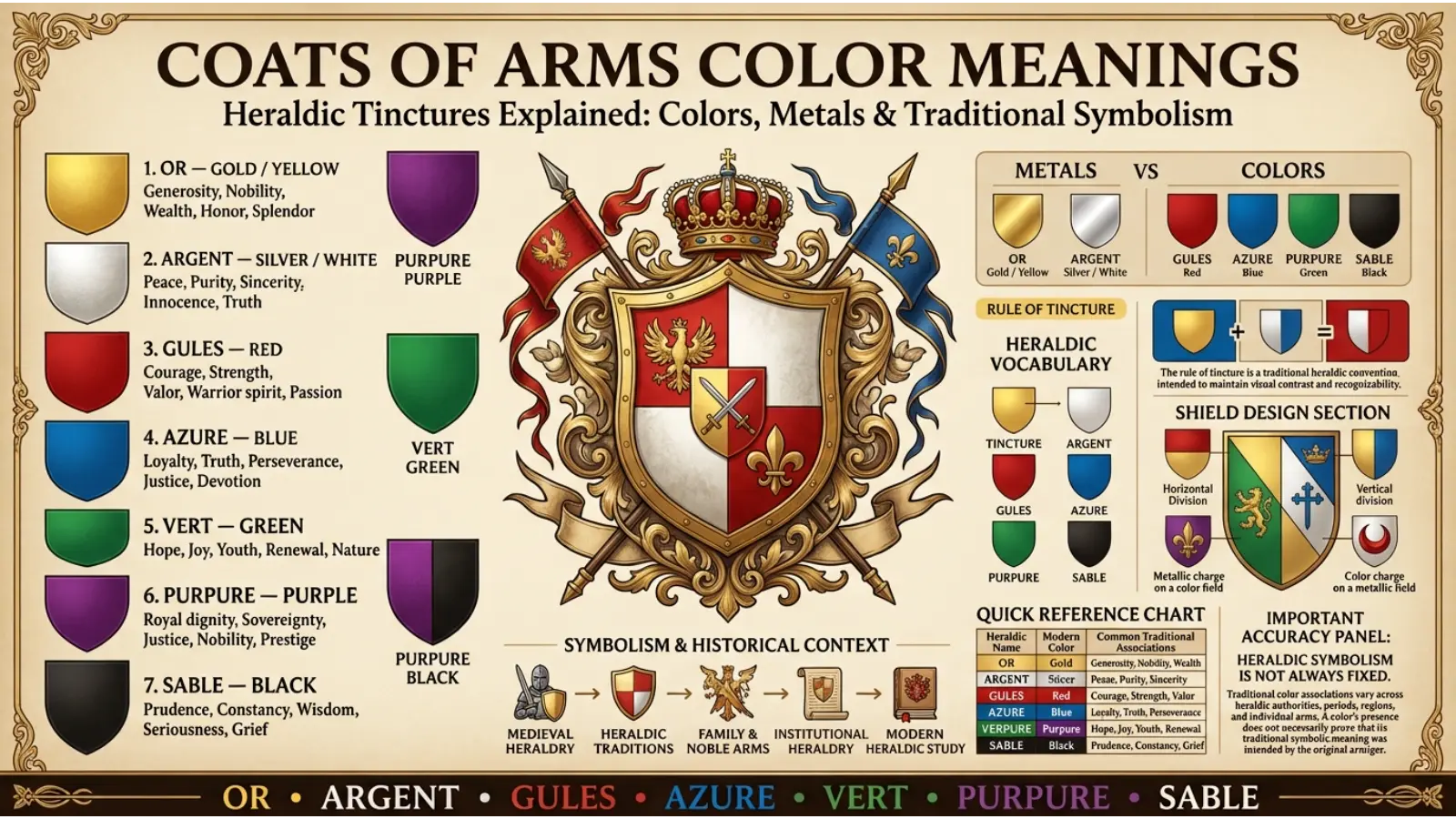
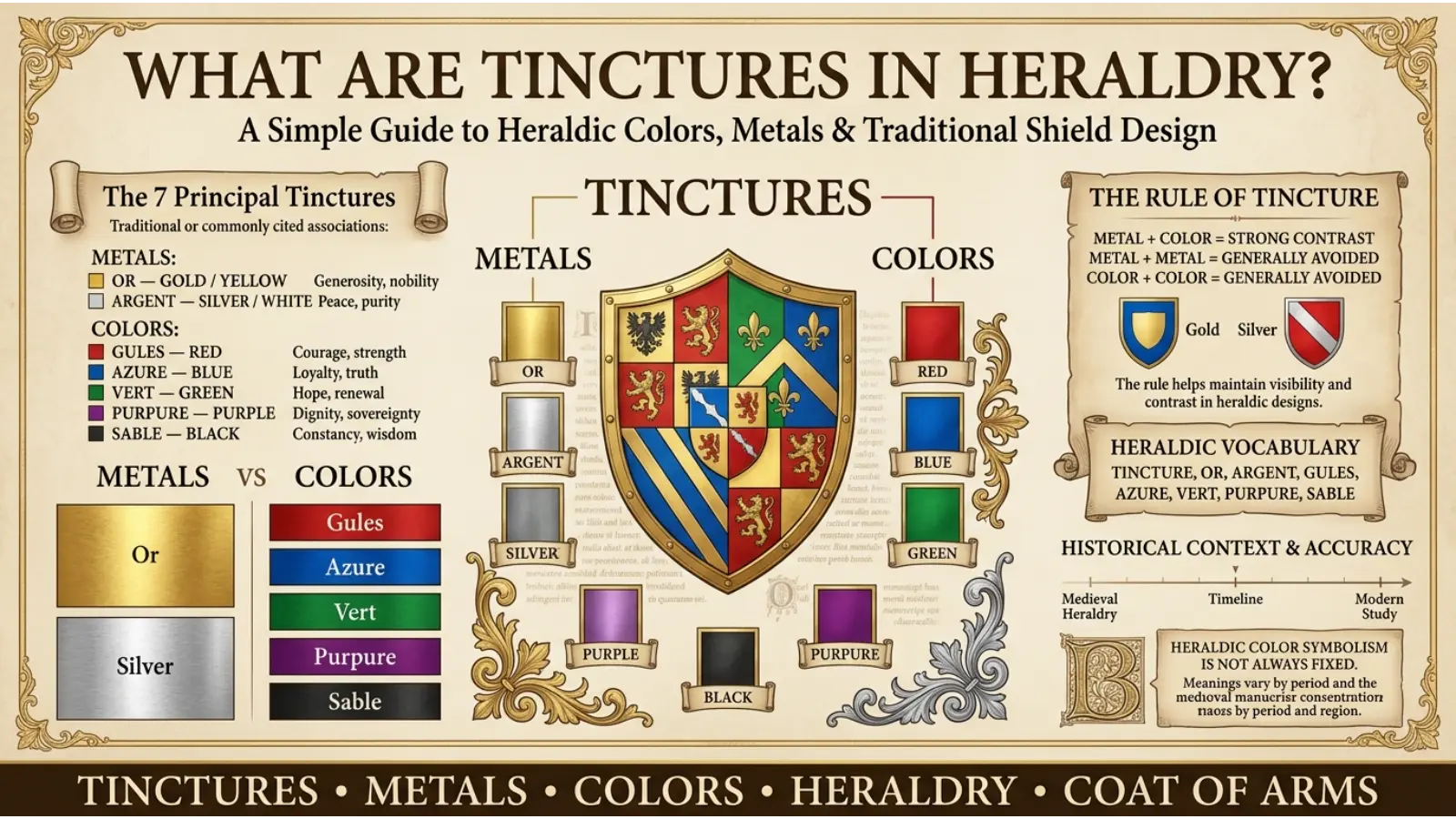
The most familiar English heraldic tinctures include Gules for red, Azure for blue, Vert for green, Purpure for purple, Sable for black, Argent for silver or white, and Or for gold or yellow. Heraldry also uses furs and additional tinctures in some traditions.
So, what do these colors mean? The answer depends on whether you are looking at traditional heraldic terminology, later symbolic interpretations, a particular family’s arms, or the modern cultural meaning of the color.
Quick Answer: What Do Coats of Arms Color Meanings?
There is no single universal meaning for every heraldic color. However, traditional and later heraldic interpretations commonly associate the main tinctures with ideas such as courage, loyalty, hope, nobility, wisdom, strength, purity, or mourning.
| Heraldic Tincture | Modern Color | Common Symbolic Associations |
|---|---|---|
| 🔴 Gules | Red | Courage, strength, sacrifice, military valor |
| 🔵 Azure | Blue | Loyalty, truth, justice, faith, stability |
| 🟢 Vert | Green | Hope, renewal, nature, growth |
| 🟣 Purpure | Purple | Royalty, dignity, sovereignty, honor |
| ⚫ Sable | Black | Constancy, seriousness, grief, endurance |
| ⚪ Argent | Silver/White | Purity, sincerity, peace, clarity |
| 🟡 Or | Gold/Yellow | Generosity, wealth, glory, elevation |
These associations should be treated as symbolic interpretations rather than universal rules. In actual heraldry, the blazon—the formal description of the arms—identifies the tinctures and arrangement. The College of Arms also notes that heraldic colors do not have fixed modern shades such as specific Pantone numbers.
What Are Tinctures in Heraldry?
In heraldry, tincture is the broad term for the colors, metals, and furs used in an armorial design.
The word may sound technical, but the idea is straightforward. A coat of arms can contain a colored background, metallic elements, patterned fur, and figures shown in particular colors. Together, these elements create the visual language of the shield.
Traditional English heraldry commonly uses two metals:
- Or — gold
- Argent — silver
It also uses several principal colors:
- Gules — red
- Azure — blue
- Vert — green
- Purpure — purple
- Sable — black
Other tinctures appear in some heraldic traditions, including Tenne, Sanguine, Murrey, and Bleu Celeste. Their use varies by country and heraldic system.
This terminology matters because a heraldic description does not simply say, “make this part dark blue.” It can say Azure, giving the herald or artist a precise traditional tincture to reproduce.
🔴 Gules: Red in Coats of Arms
Gules is the heraldic term for red. It is one of the most recognizable tinctures in European heraldry.
Red naturally attracts attention, which made it useful on shields and banners. It also became associated in later heraldic interpretation with qualities such as courage, strength, military valor, passion, and sacrifice.
Those meanings can make sense when looking at a particular coat of arms, especially when red appears alongside weapons, lions, castles, crowns, or other martial imagery. However, red does not automatically mean that the original armiger intended every one of these ideas.
What Gules Can Symbolize
Common symbolic associations include:
- Courage
- Strength
- Valor
- Determination
- Sacrifice
- Passion
- Martial spirit
Red can also create a feeling of visual urgency. On a shield, a red field can make gold, silver, black, or white charges stand out strongly.
Red in Historical Context
The historical meaning of a particular red field must be understood from the complete arms. A red shield containing a lion may communicate something different from a red shield containing agricultural tools or religious imagery.
That is one reason it is better to read a coat of arms as a complete visual statement rather than translating each color separately.
🔵 Azure: Blue in Heraldry
Azure means blue in heraldic language. Blue is among the most frequently encountered tinctures in coats of arms.
Later heraldic symbolism commonly connects blue with loyalty, truth, justice, faith, sincerity, and stability. Blue can also create a calm and dignified visual effect.
What Azure Can Represent
Common interpretations include:
- Loyalty
- Truth
- Faith
- Justice
- Sincerity
- Stability
- Honor
However, the exact meaning depends on the arms. For example, blue may simply be part of an established family or civic design rather than a coded statement about loyalty.
The College of Arms demonstrates this flexibility through actual grants of arms. Modern coats of arms frequently combine Azure with several other tinctures and charges, with the meaning of the complete design explained by the specific grant rather than by color alone.
🟢 Vert: Green and Its Meaning
Vert is the heraldic term for green.
Green is visually connected with vegetation, fields, forests, agriculture, and natural landscapes. Consequently, it can easily support ideas such as hope, renewal, growth, fertility, prosperity, and connection with the land.
Common Associations of Vert
Green is often interpreted as representing:
- Hope
- Growth
- Renewal
- Nature
- Fertility
- Prosperity
- Youth
- Life
These associations are particularly useful when green appears with trees, leaves, mountains, crops, animals, or landscapes.
Yet green does not automatically indicate nature. A coat of arms may use Vert simply because it creates the necessary contrast or forms part of an inherited design.
🟣 Purpure: Purple in Coats of Arms
Purpure is the heraldic term for purple.
Purple has long carried associations with rank, dignity, royalty, honor, and authority in European and wider cultural history. Because purple dyes were historically expensive and difficult to produce in some contexts, the color developed strong connections with wealth and status.
In heraldry, however, Purpure is less common than Gules, Azure, Vert, and Sable.
Purple Symbolism
Common later interpretations include:
- Royal dignity
- Nobility
- Honor
- Sovereignty
- Authority
- Ambition
- Spiritual dignity
Purple can therefore create a formal and distinctive appearance, particularly when combined with gold or silver.
⚫ Sable: Black in Heraldry
Sable means black.
Black is visually powerful and creates strong contrast against metallic tinctures. It can make heraldic charges appear especially clear from a distance.
Symbolically, Sable has been associated in different interpretations with constancy, endurance, seriousness, grief, and restraint.
Black Can Suggest
- Constancy
- Endurance
- Strength
- Seriousness
- Authority
- Mourning
- Resolve
The same color can therefore carry positive or solemn associations depending on the context.
A black shield does not automatically represent death or mourning. The charges, motto, history, and documented explanation of the arms are needed before making such a conclusion.
⚪ Argent: Silver and White
Argent represents silver in heraldic terminology and is commonly displayed as white.
It belongs to the category of metals, rather than the main heraldic colors.
Silver and white are often associated with:
- Purity
- Peace
- Sincerity
- Innocence
- Clarity
- Honesty
- Cleanliness
Because Argent provides a bright background, it also has an important practical function. Darker tinctures such as Gules, Azure, Vert, and Sable can appear clearly against it.
The College of Arms specifically notes that Argent may be represented by white or silver and that there is no fixed shade system for heraldic colors.
🟡 Or: Gold and Yellow
Or is the heraldic term for gold.
It is the second major heraldic metal and is usually shown using yellow or gold.
Gold naturally suggests ideas of:
- Generosity
- Wealth
- Honor
- Glory
- Nobility
- Elevation
- Achievement
Yet Or is not simply a decorative form of yellow. In a blazon, Or has a specific heraldic meaning.
For example, the College of Arms records modern arms containing Or alongside Gules, Azure, Argent, Vert, and Sable. These combinations show how gold functions as part of the formal structure of a coat of arms rather than as a standalone psychological symbol.
🦌 Heraldic Furs: Ermine, Vair, and More
Not every heraldic surface is a simple color.
Heraldry also uses furs, especially patterns such as:
- Ermine
- Ermines
- Erminois
- Vair
- Counter-vair
- Potent
Ermine is commonly represented as a white field marked with black ermine spots. Vair traditionally uses a repeating pattern of blue and white shapes.
Furs are especially interesting because they add texture and visual history to a shield. They also demonstrate why the phrase “coat of arms color meanings” can be slightly misleading: heraldic identity is created through tinctures, charges, divisions, ordinaries, and composition, not color alone.
Why Heraldry Uses Specific Color Rules
One of the most important ideas in heraldry is the rule of tincture.
In its familiar form, the rule says that a heraldic color should generally not be placed directly on another color, and a metal should generally not be placed directly on another metal.
The basic idea is visual contrast.
For example:
- 🔵 Azure on 🟡 Or creates strong contrast.
- 🔴 Gules on ⚪ Argent creates strong contrast.
- 🟢 Vert on 🟡 Or creates strong contrast.
- ⚫ Sable on ⚪ Argent creates strong contrast.
By contrast, placing red directly on blue can create weaker visual separation.
The rule has exceptions and has not been applied identically in every heraldic tradition. Continental European heraldry, for example, contains designs that do not always follow the familiar British formulation.
This rule reveals something important: heraldic color was practical as well as symbolic. A shield needed to remain recognizable, especially when viewed from a distance.
Why Color Was So Important on Medieval Shields
A medieval battlefield could contain many people wearing armor and carrying weapons. A clearly recognizable shield or banner helped identify individuals and groups.
Strong color contrast made symbols easier to see.
Therefore, heraldic color had a communication function. A red lion on gold, for example, could be visually distinct even before a viewer understood the symbolic meaning of the lion.
This practical role helps explain why it can be misleading to treat heraldry as nothing more than a secret color code.
The system developed within medieval European heraldry and later became increasingly formalized. The College of Arms describes heraldry as having international medieval European origins and notes that the laws governing arms developed within specific legal and institutional traditions.
Do Heraldic Colors Have Fixed Meanings?
No.
This is one of the most important facts to understand.
You may find charts claiming:
Red = courage
Blue = loyalty
Green = hope
Purple = royalty
Black = wisdom
Gold = generosity
Silver = peace
These lists can be useful as traditional symbolic associations, but they should not be treated as a universal law of heraldry.
A particular coat of arms may have a documented explanation for its colors that is completely different.
For example, a modern grant may use a particular color because it represents a geographical feature, organization, family history, occupation, previous arms, or another specific idea.
The College of Arms publishes examples where the rationale for a design is explicitly connected with the history and identity of the person or organization receiving the arms.
How to Read a Coats of Arms Color Meanings Correctly
If you want to understand the meaning of a coat of arms, start with the blazon rather than a generic color chart.
A blazon is the formal description of the arms. It explains the arrangement, tinctures, charges, and other details.
For example, a description might contain words such as:
- Azure
- Gules
- Argent
- Or
- Sable
- Vert
- Per pale
- Per fess
- Chevron
- Cross
- Lion
- Eagle
- Castle
The first step is to translate the heraldic vocabulary.
The second is to identify the individual symbols.
The third is to investigate the historical explanation of the specific arms.
Only after those steps should you interpret the broader symbolism.
What Does the Shield Shape Mean?
The shield is the central surface on which arms are normally displayed.
Its outline can vary according to period, country, artistic style, and medium. Therefore, the exact shape of a shield does not always carry a universal symbolic message.
The same armorial design can also appear on documents, banners, seals, buildings, uniforms, and other objects.
In other words, the identity of the arms lies in the heraldic design, not simply in one particular shield outline.
Color Meanings Depend on the Whole Design
A color can change its visual effect when surrounded by different symbols.
Consider blue.
A blue field containing:
- a silver ship may suggest a maritime theme,
- a golden crown may create a royal appearance,
- a green mountain may emphasize landscape,
- a white cross may create a religious or civic association,
- a red animal may create a dramatic contrast.
The blue has not necessarily changed its traditional heraldic identity. Instead, the context changes what the complete design communicates.
This is why a coat of arms should be interpreted as a composition.
Coats of Arms Color Meanings Symbolism of Color vs. Color Psychology
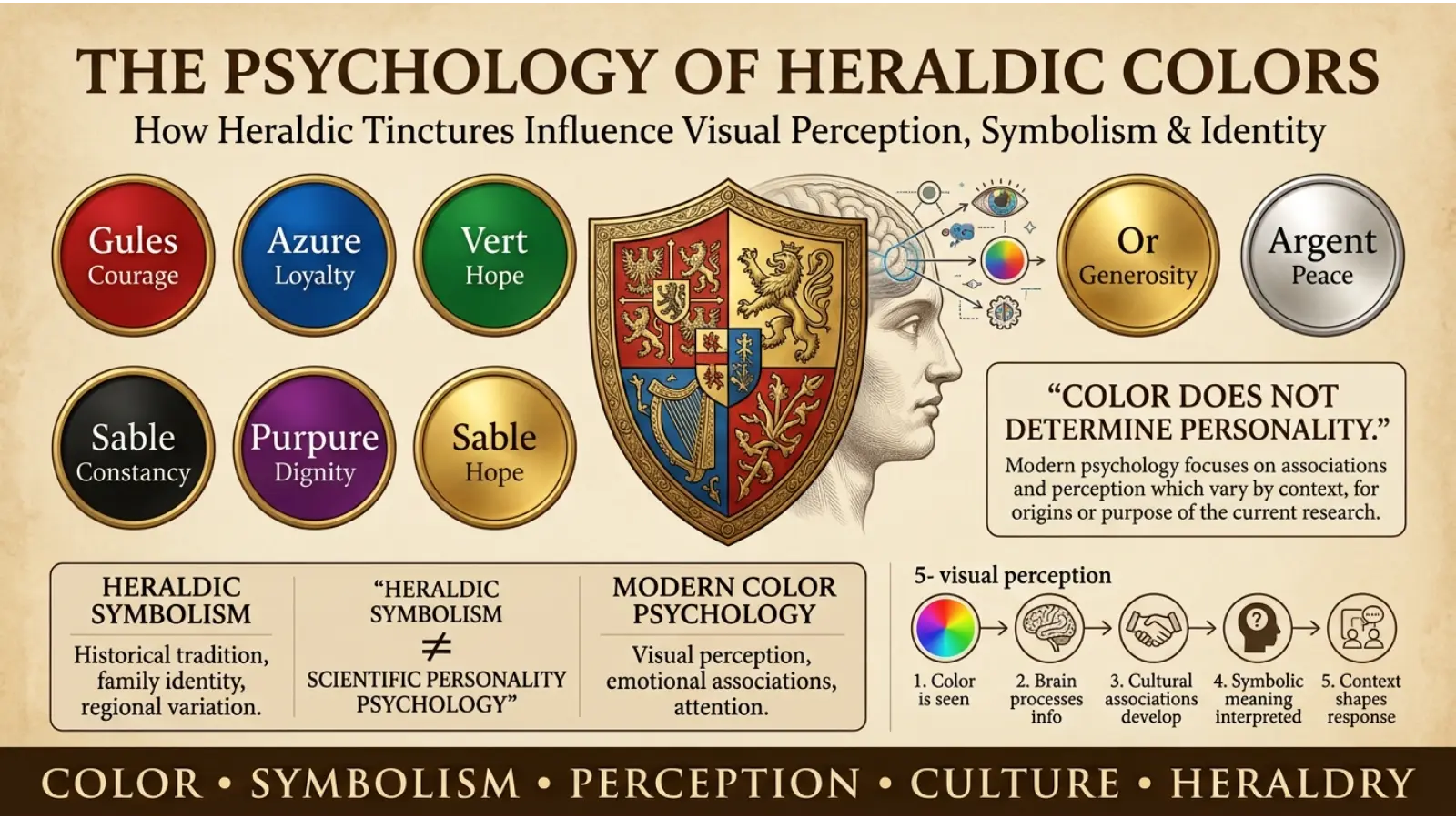
Heraldic symbolism and modern color psychology are related only in a limited sense.
Color psychology studies how people perceive and respond to colors. Heraldry, on the other hand, is a historical system of identification and symbolic representation.
For example, modern research may examine whether certain colors affect attention, preference, or perception. That does not prove that medieval heralds selected red because people had a universal psychological response to red.
Likewise, saying that blue “feels trustworthy” in modern branding does not prove that every medieval Azure field represented trust.
Keeping these categories separate makes a historical article about heraldry more accurate.
Cultural Differences in Heraldic Color
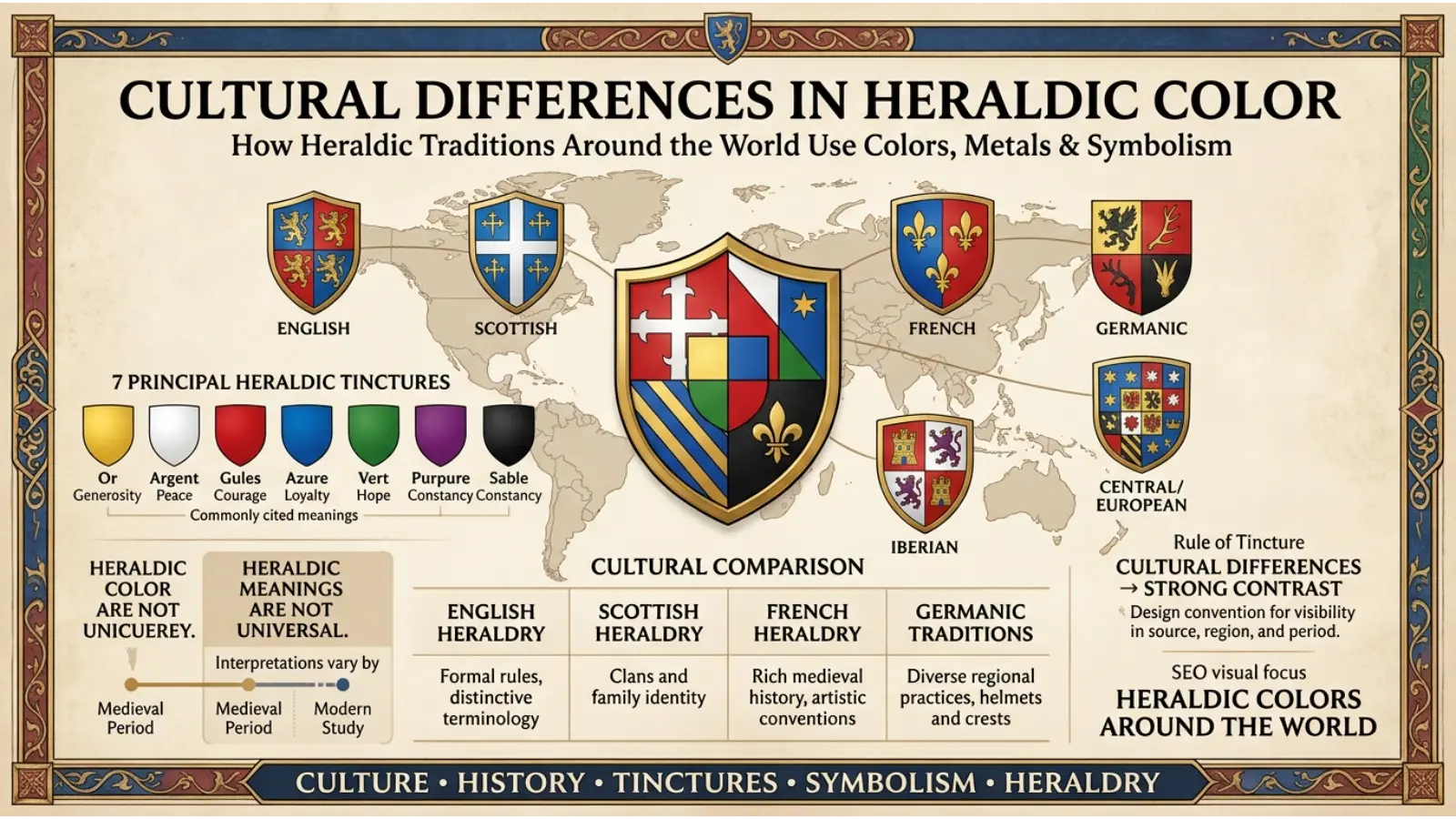
Heraldry is not identical everywhere.
European heraldic traditions developed different practices, vocabularies, conventions, and artistic styles. English, Scottish, Irish, French, German, Spanish, Italian, Scandinavian, Central European, and other traditions can differ in important details.
Even the treatment of shades may vary.
The College of Arms states that English heraldry does not prescribe fixed shades for its tinctures. An official blazon can identify Gules and Azure without requiring one precise digital color value.
Meanwhile, other heraldic traditions may display greater variation in shades and additional tinctures.
Therefore, a modern chart should never imply that one RGB value is the official universal version of every heraldic color.
Historical Evolution of Heraldic Colors
Heraldry developed during medieval Europe and gradually became a formal system for identifying arms.
As heraldic institutions, records, manuscripts, and legal traditions developed, the terminology surrounding tinctures and charges became increasingly structured.
Heraldic manuscripts known as ordinaries were arranged according to different characteristics of coats of arms and helped heralds identify existing arms and develop new designs. The College of Arms describes such manuscripts as part of the historical development of heraldic practice.
Over time, heraldry moved beyond battlefield identification.
Coats of arms came to appear on:
- Government buildings
- Churches
- Universities
- Cities
- Military organizations
- Companies
- Institutions
- Monuments
- Official documents
- Ceremonial objects
Modern grants continue to use the traditional language of tinctures.
Modern Coats of Arms Color Meanings Still Use Traditional Colors
Heraldry is not only a medieval subject.
The College of Arms continues to record new grants of arms. Recent examples include combinations of Gules, Azure, Vert, Argent, Or, and Sable in newly granted designs.
This continuity is significant because it shows that heraldic color terminology remains a living system.
A modern coat of arms may therefore combine ancient heraldic vocabulary with symbols representing contemporary occupations, achievements, places, organizations, or family histories.
Coats of Arms Color Meanings Chart
Here is a practical reference chart for the most familiar English heraldic tinctures.
| Color | Heraldic Name | Type | Common Symbolic Associations | Practical Visual Role |
|---|---|---|---|---|
| 🔴 Red | Gules | Color | Courage, valor, strength | Strong attention and contrast |
| 🔵 Blue | Azure | Color | Loyalty, truth, justice | Calm, clear visual field |
| 🟢 Green | Vert | Color | Hope, growth, renewal | Natural and earthy appearance |
| 🟣 Purple | Purpure | Color | Dignity, royalty, honor | Distinctive and formal |
| ⚫ Black | Sable | Color | Constancy, seriousness, endurance | Strong contrast |
| ⚪ White/Silver | Argent | Metal | Purity, peace, sincerity | Bright reflective field |
| 🟡 Gold/Yellow | Or | Metal | Generosity, glory, wealth | Bright metallic contrast |
Remember that the symbolic associations are not universal definitions. The formal heraldic identity comes from the tincture used in the blazon and the complete design.
How Lighting Changes Heraldic Colors
Modern viewers often see coats of arms on websites, printed materials, painted shields, stone carvings, stained glass, metalwork, or illuminated manuscripts.
As a result, the same tincture can look very different.
A dark blue painted shield may appear almost black under poor lighting. Gold leaf can look highly reflective, while flat yellow paint may look much brighter and less metallic.
This is another reason heraldry does not depend on exact modern color codes.
The College of Arms explicitly explains that there are no fixed shades for heraldic colors.
Color Combinations in Heraldry
Some combinations appear especially clear because they create strong contrast.
🔴 Gules + ⚪ Argent
Red and silver create a sharp, highly visible combination. This pairing can look energetic while remaining easy to distinguish.
🔵 Azure + 🟡 Or
Blue and gold provide strong contrast and have frequently been used in formal and civic designs.
⚫ Sable + 🟡 Or
Black and gold create a powerful visual relationship. The brightness of Or stands out strongly against Sable.
🟢 Vert + ⚪ Argent
Green and white create a lighter, more natural appearance and work particularly well when the design contains plants, landscapes, or agricultural references.
🟣 Purpure + 🟡 Or
Purple and gold create a rich, formal combination that can suggest dignity or ceremony.
These combinations should be understood first as heraldic design choices. Their symbolic interpretation comes afterward.
Why Designers Use Contrast
The practical value of contrast is easy to overlook.
A coat of arms was often designed to be recognized quickly. If the background and charge were too similar, the design could become difficult to identify.
The rule of tincture helped solve this problem by encouraging clear separation between colors and metals.
That same principle remains useful today in:
- Flags
- Logos
- Badges
- Institutional seals
- Sports emblems
- Uniform insignia
- Digital icons
Modern designers can learn from heraldry without assuming that modern branding and medieval heraldry operate under exactly the same rules.
Color in Modern Branding
Heraldic color principles continue to influence modern visual identity, although a corporate logo is not automatically heraldic.
Modern brands often use color to create recognition and emotional associations. Blue may suggest reliability, red may create energy, green may suggest nature, and gold may suggest premium quality.
However, these modern associations should not be projected backward onto medieval heraldry.
The important distinction is this:
Modern branding asks what a color communicates to an audience. Heraldry asks how a tincture functions within a formal armorial design and what the particular arms represent.
That difference prevents a great deal of misinformation.

Color in Interior Design and Decorative Heraldry
Coats of arms are sometimes displayed in homes, offices, schools, museums, churches, and public buildings.
If you are decorating with heraldic imagery, color can help create different moods.
A combination of Azure and Argent can feel clean and formal.
Gules and Or can feel dramatic and ceremonial.
Vert and Argent can create a connection with landscapes and traditional architecture.
Sable and Or can create a strong historic or prestigious appearance.
Nevertheless, decorative choices should not be confused with the documented meaning of the original arms.
Heraldry in Fashion and Jewelry
Heraldic colors also appear in:
- Family crests on accessories
- Rings
- Brooches
- Cufflinks
- Watches
- School uniforms
- Military-inspired clothing
- Ceremonial garments
- Sports merchandise
Gold and silver are particularly common in jewelry because their metallic nature closely matches the heraldic concepts of Or and Argent.
For historical accuracy, however, a designer should use the actual blazon rather than selecting colors from a generic “family crest color meanings” chart.
Common Misconceptions About Coats of Arms Color Meanings
Myth 1: Every red coat of arms means courage
Not necessarily.
Courage is a common symbolic association with red, but the documented meaning of a specific coat of arms may be different.
Myth 2: Blue always means loyalty
Loyalty is a traditional association, but Azure does not automatically encode loyalty in every armorial design.
Myth 3: Purple always means royalty
Purple has strong historical associations with rank and royalty, but Purpure can appear for many reasons and is not a universal royal code.
Myth 4: Every color has an official Pantone number
No.
The College of Arms specifically states that heraldic colors do not have fixed shades.
Myth 5: The crest and coat of arms are the same thing
They are not.
The College of Arms explains that a crest is a specific component of a full achievement of arms, traditionally placed above the helm. It is not the name for the entire armorial achievement.
Myth 6: A family surname automatically has one universal coat of arms
A coat of arms belongs to a particular armiger or corporate body under the relevant heraldic system. Finding a surname online does not automatically prove that a displayed shield belongs to every person with that surname.
How to Find the Meaning of a Specific Coats of Arms Color Meanings
If you have a particular coat of arms and want to understand its colors, use this process.
First, identify the country or heraldic authority.
The rules and records may differ between traditions.
Next, find the official blazon.
The blazon is more reliable than an image alone because colors and details can vary in artistic reproductions.
Then, translate the tinctures.
For example:
- Gules = red
- Azure = blue
- Vert = green
- Purpure = purple
- Sable = black
- Argent = silver/white
- Or = gold/yellow
After that, identify the charges.
A lion, eagle, castle, cross, ship, tree, sword, crown, or other figure may have a specific historical connection.
Finally, look for the documented rationale.
For modern grants, the official authority may explain why the particular colors and symbols were selected.
This approach is much more reliable than assigning a meaning from a generic color psychology chart.
Real-World Examples of Heraldic Color Use
Modern grants demonstrate how flexible heraldic color can be.
For example, the College of Arms records arms using combinations such as Sable with Or and Argent, as well as designs containing Azure, Gules, Vert, and other tinctures.
One recent grant uses a shield described as Sable a Cross Or, with silver dolphins and additional colored elements in the crest. The design illustrates how black, gold, and silver can work together within a single formal armorial achievement.
Another example from the College’s records uses Per pale Gules and Azure with a gold griffin and silver castles. Here, the colors work together as part of a larger composition rather than functioning as isolated symbolic words.
These real examples are valuable because they show how heraldry actually works: color, arrangement, and imagery interact.
The Psychology of Heraldic Colors
Although heraldry should not be confused with modern experimental color psychology, color perception still matters.
People tend to notice differences in brightness, saturation, and contrast. Consequently, a bright metallic tincture against a dark color can feel visually prominent, while two similar tones can blend together.
This helps explain why heraldic design places such importance on contrast.
Symbolic responses also depend on culture and context. A color that suggests celebration in one setting may suggest mourning or authority in another.
Therefore, color psychology can help explain modern perception, but it should not be used as proof of historical heraldic intention.
Why the Meaning of a Color Can Change
Color meaning is shaped by context.
A red field behind a sword may reinforce a martial impression.
The same red surrounding a rose may suggest a completely different theme.
A gold crown can emphasize royal imagery.
Gold grain or wheat may instead emphasize agriculture, prosperity, or regional resources.
A green tree naturally creates a different association from a green geometric shape.
In other words, symbolism emerges from relationships, not just isolated colors.
How Age and Culture Affect Interpretation
A medieval viewer, a Victorian heraldry enthusiast, and a modern internet user may not interpret a color in exactly the same way.
The modern internet has also popularized simplified lists of color meanings. These lists are convenient, but they often combine medieval symbolism, Victorian heraldic writing, modern psychology, spirituality, branding theory, and popular culture.
Those categories should be separated.
When researching historical arms, prioritize the documented history of the particular design over generalized modern interpretations.
Spiritual Coats of Arms Color Meanings
Heraldry can contain religious symbols, including crosses, saints, churches, angels, sacred objects, and other imagery.
However, the color itself should not automatically be assigned a religious meaning.
For example, white may be associated with purity in some Christian artistic traditions, while gold can be connected with glory or divine light in religious art. These associations belong to broader artistic and religious symbolism and should not automatically be presented as universal heraldic rules.
Religious meanings also vary between traditions.
Therefore, a responsible interpretation should identify the specific religious context before making a claim.
Coats of Arms Color Meanings and National Identity
Colors on national or civic arms can become powerful symbols of identity.
A city may use its arms on official buildings. A university may display its shield on certificates. A military organization may use heraldic imagery on badges. A nation may incorporate historic heraldic elements into state symbols.
In these cases, the meaning of a color can become tied to the specific institution.
That is why the same tincture can have different documented meanings in different coats of arms.
A Practical Guide to Reading Heraldic Colors
When you see a coat of arms, ask five questions:
1. What tinctures are present?
Identify Gules, Azure, Vert, Purpure, Sable, Argent, Or, and any other tinctures.
2. What is the field?
The field is the background of the shield.
3. What charges appear on it?
Look for animals, plants, buildings, weapons, stars, crosses, crowns, and other figures.
4. How are the elements arranged?
Terms such as per pale, per fess, per bend, and per chevron describe divisions of the shield.
5. What does the official record say?
This is the most important step when historical accuracy matters.
FAQ: Coats of Arms Color Meanings
What does red mean on a coat of arms?
Red, called Gules, is commonly associated with courage, valor, strength, and sacrifice in later heraldic symbolism. However, red does not have one universal meaning in every coat of arms.
What does blue mean on a coat of arms?
Blue is called Azure. It is commonly associated with loyalty, truth, justice, faith, and sincerity, although the meaning of a specific Azure field depends on its historical context.
What does green mean on a coat of arms?
Green is Vert in heraldic language. It is often associated with hope, growth, renewal, nature, and prosperity.
What does purple mean on a coat of arms?
Purple is called Purpure. It is commonly linked with dignity, honor, sovereignty, and royalty, although its use varies between individual arms and heraldic traditions.
What does black mean on a coat of arms?
Black is Sable. It can be associated with constancy, endurance, seriousness, and mourning. The exact interpretation depends on the complete design.
What does gold mean on a coat of arms?
Gold is called Or. It is often associated with generosity, glory, wealth, honor, and elevation. In heraldry, Or is classified as a metal.
What does white mean on a coat of arms?
White generally represents Argent, the heraldic metal associated with silver. It is often symbolically connected with purity, peace, sincerity, and clarity.
Do all coat of arms colors have fixed meanings?
No. Heraldry does not have one universal color dictionary. Symbolic associations exist, but the meaning of an individual coat of arms depends on its documented history, charges, composition, and heraldic tradition.
Why are heraldic colors called tinctures?
Tincture is the traditional heraldic term covering the colors, metals, and furs used in armorial designs. The term allows heraldic descriptions to specify the visual components of a coat of arms precisely.
Why can’t I find one exact color code for heraldry?
Because traditional heraldry does not depend on fixed modern color codes. The College of Arms states that there are no fixed shades for heraldic colors, provided the tincture remains recognizable.
Final Thoughts on Coats of Arms Color Meanings
The most useful way to understand coats of arms color meanings is to look beyond simple color charts.
Gules can suggest courage. Azure can suggest loyalty. Vert can suggest hope. Purpure can suggest dignity. Sable can suggest constancy. Argent can suggest purity. Or can suggest generosity or glory.
Yet these are interpretive associations, not universal rules.
The real strength of heraldry comes from the relationship between color, symbol, arrangement, history, and identity. A single tincture may attract the eye, but the complete coat of arms tells the larger story.
That is also why authentic heraldic research begins with the blazon and the historical record. Modern color psychology, branding, fashion, and decorative design can offer useful ways to think about color, but they should not replace the evidence behind a particular set of arms.
Once you learn to recognize Gules, Azure, Vert, Purpure, Sable, Argent, and Or, coats of arms become easier to read. What first looks like a collection of decorative colors starts to reveal a structured visual language built around identification, contrast, symbolism, and history.

Emma Wilson is a dedicated comparison writer and product researcher at ColorMystiic.com. She specializes in creating unbiased product comparisons, detailed reviews, and helpful buying guides. Her goal is to help readers make smarter purchasing decisions with confidence.