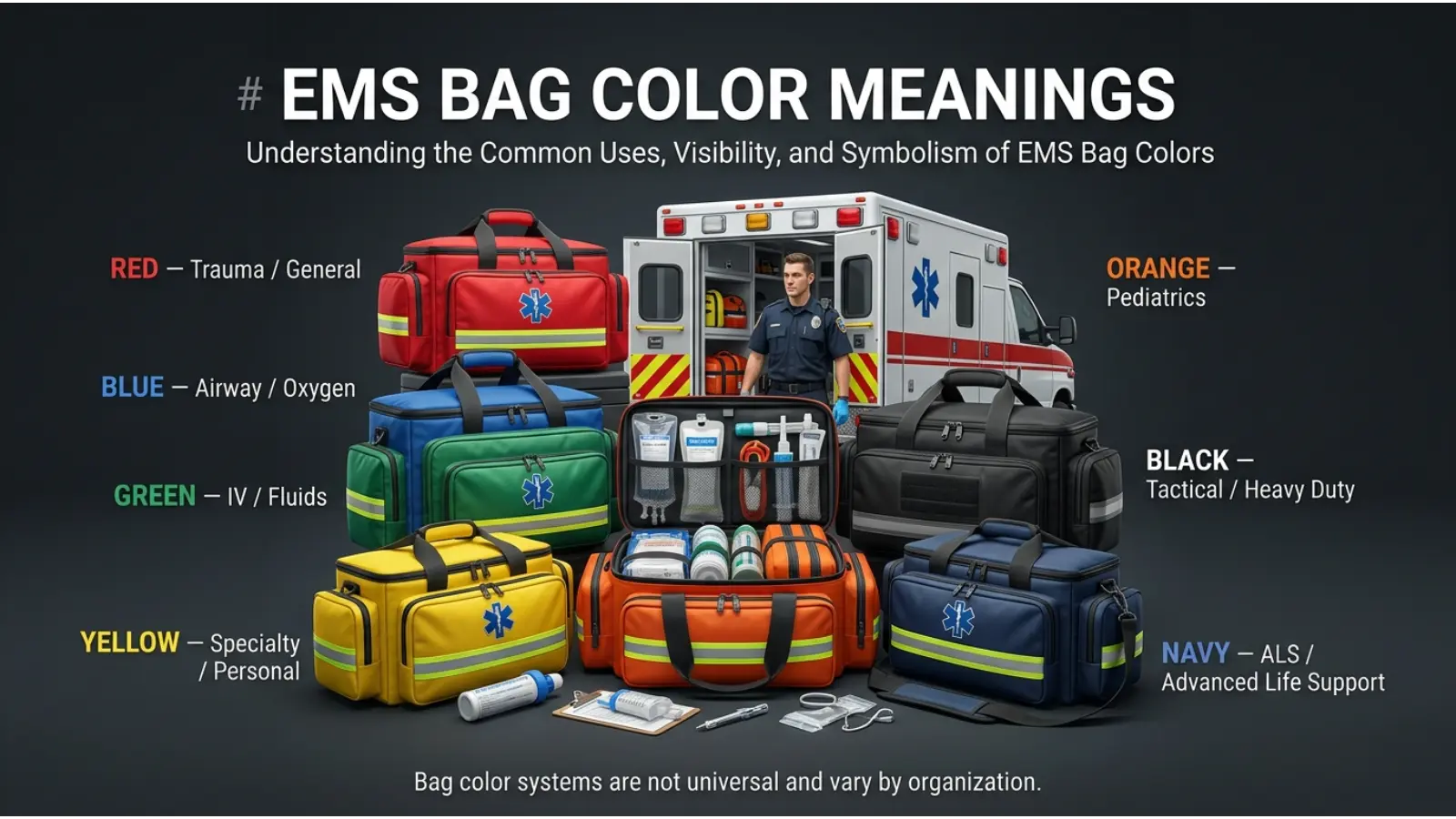
Emergency medical services depend on speed, organization, and clear communication. In a stressful situation, an EMS crew may need to find airway equipment, trauma supplies, medications, or other medical tools within seconds. That is one reason color can become a practical part of EMS bag organization.However, EMS bag color meanings are not universal. A red bag does not automatically mean the same thing in every ambulance service, hospital, fire department, or rescue organization.
Some systems use color to identify the type of equipment inside. Others use it to identify provider level, response role, or a particular team. In some cases, the color is simply chosen because it is highly visible.
For example, one EMS system may use a green bag for airway equipment, a red bag for trauma, and a blue bag for general medical supplies. Another service may use the same colors differently. WHO’s major trauma backpack also uses removable color-coded pouches to organize equipment by clinical indication, showing how color coding can support rapid access without creating one universal color language.
So, what do EMS bag colors mean? The answer depends on the organization and the system being used. This guide explains the most common associations, the psychology behind high-visibility colors, and how EMS teams can use color effectively.
Quick Answer: What Do EMS Bag Colors Mean?
EMS bag colors are mainly used for identification, organization, visibility, or role assignment rather than universal medical symbolism. Red often suggests trauma or emergency equipment, green may identify airway or medical-response equipment, blue can indicate medical or specialized response gear, while yellow and orange are often selected for high visibility or particular response roles. However, these meanings vary by agency and manufacturer.
| EMS Bag Color | Common Association | Important Note |
|---|---|---|
| 🔴 Red | Trauma, ALS, emergency equipment | Often associated with urgent care, but not universal |
| 🔵 Blue | Medical supplies, BLS, specialized teams | Meaning depends strongly on the EMS system |
| 🟢 Green | Airway, medic bag, critical-care role | Green is also commonly used for general medic bags |
| 🟡 Yellow | High visibility, event or rescue equipment | Often chosen to stand out quickly |
| 🟠 Orange | Search and rescue, wilderness, high visibility | Frequently useful in outdoor environments |
| ⚫ Black | Tactical, professional, low-profile equipment | May be chosen for durability or discreet appearance |
| ⚪ White | Clean clinical appearance or specialized equipment | Less common as a primary EMS bag color |
Why Are EMS Bag Color Meanings Coded?
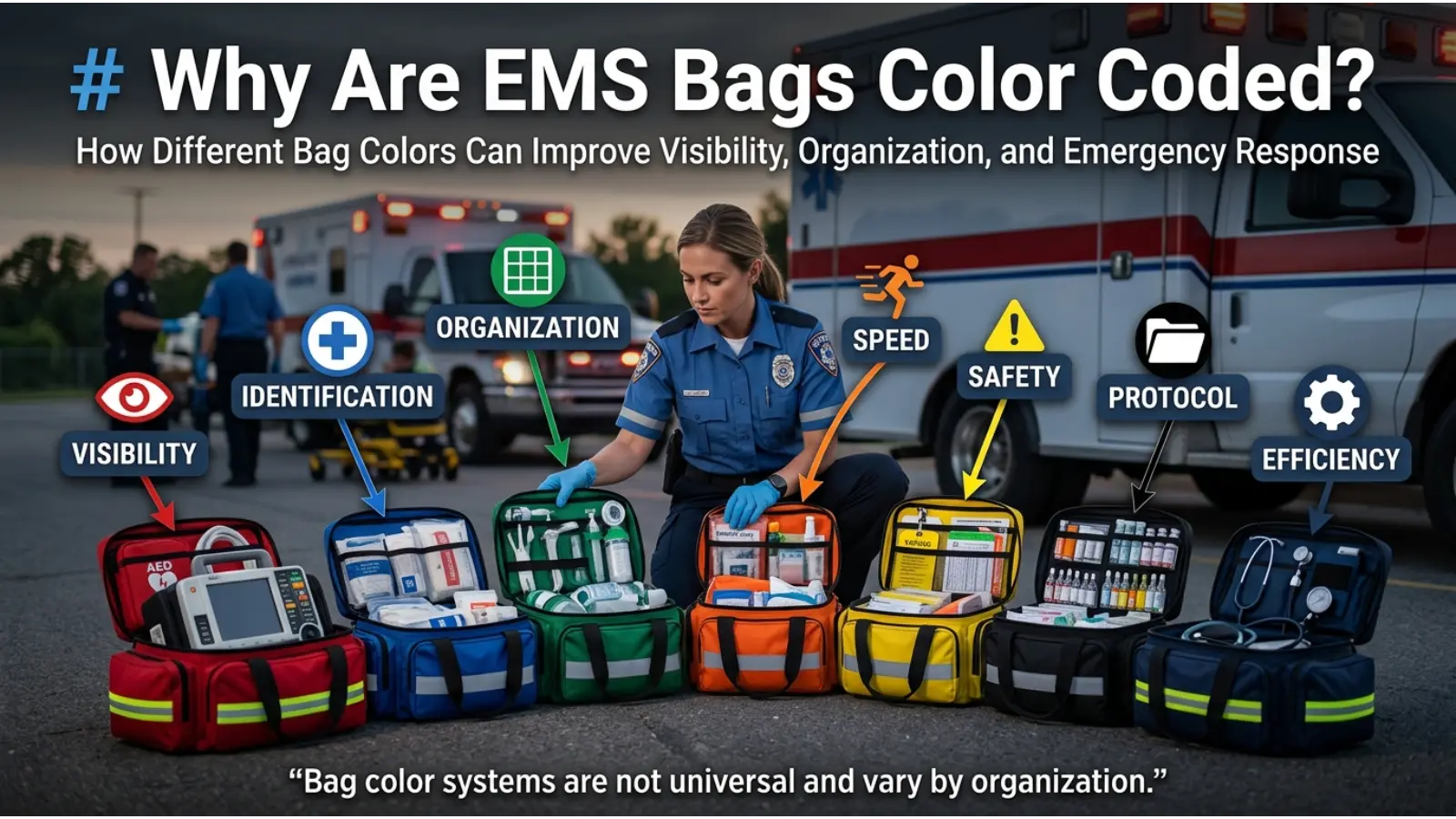
Color coding solves a simple problem: people need to identify equipment quickly.
Imagine several medical bags sitting beside an ambulance. If every bag is identical, a responder may need to open each one before finding the correct supplies. A consistent color system gives the crew another visual clue.
This becomes especially useful during high-pressure calls. Color can work together with labels, symbols, reflective strips, bag shape, and compartment design.
For example, Pinellas County EMS developed a three-bag system in which the airway bag was green, the trauma bag was red, and the medical bag was blue. The bright colors were selected partly because they made the bags easier to identify when crews arrived at a scene.
Therefore, the real value of EMS colors is often speed and organization, rather than symbolism.
🔴 Red EMS Bag Meaning
Red is one of the most recognizable colors in emergency medicine. It naturally attracts attention and is strongly associated with danger, urgency, blood, and emergency response.
In EMS equipment, red is commonly used for trauma or advanced emergency equipment. For example, one commercial EMS system identifies red with ALS or trauma use, while another documented EMS system uses a red bag specifically for trauma supplies.
Why Is Red Used for Trauma Bags?
Red is visually powerful. It can remain noticeable when many other objects are competing for attention.
From a practical design perspective, this can help a responder recognize an emergency bag without reading a label first. Nevertheless, red does not officially mean “trauma bag” everywhere.
Red EMS Bag Psychology
Red is commonly associated with:
- Urgency
- Action
- Danger
- Energy
- Attention
- Emergency response
These associations make red useful when the goal is to create a strong visual signal.
However, the psychological effect should not be confused with a medical rule. A red EMS bag is not automatically a trauma bag simply because red has an emergency association.
🔵 Blue EMS Bag Meaning
Blue is another common color for EMS equipment. Depending on the organization, it can identify medical supplies, BLS equipment, or a specialized response role.
Some EMS bag systems use blue for medical equipment, while commercial systems may assign blue to a particular provider or team. For example, one EMS gear system lists blue as a possible color for law-enforcement medic equipment, while another documented responder system associates blue with BLS.
What Does Blue Communicate?
Blue often creates a calmer visual impression than red. In broader healthcare environments, blue is frequently associated with cleanliness, professionalism, reliability, and calmness.
For an EMS bag, however, its most important meaning is usually organizational.
If an agency establishes blue as its medical bag color, the crew can learn that system and recognize the bag quickly.
🟢 Green EMS Bag Meaning
Green is particularly interesting because it has several different uses.
In the UK, green is described as a standard color for medic bags, although blue and red are also used by EMS services in other locations.
Green can also be assigned to airway equipment. In the Pinellas County system mentioned earlier, the airway bag was green while trauma was red and medical was blue.
Why Green Works for EMS Equipment
Green can stand out without having the same visual intensity as red. It is also strongly associated with medicine, health, and clinical environments.
However, green should never be assumed to mean airway equipment. The same color can mean “medic bag” in one system and “airway” in another.
🟡 Yellow EMS Bag Meaning
Yellow is highly noticeable, especially against darker backgrounds.
For EMS organizations, yellow may be selected when visibility is more important than traditional medical symbolism. Some commercial EMS bags are available in yellow specifically as a high-visibility option, and manufacturers may allow organizations to assign the color according to their own response structure.
Yellow can be particularly useful at:
- Large public events
- Roadside incidents
- Disaster scenes
- Search operations
- Low-light environments
- Crowded emergency scenes
Its practical strength is simple: it is easy to spot.
🟠 Orange EMS Bag Meaning
Orange is another high-visibility choice.
It can be especially useful for outdoor rescue, wilderness medicine, disaster response, and search-and-rescue operations. Some commercial EMS systems specifically associate orange with search and rescue or wilderness EMS.
Orange also creates a strong contrast against many natural backgrounds, including grass, soil, rock, and forest environments.
For that reason, orange may be more useful as an environmental visibility color than as a universal medical symbol.
⚫ Black EMS Bag Meaning
Black EMS bags are common because black looks professional and can hide dirt and everyday wear better than brighter colors.
A black bag may also suit tactical medical teams that prefer a lower-profile appearance. However, black does not have one universal EMS meaning.
Its main advantages are often practical:
- Professional appearance
- Less visible staining
- Easy matching with other equipment
- Low-profile appearance
- Versatile use
In contrast, brightly colored bags may be easier to identify rapidly.
EMS Bag Color Meanings Chart
The following chart summarizes common associations without presenting them as universal standards.
| Color | Common Meaning | Typical Practical Purpose |
|---|---|---|
| 🔴 Red | Emergency, trauma, ALS | Rapid recognition of urgent equipment |
| 🔵 Blue | Medical, BLS, specialized role | Identification of medical-response gear |
| 🟢 Green | Medic, airway, clinical equipment | Organization of medical or airway supplies |
| 🟡 Yellow | Visibility, attention | Events, rescue, and scene identification |
| 🟠 Orange | Rescue, wilderness, visibility | Outdoor and search operations |
| ⚫ Black | Tactical, professional, discreet | General or specialized response equipment |
| ⚪ White | Clean, clinical, specialized | Less common as an exterior EMS color |
Remember: this is a guide to common uses, not a universal EMS standard.
Are EMS Bag Colors Universal?
No.
This is one of the most important facts about EMS bag color meanings.
There is no single worldwide rule saying that every red EMS bag contains trauma supplies or every green bag contains airway equipment. Agencies can create their own systems.
Manufacturers also sell bags in multiple colors. Some products specifically state that agencies can use color to organize equipment according to response type, provider level, or role.
Consequently, responders should follow their agency’s training, labels, protocols, and equipment maps instead of relying on color alone.
EMS Bag Colors vs. EMS Triage Colors
A common source of confusion is the difference between bag colors and triage colors.
In mass-casualty triage, colors can have standardized or widely taught meanings. Red generally represents immediate treatment, yellow delayed treatment, green minor or walking-wounded patients, and black deceased or expectant patients in common U.S. triage systems.
That does not mean a red EMS bag contains equipment for a red-tagged patient.
These are two different color systems.
| Color | Triage Association | Possible EMS Bag Association |
|---|---|---|
| 🔴 Red | Immediate | Trauma or ALS |
| 🟡 Yellow | Delayed | High visibility or assigned role |
| 🟢 Green | Minor/walking wounded | Medic or airway equipment |
| ⚫ Black | Deceased/expectant | Tactical or general equipment |
The similarity is useful for understanding why colors feel meaningful, but the systems should not be treated as interchangeable.
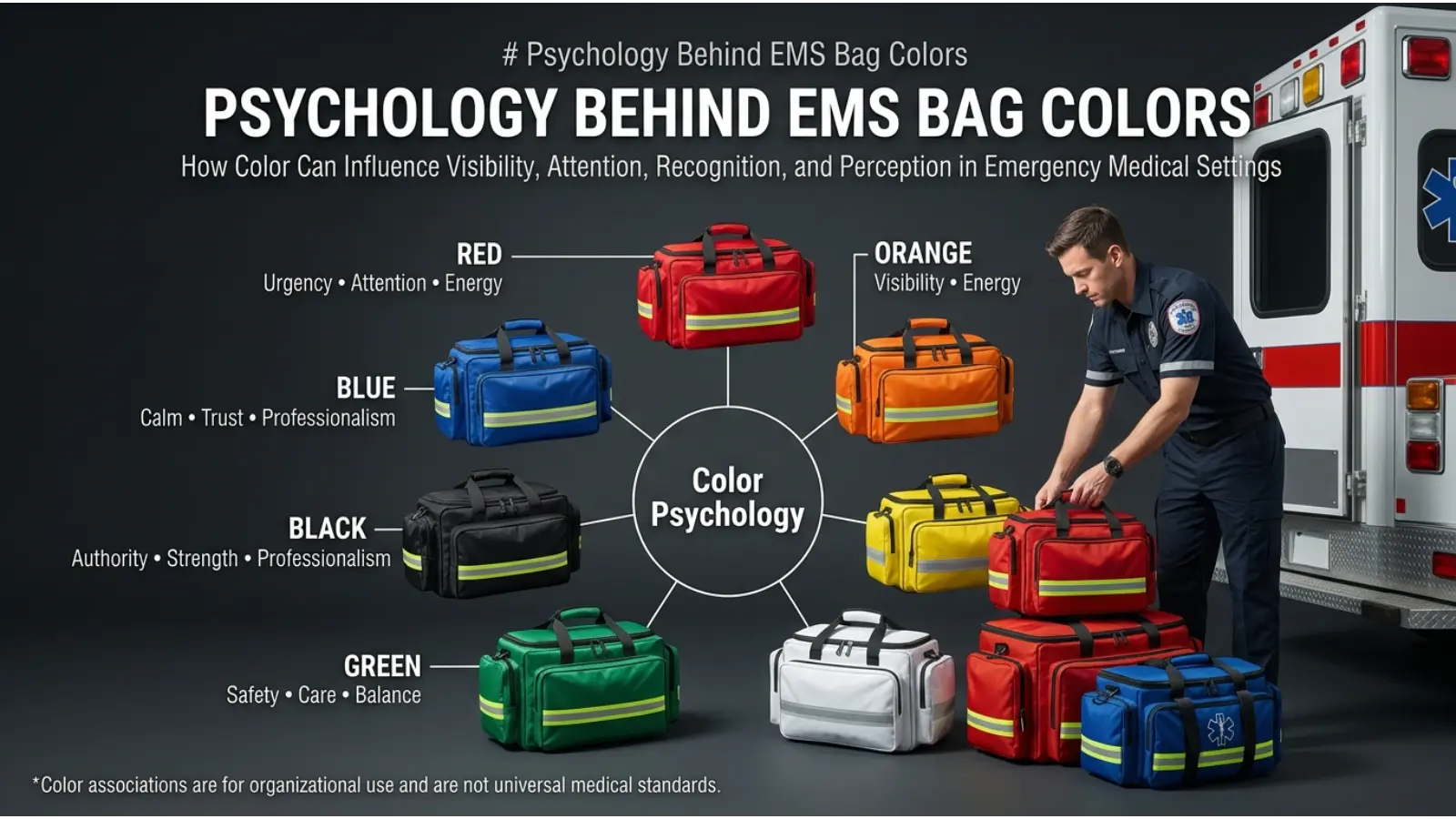
The Psychology Behind EMS Bag Color Meanings
Color can influence attention and visual recognition, but its effects depend on context.
Red and Attention
Red tends to create a strong visual signal. In an emergency environment, that can make a red object easier to notice.
Blue and Professionalism
Blue often creates associations with calmness, trust, and clinical professionalism. This can make it visually comfortable in healthcare environments.
Green and Health
Green is frequently connected with health, nature, and medicine. Consequently, it can feel appropriate for medical equipment even when the specific bag function is unrelated to those ideas.
Yellow and Visibility
Yellow is highly conspicuous and can attract attention quickly. That makes it useful when the bag must be found in a crowded or visually complex environment.
Orange and Rescue
Orange has strong visibility and is often associated with safety, rescue, and outdoor operations.
Still, color psychology should support equipment organization rather than replace clear labels. A responder should never have to guess what a bag contains.
How EMS Agencies Use Color Coding
A well-designed EMS color system usually works best when every color has one clearly defined purpose.
For example, an agency might decide:
| Bag | Color | Function |
|---|---|---|
| Airway | 🟢 Green | Airway and ventilation equipment |
| Trauma | 🔴 Red | Bleeding and trauma supplies |
| Medical | 🔵 Blue | General medical equipment |
| Rescue | 🟠 Orange | Search and rescue equipment |
| Pediatric | 🟡 Yellow | Pediatric equipment |
The exact assignments are not universal. What matters is consistency.
Once responders learn the system, they can use color as a fast visual shortcut.
Why Labels Still Matter
Color is helpful, but it should never be the only identification method.
Lighting can change how colors appear. Red may look darker at night, blue can appear different under artificial lighting, and similar shades may become difficult to distinguish.
Furthermore, some responders may have color-vision differences. Therefore, effective EMS design should combine:
- Large text labels
- High-contrast markings
- Symbols
- Reflective elements
- Consistent bag shapes
- Color coding
- Logical compartment layouts
This approach makes equipment easier to identify for everyone.
How Lighting Changes EMS Bag Colors
Lighting has a major effect on perceived color.
Under daylight, a bright orange bag may look highly visible. Under poor lighting, however, its appearance can change significantly.
Reflective strips and high-visibility materials can help solve this problem. Some EMS bags use reflective zipper pulls or reflective detailing so the bag remains easier to locate in poor lighting.
Therefore, an EMS designer should evaluate bags in the environments where they will actually be used.
Color Coding Inside EMS Bags
Color does not have to be limited to the outside of the bag.
Internal pouches can also use colors to divide equipment by function. WHO’s major trauma backpack, for example, organizes equipment into removable color-coded modules according to clinical indication.
Commercial EMS pouch systems also use combinations such as red, blue, green, and yellow to make equipment easier to organize and locate.
This creates a two-level system:
Exterior color = identify the bag.
Interior color = identify the equipment group.
That approach can reduce searching time and make restocking easier.
EMS Bag Colors and Medical Organization
A good color system can help with more than emergency response.
It can also improve:
Restocking: Staff can quickly see whether the correct bag has been returned.
Inventory: Different bags can represent different equipment categories.
Training: New responders can learn the system more easily.
Teamwork: Multiple responders can understand where specialized equipment is located.
Maintenance: Bags can be checked by category rather than item by item.
In other words, color becomes part of the organization’s workflow.
EMS Bag Color Meanings in Different Countries
Color practices vary internationally.
In the UK, green is commonly associated with medic bags, although other colors are also used.
Meanwhile, EMS organizations in the United States may develop highly specific color systems based on their operational needs. The Pinellas County example shows how one agency deliberately assigned green to airway, red to trauma, and blue to medical bags.
WHO’s trauma equipment system provides another example of color being used to organize clinical modules rather than simply labeling an entire bag.
Therefore, culture and location matter, but local EMS policy matters even more.
EMS Bag Color Meanings in Branding and Design
Color also influences how EMS equipment looks as a product.
Manufacturers need to balance visibility, professionalism, durability, and user preference.
A bright red bag immediately looks like emergency equipment. A dark bag may look more professional or tactical. Green can create a medical association, while orange can suggest rescue and outdoor operations.
However, good EMS product design should prioritize function.
A beautiful color is not useful if the bag is difficult to identify at night. Similarly, an extremely bright bag may not be appropriate for every tactical environment.
The strongest designs connect color with purpose.
EMS Bag Color Meanings in Real-World Situations
Ambulance Responses
Color-coded bags can help crews identify equipment rapidly when several bags are removed from the ambulance.
Trauma Calls
A clearly identified trauma bag can help responders move the required equipment toward the patient quickly.
Airway Emergencies
An airway-specific bag can keep ventilation and airway tools together rather than mixing them with unrelated equipment.
Mass Gatherings
High-visibility yellow or orange equipment can help medical teams stand out at concerts, sporting events, festivals, and large public gatherings.
Wilderness Rescue
Orange and other high-visibility colors can make medical equipment easier to locate outdoors.
Disaster Response
When many organizations work together, standardized labeling becomes particularly important because color meanings may differ between agencies.
EMS Bag Color Meanings and Fashion or Personal Style
EMS bags are functional equipment rather than fashion accessories, yet appearance can still affect how people perceive them.
Bright colors communicate visibility and emergency readiness. Dark colors can look more understated and professional.
For everyday first-aid bags, the best choice depends on the environment. A household emergency kit might benefit from red or orange because it is easy to locate. A workplace medical kit may use a highly visible color with a large first-aid symbol.
The key idea is simple: choose appearance according to the job the bag must perform.
Common Misconceptions About EMS Bag Colors
Myth 1: Every Red EMS Bag Is a Trauma Bag
Not necessarily. Red is often used for trauma or emergency equipment, but agencies can assign it differently.
Myth 2: Green Always Means Airway
No. Green may identify airway equipment in one system and a general medic bag in another.
Myth 3: Blue Always Means BLS
Not everywhere. Some systems use blue for BLS, while others use it for medical equipment or specialized teams.
Myth 4: EMS Bag Colors Are the Same as Triage Colors
They are different systems. Triage colors describe patient priority, while bag colors usually identify equipment or response roles.
Myth 5: Color Alone Tells You What Is Inside
It should not. Labels and organizational standards remain essential.
How to Remember EMS Bag Colors
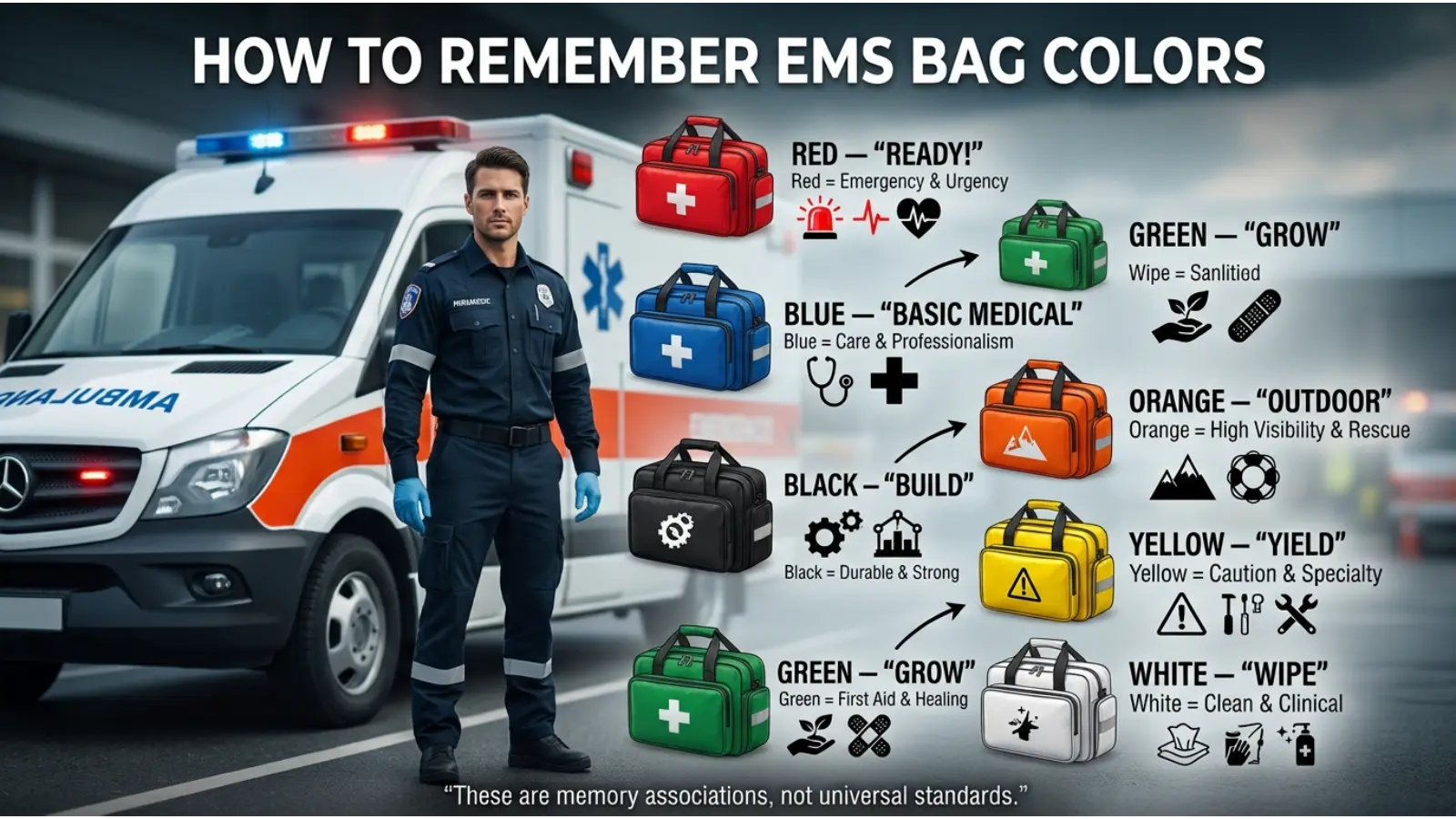
The easiest way to remember EMS bag colors is to learn the system, not isolated colors.
Try this basic memory guide:
🔴 Red = urgent/trauma
🔵 Blue = medical/professional
🟢 Green = medic/airway
🟡 Yellow = highly visible
🟠 Orange = rescue/outdoor
Then remember one important rule: your local EMS system may use a different meaning.
That final rule prevents many mistakes.
EMS Bag Color Meanings FAQ
What is the most common color for an EMS bag?
There is no single universal color. Red, green, blue, black, yellow, and orange are all used. Green is described as a standard medic-bag color in the UK, while other EMS organizations use red or blue systems.
What does a red EMS bag mean?
Red commonly suggests trauma, emergency equipment, or ALS equipment. However, the exact meaning depends on the agency or manufacturer.
What does a green EMS bag mean?
Green may represent a medic bag, airway equipment, or another medical function. Its meaning must be confirmed through the local equipment system.
What does a blue EMS bag mean?
Blue can represent general medical equipment, BLS equipment, or a specialized provider role. Different organizations use it differently.
What does a yellow EMS bag mean?
Yellow is often chosen for high visibility. It may be used for event medicine, rescue equipment, or another role defined by the agency.
What does an orange EMS bag mean?
Orange is commonly useful for search-and-rescue, wilderness, and other high-visibility applications. Some commercial EMS systems specifically associate orange with wilderness or rescue work.
Are EMS bag colors standardized?
No. EMS agencies and manufacturers can create different color systems. Always follow the local agency’s training and labeling.
Are EMS bag colors the same as triage colors?
No. Triage colors classify patient priority, while EMS bag colors generally identify equipment, functions, or response roles.
Why are EMS bags brightly colored?
Bright colors can make equipment easier to identify, particularly in crowded, outdoor, or low-light environments. They can also help teams separate different equipment categories quickly.
Can color replace labels on an EMS bag?
No. Color should support identification rather than replace labels, symbols, reflective markings, and standardized equipment organization.
Final Thoughts on EMS Bag Color Meanings
EMS bag colors are best understood as a visual organization system, not a universal medical language. Red may suggest trauma, green may identify airway or medic equipment, blue may represent medical or BLS gear, while yellow and orange can emphasize visibility and rescue roles. Yet the exact meaning can change from one EMS organization to another.
That variation is not a weakness. In fact, it shows why good EMS design focuses on consistency within each organization.
When color, labeling, compartment design, reflective materials, and training all work together, responders can find the right equipment more efficiently. Ultimately, the most meaningful EMS bag color is the one that the entire team understands the same way.

Emma Wilson is a dedicated comparison writer and product researcher at ColorMystiic.com. She specializes in creating unbiased product comparisons, detailed reviews, and helpful buying guides. Her goal is to help readers make smarter purchasing decisions with confidence.