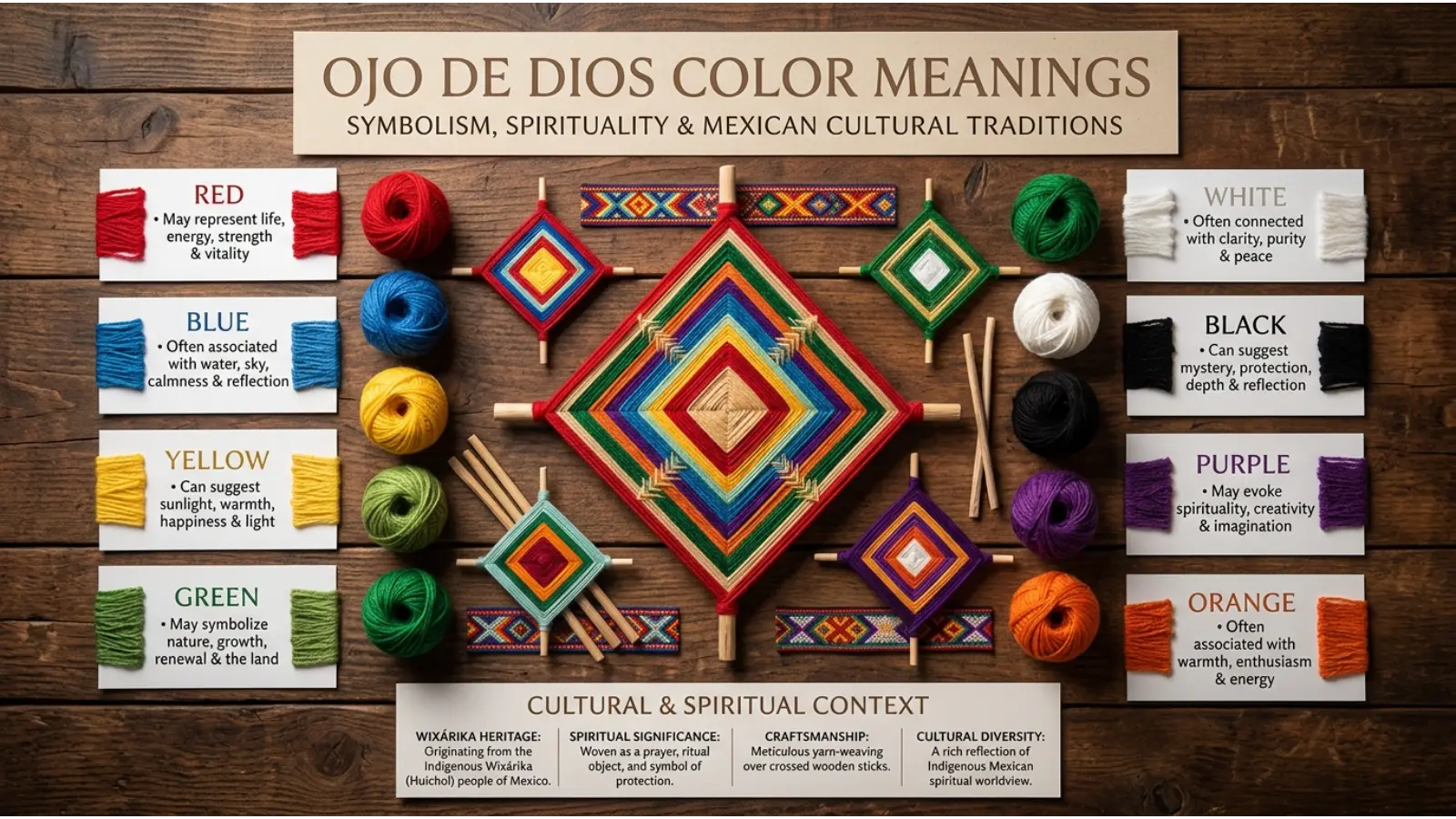
An Ojo de Dios Color Meanings is a colorful woven artwork with a meaning that goes beyond its beautiful geometric appearance. Known in Spanish as the “God’s Eye,” this traditional craft is associated with the Wixárika (Huichol) people of Mexico. It is made by wrapping colorful yarn around crossed wooden sticks to create a diamond-shaped pattern that grows outward from the center.
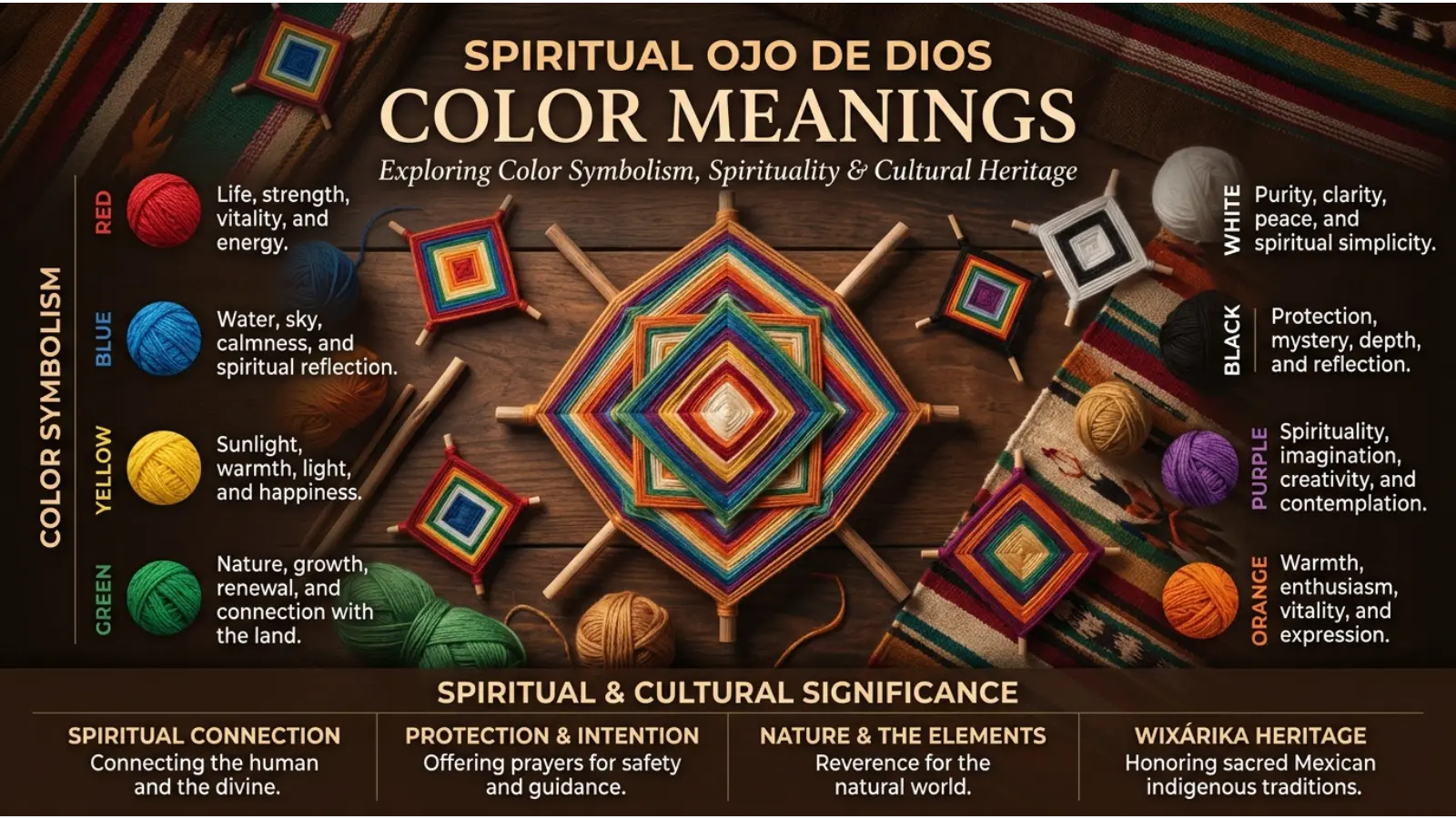
The colors used in an Ojo de Dios can express ideas connected with nature, life, spirituality, protection, and personal wishes. For example, red is commonly associated with strength, blue with peace, green with growth, and yellow with sunlight. However, these interpretations can change depending on the artist, cultural background, and purpose of the artwork.
People search for Ojo de Dios color meanings to understand the symbolism behind each shade, learn about its spiritual significance, or choose meaningful colors for their own handmade designs.
Although modern craft interpretations often assign individual meanings to colors, traditional Wixárika symbolism is more complex. Not every color has one universal meaning, and contemporary interpretations should not automatically be presented as ancient cultural beliefs.
In this complete guide, we explore the symbolism, psychology, spiritual associations, cultural history, and practical uses of Ojo de Dios colors. We also explain how different combinations create beautiful patterns and why understanding the cultural background makes this artwork even more meaningful.
Quick Answer: What Do Ojo de Dios Colors Mean?
Ojo de Dios colors are commonly associated with different symbolic ideas. Their meanings depend on the maker and cultural context.
| Color | Common Symbolic Meaning |
|---|---|
| 🔴 Red | Strength, life, courage, and energy |
| 🔵 Blue | Peace, water, sky, and reflection |
| 🟢 Green | Nature, growth, renewal, and balance |
| 🟡 Yellow | Sunlight, happiness, warmth, and hope |
| 🟣 Purple | Wisdom, mystery, creativity, and spirituality |
| ⚪ White | Peace, purity, clarity, and simplicity |
| 🟠 Orange | Enthusiasm, creativity, and vitality |
| ⚫ Black | Mystery, strength, depth, and contrast |
| 🩷 Pink | Love, kindness, affection, and compassion |
| 🟤 Brown | Earth, stability, nature, and connection |
These are broad contemporary symbolic associations, not an official color dictionary followed by every Wixárika community.
What Is an Ojo de Dios?
An Ojo de Dios is a traditional woven artwork created by wrapping yarn around two or more crossed wooden sticks. The repeated wrapping creates a diamond-shaped design that expands as more layers are added.
The name comes from the Spanish words ojo (eye) and Dios (God), meaning “God’s Eye.”
In popular explanations, the object is often associated with spiritual observation, protection, and connection with the divine. However, its cultural meaning within Wixárika traditions involves more than its Spanish name suggests.
The Wixárika people have a rich artistic heritage that includes yarn paintings, beadwork, and other objects connected with their cultural and spiritual practices.
Modern versions are also popular as handmade decorations, classroom crafts, and colorful wall hangings.
Why Is It Called God’s Eye?
The name Ojo de Dios refers to an eye associated with divine vision.
Popular interpretations describe it as a symbol of watching over someone, offering protection, or representing a connection between the physical and spiritual worlds.
Nevertheless, its meaning depends on the tradition and purpose of the object. A decorative version made for a classroom, for example, may not have the same significance as an object created within a traditional cultural setting.
What Does the Diamond Shape Represent?
The diamond shape develops naturally from the crossed wooden sticks and the yarn wrapped around them.
As the weaving expands, additional layers create a pattern that looks like an eye.
In contemporary interpretations, the expanding design is sometimes connected with awareness, growth, and the ability to see the world from different perspectives.
These ideas can be meaningful artistic interpretations, although they should not be confused with documented traditional teachings.
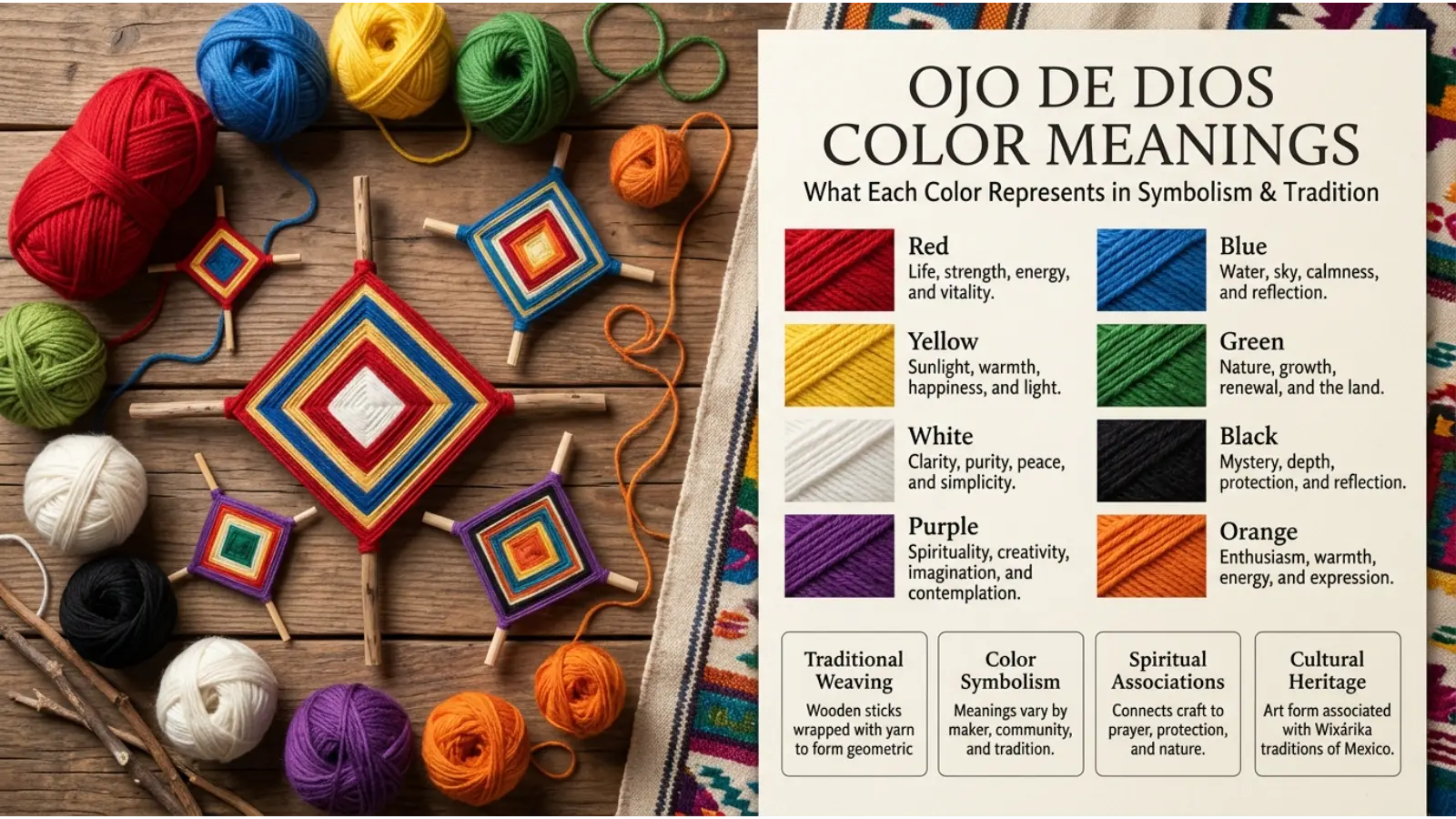
Ojo de Dios Color Meanings: What Each Color Represents
Colors give an Ojo de Dios its distinctive appearance. They also allow artists and craft makers to express personal ideas through different combinations.
Below are the commonly used symbolic interpretations of individual colors.
Red Ojo de Dios Color Meaning
Red — Strength, life, courage, and energy
The Red is one of the strongest visual colors in an Ojo de Dios design. It attracts attention and creates a powerful contrast against lighter shades.
In contemporary color symbolism, red is associated with life, passion, determination, and physical energy. It can also represent love, courage, and the willingness to face challenges.
Furthermore, red is useful when an artist wants to create a strong center or highlight an important section of the woven pattern.
Positive associations:
- Strength and courage.
- Passion and determination.
- Energy and vitality.
- Love and emotional intensity.
Possible negative associations:
- Anger and aggression.
- Danger and warning.
- Conflict and excessive intensity.
A red Ojo de Dios can be a meaningful choice for someone who wants to express confidence, strength, or enthusiasm through a handmade design.
Blue Ojo de Dios Color Meaning
Blue — Peace, water, sky, and reflection
The Blue is commonly connected with the natural world, especially the sky and water.
In modern color psychology, it is often associated with calmness, stability, communication, and trust. Its visual appearance can also create a sense of openness.
However, different blue shades create different impressions. Light blue looks fresh and gentle, while dark blue often appears deeper and more serious.
In a woven design, blue works beautifully with white, turquoise, and green.
Positive associations:
- Peace and calmness.
- Trust and stability.
- Reflection and clarity.
- Nature and openness.
Possible negative associations:
- Sadness and loneliness.
- Emotional distance.
- Coldness.
A blue Ojo de Dios can express a personal wish for peace, balance, or a closer connection with nature.
Green Ojo de Dios Color Meaning
Green — Nature, growth, renewal, and balance
The Green is strongly associated with plants, forests, and the natural environment.
It often represents growth, fresh beginnings, renewal, and stability. Because green appears frequently in nature, people commonly connect it with life and environmental balance.
In modern symbolic crafts, green can represent personal development and the desire to move toward a healthier or more balanced future.
Its shades also matter. Forest green creates a rich and natural appearance, while mint green feels lighter and fresher.
Positive associations:
- Growth and renewal.
- Nature and fertility.
- Harmony and balance.
- Fresh beginnings.
Possible negative associations:
- Envy and jealousy.
- Inexperience.
- Possessiveness.
Green works particularly well with brown, yellow, cream, and turquoise.
Yellow Ojo de Dios Color Meaning
Yellow — Sunlight, happiness, warmth, and hope
The Yellow brings brightness and visual energy to an Ojo de Dios.
It is commonly associated with sunshine, optimism, happiness, and intellectual alertness. Its bright appearance can make a woven design feel cheerful and welcoming.
However, yellow can have different effects depending on its shade. Golden yellow looks warm and rich, while pale yellow creates a softer impression.
Yellow is also useful as an accent color because it can make surrounding colors appear more noticeable.
Positive associations:
- Happiness and optimism.
- Hope and positivity.
- Warmth and sunshine.
- Creativity and alertness.
Possible negative associations:
- Jealousy.
- Anxiety.
- Excessive visual intensity.
A yellow Ojo de Dios can express joy, hope, and an appreciation for life’s positive moments.
Purple Ojo de Dios Color Meaning
Purple — Wisdom, spirituality, mystery, and creativity
The Purple has a rich history of symbolic associations across different cultures.
It has been connected with royalty, ceremony, luxury, and spiritual reflection. In modern decorative interpretations, it can also represent imagination, creativity, and personal growth.
Dark purple creates a dramatic appearance, whereas lavender and light violet feel softer.
When combined with white, gold, or blue, purple creates a balanced and elegant woven design.
Positive associations:
- Wisdom and reflection.
- Creativity and imagination.
- Spiritual exploration.
- Luxury and individuality.
Possible negative associations:
- Mystery and uncertainty.
- Emotional distance.
- Excessive extravagance.
Purple is a useful choice for artists who want to create a thoughtful and expressive design.
White Ojo de Dios Color Meaning
White — Peace, purity, clarity, and simplicity
The White creates visual space between stronger colors. It can also make complicated geometric patterns easier to appreciate.
In many modern symbolic interpretations, white represents peace, purity, honesty, and new beginnings.
It is particularly useful in designs that include several bright colors because it gives the eyes a place to rest.
Positive associations:
- Peace and simplicity.
- Purity and clarity.
- Fresh beginnings.
- Openness and balance.
Possible negative associations:
- Emptiness.
- Isolation.
- Coldness or sterility.
White pairs naturally with almost every color, especially blue, red, purple, and green.
Orange Ojo de Dios Color Meaning
Orange — Creativity, enthusiasm, warmth, and vitality
The Orange combines the brightness of yellow with the intensity of red.
As a result, it often creates an energetic, friendly, and welcoming impression.
In modern symbolic interpretations, orange represents enthusiasm, creativity, communication, and a positive attitude toward new experiences.
It is also useful for adding warmth to a design without relying entirely on red.
Positive associations:
- Creativity and inspiration.
- Enthusiasm and excitement.
- Warmth and friendship.
- Confidence and vitality.
Possible negative associations:
- Impulsiveness.
- Excessive stimulation.
- Attention-seeking.
Orange looks particularly attractive with turquoise, purple, yellow, and cream.
Black Ojo de Dios Color Meaning
Black — Mystery, strength, depth, and contrast
The Black creates strong boundaries and makes brighter yarn colors stand out.
It is commonly associated with elegance, authority, mystery, and seriousness. However, some cultural settings connect it with mourning or loss.
In modern Ojo de Dios designs, black can provide structure and create a dramatic appearance.
Positive associations:
- Strength and authority.
- Elegance and sophistication.
- Mystery and depth.
- Protection in some modern symbolic interpretations.
Possible negative associations:
- Mourning and sadness.
- Fear and uncertainty.
- Darkness and isolation.
Black works particularly well with white, gold, red, and turquoise.
Pink Ojo de Dios Color Meaning
Pink — Love, kindness, affection, and compassion
The Pink is commonly associated with tenderness, care, romance, and emotional warmth.
In modern color symbolism, it often represents kindness and gentle affection.
Light pink creates a delicate appearance, while bright pink looks more energetic and expressive.
In an Ojo de Dios, pink can be combined with white, purple, red, and lavender to create a softer design.
Positive associations:
- Love and affection.
- Kindness and compassion.
- Friendship and tenderness.
- Emotional warmth.
Possible negative associations:
- Immaturity.
- Excessive sensitivity.
- Unrealistic romantic expectations.
Pink is a good option for a personal gift or a design inspired by friendship and affection.
Brown Ojo de Dios Color Meaning
Brown — Earth, stability, nature, and connection
The Brown is closely connected with soil, wood, tree bark, and natural materials.
It often represents stability, reliability, simplicity, and a connection with the environment.
Because Ojo de Dios designs commonly use wooden sticks, brown can also complement the natural structure of the artwork.
Positive associations:
- Stability and reliability.
- Nature and simplicity.
- Grounding and connection.
- Warmth and comfort.
Possible negative associations:
- Dullness.
- Lack of excitement.
- Excessive conservatism.
Brown looks especially attractive with green, cream, orange, and golden yellow.
Color Psychology Behind Ojo de Dios Color Meanings
Color psychology studies how people perceive colors and how those perceptions may influence feelings, attention, and behavior.
However, people do not respond to colors in exactly the same way. Personal memories, cultural experiences, age, surroundings, and lighting can all influence perception.
An Ojo de Dios is particularly interesting because it combines multiple colors in one geometric design.
How Colors Influence Emotions
| Color | Common emotional association | Visual impression |
|---|---|---|
| 🔴 Red | Excitement | Powerful |
| 🔵 Blue | Calmness | Relaxed |
| 🟢 Green | Renewal | Natural |
| 🟡 Yellow | Optimism | Bright |
| 🟣 Purple | Imagination | Expressive |
| ⚪ White | Clarity | Simple |
| 🟠 Orange | Enthusiasm | Energetic |
| ⚫ Black | Mystery | Dramatic |
| 🩷 Pink | Affection | Gentle |
| 🟤 Brown | Stability | Earthy |
These associations describe common perceptions rather than guaranteed psychological effects.
Why Color Combinations Matter
A single color creates one type of visual impression. However, combining colors produces additional effects.
For example, blue and green together can create a nature-inspired appearance. Red and yellow, on the other hand, create a brighter and more energetic design.
Contrast also affects attention.
A yellow thread placed beside purple becomes more noticeable because the colors differ strongly in appearance. Similarly, white yarn can separate darker sections and make the overall pattern easier to understand.
Therefore, color placement is just as important as color selection.
How Lighting Changes Ojo de Dios Colors
Lighting can significantly change the appearance of yarn.
Warm lighting makes red, orange, and yellow threads appear richer. In contrast, cooler lighting can make blue and green shades look more noticeable.
Natural daylight often reveals subtle differences between similar colors.
For this reason, artists should examine their yarn under the lighting where the finished piece will be displayed.
Spiritual Ojo de Dios Color Meanings
The spiritual meaning of an Ojo de Dios depends on its cultural background, maker, and intended purpose.
Wixárika artistic traditions have connections with spiritual practices, sacred places, offerings, and relationships with the natural world.
Meanwhile, modern craft makers sometimes give their own personal meanings to the colors they select.
For example, someone might choose blue to represent peace, green for growth, or red for courage.
These personal interpretations can be meaningful. However, they should not automatically be described as traditional Wixárika religious teachings.
Protection and Spiritual Connection
The Ojo de Dios is widely described in popular craft explanations as a protective symbol.
Its eye-like geometric design and Spanish name have helped create this association.
Nevertheless, its specific cultural meaning is more complex than the idea of a decorative object that simply protects its owner.
A modern version may serve as a personal reminder of hope, care, and spiritual reflection.
Growth and Transformation
The weaving process offers an interesting artistic connection with personal growth.
Each layer of yarn builds upon the previous one. Gradually, the design expands outward from its center.
Modern artists may interpret this process as a symbol of learning, transformation, and personal development.
This is a contemporary artistic interpretation rather than a universal traditional belief.
Wisdom and Awareness
The eye-like appearance of the Ojo de Dios is often connected with awareness and observation in popular explanations.
Purple, blue, and white are sometimes selected in modern spiritual crafts to express wisdom, reflection, and clarity.
However, the meaning of these colors depends on the maker rather than a fixed spiritual formula.
Cultural Ojo de Dios Color Meanings
Understanding the cultural history of the Ojo de Dios is essential because its significance extends beyond decoration.
The object is strongly associated with the Wixárika people, an Indigenous community of Mexico.
Their artistic traditions include yarn paintings, beadwork, ceremonial objects, and detailed geometric designs.
Wixárika Cultural Traditions
The Wixárika people are also widely known as the Huichol, although Wixárika is their own name for their community.
Their art reflects relationships among people, nature, sacred places, and spiritual life.
In this context, yarn and color can communicate ideas that are connected with cultural knowledge and artistic practice.
Therefore, the Ojo de Dios should not be reduced to a simple collection of universal color meanings.
Ojo de Dios in Mexican Culture
The Ojo de Dios has become widely recognized as a Mexican craft.
Modern versions appear in handmade markets, art workshops, classrooms, and homes.
However, not every colorful version represents the same cultural practice.
Some are decorative adaptations, while others are made within more specific cultural traditions.
Recognizing this difference helps people appreciate the artwork without making inaccurate claims about its origins.
The Importance of Cultural Respect
When creating or purchasing an Ojo de Dios, learning about its cultural background is valuable.
Artists and sellers should avoid presenting personal color interpretations as official Indigenous teachings.
Likewise, recognizing Wixárika artists and their contributions helps preserve a more accurate understanding of the tradition.
Historical Meaning and Development of Ojo de Dios
The Ojo de Dios is commonly discussed alongside other Wixárika artistic traditions.
One important example is nierika, a term associated with forms of seeing, spiritual perception, and artistic expression in Wixárika contexts.
Yarn paintings are among the recognizable forms of Wixárika art. They can contain detailed patterns and imagery connected with cultural and spiritual ideas.
However, it is important to distinguish these traditional artistic practices from the simplified decorative Ojo de Dios crafts commonly made today.
Traditional Materials and Craftsmanship
Ojo de Dios designs generally use:
- Crossed wooden sticks.
- Wool or cotton yarn.
- Repeated wrapping and weaving techniques.
- Multiple colors and geometric patterns.
The quality of the materials affects the final appearance.
Natural fibers can create a soft, textured surface. Meanwhile, synthetic yarn often offers brighter colors and a wider range of thicknesses.
How the Craft Became Popular Worldwide
Over time, the Ojo de Dios became popular outside its original cultural setting.
Teachers introduced simplified weaving projects into classrooms. Artists adapted the geometric structure for contemporary decoration. Handmade craft markets also helped increase its visibility.
Consequently, modern interpretations expanded beyond the meanings associated with traditional Wixárika objects.
This development explains why online explanations sometimes present different color meanings for the same design.
What Do Ojo de Dios Color Combinations Mean?
Color combinations allow artists to create more detailed visual messages.
Although modern symbolic interpretations are flexible, certain combinations create especially attractive designs.
Red and Yellow: Energy and Warmth
Red + Yellow
The Red and yellow create a warm and energetic appearance.
They are useful for festive designs, bright decorations, and crafts intended to communicate excitement.
Blue and White: Peace and Clarity
Blue + White
The Blue and white create a clean and balanced appearance.
They are suitable for simple designs where the geometric weaving pattern should remain easy to see.
Green and Brown: Nature and Stability
Green + Brown
These colors create an earthy combination inspired by forests, trees, and natural environments.
They are useful for rustic decorations and nature-inspired artwork.
Purple and Gold: Creativity and Elegance
Purple + Gold
The Purple and gold create a rich visual contrast.
This pairing is suitable for decorative pieces with an elegant or luxurious appearance.
Orange and Turquoise: Creativity and Freshness
Orange + Turquoise
The Orange and turquoise create a vibrant combination.
Because their visual qualities contrast, they can make a woven pattern look lively and expressive.
Black and White: Balance and Contrast
Black + White
The Black and white produce a strong geometric appearance.
This combination is especially useful when the artist wants the shape and structure of the weaving to stand out.
How to Choose Ojo de Dios Colors for Different Purposes
Choosing yarn colors becomes easier when you understand the purpose of your design.
Instead of selecting random shades, start by deciding what visual atmosphere or personal message you want to express.
| Purpose | Suggested Colors | Overall Appearance |
|---|---|---|
| Peaceful decoration | Blue and white | Calm and clean |
| Nature-inspired craft | Green and brown | Earthy and balanced |
| Festive decoration | Red, yellow, and orange | Bright and energetic |
| Artistic design | Purple and turquoise | Creative and expressive |
| Minimalist decoration | Cream, white, and gray | Soft and simple |
| Bold modern craft | Black, red, and white | Dramatic and striking |
| Friendship gift | Pink and yellow | Warm and cheerful |
| Spiritual reflection | Purple, blue, and white | Thoughtful and gentle |
These combinations are modern design suggestions, not traditional cultural requirements.
Choose One Dominant Color
Start with one main color that establishes the overall appearance.
For example, a blue-centered design creates a different visual impression from one dominated by red.
After choosing the dominant shade, add two or three supporting colors.
Consider the Center of the Design
The center naturally attracts attention because the weaving begins there.
Using a contrasting color can make the center stand out.
Alternatively, choosing similar shades creates a smoother transition between the different layers.
Avoid Too Many Competing Colors
Using many bright colors can make a design look crowded.
Instead, balance strong shades with neutral colors such as white, cream, and brown.
This allows each section to remain visible while preserving the geometric structure.
Ojo de Dios Color Meanings in Interior Design
Ojo de Dios decorations can introduce handmade character, texture, and color into a room.
Their geometric patterns work particularly well in spaces with natural materials, woven textiles, and handcrafted furniture.
Living Room Decoration
A colorful Ojo de Dios can serve as a decorative focal point above a sofa or on an empty wall.
For neutral interiors, choose a design with two or three bright colors.
Meanwhile, a colorful room may benefit from a simpler woven pattern.
Bedroom Decoration
Soft blue, lavender, cream, and muted green can create a gentle visual appearance.
These shades work well with natural wood, neutral bedding, and warm lighting.
However, personal preference should guide the choice rather than assuming that one color produces the same emotional response in everyone.
Office and Creative Spaces
Orange, yellow, turquoise, and green can add visual interest to an office.
They are particularly suitable for creative studios, craft rooms, and informal workspaces.
Lighting and Furniture Combinations
Natural wood furniture complements earthy Ojo de Dios designs.
White walls provide a clean background for colorful weaving, while darker walls can make lighter yarn more noticeable.
Furthermore, lighting changes how the threads appear. Warm bulbs emphasize red and yellow, whereas cooler lighting can highlight blue and green.

Ojo de Dios Colors in Fashion and Personal Style
Although the Ojo de Dios is mainly recognized as a woven craft, its colors and geometric patterns can inspire fashion and accessory design.
Modern artists may use similar combinations in handmade jewelry, bags, clothing decorations, and textile accessories.
Bright and Expressive Fashion
Red, orange, yellow, and turquoise create a lively combination.
These colors work well in casual clothing, summer accessories, and creative outfits.
Natural and Earthy Fashion
Green, brown, beige, and cream produce a more understated appearance.
They pair naturally with cotton, linen, and other textured fabrics.
Elegant and Minimalist Style
Black, white, and purple create a dramatic combination.
These shades can inspire contemporary accessories and geometric textile patterns.
Real-World Applications of Ojo de Dios
The Ojo de Dios has several modern applications beyond its traditional cultural background.
Art and Handmade Crafts
Artists use yarn weaving to explore color relationships, geometric patterns, and texture.
The repeated structure also makes it a useful introduction to textile art.
Educational Activities
Teachers sometimes use simplified Ojo de Dios projects to teach students about:
- Color recognition.
- Geometric patterns.
- Symmetry.
- Hand coordination.
- Textile techniques.
- Cultural appreciation.
However, educational projects should introduce the craft’s Wixárika origins instead of presenting it as an anonymous decorative activity.
Gifts and Personal Keepsakes
A handmade Ojo de Dios can be a thoughtful decorative gift.
The maker can choose colors based on someone’s favorite shades or a personal message.
For example, blue and green might represent a shared love of nature, while yellow and orange could express happiness and celebration.
Business and Handmade Markets
Contemporary craft sellers may use Ojo de Dios-inspired designs in wall decorations, textile collections, and handmade products.
Accurate product descriptions and respectful acknowledgment of Indigenous origins help customers understand the cultural background of their purchases.
Common Misconceptions About Ojo de Dios Color Meanings
Several popular explanations make Ojo de Dios symbolism sound more fixed than it really is.
Understanding these misconceptions helps readers appreciate the artwork more accurately.
Every Color Has One Official Spiritual Meaning
This is incorrect.
Modern craft interpretations often assign meanings to individual colors. However, there is no universal color dictionary that applies to every traditional Wixárika object.
Every Ojo de Dios Is a Traditional Ceremonial Object
Not necessarily.
Some objects are connected with cultural or spiritual practices, while others are contemporary decorative crafts.
Their purposes should not be treated as identical.
The Ojo de Dios Is Only a Decoration
This is also misleading.
Its cultural background extends beyond visual decoration. It is associated with Indigenous artistic and spiritual traditions.
Black Always Represents Negative Energy
Black can communicate different ideas depending on the context.
It may represent strength, mystery, elegance, depth, or mourning. Therefore, it should not automatically be considered a negative color.
Modern Color Combinations Are Ancient Traditions
A contemporary design using pink, purple, and turquoise may look beautiful, but that does not automatically make its specific color meanings historically traditional.
It is better to distinguish personal symbolism from documented cultural practices.
Frequently Asked Questions About Ojo de Dios Color Meanings
1. What do the colors of an Ojo de Dios mean?
Ojo de Dios colors can represent different ideas depending on the maker and context. Modern interpretations commonly associate red with strength, blue with peace, green with growth, yellow with happiness, and purple with spirituality.
2. What does an Ojo de Dios symbolize?
An Ojo de Dios is associated with Wixárika artistic and spiritual traditions. It is popularly described as a symbol of divine vision, protection, and spiritual connection. Its specific significance depends on its cultural and ceremonial context.
3. What does blue mean in an Ojo de Dios?
Blue is commonly associated with water, sky, peace, and reflection in contemporary symbolic interpretations. It also creates a calm visual effect when combined with white or turquoise.
4. What does red mean in an Ojo de Dios?
Red commonly represents life, strength, courage, and energy in modern color interpretations. It also creates a bold contrast with lighter yarn colors.
5. Is an Ojo de Dios a Mexican tradition?
Yes. The Ojo de Dios is strongly associated with the Wixárika people of Mexico. Their artistic and cultural traditions include distinctive yarn and beadwork practices.
6. Does an Ojo de Dios provide spiritual protection?
It is commonly described as a protective symbol in popular explanations. However, its spiritual significance varies by tradition, maker, and purpose. A modern decorative version does not automatically carry the same cultural meaning as a traditional object.
7. What colors should I use to make an Ojo de Dios?
You can select colors according to your artistic preferences or the message you want to express. Blue and white create a peaceful appearance, while red and yellow produce a brighter, more energetic design.
8. Why is the Ojo de Dios diamond-shaped?
The diamond shape develops naturally from the crossed wooden framework and repeated wrapping of yarn. Its geometric structure is one of the craft’s most recognizable features.
9. What is the difference between an Ojo de Dios and Huichol yarn art?
Ojo de Dios generally refers to a woven geometric object made around crossed sticks. Wixárika yarn art is a broader artistic tradition that also includes detailed yarn paintings and other culturally meaningful works.
10. Can I make an Ojo de Dios as a gift?
Yes. A handmade version can be a thoughtful decorative gift. You can choose colors based on the recipient’s preferences while also explaining the craft’s cultural origins accurately and respectfully.
Conclusion: Understanding the Meaning Behind Ojo de Dios Colors
Ojo de Dios color meanings bring together artistic expression, visual symbolism, personal interpretation, and cultural history.
Red can suggest strength, blue can evoke peace, green can reflect nature, and yellow can communicate warmth. Meanwhile, purple, white, orange, black, pink, and brown offer additional possibilities for creating meaningful color combinations.
However, the significance of an Ojo de Dios goes beyond individual color associations. Its woven structure and cultural background connect it with the artistic traditions of the Wixárika people of Mexico.
Understanding this distinction makes the artwork even more interesting.
Whether you admire its geometric patterns, study its cultural roots, or create a modern version for your home, take time to appreciate both the colors and the tradition behind them.

Emma Wilson is a dedicated comparison writer and product researcher at ColorMystiic.com. She specializes in creating unbiased product comparisons, detailed reviews, and helpful buying guides. Her goal is to help readers make smarter purchasing decisions with confidence.