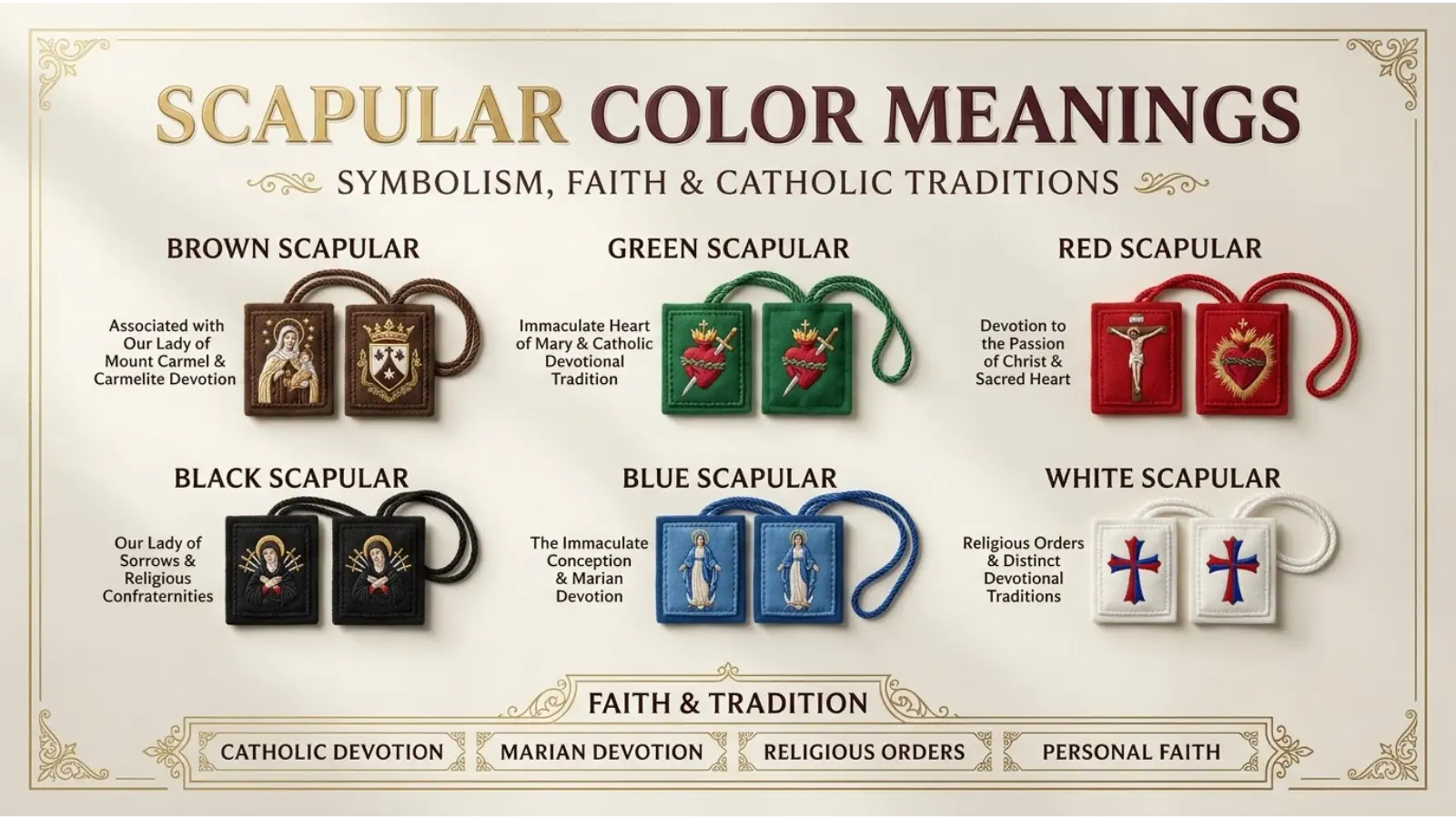
Scapular Color Meanings have a meaningful place in Catholic religious traditions. For centuries, Christians have worn them as signs of faith, devotion, prayer, and spiritual commitment.
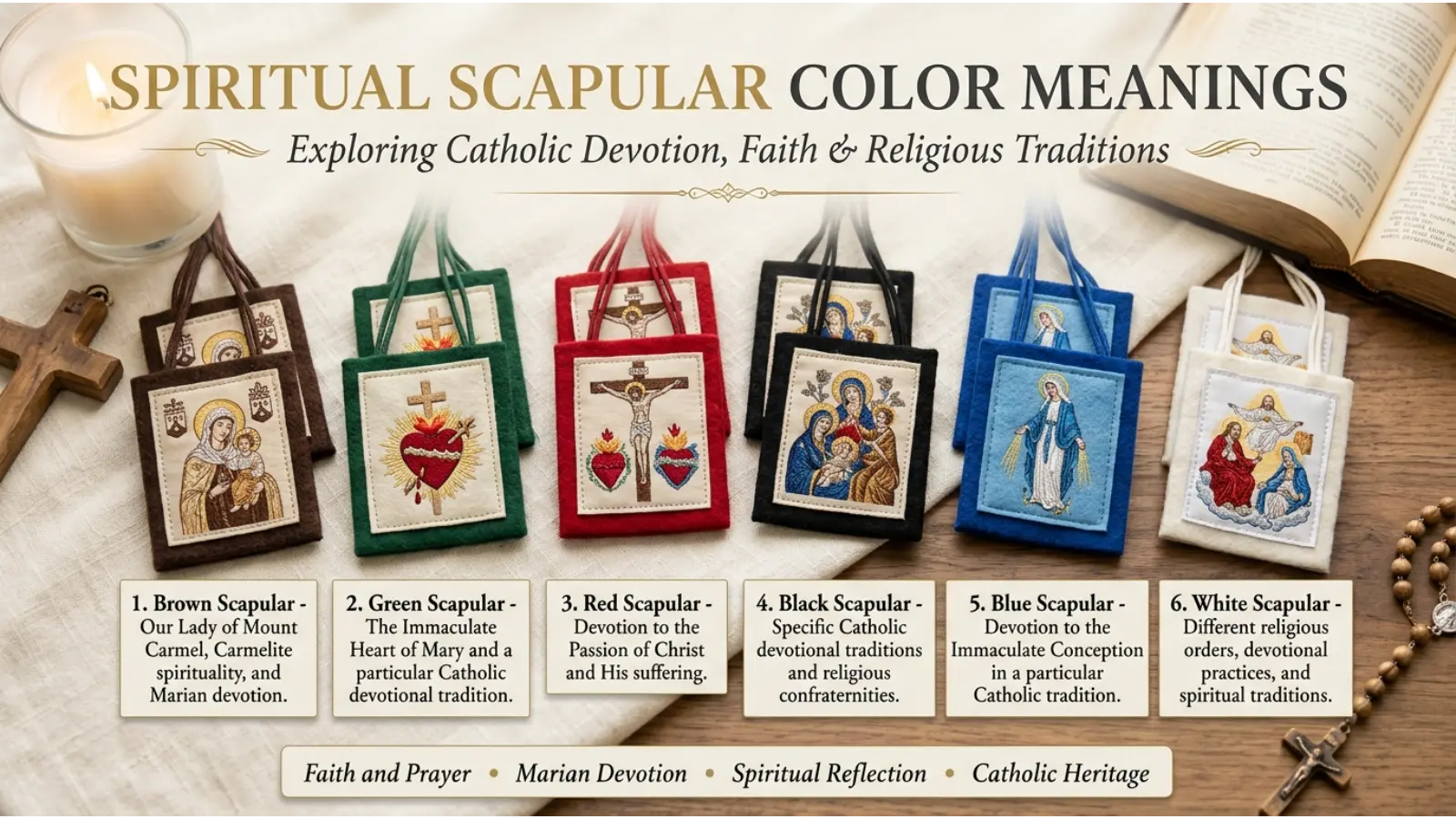
Understanding scapular color meanings helps explain why some devotional scapulars are brown, green, blue, red, black, or white. Each color may carry a particular religious association. For example, the Brown Scapular is connected with Our Lady of Mount Carmel, while the Green Scapular is associated with the Immaculate Heart of Mary.
However, scapular colors do not have one universal meaning. Their significance depends on their religious history, the devotion they represent, and the community that uses them.
Furthermore, the color of a scapular should not be confused with a person’s spiritual condition. Catholic spirituality emphasizes faith, prayer, and Christian living rather than treating colors as sources of supernatural power.
In this guide, we explore the symbolism, religious significance, historical background, and differences between traditional scapular colors.
Quick Answer: Scapular color meanings depend on the particular Catholic devotion. Brown represents the Carmelite tradition and devotion to Our Lady of Mount Carmel. Black and white scapulars have associations that vary according to their religious traditions.
What Is a Scapular in Catholic Tradition?
A scapular is a religious garment or devotional object associated with Catholic Christianity. The word comes from the Latin word scapula, meaning shoulder blade.
Historically, monks wore large scapulars over their religious habits. These garments rested on the shoulders and extended down the front and back of the body.
Over time, smaller devotional scapulars developed. They generally consist of two small pieces of cloth connected by cords and worn over the shoulders.
Catholics wear devotional scapulars as reminders of their religious commitments and spiritual beliefs.
A scapular may represent:
- Devotion to the Virgin Mary.
- Faith in Jesus Christ.
- Prayer and spiritual discipline.
- Commitment to Christian values.
- Connection with a religious community.
- A personal reminder to live faithfully.
However, wearing a scapular is not a magical practice. Rather, it serves as an outward reminder of an inward commitment to faith.
Scapular Color Meanings Chart
Different scapulars have different histories and devotional purposes. The following chart provides a simple overview of commonly discussed colors.
Catholic Scapular Color Symbolism
| Color | Religious association | Common symbolic themes |
|---|---|---|
| 🟫 Brown | Our Lady of Mount Carmel | Marian devotion, faith, commitment |
| 🟩 Green | Immaculate Heart of Mary | Prayer, hope, conversion |
| 🟦 Blue | Immaculate Conception | Purity, Marian devotion |
| 🟥 Red | Passion of Christ | Sacrifice, redemption, love |
| ⬛ Black | Particular Marian and Passion devotions | Suffering, devotion, remembrance |
| ⬜ White | Varies by tradition | Purity, holiness, faith |
| 🟨 Gold | Decorative or artistic use | Glory, honor, heavenly imagery |
These associations are not a universal Catholic color code. Some colors have specific historical connections with recognized scapular devotions, while others are general symbolic interpretations.
Brown Scapular Color Meaning: Faith, Devotion, and Commitment
The Brown Scapular is among the best-known Catholic devotional scapulars.
Its brown color reflects the traditional Carmelite habit and connects the devotional object with the spirituality of the Carmelite community.
What Does the Brown Scapular Symbolize?
The Brown Scapular is commonly associated with:
- Devotion to the Virgin Mary.
- Faithfulness to Christian teachings.
- Prayer and spiritual discipline.
- Commitment to following Jesus Christ.
- The Carmelite spiritual tradition.
Moreover, it reminds wearers to develop a closer relationship with God through prayer and faithful living.
Historical Background of the Brown Scapular
The Brown Scapular is traditionally connected with Saint Simon Stock, a Carmelite religious figure associated with a vision of the Virgin Mary in medieval tradition.
According to Carmelite tradition, Mary gave him the scapular as a sign of her protection and special relationship with the Carmelite order.
The devotion later spread beyond the religious community and became popular among Catholic laypeople.
Spiritual Significance of Brown
Brown is commonly associated with earth, simplicity, humility, and stability.
In the context of the Brown Scapular, however, its primary significance comes from its Carmelite history rather than general color psychology.
It can serve as a daily reminder to practice humility, remain faithful, and approach spiritual life with dedication.
Green Scapular Color Meaning: Hope, Prayer, and the Immaculate Heart of Mary
The Green Scapular has a distinct place in Catholic devotional tradition. Unlike the Brown Scapular, it is not primarily associated with the Carmelite order.
What Does the Green Scapular Represent?
The Green Scapular is commonly associated with:
- Devotion to the Immaculate Heart of Mary.
- Prayer for spiritual conversion.
- Hope and trust in God.
- Marian devotion.
- Prayer for others.
The color green also has broader symbolic connections with life, renewal, and hope.
These general associations can help explain its visual appeal, although its specific religious meaning comes from its devotional history.
Historical Background of the Green Scapular
The Green Scapular is traditionally associated with the apparitions of the Virgin Mary to Sister Justine Bisqueyburu, a Daughter of Charity, in nineteenth-century France.
According to this Catholic devotional tradition, Mary presented the Green Scapular and encouraged its use as an expression of devotion and prayer.
Unlike some other scapulars, it does not follow the same traditional wearing arrangement. It may also be carried or kept in a personal space.
Why Is Green Important?
Green is often connected with:
- New beginnings.
- Hope.
- Life and growth.
- Renewal.
- Spiritual encouragement.
In everyday symbolism, green reminds people of nature and fresh growth. In the Green Scapular devotion, however, the connection with the Immaculate Heart of Mary is more important than general psychological associations.
Blue Scapular Color Meaning: Purity and Marian Devotion
Blue has a long-standing association with the Virgin Mary in Christian art and religious traditions.
What Does a Blue Scapular Represent?
The Blue Scapular is particularly associated with devotion to the Immaculate Conception.
Its symbolic themes include:
- Purity.
- Marian devotion.
- Faith.
- Holiness.
- Spiritual dedication.
Nevertheless, not every blue scapular represents the same devotion.
Historical Background of the Blue Scapular
The Blue Scapular of the Immaculate Conception is associated with the Theatine religious tradition.
The use of blue reflects its connection with traditional Marian imagery.
Spiritual Meaning of Blue
Blue commonly represents peace, trust, calmness, and spiritual reflection.
In Christian artwork, it can also suggest heavenly associations and devotion to Mary.
Red Scapular Color Meaning: Sacrifice, Love, and the Passion of Christ
Red is a powerful color in Christian symbolism. It is particularly connected with the blood of Christ, sacrifice, martyrdom, and the Holy Spirit.
The Red Scapular of the Passion is associated with devotion to the Passion of Christ.
What Does the Red Scapular Symbolize?
Its devotional associations include:
- The suffering of Jesus Christ.
- Christ’s sacrifice.
- Divine love.
- Redemption.
- Christian faith.
- Remembrance of the Passion.
The color makes the themes of sacrifice and love visually recognizable.
Historical Background of the Red Scapular
The Red Scapular of the Passion is associated with a nineteenth-century devotion connected with the visions reported by Sister Apolline Andriveau, a Daughter of Charity, in France.
The devotion focuses on the Passion of Jesus Christ and the importance of remembering his suffering and sacrifice.
Why Is Red Important in Christianity?
Red has several established uses in Christian liturgical traditions.
For example, it is used on Good Friday to remember the Passion of Christ. It is also associated with Pentecost and the remembrance of martyrs.
Therefore, red can communicate both suffering and spiritual strength.
Black Scapular Color Meaning: Suffering, Devotion, and Remembrance
Black has different associations depending on the religious tradition and the specific scapular.
In Christianity, it can represent mourning, repentance, humility, and remembrance.
Some black scapular devotions are associated with particular religious communities and saints.
What Does a Black Scapular Represent?
Possible symbolic associations include:
- Remembrance of suffering.
- Humility.
- Repentance.
- Religious devotion.
- Reflection on mortality.
- Spiritual discipline.
Historical and Religious Associations
The Black Scapular of the Seven Sorrows is connected with the Servite tradition and devotion to the Seven Sorrows of Mary.
This devotion focuses on the suffering experienced by Mary throughout her life, particularly in connection with the life and Passion of Jesus.
The black color is connected with the historical Servite habit.
Spiritual Meaning of Black
Black can encourage reflection on difficult experiences, loss, and sacrifice.
In religious settings, it may also communicate seriousness and humility.
Nevertheless, black does not automatically symbolize evil or negative spiritual energy. Its meaning changes according to the religious setting.
White Scapular Color Meaning: Purity, Faith, and Holiness
White has a recognizable place in Christian symbolism.
It is frequently associated with purity, resurrection, holiness, and celebration.
However, white does not identify one single universal scapular devotion.
What Does a White Scapular Symbolize?
General symbolic associations include:
- Purity.
- Innocence.
- Peace.
- Spiritual renewal.
- Holiness.
- New beginnings.
The exact meaning depends on the scapular’s religious identity.
White in Christian Traditions
White is used during several important celebrations in the Catholic liturgical calendar.
It can also represent the joy of the Resurrection.
Why Is White Meaningful?
White reflects light and is visually associated with cleanliness and simplicity.
In religious artwork, it can communicate holiness and spiritual celebration.
Gold and Yellow Scapular Colors: Honor and Heavenly Symbolism
Gold and yellow may appear in decorative scapular designs, embroidery, printed religious images, or artistic details.
However, gold and yellow are not universal identifying colors for a particular Catholic scapular devotion.
What Do Gold and Yellow Represent?
In broader Christian artwork, gold is commonly associated with:
- Divine glory.
- Heaven.
- Holiness.
- Royal dignity.
- Sacred honor.
Yellow can suggest light, warmth, and hope.
Why Are These Colors Used?
Gold-colored details can make religious images appear more formal and ceremonial.
For example, gold embroidery may highlight a sacred image or decorative border.
Spiritual Scapular Color Meanings
Scapulars have different spiritual meanings because each one belongs to a particular devotional tradition.
Although colors can help communicate religious themes, the spiritual purpose of a scapular is more important than its appearance.
Protection and Faith
Some Catholic scapular devotions are traditionally associated with Mary’s protection and spiritual assistance.
However, this does not mean that a scapular works like a protective charm.
Rather, it reminds the wearer to trust in God and remain committed to Christian teachings.
Prayer and Spiritual Growth
Scapulars can encourage regular prayer and reflection.
For example, someone wearing a Brown Scapular may use it as a reminder to practice humility and devotion to Mary.
Similarly, a Green Scapular may remind someone to pray for another person’s spiritual well-being.
Hope and Renewal
Green and white have broader associations with renewal and hope.
Consequently, these colors may provide meaningful visual reminders during periods of personal reflection.
Still, spiritual growth comes through faith and action, not the color of a fabric object.
Sacrifice and Love
Red has a particularly strong association with the Passion of Christ.
It reminds Christians of the sacrifice of Jesus and the importance of love, forgiveness, and compassion.
Historical Development of Catholic Scapulars
Scapulars developed from the clothing worn by members of religious communities.
Their history helps explain why different colors have different meanings.
Medieval Religious Communities
Large scapulars were originally part of monastic clothing.
They served practical purposes and became recognizable elements of religious habits.
Different religious orders developed their own clothing traditions.
Development of Devotional Scapulars
Over time, smaller scapulars became popular among Catholic laypeople.
These objects allowed people outside religious communities to express a connection with particular spiritual traditions.
As devotion spread, different scapulars became associated with particular saints, religious communities, and Marian devotions.
Modern Catholic Devotion
Today, scapulars continue to be worn by Catholics around the world.
Some people wear them daily, while others keep them in prayer spaces or carry them during religious activities.
Although designs and materials have changed, their central purpose remains connected with faith and devotion.
Scapular Color Meanings in Different Cultures
Catholic scapular traditions have spread across many countries. However, their interpretation can vary depending on local religious practices and cultural backgrounds.
Western Cultural Traditions
In Europe and North America, scapulars are commonly connected with Catholic devotional practices.
Brown is particularly recognizable because of the popularity of the Brown Scapular of Our Lady of Mount Carmel.
Blue and white also appear frequently in Marian artwork.
Latin American Traditions
Catholic devotion has a strong presence in many Latin American communities.
Scapulars may be worn during religious celebrations, personal prayer, and Marian festivals.
However, the meaning of each scapular still depends on its particular devotion.
Asian Catholic Communities
Catholic communities across Asia also use scapulars as devotional objects.
In countries with different religious and cultural traditions, scapulars may be incorporated into local expressions of Catholic faith.
Their colors generally retain their established devotional associations, although artistic presentation can vary.
African Catholic Communities
In many African Catholic communities, devotional objects are used alongside prayer, worship, and community traditions.
Scapulars may serve as visible reminders of faith and religious identity.
However, African cultures are diverse, so their interpretations should not be treated as one shared belief system.
Why Cultural Context Matters
The same color can communicate different ideas in different societies.
For example, white may represent purity and celebration in one religious context, while it may be connected with mourning in another cultural setting.
Therefore, understanding a scapular requires looking at its religious tradition rather than assuming that its color has the same meaning everywhere.
Psychology of Scapular Colors
Color psychology studies how colors influence perception, emotional associations, and behavior.
However, there is an important difference between general color psychology and Catholic devotional symbolism.
A brown scapular’s religious meaning comes from its Carmelite history. Its visual appearance may also remind someone of nature, simplicity, or warmth.
How Colors Influence Emotional Associations
| Color | Common emotional association | Possible personal impression |
|---|---|---|
| 🟫 Brown | Stability and simplicity | Grounded and traditional |
| 🟩 Green | Renewal and balance | Hopeful and refreshing |
| 🟦 Blue | Calmness and trust | Peaceful and reflective |
| 🟥 Red | Energy and passion | Powerful and meaningful |
| ⬛ Black | Seriousness and reflection | Formal and contemplative |
| ⬜ White | Cleanliness and peace | Simple and peaceful |
These are broad psychological and cultural associations, not scientifically established effects of wearing scapulars.
Why People Connect Colors With Feelings
People learn color associations through culture, religion, personal memories, and repeated visual experiences.
For example, someone raised in a Catholic household may associate brown with the Brown Scapular and Marian devotion.
Another person may connect brown with nature and simplicity.
Consequently, personal experience can influence how a person responds to a particular color.
Personality Associations With Scapular Color Meanings
Some people choose scapulars because they feel connected with their devotional themes or visual appearance.
However, color preferences cannot reliably determine someone’s personality.
The following table describes common symbolic associations rather than psychological personality tests.
| Preferred color | Common symbolic personality associations |
|---|---|
| Brown | Humility, stability, simplicity |
| Green | Hope, renewal, growth |
| Blue | Peace, reflection, trust |
| Red | Courage, passion, dedication |
| Black | Seriousness, discipline, contemplation |
| White | Simplicity, purity, peace |
For example, someone who prefers a Brown Scapular may appreciate its traditional Carmelite association. This does not prove that the person is naturally humble or spiritually superior.
Faith is better understood through beliefs and actions than through color preferences.
Scapular Color Meanings in Art and Religious Design
Scapulars are devotional objects, but their visual design also communicates religious meaning.
Artists and manufacturers often use colors to distinguish one devotional tradition from another.
Traditional Fabric Colors
Brown and black fabric are strongly associated with particular historical religious habits.
These colors help preserve the visual identity of certain devotional traditions.
Religious Images and Embroidery
Many scapulars contain printed or embroidered religious images.
For example, a Brown Scapular may feature Our Lady of Mount Carmel, while a Green Scapular may display the Immaculate Heart of Mary.
The images are often more important for identifying a particular devotion than the fabric color alone.
Modern Scapular Designs
Modern devotional scapulars may use different materials, decorative borders, and artistic styles.
Some include metal medallions or embroidered details.
Nevertheless, the traditional devotional identity should remain clear.
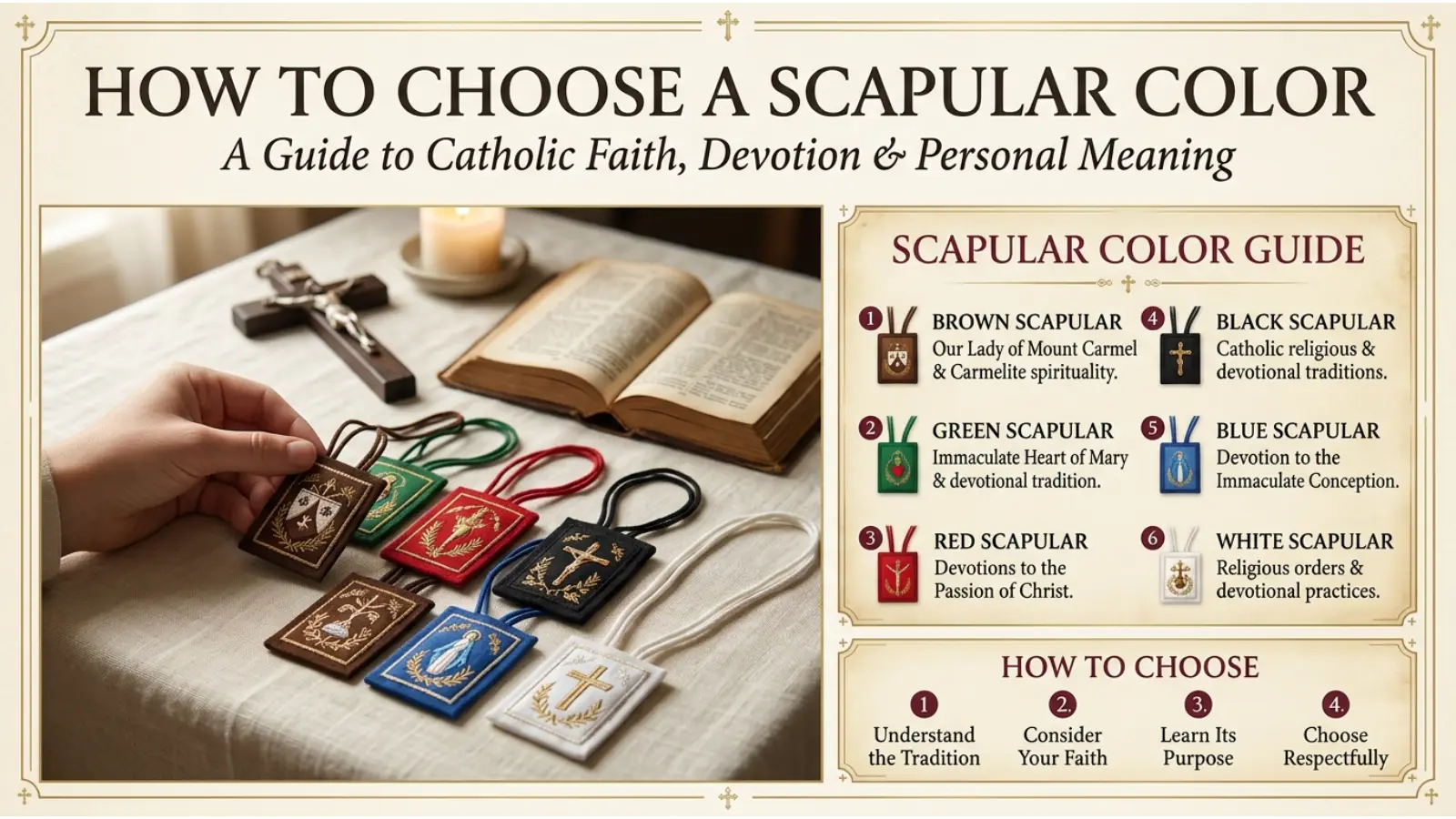
How to Choose a Scapular Color Meanings
Choosing a scapular should begin with understanding its religious purpose.
Instead of selecting one only because its color looks attractive, consider the devotion associated with it.
Choose Brown for Carmelite Devotion
The Brown Scapular is appropriate for someone interested in the Carmelite tradition and devotion to Our Lady of Mount Carmel.
Choose Green for Its Marian Devotion
The Green Scapular is associated with the Immaculate Heart of Mary and prayer for spiritual conversion.
Choose Blue for Marian Devotion
The Blue Scapular of the Immaculate Conception is connected with a particular Marian devotion.
Choose Red for the Passion of Christ
The Red Scapular of the Passion emphasizes remembrance of the suffering and sacrifice of Jesus.
Choose Black for the Seven Sorrows Tradition
The Black Scapular of the Seven Sorrows is associated with the Servite tradition and reflection on Mary’s suffering.
Understand White Scapular Traditions
White scapulars may belong to different devotional traditions. Therefore, identify the specific scapular before assuming its meaning.
Important: Some scapulars have particular requirements concerning blessing, enrollment, or devotional practice. Ask a Catholic priest or knowledgeable religious authority about the requirements of the specific scapular you wish to wear.
Scapular Color Meanings in Everyday Life
Scapulars are used in different ways depending on personal devotion and religious practice.
Daily Wear
Some Catholics wear their scapulars under their clothing throughout the day.
This allows them to keep a personal reminder of faith close to their bodies.
Prayer and Meditation
A scapular can be used as a visual reminder during personal prayer.
For instance, someone may look at their Brown Scapular and remember the importance of Marian devotion.
Religious Gifts
Scapulars are sometimes given as gifts for religious occasions.
These may include:
- Baptisms.
- First Communion.
- Confirmation.
- Birthdays.
- Religious anniversaries.
- Personal milestones.
Family Traditions
Some families pass devotional objects from one generation to another.
In these situations, a scapular may carry personal memories in addition to its religious meaning.
Common Misconceptions About Scapular Color Meanings
Several misunderstandings surround Catholic scapulars and their colors.
Myth 1: Every Scapular Color Has a Fixed Meaning
This is incorrect.
Myth 2: Wearing a Scapular Guarantees Protection
A scapular is not a magical object.
Catholic devotion connects it with faith, prayer, and trust in God. Wearing one does not guarantee freedom from illness, danger, or personal difficulties.
Myth 3: Brown Is the Only Important Scapular Color
The Brown Scapular is widely recognized, but several other scapular devotions also have important histories.
These include the Green Scapular, Blue Scapular, Red Scapular, and Black Scapular.
Myth 4: The Fabric Color Determines Spiritual Power
There is no established Catholic teaching that a particular fabric color gives a person greater spiritual power.
The meaning comes from the devotion and religious commitment associated with the scapular.
Myth 5: All Scapulars Are Worn in Exactly the Same Way
Different devotional scapulars may have different designs and practices.
Some are traditionally worn over the shoulders, while the Green Scapular has its own distinct devotional use.
Frequently Asked Questions About Scapular Color Meanings
1. What do different scapular colors mean?
Different scapular colors are associated with different Catholic devotions. Brown represents the Carmelite tradition, green is connected with the Immaculate Heart of Mary, blue with the Immaculate Conception, and red with the Passion of Christ.
2. What does a brown scapular mean spiritually?
The Brown Scapular represents devotion to Our Lady of Mount Carmel, prayer, humility, and commitment to Christian living. It is one of the most recognized Catholic devotional objects.
3. What does a green scapular represent?
The Green Scapular is associated with the Immaculate Heart of Mary. It is traditionally used as an expression of Marian devotion and prayer for spiritual conversion.
4. What does a blue scapular symbolize?
The Blue Scapular of the Immaculate Conception is associated with devotion to the Virgin Mary. Its symbolism includes purity, faith, and Marian spirituality.
5. What does a red scapular mean?
The Red Scapular of the Passion is associated with the suffering and sacrifice of Jesus Christ. It represents divine love, redemption, and remembrance of the Passion.
6. What does a black scapular represent?
The Black Scapular of the Seven Sorrows is connected with the Servite tradition and devotion to the suffering of Mary. Black also has broader associations with mourning, humility, and reflection.
7. Does a white scapular have a special meaning?
White scapulars can belong to different religious traditions. In general Christian symbolism, white represents purity, holiness, peace, and resurrection. However, the specific devotional meaning depends on the scapular.
8. Can I wear more than one scapular?
Catholics may participate in more than one scapular devotion. However, each devotion has its own practices and requirements. A priest can explain how to observe them properly.
9. Does the color of a scapular affect its spiritual meaning?
The color may help identify a particular devotion, but it does not independently determine spiritual meaning or power. The religious history, images, and devotional purpose are more important.
10. Which scapular color is best for protection?
There is no single scapular color that guarantees protection. The Brown Scapular is traditionally associated with Mary’s protection through the Carmelite devotion. However, Catholic teaching emphasizes faith, prayer, and trust in God rather than treating scapulars as magical protective objects.
Conclusion
Scapular color meanings offer an interesting way to understand Catholic devotional traditions, religious history, and spiritual symbolism. Brown, green, blue, red, and black scapulars are connected with different devotions, each carrying its own historical background and religious significance.Similarly, the Blue Scapular represents devotion to the Immaculate Conception, and the Red Scapular focuses on the Passion of Christ.
However, the true value of a scapular goes beyond its color or appearance. It is a reminder of faith, prayer, humility, and a commitment to living according to Christian values.
Understanding these traditions allows people to appreciate scapulars not simply as pieces of colored fabric, but as meaningful expressions of religious devotion and spiritual identity.

Emma Wilson is a dedicated comparison writer and product researcher at ColorMystiic.com. She specializes in creating unbiased product comparisons, detailed reviews, and helpful buying guides. Her goal is to help readers make smarter purchasing decisions with confidence.