Colors can feel deeply personal. A particular shade may make you feel calm, energized, protected, hopeful, or even nostalgic. Because of that connection, people often search for soul color meanings to understand what a color might represent on a deeper spiritual or emotional level.
The idea of a soul color is mainly found in spiritual, metaphysical, and modern symbolic traditions rather than established scientific psychology. Some people use soul colors to describe their inner nature, spiritual energy, emotional patterns, or personal journey. However, there is no scientifically proven system showing that every person has one fixed soul color.
Instead, soul colors can be viewed as a symbolic language. Their meanings can change according to culture, spiritual tradition, personal experience, shade, and context. So, a color that represents peace to one person might represent sadness or distance to another.
This guide explores common soul color meanings, their emotional and spiritual symbolism, personality associations, cultural context, and practical uses. It also separates symbolic interpretations from evidence-based psychology so you can explore the subject without confusing spiritual belief with scientific fact.
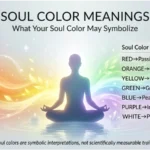
Quick Answer: Soul colors are symbolic colors that people associate with inner qualities, spiritual energy, emotions, or personal growth. Red is often linked with passion and vitality, blue with peace and wisdom, green with growth and healing, purple with spirituality, yellow with optimism, orange with creativity, pink with compassion, black with mystery or transformation, and white with purity or spiritual clarity. These meanings vary by tradition and are not scientifically proven personality tests.
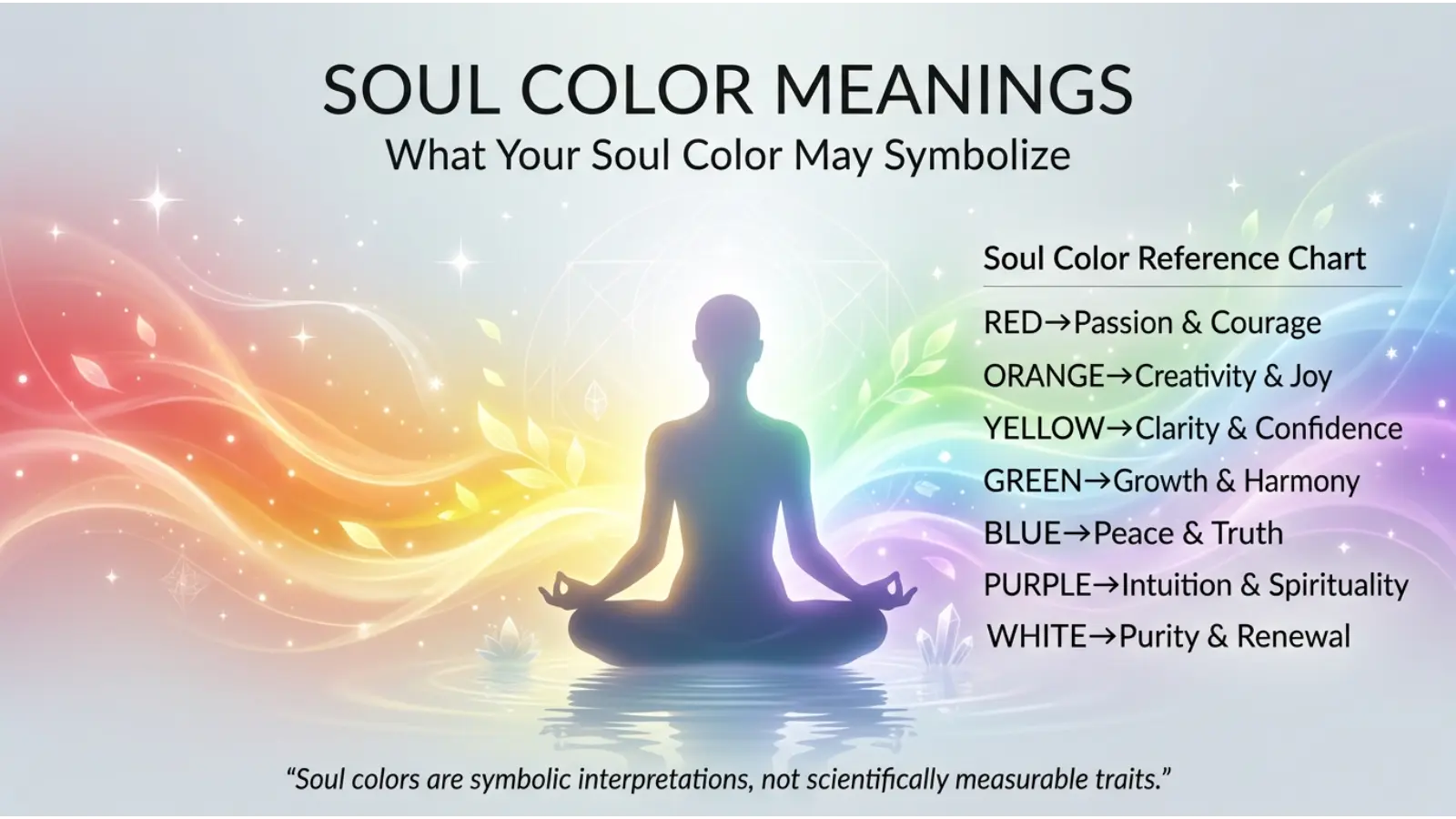
Soul Color Meanings Chart
The easiest way to understand the most common interpretations is to compare them side by side.
| Soul Color | Common Symbolism | Emotional Association | Spiritual Association |
|---|---|---|---|
| 🔴 Red | Passion, courage, vitality | Energy, desire | Life force, grounding |
| 🟠 Orange | Creativity, enthusiasm | Warmth, excitement | Expression, motivation |
| 🟡 Yellow | Joy, confidence, optimism | Happiness, curiosity | Awareness, illumination |
| 🟢 Green | Growth, balance, renewal | Calm, comfort | Healing, connection |
| 🔵 Blue | Peace, trust, wisdom | Calm, security | Truth, communication |
| 🟣 Purple | Spirituality, imagination | Reflection, mystery | Intuition, transformation |
| 🩷 Pink | Love, compassion, tenderness | Affection, warmth | Emotional healing |
| 🟤 Brown | Stability, simplicity, grounding | Comfort, security | Earth connection |
| ⚫ Black | Mystery, strength, transition | Protection, seriousness | Shadow work, transformation |
| ⚪ White | Purity, clarity, peace | Calm, openness | Renewal, transcendence |
| 🌈 Rainbow | Wholeness, diversity, integration | Hope, inspiration | Unity, spiritual balance |
These associations are symbolic rather than universal rules. Therefore, your personal experience with a color can be just as meaningful as a traditional interpretation.
What Is a Soul Color?
A soul color is a symbolic color that some spiritual and metaphysical traditions use to describe aspects of a person’s inner self. Depending on the belief system, it may be connected with personality, emotional energy, spiritual development, life purpose, or an imagined aura surrounding the body.
Unlike standardized scientific measurements, soul colors do not have one universally accepted definition. For example, one spiritual system may describe blue as a sign of wisdom, while another may connect it more strongly with communication and emotional sensitivity.
Furthermore, people sometimes use the phrase “soul color” simply as a poetic way to describe the color that feels most representative of who they are.
That makes the concept flexible. Rather than treating a soul color as a permanent label, it can be more useful to see it as a reflection tool.
How Do Soul Colors Work?
There is no scientifically established method for measuring or identifying a person’s soul color. Instead, people usually discover a symbolic color through personal reflection, spiritual practices, color-based personality quizzes, meditation, dreams, artwork, or aura-reading traditions.
For example, someone who constantly chooses blue clothing might interpret blue as representing their need for peace and stability. Another person may choose red because it reminds them of courage, ambition, or passion.
In addition, the same person may connect with different colors at different stages of life. A period of change might make purple feel meaningful, while a stressful period might create a stronger connection with green or blue.
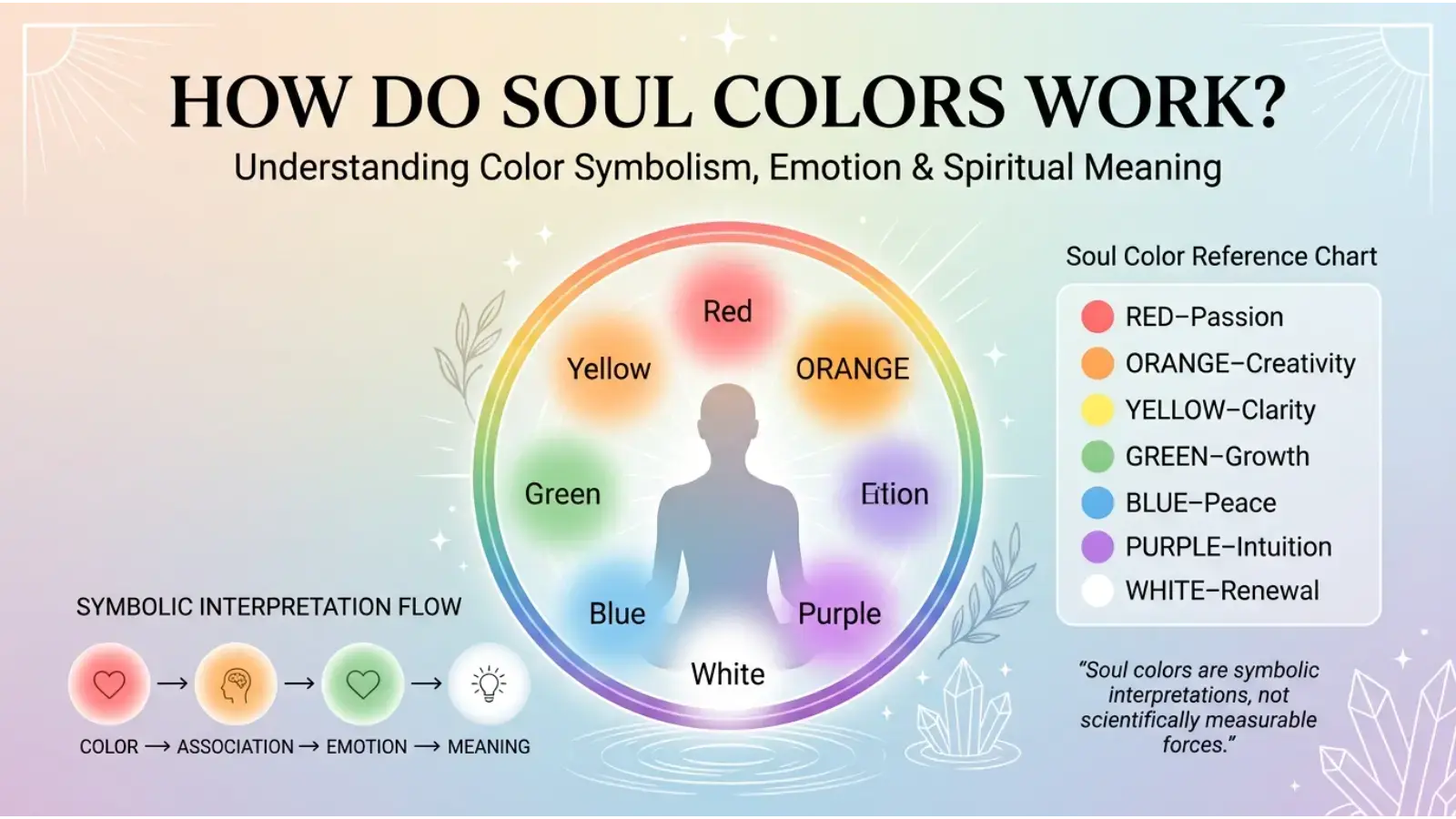
Consequently, a soul color does not need to remain fixed.
Red Soul Color Meaning
🔴 Red is commonly associated with passion, vitality, courage, strength, desire, and physical energy.
A red soul is often symbolically described as active and determined. People who strongly identify with red may see themselves as passionate, direct, competitive, protective, or willing to take action.
Spiritually, red can represent grounding and connection with physical life. It may symbolize the instinct to survive, create, protect, and move forward.
Emotionally, red can feel exciting and powerful. However, it can also represent anger, impatience, conflict, or excessive intensity.
Therefore, red works best as a symbol of life energy and courage, rather than as proof that someone has a particular personality.
Orange Soul Color Meaning
🟠 Orange often symbolizes creativity, enthusiasm, warmth, confidence, and social energy.
The color can represent a desire to create rather than simply observe.
Spiritually, orange may symbolize motivation and personal expression. It can also represent the transition between physical energy and emotional creativity.
Because orange combines the intensity of red with the brightness of yellow, it often carries a lively and outgoing symbolic quality.
On the other hand, excessive orange symbolism can suggest restlessness, impulsiveness, or a need for constant stimulation.
Yellow Soul Color Meaning
🟡 Yellow is commonly connected with optimism, curiosity, happiness, confidence, and mental brightness.
A yellow soul may symbolically represent an inquisitive mind and a desire to learn.
In spiritual symbolism, yellow can represent awareness, understanding, and personal insight.
However, yellow does not always have a positive meaning. In some contexts, it can suggest caution, jealousy, nervousness, or insecurity.
Thus, the meaning depends heavily on the shade and situation.
Green Soul Color Meaning
🟢 Green commonly represents growth, balance, renewal, nature, compassion, and harmony.
Because green appears widely in nature, people frequently associate it with renewal and restoration. Spiritually, some traditions connect green with healing and the heart, although these interpretations vary between systems.
Green can also symbolize balance because it sits between warm and cool colors on many traditional color models.
At the same time, darker or duller greens may evoke ideas such as envy, possessiveness, or stagnation.
Blue Soul Color Meaning
🔵 Blue is one of the most common colors associated with peace, trust, communication, wisdom, and emotional calm.
A blue soul may symbolically represent someone who values stability, honesty, reflection, and meaningful communication.
The color of sky and water also gives blue a strong connection with openness and depth. Consequently, blue can represent a calm surface while suggesting a rich inner world.
Yet blue can also represent sadness or emotional distance in certain contexts. Therefore, its meaning is not automatically positive.
Purple Soul Color Meaning
🟣 Purple is often associated with spirituality, intuition, imagination, mystery, transformation, and inner exploration.
A purple soul is commonly portrayed as reflective and imaginative. It may symbolize a person who enjoys exploring ideas that go beyond everyday experience.
In spiritual settings, purple may represent contemplation, intuition, transformation, or a search for deeper meaning.
Nevertheless, these ideas are symbolic. There is no scientific test showing that a preference for purple proves spiritual sensitivity or psychic ability.
Pink Soul Color Meaning
🩷 Pink often represents compassion, affection, tenderness, kindness, and emotional connection.
A pink soul may symbolically reflect a gentle approach to relationships and an appreciation for care and emotional warmth.
Light pink can suggest softness and calm, while stronger pink shades can feel energetic, playful, and expressive.
In modern culture, pink also carries strong associations with fashion, beauty, youth, and self-expression.
Brown Soul Color Meaning
🟤 Brown is commonly associated with stability, grounding, simplicity, reliability, and connection with the earth.
A brown soul may symbolize someone who appreciates practical things, familiar environments, and dependable relationships.
Because brown appears in soil, wood, stone, and other natural materials, it often creates an earthy feeling.
Spiritually, brown can be interpreted as grounding or returning attention to physical reality. It can be especially meaningful when someone feels disconnected or overwhelmed.
However, brown can also appear dull or heavy when used without contrast, so its emotional effect depends on surrounding colors.
Black Soul Color Meaning
⚫ Black can symbolize mystery, strength, protection, independence, transformation, and the unknown.
A black soul does not automatically represent negativity. In symbolic traditions, black can describe the unknown part of life, personal boundaries, or a period of transformation.
In fashion and design, black frequently communicates sophistication, authority, and simplicity.
However, black can also symbolize grief, fear, isolation, or mourning in particular cultures and situations.
White Soul Color Meaning
⚪ White commonly represents purity, peace, clarity, simplicity, innocence, and renewal.
White reflects light strongly, which helps explain its association with brightness and clarity. In spiritual symbolism, it may represent renewal, transcendence, or a fresh beginning.
However, white has different cultural meanings around the world.
Therefore, cultural context matters greatly.
Rainbow Soul Color Meaning
🌈 A rainbow soul can symbolize wholeness, diversity, integration, hope, and the coexistence of different qualities.
Rather than representing one personality trait, rainbow symbolism can suggest that a person contains many emotional or spiritual dimensions.
It may also represent acceptance, individuality, creativity, and unity.
Because rainbows combine multiple colors, they are especially useful as a symbol for balance rather than a single fixed identity.
Soul Color Meanings and Personality
Color preferences can sometimes reflect personal taste, memories, social influences, or the emotional response a person has developed toward a particular color. However, a preferred color cannot reliably determine someone’s personality.
For instance, someone may love black because it is practical and easy to combine with other clothing. Another person may choose black because it represents independence. The same preference can therefore have completely different personal causes.
Similarly, someone who prefers yellow is not automatically optimistic, and someone who dislikes red is not necessarily passive.
Color symbolism is most useful when treated as a conversation starter about personality, not a personality diagnosis.
Spiritual Soul Color Meanings
Soul colors are especially popular in spiritual and metaphysical discussions.
However, spiritual color meanings vary widely.
Some systems connect colors with energy centers or chakras. Others use colors in meditation, visualization, ritual, artwork, or aura interpretations. Still others treat color mainly as a personal symbol.
Because these traditions are diverse, it would be misleading to claim that one color has one universally accepted spiritual meaning.
A more useful approach is to ask what a color represents within a specific tradition and then consider what it means personally.
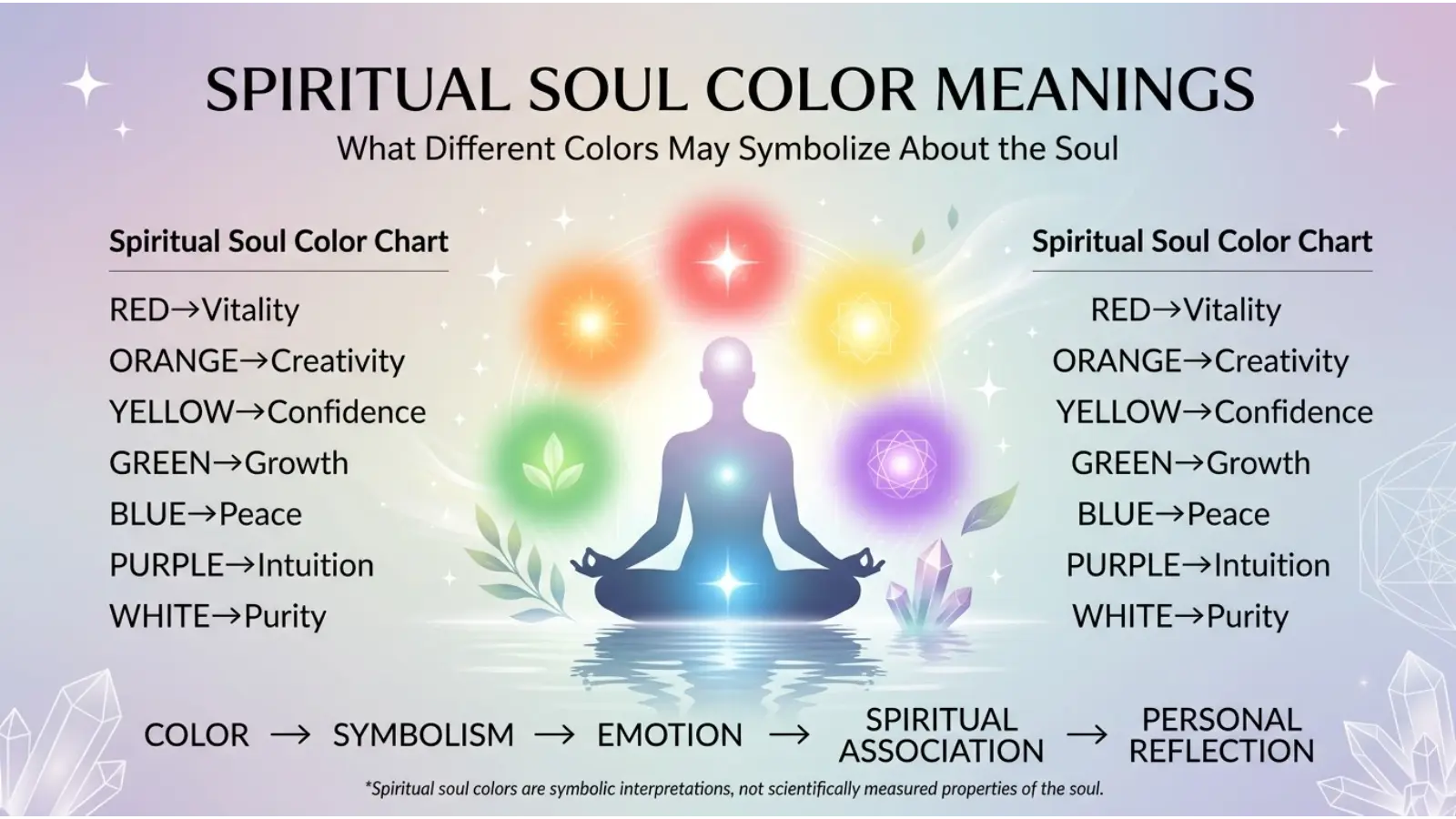
Soul Color Meanings and Emotional Energy
For example, a soft blue wall may feel peaceful because of its low visual intensity and associations with sky or water. A bright red advertisement, however, may feel energetic because of its high saturation and visual prominence.
This distinction matters because color does not carry emotion in exactly the same way everywhere.
Instead, people interpret color through a combination of visual properties and learned associations.
Do Soul Colors Change?
Symbolically, they can.
Many people believe that a person’s dominant soul color can change as they experience different emotions, relationships, challenges, or stages of personal growth.
For example, someone might identify strongly with red during an ambitious period of life and later feel drawn toward green during a period focused on balance and recovery.
From a psychological perspective, changing color preferences can also happen for ordinary reasons. Fashion trends, environment, age, memories, social influences, and changing tastes can all affect color preferences.
Cultural Meaning of Soul Color Meanings
Color symbolism is never completely separate from culture.
Western Cultural Associations
Blue is often used to communicate reliability, and red can signal danger, passion, or urgency.
These associations are common, but they are not universal.
Eastern Cultural Associations
Across Asian cultures, color meanings vary considerably. Red, for example, can have strong associations with celebration, prosperity, luck, or happiness in some Chinese cultural contexts.
White can carry mourning associations in several Asian traditions, demonstrating why a simple worldwide color dictionary can be misleading.
Middle Eastern and Islamic Cultural Contexts
Green, for instance, has important historical and religious associations in Islamic cultures, but its meaning still depends on context.
It is better to distinguish cultural history from modern spiritual claims.
African Cultural Traditions
Africa contains hundreds of cultures and many distinct symbolic systems. Colors can appear in clothing, art, ceremonies, flags, beadwork, and community traditions.
Therefore, a single “African meaning” for any color would be an oversimplification.
Latin American Cultural Contexts
Colors in Latin American cultures can carry meanings connected with religion, celebration, mourning, national identity, festivals, and local traditions.
Consequently, the meaning of a color may change significantly from one country or community to another.
Historical Soul Color Meanings
Color symbolism has changed throughout history because pigments, dyes, technology, religion, trade, social class, and politics have changed.
Purple provides a useful example. Certain purple dyes were historically difficult to produce, making intense purple associated with wealth and status in some societies.
Similarly, red has appeared throughout human history in art, clothing, ceremony, warfare, and political symbolism.
A claim that “red always meant one thing” throughout history would ignore the enormous variety of human cultures.
Soul Colors in Branding and Marketing
Although brands do not usually use the term “soul color,” color symbolism plays an important role in visual identity.
Companies choose colors to create a particular impression, but color alone does not guarantee a consumer reaction.
For example, blue is frequently used in corporate identities because it can communicate qualities such as reliability and professionalism. Green often appears in environmental, health, and natural-product branding because of its associations with nature.
Red can create a strong visual presence, while purple may help a brand appear imaginative or distinctive.
Nevertheless, successful branding depends on far more than color. Typography, imagery, product quality, cultural context, positioning, and consistency all influence perception.
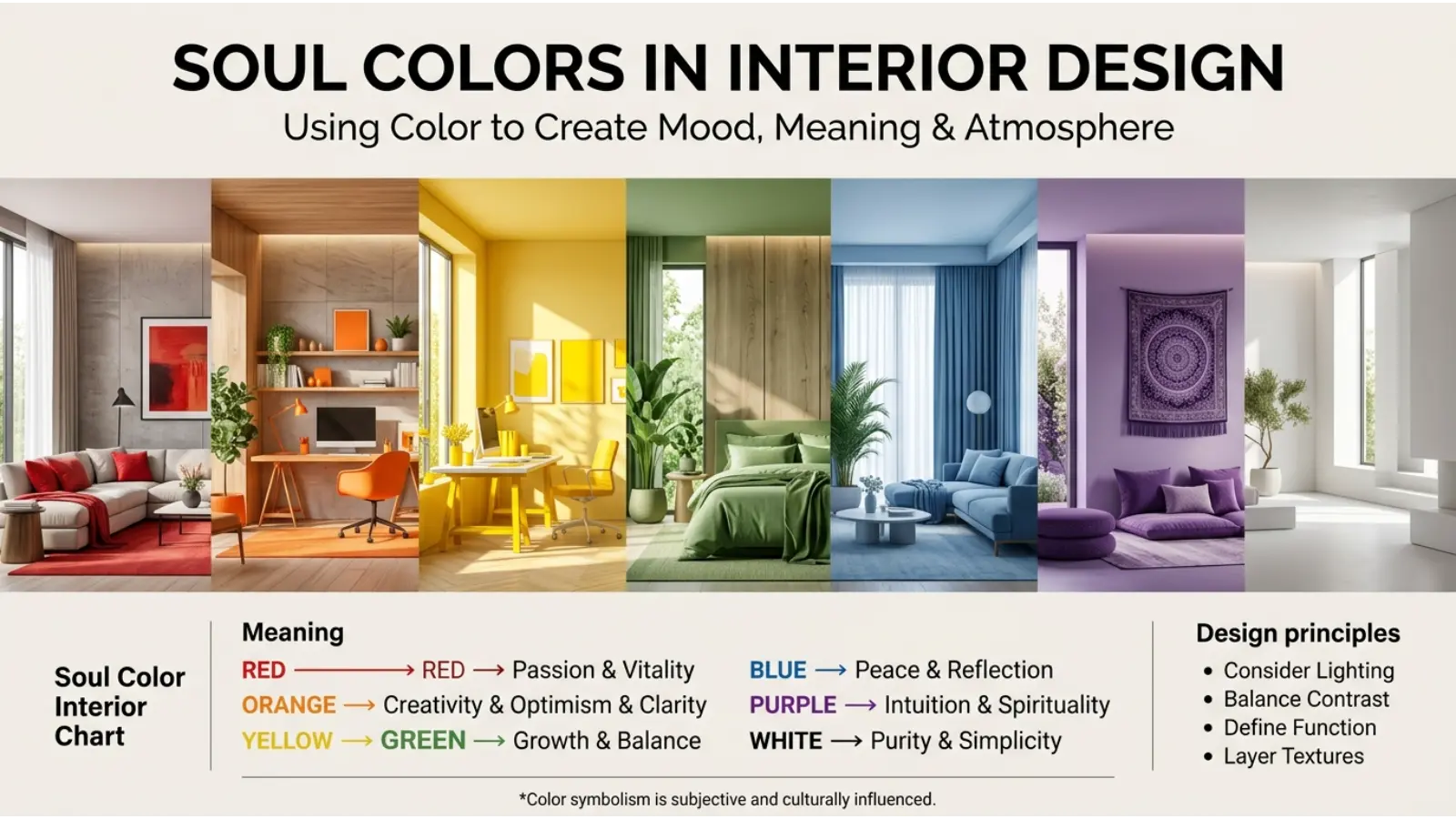
Soul Colors in Interior Design
Color becomes especially noticeable at home because people spend long periods surrounded by it.
A blue bedroom can create a quiet visual atmosphere, while green may bring a natural feeling into a living space. Warm orange or terracotta can make a room feel energetic and social.
However, room size and lighting matter.
A dark color may make a small room feel more enclosed, while a pale shade can reflect more light and create an open appearance. Artificial lighting can also shift how colors look during the evening.
For that reason, always test paint samples under the lighting that will actually be used in the room.
Soul Colors in Fashion
Fashion provides another easy way to explore color symbolism without making a permanent commitment.
Red clothing can create a bold impression, while blue may appear calm and dependable. Purple can feel artistic or unusual, green can suggest a natural or relaxed style, and black can create a polished appearance.
Furthermore, the shade matters.
A dusty rose does not communicate exactly the same feeling as neon pink. Likewise, navy blue creates a different impression from electric blue.
Therefore, when choosing a color for clothing, consider hue, brightness, saturation, fabric, occasion, and surrounding colors.
Best Color Combinations for Soul Symbolism
Combining colors can create a richer symbolic message than using one color alone.
| Color Combination | Common Symbolic Impression | Practical Use |
|---|---|---|
| 🔵 Blue + ⚪ White | Peace and clarity | Bedrooms, wellness designs |
| 🟢 Green + 🟤 Brown | Nature and grounding | Eco-inspired spaces |
| 🟣 Purple + 🔵 Blue | Intuition and reflection | Creative branding |
| 🔴 Red + 🟠 Orange | Energy and enthusiasm | Sports and entertainment |
| 🩷 Pink + ⚪ White | Compassion and softness | Beauty and lifestyle |
| 🟡 Yellow + 🟢 Green | Optimism and growth | Youthful designs |
| ⚫ Black + 🟣 Purple | Mystery and sophistication | Fashion and luxury |
| 🌈 Multiple Colors | Diversity and wholeness | Art and expressive designs |
These combinations are suggestions rather than fixed symbolic rules. Context should always guide the final choice.
How Lighting Changes Soul Color Meanings
Lighting can dramatically change how a color appears.
Warm light can make reds, oranges, and yellows appear richer. Cool light can make blues and greens look stronger. Meanwhile, low light can reduce saturation and make colors appear darker.
Consequently, a color that looks peaceful in daylight may feel completely different under bright artificial lighting.
This is particularly important for interior design, photography, branding, and clothing.
How Age Can Affect Color Interpretation
Color preferences and interpretations can change with age.
Children may respond strongly to bright, saturated colors, while adults may develop preferences influenced by fashion, work environments, cultural expectations, and personal experiences.
However, age does not create a universal color personality. Individual differences remain important.
A person’s memories can also make a particular color meaningful. For one person, yellow might recall childhood summers. For another, it might remind them of an unpleasant experience.
That personal history can be more powerful than a general color chart.
Common Misconceptions About Soul Colors
A Soul Color Is Scientifically Measurable
There is no universally accepted scientific instrument that measures a person’s soul color.
Your Soul Color Never Changes
There is no established rule requiring one permanent soul color. Many spiritual interpretations allow colors to change, while others use one dominant color as a symbolic identity.
Your Favorite Color Reveals Your Personality
A favorite color can offer clues about taste and associations, but it cannot accurately diagnose personality.
Every Culture Gives Colors the Same Meaning
This is one of the biggest mistakes in color symbolism. Meanings can differ dramatically between cultures and historical periods.
Dark Colors Are Always Negative
Black, navy, brown, and dark purple can symbolize strength, stability, sophistication, depth, protection, or transformation. Darkness does not automatically mean something bad.
Real-World Uses of Soul Color Symbolism
Soul color ideas can be useful when treated as a creative and reflective tool.
In daily life, colors can help people express mood and identity.
In art, color can communicate feelings that are difficult to explain with words.
Photography, color grading can create emotional atmosphere.
In fashion, color can help communicate style and personal expression.
In home decoration, color can influence the visual character of a room.
IBranding, carefully selected colors can support a company’s desired identity.
In entertainment, filmmakers and artists often use color to establish mood and symbolism.
The key is to understand that these applications involve perception and symbolism rather than a proven supernatural effect.
How to Find a Soul Color That Feels Meaningful to You
You do not need a formal test to explore your symbolic color.
Start by noticing which colors repeatedly attract your attention. Then ask yourself what you associate with them.
Consider these questions:
- Which color makes me feel most comfortable?
- Which color represents a major period of my life?
- What color do I naturally choose when I want confidence?
- Which color feels peaceful when I see it?
- Is there a color I avoid, and why?
- Do my color preferences change with my mood?
- Which color would represent my current goals?
- What color represents personal growth for me?
Your answers may reveal a symbolic pattern.
Instead of asking, “What is my scientifically correct soul color?” a more useful question is, “What does this color help me express about myself?”
Soul Color Meanings FAQ
What is the most spiritual soul color?
Purple, violet, white, and blue are commonly given spiritual meanings involving intuition, reflection, clarity, wisdom, or inner awareness. However, there is no universally accepted spiritual soul-color system.
What color represents the soul?
There is no single color that universally represents the soul. White, purple, blue, gold, and rainbow colors are all used symbolically in different spiritual and cultural settings.
Can your soul color change?
In many spiritual interpretations, yes. A changing soul color may symbolize emotional development, personal transformation, or a new stage of life. Scientifically, however, the concept of a changing soul color has not been established.
What does a blue soul mean?
A blue soul is often interpreted as peaceful, thoughtful, honest, communicative, and emotionally reflective. These are symbolic associations rather than proven personality characteristics.
What does a purple soul mean?
Purple commonly symbolizes spirituality, imagination, intuition, mystery, and transformation. Its meaning can change depending on the spiritual tradition and shade.
What does a red soul mean?
Red is often associated with passion, courage, vitality, physical energy, determination, and strong emotion. In some contexts, it can also represent anger or conflict.
What does a green soul mean?
Green commonly symbolizes growth, balance, nature, renewal, compassion, and healing. Its meaning can also include envy or possessiveness depending on the context.
Can color reveal someone’s personality?
Not reliably. Color preferences can reflect personal experiences, cultural influences, memories, and taste, but they should not be used as a scientific personality diagnosis.
Are soul colors scientifically proven?
No. Soul colors are primarily spiritual, symbolic, and metaphysical concepts. Color psychology does study how color can influence perception and behavior, but that research does not prove that people have measurable soul colors.
Why do different websites give different soul color meanings?
Because there is no single universal system. Spiritual traditions, cultural symbolism, modern metaphysical practices, and personal interpretations can assign different meanings to the same color.
Final Thoughts on Soul Color Meanings
Soul color meanings are best understood as a symbolic language rather than a scientific classification system. Colors can give people a powerful way to think about emotions, identity, personal growth, spirituality, and self-expression.
Red may remind someone of courage. Blue may represent peace. Green can suggest growth. Purple can encourage reflection. Yellow can express optimism, while white may symbolize clarity or renewal. Yet none of these meanings is fixed for everyone.
Ultimately, context matters. Culture, history, lighting, shade, personal memories, and individual experience can all change the way a color feels.
That is what makes color symbolism so interesting. A color does not have to tell you exactly who you are to help you think more deeply about who you are becoming.

Emma Wilson is a dedicated comparison writer and product researcher at ColorMystiic.com. She specializes in creating unbiased product comparisons, detailed reviews, and helpful buying guides. Her goal is to help readers make smarter purchasing decisions with confidence.