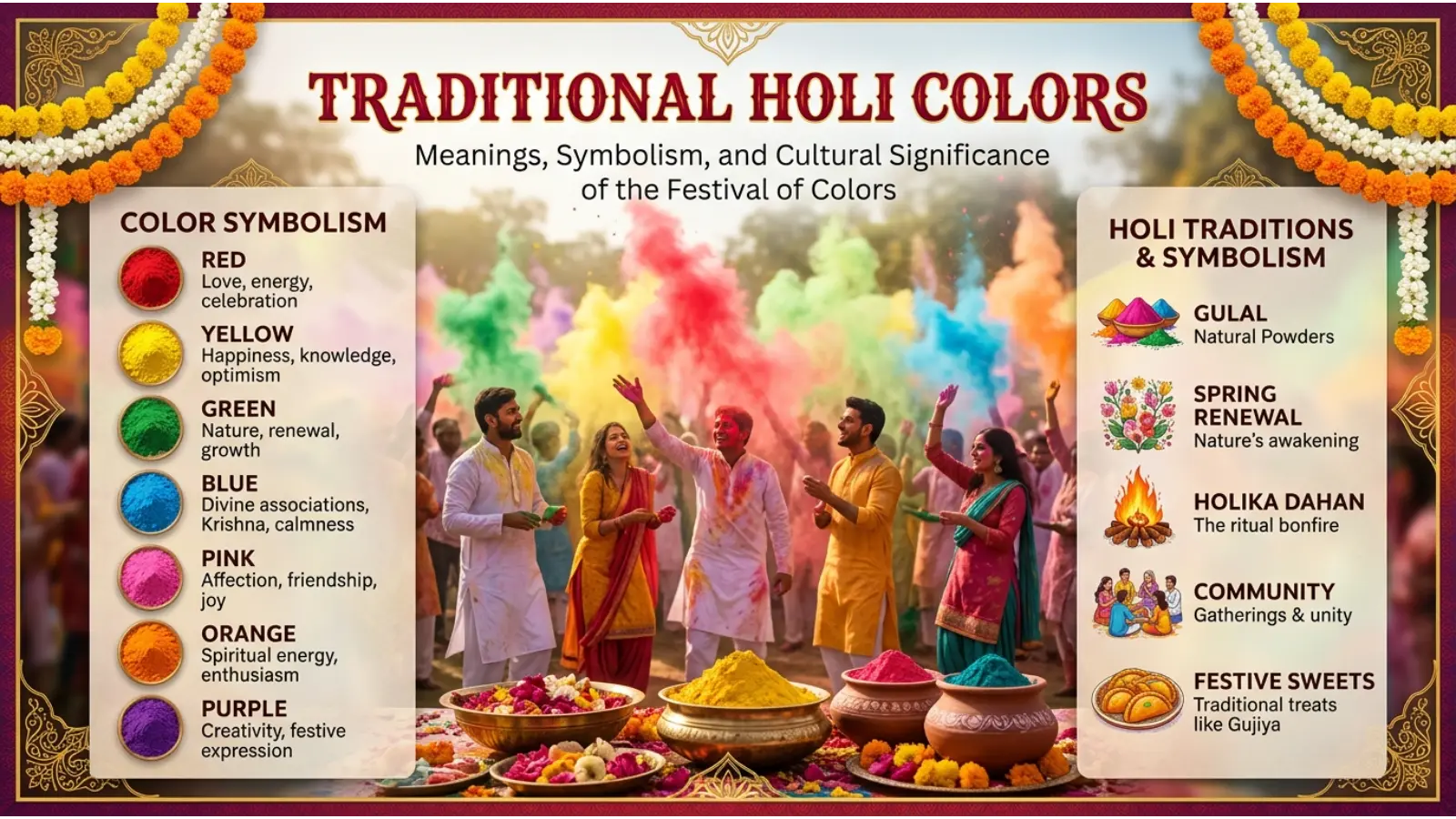
Holi is one of the most colorful festivals in the world. Celebrated mainly in India and Nepal, it brings people together through music, dancing, sweets, bonfires, and colorful powders. Each shade adds something special to the celebration. Traditional Holi colors often represent love, happiness, new beginnings, nature, energy, and spirituality. However, their meanings are not exactly the same in every region or family.
People search for traditional Holi colors because they want to understand what each shade represents and why people throw colored powder during the festival. These colors also have connections to Hindu stories, seasonal traditions, local customs, and modern celebrations. In this guide, you will discover the meanings of popular Holi colors, their cultural significance, historical background, and how they influence art, fashion, decoration, and everyday celebrations.
Quick Answer: Traditional Holi colors include red, yellow, blue, green, pink, and purple. Red is commonly associated with love and celebration, yellow with happiness and knowledge, blue with Krishna and divine associations, green with nature and renewal, pink with affection, and purple with creativity and celebration. Meanings vary across regional traditions.
What Are Traditional Holi Colors?
Traditional Holi colors are the bright powders and colored water used during the Hindu spring festival of Holi. In Hindi, colored powder is commonly called gulal. People apply it to friends and family, throw it into the air, and use it to create a joyful atmosphere.
Traditionally, Holi celebrates the arrival of spring, the victory of good over evil, and the opportunity to leave behind old disagreements. Therefore, its colors are more than decorative materials. They help express joy, friendship, community, and the changing season.
Today, people celebrate with many shades, including:
- Red
- Yellow
- Blue
- Green
- Pink
- Purple
- Orange
Although each shade has recognizable associations, there is no single official color chart that defines every traditional Holi color.
Traditional Holi Colors and Their Meanings
Each color creates a different visual feeling. Furthermore, religious stories, regional customs, and personal experiences can influence how people understand these shades.
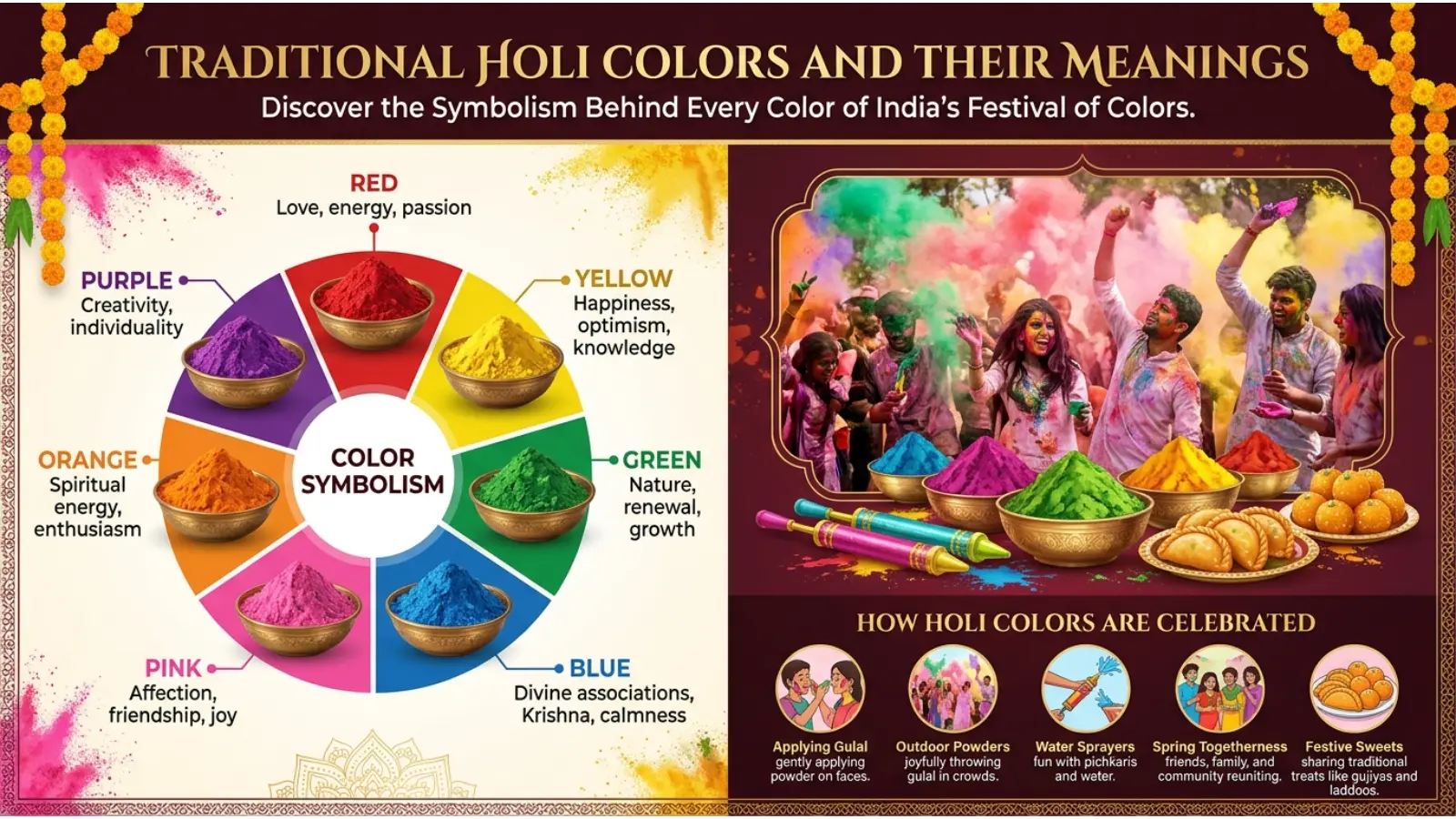
Red Holi Color Meaning: Love, Energy, and Celebration
🟥Red – Love, energy, passion, and celebration
Red is one of the most recognizable colors in Indian festivals. It has strong associations with marriage, auspicious occasions, celebration, and vitality in many Hindu cultural settings.
During Holi, red powder adds warmth and excitement to the festivities. It can also suggest affection, togetherness, and the energy of spring.
What red represents during Holi:
- Love and affection
- Passion and vitality
- Celebration and happiness
- Auspicious beginnings
- Strength and energy
Cultural significance: Red has an important place in many Indian wedding traditions, festive decorations, and religious ceremonies. However, its meaning depends on the specific ritual and community.
Practical use: Red gulal creates a bold, lively appearance in festive photographs, clothing, and decorations.
Yellow Holi Color Meaning: Happiness, Knowledge, and Positivity
🟨Yellow – Happiness, learning, warmth, and optimism
Yellow is closely associated with sunshine, turmeric, and the brightness of spring. In many Hindu traditions, yellow also has connections with knowledge, auspiciousness, and religious ceremonies.
Its cheerful appearance makes it a natural choice for Holi celebrations.
What yellow represents during Holi:
- Happiness and optimism
- Knowledge and learning
- Warmth and friendship
- Auspiciousness
- Fresh beginnings
Cultural significance: Yellow and turmeric have long-standing roles in Indian celebrations. Turmeric is used in several wedding and religious customs, although these practices differ by region.
Practical use: Yellow works beautifully with white clothing, floral decorations, and spring-themed festive arrangements.
Blue Holi Color Meaning: Krishna, Spirituality, and Peace
🟦Blue – Krishna, devotion, calmness, and spiritual symbolism
Blue has a particularly recognizable connection with Lord Krishna, who is commonly represented with blue or dark-blue skin in Hindu art and devotional traditions.
Because Krishna is closely connected with Holi celebrations, especially in Braj, blue has a meaningful place in the festival’s cultural imagery.
What blue represents during Holi:
- Krishna and devotional traditions
- Spiritual connection
- Calmness and peace
- Depth and mystery
- Divine associations
Cultural significance: In places such as Mathura and Vrindavan, Krishna-related Holi traditions are especially important. Therefore, blue can carry religious and cultural meaning beyond its visual beauty.
Practical use: Blue creates a striking contrast with yellow, pink, and white in festive designs.
Green Holi Color Meaning: Nature, Growth, and Renewal
🟩Green – Nature, growth, renewal, and harmony
Green is strongly connected with plants, leaves, fresh fields, and new growth. Since Holi arrives during the spring season, green naturally reflects the changing landscape.
It also represents renewal and the beginning of a fresh chapter.
What green represents during Holi:
- Nature and spring
- Growth and renewal
- Harmony and balance
- Fresh opportunities
- Hope and vitality
Cultural significance: Green is a familiar symbol of vegetation and seasonal change. Its association with spring makes it especially suitable for a festival that welcomes warmer weather and new growth.
Practical use: Green works well in floral arrangements, outdoor decorations, festive clothing, and nature-inspired Holi artwork.
Pink Holi Color Meaning: Friendship, Affection, and Joy
Pink – Affection, friendship, sweetness, and happiness
The Pink creates a softer and warmer impression than deep red. It is commonly associated with kindness, affection, romance, and friendly relationships.
During Holi, pink adds a playful and welcoming touch to the celebration.
What pink represents during Holi:
- Friendship and affection
- Love and kindness
- Happiness and playfulness
- Warm relationships
- Celebration
Cultural significance: Pink is popular in modern Holi photography, clothing, decorations, and festive artwork. Its meaning is influenced by broader cultural associations rather than one fixed religious interpretation.
Practical use: Pink pairs beautifully with purple, yellow, white, and blue.
Purple Holi Color Meaning: Creativity, Beauty, and Celebration
🟪Purple – Creativity, imagination, beauty, and individuality
Purple is a popular modern Holi shade. Its rich appearance adds variety to colorful celebrations and artistic displays.
In contemporary color symbolism, purple is often associated with imagination, luxury, creativity, and individuality.
What purple represents during Holi:
- Creativity and imagination
- Beauty and individuality
- Celebration and expression
- Mystery and depth
- Artistic energy
Cultural significance: Purple does not have one universally established traditional Hindu meaning for Holi. Its popularity is more closely connected with modern color powders, festive designs, and contemporary celebrations.
Practical use: Purple creates attractive combinations with pink, yellow, blue, and white.
Orange Holi Color Meaning: Energy, Warmth, and Spirituality
🟧Orange – Energy, enthusiasm, warmth, and spiritual associations
Orange brings together the brightness of yellow and the intensity of red. It creates a lively impression that fits the energetic atmosphere of Holi.
Saffron and orange shades also have important associations in several Indian religious and cultural settings.
What orange represents during Holi:
- Energy and enthusiasm
- Warmth and optimism
- Spiritual dedication
- Celebration and courage
- Transformation
Cultural significance: Saffron-colored clothing and symbols have religious and cultural importance in different Hindu traditions. However, ordinary orange Holi powder should not automatically be treated as a religious symbol.
Practical use: Orange looks attractive alongside yellow, green, and red in festive decorations.
Traditional Holi Colors Chart: Meanings at a Glance
The following chart provides a simple comparison of the most popular Holi colors and their commonly recognized associations.
| Holi Color | Color Symbolism | Emotional Association |
|---|---|---|
| 🟥 Red | Love and celebration | Passion and excitement |
| 🟨 Yellow | Knowledge and positivity | Happiness and warmth |
| 🟦 Blue | Krishna and spirituality | Calmness and devotion |
| 🟩 Green | Nature and renewal | Hope and freshness |
| 🩷 Pink | Affection and friendship | Kindness and joy |
| 🟪 Purple | Creativity and beauty | Imagination |
| 🟧 Orange | Energy and spirituality | Enthusiasm |
Why Are Colors Used During Holi?
Holi colors help turn a seasonal and religious celebration into a shared experience. They create a sense of participation because everyone can join the festivities regardless of age, background, or social position.
There are several reasons behind this tradition.
Celebrating the Arrival of Spring
Holi takes place near the beginning of spring in the traditional Hindu calendar. During this period, flowers bloom, fields change, and the weather becomes warmer.
Consequently, bright colors reflect the beauty and energy of the season.
Expressing Happiness and Friendship
People apply gulal to friends, relatives, and neighbors. This simple gesture can express affection, welcome, and goodwill.
Moreover, playing with colors helps people connect in a relaxed and joyful atmosphere.
Celebrating the Victory of Good Over Evil
Holi is associated with the story of Prahlad and Holika. According to the Hindu tradition, Prahlad’s devotion to Vishnu protects him when Holika’s plan to destroy him fails.
Holika Dahan, the traditional bonfire before the main day of Holi, commemorates the victory of good over evil.
Although the story explains an important religious meaning of Holi, individual colors do not each represent a fixed part of this story.
Bringing Communities Together
Holi is also a social festival. People visit relatives, share food, exchange greetings, and celebrate together.
Therefore, the use of color becomes a symbol of participation, connection, and shared happiness.
Historical and Religious Background of Holi Colors
Holi has a long history within Indian religious and cultural traditions. Its development is connected with seasonal celebrations, Hindu mythology, devotional practices, and regional customs.
However, it is useful to distinguish the history of Holi itself from the modern popularity of specific colored powders.
The Story of Prahlad and Holika
One of the best-known stories associated with Holi describes Prahlad, a devoted follower of Lord Vishnu.
According to the story, his father, King Hiranyakashipu, opposed his devotion. Holika, the king’s sister, attempted to burn Prahlad using a protective power that was supposed to keep her safe from fire.
Instead, Prahlad survived, while Holika was destroyed.
This story forms the religious background of Holika Dahan and represents the victory of faith and goodness over arrogance and evil.
Krishna and Radha’s Connection With Holi
Another important tradition connects Holi with Lord Krishna and Radha.
In popular accounts, Krishna playfully applies color to Radha and other companions. These stories are especially important in Braj, including Mathura and Vrindavan.
Over time, playful color traditions became a recognizable part of the festival’s celebrations.
Traditional Gulal and Natural Materials
Historically, people used naturally available materials to create festive colors.
Examples include:
- Turmeric for yellow shades.
- Flowers such as tesu or palash for orange and saffron-like shades.
- Plant materials for certain green shades.
- Other locally available flowers and natural ingredients for different colors.
The exact ingredients depended on local plants, preparation methods, and regional customs.
Today, commercially produced powders are widely used. However, natural-color traditions remain meaningful for people who want to connect Holi with older seasonal practices.
Natural Traditional Holi Colors and Their Sources
Natural materials have an important place in the history of Holi color preparation. They also show how people used local plants and ingredients to create festive shades.
| Natural Material | Color Produced | Traditional Association |
|---|---|---|
| 🟨 Turmeric | Yellow | Warmth and auspiciousness |
| 🟧 Palash flowers | Orange | Spring and celebration |
| 🟥 Beetroot | Pinkish red | Natural color preparation |
| 🟩 Henna leaves | Greenish shades | Plant-based coloring |
| 🟪 Certain flower extracts | Purple shades | Floral color traditions |
Important: These are examples of possible natural color sources, not a complete historical recipe list. The actual shade depends on preparation, concentration, and the plant material used.
Also, natural does not automatically mean safe for every skin type. Plant extracts can cause irritation or allergic reactions.
The Psychology of Traditional Holi Colors
Color psychology explores how colors influence perception, emotion, and visual attention. Holi provides an interesting example because several bright shades appear together in an energetic social setting.
However, color psychology does not mean that a particular shade produces the same emotional response in every person.
Why Bright Colors Feel Festive
Bright and saturated colors attract visual attention. They are easy to notice in photographs, decorations, and crowded celebrations.
As a result, bright Holi powders contribute to the energetic appearance of the festival.
How Different Colors Influence Perception
| Color | Common Visual Impression | Possible Emotional Association |
|---|---|---|
| 🟥 Red | Bold and intense | Excitement |
| 🟨 Yellow | Bright and warm | Cheerfulness |
| 🟦 Blue | Cool and balanced | Calmness |
| 🟩 Green | Fresh and natural | Renewal |
| 🩷 Pink | Soft and welcoming | Affection |
| 🟪 Purple | Rich and expressive | Creativity |
| 🟧 Orange | Warm and energetic | Enthusiasm |
These associations are broad cultural and visual patterns, not guaranteed psychological effects.
Why Context Changes Color Meaning
A color can have different meanings depending on where and how it appears.
For example, blue in a Krishna painting may communicate devotion. However, blue powder at a modern Holi party may simply add visual excitement.
Similarly, red can represent love in one setting and danger or warning in another.
Therefore, the surrounding objects, traditions, people, and occasion all influence color interpretation.
Spiritual Meaning of Holi Colors
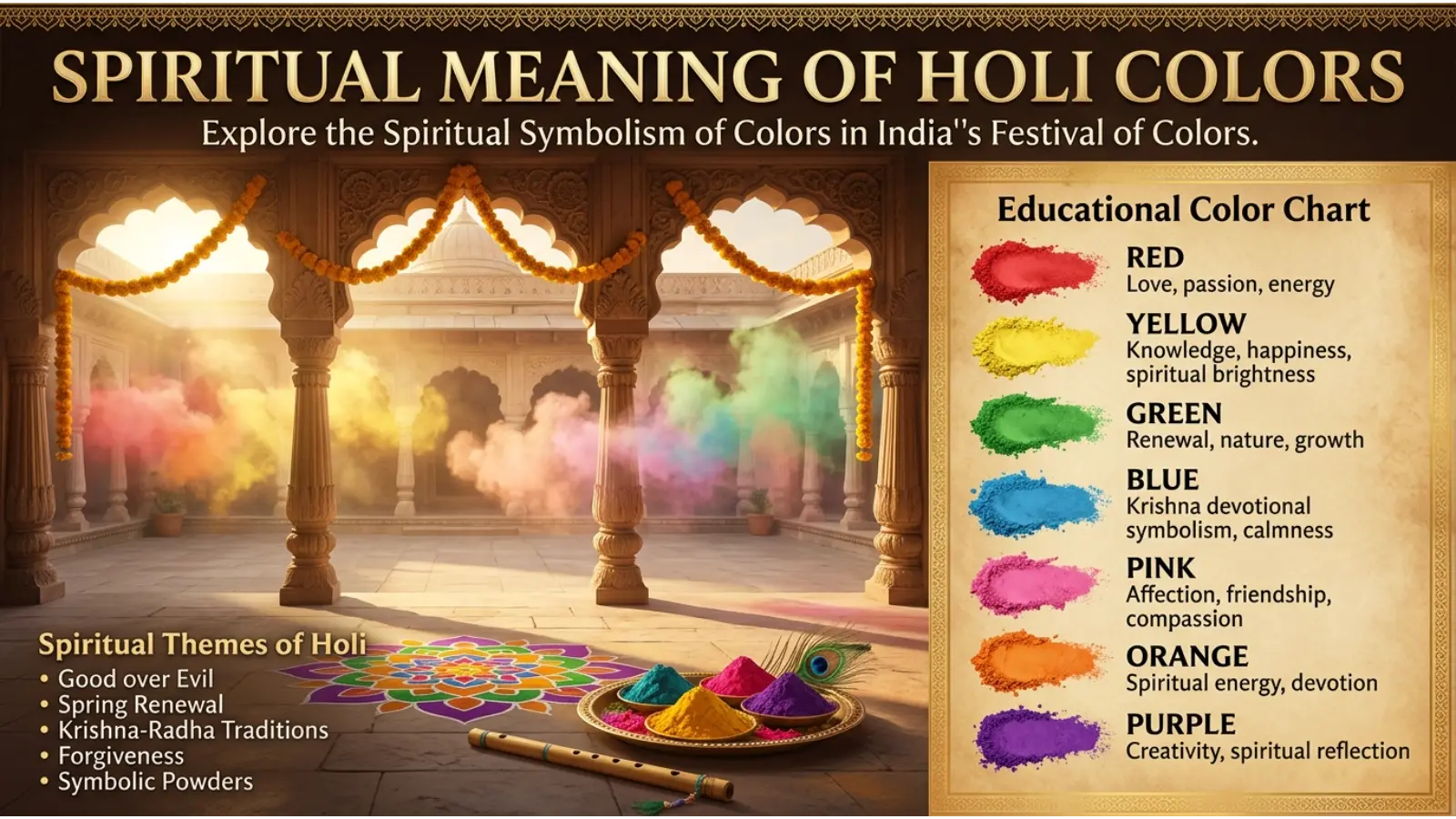
Holi has spiritual significance in many Hindu traditions. It is connected with devotion, the victory of good over evil, renewal, and the arrival of spring.
Nevertheless, there is no universal religious rule assigning one spiritual meaning to every Holi color.
Some commonly used symbolic interpretations include:
- 🟥 Red: Love, vitality, and auspicious celebration.
- 🟨 Yellow: Knowledge, warmth, and sacred associations.
- 🟦 Blue: Krishna, devotion, and divine symbolism.
- 🟩 Green: Renewal, nature, and growth.
- 🩷 Pink: Affection, kindness, and friendship.
- 🟪 Purple: Creativity and modern artistic expression.
- 🟧 Orange: Spiritual dedication and energy.
These interpretations reflect a mixture of religious imagery, cultural traditions, and contemporary symbolism.
Regional Differences in Holi Color Traditions
Holi is celebrated in different ways across India and Nepal. Although colored powders are widely recognized, local customs influence the festival’s appearance and meaning.
Braj Region: Mathura and Vrindavan
Main association: Krishna and Radha traditions\
Mathura and Vrindavan are especially famous for Krishna-related Holi celebrations.
The region includes several distinctive traditions, such as Lathmar Holi in Barsana and Nandgaon. These celebrations include playful rituals, songs, and large gatherings.
Colors here are closely connected with devotional stories and the cultural heritage of Braj.
Rajasthan
Main association: Royal heritage and community celebration\
In Rajasthan, Holi celebrations often combine bright colors, traditional music, folk performances, and community gatherings.
Local practices vary between cities and villages. Some celebrations also include processions and cultural performances.
West Bengal
Main association: Basanta Utsav and spring celebrations\
In Santiniketan, Basanta Utsav is associated with spring, music, dance, and colorful clothing.
Yellow often appears prominently in clothing and decoration because of its connection with spring and warmth.
Nepal
Main association: Community gatherings and Fagu Purnima\
Holi is widely celebrated in Nepal under the name Fagu Purnima.
People enjoy colored powder, music, family gatherings, and festive activities. The celebration takes place on different dates in the hill and Terai regions according to the local calendar.
Punjab and Northern India
Main association: Community celebration and Hola Mohalla\
In Punjab, Holi-related festive culture also includes Hola Mohalla, a distinct Sikh festival associated with Anandpur Sahib.
It features martial arts displays, processions, devotional activities, and community gatherings. It should not be confused with ordinary Holi color celebrations, even though the two festivals occur around the same period.
Traditional Holi Colors in Art and Decoration
Holi colors provide inspiration for paintings, posters, textiles, and decorative designs.
Artists often use bright shades to communicate movement, happiness, and celebration.
Holi Color Themes for Home Decoration
| Color Theme | Suggested Use | Overall Appearance |
|---|---|---|
| 🟥 Red + Yellow | Festive wall decorations | Warm and energetic |
| 🟦 Blue + White | Table decorations | Fresh and balanced |
| 🟩 Green + Yellow | Floral arrangements | Natural and cheerful |
| 🩷 Pink + Purple | Party decorations | Playful and expressive |
| 🟧 Orange + Red | Festival entrance | Bold and vibrant |
For a balanced appearance, choose two main colors and one supporting shade. In addition, use white or neutral backgrounds to prevent the decoration from looking overcrowded.
Traditional Holi Colors in Fashion
Holi fashion combines comfort, bright colors, and traditional clothing.
White clothing is especially popular because colored powder creates visible patterns against a light background.
However, people also wear colorful kurtas, dupattas, sarees, and casual outfits.
Popular Holi Clothing Colors
- White: Creates a clean background for colored powder.
- Yellow: Reflects sunshine and spring.
- Pink: Creates a cheerful and friendly appearance.
- Blue: Offers a cool visual contrast.
- Green: Adds a fresh seasonal feeling.
Best Color Combinations for Holi Outfits
| Combination | Style Impression |
|---|---|
| 🟨 Yellow + White | Fresh and traditional |
| 🩷 Pink + White | Soft and cheerful |
| 🟦 Blue + White | Clean and balanced |
| 🟩 Green + Yellow | Natural and lively |
| 🟧 Orange + White | Bright and festive |
| 🟥 Red + Pink | Bold and expressive |
Choose comfortable fabrics that are easy to wash. Also, avoid expensive clothing because some commercial colors can leave permanent stains.
Traditional Holi Colors in Branding and Marketing
Holi creates a strong visual opportunity for businesses, especially during the spring festival season.
Brands often use bright colors in advertisements, product packaging, social media campaigns, and seasonal promotions.
Why Businesses Use Holi Colors
Red: Creates a bold festive impression and attracts attention.
Yellow: Suggests warmth, optimism, and happiness.
Blue: Offers a recognizable visual connection with Krishna-themed campaigns.
Green: Works well for spring, nature, and sustainability themes.
Pink: Creates a friendly and playful mood.
Orange: Adds energy and visual warmth.
Practical Marketing Examples
- Clothing brands can introduce colorful spring collections.
- Sweet shops can create festive packaging using yellow, pink, and orange.
- Event organizers can use colorful posters to advertise Holi gatherings.
- Beauty businesses can promote festival-inspired designs and accessories.
- Restaurants can introduce seasonal menus and festive decorations.
However, businesses should use cultural symbols respectfully. A successful campaign should understand the meaning of the festival rather than simply adding random bright colors.
Traditional Holi Colors in Photography and Social Media
Holi is highly visual, which makes it popular for photographs and short videos.
The movement of colored powder creates interesting shapes, textures, and contrasts.
Photography Tips
- Use natural daylight whenever possible.
- Choose a simple background to make colors stand out.
- Capture colored powder in motion for dramatic photographs.
- Use contrasting colors to create visual interest.
- Keep camera equipment protected from powder and water.
For social media designs, use clear typography and avoid placing text over busy color patterns.
A white background with colorful powder effects can make festival posters easier to read.
Traditional Holi Colors and Their Use in Everyday Life
The symbolism of Holi colors can also inspire everyday creative choices.
| Everyday Area | Suitable Colors | Why They Work |
|---|---|---|
| Home decoration | 🟩 Green, 🟨 Yellow | Fresh and welcoming |
| Party planning | 🟥 Red, 🟧 Orange | Energetic appearance |
| Fashion | 🩷 Pink, 🟦 Blue | Expressive combinations |
| Art projects | 🟪 Purple, 🟥 Red | Creative contrast |
| Spring displays | 🟩 Green, 🟨 Yellow | Seasonal connection |
| Marketing | Multiple bright shades | Strong visual attention |
These are design suggestions based on common color associations. They are not strict rules.
How to Choose Safe Holi Colors
The quality of Holi powder matters just as much as its appearance.
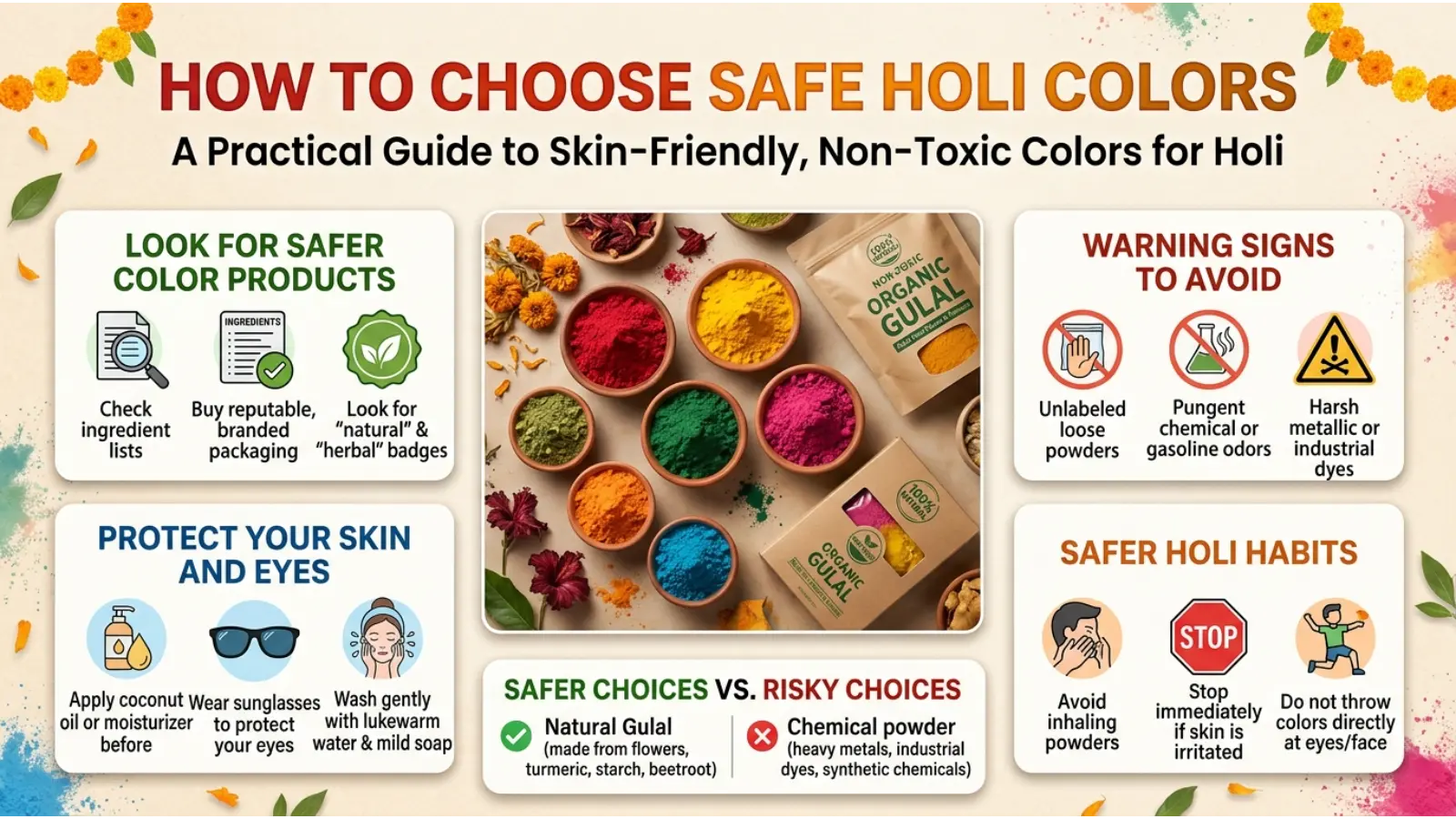
Some commercial powders may contain unwanted chemicals, artificial dyes, or irritating ingredients. Therefore, choose products carefully.
Tips for Safer Holi Celebrations
- Buy colors from sellers who provide clear ingredient information.
- Prefer products specifically made for skin contact.
- Avoid powders with a strong chemical smell.
- Do not apply powder near the eyes, nose, or mouth.
- Avoid throwing powder directly into someone’s face.
- Test a small amount on the skin first.
- Stop using a product if irritation develops.
- Keep children away from unknown powders.
- Avoid using industrial dyes, paints, or construction pigments.
Natural colors can also trigger allergies. Therefore, always consider skin sensitivity rather than assuming every plant-based powder is harmless.
Are Organic Holi Colors Better?
Organic or plant-based colors can be a useful choice when they come from reliable manufacturers and have clear ingredient information.
However, the word organic alone does not guarantee safety.
Check the product label, manufacturer details, and intended use before purchasing.
Common Misconceptions About Traditional Holi Colors
Several misunderstandings surround the meanings and origins of Holi colors.
Myth 1: Every Holi Color Has an Official Religious Meaning
Fact: Holi colors have many cultural and symbolic associations, but there is no universally accepted religious chart assigning a fixed meaning to every shade.
Myth 2: Purple Is One of the Ancient Required Holi Colors
Fact: Purple is popular in modern celebrations, but it is not a universally established ancient religious requirement.
Myth 3: All Traditional Holi Colors Were Made From the Same Materials
Fact: Different communities used different local flowers, plants, and ingredients. Preparation methods varied.
Myth 4: Every Color Creates the Same Emotion in Everyone
Fact: Color perception depends on personal experience, culture, surroundings, and context.
Myth 5: Natural Colors Are Always Completely Safe
Fact: Some natural ingredients can still irritate the skin or cause allergic reactions.
Myth 6: Holi Is Celebrated Only With Colored Powder
Fact: Holi also includes bonfires, devotional traditions, food, music, dancing, family gatherings, and regional customs.
Frequently Asked Questions About Traditional Holi Colors
1. What are the traditional colors of Holi?
The most popular Holi colors include red, yellow, blue, green, pink, and orange. Purple is also widely used in modern celebrations. Each color has different cultural and symbolic associations.
2. What does red color mean in Holi?
Red commonly represents love, passion, vitality, and celebration. It also has important associations with auspicious occasions and traditional Indian ceremonies.
3. Why is yellow used during Holi?
Yellow is associated with sunshine, happiness, warmth, knowledge, and auspiciousness. It also connects with turmeric, which has a long history in Indian cultural and religious practices.
4. What does blue color represent in Holi?
Blue is strongly associated with Lord Krishna in Hindu art and devotional traditions. It can also represent spirituality, devotion, calmness, and divine symbolism.
5. What does green color symbolize during Holi?
Green commonly represents nature, growth, renewal, and harmony. Its connection with fresh leaves and spring makes it suitable for the seasonal celebration.
6. Why do people use different colors during Holi?
Different colors make the celebration visually exciting and provide a way to express happiness, friendship, and togetherness. They also reflect springtime and regional cultural traditions.
7. What are natural traditional Holi colors made from?
Traditional natural colors can be prepared using ingredients such as turmeric, palash flowers, and other locally available plant materials. Modern products also use manufactured pigments and dyes.
8. Which color is most important in Holi?
There is no single color that is officially the most important across all Holi traditions. Red, yellow, blue, green, and other bright shades all have recognizable cultural and festive associations.
9. Are traditional Holi colors safe for skin?
Not all Holi colors are safe. Some powders may contain irritating ingredients or harmful contaminants. Choose products designed for skin contact, check their ingredients, and avoid unknown powders.
10. Why do people wear white clothes during Holi?
White clothing provides a clear background for colored powder. As people apply different shades, the clothes develop colorful patterns that make the celebration more visually exciting.
Conclusion: The Meaning Behind Traditional Holi Colors
Traditional Holi colors represent much more than bright powder. They connect the festival with spring, friendship, devotion, happiness, and cultural heritage.
Red expresses love and celebration, yellow reflects warmth and positivity, blue connects with Krishna, and green represents nature and renewal. Meanwhile, pink, purple, and orange add their own modern and cultural expressions to the festivities.
However, the beauty of Holi lies in the way people celebrate together. Colors become meaningful through traditions, stories, relationships, and shared experiences.
The next time you see a cloud of colorful gulal, remember that every shade can tell a different story. Together, they reflect the joyful spirit of Holi and the many traditions that make this festival special.
Remove duplicated title and tighten the introduction

Emma Wilson is a dedicated comparison writer and product researcher at ColorMystiic.com. She specializes in creating unbiased product comparisons, detailed reviews, and helpful buying guides. Her goal is to help readers make smarter purchasing decisions with confidence.