Colors have a special place in Vietnamese Color Meanings culture. They appear in traditional clothing, weddings, festivals, religious ceremonies, architecture, art, and everyday life. However, their meanings often go much deeper than their appearance. A particular color can express happiness, respect, wealth, sadness, spiritual beliefs, or national identity.
Understanding Vietnamese color meanings requires looking at the country’s history, traditions, beliefs, and changing lifestyle. For example, red is widely associated with happiness and good fortune, while yellow has connections with prosperity and imperial power. White, on the other hand, is traditionally connected with mourning and remembrance.
However, these meanings are not always universal. The same color can communicate different ideas depending on the occasion, region, historical period, and cultural setting.
In this complete guide, we explore the symbolism of Vietnamese colors, their psychological associations, historical importance, spiritual interpretations, and modern applications. You will also discover how Vietnamese colors influence fashion, interior design, branding, celebrations, and everyday visual culture.
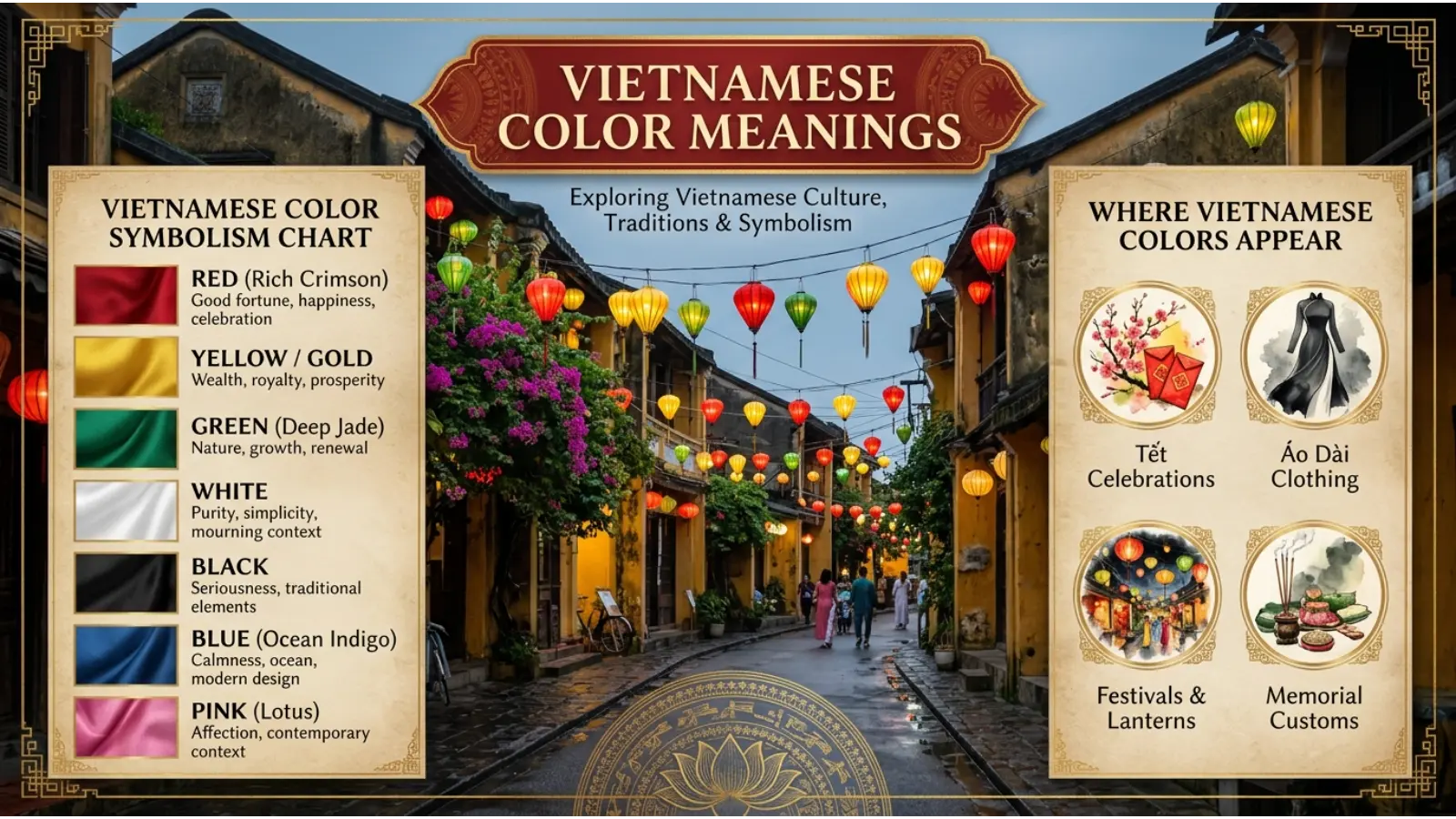
Quick Answer: What Do Colors Mean in Vietnamese Culture?
Vietnamese colors carry cultural, historical, and symbolic meanings.
| Color | Common Vietnamese Meaning |
|---|---|
| 🔴 Red | Happiness, good fortune, celebration, strength, and prosperity |
| 🟡 Yellow | Wealth, royalty, abundance, and imperial authority |
| ⚪ White | Mourning, remembrance, purity, and simplicity |
| ⚫ Black | Water symbolism, mystery, seriousness, and sometimes misfortune |
| 🟢 Green | Nature, growth, freshness, and vitality |
| 🔵 Blue | Calmness, nature, and associations with the Wood element in some traditional systems |
| 🟣 Purple | Loyalty, affection, dignity, and gratitude in certain traditional contexts |
These meanings are influenced by Vietnamese traditions, the five-element philosophy, historical clothing customs, and modern culture.
What Do Colors Symbolize in Vietnamese Culture?
Vietnamese color symbolism developed through centuries of cultural exchange, traditional philosophy, religious practices, and local customs.
One important influence is the Five Elements philosophy, commonly known as Ngũ Hành. It connects five natural elements with colors, directions, and other parts of the universe.
The five elements are:
- Wood
- Fire
- Earth
- Metal
- Water
Rather than treating colors as separate decorations, this philosophy views them as part of a connected natural system.
Additionally, Vietnamese traditions include influences from Buddhism, Confucianism, Taoism, and indigenous folk beliefs. Therefore, color meanings can change depending on the tradition being followed.
The Five Elements and Traditional Vietnamese Color Meanings
The Five Elements philosophy is one of the most interesting ways to understand traditional Vietnamese color symbolism.
Each element has a corresponding color and direction. These relationships appear in traditional cosmology, ceremonial objects, decorative practices, and cultural traditions.
Vietnamese Five Elements Color Chart
| Element | Traditional Color | Direction | Symbolic Associations |
|---|---|---|---|
| 🔥 Fire (Hỏa) | Red | South | Energy, happiness, strength |
| 🌍 Earth (Thổ) | Yellow | Center | Stability, prosperity, abundance |
| ⚪ Metal (Kim) | White | West | Clarity, purity, reflection |
| 💧 Water (Thủy) | Black | North | Depth, wisdom, adaptability |
| 🌳 Wood (Mộc) | Green or blue-green | East | Growth, renewal, vitality |
These associations are part of a traditional philosophical framework. They should not be confused with modern scientific explanations of color or with a universal set of Vietnamese beliefs.
For example, traditional five-element arrangements can use different shades and interpretations. Moreover, five-color festival decorations and religious objects may have their own specific meanings.
A beautiful example is xôi ngũ sắc, a traditional five-color sticky rice dish associated with ethnic communities in Vietnam’s northern mountainous regions. Its colors represent the five elements and express harmony, abundance, and gratitude.
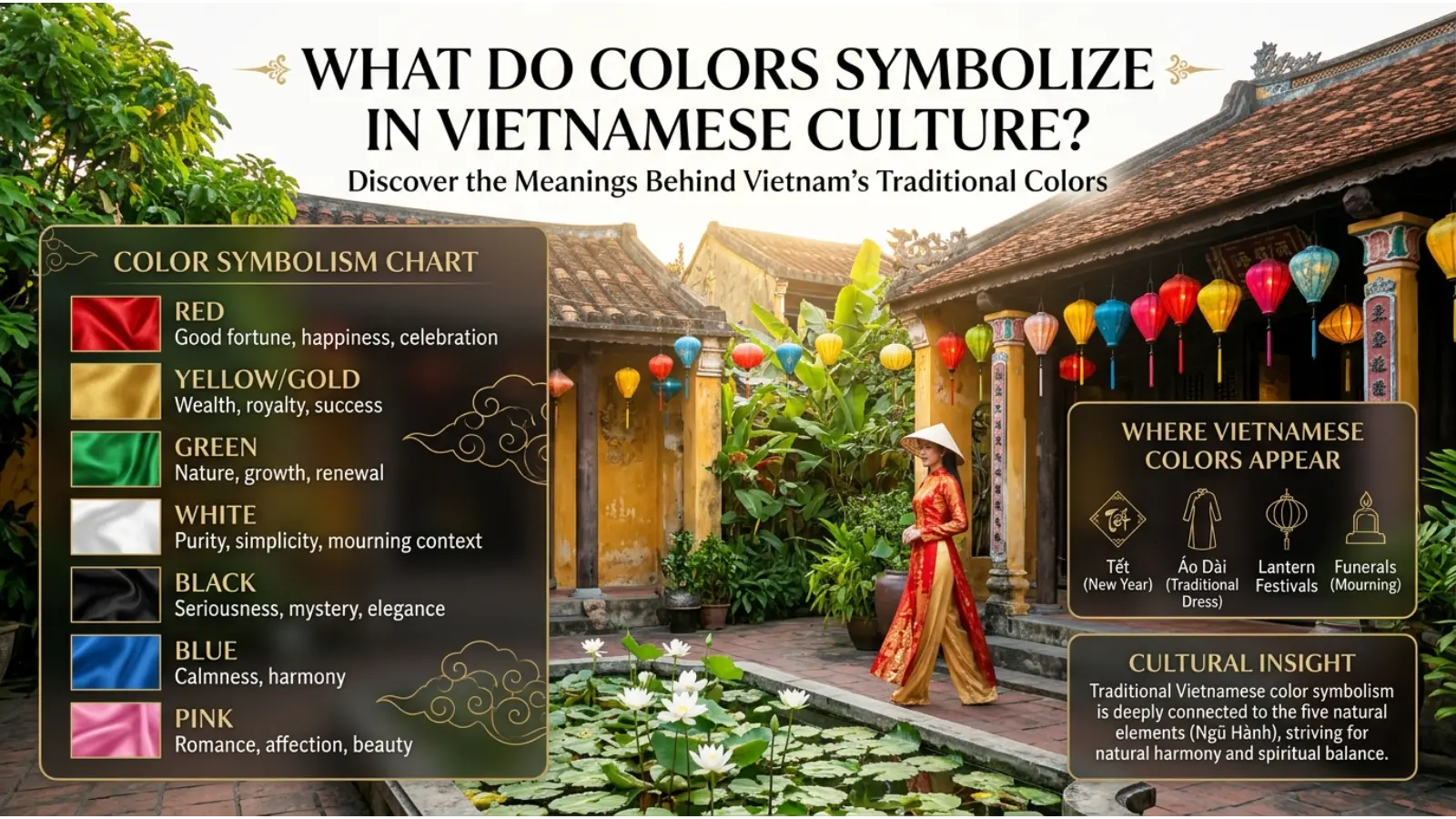
Red Color Meaning in Vietnamese Culture
Vietnamese red (Đỏ): Happiness, good fortune, and celebration.
Red is among the most recognizable colors in Vietnamese celebrations. It represents happiness, prosperity, positive energy, and good wishes.
Red has a strong connection with important life events. You can see it in wedding decorations, traditional clothing, festival ornaments, and Lunar New Year celebrations.
Red in Vietnamese Weddings
Red is a popular choice for traditional Vietnamese wedding clothing and decorations.
Brides and grooms may wear red áo dài because the color expresses wishes for a happy marriage, good fortune, and a prosperous future.
Furthermore, red decorations create a warm and festive atmosphere.
Red in Festivals and Celebrations
During Tết, red appears in lanterns, decorations, greeting cards, and festive displays.
People use it to express positive wishes for the coming year. In addition, red creates a strong visual contrast with gold and yellow, making celebrations feel bright and welcoming.
Positive and Negative Associations of Red
| Positive Meaning | Possible Negative Meaning |
|---|---|
| Happiness | Danger |
| Good fortune | Warning |
| Love | Aggression |
| Strength | Anger |
| Prosperity | Excessive intensity |
Although red has strong positive associations in traditional celebrations, its meaning can change in traffic signs, political imagery, and warning messages.
Yellow Color Meaning in Vietnamese Culture
Vietnamese yellow (Vàng): Prosperity, wealth, and imperial history.
Yellow has a particularly interesting history in Vietnam.
During different Vietnamese dynasties, yellow clothing was closely connected with imperial status. Royal garments, especially those associated with emperors, used yellow and golden shades to communicate authority and high social position.
Historical research also documents restrictions on ordinary people wearing yellow garments during certain periods. However, these rules did not mean that every Vietnamese person viewed yellow in exactly the same way.
Yellow as a Symbol of Wealth
In modern Vietnamese visual culture, yellow and gold are frequently used to suggest:
- Financial success
- Prosperity
- Abundance
- Celebration
- Luxury
- Good fortune
For example, golden decorations are popular during Tết because they create a connection with wealth and positive expectations for the new year.
Yellow in Traditional Clothing
Yellow áo dài can create an elegant and traditional appearance.
Depending on the shade, it can communicate warmth, refinement, celebration, and cultural pride.
Golden yellow is particularly effective for formal occasions because it attracts attention without requiring complicated decoration.
White Color Meaning in Vietnamese Culture
Vietnamese white (Trắng): Mourning, remembrance, purity, and simplicity.
White is one of the most interesting examples of how cultural background changes color symbolism.
In many Western traditions, white is associated with weddings, innocence, and purity. However, traditional Vietnamese funeral customs give white a different meaning.
White in Vietnamese Funerals
White clothing and white mourning headbands have traditionally been worn by family members during funeral ceremonies.
These garments express grief, respect, and remembrance.
The practice has a long history. Research on Vietnamese clothing traditions documents white mourning garments during the Later Lý dynasty (1009–1225).
Does White Also Represent Purity?
Yes. White can also suggest simplicity, clarity, cleanliness, and purity in appropriate settings.
However, it is important not to assume that white always communicates happiness or innocence in Vietnam.
For example, a white garment worn at a funeral has a different cultural message from a white shirt worn at work.
Practical lesson: When choosing white for Vietnamese cultural events, consider the occasion before deciding what the color communicates.
Black Color Meaning in Vietnamese Culture
Vietnamese black (Đen): Water, mystery, depth, and seriousness.
Black has several meanings depending on how it is used.
Within traditional five-element symbolism, black is connected with water. Water represents movement, depth, and adaptability.
However, black also appears in traditional clothing, art, and contemporary fashion.
Black in Traditional Clothing
Black fabrics have been used in Vietnamese clothing for their practical and visual qualities.
They can create a simple, modest, and elegant appearance. Moreover, black works well with brighter colors, especially red, yellow, and white.
Black in Modern Culture
Today, black is widely used in formal clothing, business fashion, and product design.
It can communicate sophistication, authority, professionalism, mystery, strength, and simplicity.
Nevertheless, traditional expressions and beliefs can associate black with bad luck or negative situations. Therefore, its interpretation depends heavily on context.
Green Color Meaning in Vietnamese Culture
Vietnamese green (Xanh lá cây): Nature, growth, freshness, and renewal.
Vietnam’s natural environment makes green an important visual part of everyday life.
Rice fields, tropical forests, gardens, and mountain landscapes create a strong connection between green and nature.
Green and Agriculture
Rice farming has played a major role in Vietnamese history and daily life.
Consequently, green rice plants can suggest fertility, seasonal growth, and the promise of future harvests.
Green also appears in traditional food. For example, green sticky rice, known as cốm, is a well-known Vietnamese specialty associated with young rice.
Green in the Five Elements System
Green and blue-green shades are associated with Wood in traditional Five Elements symbolism.
Wood represents growth, development, and renewal.
Therefore, green can work as a visual symbol of life and natural balance.
Modern Green Symbolism
Today, green is also used to communicate environmental awareness, sustainability, health, and responsible business practices.
However, these modern meanings should be separated from older traditional beliefs.
Blue Color Meaning in Vietnamese Culture
Vietnamese blue (Xanh dương): Calmness, nature, and traditional craftsmanship.
Blue is an interesting color because Vietnamese language and traditional color systems do not always divide blue and green in the same way as English.
The word xanh, for example, can describe different blue and green shades depending on the expression.
This linguistic detail matters when studying Vietnamese color meanings because translating a color word directly into English may not fully communicate its cultural meaning.
Blue in Traditional Clothing
Blue and indigo fabrics have an important place in Vietnamese textile traditions.
These fabrics can express local identity, traditional craftsmanship, and cultural heritage.
Blue in Modern Design
In modern settings, blue is commonly associated with calmness, reliability, stability, freshness, and professionalism.
It is also popular in business clothing and contemporary branding because it creates a controlled and balanced appearance.
Purple Vietnamese Color Meanings Culture
Vietnamese purple (Tím): Loyalty, affection, dignity, and emotional depth.
The Purple has a distinctive place in Vietnamese clothing and visual culture.
Purple in Traditional Clothing
Purple áo dài can create an elegant and graceful appearance.
The color is often selected for its rich visual character. Lighter purple shades can feel gentle and romantic, while darker purple creates a more formal impression.
Purple in Traditional Five-Color Foods
Purple also appears in xôi ngũ sắc, where it is associated with loyalty, affection, and gratitude in certain cultural explanations.
However, purple does not have one fixed spiritual meaning across every Vietnamese community.
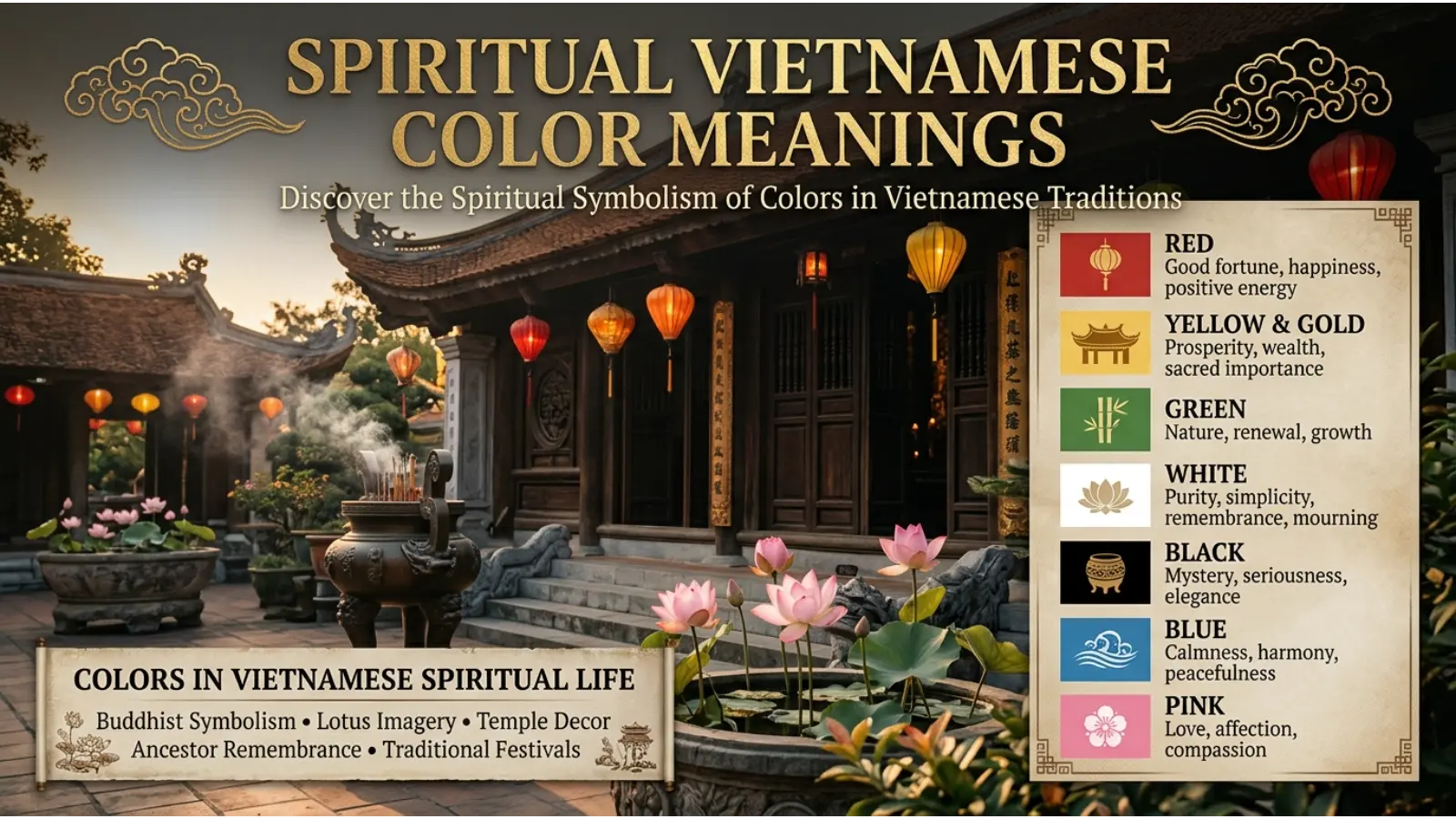
Spiritual Vietnamese Color Meanings
Vietnamese spiritual color symbolism is connected with several traditions rather than one single belief system.
Buddhist practices, Taoist philosophy, Confucian influences, and Vietnamese folk traditions have all contributed to the ways people use colors in ceremonies and spiritual settings.
The Five Elements system is particularly important.
Red: Positive Energy and Celebration
Red is associated with fire and can represent warmth, energy, strength, and good fortune.
It appears in various celebrations and ceremonial decorations.
Yellow: Prosperity and Importance
Yellow has historical associations with imperial authority and can also communicate wealth, abundance, and respect.
White: Remembrance and Reflection
White has a traditional role in mourning and funeral customs.
It can also represent simplicity and purity in other settings.
Black: Water and Depth
Black is associated with water in Five Elements symbolism.
Water can represent movement, depth, and adaptability.
Green: Growth and Renewal
Green is connected with Wood and natural growth.
It can communicate renewal, life, and development.
Five-Color Spiritual Decorations
Five-color decorations are used in some Vietnamese festivals and religious practices.
They can represent harmony between the Five Elements and the natural world.
Historical Vietnamese Color Meanings
Vietnamese color symbolism has developed through different historical periods.
Its history reflects changes in government, religion, clothing, trade, and cultural identity.
Colors During Imperial Vietnam
During the imperial period, clothing colors could communicate social position and ceremonial importance.
Yellow was particularly associated with imperial authority.
Royal clothing also used different combinations of colors, patterns, and decorative details to communicate rank.
Historical clothing regulations show that colors were sometimes controlled by the ruling class rather than freely selected for personal style.
Chinese Cultural Influence
Vietnamese color traditions were influenced by exchanges with Chinese philosophical and cultural systems.
The Five Elements philosophy and five-color model became important parts of Vietnamese cultural symbolism.
However, Vietnamese communities adapted these ideas in their own ways.
Colors During the Nguyễn Dynasty
The Nguyễn dynasty (1802–1945) is an important period in the history of Vietnamese ceremonial clothing.
Yellow dragon robes and other imperial garments expressed royal authority.
Clothing colors, fabric quality, and decorative patterns helped distinguish different positions within the imperial court.
Colors in Modern Vietnam
Today, traditional meanings exist alongside modern fashion, international branding, entertainment, and contemporary design.
Red and yellow, for example, are especially recognizable in national symbolism.
Vietnamese National Flag Color Meanings
The Vietnamese national flag is one of the most recognizable examples of color symbolism in modern Vietnam.
It has a red background with a yellow five-pointed star in the center.
What Does Red Represent?
Red is associated with revolution and the struggle for independence.
It reflects the country’s revolutionary history and the sacrifices made during its struggle.
What Does the Yellow Star Represent?
The yellow star represents national unity.
- Workers
- Peasants
- Soldiers
- Intellectuals
- Youth
Together, the colors create a powerful national symbol.
It is important to distinguish these national meanings from the older traditional symbolism of red and yellow.
Cultural Differences in Vietnamese Color Meanings
Color meanings are not identical across cultures.
A color that represents happiness in one country may communicate mourning or danger somewhere else.
Vietnamese traditions offer several interesting examples.
Red: Vietnamese and Western Interpretations
In Vietnamese celebrations, red is strongly connected with happiness and good fortune.
White: Vietnamese and Western Interpretations
White traditionally has an important mourning association in Vietnam.
In many Western wedding traditions, however, white represents purity and innocence.
This difference is particularly important for international wedding planners and fashion businesses.
Yellow: Vietnamese and Other Asian Interpretations
Yellow has historical connections with Vietnamese imperial authority.
In other Asian traditions, yellow can also symbolize royalty, wealth, or religious significance.
However, the exact meaning varies between countries and communities.
Black: Different Cultural Associations
Black can communicate sophistication and authority in modern fashion.
At the same time, traditional expressions may associate it with misfortune or negative situations.
Regional and Community Differences
Vietnam is culturally diverse.
Ethnic minority communities have their own clothing traditions, ceremonial practices, and textile designs.
For example, northern mountainous communities have distinctive indigo-dyeing and five-color food traditions.
Therefore, a single color chart cannot explain every Vietnamese community’s beliefs.
Personality Associations of Vietnamese Colors
People sometimes connect their favorite colors with personality traits.
These associations can be interesting for personal reflection. However, there is no reliable basis for using a person’s favorite color to determine their personality.
Here are some common symbolic associations.
| Favorite Color | Common Personality Association |
|---|---|
| 🔴 Red | Energetic, confident, outgoing |
| 🟡 Yellow | Optimistic, creative, cheerful |
| ⚪ White | Simple, organized, peaceful |
| ⚫ Black | Independent, serious, sophisticated |
| 🟢 Green | Natural, balanced, thoughtful |
| 🔵 Blue | Calm, reliable, reflective |
| 🟣 Purple | Creative, imaginative, expressive |
These are cultural and design associations, not scientifically established personality tests.
For example, someone who prefers black clothing may simply enjoy its versatility rather than identify with mystery or authority.
Similarly, a person who likes green may appreciate nature without having a particular personality type.
Vietnamese Colors in Branding and Marketing
Color plays an important role in business communication.
Vietnamese brands, restaurants, clothing companies, hotels, and product manufacturers use colors to create recognizable identities.
However, successful color selection requires understanding both the product and the intended audience.
Red in Marketing
Red is a useful choice for products connected with Tết celebrations, weddings, festive gifts, food packaging, and special promotions.
Its cultural associations with happiness and good fortune make it particularly suitable for celebratory products.
Yellow in Luxury Branding
Yellow and gold can create a feeling of prestige, value, and celebration.
They are often used in premium gift packaging, hotels, restaurants, and decorative products.
However, too much bright yellow can make a design visually overwhelming.
Green in Environmental Branding
Green is useful for brands communicating natural ingredients, environmental responsibility, and sustainability.
For example, a Vietnamese agricultural business might use green to connect its identity with fresh produce and farming.
Blue in Professional Branding
Blue can create a calm and professional visual identity.
It is useful for technology companies, financial services, education businesses, and corporate communication.
Black in Premium Products
Black works well for luxury packaging, fashion, electronics, and premium services.
It creates strong contrast and can make a product appear refined.
Choosing the Right Brand Colors
| Business Type | Suitable Color Choices | Visual Message |
|---|---|---|
| Wedding business | 🔴 Red + 🟡 Gold | Celebration |
| Organic products | 🟢 Green + ⚪ White | Natural and fresh |
| Luxury hotel | ⚫ Black + 🟡 Gold | Premium and elegant |
| Technology | 🔵 Blue + ⚪ White | Professional |
| Traditional restaurant | 🔴 Red + 🟡 Gold | Warm and festive |
| Wellness business | 🟢 Green + 🔵 Blue | Calm and natural |
A brand should also consider readability, cultural expectations, and how its colors appear on mobile screens and printed packaging.
Vietnamese Colors in Interior Design
Color choices can change how a room looks and feels.
Vietnamese interior design often combines natural materials, traditional decoration, modern furniture, and cultural elements.
The best color depends on the room’s size, lighting, furniture, and intended atmosphere.
Red in Living Rooms
Red can create warmth and visual energy.
However, a completely red living room may feel overwhelming.
Instead, use red in decorative cushions, wall artwork, lanterns, small furniture details, and traditional ornaments.
Pairing red with beige or natural wood creates a more balanced appearance.
Yellow in Living Rooms and Dining Areas
Yellow creates a warm and welcoming visual effect.
Golden decorative pieces can also introduce a traditional Vietnamese feeling.
For a comfortable interior, consider combining yellow with cream, brown, or natural wood.
White in Bedrooms
White can make a small bedroom feel more spacious and bright.
It works particularly well with wooden furniture, soft lighting, and neutral fabrics.
However, remember that white has traditional mourning associations in Vietnam. This does not make it unsuitable for modern interiors, but it is worth considering when designing culturally specific spaces.
Green in Offices
Green can introduce a natural atmosphere into a workspace.
Indoor plants, green furniture, and subtle wall accents are practical options.
Furthermore, green works well with light wood and white surfaces.
Blue in Relaxing Spaces
Blue is a popular choice for bedrooms and quiet working areas.
Lighter shades can create an open and peaceful visual atmosphere.
Meanwhile, dark blue can make a room feel more formal.
Interior Color Combination Chart
| Room | Recommended Combination | Design Effect |
|---|---|---|
| Living room | 🔴 Red + Beige | Warm and welcoming |
| Bedroom | 🔵 Blue + ⚪ White | Calm and simple |
| Kitchen | 🟡 Yellow + ⚪ White | Bright and cheerful |
| Office | 🟢 Green + Natural Wood | Fresh and balanced |
| Dining room | 🔴 Red + 🟡 Gold | Festive and traditional |
| Luxury room | ⚫ Black + 🟡 Gold | Elegant and refined |
Lighting matters: A yellow wall may look golden under warm lighting but appear dull under cool lighting. Therefore, test paint samples during both daytime and evening before decorating an entire room.
Vietnamese Colors in Fashion
Fashion is one of the strongest expressions of Vietnamese color culture.
Traditional garments, especially the áo dài, demonstrate how colors can communicate identity, elegance, and cultural heritage.
Red Áo Dài
Red áo dài is a popular choice for weddings, celebrations, and special events.
It creates a bold appearance and communicates festive energy.
Yellow Áo Dài
Yellow áo dài can create an elegant and radiant look.
Gold and softer yellow shades are often suitable for formal celebrations.
White Áo Dài
White áo dài is a recognizable part of Vietnamese visual culture, particularly in modern school and youth imagery.
Nevertheless, it is important to distinguish everyday clothing from traditional funeral garments and their associated meanings.
Purple Áo Dài
Purple is particularly associated with the visual identity of Huế.
It creates a graceful appearance and works well with traditional fabrics and delicate accessories.
Blue Áo Dài
Blue áo dài offers a versatile style.
Light blue can feel gentle and fresh, while darker blue creates a more formal impression.
How to Combine Vietnamese Colors in Fashion
| Main Color | Good Combinations | Style |
|---|---|---|
| 🔴 Red | Gold, cream, black | Traditional and bold |
| 🟡 Yellow | White, brown, green | Warm and elegant |
| ⚪ White | Blue, red, beige | Clean and classic |
| ⚫ Black | Gold, white, red | Formal and modern |
| 🟢 Green | Cream, brown, gold | Natural and fresh |
| 🔵 Blue | White, silver, beige | Calm and refined |
| 🟣 Purple | White, silver, pink | Graceful and romantic |
When choosing an outfit for a Vietnamese cultural event, consider the occasion, local customs, and the meaning of the color rather than focusing only on fashion trends.
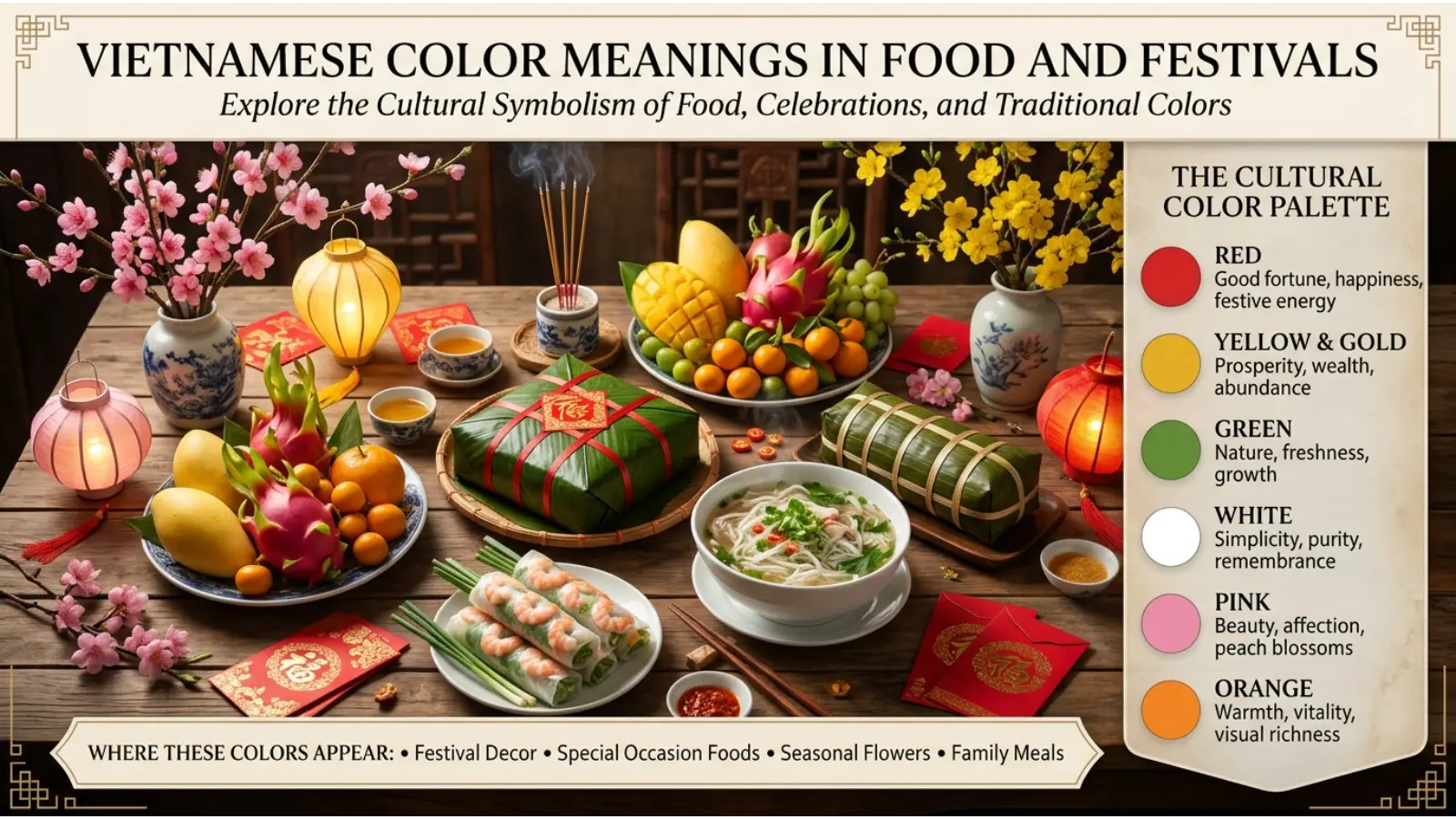
Vietnamese Color Meanings in Food and Festivals
Food is another important part of Vietnamese color culture.
Traditional dishes often use natural ingredients to create beautiful colors while maintaining cultural and seasonal significance.
Five-Color Sticky Rice (Xôi Ngũ Sắc)
Xôi ngũ sắc is a traditional dish especially associated with ethnic communities in northern mountainous Vietnam.
The dish uses different natural ingredients to create five colors.
Its colors commonly symbolize:
- 🔴 Red: Good fortune, positive energy, and strength.
- 🟡 Yellow: Wealth and abundance.
- 🟢 Green: Freshness, hope, and life.
- 🟣 Purple: Loyalty, affection, and gratitude.
- ⚪ White: Purity, clarity, and new beginnings.
Colors During Tết
Tết is one of the most important celebrations in Vietnam.
Red and yellow are particularly visible during this period.
Red decorations express happiness and good fortune, while yellow flowers and golden decorations create associations with wealth, warmth, and prosperity.
Some popular Tết decorations include:
- Red envelopes
- Yellow apricot blossoms
- Pink peach blossoms
- Golden ornaments
- Colorful lanterns
These decorations help create a festive environment and express positive wishes for the new year.
Vietnamese Color Meanings in Art and Photography
Vietnamese artists and photographers use color to communicate more than the appearance of a subject.
Colors can help express history, atmosphere, identity, and emotion.
Red in Traditional Art
Red can draw attention to important subjects.
It is useful for illustrating celebrations, festivals, traditional clothing, and ceremonial decorations.
Yellow in Historical Photography
Golden and yellow shades can emphasize imperial architecture, temples, historical objects, and traditional clothing.
They also create a warm visual atmosphere.
Green in Landscape Photography
Green is especially useful for capturing Vietnam’s natural landscapes.
Photographers often use it to highlight rice fields, forests, gardens, and rural environments.
Blue in Landscape Photography
Blue can emphasize water, skies, rivers, and coastal environments.
It also creates a visual contrast with green landscapes and traditional buildings.
Black and White Photography
Black-and-white photography can emphasize texture, facial expressions, architecture, and historical details.
It removes the influence of bright colors and allows viewers to focus on shapes and contrast.
Real-World Applications of Vietnamese Color Meanings
Vietnamese color symbolism has practical value beyond historical research.
It can help people make better choices in clothing, business, photography, marketing, and everyday decoration.
| Application | Useful Colors | Practical Purpose |
|---|---|---|
| Weddings | 🔴 Red and 🟡 Gold | Express celebration and good wishes |
| Tết decorations | 🔴 Red and 🟡 Yellow | Create a festive atmosphere |
| Traditional clothing | 🔵 Indigo, 🟣 Purple, 🔴 Red | Express cultural identity |
| Food presentation | Multiple colors | Show variety and cultural heritage |
| Business branding | 🔵 Blue, 🟢 Green, ⚫ Black | Communicate brand values |
| Home decoration | Natural colors and warm accents | Create a balanced environment |
| Photography | Contrasting colors | Highlight subjects and atmosphere |
| Art | Symbolic color combinations | Communicate emotion and cultural ideas |
| Sports | Team-specific colors | Build recognition and identity |
| Entertainment | Context-dependent colors | Establish mood and visual storytelling |
For designers and marketers, the most useful lesson is that cultural context should guide color selection. A color that works beautifully for a wedding advertisement may not be appropriate for a funeral-related service.
Why Do Vietnamese Color Meanings Change?
There is no single reason why people interpret colors differently.
Instead, several factors influence their meanings.
Historical Background
Vietnam’s historical experiences have shaped its color traditions.
For example, yellow’s association with imperial authority developed through historical court customs.
Religious and Philosophical Beliefs
The Five Elements system, Buddhist practices, Taoist influences, and local beliefs have contributed to traditional symbolism.
Language
Vietnamese color words do not always match English color categories.
The word xanh is a useful example because it can describe shades that English speakers would call blue or green.
Age and Generation
Older and younger generations may have different experiences with traditional clothing, ceremonies, fashion, and international media.
Therefore, a younger Vietnamese consumer may interpret a particular color through modern fashion, while an older person may connect it with a traditional custom.
Region and Community
Vietnam has many regional and ethnic traditions.
Consequently, a color’s meaning in one community may not be identical to its meaning elsewhere.
Occasion
Perhaps the most important factor is the situation.
Red at a wedding communicates celebration, while red on a warning sign communicates danger.
The color remains the same, but its visual message changes.
How Lighting Changes Vietnamese Colors
Color does not always look the same under different lighting conditions.
A fabric that appears bright yellow outdoors may look golden under warm indoor lights.
Similarly, a dark blue áo dài may appear almost black in photographs taken with poor lighting.
Here are some practical examples:
| Color | Natural Daylight | Warm Lighting | Cool Lighting |
|---|---|---|---|
| 🔴 Red | Bright and clear | Rich and warm | More intense |
| 🟡 Yellow | Fresh and vivid | Golden | Sometimes pale |
| ⚪ White | Clean and neutral | Creamy | Slightly blue |
| ⚫ Black | Deep and clear | Softer | Sharper |
| 🟢 Green | Natural | Warmer | Cooler |
| 🔵 Blue | Balanced | Slightly muted | Brighter |
| 🟣 Purple | Rich | Warmer | Cooler |
This is why fashion designers, photographers, and interior decorators test colors under different lighting conditions.
Common Misconceptions About Vietnamese Color Meanings
Several misunderstandings can make Vietnamese color symbolism seem simpler than it really is.
Misconception 1: Red Always Means Good Luck
Red is strongly associated with good fortune during celebrations.
However, it can also represent danger, warnings, anger, and political symbolism.
Misconception 2: White Is Always a Symbol of Purity
White has traditional connections with mourning in Vietnam.
Although it can represent cleanliness and purity in other settings, the occasion matters.
Misconception 3: Yellow Has Always Been Reserved for the Emperor
Yellow had important imperial associations, and clothing restrictions existed during particular historical periods.
Nevertheless, ordinary Vietnamese people also wore yellow garments, sometimes despite official restrictions.
Misconception 4: All Vietnamese People Follow the Same Color Traditions
Vietnam is culturally diverse.
Regional customs, ethnic traditions, family practices, and personal preferences all influence color choices.
Misconception 5: The Five Elements Explain Every Vietnamese Color
The Five Elements system is influential, but it does not explain every color tradition.
Fashion, language, religion, history, nature, and modern society also shape color meanings.
Misconception 6: Color Psychology Is the Same as Traditional Symbolism
Traditional symbolism comes from cultural beliefs and historical practices.
Color psychology studies how people perceive and respond to colors.
Although these subjects can overlap, they are not the same thing.
Frequently Asked Questions About Vietnamese Color Meanings
1. What is the most important color in Vietnamese culture?
Red and yellow are among the most recognizable colors in Vietnamese culture. Red is strongly connected with happiness and good fortune, while yellow has historical associations with wealth and imperial authority.
2. What does red mean in Vietnam?
Red commonly represents happiness, luck, celebration, prosperity, and positive energy. It is especially popular during weddings and Tết celebrations.
3. What does yellow symbolize in Vietnamese culture?
Yellow is associated with wealth, abundance, prosperity, and historical royal authority. Golden shades are also popular in festive decorations.
4. Why is white associated with mourning in Vietnam?
White has a traditional role in Vietnamese funeral customs. Family members may wear white clothing or mourning headbands to express grief and respect for deceased relatives.
5. What does black mean in Vietnamese culture?
Black is associated with water in the Five Elements system. It can also represent mystery, seriousness, elegance, and sometimes misfortune.
6. What does green symbolize in Vietnam?
Green is associated with nature, agriculture, growth, and renewal. It also connects with the Wood element in traditional five-element symbolism.
7. What does purple mean in Vietnamese culture?
Purple can symbolize loyalty, affection, gratitude, and dignity. It also has strong visual associations with traditional clothing and the city of Huế.
8. What are the five traditional element colors in Vietnam?
The common Five Elements color associations are:
- Red for Fire.
- Yellow for Earth.
- White for Metal.
- Black for Water.
- Blue or green for Wood.
9. What colors are popular during Vietnamese Lunar New Year?
Red and yellow are particularly popular during Tết.
Red represents happiness and good fortune, while yellow is associated with prosperity and abundance. Pink peach blossoms and yellow apricot blossoms are also common seasonal decorations.
10. What do the colors of the Vietnamese flag represent?
The Vietnamese flag has a red background and a yellow five-pointed star.
Conclusion: The Meaning Behind Vietnamese Colors
Vietnamese color meanings reveal how closely colors are connected with history, cultural identity, traditional philosophy, and everyday experiences.
Red expresses happiness and good fortune, yellow reflects prosperity and imperial history, and white has an important place in mourning traditions. Meanwhile, green connects with nature, blue suggests calmness, purple communicates affection in certain settings, and black has associations with water and depth.However, no color has only one meaning.
The Five Elements philosophy offers one valuable way to understand traditional Vietnamese color symbolism. Nevertheless, clothing, festivals, food, national identity, and modern design provide many other examples.
Ultimately, understanding Vietnamese colors means looking beyond their appearance. Each shade can tell a different story about the people, traditions, and cultural experiences that give it meaning.
Trim repeated color explanationsClarify the psychology evidence limits

Emma Wilson is a dedicated comparison writer and product researcher at ColorMystiic.com. She specializes in creating unbiased product comparisons, detailed reviews, and helpful buying guides. Her goal is to help readers make smarter purchasing decisions with confidence.