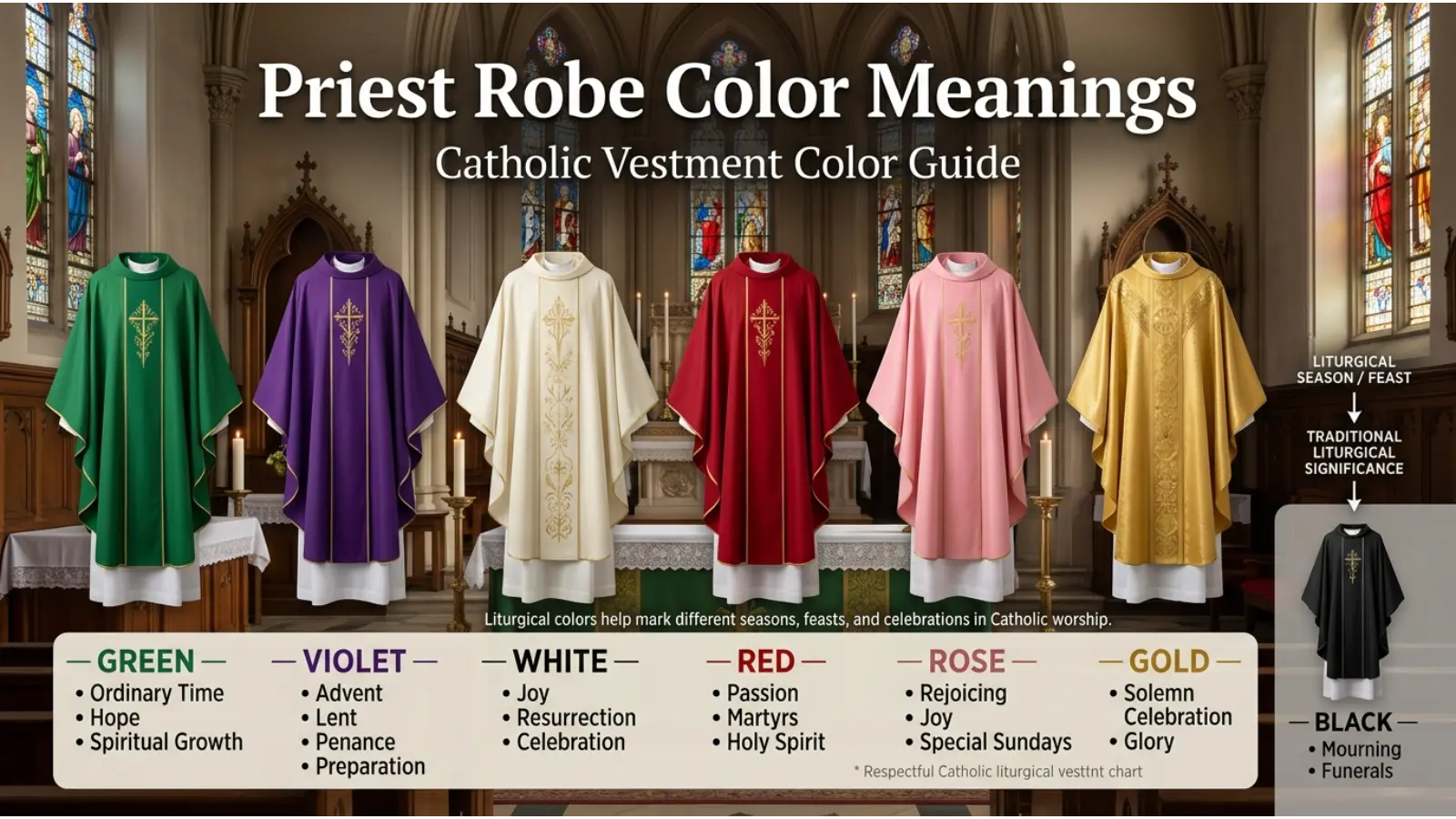
A priest’s vestment color can quietly tell you what kind of celebration is taking place. Green, purple, white, red, and rose are not simply fashion choices. In the Roman Catholic tradition, these colors are part of a visual system connected with the seasons, feasts, and themes of the Church year.That is why a Priest Robe Color Meanings may wear green on one Sunday, purple during Lent, white at Easter, or red on Pentecost.
Each color has an official liturgical use, while its deeper symbolism has developed through Christian tradition and worship.Still, color meanings should not be treated like a simple dictionary. The same color can communicate different ideas depending on the celebration. Red, for example, can point toward martyrdom, the Passion of Christ, or the fire of the Holy Spirit.
This guide explains priest robe color meanings in simple language, including the official uses of the colors, their common symbolism, their place in the Catholic liturgical year, and some common misunderstandings.
Quick Answer: What Do Priest Robe Color Meanings?
In the Roman Rite, green is used during Ordinary Time, purple or violet during Advent and Lent, white during Christmas and Easter and many celebrations of Christ, Mary, angels, and non-martyr saints, and red for the Passion, Pentecost, Apostles, Evangelists, and martyrs. Rose may be worn on Gaudete Sunday and Laetare Sunday.
Priest Robe Color Meanings Chart
| Color | Common Symbolism | Main Liturgical Use |
|---|---|---|
| 🟢 Green | Hope, growth, life, perseverance | Ordinary Time |
| 🟣 Purple/Violet | Preparation, penance, repentance, reflection | Advent and Lent |
| ⚪ White | Joy, resurrection, purity, glory | Christmas, Easter, Mary, angels, non-martyr saints |
| 🔴 Red | Sacrifice, martyrdom, fire, the Holy Spirit | Passion, Pentecost, Apostles, Evangelists, martyrs |
| 🌹 Rose | Joy, encouragement, anticipation | Gaudete and Laetare Sundays |
| ⚫ Black | Mourning, remembrance, death | Masses for the Dead where permitted |
| 🟡 Gold | Celebration, glory, solemnity | More solemn occasions where permitted |
| ⚪ Silver | Festivity, honor, solemnity | More solemn occasions where permitted |
The official liturgical use of these colors comes from the Roman Rite’s rules for sacred vestments.
What Is a Priest’s Colored Robe Called?
What many people call a priest’s “robe” at Mass is usually a chasuble when referring to the main outer vestment worn by the priest celebrant.
A priest normally wears several layers of liturgical clothing.
The chasuble is often the garment people notice most because its color changes according to the liturgical celebration.
This distinction matters because not every piece of a priest’s clothing follows the same color pattern. The white alb, for example, remains white even when the priest is wearing a purple, green, or red chasuble.
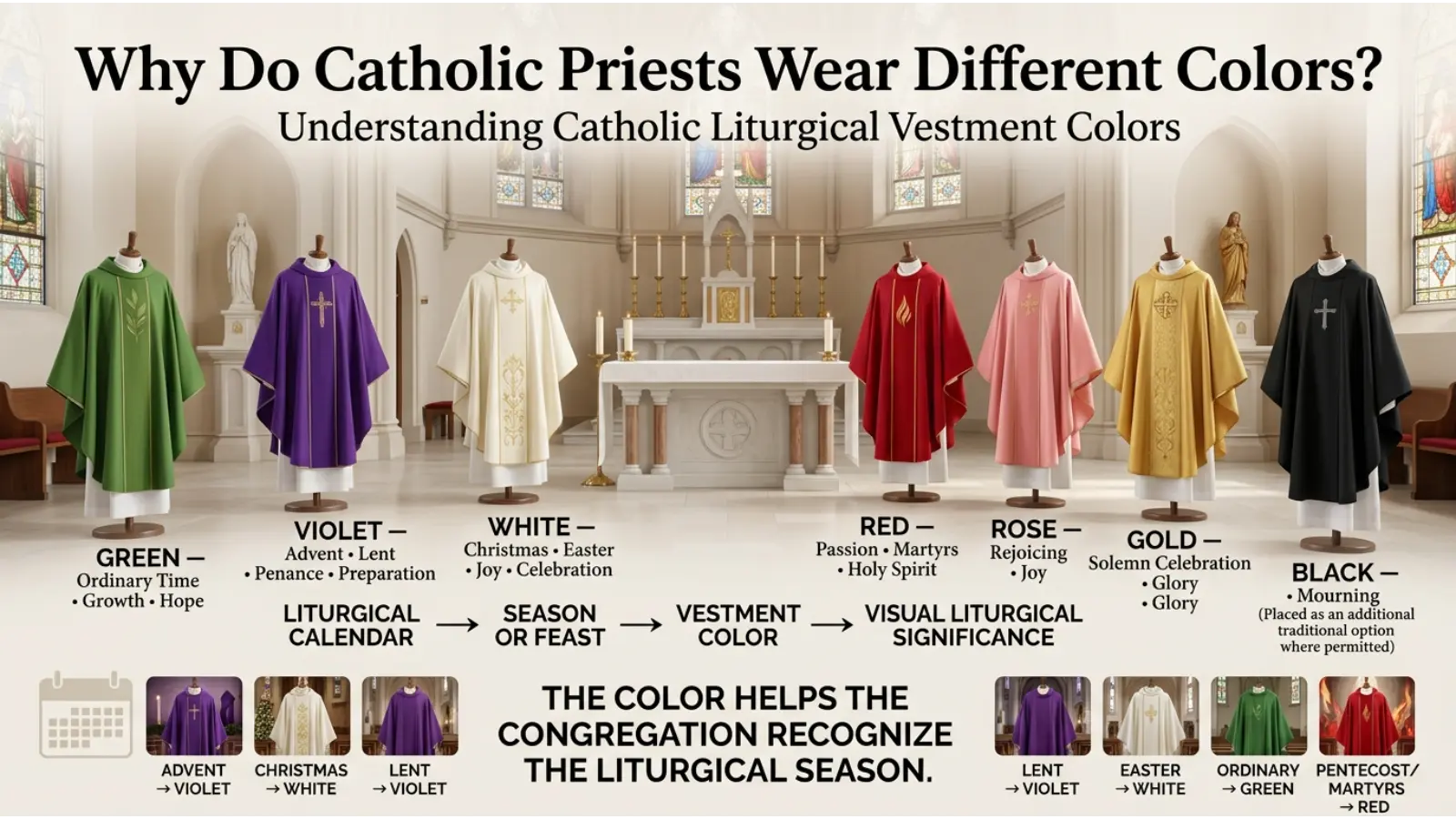
Why Do Catholic Priests Wear Different Colors?
The Catholic Church follows a liturgical year rather than treating every Sunday as visually identical.
The year includes seasons such as Advent, Christmas, Lent, Easter, and Ordinary Time. It also includes celebrations of Christ, Mary, saints, Apostles, martyrs, and other important events.
Vestment colors help make these changes visible.
A person may not remember every date on the Church calendar, but a change from green to purple or from purple to white can immediately create a different visual atmosphere.
The color therefore works as a kind of visual reminder.
It can help worshippers recognize:
- The season of the Church year
- The type of celebration
- The mood or character of the liturgy
- The movement from preparation toward celebration
- Important themes such as sacrifice, resurrection, or hope
The official purpose is not simply decoration.
🟢 Green Priest Robe Meaning
Green is the color most strongly associated with Ordinary Time.
Ordinary Time covers the periods of the Catholic liturgical year that fall outside the major seasons of Advent, Christmas, Lent, and Easter.
What Does Green Symbolize?
Green is commonly connected with:
- 🌱 Growth
- 🌿 Life
- 💚 Hope
- Renewal
- Perseverance
- Spiritual development
These associations fit the long character of Ordinary Time. It is a period in which Christians continue learning, worshipping, praying, and growing in faith rather than focusing on one major seasonal event.
Why Is Green Used So Often?
Ordinary Time occupies a large portion of the liturgical calendar.
Therefore, green can appear at Mass more frequently than some of the other colors.
That does not mean the celebration is less important. “Ordinary” here refers to the ordered numbering of the weeks rather than something boring, inferior, or unimportant.
Green and Spiritual Growth
Green also has a natural connection with plants and new growth. A young tree does not become strong overnight. It develops gradually.
This makes green a useful symbolic image for Christian life: growth can be slow, steady, and sometimes difficult to notice from one day to the next.
🟣 Purple or Violet Priest Robe Meaning
Purple, often called violet in liturgical language, is especially associated with Advent and Lent.
These seasons prepare Christians for major celebrations.
Advent leads toward Christmas, while Lent leads toward Easter.
What Does Purple Symbolize?
Purple is commonly associated with:
- Reflection
- Preparation
- Repentance
- Penance
- Spiritual discipline
- Waiting
- Seriousness
- Renewal
Purple should not simply be described as the “sad color.”
Its meaning is deeper than sadness.
During Lent, purple fits a season of prayer, self-examination, fasting, repentance, and preparation. During Advent, it emphasizes preparation and expectation as Christmas approaches.
Purple During Lent
Lent is a period in which Christians are encouraged to examine their lives and prepare spiritually for Easter.
The darker appearance of violet can create a more restrained atmosphere than the bright colors associated with major celebrations.
The visual change itself can encourage people to notice that the character of the liturgy has changed.
Purple During Advent
Advent contains expectation and hope alongside its reflective character.
That is why describing purple as simply a “color of sadness” misses much of its meaning.
⚪ White Priest Robe Meaning
White is one of the most joyful liturgical colors.
What Does White Symbolize?
White is commonly associated with:
- Light
- Joy
- Purity
- Resurrection
- Glory
- Celebration
- New life
- Peace
Among these ideas, resurrection and joy are especially powerful during Easter.
After the darker and more restrained visual character of Lent and Holy Week, white creates a dramatic contrast.
Why Is White Used at Easter?
Easter celebrates the Resurrection of Jesus Christ.
White therefore creates a visual language of celebration, light, and new life.
Churches may also use gold decorations with white vestments during especially festive celebrations.
White for Saints
White is also used for many celebrations of saints who were not martyrs.
This creates an interesting contrast with red.
🔴 Red Priest Robe Meaning
Red is one of the strongest and most dramatic liturgical colors.
What Does Red Symbolize?
Depending on the celebration, red can represent:
- 🔥 Fire
- ❤️ Sacrifice
- Blood
- Martyrdom
- Courage
- Passion
- The Holy Spirit
- Faithful witness
Red does not have only one meaning.
Red and Martyrdo
The color can remind worshippers that Christian faith has sometimes involved extraordinary courage and suffering.
Red and the Passion of Christ
Red is also used for celebrations connected with the Passion of Jesus.
Here, the color naturally creates associations with sacrifice and suffering.
Red and Pentecost
Pentecost provides a different emphasis.
So the same color can communicate different but related ideas depending on the celebration.
🌹 Rose Priest Robe Meaning
Rose is a special liturgical color because it is used only on particular Sundays.
It may be worn on:
- Gaudete Sunday, the Third Sunday of Advent
- Laetare Sunday, the Fourth Sunday of Lent
What Does Rose Symbolize?
Rose is commonly associated with:
- Joy
- Hope
- Encouragement
- Anticipation
- Celebration
- A moment of brightness
Its meaning becomes clearer when you look at where it appears.
Advent and Lent normally use purple. Rose briefly interrupts that visual pattern.
It is almost like a visual reminder that the anticipated celebration is getting closer.
Why Is Rose Called Pink?
Many people call the vestment “pink,” and the color can certainly look pink in photographs.
However, rose is the traditional liturgical term.
The exact shade may vary depending on the fabric, lighting, embroidery, and manufacturing process.
⚫ Black Priest Robe Meaning
Black has a more limited role in modern Catholic liturgical practice.
It may be used for Masses for the Dead where permitted.
What Does Black Symbolize?
- Mourning
- Death
- Grief
- Remembrance
- Serious reflection
- The reality of human mortality
A black vestment can create a solemn atmosphere.
However, black does not mean that every Catholic funeral must use black.
This is an important example of why local practice can affect what people see in different churches.
🟡 Gold Priest Robe Meaning
Gold is not one of the main seasonal colors in the same way as green, red, white, or violet.
What Does Gold Symbolize?
Gold naturally suggests:
- Glory
- Honor
- Celebration
- Royal dignity
- Wealth
- Light
- Solemnity
Its reflective surface also makes it visually powerful.
Gold embroidery can catch church lighting and make a vestment appear brighter than its base color.
Because of this, gold is especially effective when the goal is to create a highly festive appearance.
⚪ Silver Priest Robe Color Meanings
Silver can also be used for more solemn occasions where permitted.
It is often associated with:
- Brightness
- Honor
- Purity
- Celebration
- Dignity
- Festivity
Silver reflects light differently from gold.
As a result, silver embroidery or fabric can create a cooler and more restrained appearance while still looking ceremonial.
Priest Robe Color Meanings During the Catholic Liturgical Year
The easiest way to understand the colors is to follow them through the Church year.
Advent — 🟣 Purple and 🌹 Rose
Advent is a season of preparation and expectation.
Purple is commonly used, while rose may appear on Gaudete Sunday.
The visual change from purple to rose creates a moment of joy before Christmas arrives.
Christmas — ⚪ White
Christmas celebrates the birth of Jesus.
White creates a bright and festive visual setting.
Ordinary Time — 🟢 Green
Green returns during Ordinary Time.
Its repeated appearance reflects the continuing journey of Christian life between the major seasons.
Lent — 🟣 Purple
Purple marks Lent as a season of preparation, penance, reflection, and spiritual renewal.
The color helps create a noticeable contrast with the celebration that follows.
Holy Week — 🔴 Red and Other Liturgical Colors
Holy Week contains some of the most important celebrations in Christianity.
The color draws attention to the Passion and sacrifice of Christ.
Easter — ⚪ White
Easter brings a major visual transformation.
White becomes the dominant liturgical color, expressing the joy and celebration of Christ’s Resurrection.
Pentecost — 🔴 Red
Pentecost brings another dramatic change.
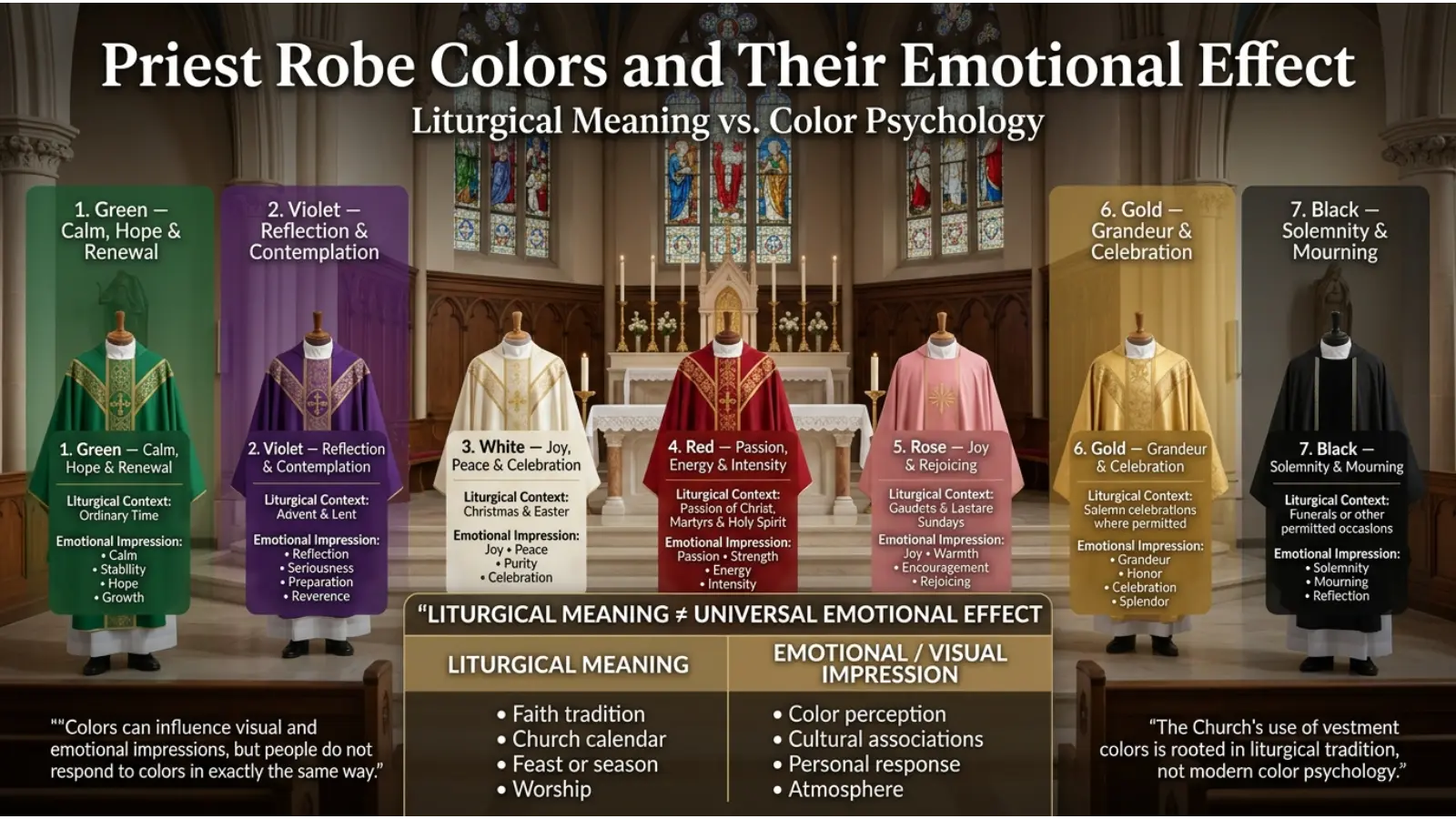
Priest Robe Color Meanings and Their Emotional Effect
Color can influence the atmosphere people perceive, but it is important not to exaggerate what color psychology can prove.
People often respond to colors through learned associations, culture, personal experiences, lighting, and context.
For example, green may feel natural and calming because people associate it with plants and landscapes. Red can feel energetic or intense. White may appear clean and bright. Purple can appear serious or reflective.
However, these reactions are not identical for everyone.
A Catholic worshipper who understands liturgical colors may see purple and immediately think of Lent. Someone unfamiliar with Catholic traditions may simply see purple fabric.
The meaning comes from both the color and the context.
Why Context Changes Priest Robe Color Meanings
Consider red.
Red at Pentecost points toward the Holy Spirit and fire.
Red on a martyr’s feast can point toward sacrifice and witness.
The Red during celebrations of the Passion directs attention toward Christ’s suffering and sacrifice.
The fabric has not changed.
The context has.
This is one of the most useful lessons in understanding religious color symbolism:
A color does not create meaning by itself. The event, tradition, culture, and surrounding symbols help determine what it means.
How Lighting Changes the Appearance of Priest Vestments
A vestment can look completely different under different lighting.
For example:
Warm Church Lighting
Warm bulbs can make white fabric appear cream-colored and can make gold decorations look stronger.
Daylight
Natural daylight can make white look brighter and cooler.
Dark Interior
Deep purple may look almost black when photographed in a poorly lit church.
Camera Flash
Flash photography can make red, white, and gold appear much brighter than they look in person.
Digital Photography
Phone cameras automatically adjust exposure and white balance. This can change how the color appears on the screen.
Therefore, a photograph is not always an accurate guide to the actual liturgical shade.
Why Priest Vestments Often Include Other Colors
A chasuble does not have to be completely one solid color.
It may contain:
- Gold embroidery
- Silver details
- Crosses
- Biblical symbols
- Images of saints
- Decorative borders
- Patterns
- Religious artwork
The important point is that decorative colors do not necessarily change the main liturgical color.
This allows vestment designers to combine beauty with liturgical meaning.
Priest Robe Color Meanings and Religious Art
Liturgical colors have also influenced religious painting, photography, church decoration, and visual storytelling.
An artist can place a priest in purple to suggest Lent or Advent without explaining the season in words.
A red vestment can help establish a connection with martyrdom or Pentecost.
White can make an Easter scene feel bright and celebratory.
Green can establish an Ordinary Time setting.
Rose can immediately suggest one of the special Sundays in Advent or Lent.
This makes liturgical color a useful visual language for artists.
Historical Development of Liturgical Colors
The modern system of Catholic liturgical colors developed over a long period.
Early Christian worship did not begin with today’s complete color chart. Liturgical clothing developed gradually, and different regions used different practices.
Over time, Western Christianity increasingly organized the use of colors according to the liturgical calendar.
The Roman Rite eventually established a more defined system involving colors such as white, red, green, violet, and black, with rose used for particular Sundays.
This history also explains why it is risky to claim that every color has had exactly the same meaning throughout Christian history.
Traditions develop.
Local customs change.
Liturgical practices can also differ between rites and regions.
Do All Catholic Churches Use the Same Priest Robe Color Meanings?
Not necessarily.
The color system discussed here mainly describes the Roman Rite, which is the largest Catholic liturgical tradition.
Catholicism includes other liturgical traditions, and Christian churches outside Catholicism can follow different systems.
Local rules can also provide certain variations.
For example, practices concerning funerals and the use of gold or silver can differ according to the applicable liturgical norms.
So if you visit different churches and notice slightly different practices, that does not automatically mean one church is using the “wrong” color.
The wider liturgical tradition and local rules matter.
Common Misconceptions About Priest Robe Colors
Purple Means the Priest Is Sad
Not exactly.
Sadness alone does not explain its role.
Red Always Means Blood
Blood and sacrifice are important associations, particularly for martyrs and the Passion.
White Is Only an Easter Color
No.
Green Means an Unimportant Mass
Absolutely not.
Green simply identifies Ordinary Time.
The word “ordinary” refers to the structure of the calendar, not the importance of the Mass.
Rose Is Used Every Sunday
No.
Black Must Be Used at Every Funeral
No.
Black is permitted for Masses for the Dead in certain circumstances, but other colors can also be used according to the applicable rules.
Priests Choose Colors Based on Their Mood
Normally, liturgical colors are determined by the celebration and the liturgical calendar rather than by a priest’s personal preference.
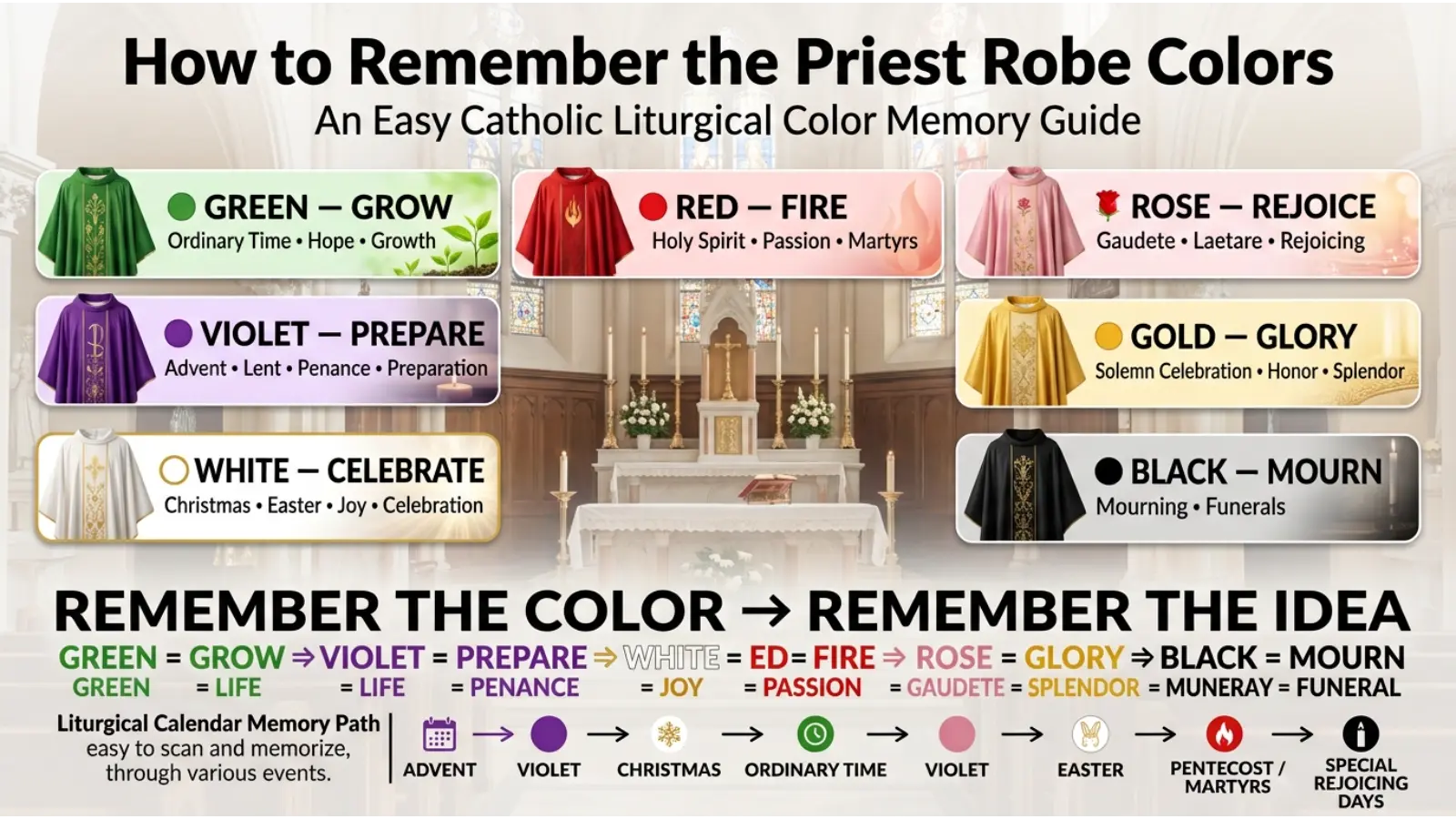
How to Remember the Priest Robe Colors
A simple memory system can make the colors easier to understand.
🟢 Green = Grow
Think of plants growing.
Green → Ordinary Time → Growth and continuing faith
🟣 Purple = Prepare
Think of preparation.
Purple → Advent and Lent → Preparation and reflection
⚪ White = Celebrate
Think of brightness and celebration.
White → Christmas and Easter → Joy and resurrection
🔴 Red = Fire and Sacrifice
Think of fire and courageous witness.
Red → Pentecost, Passion, Apostles, martyrs
🌹 Rose = Rejoice
Think of a brief moment of joy.
Rose → Gaudete and Laetare Sundays
⚫ Black = Remember
Think of mourning and remembrance.
Black → Masses for the Dead where permitted
This memory method is not a substitute for the official liturgical rules, but it makes the basic system easier to remember.
Priest Robe Colors and Personal Color Preference
Some people naturally prefer one color over another.
Someone may love green because it feels peaceful. Another person may prefer purple because it appears rich and elegant. Someone else may find white more uplifting.
However, personal color preference should not be confused with personality diagnosis.
A person’s favorite color cannot reliably tell you whether they are kind, intelligent, spiritual, confident, introverted, or extroverted.
Similarly, seeing a priest wearing red does not tell you anything about his personality.
The color describes the liturgical celebration, not the priest’s personal character.
Why Designers Use Color in Catholic Vestments
Vestment designers work with more than color alone.
They also consider:
- Fabric
- Texture
- Embroidery
- Religious symbols
- Shape
- Pattern
- Light reflection
- Historical style
- Season
- The solemnity of the celebration
A simple green vestment can create a calm visual effect, while a richly embroidered gold-and-white chasuble can make a major feast feel more ceremonial.
The strongest designs balance beauty with meaning rather than adding decoration simply for decoration’s sake.
Real-World Uses of Priest Robe Color Knowledge
Understanding liturgical colors can help in many situations.
When Visiting a Catholic Church
The vestment color can help you identify the liturgical season.
When Watching Mass
You can understand why the priest’s clothing changes from one celebration to another.
When Studying Catholic Art
Vestment colors can provide clues about the event represented in a painting.
When Photographing a Church
Knowing the meaning of the colors can help you understand the visual story behind the scene.
When Designing Religious Artwork
Using the correct color can make an image more consistent with the celebration being represented.
When Teaching Children
A simple color chart can make the Church year easier to understand.
Frequently Asked Questions
What is the main color of a priest’s robe during Ordinary Time?
Green is the standard liturgical color for Ordinary Time.
What color does a priest wear during Lent?
Purple or violet is normally used during Lent.
What color does a priest wear during Advent?
Purple or violet is normally used during Advent, although rose may be used on Gaudete Sunday where the practice is observed.
What color does a priest wear on Easter?
White is the main liturgical color for Easter.
Why does a priest wear red?
Red is used for celebrations connected with the Passion of Christ, Pentecost, Apostles, Evangelists, and martyrs.
What does a white priest robe symbolize?
White is commonly associated with joy, light, purity, resurrection, glory, and celebration. Its official liturgical use depends on the celebration.
What does a purple priest robe symbolize?
Purple or violet is commonly associated with preparation, repentance, penance, reflection, and spiritual renewal.
When does a priest wear a pink or rose robe?
Rose may be worn on Gaudete Sunday, the Third Sunday of Advent, and Laetare Sunday, the Fourth Sunday of Lent, where the practice is observed.
Can a priest wear a black robe?
Black may be used for Masses for the Dead according to applicable liturgical rules and local practice.
Are gold and silver official liturgical colors?
Gold and silver are not the main seasonal colors, but they may be used for more solemn occasions where permitted by the applicable rules.
Does every Christian church use the same priest robe colors?
No. Different Christian traditions and Catholic rites can have different vestment customs and liturgical color systems.
Conclusion
Priest robe colors are more than decorative choices. They create a visual language that helps communicate the changing seasons and celebrations of the Catholic liturgical year.
Green points to Ordinary Time and the continuing journey of faith. Purple or violet marks Advent and Lent and suggests preparation and reflection. White brings a sense of joy and celebration to Christmas, Easter, and many other important feasts. Red connects with the Passion, Pentecost, Apostles, Evangelists, and martyrs. Rose offers a brief visual note of joy during Advent and Lent, while black, gold, and silver have more limited uses under particular circumstances.
The most important thing to remember is that a color does not have one meaning in every situation. The celebration, season, tradition, and surrounding symbols all shape its message.
Once you understand that visual language, the next time you see a priest wearing a different-colored vestment, you can often recognize something about the season, celebration, or spiritual focus of the Mass simply by looking at the color.

Emma Wilson is a dedicated comparison writer and product researcher at ColorMystiic.com. She specializes in creating unbiased product comparisons, detailed reviews, and helpful buying guides. Her goal is to help readers make smarter purchasing decisions with confidence.