A witch ball is a decorative glass sphere surrounded by centuries of folklore. Traditionally, these colorful or reflective balls were hung in windows, rooms, and other parts of the home as protective objects. Historical examples are especially associated with England, where brightly colored glass spheres were believed to help guard a household against witches, evil spirits, bad luck, or harmful influences.Today, people search for witch ball color meanings for a slightly different reason. Modern witch balls are often chosen according to color symbolism, personal spirituality, home décor, seasonal decoration, or simply visual preference.
There is an important distinction, however: historical sources do not provide one universal color code in which every witch ball color had a fixed magical meaning. Blue and green appear frequently in historical examples, while other colors and multicolored designs also existed. Modern interpretations often combine the folklore of the witch ball with broader color symbolism.
So, this guide separates documented history from modern symbolic interpretation. You will learn what witch balls were traditionally believed to do, what different colors can represent today, how color changes their appearance, and how to use a witch ball thoughtfully in your home.
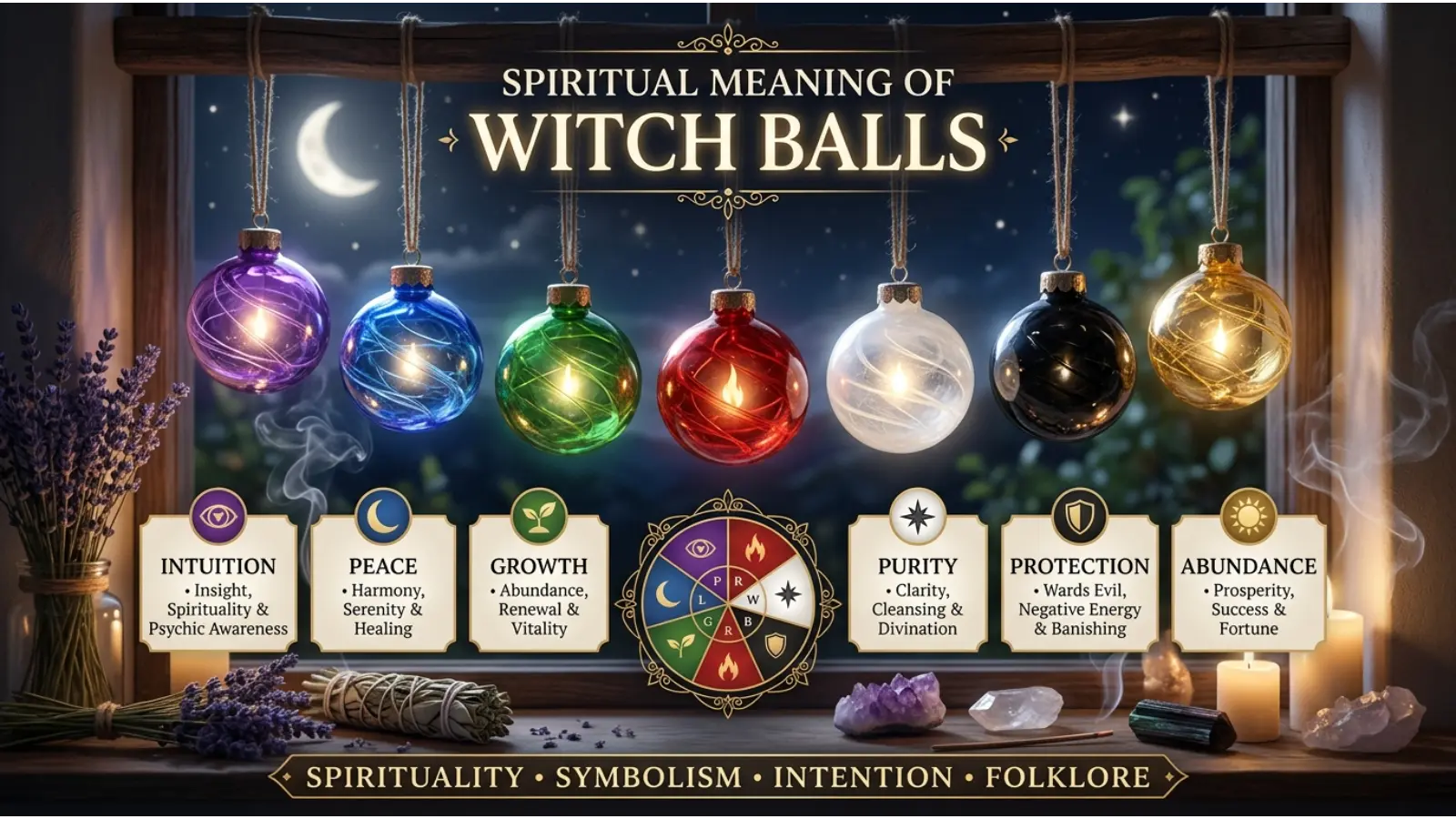
Quick Answer: Witch ball colors do not have one historically fixed meaning. Traditionally, the glass sphere itself was associated with protection, reflection, and the warding off of evil or bad luck. Today, colors such as blue, green, red, purple, white, and silver are often given additional symbolic meanings based on broader cultural and spiritual color traditions.
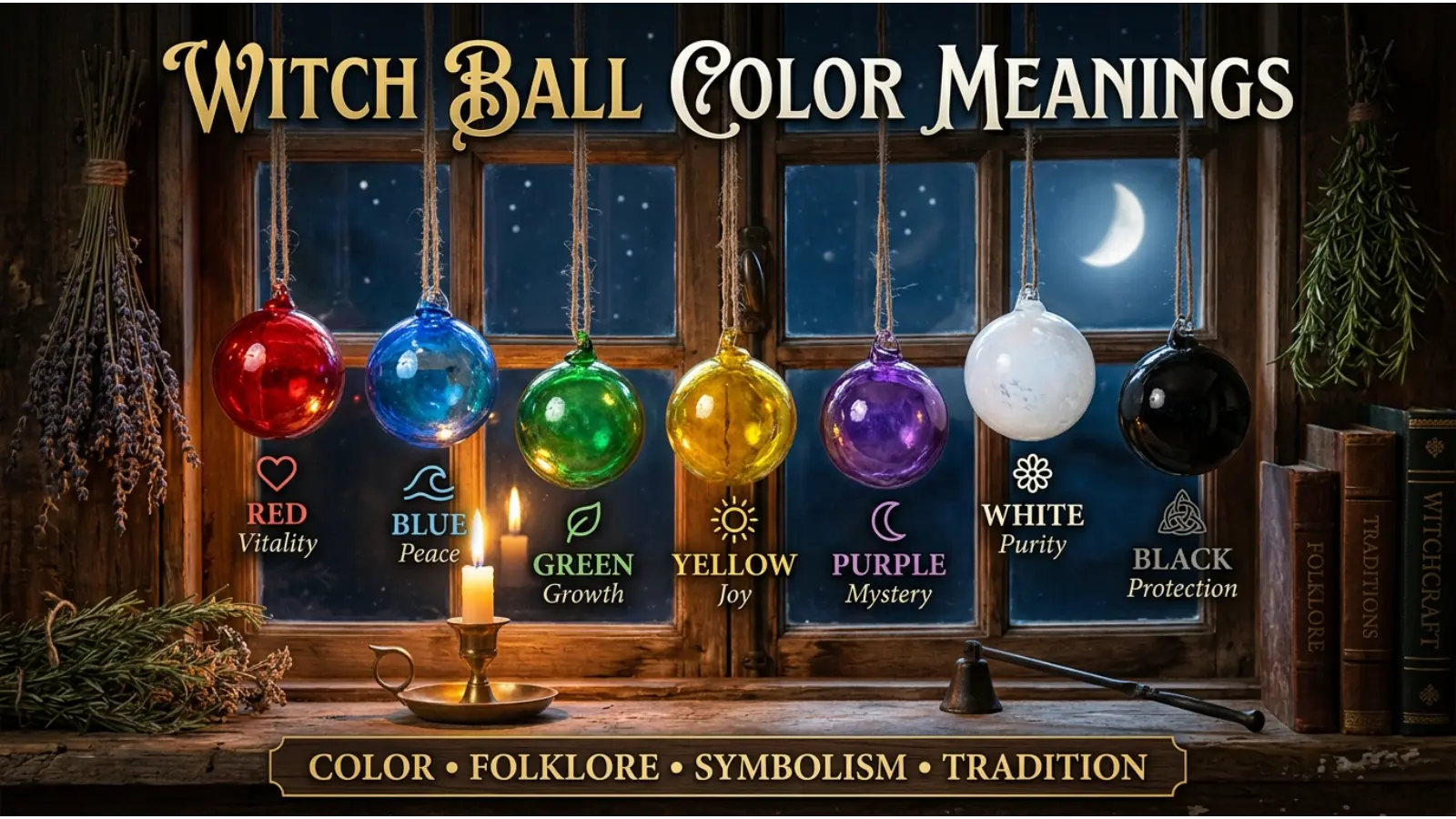
Witch Ball Color Meanings at a Glance
Because modern color meanings vary by tradition, the chart below should be read as a symbolic guide rather than a historical rulebook.
| Color | Common Modern Association | Possible Witch Ball Theme |
|---|---|---|
| 🔵 Blue | Peace, protection, calm | Peaceful protection |
| 🟢 Green | Nature, growth, renewal | Growth and harmony |
| 🔴 Red | Energy, passion, strength | Vitality and courage |
| 🟣 Purple | Mystery, spirituality, wisdom | Intuition and reflection |
| ⚪ White | Purity, clarity, peace | Cleansing and simplicity |
| ⚫ Black | Mystery, boundaries, protection | Grounding and privacy |
| 🟡 Yellow | Joy, warmth, optimism | Happiness and brightness |
| 🟠 Orange | Creativity, warmth, enthusiasm | Energy and creativity |
| 🩷 Pink | Affection, tenderness, compassion | Love and gentle energy |
| 🩵 Silver | Reflection, moonlight, elegance | Reflection and protection |
| 🟨 Gold | Wealth, prestige, sunlight | Abundance and confidence |
| 🌈 Multicolor | Variety, celebration, creativity | Balanced or personal symbolism |
These associations are best understood as modern symbolic interpretations, not universal historical definitions.
What Is a Witch Ball?
A witch ball is generally a hollow glass sphere, often decorated with brilliant colors, stripes, swirls, reflective surfaces, or glass threads inside. Historical examples were commonly associated with windows and household protection.
The objects have a surprisingly complicated history. They were not used for only one purpose. Museum research describes witch balls and related spherical glasses as protective charms, decorative objects, divination devices, and objects with other practical or ceremonial uses.
Some historical examples were made from colored glass, while others were reflective or silvered. The Museum of Witchcraft and Magic records English witch balls manufactured by Nailsea glassmakers from the late eighteenth century onward.
The interior could also be visually striking. Some balls contained strands or threads of glass, while surviving examples in museum collections have been found with textile material inside. For example, the London Museum has an approximately 1800 witch ball containing pink and purple textile threads.
Why Were Witch Balls Hung in Windows?
The window was an important location because folklore often treated it as a possible point through which harmful forces could enter a home.
One traditional explanation was that a witch ball could attract or confuse an unwanted spirit. Another connected the reflective surface with the idea of turning harmful influences away. Some folklore also claimed that spirits would become caught among the strands inside the sphere.
However, these stories should be treated as folklore rather than established supernatural fact.
Historical beliefs also varied. The Museum of Cambridge describes a blue witch ball from 1721 that was associated with the belief that refracted light could dazzle witches and prevent them from entering the home.
That variation is one reason there is no reliable historical dictionary saying that, for example, “red always means courage” or “purple always means psychic power” for witch balls.
The Historical Witch Ball Color Meanings
The strongest recurring historical association is protection.
Witch balls were connected with the idea of guarding the household from evil spirits, witches, bad luck, or unwanted influences. Reflective surfaces were particularly important in some traditions because reflection was thought to repel or confuse harmful forces.
Some accounts also connect them with the evil eye. In this interpretation, the striking sphere could attract or distract a harmful gaze before it reached the household. The Museum of Witchcraft and Magic documents several versions of this folklore, showing that the protective idea changed from place to place.
Over time, the object became increasingly decorative. By the twentieth century, witch balls could be found as fashionable household ornaments, wedding gifts, and colorful decorative pieces.
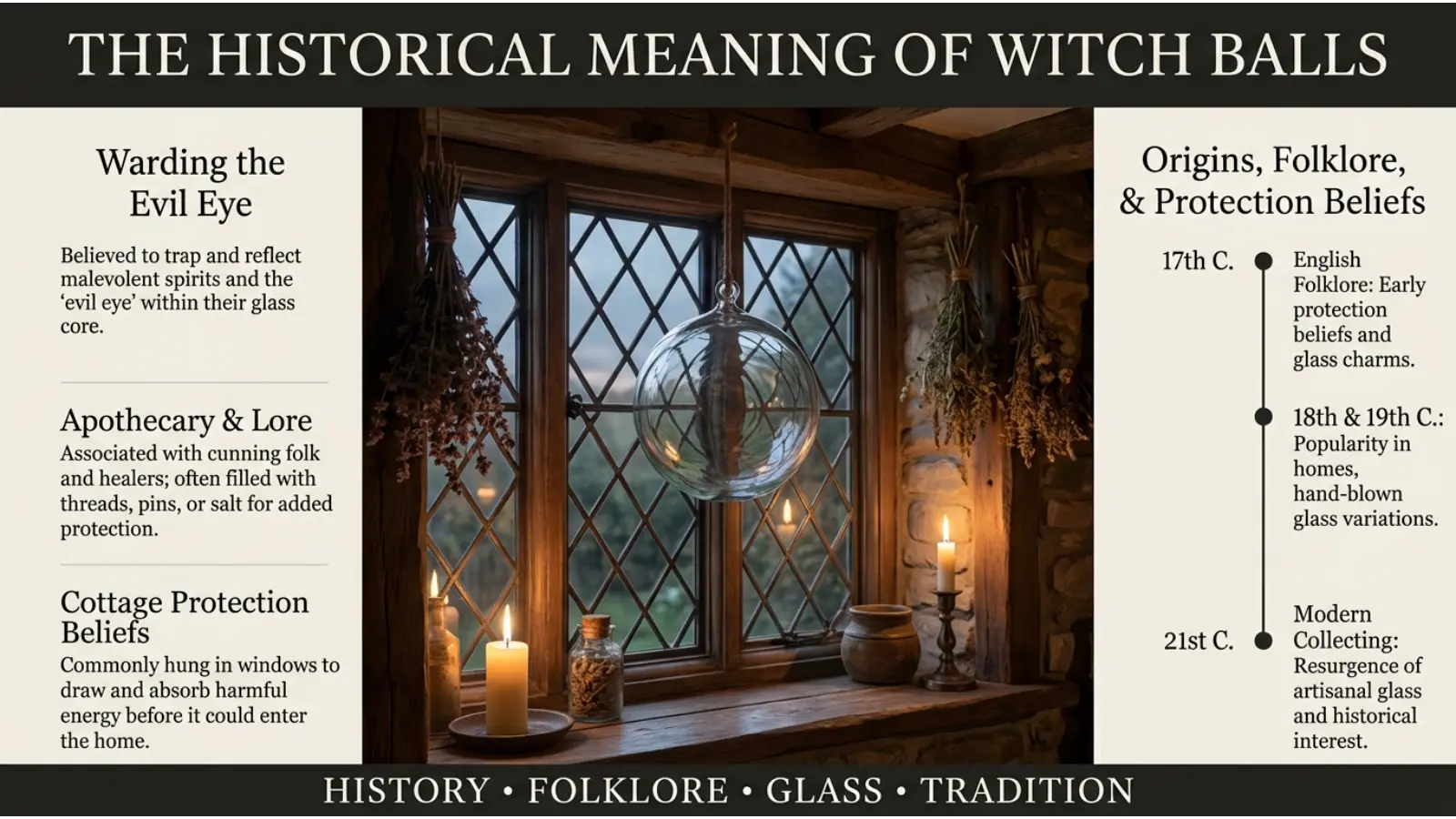
That evolution explains why a witch ball can now function in two different ways: as a historical folk object and as a modern decorative or symbolic object.
Blue Witch Ball Meaning 🔵
Blue is one of the colors most strongly associated with historical witch balls. The National Museum of Ireland records a sapphire-blue glass witch ball dating to around 1800, while the Museum of Cambridge has documented vivid blue examples.
What a Blue Witch Ball Can Symbolize
A blue witch ball may be chosen to represent:
- Peace
- Calm
- Protection
- Emotional balance
- Reflection
- Serenity
- Trust
- A peaceful home
The connection between blue and protection should be understood as a modern interpretation layered onto the older protective role of the witch ball itself. The historical evidence confirms blue witch balls existed; it does not establish a universal rule that blue specifically meant one particular magical quality.
Blue Witch Balls in Home Décor
Blue glass looks especially attractive near natural daylight. Near a window, the color can become brighter as sunlight passes through or reflects from the glass.
A deep sapphire blue creates a dramatic appearance, while pale blue produces a softer and more relaxed effect.
Green Witch Ball Meaning 🟢
Green is another color strongly associated with traditional witch balls. Historical descriptions identify green and blue among the common traditional colors, and the Museum of Witchcraft and Magic holds a pale-green example classified under protection.
Modern Symbolism of a Green Witch Ball
A green witch ball can represent:
- Growth
- Renewal
- Nature
- Balance
- Harmony
- Fresh beginnings
- Connection with the natural world
A pale green ball can feel light and gentle, whereas emerald or forest green creates a richer and more dramatic effect.
Red Witch Ball Meaning 🔴
Red is not established as a universal historical “witch ball protection” color. However, modern color symbolism often connects red with energy, passion, strength, warmth, courage, and attention.
Therefore, a red witch ball may be interpreted as a symbolic object representing:
- Strength
- Courage
- Passion
- Vitality
- Determination
- Protection through personal confidence
Red also catches attention quickly. Consequently, a red witch ball works well when the decoration is intended to become a visual focal point.
Purple Witch Ball Meaning 🟣
Purple has long carried associations with mystery, spirituality, royalty, imagination, and wisdom in various cultural settings. Those associations are broader color symbolism rather than a fixed historical witch-ball code.
A purple witch ball may therefore symbolize:
- Spiritual reflection
- Mystery
- Intuition
- Wisdom
- Imagination
- Transformation
- Personal growth
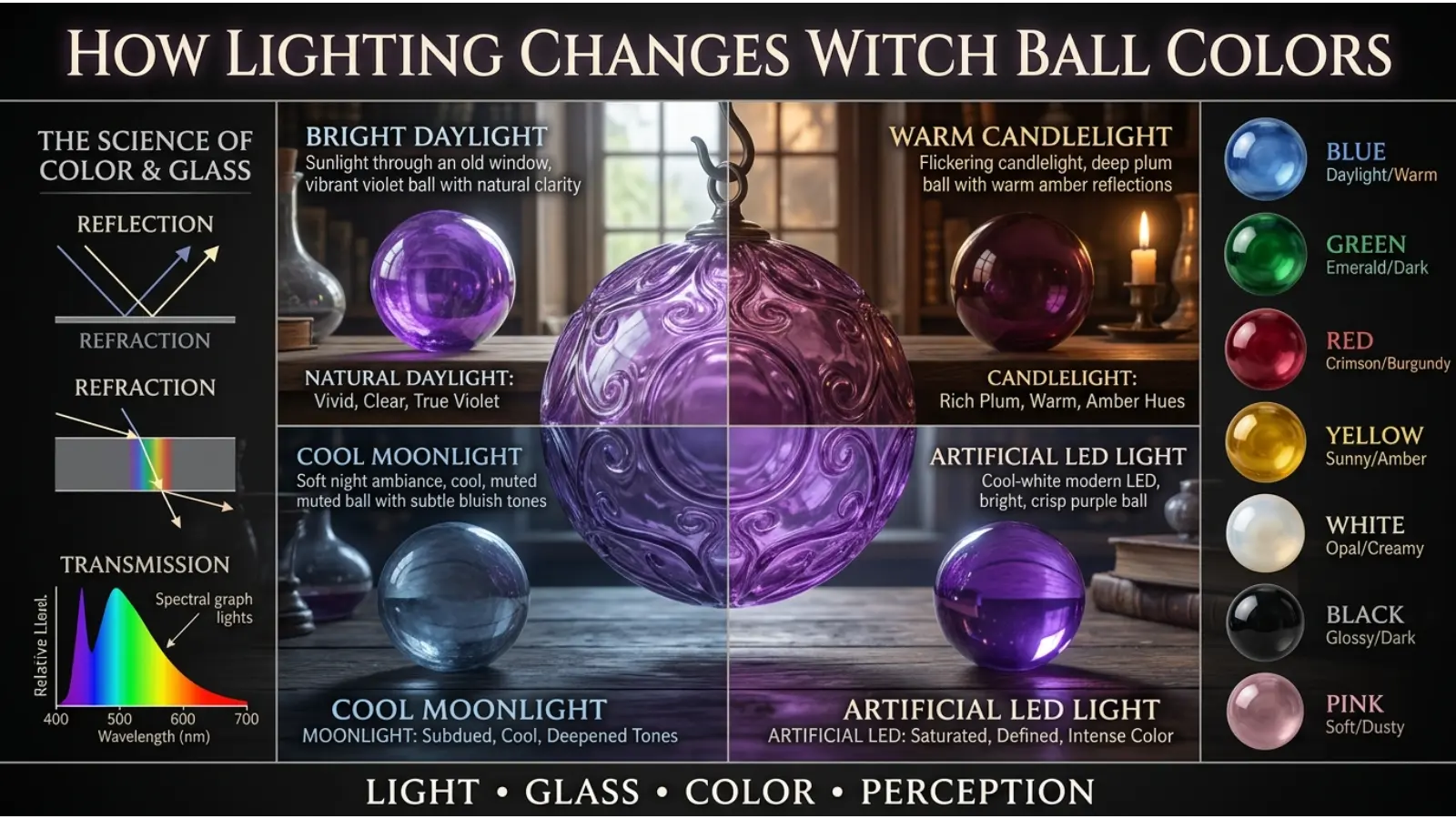
Purple can also change dramatically with lighting. In warm light, it may appear richer and more reddish. Under cooler light, it can look more blue or violet.
That makes purple especially interesting in glass decorations because the perceived color may shift throughout the day.
White Witch Ball Meaning ⚪
White often suggests clarity, simplicity, peace, cleanliness, and light in modern symbolic systems.
A white witch ball can therefore represent:
- Peace
- Clarity
- Fresh beginnings
- Simplicity
- Light
- Calm
- A clean visual atmosphere
White glass is particularly useful in minimalist interiors. It can also create an attractive contrast against dark walls, wood, green plants, or colorful Christmas decorations.
Black Witch Ball Meaning ⚫
Black is a modern symbolic choice rather than a clearly established traditional witch-ball color code.
In contemporary design and symbolism, black can suggest:
- Mystery
- Strength
- Boundaries
- Depth
- Privacy
- Grounding
- Protection
A black glass sphere can create a dramatic reflective surface. In interior design, it works particularly well with metallic finishes, warm wood, white walls, and neutral colors.
Because black absorbs rather than visually scatters light as brightly as lighter colors, its appearance can feel more understated and mysterious.
Yellow Witch Ball Meaning 🟡
Yellow is often associated with sunlight, happiness, optimism, warmth, and energy.
A yellow witch ball can symbolically represent:
- Joy
- Hope
- Optimism
- Warmth
- Creativity
- Celebration
- Positive energy
Yellow glass is especially effective in sunny rooms because natural light can make it appear luminous.
However, strong yellow can become visually dominant. For a balanced display, combine it with neutral or cooler colors.
Orange Witch Ball Meaning 🟠
Orange combines the warmth of red with some of the brightness associated with yellow.
Modern symbolic interpretations often connect orange with:
- Creativity
- Enthusiasm
- Social energy
- Warmth
- Adventure
- Confidence
- Celebration
An orange witch ball can work especially well in autumn displays, creative spaces, kitchens, and colorful seasonal arrangements.
Pink Witch Ball Meaning 🩷
Pink is commonly associated with affection, tenderness, care, compassion, and romance in modern Western color symbolism.
A pink witch ball may therefore be used to represent:
- Love
- Friendship
- Compassion
- Gentleness
- Affection
- Emotional warmth
Because the historical witch ball itself was often a household protective object, a modern pink interpretation can combine the idea of protection with care for the home and people within it.
Silver Witch Ball Meaning 🩵
Silver has a particularly interesting relationship with witch balls because historical examples were sometimes silvered or reflective. Museum records describe large silver witch balls intended to reflect away evil and ill-fortune.
That makes silver especially appropriate when discussing the reflective side of witch-ball folklore.
Modern symbolism may associate silver with:
- Reflection
- Moonlight
- Mystery
- Elegance
- Intuition
- Protection
- Modernity
A silver witch ball also works beautifully with contemporary interiors because its reflective surface can interact with surrounding light.
Gold Witch Ball Meaning 🟨
Gold is strongly associated in modern symbolism with sunlight, wealth, achievement, luxury, and prestige.
A gold witch ball may represent:
- Abundance
- Success
- Confidence
- Celebration
- Warmth
- Achievement
- Prosperity
Gold works particularly well as an accent color rather than covering an entire display. A blue or green witch ball with gold detailing, for example, can create a sophisticated contrast.
Multicolor Witch Ball Meaning 🌈
Multicolored witch balls have a strong visual connection with the decorative history of the object. Historical examples could feature stripes, swirls, and brilliant combinations of colors.
Today, a multicolor witch ball can symbolize:
- Diversity
- Creativity
- Celebration
- Balance
- Individuality
- Multiple intentions
- Joy
Rather than assigning one meaning to the entire object, you can interpret each visible color according to your own symbolic system.
This makes multicolored witch balls especially suitable for personal décor.
Witch Ball Color Meanings vs. Historical Evidence
One of the easiest mistakes in this subject is presenting modern spiritual interpretations as ancient historical facts.
The evidence supports several points:
Historically documented:
- Witch balls were used in England and other places.
- They were often made from glass.
- Blue and green examples existed.
- Reflective and silvered versions existed.
- They were associated with protection from evil, witches, bad luck, or harmful influences.
- Some traditions connected them with reflection or distraction.
- Their uses later became increasingly decorative.
Modern symbolic interpretation:
- Blue = calm
- Green = growth
- Red = energy
- Purple = spirituality
- White = clarity
- Black = grounding
- Yellow = optimism
- Pink = affection
- Gold = abundance
Witch Ball Color Meanings Psychology: Why Does Color Matter?
Color can influence visual attention and emotional associations, but color psychology is more complicated than assigning one emotion to each color.
People experience colors through several layers at once. Hue matters, but so do brightness, saturation, surrounding colors, lighting, personal experience, and cultural background.
For example, a dark blue sphere can appear serious and dramatic, while pale blue may feel lighter and more delicate. Both are technically blue, yet they create different visual impressions.
The same principle applies to witch balls.
A bright red sphere hanging in a sunny window attracts attention quickly. A dark green sphere among houseplants may visually disappear into its surroundings. A mirrored silver sphere may reflect the room rather than simply displaying one fixed color.
Therefore, the meaning of a witch ball comes from both symbolism and context.
Spiritual Witch Ball Color Meanings
Some contemporary practitioners may use a witch ball as a symbolic reminder of:
- Protection
- Personal boundaries
- Reflection
- Intention
- Transformation
- Spiritual awareness
- Peace
- Personal growth
The historical record itself shows variation. Different communities attached different explanations to similar glass objects, and some uses were decorative or practical rather than magical.
For that reason, a respectful approach is to describe modern spiritual symbolism as a contemporary interpretation rather than an ancient rule.
Cultural Witch Ball Color Meanings
The history of witch balls is particularly connected with British and English folk traditions. Historical examples have also appeared in American collections and later decorative traditions.
The meaning was not identical everywhere.
In England, witch balls were associated with household protection and folklore concerning witches and evil influences. In other settings, similar spherical glass objects could have different purposes, including decoration or divination.
The Museum of Witchcraft and Magic documents how related glass spheres moved between protective, decorative, and divinatory uses.
This is an important cultural lesson: objects can travel while their meanings change.
Modern internet lists sometimes present witch-ball color meanings as though one ancient tradition assigned a precise purpose to every shade. The historical record does not support that level of certainty.
The History of Witch Ball Color Meanings
The history of the witch ball reaches back several centuries, although the exact origin remains complicated.
Spherical glasses were known in earlier periods, and historical research describes several related uses. By the eighteenth century, brightly colored glass witch balls were being hung in English homes. The National Museum of Ireland records an English blue witch ball dating to approximately 1800, while the Museum of Cambridge describes a blue example made in 1721.
By the late eighteenth century, Nailsea glassmakers in England were producing reflective witch balls.
During the nineteenth century, related glass spheres also became popular in America. Some evolved into the garden ornaments now known as gazing balls.
By the twentieth century, the objects had become fashionable decorative pieces. The Museum of Witchcraft and Magic records their appearance in shops, homes, gardens, and wedding-related decoration.
Witch Ball Color Chart
| Color | Symbolic Theme | Best Visual Setting |
|---|---|---|
| 🔵 Blue | Calm & peaceful protection | Windows, bedrooms |
| 🟢 Green | Growth & nature | Gardens, plant rooms |
| 🔴 Red | Strength & vitality | Entryways, focal displays |
| 🟣 Purple | Mystery & reflection | Meditation or creative spaces |
| ⚪ White | Clarity & peace | Minimalist interiors |
| ⚫ Black | Mystery & boundaries | Modern interiors |
| 🟡 Yellow | Joy & optimism | Sunny rooms |
| 🟠 Orange | Creativity & warmth | Kitchens, studios |
| 🩷 Pink | Love & compassion | Bedrooms, personal spaces |
| 🩵 Silver | Reflection & elegance | Windows, contemporary décor |
| 🟨 Gold | Abundance & celebration | Holiday displays |
| 🌈 Multicolor | Creativity & individuality | Eclectic interiors |
Witch Ball Color Meanings in Interior Design
A witch ball can function as more than a symbolic object. Its spherical shape and reflective surface make it an effective decorative accent.
Living Room
Place a witch ball near a window where natural light can interact with the glass.
Blue, green, silver, and multicolored balls work especially well when the room already contains glass, plants, metal, or natural textures.
Bedroom
Softer colors can create a quieter visual effect.
Pale blue, lavender, white, or muted green can complement neutral bedding without making the ornament dominate the room.
Office
For a workspace, color can become part of the room’s visual identity.
Green can connect the space with nature, blue can create a calm visual atmosphere, while yellow or orange can add brightness.
Kitchen
Warm colors such as yellow, orange, red, and green can work naturally with kitchens because they complement food-related colors and natural materials.
Windows
Windows are one of the most historically meaningful places to display a witch ball.
They also make practical design sense because daylight can pass through colored glass and reflections can move across nearby surfaces.
Witch Ball Color Meanings in Fashion and Personal Style
Witch-ball symbolism has also influenced modern alternative, gothic, fantasy, and witchcraft-inspired aesthetics.
A witch-ball-inspired color palette might include:
- Deep blue with silver
- Forest green with bronze
- Purple with black
- Red with gold
- White with silver
- Multicolor glass with neutral clothing
The important point is that the object does not have to dictate a person’s identity. Instead, it can serve as a visual accessory representing an interest in folklore, glass art, history, fantasy, or personal symbolism.
Best Color Combinations for Witch Balls
Color combinations can completely change the personality of a witch ball.
Blue + Silver
This pairing creates a cool, reflective appearance and works especially well near windows.
Green + Gold
Green provides a natural foundation while gold adds warmth and visual richness.
Purple + Silver
The combination creates a mysterious, elegant look suited to darker or creative interiors.
Red + Gold
This is a bold combination that feels warm and celebratory.
White + Blue
The contrast produces a clean, peaceful appearance.
Black + Purple
This combination creates a dramatic, mysterious aesthetic often used in gothic-inspired décor.
Multicolor + Neutral
A colorful witch ball can become the focal point when surrounded by white, gray, beige, or natural wood.
How Lighting Changes Witch Ball Colors
Lighting is one of the most overlooked parts of color interpretation.
A glass sphere can look completely different under morning sunlight, afternoon light, warm lamps, and cool LED bulbs.
For example, a blue witch ball may look brighter near a window but deeper under low indoor lighting. Purple can shift toward red or blue depending on the light source. Metallic silver can reflect nearby colors, making the sphere appear different from one room to another.
Therefore, if you are buying a witch ball for décor, examine its color under the lighting where you actually plan to display it.
Personality Associations
People sometimes connect favorite colors with personality traits. These associations can be interesting, but they should not be treated as personality tests.
Someone who chooses a purple witch ball is not automatically spiritual. Someone who prefers red is not necessarily aggressive. A person choosing green may simply like plants or the appearance of green glass.
Color preference is influenced by culture, memories, surroundings, fashion, design trends, and individual taste.
A better way to use color symbolism is as a tool for expression, not as a method for judging someone’s character.
Common Misconceptions About Witch Ball Colors
Every color has an ancient magical meaning
There is no reliable historical evidence for one universal color chart covering every witch-ball color.
Blue always means protection
Blue witch balls are historically documented, and witch balls themselves were associated with protection. However, the evidence does not establish a universal rule that blue alone meant protection.
Witch balls were only used for magic
Not necessarily. Museum research shows that related spherical glass objects had decorative, practical, and divinatory uses as well as protective associations.
A witch ball automatically belongs to one religion
No. Witch balls have a complicated history involving folklore, household customs, glassmaking, decoration, and later spiritual interpretations.
The color determines what the ball does
The historical role was attached primarily to the object and the beliefs surrounding it, not to a standardized modern color chart.
Real-World Uses of Witch Ball Colors
Modern witch balls can be used in several ways:
Home decoration: Choose colors that complement furniture, walls, plants, and lighting.
Seasonal decoration: Use red and gold for festive displays, orange for autumn, or blue and silver for winter themes.
Personal symbolism: Select a color that represents an intention or quality meaningful to you.
Glass art: Appreciate the sphere as a handmade or collectible glass object rather than assigning supernatural properties to it.
Gift giving: Choose colors according to the recipient’s taste rather than assuming a fixed magical meaning.
Photography: Reflective and transparent glass can create interesting highlights, refractions, and background effects.
Gardens: Weather-resistant gazing-ball-style spheres can provide a related decorative effect outdoors.
How to Choose the Right Witch Ball Color
Start with the purpose.
If you want a calm visual effect, blue or pale green may fit naturally. For warmth, consider red, orange, or gold. If you want mystery and drama, purple, black, or deep blue can work well.
Next, examine the surroundings.
A color that looks beautiful by itself may clash with the room. Consider the wall color, furniture, plants, flooring, and natural light.
Finally, think about your personal association.
If green reminds you of forests, choose green. If blue reminds you of the ocean, choose blue. Personal meaning can be just as valuable as traditional symbolism.
Why Witch Balls Still Fascinate People
Part of the appeal comes from the combination of history and visual beauty.
A witch ball is not simply a colored sphere. It can represent a meeting point between folk belief, craftsmanship, household decoration, storytelling, and changing cultural traditions.
Its reflective surface also creates an unusual visual experience. Instead of simply showing its own color, the sphere can mirror windows, plants, lights, furniture, and people around it.
That quality helps explain why the object has remained attractive even as its original folklore has changed.
Frequently Asked Questions
What is the most traditional witch ball color?
Blue and green are among the colors most strongly associated with traditional witch balls. Historical examples in both colors are documented by museums.
What does a blue witch ball mean?
Historically, blue witch balls existed as protective folk objects. In modern symbolism, blue is often associated with calmness, peace, reflection, and serenity.
What does a green witch ball mean?
A green witch ball can represent nature, growth, renewal, balance, and harmony in modern symbolic interpretation. Green witch balls are also historically documented.
What does a purple witch ball symbolize?
Modern interpretations often connect purple with mystery, spirituality, imagination, wisdom, and intuition. These are contemporary symbolic associations rather than a universal historical witch-ball code.
Are witch balls actually magical?
Witch balls are historical folk objects associated with magical and protective beliefs. There is no scientific evidence establishing supernatural powers. Their historical importance comes from the beliefs and customs surrounding them.
Why do witch balls have strings or strands inside?
Some witch balls contain decorative glass strands, while other surviving examples contain textile material. Folklore sometimes described internal strands as trapping harmful spirits, but that is a traditional belief rather than a demonstrated physical effect.
Where should a witch ball be placed?
Historically, windows were an important location. Today, you can place one wherever it looks attractive and receives suitable light. A window remains especially appropriate because it connects with the object’s historical decorative and protective associations.
Are witch balls the same as gazing balls?
They are closely related but are not always identical. Reflective witch balls contributed to the tradition of garden gazing balls, while gazing balls were also used for decorative purposes and, in some traditions, scrying.
Can I choose a witch ball color based on my intention?
Yes, as a modern personal practice. You can use color symbolism to choose a ball that represents qualities such as peace, growth, courage, creativity, or reflection. Just distinguish personal symbolism from documented historical tradition.
Do witch ball colors have the same meanings in every culture?
No. Color symbolism changes across cultures, historical periods, religions, and individual communities. Even the folklore surrounding witch balls varied considerably.
Conclusion
Witch ball color meanings are best understood through two connected but different stories.
The historical story centers on colorful and reflective glass spheres used in folklore, especially as protective objects associated with windows, households, witches, evil spirits, bad luck, and reflection. Blue and green examples are particularly well documented, while silvered and multicolored versions also appear in the historical record.
The modern story is more personal. Today, people may choose blue for calm, green for growth, red for strength, purple for mystery, white for clarity, or silver for reflection. These meanings can make a witch ball more meaningful, but they should not be mistaken for a universal ancient color code.
Ultimately, the most useful way to understand a witch ball is to look at history, color, context, and personal meaning together. Whether displayed as a piece of glass art, a historical-inspired ornament, or a personal symbol, its appeal comes from the way a simple sphere can hold centuries of stories while still fitting naturally into modern life.

Emma Wilson is a dedicated comparison writer and product researcher at ColorMystiic.com. She specializes in creating unbiased product comparisons, detailed reviews, and helpful buying guides. Her goal is to help readers make smarter purchasing decisions with confidence.