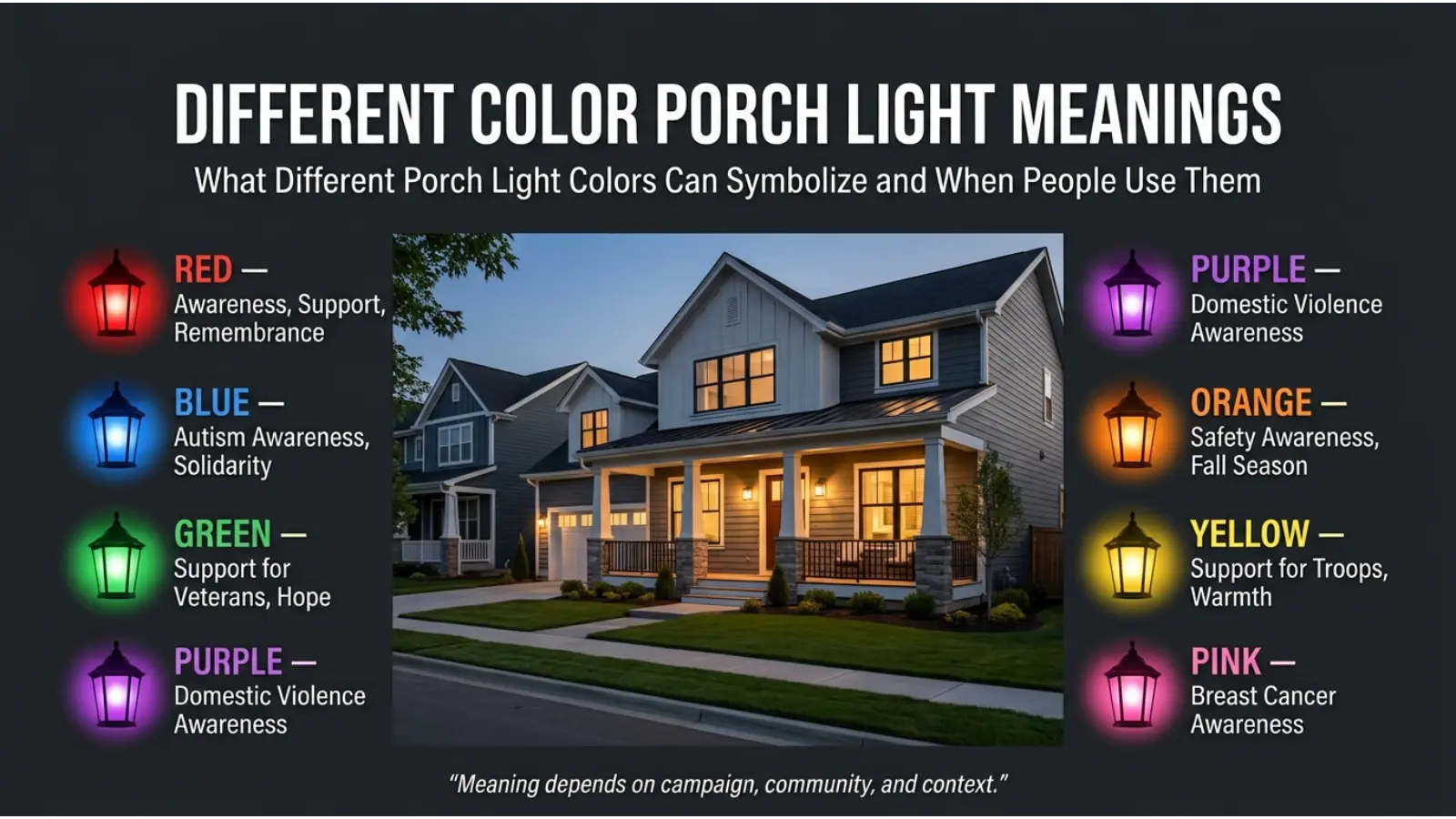
A porch light does more than brighten a doorway. Its color can create a mood, communicate a message, support a celebration, or simply make a home feel more welcoming. That is why people search for different color porch light meanings when they notice a blue, red, green, purple, or another unusual light outside a house.
However, porch-light colors do not have one universal dictionary. A color may have a common association, yet the actual meaning depends on the homeowner, community, holiday, awareness campaign, local tradition, or personal preference. A blue porch light, for example, may be connected with autism awareness, police support, or a completely personal design choice.
This guide separates established uses from general color symbolism. You will learn what common porch-light colors can communicate, how psychology affects color perception, how holidays and cultural events influence meanings, and how to choose a porch light color without sending an unintended message.
Quick Answer: What Do Different Porch Light Colors Mean?
Different porch light colors can have different meanings depending on context. Blue is often associated with calmness, support, awareness, or law enforcement. Red can suggest love, urgency, remembrance, or holiday celebration. Green is commonly connected with nature, renewal, St. Patrick’s Day, and military-veteran support in some campaigns. Purple can represent awareness, dignity, remembrance, or Halloween-style decoration. White usually communicates visibility, cleanliness, safety, and a neutral welcome. Orange often suggests warmth, autumn, Halloween, or energy, while pink is frequently associated with breast cancer awareness, compassion, and femininity.
| Porch Light Color | Common Associations | Typical Impression |
|---|---|---|
| 🔵 Blue | Calm, awareness, support, law enforcement | Peaceful and reassuring |
| 🔴 Red | Love, urgency, remembrance, holidays | Strong and attention-grabbing |
| 🟢 Green | Nature, renewal, military support, St. Patrick’s Day | Hopeful and welcoming |
| 🟣 Purple | Awareness, dignity, remembrance, Halloween | Mysterious and meaningful |
| ⚪ White | Safety, clarity, cleanliness, welcome | Neutral and bright |
| 🟠 Orange | Autumn, warmth, Halloween, energy | Friendly and energetic |
| 🩷 Pink | Awareness, compassion, care | Gentle and supportive |
| 🟡 Yellow | Happiness, warmth, caution | Cheerful and inviting |
| 🩵 Light Blue | Calm, trust, softness | Relaxed and peaceful |
| 🟦 Teal | Awareness, healing, creativity | Modern and distinctive |
What Do Different Color Porch Light Meanings Symbolize?
The symbolism of a porch light begins with the symbolism people already attach to color. Yet the light’s location adds another layer. A color displayed at a home’s entrance can feel more personal than the same color used on a wall or advertisement.
A blue porch light can feel calm and reassuring. A red porch light immediately attracts attention because red has a strong visual presence. Meanwhile, a green porch light may create a connection with nature, renewal, or a particular campaign.
The key is context. A red light in December may be holiday decoration, while the same red light during another month could represent an awareness event or simply match a home’s exterior.
Color also changes under different lighting conditions. A saturated LED can look much brighter than a soft bulb, and a cool white surrounding environment can make colored light appear different from the same bulb viewed against a dark street.
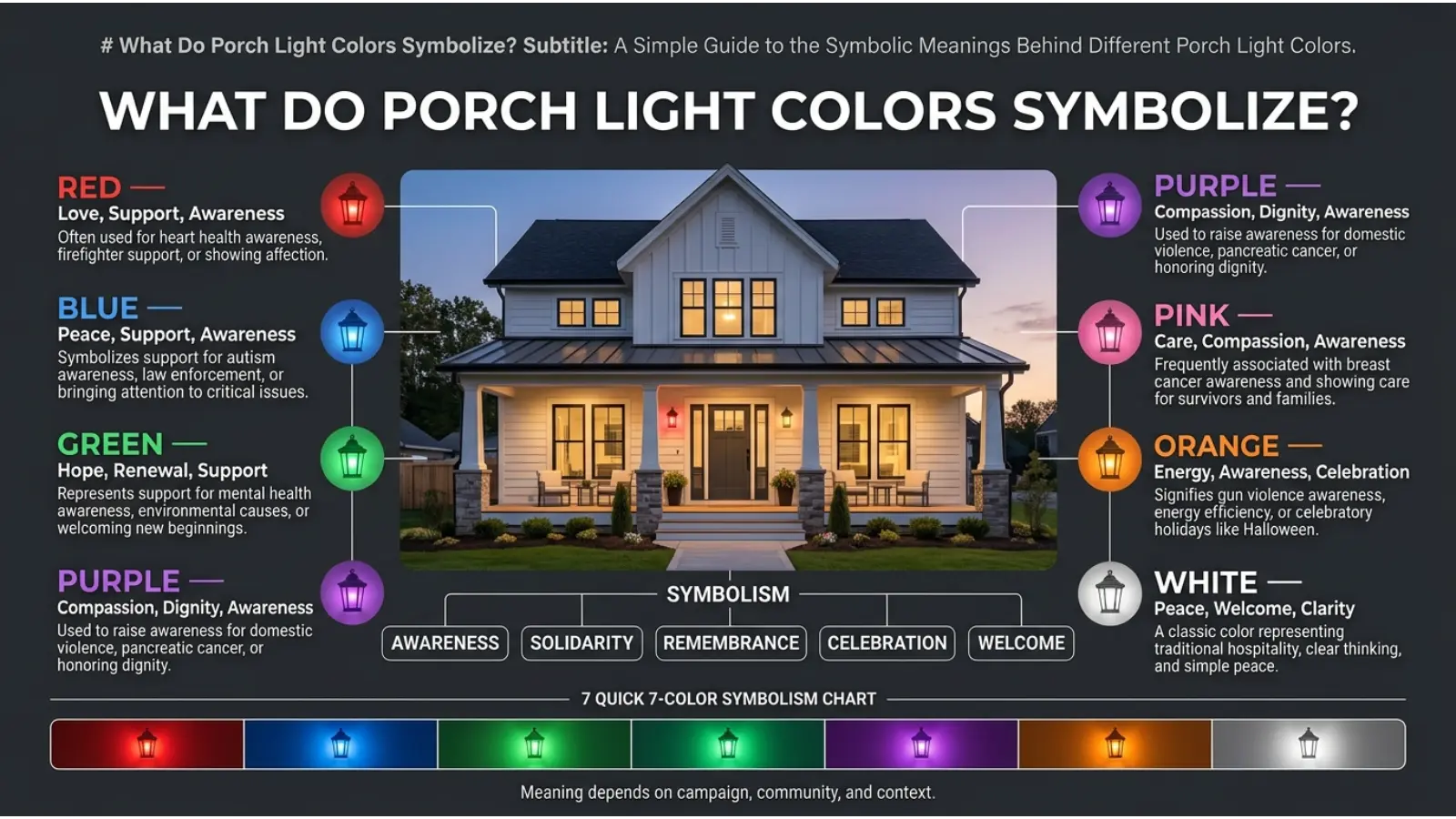
Blue Porch Light Meaning 🔵
Blue is one of the most recognizable porch-light colors.
It commonly creates associations with calm, trust, peace, support, and stability. In some contexts, blue porch lights have also been used to show support for law enforcement or awareness campaigns.
Blue became especially visible in public discussions around autism awareness because the color blue has been used in awareness campaigns connected with autism. However, awareness organizations and communities may use different colors or symbols, so a blue light should not automatically be interpreted as an official statement.
From a design perspective, blue works well when a homeowner wants an entrance to feel cool, peaceful, and modern.
Blue Porch Light Psychology
Blue wavelengths and color experiences can influence how people perceive an environment, but color psychology should not be treated as a simple formula. A blue light does not automatically make every person calmer.
Instead, perception develops from several factors, including brightness, saturation, surroundings, personal experience, and cultural learning.
A dim blue porch light may feel peaceful. A very bright electric-blue light can feel energetic or even futuristic.
Red Porch Light Meaning 🔴
Red is visually powerful and often communicates energy, passion, love, urgency, warning, or remembrance.
A red porch light may be used during holidays, community events, awareness campaigns, or personal celebrations. In some places, people have also used red lights for causes or memorial purposes.
Because red naturally attracts attention, it can make a doorway stand out more strongly than softer colors.
Red Porch Light Psychology
Red tends to produce a stronger visual response than many muted colors. It can suggest importance or excitement, but its effect depends heavily on intensity.
A soft red glow can create a warm, dramatic atmosphere. A bright red LED may feel more like a warning or signal.
For everyday home lighting, this difference matters. If your goal is hospitality, a deep warm-red accent can feel intentional, while a highly saturated red bulb may appear too intense.
Green Porch Light Meaning 🟢
Green commonly represents nature, renewal, growth, hope, freshness, and balance.
A green porch light may also be used for specific awareness or support campaigns. One well-known example is the use of green lighting to show support for military veterans in certain initiatives. Green is also strongly connected with St. Patrick’s Day and spring-themed decoration.
Because green has several established associations, the exact message cannot be determined from color alone.
Green Porch Light Psychology
Green sits between blue and yellow in traditional color models, which can give it both cool and warm visual qualities depending on the shade.
Dark emerald green can feel rich and elegant. Soft sage green can feel natural and restful. Bright lime green feels much more energetic.
This makes green especially flexible for exterior design.
Purple Porch Light Meaning 🟣
Purple often symbolizes dignity, awareness, remembrance, mystery, spirituality, and transformation.
The Purple porch lights have been used in various awareness campaigns, so the meaning can change according to the specific campaign and location. Purple is also popular for Halloween and other decorative events because it creates a mysterious nighttime atmosphere.
That historical association helped give purple a connection with luxury and prestige.
Purple Porch Light Psychology
Purple combines visual qualities associated with red and blue, so it can feel both energetic and calm. The result depends on the exact shade.
Lavender tends to look softer and more relaxed, while deep violet can appear dramatic and luxurious.
White Porch Light Meaning ⚪
White is usually the most neutral porch-light choice.
It commonly communicates visibility, cleanliness, simplicity, safety, clarity, and welcome rather than a specific social message.
For practical lighting, white is often the easiest choice because it provides useful illumination around steps, doors, pathways, and house numbers.
Warm White vs. Cool White
Not every white porch light looks the same.
Warm white has a yellow or golden appearance and usually creates a comfortable residential atmosphere.
Cool white has a bluer appearance and can make exterior areas look sharper and more modern.
For a traditional home, warm white often feels welcoming. For a contemporary property, cooler white can emphasize clean architectural lines.
Orange Porch Light Meaning 🟠
Orange is associated with warmth, energy, friendliness, autumn, creativity, and excitement.
It is especially common as a decorative porch-light color during Halloween and fall.
Orange also has strong visibility against dark backgrounds. That makes it useful when the goal is decorative impact rather than subtle illumination.
A soft amber bulb can create a cozy atmosphere, while bright orange LEDs can produce a playful or theatrical effect.
Pink Porch Light Meaning 🩷
The Pink lighting may appear during breast cancer awareness activities and other charitable or awareness events. However, as with other awareness colors, the exact campaign should be considered before assuming a particular meaning.
In home design, pink creates a softer atmosphere than red. Dusty rose and blush tones can feel sophisticated, while vivid hot pink produces a much more energetic effect.
Yellow Porch Light Meaning 🟡
Yellow commonly suggests happiness, warmth, friendliness, optimism, and energy.
A yellow porch light can make an entrance feel cheerful and noticeable. Warm yellow lighting is also common in traditional outdoor lamps because it creates a cozy nighttime appearance.
However, yellow can sometimes be associated with caution. The difference usually comes from context and brightness.
A soft golden light feels welcoming; a highly saturated yellow signal can feel more attention-oriented.
Light Blue Porch Light Meaning 🩵
Light blue tends to communicate peace, softness, trust, openness, and relaxation.
It can be a good decorative choice for coastal, minimalist, or modern homes. Compared with deep blue, light blue usually feels less formal and less intense.
Teal Porch Light Meaning
Teal combines qualities commonly associated with blue and green. It can suggest calmness, healing, freshness, communication, creativity, and awareness.
For home design, teal works particularly well when a homeowner wants something more distinctive than blue without the intensity of a bright green light.
Porch Light Color Meanings Chart
The following chart provides a practical starting point, but it should not be treated as a universal code.
| Color | Symbolic Associations | Common Decorative Uses | Overall Feel |
|---|---|---|---|
| 🔵 Blue | Calm, trust, support | Awareness, modern homes | Peaceful |
| 🔴 Red | Passion, urgency, love | Holidays, events | Powerful |
| 🟢 Green | Renewal, nature, hope | Spring, St. Patrick’s Day | Fresh |
| 🟣 Purple | Dignity, mystery, awareness | Halloween, awareness | Dramatic |
| ⚪ White | Clarity, safety, welcome | Everyday lighting | Clean |
| 🟠 Orange | Warmth, energy, autumn | Halloween, fall | Cheerful |
| 🩷 Pink | Care, compassion, awareness | Awareness events | Gentle |
| 🟡 Yellow | Happiness, warmth | Decorative lighting | Friendly |
| 🩵 Light Blue | Peace, softness | Coastal designs | Relaxed |
| 🟦 Teal | Freshness, creativity | Awareness, modern décor | Distinctive |
Why Do People Use Colored Porch Lights?
There is no single reason.
Some homeowners choose a colored bulb because they like the appearance. Others use one for a holiday, sports event, neighborhood activity, awareness campaign, memorial, or personal tradition.
A colored porch light can also become a form of environmental communication. Because the light is visible from outside, it can show that a household is participating in a shared event.
Still, viewers should avoid assuming a precise meaning without context.
The same purple light could be Halloween decoration in one neighborhood and an awareness display in another.
Psychology of Different Color Porch Light Meanings
Three factors are especially important:
Hue
Hue is the basic color family, such as blue, red, green, or purple.
Saturation
Saturation describes how intense or vivid a color appears. A muted green and a neon green can have very different emotional effects even though both are green.
Brightness
Brightness changes the perceived strength of the light. A dark blue glow may look elegant, while an extremely bright blue light may feel harsh.
These variables explain why simply naming a color does not fully describe its psychological effect.
Why Nighttime Changes Color Meaning
At night, the surroundings become darker, so colored light becomes much more noticeable.
A small colored bulb can therefore have a greater visual impact after sunset than it would during daylight.
The color also spills onto nearby surfaces. A blue bulb can make a white doorway appear blue, while a red bulb can tint steps, walls, and plants.
Consequently, porch-light selection is partly a lighting-design decision, not just a symbolism decision.
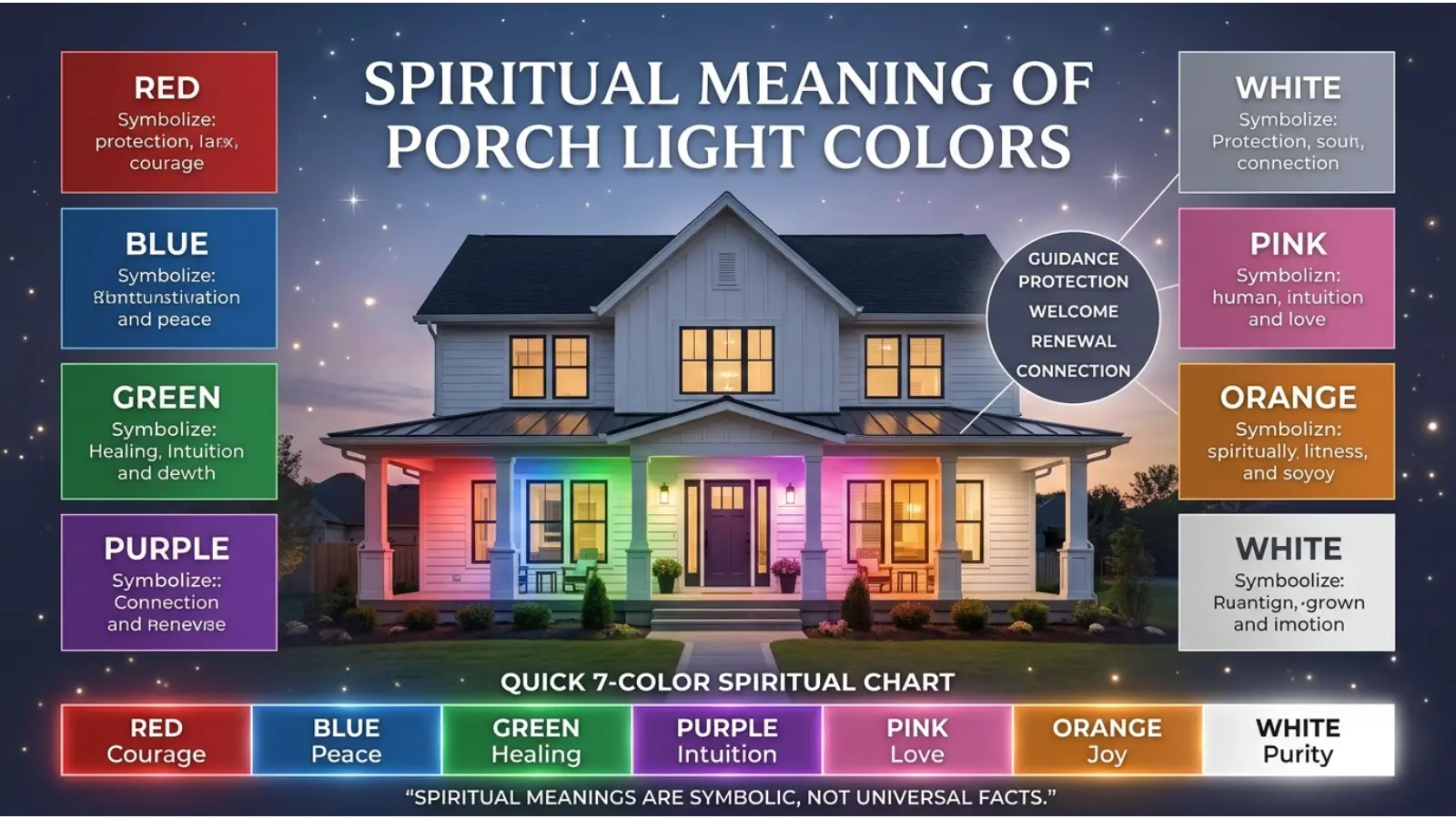
Spiritual Different Color Porch Light Meanings
Colored lights can have spiritual meanings in personal and cultural practices, but there is no universal spiritual code for porch-light colors.
People may personally associate colors with ideas such as protection, healing, hope, transformation, peace, or spiritual energy. Those associations can come from religious traditions, cultural practices, meditation systems, personal experiences, or modern spiritual communities.
For example, green may personally represent renewal, while purple may represent spiritual reflection. These are symbolic interpretations rather than universal rules.
It is therefore better to say that a color can symbolize something rather than claiming that every colored porch light has an established spiritual message.
Cultural Different Color Porch Light Meanings
Color meanings vary across cultures and communities.
Green may suggest nature, renewal, luck, or particular celebrations.
In East Asian cultures, colors can carry different historical and ceremonial associations. Red, for example, has important positive associations in Chinese culture, including celebration, prosperity, and good fortune.
Across African, Middle Eastern, Latin American, Indigenous, and other cultural traditions, colors can also carry meanings shaped by local history, textiles, ceremonies, religion, nature, and social customs.
However, culture should never be treated as a single fixed system. Meanings vary between countries, generations, communities, and situations.
Historical Meaning of Colored Light
Colored outdoor lighting became increasingly flexible as electric lighting technology developed. Earlier outdoor lights were mainly practical sources of illumination, while modern LED technology makes it inexpensive to change color for decoration and events.
The spread of programmable LEDs has made color-changing porch lights common in homes. As a result, colored lighting now serves several purposes at once: decoration, mood creation, event participation, and symbolic communication.
This is an important shift. The technology has made temporary color symbolism much easier than it was when outdoor lighting depended mainly on fixed bulbs or candles.
Personality Associations With Porch Light Colors
People sometimes choose colors that reflect the atmosphere they want around their home.
Someone who prefers blue lighting may enjoy calm, cool, or orderly environments. A person who chooses bright orange might enjoy energetic and playful decoration. Someone who selects green may appreciate natural-looking design.
However, color preference does not determine personality.
Therefore, personality associations are best viewed as tendencies in perception rather than psychological diagnoses.
Different Color Porch Light Meanings in Home Design
A porch light should work with the house rather than compete with it.
Traditional Homes
Warm white, soft yellow, or muted amber usually complements brick, stone, wood, and traditional architectural details.
Modern Homes
Cool white, blue, teal, or carefully controlled purple can work with modern materials and clean lines.
Rustic Homes
Warm white, amber, orange, and earthy green shades can reinforce natural materials.
Seasonal Decoration
Red and green work well during winter holidays, orange and purple during Halloween, and green during spring celebrations.
The best result usually comes from treating the colored light as an accent rather than making every exterior element the same color.
How Lighting Changes Porch Light Colors
A bulb’s color temperature and brightness can change how a colored light looks.
A colored LED placed beside warm white lighting may appear different from the same LED beside cool white lighting.
Weather can also affect perception. Fog, rain, snow, and moisture can scatter light and make colors appear softer or more diffuse.
Surrounding surfaces matter too. A dark brick wall absorbs more light than a pale exterior, while white siding can reflect a colored glow across a larger area.
This is why testing a bulb after sunset is often more useful than judging it in daylight.
Porch Light Colors in Fashion and Lifestyle Design
Although porch lighting is not fashion in the traditional sense, the same color principles used in clothing can influence exterior styling.
For example, homeowners may coordinate a green porch light with seasonal greenery, a purple light with decorative flowers, or a red light with holiday accessories.
Color coordination creates visual unity.
The goal does not have to be an exact color match. Complementary or analogous colors can produce a more balanced appearance.
Best Color Combinations for Porch Lighting
| Light Color | Works Well With | Design Effect |
|---|---|---|
| 🔵 Blue | White, gray, silver | Cool and modern |
| 🔴 Red | White, black, gold | Bold and dramatic |
| 🟢 Green | Brown, cream, white | Natural and fresh |
| 🟣 Purple | White, silver, dark gray | Elegant and mysterious |
| 🟠 Orange | Brown, cream, dark green | Warm and seasonal |
| 🩷 Pink | White, gray, soft green | Gentle and playful |
| 🟡 Yellow | Brown, navy, white | Cheerful and welcoming |
| ⚪ Warm White | Wood, brick, stone | Classic and comfortable |
When combining several colors, restraint usually produces a better result. Two coordinated colors often look more polished than a large collection of unrelated colors.
Real-World Uses of Colored Porch Lights
Colored porch lights appear in many everyday situations.
Daily life: Homeowners use them to create atmosphere or distinguish their homes.
Holidays: Red, green, orange, purple, and other colors can reinforce seasonal decoration.
Memorials: Families may use a particular color as a personal symbol of remembrance.
Sports: Fans sometimes illuminate homes using team colors.
Entertainment: Programmable LEDs can create dramatic effects for parties and themed events.
Business: Some small businesses use exterior lighting as part of a recognizable visual identity.
Photography: Colored porch lights can provide practical accent lighting for nighttime portraits and architectural photographs.
How to Choose a Porch Light Color
Start with your purpose.
If you want everyday visibility, warm white is usually the simplest choice.
If you want a calm atmosphere, blue or soft green may work.
For holiday decoration, choose a color connected with the season.
For an awareness campaign, check the official information for that campaign rather than relying on general color symbolism.
Modern decoration, teal, blue, purple, or cool white can create a contemporary look.
Most importantly, consider your neighbors. Extremely bright or rapidly changing lights can create glare and may be distracting.
Common Misconceptions About Porch Light Meanings
Every colored porch light has one official meaning
False. Many colors have several associations, and some lights have no symbolic meaning at all.
A blue porch light always means the same thing
Not necessarily.
A red porch light always means danger
No. Red can represent holidays, love, remembrance, awareness, decoration, or personal preference.
Purple porch lights always have a spiritual meaning
No. Purple can be decorative, cultural, seasonal, awareness-related, or personally symbolic.
Colored porch lights are always messages to neighbors
Not necessarily. Many homeowners simply like the way colored lighting looks.
Color psychology predicts exactly how people will react
Color psychology is more complicated than assigning one emotion to each hue. Brightness, context, culture, personal experience, and surrounding colors all matter.
Frequently Asked Questions
What is the most common meaning of a blue porch light?
Blue is commonly associated with calmness, trust, support, awareness, and certain community or law-enforcement-related displays. However, the homeowner may simply prefer blue lighting.
What does a red porch light mean?
A red porch light can symbolize love, passion, remembrance, urgency, or a holiday. Its meaning depends strongly on the context in which it is being used.
What does a green porch light mean?
Green commonly represents nature, renewal, hope, and growth.
What does a purple porch light mean?
Purple can represent dignity, awareness, remembrance, mystery, or transformation. It is also popular for Halloween and decorative nighttime lighting.
What does a white porch light mean?
White usually has a practical and neutral meaning. It provides visibility and can create a clean, safe, welcoming appearance around an entrance.
What does an orange porch light mean?
Orange is commonly connected with warmth, energy, autumn, and Halloween. It can create a cheerful and highly visible decorative effect.
Does a porch light color have a universal meaning?
No. Some colors have widely recognized associations, but there is no universal porch-light color code that applies everywhere.
Can porch lights have spiritual meanings?
They can have personal or tradition-based spiritual meanings, but these interpretations vary.
Why do people put colored lights on their porches?
People use them for decoration, holidays, awareness campaigns, celebrations, memorials, personal symbolism, and home ambiance. Often, there is no deeper message.
Can colored porch lights affect mood?
Lighting can influence how an environment feels, but the effect depends on color, brightness, context, and individual experience. Color should not be treated as a guaranteed mood changer.
Final Thoughts on Different Color Porch Light Meanings
The meaning of a porch light begins with color, but it does not end there. Different color porch light meanings are shaped by context, culture, personal choice, seasonal events, awareness campaigns, and the way light interacts with the surrounding environment.
Blue can feel peaceful, red can feel powerful, green can suggest renewal, purple can create mystery, orange can bring warmth, and white can provide a neutral sense of clarity. Yet none of these meanings should be assumed to be universal.
That is what makes porch lighting interesting. A small light at the entrance of a home can function as decoration, practical illumination, emotional design, or symbolic communication at the same time.
When choosing a porch light, think beyond the color name. Consider the shade, brightness, architecture, season, neighborhood, and message you actually want people to receive. In many cases, the most effective color is simply the one that creates the right atmosphere while remaining practical and respectful of the people around you.

Emma Wilson is a dedicated comparison writer and product researcher at ColorMystiic.com. She specializes in creating unbiased product comparisons, detailed reviews, and helpful buying guides. Her goal is to help readers make smarter purchasing decisions with confidence.