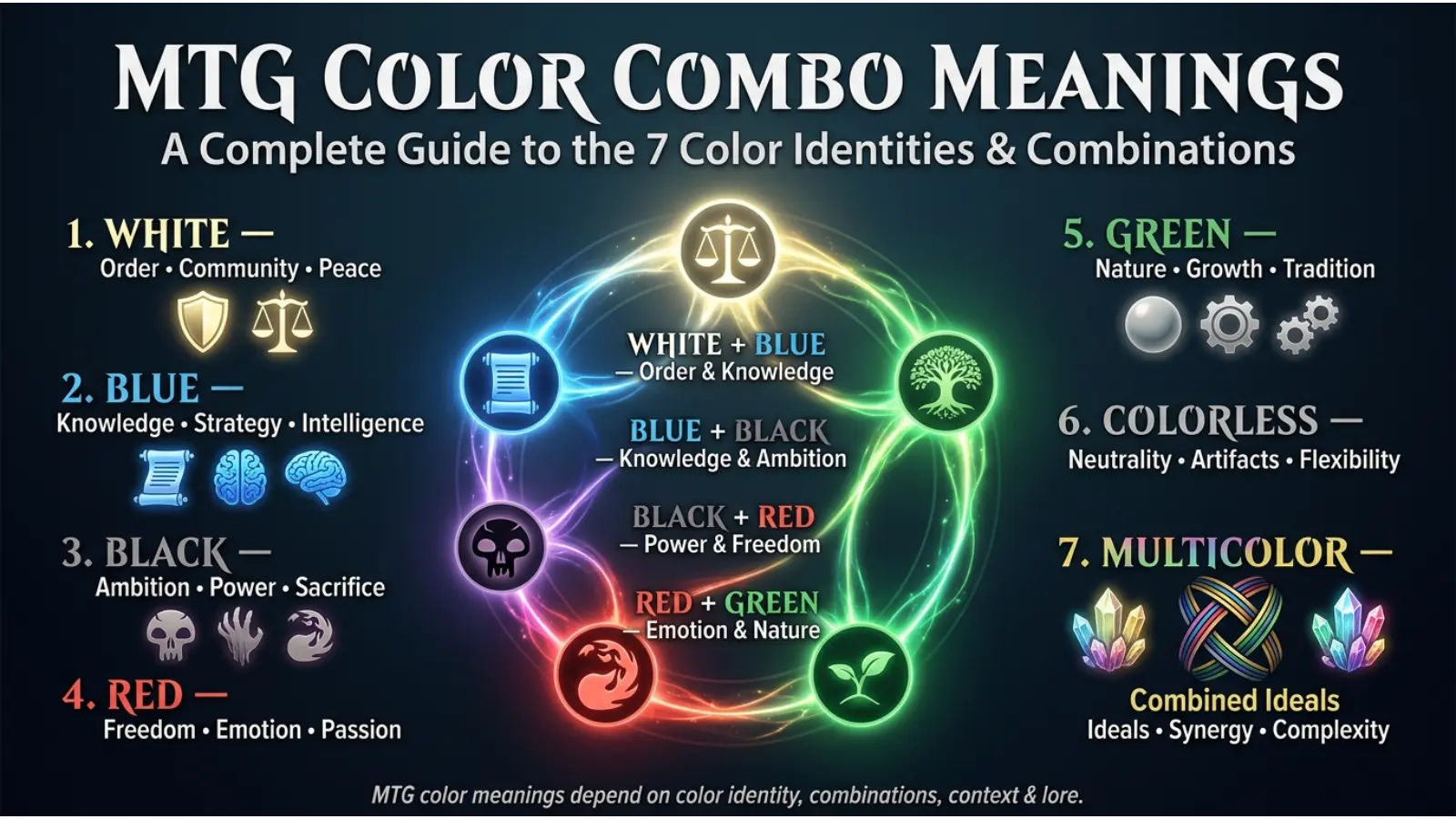
The Gathering uses five colors to represent different philosophies, strengths, weaknesses, and ways of solving problems. When two or more colors work together, their philosophies create a new identity that can feel very different from either color alone. That is why people search for MTG color combo meanings when they want to understand what a deck’s colors say about its strategy, personality, and worldview.
These meanings are not the same as ordinary color psychology. In Magic: The Gathering, color symbolism comes primarily from the game’s color pie, its mechanics, its lore, and the philosophies associated with each color. A color combination can therefore describe both how a deck plays and the kind of values it represents.
Quick Answer: MTG color combo meanings describe the shared philosophy and gameplay identity created when Magic’s five colors—White, Blue, Black, Red, and Green—are combined. Two-color pairs are commonly known as guilds, while three-color combinations include shards and wedges. Four- and five-color decks create broader identities by combining multiple philosophies.
Understanding the Five MTG Colors
Before looking at combinations, it helps to understand what each individual color stands for. The five colors are not simply “good,” “bad,” or emotional colors. Each one represents a different answer to the question of how the world should work.
| Color | Symbol | Core Philosophy | Common Strengths | Common Weaknesses |
|---|---|---|---|---|
| ⚪ White | W | Order, peace, community | Defense, teamwork, rules | Individual freedom, flexibility |
| 🔵 Blue | U | Knowledge, perfection, possibility | Card advantage, control, adaptation | Slow development, dependence on setup |
| ⚫ Black | B | Ambition, power, self-interest | Removal, sacrifice, resource use | Life loss, graveyard risks, greed |
| 🔴 Red | R | Freedom, emotion, action | Speed, damage, impulsive plays | Limited long-term planning |
| 🟢 Green | G | Growth, nature, instinct | Mana, creatures, resilience | Difficulty answering some noncreature threats |
The important idea is that every color has strengths and weaknesses. White can create order, but too much order can become restrictive. Blue seeks knowledge and improvement, but excessive planning can become detached from reality. Black values power and personal choice, yet its pursuit of advantage can carry serious costs.
Likewise, Red represents freedom and emotion rather than simply anger. Green represents acceptance of natural growth rather than merely nature-themed creatures.
This balance is the foundation of MTG color combo meanings.
What Do MTG Color Combo Meanings?
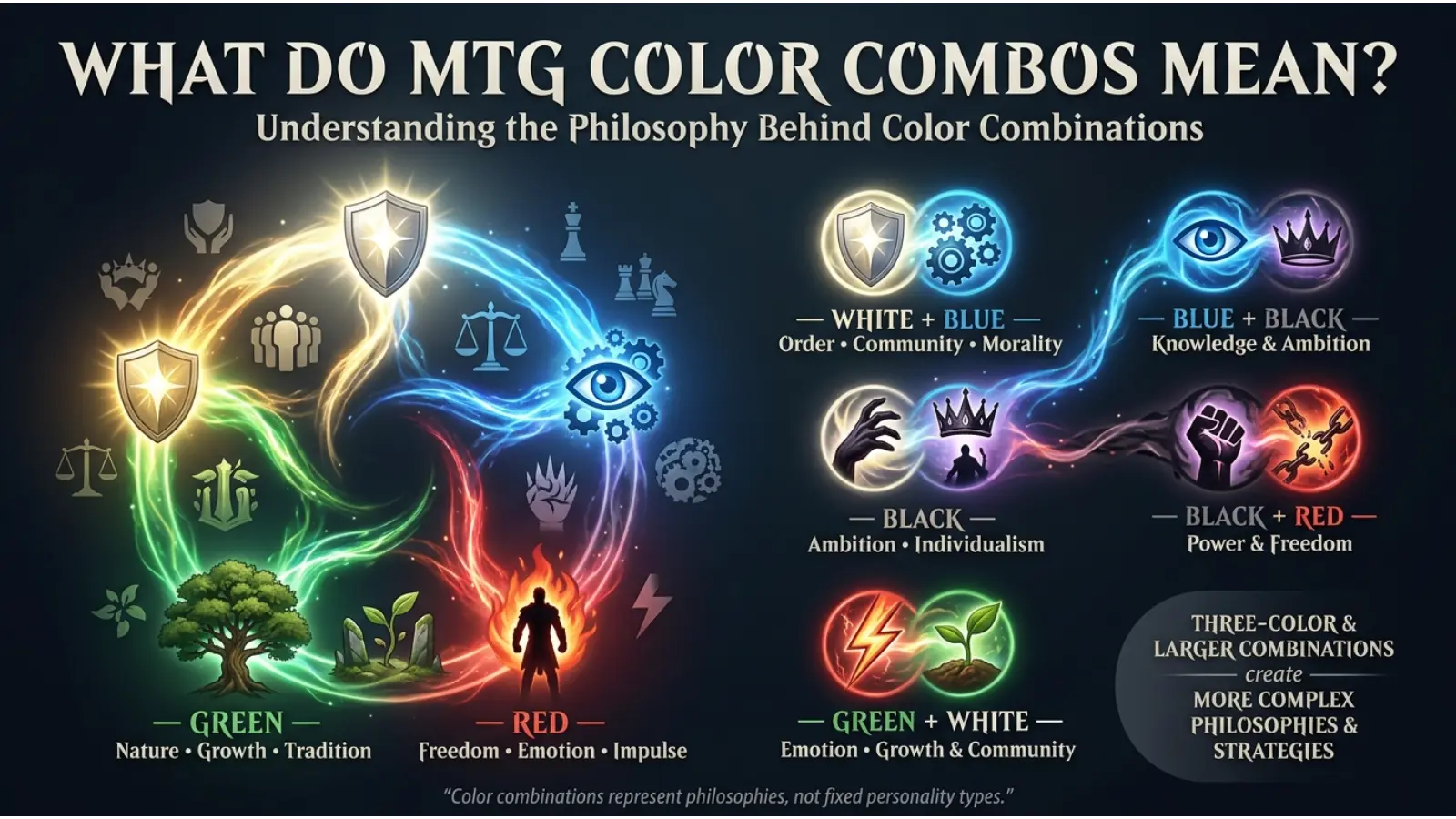
A color combination represents a philosophical meeting point.
For example, White and Blue both value structure, but they approach it differently. White looks toward social order and collective stability, while Blue focuses on knowledge, planning, and improvement. Together, they create an identity strongly associated with control, preparation, and careful decision-making.
Red and Green provide a very different combination. Both value natural action and freedom, but Red emphasizes immediate emotion while Green trusts instinct and natural growth. Their combination often feels aggressive, creature-focused, and less interested in elaborate plans.
This is why color combinations can be useful when choosing a deck. They tell you more than what cards are available. They also hint at how you want to solve problems.
MTG Two-Color Combo Meanings
Magic’s ten two-color combinations are among the easiest ways to understand the color pie. Each pair combines two philosophies while also revealing tensions between them.
⚪🔵 White-Blue — Azorius
Core meaning: Order, planning, law, knowledge, and control.
White-Blue combines White’s desire for structure with Blue’s pursuit of information and perfection. The result is one of the most methodical identities in Magic.
Azorius strategies often reward patience. Instead of winning through raw speed, they may prevent opponents from acting effectively, protect important resources, and gradually establish control.
Personality association: Analytical, organized, disciplined, patient, and strategic.
Gameplay identity: Counterspells, defensive creatures, removal, card selection, taxation effects, and control.
Best for players who enjoy: Planning several turns ahead and making opponents play on your terms.
The deeper meaning is the tension between rules and knowledge. White asks, “How should society function?” Blue asks, “How can we understand and improve it?” Together, they seek a carefully managed system.
⚪⚫ White-Black — Orzhov
Core meaning: Structure, power, obligation, wealth, and hierarchy.
White-Black is especially interesting because the colors share an appreciation for organization but disagree about its purpose. White wants order for stability and community, while Black is willing to use hierarchy and power for personal advantage.
This combination often explores contracts, debts, sacrifice, status, and the price of security.
Personality association: Practical, ambitious, disciplined, calculating, and socially aware.
Gameplay identity: Life-drain, sacrifice, removal, tokens, recursion, and value from creatures entering or leaving the battlefield.
Best for players who enjoy: Turning resources, including creatures and life, into long-term advantage.
Its central question could be summarized as: What are you willing to give up to gain power and security?
⚪🔴 White-Red — Boros
Core meaning: Community, courage, justice, action, and conviction.
White-Red combines White’s sense of justice and community with Red’s passion and freedom. Rather than carefully debating every decision, Boros often acts when it believes something must be done.
This produces an identity associated with teamwork and direct action.
Personality association: Courageous, passionate, loyal, energetic, and idealistic.
Gameplay identity: Aggressive creatures, combat tricks, equipment, tokens, direct damage, and combat-focused strategies.
Best for players who enjoy: Attacking, teamwork, and making decisive plays.
The interesting contrast is that White supplies the cause, while Red supplies the passion to act on it.
⚪🟢 White-Green — Selesnya
Core meaning: Community, harmony, growth, cooperation, and tradition.
White-Green combines White’s community-focused philosophy with Green’s belief in natural growth and interconnectedness.
The result often emphasizes creatures working together rather than individual cards acting alone.
Personality association: Cooperative, patient, traditional, nurturing, and community-minded.
Gameplay identity: Creature armies, +1/+1 counters, tokens, life gain, mana development, and board-wide benefits.
Best for players who enjoy: Building a strong board and making many creatures work together.
Its philosophical strength comes from the idea that individual strength can become greater through community.
🔵⚫ Blue-Black — Dimir
Core meaning: Information, secrecy, ambition, manipulation, and strategy.
Blue wants knowledge. Black wants power. When combined, information can become a weapon.
Dimir is therefore strongly associated with secrecy, espionage, deception, and carefully calculated advantage.
Personality association: Mysterious, intelligent, independent, observant, and calculating.
Gameplay identity: Discard, counterspells, evasive creatures, graveyard strategies, card advantage, and manipulation.
Best for players who enjoy: Winning through information and making opponents uncertain about your plans.
Dimir demonstrates an important principle of the color pie: knowledge becomes especially dangerous when combined with unrestricted ambition.
🔵🔴 Blue-Red — Izzet
Core meaning: Curiosity, creativity, experimentation, invention, and unpredictability.
Blue seeks understanding and Red seeks freedom. Together, they create a philosophy that loves experimentation.
Izzet is often associated with scientists, inventors, spellcasters, and people who would rather test an idea than follow an established process.
Personality association: Curious, inventive, energetic, rebellious, and intellectually playful.
Gameplay identity: Instants, sorceries, spells-matter effects, card draw, copying spells, and direct damage.
Best for players who enjoy: Combining cards in clever ways and discovering unexpected interactions.
Izzet’s central tension is simple: Blue wants the experiment to work; Red wants to see what happens.
🔵🟢 Blue-Green — Simic
Core meaning: Adaptation, evolution, knowledge, growth, and improvement.
Blue and Green disagree about how change should happen. Blue believes improvement can be achieved through knowledge and deliberate modification. Green trusts natural development and adaptation.
Together, they produce one of Magic’s clearest identities around growth through adaptation.
Personality association: Curious, adaptable, patient, observant, and improvement-focused.
Gameplay identity: Ramp, card draw, +1/+1 counters, creatures that grow, and powerful creatures supported by resources.
Best for players who enjoy: Developing a strong board while gaining resources over time.
Simic asks a fascinating question: Can nature and deliberate improvement work together?
⚫🔴 Black-Red — Rakdos
Core meaning: Freedom, passion, ambition, destruction, and indulgence.
Black-Red rejects many restrictions. Black wants to pursue its desires without moral limits, while Red wants to live freely and emotionally.
The combination therefore often represents intense experiences and immediate consequences.
Personality association: Bold, passionate, rebellious, independent, daring, and impulsive.
Gameplay identity: Aggression, sacrifice, direct damage, removal, discard, and graveyard value.
Best for players who enjoy: Fast pressure, risky decisions, and explosive turns.
Rakdos is not simply “evil.” Its deeper philosophy is about refusing to let outside rules determine what you should want or do.
⚫🟢 Black-Green — Golgari
Core meaning: Death, renewal, survival, decay, resources, and natural cycles.
Black accepts death as a resource. Green accepts death as part of the natural cycle. Their combination creates one of Magic’s strongest themes of life emerging from decay.
Personality association: Resilient, practical, patient, realistic, resourceful, and accepting of difficult realities.
Gameplay identity: Graveyard recursion, sacrifice, creatures, removal, self-mill, and incremental value.
Best for players who enjoy: Using the graveyard as a resource and getting value from things that have already died.
Golgari’s central lesson is that an ending can become another resource.
🔴🟢 Red-Green — Gruul
Core meaning: Freedom, instinct, strength, nature, emotion, and independence.
Red and Green both resist excessive control. Red trusts emotion and personal freedom, while Green trusts instinct and natural order.
Their combination often favors direct, physical solutions.
Personality association: Independent, energetic, instinctive, adventurous, passionate, and straightforward.
Gameplay identity: Large creatures, mana acceleration, combat, direct damage, and aggressive strategies.
Best for players who enjoy: Attacking with powerful creatures and solving problems through action.
Gruul represents the belief that sometimes the strongest answer is simply to act.
MTG Three-Color Combo Meanings
Three-color combinations create more complicated identities because three philosophies must coexist. Magic commonly groups these combinations into shards and wedges.
⚪🔵⚫ Esper
Core meaning: Order, knowledge, ambition, control, and perfection.
Esper combines White, Blue, and Black. It brings together structure, intellect, and personal ambition.
Its philosophy can feel highly calculated because each color contributes a different form of control.
Typical identity: Artifacts, control, removal, card advantage, and highly efficient resource management.
Personality association: Strategic, sophisticated, analytical, ambitious, and precise.
⚪🔵🔴 Jeskai
Core meaning: Knowledge, freedom, discipline, creativity, and mastery.
Jeskai combines Blue’s intellect, Red’s passion, and White’s discipline.
Rather than choosing between planning and action, Jeskai often represents mastering both.
Typical identity: Spells, prowess-style creatures, tempo, combat tricks, and flexible interaction.
Personality association: Creative, disciplined, curious, energetic, and skilled.
🔵⚫🔴 Grixis
Core meaning: Ambition, knowledge, freedom, death, and power.
Grixis brings together Blue’s knowledge, Black’s ambition, and Red’s emotional freedom.
The combination tends to value individual power rather than social stability or natural harmony.
Typical identity: Removal, graveyards, spells, sacrifice, direct damage, and resource manipulation.
Personality association: Independent, clever, ambitious, unpredictable, and pragmatic.
⚫🔴🟢 Jund
Core meaning: Survival, instinct, strength, ambition, and natural power.
Jund combines Black, Red, and Green. All three colors emphasize individual strength in different ways.
Black seeks advantage, Red follows instinct, and Green trusts natural strength.
Typical identity: Powerful creatures, removal, sacrifice, graveyard value, and aggressive midrange strategies.
Personality association: Tough, practical, instinctive, ambitious, and resilient.
🔴🟢⚪ Naya
Core meaning: Life, community, strength, growth, and passion.
Naya combines Red’s energy, Green’s natural growth, and White’s community.
The result emphasizes creatures, teamwork, vitality, and physical strength.
Typical identity: Creature-heavy strategies, tokens, combat, buffs, and powerful board presence.
Personality association: Warm, energetic, loyal, optimistic, and community-oriented.
🔵⚫⚪ — Abzan
Core meaning: Endurance, discipline, sacrifice, resilience, and tradition.
Abzan brings together White’s order, Black’s willingness to use sacrifice, and Green’s resilience.
Its identity often centers on surviving pressure and turning losses into future strength.
Typical identity: +1/+1 counters, creatures, graveyard value, recursion, and long-game strategies.
Personality association: Patient, resilient, disciplined, protective, and determined.
⚫🔴🔵 — Sultai
Core meaning: Ambition, knowledge, survival, manipulation, and adaptability.
Sultai combines Black’s ambition, Blue’s intellect, and Green’s acceptance of natural growth.
The result is a philosophy where knowledge and resources are used aggressively to survive and prosper.
Typical identity: Graveyards, powerful creatures, card advantage, ramp, and resource manipulation.
Personality association: Intelligent, calculating, adaptable, ambitious, and pragmatic.
🔴🟢🔵 — Temur
Core meaning: Instinct, freedom, growth, strength, and discovery.
Temur combines Green’s natural strength, Red’s freedom, and Blue’s curiosity.
It represents a balance between instinctive action and intellectual discovery.
Typical identity: Ramp, large creatures, spells, card advantage, and explosive turns.
Personality association: Adventurous, curious, independent, energetic, and instinctive.
🟢⚪🔵 — Bant
Core meaning: Community, order, growth, knowledge, and cooperation.
Bant combines White’s structure, Blue’s intellect, and Green’s natural development.
It often emphasizes cooperation rather than individual destruction.
Typical identity: Creatures, counters, protection, value, and organized board development.
Personality association: Calm, cooperative, disciplined, thoughtful, and patient.
🔵⚫🔴 — Grixis
Core meaning: Knowledge, ambition, freedom, and individual power.
Grixis is the three-color identity formed by Blue, Black, and Red. It combines three philosophies that strongly prioritize personal agency.
It often feels unpredictable because Blue plans, Black exploits opportunities, and Red acts quickly.
Typical identity: Spells, removal, graveyard interactions, discard, and flexible control.
Personality association: Clever, independent, ambitious, creative, and unpredictable.
Shards and Wedges: Why the Three-Color Names Matter
Three-color MTG combinations are often divided into two broad groups.
Shards contain three colors that sit next to one another around the color wheel, leaving one color out.
| Shard | Colors | Core Feel |
|---|---|---|
| Esper | ⚪🔵⚫ | Control and perfection |
| Grixis | 🔵⚫🔴 | Ambition and power |
| Jund | ⚫🔴🟢 | Survival and strength |
| Naya | 🔴🟢⚪ | Life and community |
| Bant | 🟢⚪🔵 | Cooperation and order |
Wedges contain one central color and its two enemy colors.
| Wedge | Colors | Core Feel |
|---|---|---|
| Abzan | ⚪⚫🟢 | Endurance and resilience |
| Jeskai | 🔵🔴⚪ | Skill and creativity |
| Sultai | ⚫🟢🔵 | Ambition and adaptation |
| Mardu | 🔴⚪⚫ | Action and conquest |
| Temur | 🟢🔵🔴 | Instinct and discovery |
The exact mechanical identity of a color combination can change between sets, but these philosophical foundations remain useful when interpreting the colors.
⚪🔴⚫ Mardu — Action, Ambition, and Conquest
Mardu combines White, Red, and Black. White supplies organization and teamwork, Red supplies speed and passion, and Black adds ambition.
The combination often feels aggressive and decisive.
Personality association: Bold, competitive, courageous, ambitious, and action-oriented.
Gameplay identity: Aggression, combat, tokens, sacrifice, removal, and efficient threats.
Mardu asks: How quickly can a determined group achieve its goal?
Four-Color MTG Combinations
Four-color combinations are unusual because they contain almost the entire color pie while deliberately excluding one color.
Their meanings are often best understood by asking which philosophy is missing.
| Combination | Missing Color | General Identity |
|---|---|---|
| ⚪🔵⚫🔴 | 🟢 Green | Civilization, intellect, ambition, action |
| 🔵⚫🔴🟢 | ⚪ White | Individual freedom and survival |
| ⚫🔴🟢⚪ | 🔵 Blue | Instinct, community, action, growth |
| 🔴🟢⚪🔵 | ⚫ Black | Community, growth, knowledge, creativity |
| 🟢⚪🔵⚫ | 🔴 Red | Structure, knowledge, ambition, growth |
The missing color is often as important as the four colors that remain.
For example, a four-color combination without Green lacks Green’s philosophy of natural growth and acceptance. A four-color combination without Red lacks Red’s emphasis on emotion, spontaneity, and personal freedom.
Five-Color MTG — The Meaning of All Colors
⚪🔵⚫🔴🟢 Five-color Magic represents the full color pie.
Instead of choosing one philosophy, five-color strategies can draw from all five.
Core meaning: Diversity, possibility, completeness, balance, and unrestricted access to different philosophies.
However, five colors do not automatically mean perfect balance. In gameplay, managing a five-color mana base can create significant challenges.
Philosophically, five-color Magic suggests that no single color contains every answer. Each philosophy contributes something valuable while also carrying limitations.
That makes five-color identity especially useful when thinking about the color pie as a whole.
MTG Color Combo Personality Meanings
Players often use MTG colors as a way to describe their personalities. This can be fun, but it should not be treated as a scientific personality test.
A player who enjoys Blue decks is not necessarily more intelligent. Someone who plays Red is not automatically impulsive. Likewise, choosing Black does not mean someone has a dark personality.
Instead, color preferences may reflect the types of decisions and stories a player finds enjoyable.
| MTG Colors | Common Personality Association |
|---|---|
| ⚪ White | Organized, cooperative, principled |
| 🔵 Blue | Curious, analytical, strategic |
| ⚫ Black | Independent, ambitious, pragmatic |
| 🔴 Red | Passionate, spontaneous, expressive |
| 🟢 Green | Patient, instinctive, grounded |
| ⚪🔵 | Logical and structured |
| 🔵🔴 | Creative and experimental |
| ⚫🔴 | Rebellious and passionate |
| ⚫🟢 | Resilient and practical |
| 🔴🟢 | Independent and energetic |
These are symbolic associations, not established psychological measurements.
The Psychology Behind MTG Color Combo Meanings
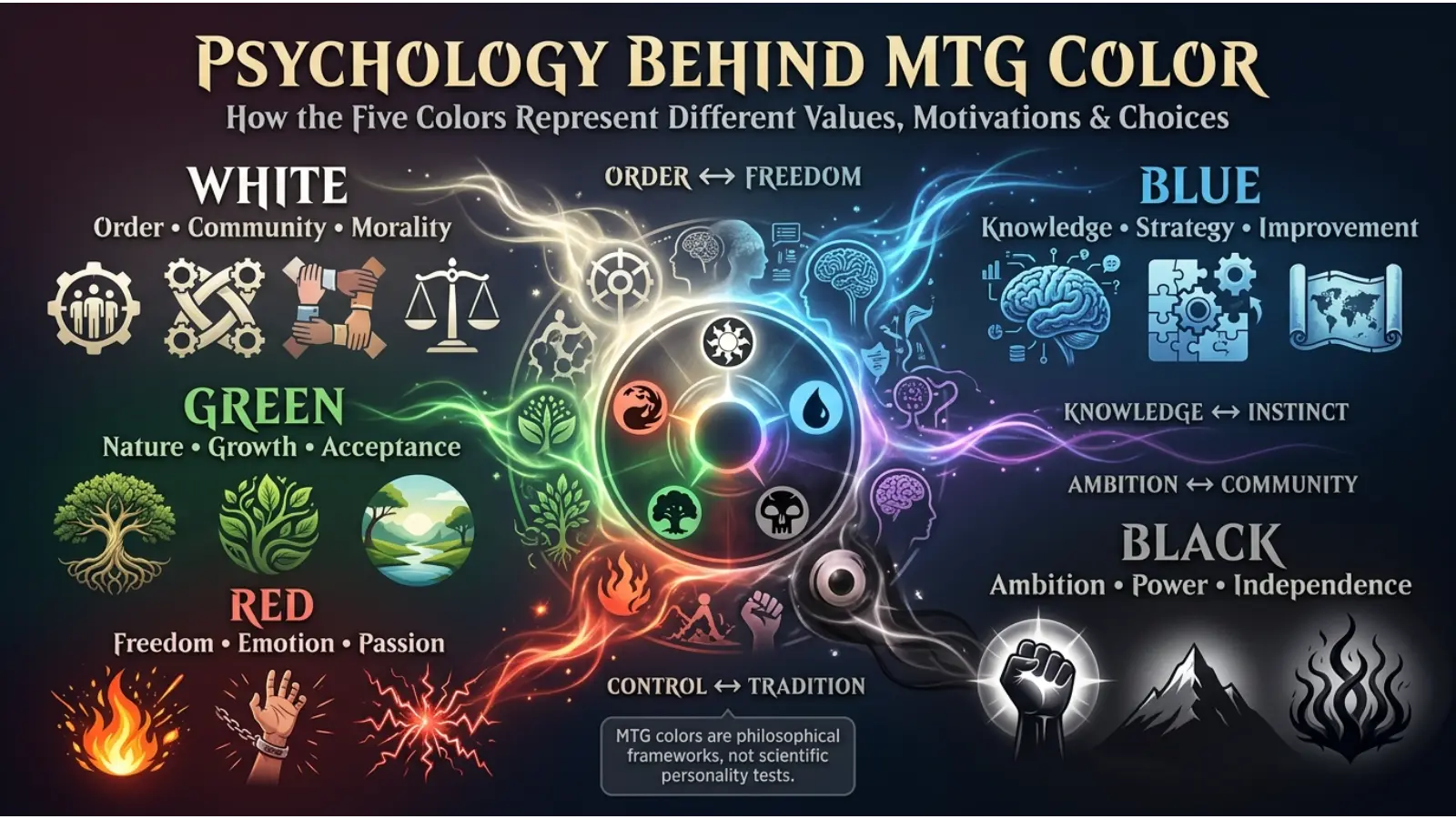
MTG color philosophy can feel psychologically powerful because the colors turn abstract values into visible game choices.
A player who repeatedly chooses White may enjoy coordinated strategies and clear rules. A Blue player may enjoy information and prediction. A Red player may enjoy immediate decisions and dramatic swings.
Yet gameplay preference can also depend on experience, competition, favorite cards, artwork, lore, or the simple enjoyment of a particular mechanic.
That distinction matters. MTG color philosophy is a fictional philosophical framework, not a clinical or scientific personality system.
How Color Combinations Influence Gameplay
The strongest practical meaning of an MTG color combination comes from what it allows you to do during a game.
Consider the difference between these pairs:
White-Blue: Prevent problems, control the pace, and gain information.
Black-Red: Create pressure, trade resources, and punish weaknesses.
Blue-Green: Build resources, adapt, and grow stronger.
Red-Green: Develop powerful threats and attack quickly.
White-Green: Build a wide board and make creatures stronger together.
These combinations can overlap mechanically, but their decision-making patterns remain different.
That is why understanding the color pie can improve deck-building. Instead of asking only, “What cards are powerful?” you can ask, “What kinds of problems does my color combination naturally solve?”
MTG Color Combo Meanings Combinations and Deck Strategy
Your colors affect several major areas of deck construction.
Mana
Adding more colors gives you access to more effects, but it also makes mana management harder.
A two-color deck usually has fewer color requirements than a four- or five-color deck. Therefore, the power gained from additional colors must be balanced against consistency.
Removal
Different colors answer threats differently.
White often uses exile, destruction, or restrictive effects. Blue frequently relies on countering, returning, or manipulating spells and permanents. Black is known for creature removal. Red commonly uses damage. Green excels at dealing with many creatures, artifacts, and enchantments through its own style of interaction.
Because of this, color combinations can compensate for individual weaknesses.
Card Advantage
Blue is traditionally strongest at direct card selection and card draw, while Black can gain cards through life loss, sacrifice, or other costs. Green can generate resources through creatures and mana, while White and Red often use more specialized methods.
The combination determines which forms of advantage are easiest to access.
Threats
Green is strongly associated with large creatures and natural growth. White often builds coordinated creature boards. Black can exploit graveyards and sacrifice. Red emphasizes fast threats. Blue commonly relies on evasive creatures, spells, and tempo.
Therefore, color identity affects not only answers but also how a deck expects to win.
Color Combinations in MTG Lore
Color combinations also help communicate character and world-building.
A society built around White may emphasize law and collective order. A Blue-centered civilization may value knowledge and experimentation. A Black society may prioritize ambition and personal power.
When multiple colors appear together, the setting can communicate internal tension.
A Blue-Red character might be brilliant but impatient. A White-Black organization might promise security while demanding obedience. A Green-Blue faction might pursue evolution through both natural growth and deliberate experimentation.
This makes MTG’s color system useful beyond gameplay. It acts as a storytelling language.
Common Misconceptions About MTG Color Meanings
Does Black Mean Evil?
No. Black represents concepts such as ambition, self-determination, pragmatism, and willingness to pay costs. These ideas can produce cruel actions, but Black is not simply a symbol for evil.
Does White Always Mean Good?
No. White values order and community, but excessive order can become oppressive. The color pie intentionally gives every color strengths and weaknesses.
Is Red Just Anger?
No. Red also represents freedom, emotion, spontaneity, creativity, passion, and action.
Is Green Just Nature?
Green is strongly connected with nature, but its philosophy goes deeper. It also represents acceptance, instinct, growth, tradition, and the belief that individuals are part of larger systems.
Is Blue Always the Smart Color?
Blue represents knowledge, planning, and improvement, but intelligence is not exclusive to Blue. Every color can be strategically sophisticated.
Does Your Favorite MTG Color Reveal Your Personality?
Not scientifically. Color preference can be a fun way to discuss values and play styles, but it cannot reliably determine someone’s personality.
MTG Color Combo Meanings Combinations in Art and Design
MTG color combinations are also useful as a visual design language.
White-Blue artwork can suggest clean structure, technology, calmness, or authority.
Black-Red combinations can create a dramatic, dangerous, energetic atmosphere.
Blue-Green palettes often communicate growth, exploration, water, science, or adaptation.
White-Green combinations can feel natural, peaceful, communal, and organic.
Black-Green designs can emphasize decay, forests, survival, mushrooms, ruins, or natural cycles.
These effects are not universal psychological laws. They are interpretations shaped by MTG’s established fictional symbolism and by broader visual conventions.
How Lighting Changes MTG Color Perception
Color meaning can change when the actual color appearance changes.
Warm lighting may make Red, Orange, and Yellow elements appear more intense. Cool lighting can make Blue and Green appear stronger. Dark environments can make Black-heavy artwork feel more dramatic, while bright backgrounds can reduce visual weight.
This matters for MTG cards, deck boxes, playmats, digital graphics, and gaming-room decoration.
Designers should therefore judge a color combination under the lighting where it will actually be used.
MTG Color Combinations in Fashion and Merchandise
MTG-inspired clothing can use color combinations to communicate identity without directly explaining the symbolism.
⚪🔵 can create a clean, controlled appearance.
⚫🔴 can produce a bold and dramatic look.
🔵🟢 can feel fresh and energetic.
⚪🟢 can create a natural, balanced appearance.
⚫🟢 can create a darker nature-inspired style.
For subtle outfits, one color can act as the dominant shade while the second becomes an accent. This usually looks more intentional than using every color equally.
A Practical MTG Color Combo Chart
| Color Combo | Symbolic Meaning | Common Strategic Feel |
|---|---|---|
| ⚪🔵 Azorius | Order + knowledge | Control |
| ⚪⚫ Orzhov | Order + ambition | Value and sacrifice |
| ⚪🔴 Boros | Justice + passion | Aggression and combat |
| ⚪🟢 Selesnya | Community + growth | Creatures and teamwork |
| 🔵⚫ Dimir | Knowledge + ambition | Secrets and manipulation |
| 🔵🔴 Izzet | Knowledge + freedom | Spells and experimentation |
| 🔵🟢 Simic | Knowledge + growth | Adaptation and development |
| ⚫🔴 Rakdos | Ambition + freedom | Aggression and sacrifice |
| ⚫🟢 Golgari | Ambition + nature | Graveyard and resilience |
| 🔴🟢 Gruul | Freedom + nature | Strength and instinct |
How to Choose an MTG Color Combo Meanings Combination
If you are choosing colors for a new deck, start with the kind of decisions you enjoy.
Choose White if you like structure, teamwork, and protection.
Choose Blue if you enjoy planning, information, and controlling possibilities.
The Choose Black if you like resource exchange, ambition, and powerful effects with costs.
Choose Red if you want speed, emotion, freedom, and direct action.
Choose Green if you enjoy creatures, growth, mana development, and natural strength.
Then combine colors based on what you want to add.
For example, someone who likes Blue but wants more aggressive spellcasting may enjoy Blue-Red. A player who likes Green’s creatures but wants stronger removal and graveyard interaction may prefer Black-Green.
The best combination is therefore not necessarily the strongest one. It is the one whose strategy and philosophy you enjoy playing.
Why MTG Color Meanings Change With Context
A color combination does not have one fixed emotional meaning.
A Blue-Red deck built around small creatures can feel very different from a Blue-Red deck built around powerful spells. Likewise, White-Black can represent either oppressive control or cooperative sacrifice-based strategies depending on the cards involved.
Artwork changes the emotional impression too.
A Green-Black forest filled with decay may feel sinister, while the same colors used for mushrooms and regeneration may feel natural and hopeful.
The colors provide a foundation. Cards, mechanics, story, artwork, and setting provide the context.
MTG Color Combo Meanings at a Glance
| Colors | Main Philosophy | One-Word Impression |
|---|---|---|
| ⚪ White | Order and community | Structure |
| 🔵 Blue | Knowledge and possibility | Intellect |
| ⚫ Black | Ambition and self-determination | Power |
| 🔴 Red | Freedom and emotion | Passion |
| 🟢 Green | Growth and acceptance | Nature |
| ⚪🔵 | Order + knowledge | Control |
| ⚪⚫ | Order + ambition | Authority |
| ⚪🔴 | Justice + emotion | Action |
| ⚪🟢 | Community + growth | Harmony |
| 🔵⚫ | Knowledge + ambition | Manipulation |
| 🔵🔴 | Knowledge + freedom | Creativity |
| 🔵🟢 | Knowledge + growth | Adaptation |
| ⚫🔴 | Ambition + freedom | Rebellion |
| ⚫🟢 | Ambition + nature | Survival |
| 🔴🟢 | Freedom + nature | Instinct |
Frequently Asked Questions About MTG Color Combo Meanings
What do the five MTG colors mean?
White represents order and community, Blue represents knowledge and possibility, Black represents ambition and self-determination, Red represents freedom and emotion, and Green represents growth and acceptance.
What is the strongest MTG color combination?
There is no single permanently strongest color combination. Power depends on the format, card pool, metagame, deck construction, and specific cards available.
What does Blue-Red mean in MTG?
Blue-Red, commonly called Izzet, represents the meeting of knowledge and freedom. It is often associated with creativity, experimentation, spells, clever interactions, and unpredictable play.
What does Black-Green mean in MTG?
Black-Green, commonly called Golgari, combines ambition with natural growth and acceptance. It is strongly associated with graveyards, recursion, sacrifice, resilience, and resource use.
What does White-Blue mean in MTG?
White-Blue, known as Azorius, combines order with knowledge. It is commonly associated with planning, control, rules, defensive play, and carefully managing the game.
What does Red-Green mean in MTG?
Red-Green, known as Gruul, combines freedom, emotion, instinct, and natural strength. It commonly produces creature-focused and aggressive strategies.
What do three-color combinations mean in MTG?
Three-color combinations combine three philosophies and often create more specialized identities. Examples include Esper, Jeskai, Grixis, Jund, Naya, Abzan, Mardu, Sultai, Temur, and Bant.
What does five-color mean in MTG?
Five-color Magic represents access to all five philosophies. It can symbolize diversity, completeness, and the ability to use different approaches rather than committing to one color philosophy.
Do MTG colors represent personality types?
They can be used as a fun personality framework, but they are not scientifically validated personality types. Your favorite MTG color may reflect your preferred strategy, aesthetics, lore, or style of play rather than a fixed personality trait.
Why are MTG color combinations important?
Color combinations help players understand deck strategy, card access, flavor, lore, and philosophical identity. They also make it easier to predict what kinds of strengths and weaknesses a deck may have.
Conclusion
MTG color combo meanings are more than a list of color names. They form a philosophical system that connects gameplay, storytelling, character design, artwork, and deck-building.
White asks how order and community can create stability. Blue seeks knowledge and improvement. Black values ambition and personal agency. Red follows freedom and emotion. Green trusts growth, instinct, and natural relationships.
When these philosophies meet, their differences become just as important as their similarities. Blue-Red turns knowledge into experimentation. Black-Green turns ambition and death into survival. White-Green turns individual creatures into a community. White-Blue turns information and rules into control.
The most useful way to understand an MTG color combination is therefore to look beyond the label. Ask what the colors value, where they disagree, what problems they solve, and what costs they accept. That approach makes the color pie easier to understand—and makes your next deck choice much more meaningful.

Emma Wilson is a dedicated comparison writer and product researcher at ColorMystiic.com. She specializes in creating unbiased product comparisons, detailed reviews, and helpful buying guides. Her goal is to help readers make smarter purchasing decisions with confidence.