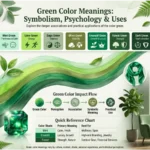
Green is one of the most strongly connected colors in everyday life. We see it in leaves, forests, gardens, gemstones, traffic signals, money, uniforms, packaging, technology, and interior spaces. Because of these different settings, green color meanings can range from growth and renewal to safety, wealth, freshness, envy, or even inexperience.
People often search for the meaning of green because they want to understand what the color communicates. A green logo may feel natural, while a dark green room can appear sophisticated and grounded. Likewise, a bright green outfit can look energetic, but the same shade may suggest artificiality when used in a different setting.
Color meaning is not fixed, however. Psychology, culture, personal experience, lighting, shade, and context can all change how green is perceived. This guide explores the symbolism, psychology, spiritual interpretations, cultural associations, personality ideas, branding uses, fashion, interior design, and practical applications of green.
Quick Answer: Green commonly symbolizes nature, growth, renewal, balance, health, freshness, and prosperity. Depending on the shade and context, it can also represent wealth, safety, peace, jealousy, inexperience, or artificiality. Its meaning is shaped by culture, surroundings, and personal experience.
What Does Green Symbolize?
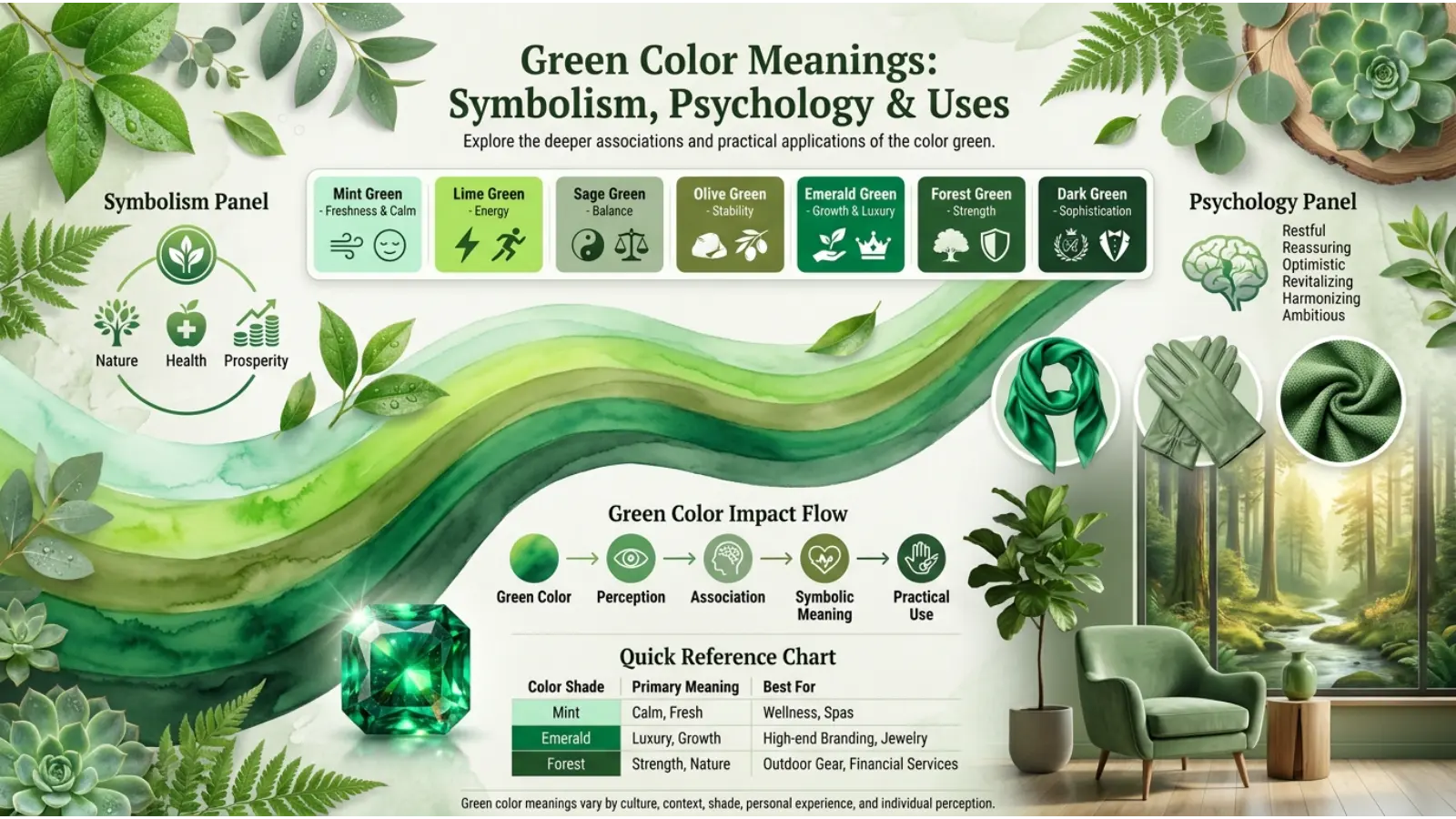
Green is most closely associated with the living world. Plants, trees, moss, grass, and many natural landscapes make the color feel connected to life and renewal. As a result, green often communicates ideas of growth, freshness, health, balance, and restoration.
At the same time, green has contrasting meanings. A soft sage green can feel calm and gentle, whereas neon green can feel energetic and attention-grabbing. Dark forest green may suggest tradition and stability, while yellow-green can appear playful or youthful.
Common Green Symbolism
| Green Association | What It Can Communicate |
|---|---|
| Nature | Connection with plants and the environment |
| Growth | Development, progress, and new beginnings |
| Renewal | Fresh starts and restoration |
| Balance | Harmony and visual stability |
| Health | Wellness, freshness, and natural living |
| Peace | Calmness and a relaxed atmosphere |
| Wealth | Prosperity and financial success |
| Safety | Permission, approval, or a clear path |
| Envy | Jealousy and comparison |
| Inexperience | Being new, immature, or “green” |
| Sustainability | Environmental awareness and conservation |
| Freshness | Clean, natural, and lively qualities |
Therefore, green is not simply a “positive” color. Its message depends heavily on the specific shade and the situation in which it appears.
Positive and Negative Meanings of Green
The positive side of green is easy to see in nature. It can suggest life, health, hope, stability, and abundance. Gardens and forests often make the color feel restorative because green is visually connected to living landscapes.
However, green also has a long history of negative associations. Expressions such as “green with envy” connect the color with jealousy. Inexperience can also be described as being “green.” Certain yellowish greens may feel unpleasant when they resemble decay or artificial chemical colors.
This contrast makes green especially useful for visual communication. A designer can make it peaceful and natural or bold and unsettling simply by changing the shade, saturation, surrounding colors, and lighting.
Psychology of Green Color Meanings
Color psychology examines how colors can influence perception, emotion, and behavior. However, color effects are not universal rules. People respond differently depending on culture, personal memories, context, and the particular shade being viewed.
Green frequently benefits from its strong association with nature. Seeing green can remind people of vegetation, outdoor environments, gardens, and healthy landscapes. These associations can influence the emotional impression of a design even when the color itself has no inherent emotional meaning.
Green and Emotion
Green is often perceived as:
- Calm
- Fresh
- Balanced
- Restorative
- Natural
- Secure
- Hopeful
- Stable
Darker greens can feel more serious and established, while lighter greens often appear softer and more youthful. Bright greens can create a much more energetic impression.
Green and Mood
Green can contribute to a relaxed visual environment when used in muted or natural shades. That is one reason sage, olive, and soft botanical greens are popular in homes, wellness spaces, and nature-inspired designs.
However, saturation matters. A highly saturated green can feel lively rather than peaceful. Therefore, saying that “green always makes people calm” would be too simplistic.
Green and Behavior
Color can influence attention and perception, but it does not control behavior by itself. Green may encourage associations with natural products, health, sustainability, or freshness when those ideas already fit the surrounding message.
For example, a green package labeled with natural ingredients may strengthen a natural impression. Yet the color alone cannot prove that a product is healthy, organic, or environmentally friendly.
Why Different Shades of Green Feel Different
One of the most important parts of understanding green color meanings is recognizing that green is not one visual experience.
| Green Shade | Common Impression |
|---|---|
| Emerald green | Luxury, richness, vitality |
| Forest green | Nature, stability, tradition |
| Sage green | Calmness, softness, understated elegance |
| Olive green | Earthiness, maturity, practicality |
| Mint green | Freshness, cleanliness, lightness |
| Lime green | Energy, playfulness, youth |
| Moss green | Natural, rustic, earthy |
| Kelly green | Brightness, confidence, vitality |
| Sea green | Freshness, water, relaxation |
| Neon green | Energy, visibility, modernity |
| Dark green | Wealth, authority, sophistication |
| Yellow-green | Youthfulness, energy, but sometimes artificiality |
Consequently, choosing “green” for a design is only the beginning. The exact shade can change the message considerably.
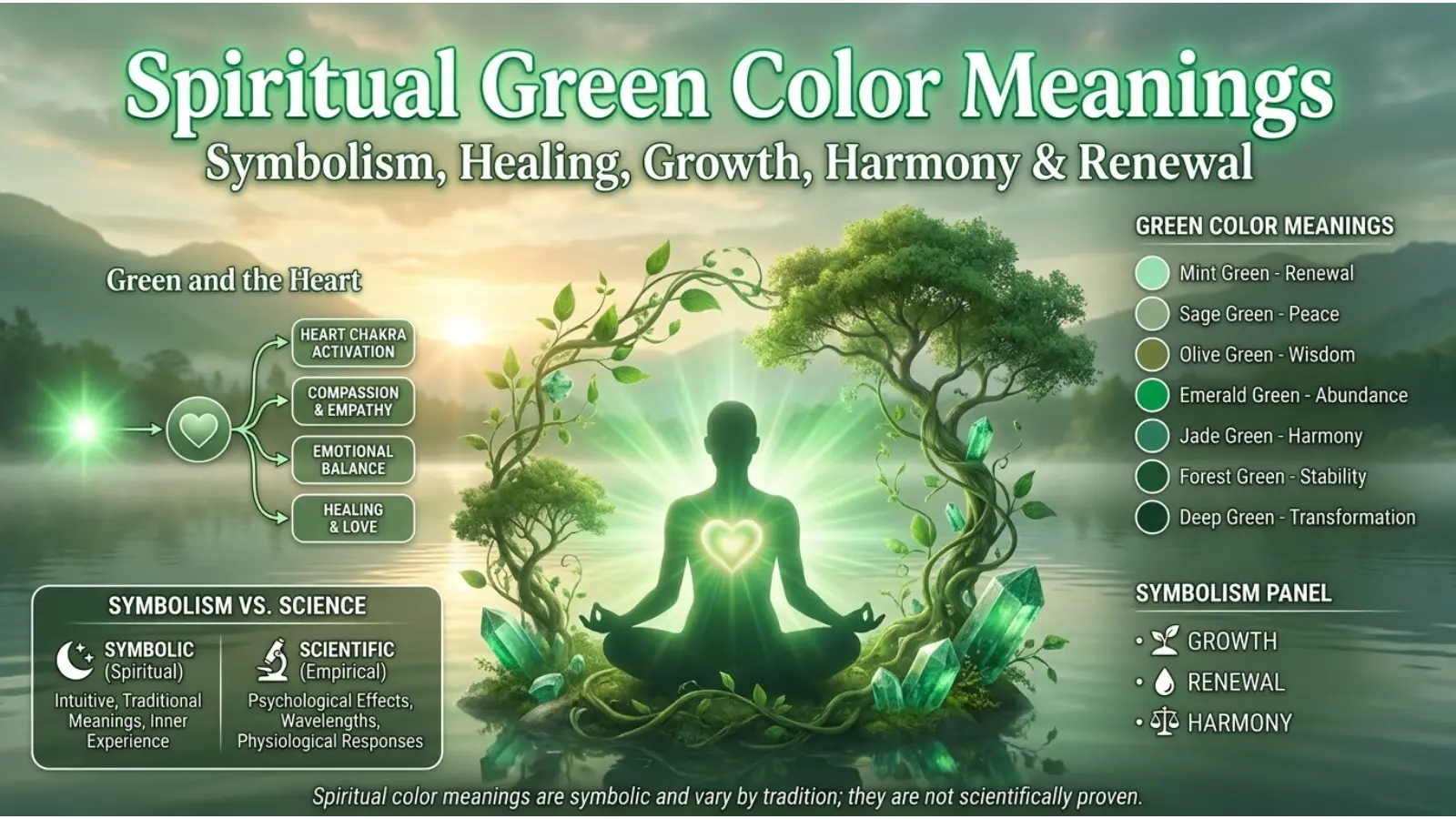
Spiritual Green Color Meanings
Green is often given spiritual meanings related to growth, renewal, healing, balance, compassion, hope, and connection with nature. These interpretations appear in different modern spiritual practices, symbolic systems, and personal belief frameworks.
However, spiritual color meanings are not universal scientific facts. Different religions, cultures, and spiritual traditions use colors differently, so one should avoid presenting a single interpretation as a universal religious rule.
Green may symbolically represent:
- Growth after a difficult period
- Renewal and fresh beginnings
- Emotional balance
- Connection with nature
- Hope
- Compassion
- Restoration
- Abundance
- Peace
- Life energy
In contemporary spiritual practices, green is sometimes associated with the heart and emotional harmony. That association belongs to particular symbolic systems and should not be confused with established scientific evidence.
Green Color Meaningsin Nature
Nature provides much of the emotional foundation behind green symbolism.
Leaves use green pigments primarily because of chlorophyll, which plays a central role in photosynthesis. As a result, green became visually linked with plant life long before modern advertising and branding existed.
Forests, fields, gardens, moss, vines, and fresh leaves all reinforce the connection between green and living environments. Consequently, people often interpret botanical green as more organic and calming than highly artificial green.
This natural association explains why green appears so often in environmental campaigns, gardening products, wellness spaces, and nature photography.
Cultural Green Color Meanings
Green does not have one universal cultural meaning. Its interpretation changes across regions, historical periods, religions, and social traditions.
Green in Western Culture
In many Western contexts, green can represent nature, environmentalism, freshness, growth, and luck. It is also associated with money in some settings, particularly in the United States because of the green appearance of U.S. currency.
At the same time, Western expressions connect green with jealousy and envy. Therefore, even within one cultural tradition, green can carry both positive and negative meanings.
Green in Islamic Cultures
Green has an important place in Islamic history and visual culture and is often treated with respect. It has associations with paradise and appears in various forms of Islamic art, architecture, textiles, and flags.
However, there is no single meaning attached to every use of green across all Muslim communities. Historical, regional, political, and artistic contexts matter.
Green in East Asian Cultures
Green can carry different meanings across East Asian societies. In China, for example, certain shades and uses of green have had changing cultural associations throughout history. Green may also appear in contexts involving nature, spring, vitality, or traditional aesthetics.
In Japan, green is strongly visible in the natural landscape and in cultural imagery associated with plants, gardens, and seasonal change.
Green in Latin American Cultures
Green can be associated with nature, hope, agriculture, national identity, and political symbolism in different Latin American contexts. National flags can give the color additional meanings that differ from general color symbolism.
Green in Africa
Green frequently appears in African national flags and may represent land, agriculture, natural resources, hope, or prosperity depending on the country. There is no single “African meaning” of green because the continent contains hundreds of cultural traditions and many distinct symbolic systems.
Modern Global Culture
Today, green is strongly connected with environmental awareness, sustainability, organic products, renewable energy, and ecological movements. These meanings are relatively modern compared with older associations involving nature, fertility, and vegetation.
Historical Green Color Meanings
Green has been used symbolically for centuries, although its availability and appearance changed as pigment technology developed.
In medieval and early modern Europe, green could appear in clothing, manuscripts, paintings, heraldry, and decorative arts. Its meaning varied according to social setting and artistic context.
Green also became connected with nature and spring because seasonal vegetation provided a visible sign of renewal. Over time, those associations continued into modern advertising and design.
The development of synthetic pigments later made a wider range of vivid greens possible. This expanded the color’s use in fashion, printing, advertising, art, and industrial design.
Green and Personality Associations
People often associate green preferences with traits such as:
- Calmness
- Reliability
- Practicality
- Generosity
- Patience
- Love of nature
- Emotional balance
- Independence
- Stability
These are associations, not personality tests. Choosing green does not prove that someone is calm, kind, environmentally conscious, or emotionally balanced.
Personal preference can come from many sources, including memories, cultural background, fashion trends, favorite places, experiences in nature, and simple visual taste.
Someone may also prefer one shade of green while strongly disliking another. Therefore, personality interpretations should always be treated as informal symbolism rather than psychological diagnosis.
Green Color Meanings in Branding and Marketing
Green is one of the most useful colors for brands that want to communicate ideas connected with nature, health, freshness, sustainability, agriculture, or growth.
Companies can also use green to create a feeling of stability or prosperity. Dark green often looks more established and sophisticated than bright green, while lighter greens can feel cleaner and more approachable.
Why Brands Choose Green
Green can help communicate:
- Natural products
- Environmental responsibility
- Health and wellness
- Fresh ingredients
- Agriculture
- Outdoor living
- Financial prosperity
- Growth
- Balance
- Innovation
However, green does not automatically make a brand sustainable. Consumers may question environmental claims if the product, packaging, or business practices do not support the visual message.
Green in Packaging
A green package can immediately create a natural or fresh impression. Food, gardening, skincare, household, and wellness products frequently benefit from this association.
Yet packaging designers must consider the shade. A dark green package can look premium, while bright green may feel energetic and youthful.
Green and Financial Brands
Green has a special relationship with money in some cultures, especially the United States. Consequently, it can be useful for financial communication.
Still, using too much green can make a financial brand feel predictable. Combining it with neutral colors can create a more refined identity.
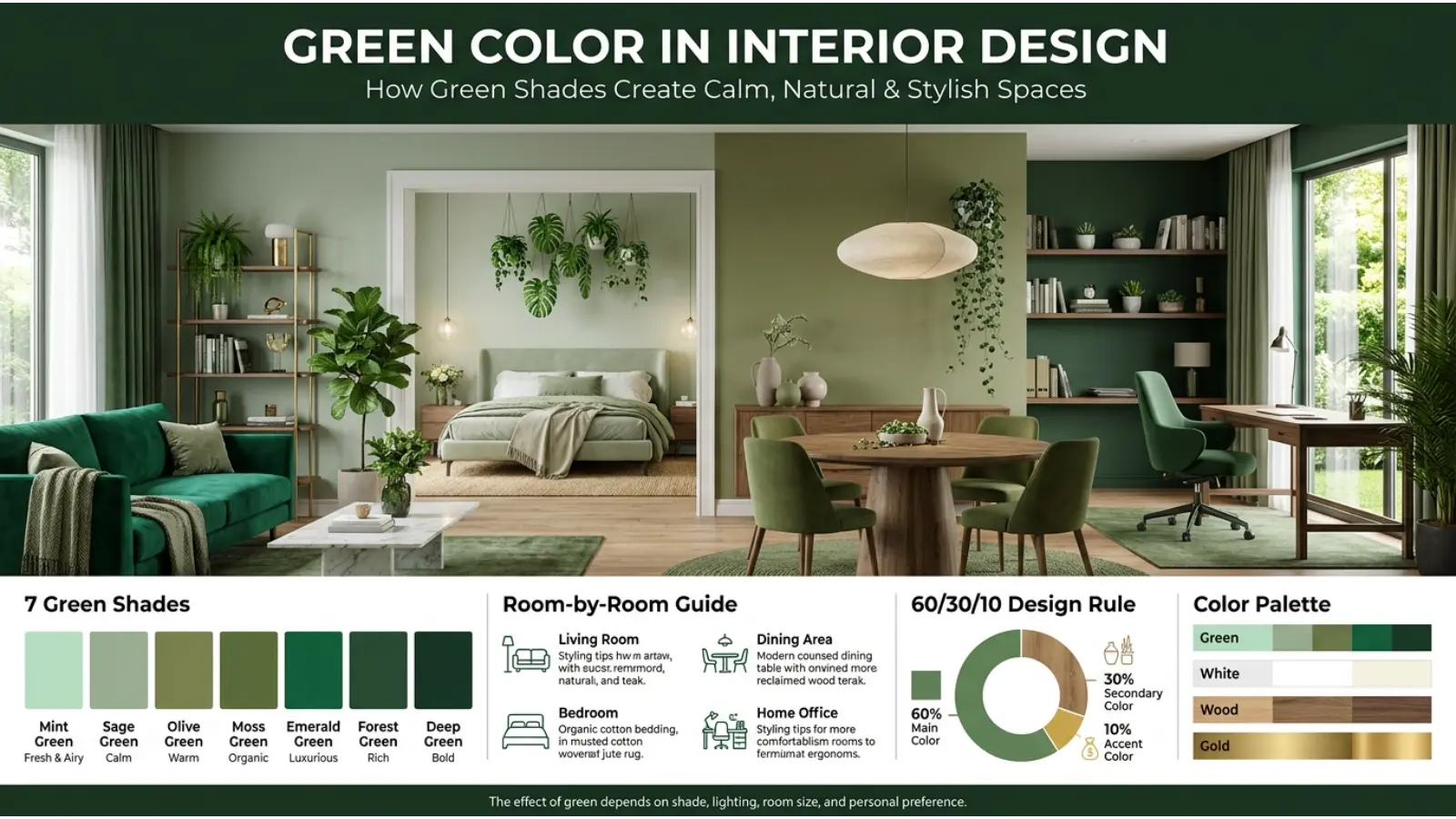
Green Color Meanings in Interior Design
The Green works especially well in interiors because it connects indoor spaces with the natural world.
Green Living Room
Sage, olive, and muted botanical greens can create a relaxed living room. Pairing them with wood, cream, beige, or natural stone can strengthen an earthy feeling.
For a more dramatic room, deep forest green can work well on one feature wall or through furniture.
Green Bedroom
Soft greens are often suitable for bedrooms because they can create a quiet, nature-inspired atmosphere. Pale sage and muted eucalyptus tones are particularly easy to combine with neutral bedding.
Very bright greens may be better used as accents rather than covering large surfaces.
Green Office
Green can give an office a natural and grounded character. Olive and muted green can work particularly well with wood, black, white, or warm gray.
Plants can reinforce the same visual theme without requiring every surface to be green.
Green Kitchen
Green cabinetry can make a kitchen feel fresh and distinctive. Sage green creates a softer appearance, whereas deep green can make cabinetry look richer and more traditional.
Green also works well with natural wood, brass, stone, cream, and white.
Lighting Changes Green
Lighting can dramatically change how green appears.
Warm lighting can make some greens look more yellow or earthy, while cool lighting may make them appear bluer or sharper. Daylight also changes throughout the day.
Therefore, always test a paint sample under the actual lighting of the room before committing to a large area.
Green Color in Fashion
Green has become a flexible fashion color because its many shades can create completely different impressions.
Dark green can appear sophisticated and formal. Olive can feel practical and casual. Emerald can look luxurious, while mint can appear fresh and delicate.
Green for Formal Wear
Deep emerald, forest, and bottle green can provide an alternative to traditional black or navy formal clothing. These shades are especially effective when the fabric has texture or subtle shine.
Green for Casual Wear
Olive, sage, khaki, and muted green work naturally with denim, beige, white, brown, and black. These combinations are easy to wear because they echo earthy colors.
Green Accessories
If wearing a full green outfit feels too strong, use the color through:
- Handbags
- Shoes
- Watches
- Scarves
- Jewelry
- Hats
- Belts
- Ties
A small green accessory can add freshness without dominating an outfit.
Green Color Combinations
Green pairs naturally with many colors because nature itself provides countless green combinations.
| Green + Color | Overall Effect |
|---|---|
| Green + White | Clean and fresh |
| Green + Beige | Warm and natural |
| Green + Brown | Earthy and grounded |
| Green + Gold | Rich and elegant |
| Green + Black | Dramatic and sophisticated |
| Green + Navy | Calm and refined |
| Green + Pink | Botanical and lively |
| Green + Yellow | Energetic and cheerful |
| Green + Blue | Fresh and harmonious |
| Green + Gray | Modern and understated |
| Green + Cream | Soft and welcoming |
| Green + Orange | Warm and energetic |
The proportion matters as much as the colors themselves. A small amount of bright green can act as an accent, while a large amount may become visually dominant.
Green in Art and Photography
Artists often use green to communicate environment, life, distance, emotion, or atmosphere.
In landscape art, green creates a sense of vegetation and natural space. In portraits, green backgrounds can contrast with skin tones and clothing.The abstract work, different greens can express tension, calmness, movement, or growth without representing anything literally.
Photographers also use green to establish a mood. A lush green forest can suggest freshness and depth, while a muted green landscape can feel nostalgic or quiet.
Because green is common in nature, photographers should also consider color balance. Too much green can overpower other subjects, especially in heavily vegetated scenes.
Green in Everyday Life
Green appears in many practical systems because it is easy to associate with positive status or permission.
Traffic lights are a familiar example. Green generally means that movement is permitted when conditions are safe. Similar green indicators appear on dashboards, interfaces, status lights, maps, and signs.
Digital interfaces often use green to indicate success, completion, availability, or an active state. However, designers should not rely on color alone because people with color-vision deficiencies may have difficulty distinguishing certain colors.
Icons, labels, text, and shapes should provide additional information.
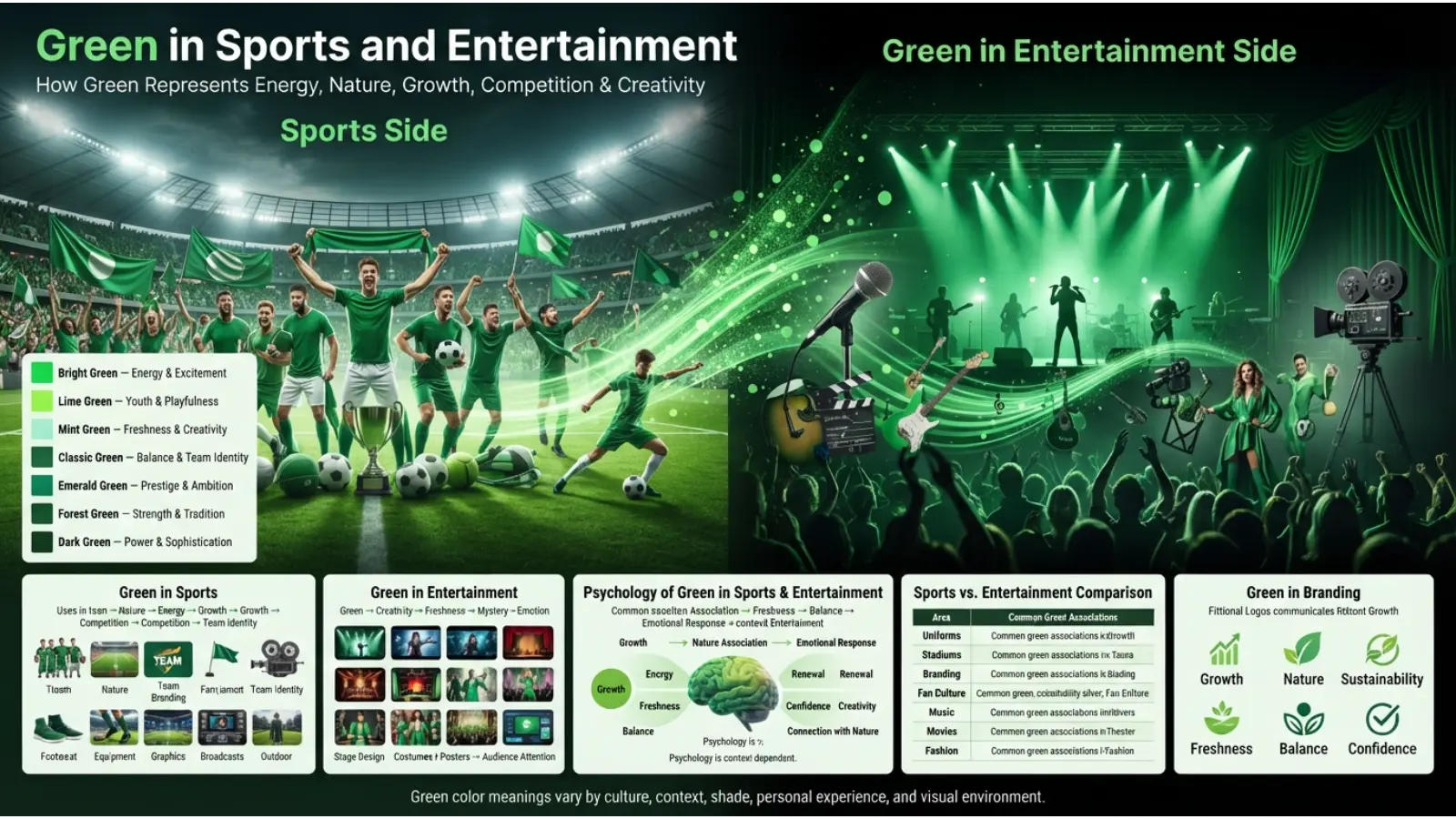
Green in Sports and Entertainment
Green frequently appears in sports because of grass, fields, outdoor competition, and team identity. It can communicate energy, natural environments, tradition, or regional identity.
In entertainment, green may represent nature, fantasy, magic, aliens, toxic substances, technology, or supernatural energy. The meaning depends almost entirely on the story and visual context.
That flexibility makes green useful for fictional worlds. A gentle forest green can create a peaceful setting, while glowing neon green can suggest something strange or futuristic.
Green and Sustainability
Modern environmental movements have made green almost synonymous with ecological awareness.
Businesses use green to communicate ideas such as:
- Recycling
- Conservation
- Renewable energy
- Organic farming
- Sustainable packaging
- Natural ingredients
- Environmental responsibility
However, color is not evidence of environmental performance. A company can use green branding without actually operating sustainably.
This is why responsible branding should support environmental imagery with clear, verifiable information rather than relying on color alone.
How Lighting Changes Green
Green is highly sensitive to its surrounding colors and light source.
Under warm indoor lighting, a green may appear more yellow or olive. Under cool lighting, it can look bluer. Strong daylight can reveal undertones that are difficult to see indoors.
The surface also matters. Matte green absorbs and scatters light differently from glossy green. Velvet can make a green look deeper, while polished surfaces may make it appear brighter.
As a result, a green paint, fabric, logo, or product should always be evaluated in the environment where it will actually be used.
Age and Personal Experience Can Change Green’s Meaning
Color preferences are shaped partly by experience. A child may associate bright green with toys, cartoons, or games, while an adult may connect dark green with formal clothing or financial institutions.
Generational trends can also influence color preferences. Fashion cycles repeatedly bring particular shades into popularity, changing how those shades are perceived.
Personal memories matter too. Someone who grew up around forests may associate green with comfort, while another person may connect the same color with a negative experience.
Thus, color meaning operates on both cultural and personal levels.
Common Misconceptions About Green
Does green always mean nature?
No. Green often suggests nature because of its connection with vegetation, but context can completely change the message. Neon green, for example, may feel technological or futuristic.
Does green automatically mean health?
Not necessarily. Green can suggest health and freshness, but the color itself does not prove that a product is healthy.
Does liking green reveal personality?
Only in a very general symbolic sense. A favorite color cannot reliably determine someone’s personality.
Is green always calming?
No. Soft greens may feel calm, but bright or highly saturated greens can feel energetic or visually intense.
Does green always represent money?
No. The financial association is especially strong in some cultures and contexts, including U.S. currency, but it is not universal.
Does green have the same spiritual meaning everywhere?
No. Spiritual and religious meanings vary significantly between traditions, regions, and belief systems.
Practical Green Color Guide
The following chart provides a quick way to choose a green based on the impression you want to create.
| Goal | Useful Green Direction |
|---|---|
| Natural | Forest, moss, botanical |
| Calm | Sage, eucalyptus, muted green |
| Luxury | Emerald, deep forest |
| Fresh | Mint, light green |
| Youthful | Lime, bright spring green |
| Traditional | Hunter, forest, bottle green |
| Earthy | Olive, moss, khaki |
| Environmental | Botanical, leaf, natural green |
| Modern | Muted green with gray or neutral tones |
| Dramatic | Very dark green |
| Energetic | Lime or vivid green |
| Soft | Pale sage or pastel green |
How to Use Green Effectively
The best green is not necessarily the brightest or most attractive shade. It is the one that fits the message.
For a wellness website, muted green can support a calm visual identity. For a children’s product, brighter green may communicate playfulness.A luxury product, deep emerald may feel more appropriate.
Similarly, a home decorator might choose sage for a relaxing bedroom but use dark green for a dramatic dining room.
In other words, context should determine the green rather than the other way around.
Green Color Meanings at a Glance
| Category | Common Green Meaning |
|---|---|
| Emotional | Calm, hope, freshness |
| Psychological | Balance, restoration, natural association |
| Spiritual | Growth, renewal, harmony in some traditions |
| Cultural | Nature, luck, prosperity, identity, depending on context |
| Nature | Plants, life, vegetation |
| Business | Growth, sustainability, freshness |
| Fashion | Natural, refined, versatile |
| Interior design | Relaxed, earthy, refreshing |
| Marketing | Natural, healthy, environmentally aware |
| Negative symbolism | Envy, jealousy, immaturity in some contexts |
Frequently Asked Questions
What is the main meaning of green?
Green most commonly represents nature, growth, renewal, freshness, balance, and life. Depending on context, it can also symbolize wealth, safety, jealousy, or inexperience.
What does green mean psychologically?
Green is often associated with nature, balance, restoration, and freshness. However, psychological responses vary by shade, context, culture, and individual experience.
What does green symbolize spiritually?
In some spiritual systems, green represents growth, healing, renewal, compassion, balance, hope, or connection with nature. These meanings vary across traditions and should not be treated as universal religious facts.
What does green say about a person’s personality?
Green is sometimes symbolically associated with calm, practical, generous, balanced, or nature-loving personalities. However, color preference cannot reliably determine personality.
Why is green associated with nature?
Plants and vegetation provide one of the most common sources of green in the natural world. This repeated visual connection has helped make green a strong symbol of life, vegetation, and environmental awareness.
Why is green used in branding?
Brands often choose green when they want to communicate nature, freshness, health, growth, sustainability, or prosperity. The exact message depends on the shade and overall design.
What does dark green mean?
Dark green can suggest stability, sophistication, tradition, wealth, maturity, and a strong connection with nature. It is often more formal than bright green.
What does light green mean?
Light green commonly creates a softer impression associated with freshness, youthfulness, spring, plants, cleanliness, and renewal.
What colors go well with green?
Green pairs well with white, cream, beige, brown, black, navy, gold, pink, yellow, blue, and gray. The best combination depends on the shade and desired mood.
Is green a positive or negative color?
Green can communicate both positive and negative ideas. Growth, nature, health, and renewal are common positive associations, while envy, jealousy, and inexperience are common negative ones.
Final Thoughts on Green Color Meanings
Green is powerful because its meaning is built from many different experiences. Nature gives it associations with leaves, forests, growth, and renewal. Culture adds ideas of luck, prosperity, identity, spirituality, or jealousy. Modern design adds sustainability, wellness, freshness, and technology.
Most importantly, green color meanings are contextual rather than fixed. A muted sage green does not communicate the same feeling as neon green, and forest green does not carry exactly the same message as emerald. Lighting, surrounding colors, cultural background, personal memories, and the purpose of the design all influence perception.
That flexibility is what makes green so useful. It can make a room feel connected to nature, give a brand a fresh identity, add sophistication to clothing, or create a strong visual symbol in art and media. When you understand the shade and the context, green becomes more than a color—it becomes a practical tool for communication.