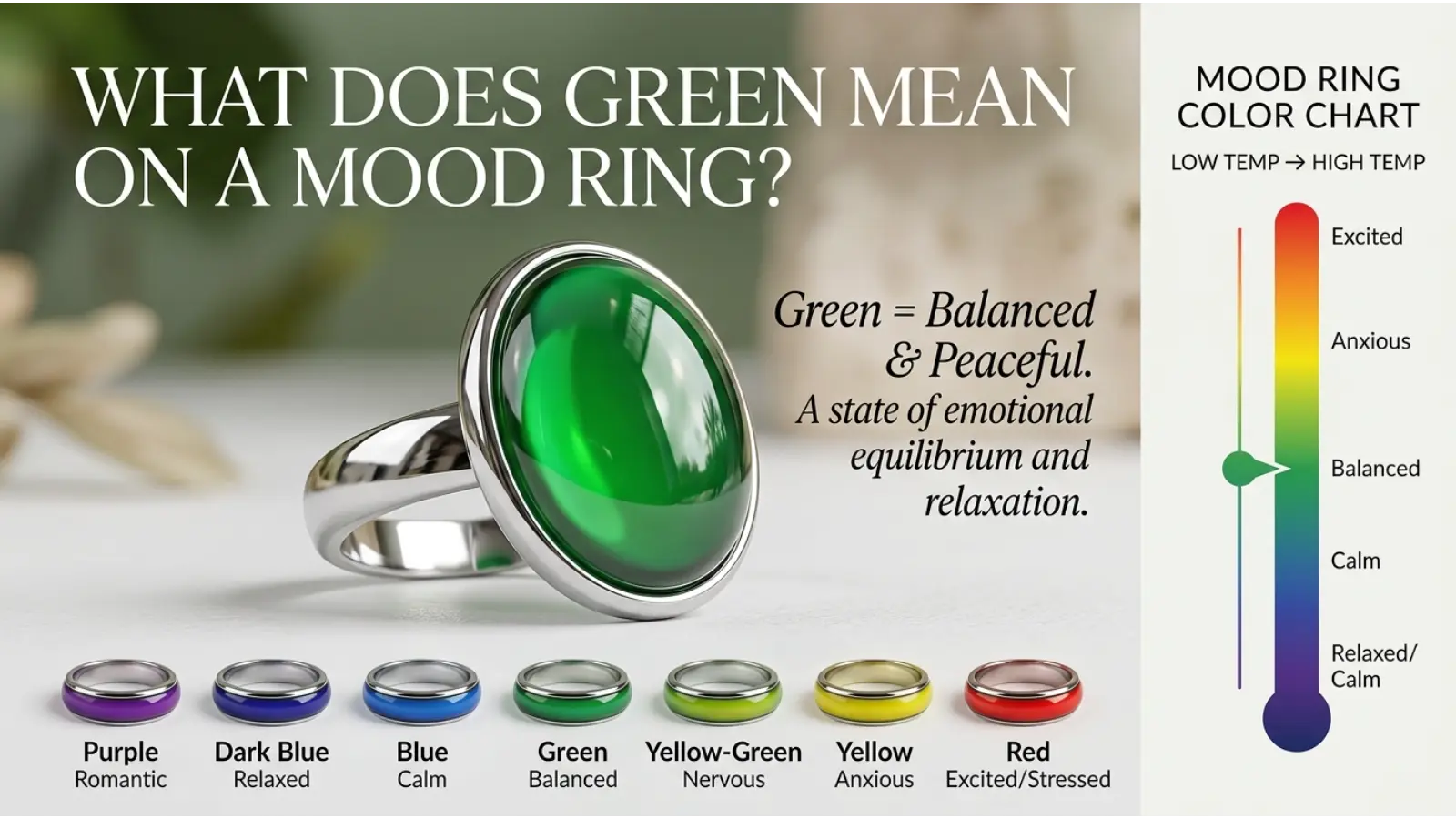
A Mood ring color meanings green is often associated with balance, calmness, comfort, and emotional steadiness. In traditional mood-ring color charts, green is commonly described as a neutral or relaxed state. However, the color does not scientifically reveal a person’s emotions.
Mood rings work through thermochromic materials that change color as their temperature changes. When your finger warms or cools the ring, the material can shift between colors. Because body temperature can be affected by surroundings, circulation, activity, stress, and many other factors, a green mood ring should be viewed as a fun visual indicator rather than a reliable emotional test.
So, what do mood ring color meanings green actually suggest? Green has a long history of symbolism connected with nature, renewal, harmony, and growth. Those traditional associations have influenced the way green is interpreted on mood-ring charts.
Quick Answer
Green on a mood ring is commonly interpreted as calmness, balance, relaxation, comfort, or a relatively steady emotional state. Scientifically, however, green mainly indicates that the thermochromic material has reached a particular temperature range. The exact meaning varies by ring and manufacturer.
Mood ring color meanings green at a Glance
| Mood Ring Color | Common Traditional Interpretation |
|---|---|
| 🟢 Green | Calm, balanced, comfortable, relaxed |
| 🔵 Blue | Relaxed, peaceful, content |
| 🟣 Purple | Excitement, passion, strong emotion |
| 🟡 Yellow | Nervousness, uncertainty, tension |
| 🟠 Orange | Anxiety, excitement, heightened emotion |
| ⚫ Black | Cold, stress, inactivity, or low temperature |
| 🟤 Brown | Tension, restlessness, or unsettled feelings |
| 🔴 Red | Energy, stimulation, or strong emotion |
These are traditional mood-ring interpretations, not scientifically validated emotional measurements.
What Does Green Symbolize on a Mood Ring?
Green occupies an interesting place in mood-ring symbolism because it is often treated as a middle or balanced color.
Traditional charts frequently connect green with feelings such as:
- Calmness
- Balance
- Relaxation
- Comfort
- Emotional stability
- Contentment
- Normal or neutral feelings
The idea makes intuitive sense because green is strongly associated with natural environments. Trees, leaves, grass, and other forms of vegetation make green a familiar visual cue for life and renewal.
However, context matters. A person may see green as peaceful, while someone else may associate it with jealousy, sickness, money, or something entirely different.
That is why a mood ring cannot tell you exactly what someone is feeling.
Is Green a Good Mood Ring Color?
Usually, yes, in traditional mood-ring charts, green is considered a positive or balanced color.
It is often described as indicating a relaxed or comfortable state. Some charts call green a “normal” mood, while others associate different shades of green with different emotional conditions.
There is no universal standard, though. Two mood rings can display similar-looking green shades at different temperatures, and their included charts may assign different meanings to those shades.

How Does a Mood Ring Turn Green?
The science behind a mood ring is more interesting than the symbolism.
Most classic mood rings use thermochromic liquid crystals or another thermochromic material. These materials respond to changes in temperature by changing the way they interact with light.
When the temperature around the ring changes, the molecular structure of the thermochromic material changes. That affects which wavelengths of light are reflected, producing a visible color shift.
In simple terms:
Finger temperature changes → thermochromic material responds → reflected light changes → ring changes color.
Therefore, the green color is primarily a temperature signal, not an emotional signal.
Why Does Body Temperature Matter?
Your fingers can become warmer or cooler for many reasons.
For example:
- Cold weather can cool your fingers.
- Physical activity can increase warmth.
- Holding a warm object can change the ring’s appearance.
- Stress may sometimes affect blood flow and skin temperature.
- Sitting still in a cool room may produce a different color.
- Tight jewelry can influence how comfortable the ring feels and how it contacts your skin.
Because so many factors affect finger temperature, the same person can see different mood-ring colors throughout the day.
Green Mood Ring Meaning vs. Scientific Meaning
This distinction is essential when interpreting mood rings.
| Aspect | Traditional Meaning | Scientific Explanation |
|---|---|---|
| 🟢 Green | Calm or balanced | A particular temperature range |
| 🔵 Blue | Relaxed | A different temperature range |
| 🟣 Purple | Excited or passionate | Another temperature range |
| 🟡 Yellow | Nervous or uneasy | Another temperature response |
| ⚫ Black | Stressed or upset | Often associated with lower temperatures or the ring’s inactive range |
The symbolic meaning comes from mood-ring charts and popular culture.
The physical meaning comes from thermochromic chemistry and temperature.
Keeping these two ideas separate makes the subject much easier to understand.
Different Shades of Green on a Mood Ring
Not every green-looking mood ring produces exactly the same shade.
You may see colors described as:
- Light green
- Bright green
- Emerald green
- Yellow-green
- Blue-green
- Dark green
- Greenish turquoise
Some mood-ring charts assign different meanings to these shades. Others simply group them under green.
Light Green
Light green is sometimes interpreted as relaxation, comfort, or emotional openness.
From a scientific perspective, the exact shade simply reflects the optical response of the thermochromic material at a particular temperature.
Bright Green
Bright green is commonly associated with balance, normality, or a positive mood on traditional charts.
It can also appear when the ring is near the middle of its intended temperature range.
Dark Green
Dark green may be interpreted as calmness, stability, or a serious emotional state, depending on the chart.
The color itself does not provide enough information to determine which interpretation is correct.
Yellow-Green
A yellow-green appearance is sometimes connected with nervousness, uncertainty, or mild tension.
Again, the scientific explanation is simpler: the ring is showing a color produced by a particular temperature condition.
Why Does My Mood Ring Stay Green?
If your mood ring stays green for a long time, there is usually no reason to worry.
The ring may simply be exposed to a fairly stable temperature.
Your finger temperature may remain within the color range that produces green, particularly when:
- The room is comfortable.
- Your hands are warm.
- You are sitting quietly.
- The ring has reached skin temperature.
- The thermochromic material has a limited color-changing range.
A mood ring is not designed to change dramatically every time your feelings change.
Why Does My Mood Ring Change From Green to Blue?
A change from green toward blue generally means the thermochromic material is experiencing a different temperature.
Traditional mood-ring charts may describe blue as peaceful, relaxed, or calm. Scientifically, however, the important factor is the temperature associated with that ring’s color transition.
A cooler environment, changes in circulation, or removing and replacing the ring can all affect the displayed color.
Why Does My Mood Ring Change From Green to Yellow?
Green shifting toward yellow is commonly interpreted as a movement from calmness toward nervousness, tension, or uncertainty.
But the ring itself cannot distinguish between emotional causes.
For example, your finger might become cooler because you walked outside, entered an air-conditioned room, or stopped moving your hands. The ring can respond to that physical temperature change without any major change in your mood.
Mood ring color meanings green in Psychology
Green has broad psychological associations, but these should not be confused with a diagnostic emotional code.
People often connect green with:
- Nature
- Freshness
- Growth
- Safety
- Renewal
- Balance
- Rest
- Harmony
These associations can influence how green feels in a particular setting.
For instance, soft green walls may create a very different impression from an intense neon green sign. The color’s brightness, saturation, surrounding colors, lighting, and cultural context all matter.
Does Green Actually Mean You Are Calm?
Not necessarily.
A green mood ring does not prove that you are calm.
You could feel excited, worried, tired, happy, or frustrated while wearing a green ring. The device is responding to temperature rather than directly measuring emotion.
This is one of the most important facts to remember when reading mood ring color meanings.

Emotional Mood ring color meanings green
Although a mood ring cannot measure emotions, green has symbolic emotional associations that explain why people often interpret it positively.
Calmness
Green is frequently associated with peaceful natural spaces. Forests, gardens, and grassy landscapes can create a visual sense of quiet and stability.
Balance
Green sits between blue and yellow on the traditional color wheel. Symbolically, that position can contribute to its association with moderation and balance.
Growth
Because plants grow and regenerate, green naturally became connected with development, renewal, and fresh beginnings.
Comfort
Familiar natural greens can feel visually approachable. Softer greens are often used when a space is intended to feel restful.
Jealousy
Green also has a famous negative association with jealousy and envy, especially in Western expressions and literature.
This shows why a color never has just one universal meaning.
Green Mood Ring Meaning in Different Cultures
Color meanings are shaped by culture, history, religion, geography, and everyday experience.
Green is often linked with nature and fertility because vegetation is associated with life and growth. In many cultures, it can also carry religious or national meanings that have little connection to mood-ring symbolism.
In Islamic cultural contexts, green has longstanding religious and historical associations and is often treated with respect. However, it would be inaccurate to claim that every Muslim community assigns exactly the same meaning to green.
In Western popular culture, green may suggest nature, environmental awareness, freshness, money, luck, or jealousy.
In parts of East Asia, green can have its own historical and social associations that vary by country and period.
The lesson is simple: a mood-ring chart should not be treated as a universal cultural dictionary.
Spiritual Mood ring color meanings green
Green is commonly used in spiritual and symbolic systems to represent ideas such as:
- Growth
- Renewal
- Healing
- Harmony
- Compassion
- Balance
- Connection with nature
These meanings are symbolic rather than scientific.
Different spiritual traditions use colors in different ways, so there is no single universal spiritual definition of green.
For example, modern chakra systems commonly associate green with the heart chakra and themes such as love and compassion. That is a spiritual framework, not a scientifically established measurement of a person’s emotional or physical condition.

Green and Nature
Much of green’s symbolic power comes from the natural world.
Green leaves signal active plant growth. Forests create vast green landscapes. New shoots appear green during early stages of plant development.
As a result, people often use green to communicate:
life → growth → renewal → balance
This natural association also helps explain why green appears so often in environmental branding, wellness design, gardens, packaging, and lifestyle products.
Green in Branding and Marketing
Green is a popular branding color because it can communicate several different ideas depending on its shade and context.
Brands may use green to suggest:
- Natural products
- Sustainability
- Freshness
- Health
- Organic ingredients
- Outdoor activities
- Financial growth
- Environmental responsibility
However, green does not automatically make a product appear environmentally friendly. Consumers may judge a brand by its claims, packaging, materials, and reputation as well as its color.
Light Green in Branding
Light green often feels fresh, youthful, and natural.
It can work well for:
- Wellness brands
- Gardening products
- Natural foods
- Lifestyle products
- Eco-focused designs
Dark Green in Branding
Dark green can feel more mature, established, and sophisticated.
It can suit:
- Financial services
- Luxury products
- Outdoor brands
- Organic products
- Premium packaging
Bright Green in Branding
Bright green attracts attention more strongly and can feel energetic or modern.
It is useful when a brand wants to communicate freshness or energy rather than quiet luxury.
Green in Interior Design
Green can change the character of a room dramatically depending on its shade.
Living Room
Muted green can create a natural and comfortable atmosphere. Pairing it with warm wood, cream, beige, or natural fabrics can make the space feel grounded.
Bedroom
Soft sage, olive, or muted green can create a restful visual environment without making the room feel completely neutral.
Office
Darker or subdued greens can provide a professional appearance while adding more personality than gray or beige.
Kitchen
Green works especially well with:
- White
- Natural wood
- Brass
- Cream
- Stone
- Warm neutral colors
Lighting Matters
The same green paint can look very different under warm and cool lighting.
Warm bulbs can make some greens appear more yellow or earthy. Cool lighting can make certain greens appear bluer.
This is another reason a color should never be judged from a single photograph.
Green in Fashion
Green can create very different impressions depending on its shade.
Sage green often feels soft and understated.
Olive green can create an earthy, practical appearance.
Emerald green tends to look richer and more dramatic.
Lime green is energetic and attention-grabbing.
Forest green can appear sophisticated and traditional.
For everyday clothing, green pairs easily with neutrals such as black, white, cream, gray, brown, and denim.
For a stronger look, green can also be combined with complementary or contrasting shades, but the balance of brightness and saturation matters.
Green Personality Meaning
People who prefer green are sometimes described as:
- Balanced
- Patient
- Caring
- Nature-loving
- Practical
- Reliable
- Peace-seeking
- Growth-oriented
These are color associations, not personality diagnoses.
A person’s favorite color cannot reliably determine their personality. Preferences can be influenced by memories, fashion, culture, age, environment, and personal experiences.
Someone may love green simply because they like forests or because green looks good with their wardrobe.
Green Color Combinations
Green is highly flexible because it occurs naturally alongside many colors.
| Green Combination | Common Visual Effect |
|---|---|
| 🟢 Green + White | Fresh and clean |
| 🟢 Green + Beige | Natural and warm |
| 🟢 Green + Brown | Earthy and grounded |
| 🟢 Green + Gold | Rich and elegant |
| 🟢 Green + Black | Dramatic and sophisticated |
| 🟢 Green + Blue | Calm and natural |
| 🟢 Green + Pink | Playful and contrasting |
| 🟢 Green + Cream | Soft and comfortable |
| 🟢 Green + Gray | Modern and balanced |
| 🟢 Green + Orange | Energetic and bold |
The best combination depends on the particular green. A pale sage green and a neon lime green behave very differently when placed beside the same color.
Why Lighting Changes Green
Lighting is one of the most overlooked factors in color perception.
A green object does not have one fixed visual appearance under every light source.
Natural daylight, warm household lighting, fluorescent lighting, and LED lighting can change how green appears.
This matters for:
- Interior paint
- Clothing
- Photography
- Product packaging
- Graphic design
- Mood-ring photographs
If you photograph a green mood ring under one type of lighting and compare it with a picture taken under another, the colors may look noticeably different even if the ring’s temperature has not changed much.
Mood ring color meanings green and Temperature
A useful way to understand your ring is to separate color observation from emotional interpretation.
Instead of saying:
“My ring is green, so I must be calm.”
A more accurate interpretation is:
“My ring is green, which means the thermochromic material is currently showing its green temperature range. Traditional charts associate this color with calmness or balance.”
That small distinction makes mood-ring interpretation much more accurate.
Why Mood Ring Charts Are Different
There is no single universal mood-ring color scale.
Manufacturers can use different thermochromic materials, color ranges, temperature thresholds, and printed interpretation charts.
As a result, one ring may label green as “normal,” while another may describe it as “calm,” “relaxed,” or “balanced.”
This is why the chart supplied with your specific ring is the best reference for that particular product.
Online color charts can be useful for general information, but they should not override the manufacturer’s instructions.
Common Misconceptions About Green Mood Rings
Myth: Green Proves You Are Happy
A green ring does not measure happiness. It reflects a temperature-related color change.
Myth: Every Green Mood Ring Has the Same Meaning
Different products can use different materials and charts.
Myth: Mood Rings Can Read Your Emotions
Mood rings cannot directly measure emotions, thoughts, stress levels, or personality.
Myth: A Sudden Color Change Means Your Mood Changed
The ring can change because your finger temperature changed. Emotional changes are only one possible factor that might indirectly affect body temperature.
Myth: Darker Green Always Means a Stronger Emotion
There is no universal scientific scale in which darker green equals stronger feelings.
How to Get the Most Consistent Mood Ring Colors
If you want to observe how your ring behaves, try keeping the conditions similar.
For example:
- Wear the ring on the same finger.
- Give it several minutes to reach skin temperature.
- Observe it in consistent lighting.
- Compare colors at different times of day.
- Note room temperature.
- Avoid touching very hot or cold objects immediately beforehand.
You can even keep a simple journal of the ring’s color and the surrounding conditions.
This turns the ring into an interesting personal experiment rather than treating it as an emotional diagnostic tool.
Real-World Uses of Green Symbolism
Green appears far beyond mood rings.
Everyday Life
Green is commonly used for signs, plants, clothing, home décor, and personal accessories.
Business
Companies may use green to suggest nature, stability, growth, or environmental awareness.
Marketing
Green packaging can make a product appear more natural, although color alone cannot prove that a product is sustainable.
Art
Artists use green to represent landscapes, life, youth, decay, mystery, or contrast depending on the subject.
Photography
Green backgrounds can create a natural atmosphere and provide strong contrast with warm skin tones, reds, oranges, and some neutral colors.
Sports
Green may represent fields, outdoor competition, particular teams, or associations with nature and freshness.
Entertainment
Green can represent nature, magic, aliens, supernatural themes, jealousy, fantasy, or transformation depending on the story.
What Does Green Mean Emotionally?
Emotionally, green is often associated with calmness, balance, comfort, renewal, and growth.
Yet its emotional effect depends on the exact shade and context.
A soft sage green can feel quiet and gentle. A vivid lime green can feel energetic and intense. A dark forest green can feel serious and grounded.
So when someone asks for the meaning of green, the most useful answer is not a single word. It is a combination of shade + context + culture + personal experience.
Frequently Asked Questions
What does green mean on a mood ring?
Green is traditionally interpreted as calmness, balance, relaxation, comfort, or a neutral emotional state. Scientifically, it represents a particular temperature response from the thermochromic material.
Is green a good color on a mood ring?
Generally, yes. Traditional mood-ring charts usually give green a positive or balanced interpretation. However, the actual color mainly reflects temperature.
Does green on a mood ring mean I am calm?
Not necessarily. Green does not prove that you are calm. The ring responds to temperature rather than directly measuring your emotions.
Why is my mood ring green all the time?
Your finger may remain within the temperature range that produces green. Stable room conditions and steady skin temperature can make the color remain relatively constant.
Can stress make a mood ring turn green?
Stress can sometimes influence circulation or skin temperature, but a green color cannot prove that you are stressed, calm, or experiencing any particular emotion.
Why does my mood ring turn green after I put it on?
The ring may be adjusting to your skin temperature. As the thermochromic material reaches a particular temperature range, it can display green.
Do all mood rings use the same green meaning?
No. Mood-ring charts vary by manufacturer and product. Always check the chart supplied with your particular ring.
Can a mood ring really detect emotions?
No. A mood ring is not an emotional detector. Its color-changing material primarily responds to temperature.
What does dark green mean on a mood ring?
Dark green has different traditional interpretations depending on the chart. It may be described as calmness, stability, or another emotional state, but the physical color still comes from temperature.
Why does my green mood ring change color during the day?
Finger temperature naturally changes with room temperature, physical activity, circulation, contact with objects, and other conditions. Those changes can make the ring display different colors.
Conclusion
The most common mood ring color meanings for green point toward calmness, balance, comfort, and emotional steadiness. Those interpretations come from popular mood-ring charts and the wider symbolism of green as a color associated with nature, growth, and renewal.
The science tells a different but equally interesting story. A mood ring changes color because its thermochromic material responds to temperature. It does not directly read emotions or reveal someone’s true mood.
That distinction does not make mood rings meaningless. Instead, it makes them more interesting. Green can be enjoyed as a symbolic reminder of balance while the actual ring provides a simple demonstration of how temperature-responsive materials can change what we see.
In the end, green on a mood ring is best understood as a temperature-based color with a traditional symbolic interpretation—not a scientific measurement of emotion.
Emma Wilson is a dedicated comparison writer and product researcher at ColorMystiic.com. She specializes in creating unbiased product comparisons, detailed reviews, and helpful buying guides. Her goal is to help readers make smarter purchasing decisions with confidence.