Claire’s Mood Ring Color Meanings are eye-catching accessories that change color as their temperature changes. These colorful rings are often linked with emotions such as happiness, calmness, excitement, and stress. However, their colors do not actually read your thoughts or identify your feelings. Instead, temperature-sensitive materials inside the ring react to changes in heat.
Understanding Claire’s mood ring color meanings makes it easier to explore the traditional interpretations associated with each shade. For example, blue is commonly linked with calmness, green with balance, and purple with imagination or affection. Nevertheless, the exact meanings may vary depending on the ring and its accompanying color chart.
This guide includes a colorful mood ring chart, explanations of individual shades, and practical tips for understanding why your ring changes color.
Quick Answer: What Do Claire’s Mood Ring Colors Mean?
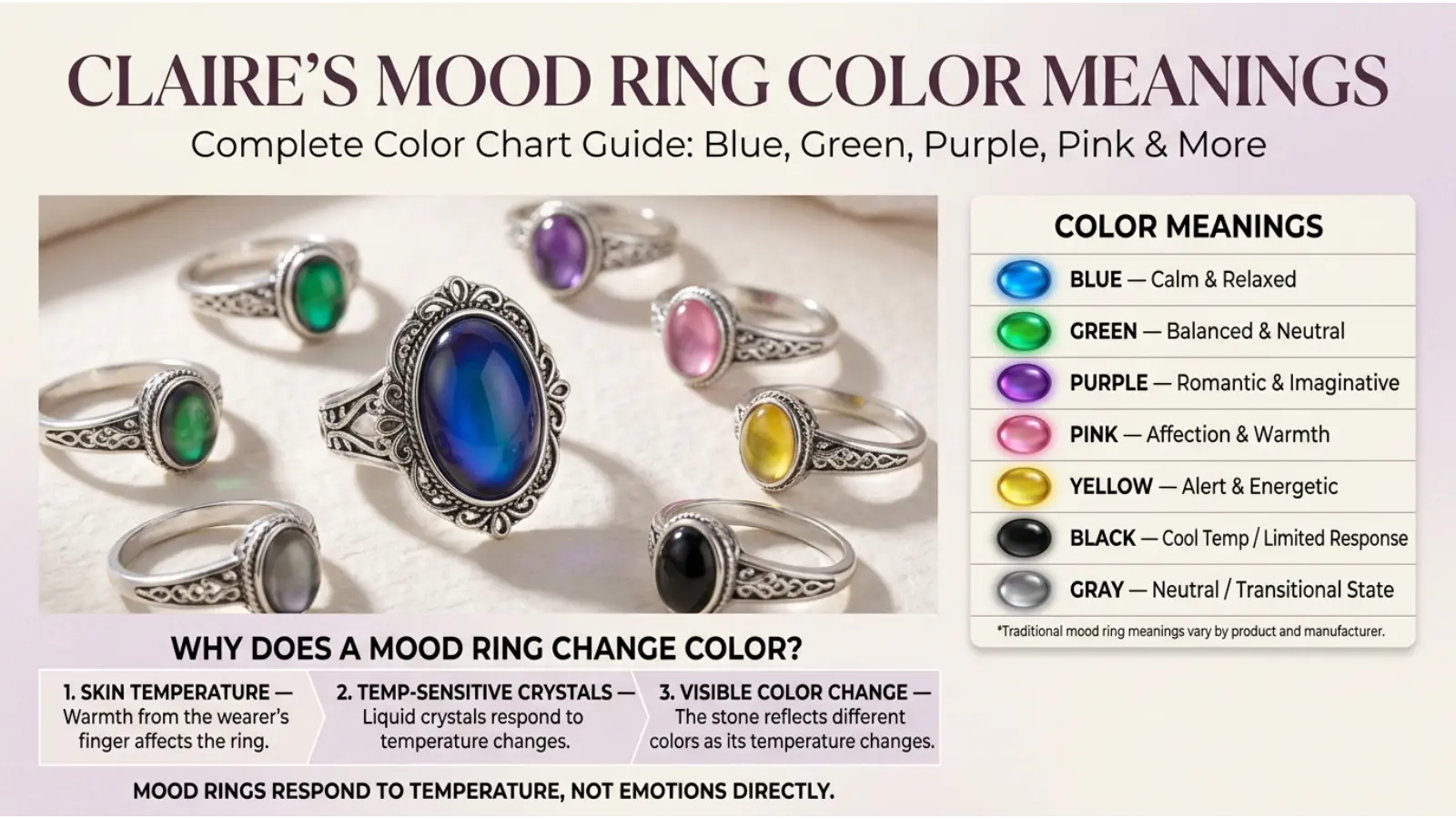
Claire’s mood ring colors are commonly associated with different emotional states. These meanings are symbolic rather than scientifically proven. Mood rings actually change color in response to temperature.
Claire’s Mood Ring Color Meanings Chart
The chart below explains common mood ring color associations. The meanings are general interpretations, not a verified official Claire’s chart. Check the instructions supplied with your particular ring for product-specific information.
| Color | Common Mood Association | Symbolic Meaning |
|---|---|---|
| 🟦 Dark Blue | Calm and relaxed | Peace, comfort, stability |
| 🩵 Light Blue | Peaceful and content | Ease, friendliness, openness |
| 🩵 Turquoise | Cheerful and energetic | Creativity, freshness, enthusiasm |
| 🟩 Green | Balanced or average | Harmony, stability, renewal |
| 🟨 Yellow | Alert or unsettled | Curiosity, nervous energy |
| 🟧 Orange | Excitement or tension | Energy, anticipation |
| 🩷 Pink | Warmth or affection | Love, tenderness, friendliness |
| 🟥 Red | Strong emotions | Passion, excitement, intensity |
| 🟪 Purple | Excitement or romance | Imagination, affection, mystery |
| 🟣 Dark Purple | Deep feelings | Intensity, reflection |
| ⬜ Gray | Uncertainty or tension | Hesitation, sensitivity |
| 🟫 Brown | Uneasiness or nervousness | Caution, restlessness |
| ⬛ Black | Stress or low color response | Tension or a cooler ring |
Remember: Mood ring charts differ. The same shade may have a slightly different interpretation depending on the manufacturer, so use your ring’s own guide when available.
What Does Each Claire’s Mood Ring Color Mean?
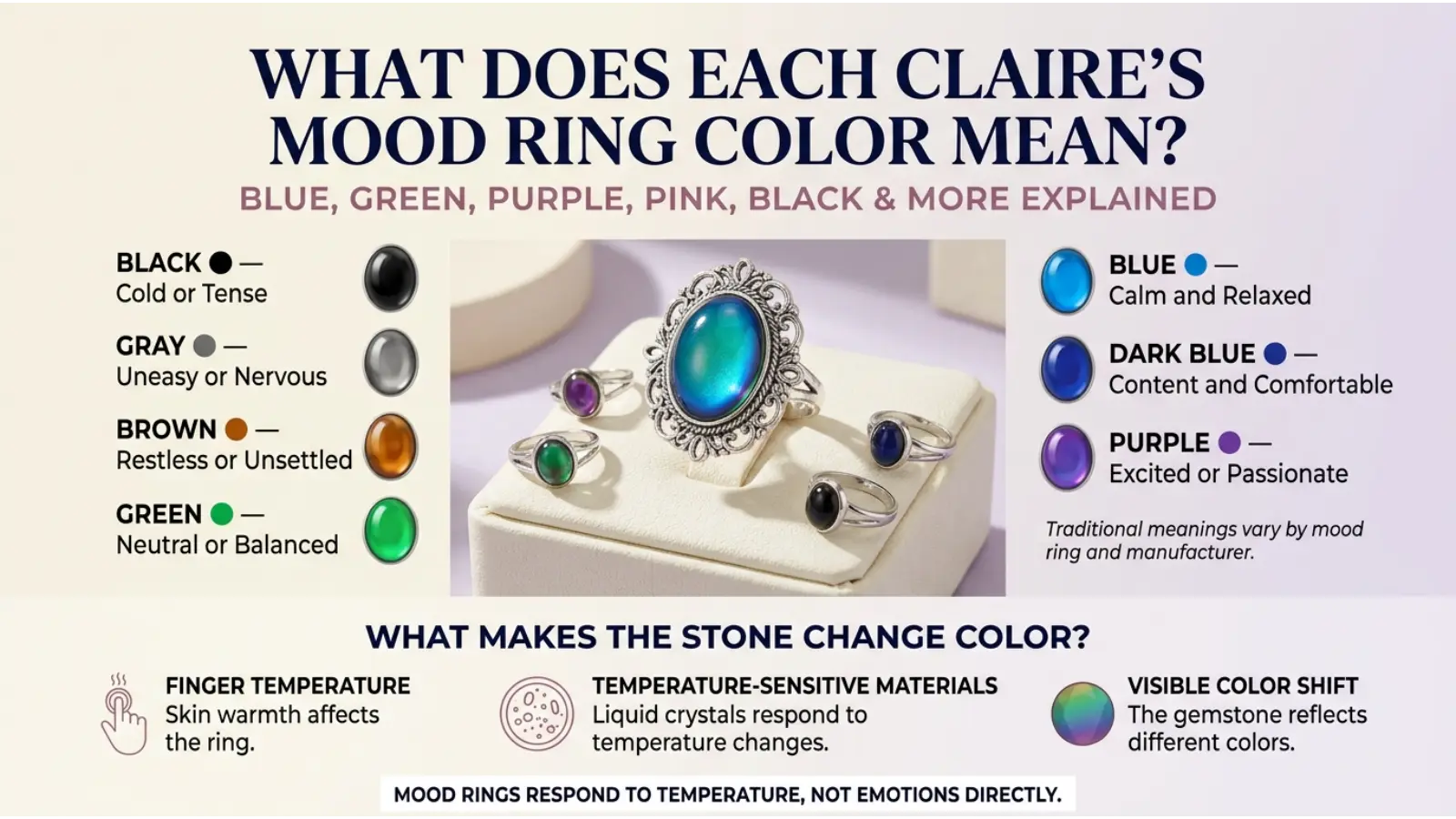
1. Blue: Calmness and Relaxation
Blue is one of the most familiar colors in traditional mood ring charts.These meanings make blue a popular color in mood jewelry.
From a practical perspective, a blue ring may simply indicate that its temperature-sensitive material has reached a particular temperature range. It cannot confirm whether you are happy, relaxed, or emotionally balanced.
2. Green: Balance and Stability
Green is often described as the neutral or balanced color on a traditional mood ring chart. It can symbolize harmony, renewal, and a steady state.
In mood jewelry, however, green may indicate that the ring is within a middle temperature range rather than revealing a particular emotional state.
3. Purple: Imagination and Affection
Purple is frequently associated with imagination, mystery, romance, and creativity. Some traditional mood ring charts connect it with excitement or affectionate feelings.
4. Pink: Warmth and Happiness
Pink is commonly linked with tenderness, friendliness, affection, and warmth. Its soft appearance makes it a popular color in jewelry and fashion.
On a mood ring, pink may be interpreted as a positive or affectionate mood. Nevertheless, the actual shade depends on the temperature response of the ring’s material, not on whether you are feeling romantic or happy.
5. Red: Passion and Excitement
Red often represents passion, energy, excitement, and strong emotions. In traditional color symbolism, it can communicate confidence, urgency, or intensity.
If your ring turns red, you might associate the shade with an energetic moment. However, a red appearance does not prove that your heart rate has increased or that you are experiencing a particular emotion.
6. Turquoise: Freshness and Energy
Turquoise combines the familiar symbolism of blue and green. It is often associated with freshness, creativity, friendliness, and positive energy.
Mood ring enthusiasts may interpret turquoise as a cheerful or active state. The ring itself, however, responds to temperature rather than measuring energy levels or emotional excitement.
7. Yellow: Alertness and Nervous Energy
Yellow is often connected with curiosity, alertness, optimism, and mental activity. Some mood ring charts interpret it as nervousness or uncertainty.
These interpretations may seem contradictory because yellow can symbolize both positivity and tension. Context helps explain the difference: bright yellow often suggests cheerfulness in design, while certain mood ring guides assign it a more unsettled meaning.
8. Orange: Excitement and Tension
Orange is commonly associated with enthusiasm, activity, warmth, and excitement. Some traditional mood ring charts also connect it with nervousness or tension.
The difference reflects the flexible nature of color symbolism. Orange may communicate fun and energy in fashion, yet a particular mood ring chart may give it a more cautious interpretation.
9. Gray: Uncertainty and Sensitivity
Gray is often linked with uncertainty, hesitation, or a subdued mood. It can also symbolize neutrality and simplicity in general color symbolism.
If your ring appears gray, the shade may be the result of its temperature-sensitive material. Lighting, the ring’s design, and the exact temperature can also affect how the color looks.
10. Brown: Uneasiness and Restlessness
Brown is sometimes associated with nervousness, discomfort, or restlessness in traditional mood ring guides. Outside mood jewelry, it can symbolize earthiness, reliability, warmth, and stability.
If your ring turns brown, do not assume that something is wrong with your emotional state. It is more useful to check whether the ring is cold, exposed to a different environment, or showing a shade listed in its product guide.
11. Black: Stress or a Cool Ring
Black is often described as the stress color on mood ring charts. However, that interpretation is not a reliable scientific conclusion.
A ring may appear black or very dark when its temperature-sensitive material reaches a particular temperature range, when the material is not displaying a distinct color, or when the ring is not functioning as intended. Check the manufacturer’s instructions before drawing conclusions.
How Do Claire’s Mood Rings Change Color?
Mood rings commonly use thermochromic liquid crystals or other temperature-sensitive materials. These materials respond to changes in temperature by changing the wavelengths of light they reflect, which makes the ring appear to change color.
For example, when your finger becomes warmer or cooler, the material may shift from blue to green or from purple to another shade. The response depends on the material and its temperature range.
Several factors can influence the color:
- Finger temperature: Changes in skin temperature can affect the ring’s appearance.
- Room temperature: Cold or warm surroundings may influence the material.
- Ring fit: A loose ring may respond differently from one that makes steady contact with your finger.
- Lighting: Indoor and outdoor lighting can make the same shade appear different.
- Product design: Different rings may use different materials and color ranges.
As a result, your ring may change color even when your emotional state remains the same.
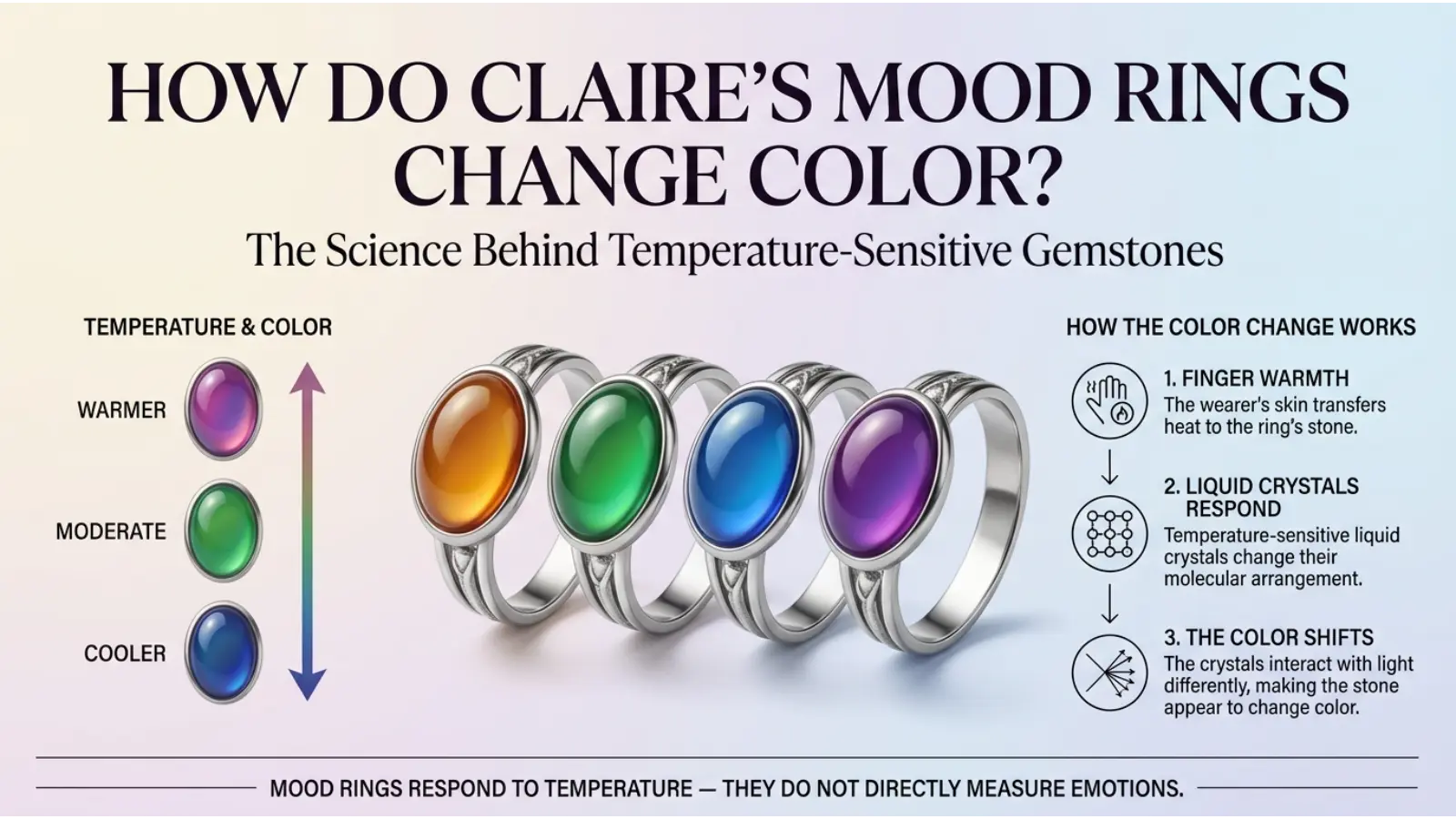
Colorful Mood Ring Temperature Guide
The following visual guide shows how traditional mood ring charts often organize colors. It is illustrative only and does not represent verified temperature thresholds for every Claire’s ring.
| Color Range | General Temperature Interpretation |
|---|---|
| 🟦 Dark blue | Often associated with a warmer ring and a relaxed mood |
| Light blue | Commonly associated with a comfortable temperature |
| 🟩 Green | Often represents a middle temperature range |
| 🟨 Yellow | May appear as the material shifts between ranges |
| 🟧 Orange | Depends on the material’s temperature response |
| 🟪 Purple | May appear at a particular temperature range |
| ⬛ Black | May indicate a very dark response, low-temperature state, or a lack of distinct color |
The order and temperature associated with each shade vary by product. Do not use this general chart to estimate your body’s temperature or diagnose a health condition.
Why Does Your Claire’s Mood Ring Color Meanings Keep Changing Color?
A mood ring may change several times in a single day because your finger temperature and surroundings are not constant.
For example, your ring may look different after you come inside from cold weather. It may also change after you wash your hands with warm water or move into a cooler room.
These changes are normal for many temperature-sensitive accessories. If the ring remains black or stops showing its usual range of colors, consult the product instructions. Damage, aging, or exposure to unsuitable conditions may affect its performance.
Can Claire’s Mood Ring Color Meanings Really Read Your Emotions?
No. Mood rings cannot reliably identify your feelings, thoughts, or personality.
Emotions and body temperature can sometimes change together, but the relationship is not simple enough for a ring to determine your emotional state. For example, nervousness may affect sweating or skin temperature, while a cold room can change your finger temperature without changing your mood. They can be a fun way to start a conversation about feelings, but they are not psychological tests or medical devices.
How to Read Your Claire’s Mood Ring Correctly
Follow these practical steps to understand your ring more consistently.
- Check the original color chart. Use the guide provided with your particular ring because color ranges may differ.
- Allow the ring to adjust. Give it a little time after moving between warm and cold environments.
- Look at it under consistent lighting. This makes it easier to compare similar shades.
- Notice the actual color. Describe the shade you see before applying a symbolic interpretation.
- Treat the meaning as entertainment.
For example, if your ring turns blue during a relaxing evening, you may enjoy interpreting the shade as calmness. However, the color alone cannot confirm that interpretation.
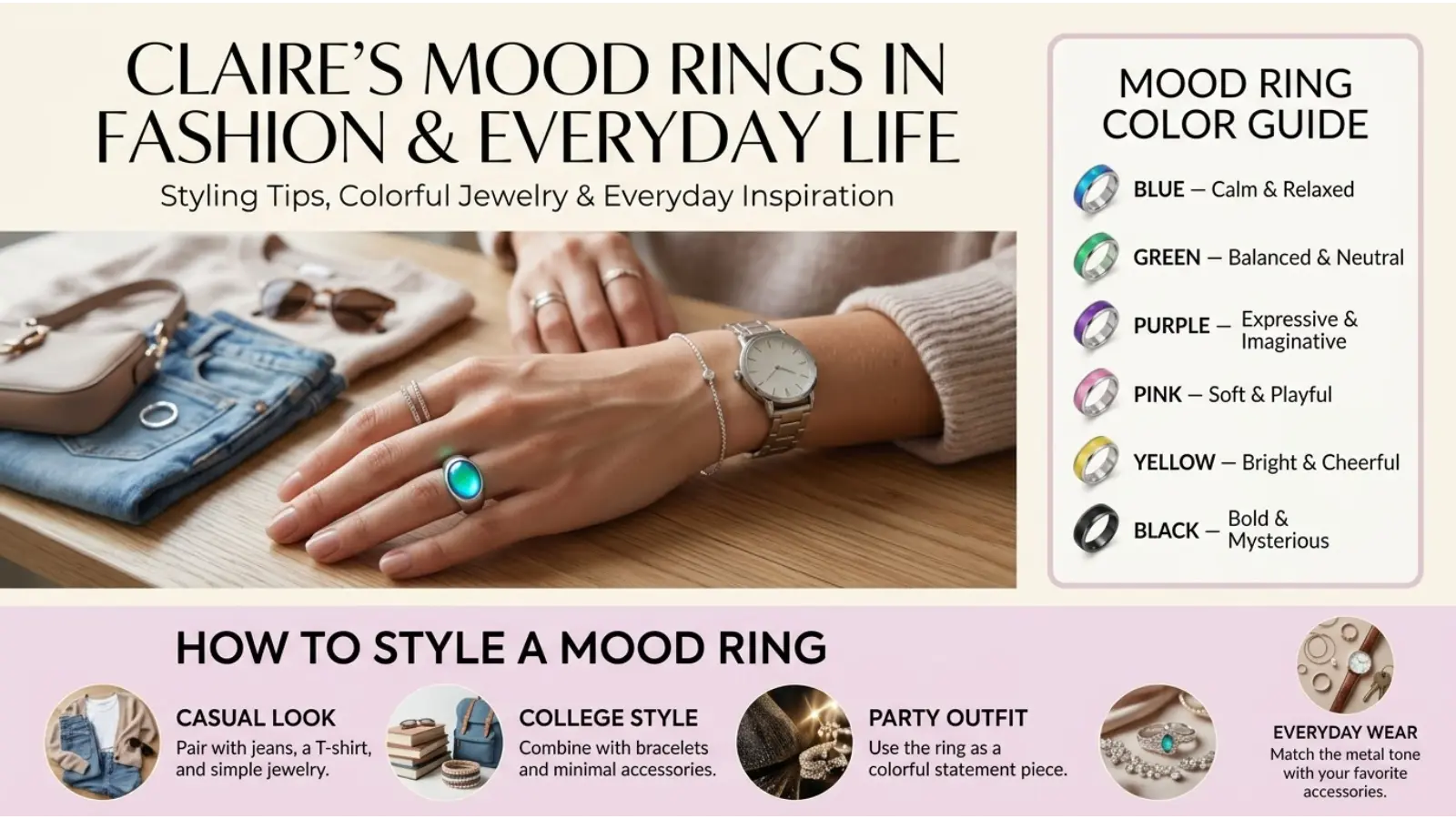
Claire’s Mood Rings in Fashion and Everyday Life
Mood rings combine color-changing materials with personal style. Their shifting shades can make an ordinary accessory more interesting and give the wearer something to discuss with friends.
They can also complement different outfits. Blue and turquoise pair naturally with white, denim, and silver-toned accessories. Pink and purple work well with softer colors, while green can complement neutral outfits and nature-inspired styles.
Because the color changes with temperature, a mood ring may look different throughout the day. This quality makes it a playful accessory rather than a dependable way to coordinate a fixed color scheme.
Common Misconceptions About Claire’s Mood Ring Colors
Black always means stress
Black is often given this meaning in traditional charts, but the ring’s color is influenced by temperature. It cannot prove that you are stressed.
Blue always means happiness
Blue is commonly associated with calmness, but the ring does not measure happiness. The color may appear because the material has reached a certain temperature.
Every mood ring uses the same chart
Different products may use different temperature-sensitive materials and color ranges. A general chart may not match the exact guide for your Claire’s ring.
Mood rings reveal your personality
A color-changing accessory cannot determine whether you are confident, shy, romantic, or creative. Personality is far more complex than a single color.
Frequently Asked Questions
1. What do Claire’s mood ring colors mean?
They have traditional symbolic associations. Blue commonly represents calmness, green balance, purple imagination or affection, pink warmth, and black stress or a cool ring. Exact interpretations depend on the product’s chart.
2. What does blue mean on a Claire’s mood ring?
Blue is often associated with calmness, relaxation, and comfort. Scientifically, the color reflects the temperature response of the ring’s material rather than a confirmed emotional state.
3. What does green mean on a Claire’s mood ring?
Green is commonly interpreted as balance or a neutral mood. It may also indicate that the ring’s temperature-sensitive material is within a particular temperature range.
4. What does purple mean on a Claire’s mood ring?
Purple is often linked with imagination, affection, romance, or excitement. These are traditional symbolic meanings, not scientifically established readings of emotions.
5. Why is my Claire’s mood ring black?
The ring may be responding to a particular temperature, displaying a very dark shade, or experiencing a problem with its color-changing material. Check the original product instructions before interpreting the color.
6. Does a Claire’s mood ring really detect stress?
No. It reacts to temperature changes, not stress itself. Although stress can sometimes influence skin temperature, the ring cannot reliably identify the cause of a temperature change.
7. Why does my mood ring change colors throughout the day?
Your finger temperature and surrounding environment change throughout the day. These shifts can cause the temperature-sensitive material to display different colors.
8. Are Claire’s mood ring color charts accurate?
They can be useful for learning the product’s intended color associations, but they do not provide scientifically reliable emotional readings. Use the chart supplied with your ring for its specific color range.
9. Can two Claire’s mood rings show different colors at the same time?
Yes. Different rings may use different materials or temperature ranges. Even similar rings can respond differently because of fit, skin temperature, and environmental conditions.
10. Can I use my mood ring to check my body temperature?
No. A mood ring is not a medical thermometer. Use an appropriate thermometer if you need to measure your body temperature.
Conclusion
Claire’s mood ring color meanings combine playful symbolism with the science of temperature-sensitive materials. Meanwhile, black and other dark shades may reflect the ring’s temperature response rather than a negative emotion.
The most useful way to read your ring is to understand its original color chart, observe how its shades change, and remember that symbolic meanings are not scientific measurements. Enjoy the colors as a fun part of your personal style, but let your own experiences—not a changing ring—guide your understanding of your feelings.
Clarify the temperature color chartRemove unsupported temperature associations
Emma Wilson is a dedicated comparison writer and product researcher at ColorMystiic.com. She specializes in creating unbiased product comparisons, detailed reviews, and helpful buying guides. Her goal is to help readers make smarter purchasing decisions with confidence.