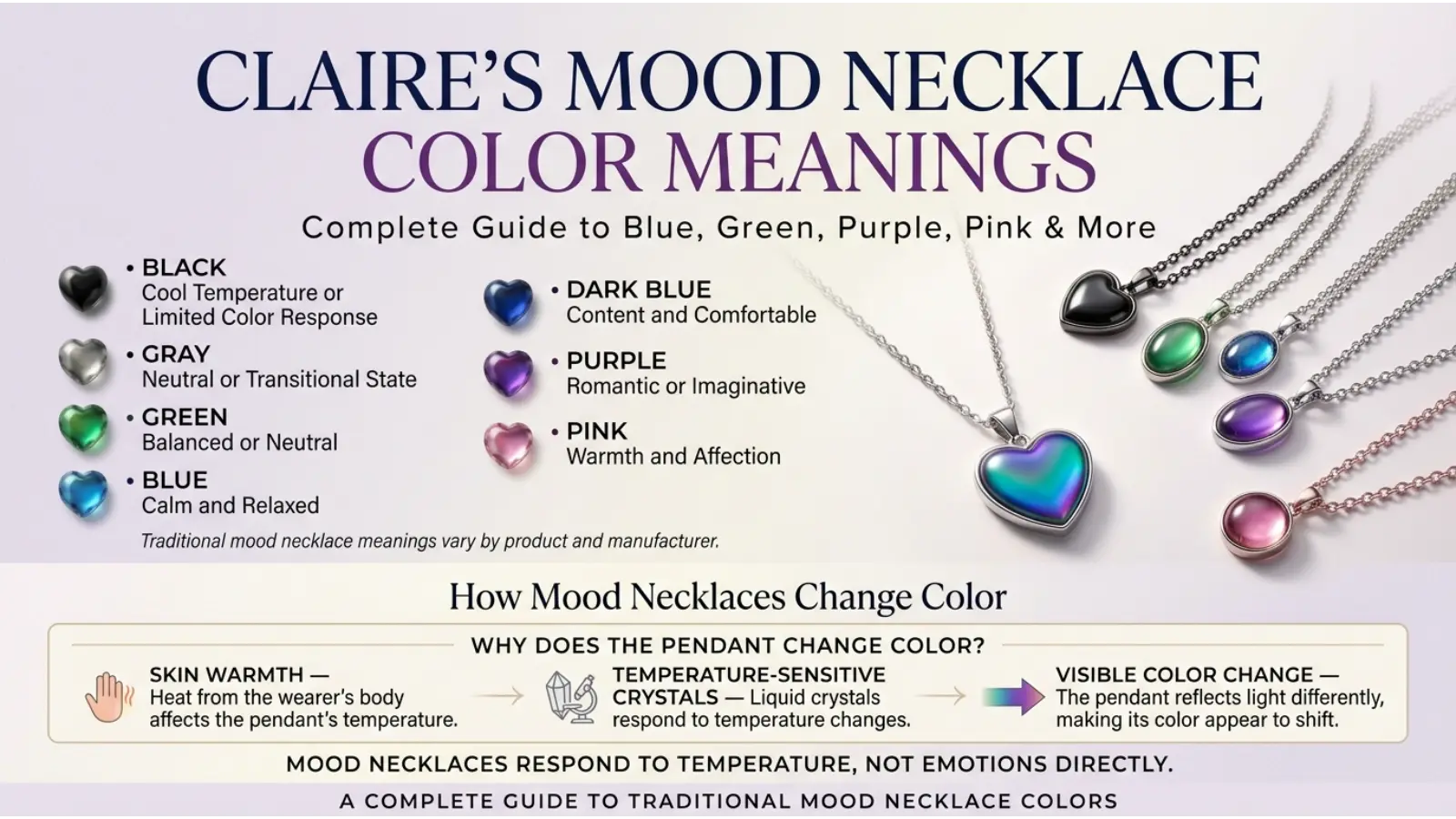
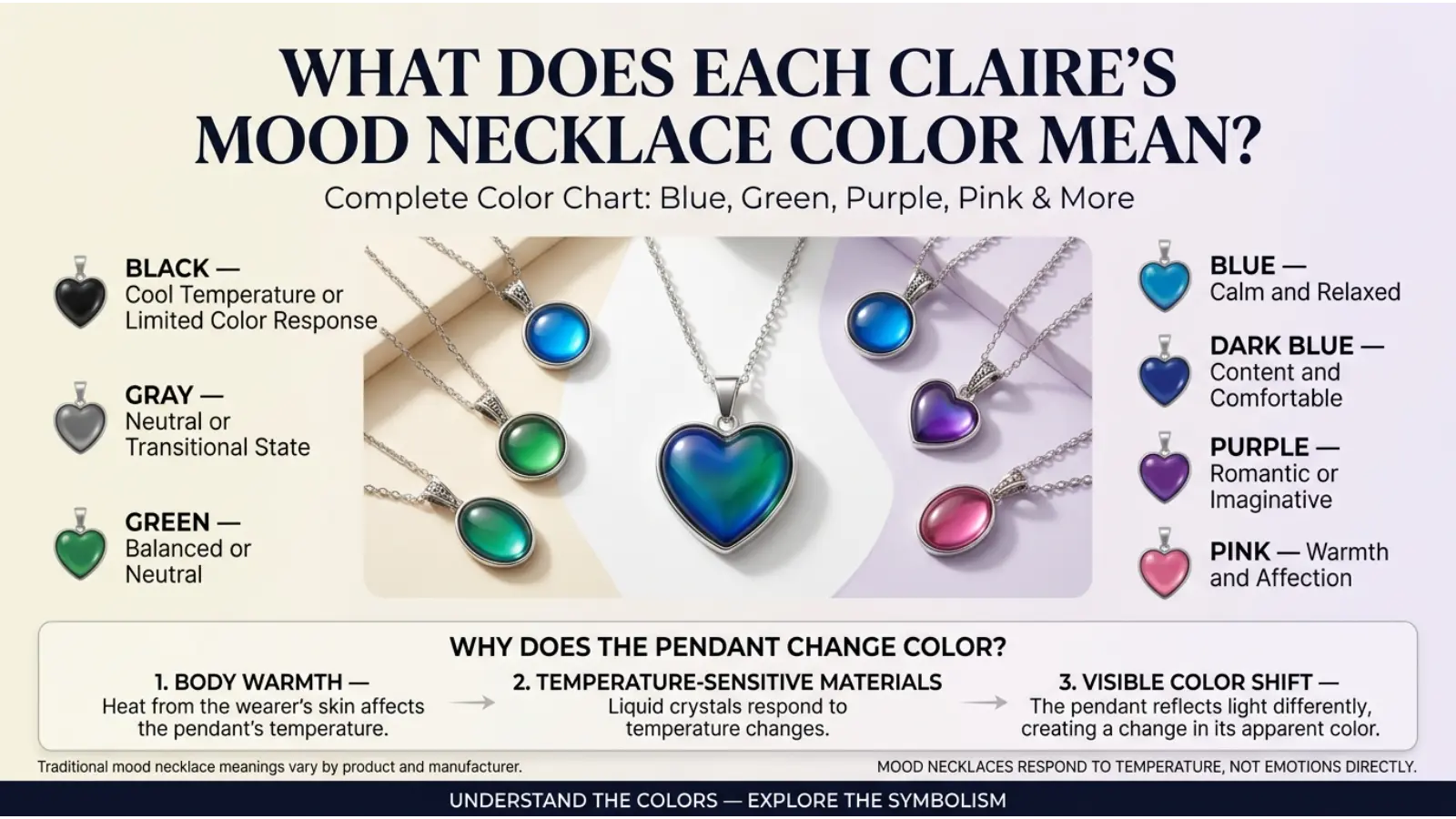
Claire’s Mood Necklace Color Meanings combine colorful jewelry with the fun of watching a pendant change shades throughout the day. Each color has a traditional symbolic meaning, from blue for calmness to pink for affection and purple for creativity. However, these meanings are not the same as scientifically measuring emotions. A mood necklace responds to temperature, while its emotional associations come from popular mood jewelry charts and color symbolism.
Understanding Claire’s mood necklace color meanings can help you interpret common color charts, choose accessories that match your style, and learn why the same necklace may look different in different environments. Since product designs can vary, the chart below provides general mood jewelry meanings rather than a verified, exclusive Claire’s color chart.
Quick Answer: Claire’s mood necklace colors traditionally represent different emotional states. Blue often symbolizes calmness, green balance, purple creativity, pink affection, red passion, yellow optimism, and orange enthusiasm. However, the necklace changes color in response to temperature, not because it can directly detect your feelings.
Claire’s Mood Necklace Color Meanings Chart
The following colorful chart summarizes the meanings commonly associated with mood necklaces. Actual colors and temperature ranges may differ depending on the product.
| Color | Common symbolic meaning | Emotional association | Color preview |
|---|---|---|---|
| Dark blue | Calmness | Relaxed and peaceful | 🟦 |
| Light blue | Comfort | Content and at ease | 🩵 |
| Green | Balance | Steady and harmonious | 🟩 |
| Purple | Creativity | Imaginative and expressive | 🟪 |
| Pink | Affection | Warm and caring | 🩷 |
| Red | Passion | Excited and energetic | 🟥 |
| Yellow | Optimism | Cheerful and positive | 🟨 |
| Orange | Enthusiasm | Playful and lively | 🟧 |
| Brown | Stability | Grounded and comfortable | 🟫 |
| Black | Tension in some charts | Sometimes associated with stress | ⬛ |
These are general interpretations from traditional mood jewelry charts, not a confirmed Claire’s-specific color sequence. A color alone cannot establish someone’s emotional state.
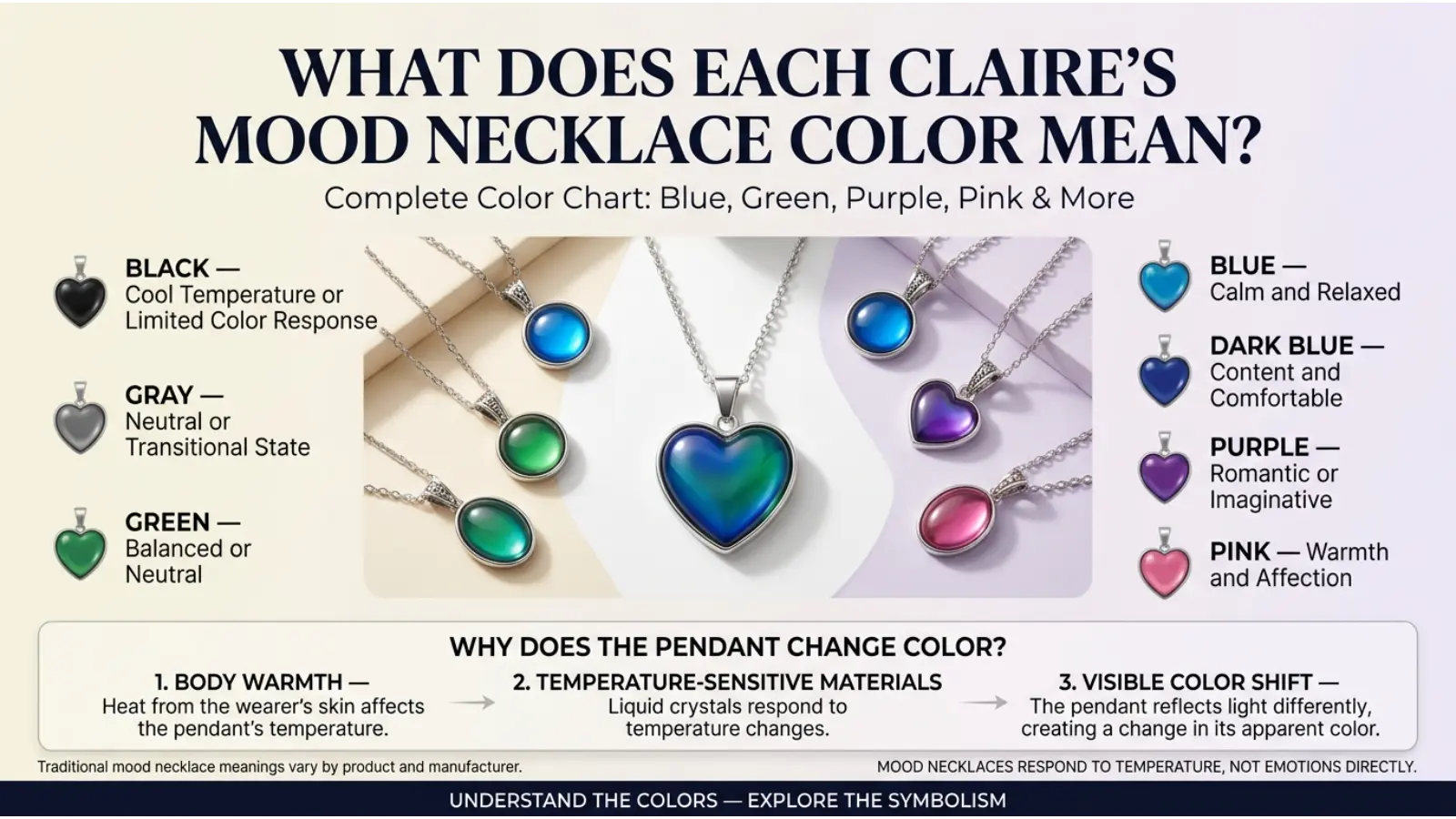
What Does Each Claire’s Mood Necklace Color Meanings?
1. Dark Blue: Calmness and Relaxation
Dark blue is commonly associated with peace, trust, and relaxation. In traditional mood jewelry charts, it often represents a comfortable or settled emotional state.
Blue also brings to mind the sky and ocean, which can create associations with open space and tranquility. In fashion, a dark blue pendant looks attractive with white, denim, gray, or black clothing.
Nevertheless, a blue stone does not prove that you are relaxed. Its appearance depends on the temperature response of the material inside the pendant.
2. Light Blue: Peace and Comfort
Light blue often symbolizes ease, openness, and a gentle mood. Compared with darker blue, it has a softer appearance that works well with casual and pastel outfits.
For example, a light blue necklace can complement a white shirt, a summer dress, or a light denim jacket. Its cool appearance also makes it a useful accessory for simple everyday styling.
However, different necklaces may display light blue at different temperatures, so the exact meaning depends on the chart being used.
3. Green: Balance and Harmony
Green is closely associated with nature, growth, renewal, and balance. Consequently, many mood necklace charts connect green with a steady or balanced emotional state.
In everyday fashion, green jewelry pairs well with cream, brown, black, and other earthy colors. It can create a fresh, nature-inspired look without being too bright.
Green also has different meanings in different settings. It may represent environmental awareness in branding, growth in design, or luck in certain cultural contexts. Therefore, its meaning depends on more than the shade alone.
4. Purple: Creativity and Mystery
Purple is often linked with imagination, individuality, mystery, and artistic expression. Some mood jewelry charts associate it with a creative or expressive state.
A purple pendant can stand out against black, white, silver, or soft pink clothing. Moreover, deeper purple shades can create a dramatic look, while lighter lavender tones feel gentle and playful.
These associations are symbolic rather than scientific. A purple necklace cannot measure creativity or determine someone’s personality.
5. Pink: Affection and Warmth
Pink commonly represents affection, tenderness, kindness, and romance. This makes it a popular symbolic color for jewelry given as a gift or worn as part of a soft, feminine-inspired outfit.
Light pink pairs naturally with white, cream, gray, and pastel shades. Brighter pink, on the other hand, can create a more noticeable and playful appearance.
Although pink is often connected with love, seeing pink on a mood necklace does not mean that someone is in love. The color change is caused by temperature, not a reading of romantic feelings.
6. Red: Passion and Excitement
Red is associated with passion, intensity, energy, and confidence. Because it attracts attention, it is often used in fashion, advertising, and visual design to create a bold impression.
A red mood necklace can add contrast to a black or white outfit. It can also complement warm colors such as orange and burgundy.
Some traditional mood charts link red with excitement or strong feelings. However, the stone cannot tell whether someone is excited, angry, confident, or experiencing another emotion.
7. Yellow: Happiness and Optimism
Yellow often symbolizes sunshine, hope, cheerfulness, and optimism. Its bright appearance can make a necklace look lively and youthful.
For styling, yellow works well with navy, denim, white, and neutral colors. A small yellow pendant can brighten a simple outfit without requiring several accessories.
Even so, yellow does not automatically indicate happiness. Its traditional meaning comes from color symbolism, while the necklace itself responds to temperature.
8. Orange: Energy and Enthusiasm
Orange combines the warmth commonly associated with red and the brightness linked with yellow. As a result, it is often connected with enthusiasm, friendliness, and adventure.
An orange mood necklace can complement brown, beige, cream, and denim. It is particularly suitable for casual outfits and colorful accessories.
However, orange does not confirm that the wearer is excited or outgoing. Its meaning remains a symbolic interpretation rather than an accurate emotional measurement.
9. Brown: Stability and Comfort
Brown is associated with earth, reliability, simplicity, and warmth. Some mood jewelry charts interpret brown as a grounded or practical emotional state.
Brown accessories work naturally with cream, tan, olive, and other earthy colors. They can also create a vintage-inspired look when combined with antique-style metal details.
If a necklace turns brown, do not assume that your emotions have changed. The shade may simply reflect the temperature range of its particular material.
10. Black: Tension or Low Energy
Black is sometimes associated with tension, uncertainty, or low energy in popular mood jewelry charts. However, this interpretation should be treated carefully.
A dark pendant may have cooled below the temperature range associated with its brighter shades. Lighting, product design, and the properties of the temperature-sensitive material can also affect its appearance.
In fashion, black has a separate meaning. It often represents elegance, simplicity, and a modern style. Therefore, a black mood necklace can look sophisticated without suggesting anything negative about the wearer.
Colorful Mood Necklace Chart: Meaning at a Glance
Use this simplified chart when you want to compare the common symbolic meanings quickly.
| 🟦 Blue | 🟩 Green | 🟪 Purple |
|---|---|---|
| Calmness and peace | Balance and growth | Creativity and mystery |
| 🩷 Pink | 🟥 Red | 🟨 Yellow |
|---|---|---|
| Affection and warmth | Passion and excitement | Joy and optimism |
| 🟧 Orange | 🟫 Brown | ⬛ Black |
|---|---|---|
| Enthusiasm and energy | Stability and comfort | Tension in some charts |
Remember: This is a symbolic guide, not a scientific mood test. The same shade can carry different meanings depending on personal experience, culture, and the chart used by a jewelry manufacturer.
How Does a Claire’s Mood Necklace Change Color?
Mood necklaces generally use temperature-sensitive materials known as thermochromic materials. In many classic mood jewelry designs, liquid crystals change how they reflect light when their temperature shifts. This creates the appearance of changing colors.
For example, a pendant may display a blue shade when it is warmer and a darker shade when it cools. The exact sequence depends on the product’s materials and temperature range.
Several everyday factors can affect the necklace:
- Body temperature: Heat transferred from your skin can warm the pendant.
- Room temperature: A cool room may make the stone look different from a warm room.
- Weather: Moving outdoors can change the pendant’s temperature.
- Air conditioning: Cool airflow may affect how quickly the jewelry loses heat.
- Product design: Different materials can produce different color ranges.
Therefore, your necklace may display different shades during the day even when your emotional state remains unchanged.
Can a Claire’s Mood Necklace Color Meanings Really Detect Emotions?
No. A mood necklace cannot reliably identify or measure emotions.
Although emotional experiences can sometimes affect skin temperature, many other factors influence temperature as well. Physical activity, the surrounding environment, circulation, and contact with warm or cool objects can all affect how the pendant responds.
For example, two people who feel equally relaxed may see different colors because they have different skin temperatures or are in different environments. Similarly, one person’s necklace may change from blue to green simply because the room has become cooler.
Mood necklaces are best enjoyed as decorative accessories with symbolic meanings. If you want to understand your feelings, personal reflection and communication are much more useful than interpreting a jewelry stone.
Why Do Mood Necklace Colors Have Different Meanings?
Color meanings develop through a combination of culture, personal experience, nature, history, and common visual associations.
Blue, for instance, may remind people of a peaceful sky or calm water. Red can bring to mind fire, heat, or strong visual signals. Green often recalls plants and new growth, while yellow is associated with sunshine.
However, these connections are not universal rules. Different cultures and individuals can interpret the same color differently. The meaning can also change according to context: red may symbolize romance in one setting and warning in another.
For this reason, mood jewelry charts should be understood as popular symbolic systems rather than universal descriptions of human emotion.
How to Wear a Claire’s Mood Necklace
Mood necklaces are easy to style because their changing colors can become a small focal point in an outfit.
Casual Everyday Outfits
Pair your necklace with a plain T-shirt, jeans, or a denim jacket. Neutral clothing allows the pendant to stand out without making your overall look too busy.
Colorful and Playful Styles
Combine the necklace with a simple bracelet or small earrings. If your pendant already has several bright colors, keep other accessories understated to maintain balance.
Elegant Outfits
Wear the necklace with a black dress, white blouse, or a simple top. Silver-toned accessories may complement cool shades, while gold-toned details can work well with warmer colors.
Seasonal Styling
Pastel colors can complement spring and summer outfits, while deeper shades often work well with autumn and winter clothing. However, your personal preference matters more than seasonal rules.
How to Care for Your Mood Necklace
Temperature-sensitive jewelry may require careful handling. Although the correct instructions depend on the specific product, these general practices can help:
- Keep the pendant away from excessive heat.
- Follow the manufacturer’s guidance about water exposure.
- Avoid harsh cleaning products and abrasive materials.
- Wipe the necklace gently with a soft cloth.
- Store it in a dry, safe place when not in use.
- Do not use ice, extreme heat, or sudden temperature changes to force a color change.
If the necklace stops changing color, check its product instructions before attempting any repair. Opening or heating the pendant may damage its temperature-sensitive material.
Common Misconceptions About Claire’s Mood Necklace Colors
Myth 1: Every Mood Necklace Uses the Same Chart
Different products may have different materials, temperature ranges, and color sequences. A general chart can explain common meanings, but it may not match every Claire’s necklace.
Myth 2: Black Always Means Stress
A dark shade may simply indicate that the pendant is cooler than the temperature range associated with its brighter colors. It does not prove that the wearer is stressed.
Myth 3: Blue Means You Are Definitely Relaxed
Blue is traditionally linked with calmness, but the necklace responds to temperature. It cannot reliably identify an emotional state.
Myth 4: Color Meanings Are Universal
Color symbolism varies between cultures, situations, and individuals. A color associated with one feeling in a mood jewelry chart may have another meaning elsewhere.
Myth 5: Mood Jewelry Can Diagnose Mental Health Conditions
Mood necklaces are fashion accessories, not medical or psychological assessment tools. They cannot diagnose anxiety, depression, or any other condition.
Frequently Asked Questions
1. What do Claire’s mood necklace colors mean?
Common mood jewelry charts associate blue with calmness, green with balance, purple with creativity, pink with affection, red with passion, yellow with optimism, and orange with enthusiasm. Exact meanings and color sequences vary.
2. What does blue mean on a Claire’s mood necklace?
Blue traditionally symbolizes calmness, relaxation, and peace. However, the pendant changes color in response to temperature rather than directly detecting emotions.
3. What does purple mean on a mood necklace?
Purple is often linked with creativity, imagination, and mystery. These associations are symbolic and do not scientifically describe the wearer’s emotional state.
4. Why does my Claire’s mood necklace turn black?
The pendant may have cooled below the temperature range associated with its brighter shades. A black appearance does not necessarily indicate stress, sadness, or anger.
5. Do Claire’s mood necklaces really work?
They can work as temperature-sensitive jewelry by changing their appearance as the material’s temperature changes. However, they cannot reliably measure or identify emotions.
6. Why does my mood necklace change colors throughout the day?
Changes in room temperature, weather, airflow, and heat transferred from your skin can affect the pendant. Consequently, the necklace may display different shades during the day.
7. Can a mood necklace tell if I am happy or sad?
No. Its color cannot reliably distinguish happiness from sadness. Traditional color charts offer symbolic interpretations rather than an accurate measurement of feelings.
8. Do all Claire’s mood necklaces have the same colors?
Not necessarily. Designs and temperature-sensitive materials may differ. Check the packaging or product information for the color range associated with your particular necklace.
9. How can I make my mood necklace change color?
Wear it normally and allow it to respond to natural temperature changes. Avoid extreme heat, ice, or sudden temperature shocks that could damage the pendant.
10. Are Claire’s mood necklaces good gifts?
Yes. They can be fun gifts for people who enjoy colorful accessories, nostalgic jewelry, and changing designs. Their symbolic meanings can make them interesting conversation starters.
Conclusion
Claire’s mood necklace color meanings bring together the appeal of changing jewelry and familiar ideas about color symbolism. Blue may represent calmness, green may suggest balance, and purple may evoke creativity. Meanwhile, the actual color change depends on the pendant’s temperature-sensitive materials and surrounding conditions.
Enjoy your necklace as a personal accessory, experiment with different outfit combinations, and treat its color chart as a playful guide rather than a reliable reading of your emotions. After all, colors can inspire personal meaning, but they do not define your feelings or personality.
Add a Claire’s-specific product disclaimerCondense repeated temperature explanations
Emma Wilson is a dedicated comparison writer and product researcher at ColorMystiic.com. She specializes in creating unbiased product comparisons, detailed reviews, and helpful buying guides. Her goal is to help readers make smarter purchasing decisions with confidence.