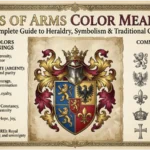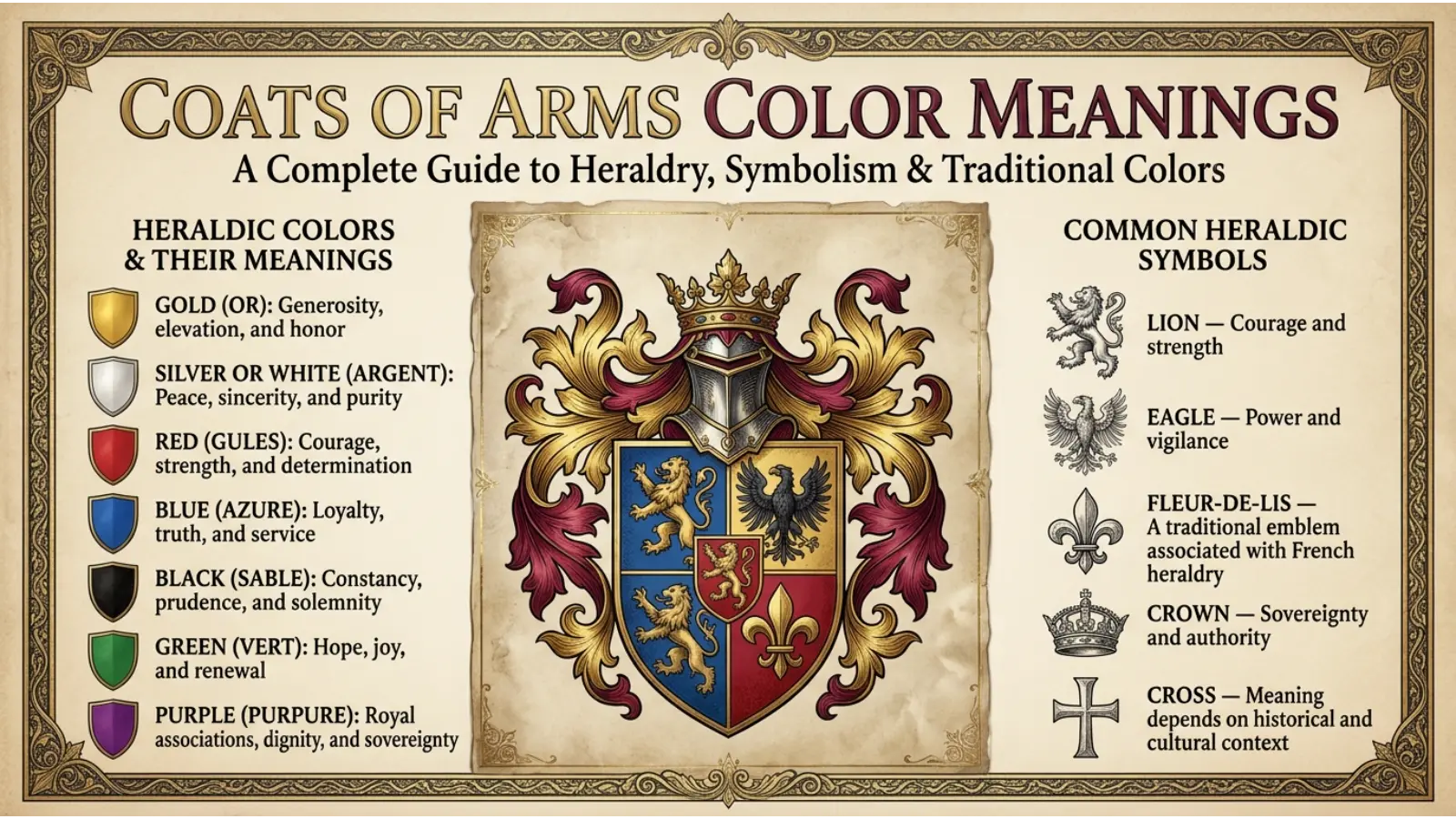
A Coats of Arms Color Meanings is more than a shield with attractive colors and symbols. It can represent a family’s heritage, a community’s identity, a noble house, or an institution’s history. In heraldry, the traditional art of designing and describing coats of arms, colors help make these designs meaningful and recognizable.
The coats of arms color meanings people search for often include courage, loyalty, wisdom, honor, and hope. However, heraldic colors do not always have one fixed meaning. Their significance depends on the historical period, the person or institution represented, and the symbols used alongside them.
For example, red is commonly associated with courage, while blue often represents loyalty. Gold can suggest generosity or elevation, and black may communicate constancy or grief in certain contexts.
In this guide, you will learn the traditional names of heraldic colors, their symbolic associations, their historical uses, and how to interpret them in family crests, flags, artwork, and modern design.
Quick Answer: Coats of arms color meanings are the symbolic associations attached to heraldic colors. Red commonly represents courage, blue loyalty, green hope or joy, black constancy or grief, purple royal dignity, silver peace or sincerity, and gold generosity or elevation. Exact meanings vary by historical and heraldic context.
What Are the Traditional Coats of Arms Color Meanings?
Heraldry uses a specialized vocabulary for colors and surface patterns. These terms are known as tinctures. They help heralds describe a coat of arms clearly, even when the design is reproduced in different styles.
The Two Main Heraldic Metals
Gold and silver are the two traditional metals in European heraldry. They may appear as yellow and white when metallic materials are unavailable.
- Or: Gold or yellow.
- Argent: Silver or white.
Gold often suggests generosity, honor, or elevation in symbolic interpretations.
The Main Heraldic Colors
The traditional colors include:
- Gules: Red.
- Azure: Blue.
- Vert: Green.
- Sable: Black.
- Purpure: Purple.
Additional tinctures, such as orange (tenné) and blood-red or dark reddish-brown (sanguine), appear in some heraldic systems, although they are less common in traditional designs.
What Are Heraldic Furs?
Heraldic furs are conventional patterns used in coats of arms. Two well-known examples are ermine, a white field marked with black tail-like spots, and vair, a pattern based on the appearance of squirrel fur.
These patterns are not simply extra colors. Instead, they have their own established forms and historical uses.
Colorful Chart: Coats of Arms Color Meanings at a Glance
The chart below summarizes common symbolic associations found in European heraldic traditions. These are interpretive guides, not universal definitions assigned to every historical coat of arms.
| Heraldic color | Traditional name | Common symbolic associations |
|---|---|---|
| 🟥 Red | Gules | Courage, strength, determination |
| 🟦 Blue | Azure | Loyalty, truth, faithfulness |
| 🟩 Green | Vert | Hope, joy, renewal |
| ⬛ Black | Sable | Constancy, solemnity, grief |
| 🟪 Purple | Purpure | Dignity, sovereignty, prestige |
| 🟨 Gold | Or | Generosity, honor, elevation |
| ⬜ Silver or white | Argent | Peace, sincerity, purity |
| 🟧 Orange | Tenné | Less standardized; sometimes linked with endurance or ambition |
| 🟥 Dark reddish-brown | Sanguine | Less standardized; interpretations vary |
How to read this chart: Begin with the color, then examine the shield’s symbols, historical records, and family or institutional background. The combination provides a stronger interpretation than the color alone.
Red in Heraldry: Courage and Strength
Red, known as gules, is one of the most recognizable colors in heraldic design.
What Does Red Represent on a Coat of Arms?
Red can suggest bravery in the face of danger, the willingness to defend a community, or a reputation for strength. However, a red shield does not automatically prove that a family’s ancestors fought in a particular battle.
The color may have been selected for visual contrast, inheritance, political identity, or reasons that are no longer documented.
Why Is Red Used in Heraldic Designs?
Red stands out against silver, white, and gold. As a result, it can make a central symbol easier to recognize.
For example, a red lion on a gold shield creates a bold contrast. In modern graphic design, the same combination can communicate confidence, energy, and authority.
Practical insight: When researching a red family crest, distinguish between a traditional symbolic association and a documented explanation of why that particular family chose red.
Blue in Heraldry: Loyalty and Truth
Blue, known as azure, is commonly connected with loyalty, faithfulness, and truth in traditional heraldic symbolism.
Its associations make it useful in designs intended to communicate trust, service, or a lasting commitment.
What Does a Blue Coat of Arms Mean?
A blue shield may be interpreted as a sign of loyalty or steadfastness. Nevertheless, its actual meaning depends on the arms’ history rather than the color alone.
Blue also creates a calm, clear appearance. When paired with silver or white, it provides strong contrast without appearing as aggressive as some red-and-black combinations.
Blue in Family Crests and Institutional Arms
Blue appears in many kinds of heraldic designs, including those associated with families, towns, educational institutions, and public organizations.
In a modern institutional emblem, blue may suggest reliability and responsibility. In a historical family crest, however, it is safer to investigate the specific arms before assigning a personal or family meaning.
Practical insight: Blue and silver work well when a design needs to look dignified, readable, and balanced.
Green in Heraldry: Hope and Renewal
Green, known as vert, is frequently associated with hope, joy, renewal, and the natural world in heraldic interpretations.
Because green resembles growing plants and landscapes, modern viewers may also connect it with fertility, growth, and environmental awareness.
What Does Green Mean on a Coat of Arms?
Green may communicate optimism or a connection with land and nature. In some designs, it can complement symbols such as trees, leaves, mountains, or animals.
However, a green shield does not necessarily mean that a family owned farmland or worked in agriculture. Such a claim needs supporting historical evidence.
Why Designers Choose Green
Green is especially useful for arms connected with towns, parks, environmental organizations, or institutions that want to emphasize renewal.
For example, a green tree on a silver shield creates a fresh, natural appearance. Meanwhile, green combined with gold can feel traditional and prestigious.
Practical insight: Use green when the desired impression involves growth, hope, or nature, but let the complete design establish the message.
Black in Heraldry: Constancy and Solemnity
Black, known as sable, has several possible symbolic associations. Traditional interpretations can include constancy, determination, solemnity, and grief.
These meanings may appear contradictory. In reality, a color can communicate different ideas in different settings.
What Does Black Represent in a Coat of Arms?
Black may suggest firmness or a steadfast character. In another context, it can evoke mourning or remembrance.
Yet a black shield is not automatically a symbol of death, wrongdoing, or misfortune. It may simply provide contrast or form part of an inherited heraldic design.
Black in Modern Heraldic Design
Black pairs effectively with gold, silver, and red.
A black shield with gold details can appear formal and authoritative. Black and silver can create a restrained, elegant effect, while black and red may look bold and forceful.
Practical insight: Consider the symbols and surrounding colors before deciding whether black creates a solemn, powerful, or refined impression.
Purple in Heraldry: Dignity and Royal Prestige
Purple, known as purpure, is associated in some heraldic interpretations with dignity, sovereignty, and prestige.
What Does Purple Mean on a Coat of Arms?
Purple may suggest distinction, high status, or ceremonial dignity. Nevertheless, it does not prove that a family belonged to a royal house.
Purple is less common than red, blue, green, black, gold, and silver in many traditional European heraldic systems. Its use can therefore make a design visually distinctive.
Purple in Modern Emblems
Purple can be combined with gold for a rich, ceremonial appearance. It also works with silver when a design needs to look formal without relying on strong red or blue.
Practical insight: Use purple sparingly when creating a heraldic-inspired design. Its visual prominence can make a small symbol or central figure stand out.
Gold in Heraldry: Generosity and Honor
Gold, called or, is one of the two traditional heraldic metals. In ordinary reproductions, it is often shown as yellow.
What Does Gold Represent?
Gold can communicate value, dignity, and distinction. It may also create a sense of warmth and celebration.
However, gold on a coat of arms does not automatically indicate wealth or prove that a family possessed valuable property. A historical interpretation must be supported by records.
Why Gold Is Visually Important
Gold or yellow contrasts clearly with many darker heraldic colors, particularly red, blue, green, and black.
For example, a gold star on a blue shield is easy to recognize. Similarly, a gold lion on red creates a strong and memorable emblem.
Practical insight: Gold works well for crowns, stars, lions, lettering, and borders when the design needs a clear focal point.
Silver and White in Heraldry: Peace and Sincerity
Silver, known as argent, is usually represented by white when metallic silver is not used.
Traditional interpretations often connect silver or white with peace, sincerity, purity, and truth.
What Does White Mean on a Coat of Arms?
White can create an impression of openness, simplicity, or clarity. It also helps separate darker shapes and makes complex heraldic designs easier to read.
Silver and white are not always interchangeable in appearance, but they represent the same traditional heraldic metal in standard descriptions.
Why Silver Is a Useful Heraldic Tincture
Silver provides a bright background for symbols in black, red, blue, or green.
For example, a black eagle on a silver field appears clear and dramatic. A blue cross on silver can look balanced and formal.
Practical insight: If a coat of arms contains many details, silver or white can provide visual space and help prevent the design from becoming crowded.
How Heraldic Color Combinations Change Meaning
A single color offers only part of the story. The relationship between colors can change how a coat of arms looks and how viewers interpret it.
Colorful Chart: Popular Heraldic Color Combinations
| Color combination | Visual impression | Useful modern application |
|---|---|---|
| 🟥 Red + 🟨 Gold | Bold, prestigious, energetic | Ceremonial emblems |
| 🟦 Blue + ⬜ Silver | Trustworthy, balanced, dignified | Schools and institutions |
| 🟩 Green + 🟨 Gold | Natural, hopeful, traditional | Community or nature emblems |
| ⬛ Black + 🟨 Gold | Formal, powerful, refined | Premium identity designs |
| 🟪 Purple + 🟨 Gold | Ceremonial, distinctive, regal | Awards and special events |
| 🟥 Red + ⬜ Silver | Clear, strong, direct | Sports and club emblems |
| ⬛ Black + ⬜ Silver | Restrained, formal, dramatic | Monograms and modern crests |
These descriptions explain likely visual impressions, not fixed historical meanings. For instance, a red-and-gold shield might be used for a sports club without making any claim about courage or ancestry.
Why Contrast Matters in Heraldry
Heraldic design developed a strong preference for placing light tinctures against dark ones. A major convention is the rule of tincture: metals are generally placed against colors, and colors against metals.
The principle helps important shapes remain visible. Gold against blue, for example, usually creates a clear distinction.
The rule has exceptions, and historical arms do not always follow it perfectly. Still, it remains a useful starting point for creating readable heraldic-inspired designs.
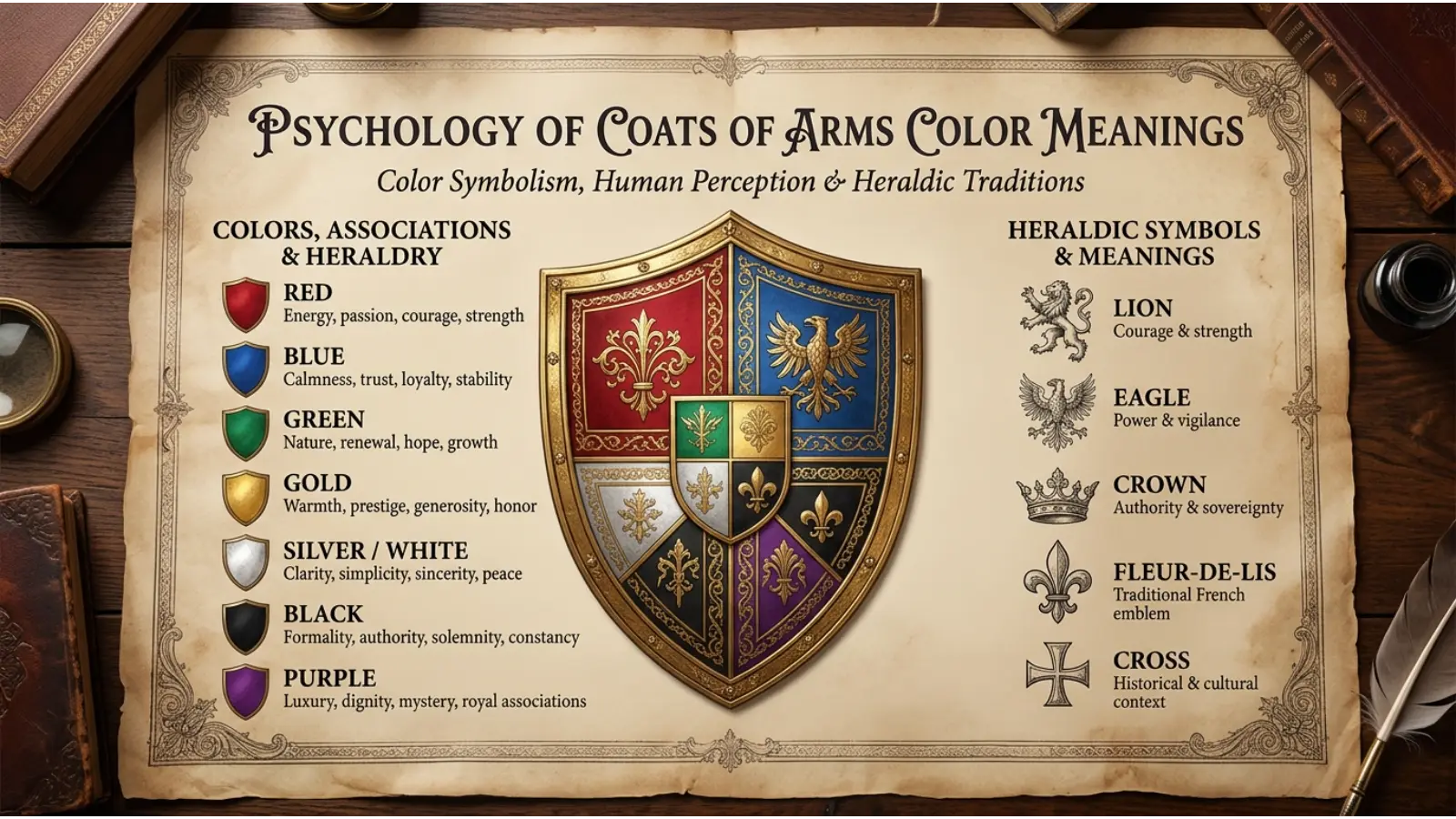
Psychology of Coats of Arms Color Meanings
Color psychology examines how people perceive and respond to color. Heraldic symbolism, by contrast, concerns established conventions and meanings attached to particular designs.
The two fields overlap, but they are not the same.
How Colors Influence Perception
Color can affect visual attention, contrast, and the impressions people form about an image. However, emotional responses depend on the person, the surrounding design, and the situation.
For example, red may appear exciting or threatening in one context and festive in another. Blue may feel calm to one viewer but cold or distant to someone else.
Research does not establish that a particular heraldic color produces the same emotional response in everyone.
Why Heraldic Designs Feel Powerful
A coat of arms combines several visual elements:
- Color: Establishes contrast and helps organize the design.
- Shape: Creates a recognizable outline.
- Symbol: Adds a possible connection with an animal, object, place, or ideal.
- Composition: Determines which elements receive the most attention.
- Historical context: Explains the design’s documented associations.
Together, these elements can make a coat of arms memorable. Therefore, its effect should not be attributed to color alone.
Historical Coats of Arms Color Meanings
Heraldry developed in medieval Europe and became a formal system for identifying individuals, families, institutions, and political groups. Shields, seals, banners, and other objects helped distinguish one bearer from another.
Over time, coats of arms became hereditary in many European traditions. They also developed formal rules for describing, displaying, and recording designs.
Why Heraldic Colors Became Standardized
Distinct colors made it easier to recognize a shield at a distance, particularly when people needed to identify one another in public or military settings.
As heraldry developed, specialist terms such as gules, azure, vert, and sable provided a shared vocabulary. Consequently, a written description could communicate a design without requiring an identical painting.
Did Every Color Have One Official Meaning?
No. Heraldic colors have traditional symbolic associations, but there is no universal code that assigns every shield color one fixed explanation.
Some coats of arms have documented histories explaining their imagery. Others have no surviving explanation for the original choice of colors.
Therefore, a modern color chart should be treated as a guide to common interpretations, not as proof of the intentions of a historical family.
How Heraldic Colors Changed Over Time
The appearance of heraldic colors has also changed with the materials used to reproduce them. Paint, cloth, printing methods, digital screens, and lighting can make the same tincture look different.
Gold might appear metallic on a ceremonial shield but flat yellow on a printed document. Likewise, silver may look reflective in one reproduction and plain white in another.
These differences affect appearance without necessarily changing the official heraldic description.
Cultural Interpretations of Coats of Arms Color Meanings
Heraldry has developed differently across countries and communities. European heraldic conventions are influential, but they should not be treated as a universal system for understanding every culture’s symbols.
European Heraldry
The European heraldry has a long-established vocabulary of tinctures and rules for describing arms. Traditional interpretations of red, blue, gold, silver, green, black, and purple often come from this setting.
Even within Europe, however, historical practices and symbolic associations vary.
British Heraldry
British heraldry uses the familiar tinctures and formal descriptions found in other European heraldic traditions.
A family coat of arms is not simply a decorative picture that anyone with the same surname can automatically claim. Its ownership and use depend on the relevant heraldic tradition and documented entitlement.
Continental European Traditions
Heraldry in countries such as France, Germany, and Spain developed its own conventions, terminology, and institutional history.
Middle Eastern and Other Cultural Traditions
Many societies have rich traditions of flags, seals, emblems, calligraphy, and symbolic colors. However, these traditions should not automatically be interpreted through medieval European heraldry.
For example, a color used on a national flag may have a documented political or religious association that differs from its traditional European heraldic interpretation.
Similarly, African and Indigenous communities have diverse symbolic systems. Their meanings should be researched within their own histories rather than assigned from a generic heraldic chart.
Key lesson: Before interpreting a coat of arms from another region, identify the tradition it belongs to and investigate the documented meaning of its symbols.
Symbols and Colors: Why the Whole Coats of Arms Color Meanings Matters
A coat of arms is a complete visual system. Its animals, objects, shapes, divisions, and colors work together to distinguish the design.
Lions and Other Animals
Lions are frequently associated with strength and courage in European heraldic interpretation. Eagles can suggest power or authority, while other animals may reflect local traditions or specific historical associations.
However, these are not universal definitions. A lion may have been selected because of a family name, a local emblem, or another reason that requires historical investigation.
Crosses, Stars, and Other Shapes
Crosses, stars, crescents, and geometric shapes can be important parts of heraldic designs.
Their meanings depend on their form and context. A cross, for example, may have a religious, political, institutional, or purely heraldic role.
Likewise, a star may be decorative, symbolic, or connected with a documented family or institutional history.
Shield Divisions
A shield may be divided into sections containing different colors and symbols. Common arrangements include divisions into halves, quarters, and diagonal sections.
These divisions can reflect inherited arms, combinations of different arms, or other heraldic practices. They should not be assigned an invented meaning simply because a modern viewer sees a particular pattern.
Personality Associations of Heraldic Colors
People sometimes connect heraldic colors with personal qualities. These associations can be useful when creating a fictional crest, a club emblem, or a personal design.
Nevertheless, color preference does not determine personality, character, or moral worth.
| Color | Common personality association | A balanced interpretation |
|---|---|---|
| 🟥 Red | Brave, energetic, determined | A design choice, not proof of courage |
| 🟦 Blue | Loyal, calm, dependable | A symbolic impression, not a personality test |
| 🟩 Green | Hopeful, balanced, growth-minded | An association rather than a measured trait |
| ⬛ Black | Strong, serious, persistent | Depends on the design and setting |
| 🟪 Purple | Dignified, creative, ambitious | Not evidence of status or ability |
| 🟨 Gold | Generous, confident, honorable | A traditional association, not a personal fact |
| ⬜ White | Sincere, peaceful, clear-minded | A symbolic impression, not a psychological diagnosis |
For example, someone might choose blue and silver for a family-inspired emblem because those colors look dignified together. That decision does not prove that the person is more loyal or trustworthy than someone who chooses red and black.
Coats of Arms Color Meanings in Branding and Marketing
Heraldic design continues to influence modern branding. Businesses, schools, sports teams, clubs, and organizations often use shield shapes, crowns, animals, and traditional color combinations to create a sense of identity.
Why Brands Use Heraldic Colors
Gold can create a premium appearance, while blue may communicate reliability. Red can attract attention, and black can make a logo feel formal.
However, these impressions depend on typography, layout, audience, and industry. No color guarantees trust, sales, or customer loyalty.
Using Heraldic Colors in a Business Logo
A business inspired by traditional crests can begin with two main colors and one supporting color.
For example:
- A blue-and-silver identity may suit an educational or professional organization.
- A black-and-gold identity may suit a premium product or formal service.
- A green-and-gold identity may suit a nature-focused brand.
- A red-and-silver identity may suit a sports team or active club.
The colors should support the organization’s actual identity rather than make unsupported claims about its history.
Why Simplicity Improves Heraldic Branding
A logo must remain recognizable on packaging, websites, uniforms, and small screens. Therefore, a design with too many colors and tiny details can lose clarity.
Start with a strong shield outline, one main symbol, and a limited palette. Then test the design in black and white and at small sizes.
This approach helps ensure that the identity remains recognizable even when color printing is unavailable.
Heraldic Colors in Interior Design
Traditional heraldic palettes can inspire room decoration, particularly when combined with wood, stone, metal, and patterned fabrics.
Instead of turning a room into a literal shield design, use its colors as a coordinated palette.
Living Rooms
Blue and silver can create a balanced, formal appearance. Meanwhile, green and gold can add warmth and a traditional character.
A practical approach is to use a neutral wall color, introduce the main color through furniture, and reserve gold or silver for smaller details.
Bedrooms
Blue, silver, and soft white may create a quiet visual atmosphere. Purple can be introduced through cushions, curtains, or artwork for a richer appearance.
However, lighting matters. A deep blue may appear nearly black in a dim room, while a pale silver may look cool under certain artificial lights.
Offices and Study Areas
Blue and neutral shades can provide a restrained professional appearance. Black and gold can make a study feel formal, particularly when used in picture frames, desk accessories, or shelving details.
Green can add variety through plants, fabrics, or artwork.
Kitchens and Dining Rooms
Green and gold can work well with natural wood and warm lighting. Red can provide a stronger accent through chairs, tableware, or small decorative pieces.
Before selecting paint, test a sample on the wall and view it in daylight and at night. The same color can look very different under different light sources.

Heraldic Colors in Fashion
Heraldic colors can also inspire formal clothing, accessories, uniforms, and statement outfits.
The key is to use the palette as a styling guide rather than assume that a particular color communicates the same message in every situation.
Formal Wear
Black and gold can create a ceremonial appearance, while navy and silver may feel understated and polished.
Red accessories can add contrast to a neutral outfit. Purple can serve as an accent for events where a richer color is appropriate.
Everyday Clothing
Blue jeans, white shirts, green jackets, and black shoes are practical ways to use familiar colors without creating a literal heraldic outfit.
For a more traditional appearance, choose one dominant color and introduce a second through a belt, scarf, bag, or other accessory.
Seasonal Styling
Deep red, green, and gold can feel suitable for autumn and winter outfits, while lighter blue and white may create a fresh appearance in spring and summer.
These are styling conventions rather than fixed rules. Fabric texture, personal preference, climate, and local customs all affect what works.
How Artists Use Coats of Arms Color Meanings
Artists use heraldic palettes to create visual hierarchy, historical atmosphere, and recognizable symbols.
A red shield can draw attention to the central subject, while a gold border can separate the shield from a darker background. Blue and silver may help create a formal, balanced composition.
Color in Historical Illustrations
When illustrating a historical coat of arms, accuracy matters more than inventing symbolic meaning. Artists should consult a reliable record of the specific arms whenever possible.
A modern illustration may use brighter colors than an old painting because of differences in materials, printing, and display. Nevertheless, the artist should preserve the documented tinctures if historical accuracy is the goal.
Color in Photography
Lighting can alter the appearance of heraldic colors. Warm light may make gold appear more orange, while cool light can make silver or white look bluish.
To photograph a shield accurately, use even lighting, avoid strong colored reflections, and compare the photograph with a reliable reference.
This is especially important when recording historic objects, restoring family memorabilia, or preparing images for a museum display.
Heraldic Colors in Sports and Entertainment
Sports teams and entertainment franchises often borrow visual elements from heraldry because shields, animals, and bold colors are easy to recognize.
Sports Team Emblems
Red and silver can create a strong contrast on uniforms. Blue and gold can look traditional and polished, while black and gold may create a bold identity.
These combinations can help distinguish teams on a field or court. Their success depends on visibility, consistency, and the ability to reproduce the emblem across different materials.
Fantasy and Fictional Crests
Books, films, games, and fantasy settings often use heraldic colors to distinguish fictional houses, kingdoms, and factions.
A writer might give a peaceful kingdom blue and silver, while a rival faction uses red and black. These choices help audiences distinguish groups quickly.
However, fictional symbolism is a creative decision. It should not be presented as a universal historical rule.
Common Misconceptions About Coats of Arms Color Meanings
Myth 1: Every Heraldic Color Has One Official Meaning
Fact: Traditional associations exist, but no single meaning explains every use of a color. The historical context and complete design matter.
Myth 2: A Family Crest Proves a Person’s Character
Fact: A coat of arms identifies or represents a particular bearer or institution. It does not prove that every descendant possesses qualities such as courage, loyalty, or honesty.
Myth 3: Everyone With the Same Surname Shares One Coat of Arms
Fact: In many heraldic traditions, arms belong to specific people or lines and may be subject to rules of inheritance. A shared surname alone does not establish entitlement.
Myth 4: Gold Always Means Wealth
Fact: Gold can be associated with generosity, honor, or elevation, but its presence does not prove that a historical family was wealthy.
Myth 5: Black Always Represents Evil or Death
Fact: Black may be associated with constancy, solemnity, or grief, depending on the context. It is not automatically a negative symbol.
Myth 6: Modern Color Psychology Explains All Heraldic Symbols
Fact: Heraldry is a historical and visual tradition. Psychological research may help explain aspects of color perception, but it cannot establish the original intention behind every historical design.
Myth 7: The Same Color Has the Same Meaning Worldwide
Fact: Color associations vary across cultures, periods, and situations. European heraldic meanings should not be applied automatically to other traditions.
How to Interpret a Coat of Arms Correctly
If you discover a family crest or historical shield, use a careful process instead of relying only on a color chart.
Step 1: Identify the exact design. Record the shield’s colors, animals, shapes, and other symbols.
Step 2: Find its historical context. Determine the person, family, institution, or place associated with the arms.
Step 3: Examine the written description. Heraldic descriptions, often called blazons, identify the tinctures and arrangement of the design.
Step 4: Separate tradition from evidence. A color may have a common symbolic association, but the reason a specific bearer selected it may be unknown.
Step 5: Check the reproduction. Paint, printing, fading, and lighting can change how the colors appear.
Step 6: Avoid unsupported family claims. A similar surname, shield, or color combination does not prove a genealogical connection.
This method is especially useful for family-history research, historical artwork, and people interested in creating a personal heraldic-inspired emblem.
Frequently Asked Questions
1. What do colors mean on a coat of arms?
Heraldic colors have traditional symbolic associations. Red commonly represents courage, blue loyalty, green hope or joy, black constancy or grief, purple dignity, gold generosity or elevation, and silver or white peace or sincerity. The exact interpretation depends on the complete design and its history.
2. What is the most important color in heraldry?
There is no single most important heraldic color. Red, blue, gold, silver, green, and black are all widely recognized. Their importance depends on the specific coat of arms and the role each tincture plays in the design.
3. What does red mean on a family crest?
Red, called gules, is commonly associated with courage, strength, and determination. However, a red field does not prove that a family had a military background or that its original bearer selected red for a particular symbolic reason.
4. What does blue mean on a coat of arms?
Blue, known as azure, is traditionally associated with loyalty, truth, and faithfulness. It also creates a clear visual contrast with gold or silver, making it useful in heraldic designs.
5. What do gold and silver mean in heraldry?
Gold, or or, is commonly associated with generosity, honor, and elevation. Silver, or argent, is often connected with peace, sincerity, and purity. In ordinary reproductions, these metals may appear as yellow and white.
6. What does black mean on a family crest?
Black, or sable, can represent constancy, solemnity, or grief in traditional interpretations. It is not automatically a sign of evil or death. The meaning depends on the design and its historical context.
7. Does every family have its own coat of arms?
No. Not every family has a documented coat of arms, and a coat of arms is not automatically shared by everyone with the same surname. Rules concerning ownership and inheritance differ across heraldic traditions.
8. Can I choose my own coat of arms colors?
You can choose colors for a personal emblem or heraldic-inspired design. However, if you intend to claim or register formal arms, the rules depend on the relevant country and heraldic authority. A newly created design should not be presented as an inherited historical coat of arms without evidence.
9. Why do coats of arms use gold and silver?
Gold and silver are traditional heraldic metals. They help create contrast against darker colors and make symbols easier to recognize. Their symbolic associations may add meaning, but their practical role in visibility is also important.
10. Do coats of arms color meanings differ between cultures?
Yes. Traditional European heraldry has its own vocabulary and conventions, while other cultures have different histories of color symbolism. The most accurate interpretation begins by identifying the tradition and historical context of the particular emblem.
Conclusion: Understanding the Meaning Behind Heraldic Colors
Coats of arms color meanings offer a useful starting point for understanding the visual language of heraldry. Red can suggest courage, blue loyalty, green hope, black constancy, purple dignity, gold generosity, and silver sincerity. Yet these associations are guides rather than universal definitions.
The most meaningful interpretation comes from examining the complete design. Its colors, symbols, arrangement, and historical background work together to create an identity that may have developed over generations.
Therefore, when you encounter a family crest, school emblem, sports shield, or historical flag, look beyond the colors alone. Ask who created it, whom it represents, and what evidence explains its design. By combining traditional symbolism with careful research, you can appreciate both the beauty of heraldry and the history behind it.

Emma Wilson is a dedicated comparison writer and product researcher at ColorMystiic.com. She specializes in creating unbiased product comparisons, detailed reviews, and helpful buying guides. Her goal is to help readers make smarter purchasing decisions with confidence.