Colors can change how a space feels, shape visual attention, and carry powerful symbolic meanings. That is why people often look for energy color meanings when they notice a particular color in their surroundings, clothing, art, meditation practice, or spiritual experiences.
The idea of energy colors is used in several different ways. In color psychology, colors can influence perception and emotional responses. In spiritual and aura traditions, colors may be interpreted as signs of mood, vitality, intention, or personal growth. These ideas are not the same thing, and there is no scientific method that proves a person’s aura has a particular color.
The meaning of a color also depends on its shade, brightness, context, culture, and personal experience. A deep red can suggest strength, while a soft red may feel romantic or gentle. Blue can communicate calmness in one setting and sadness in another.
This guide explores the most commonly associated energy colors, their symbolic meanings, emotional associations, spiritual interpretations, cultural context, and practical uses.
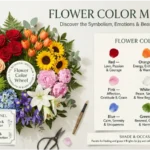
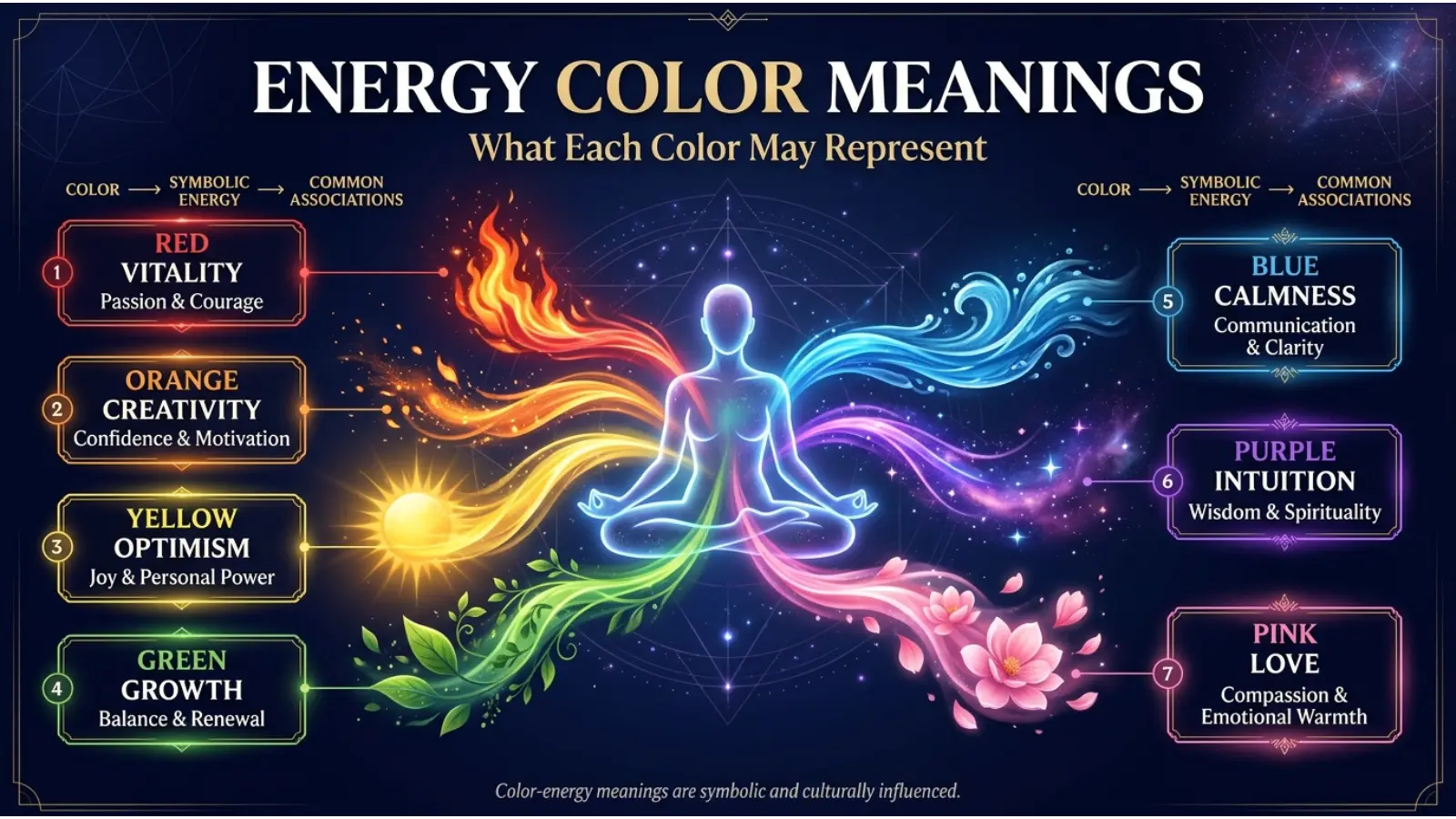
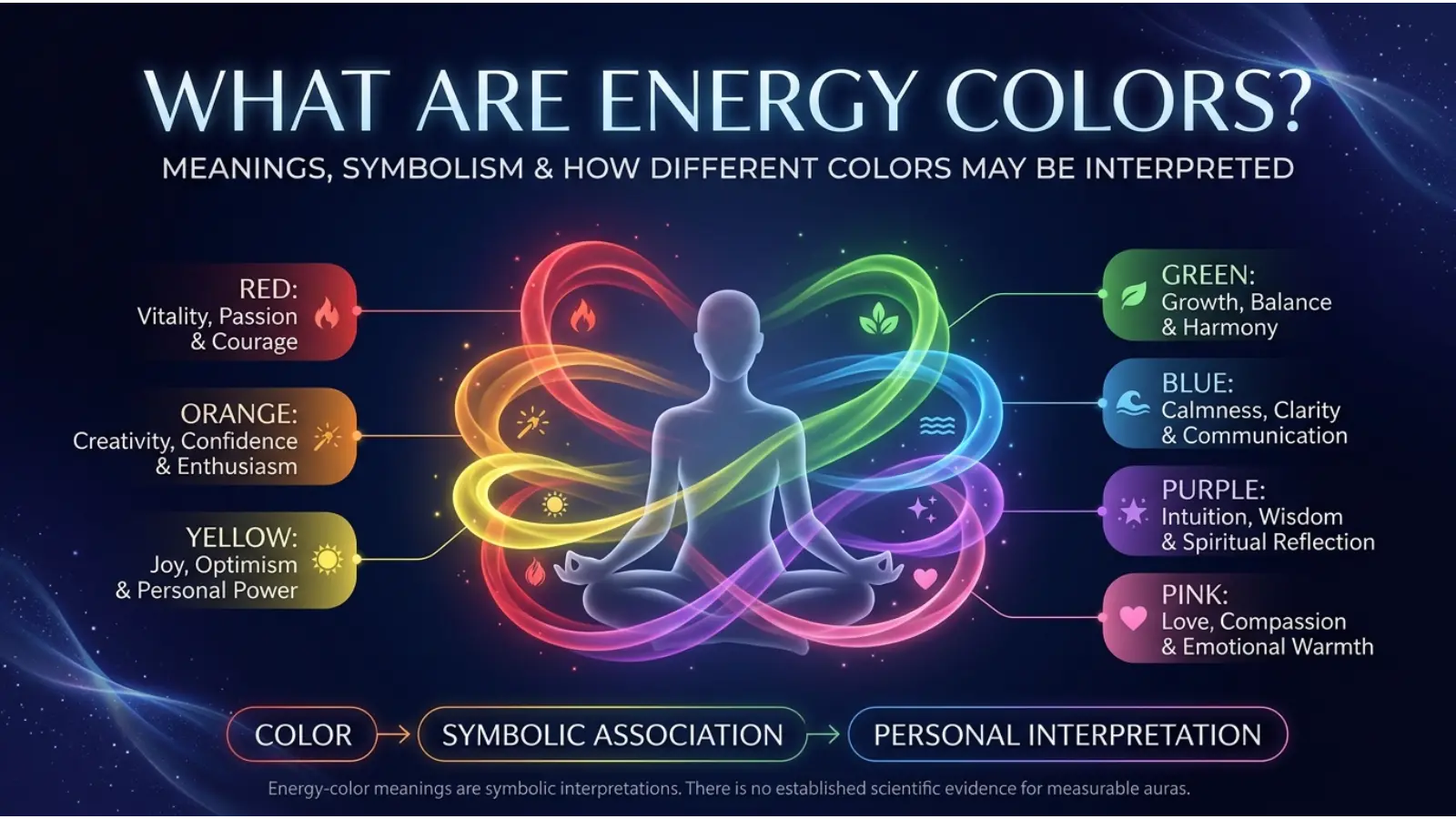
Quick Answer: Energy color meanings are symbolic interpretations of colors as representations of qualities such as energy, calmness, creativity, love, growth, communication, intuition, or transformation. Common associations include red with vitality, orange with enthusiasm, yellow with optimism, green with growth, blue with calmness, purple with spirituality, white with clarity, black with protection, and pink with compassion. These meanings vary by culture and spiritual tradition and should not be treated as scientific measurements of a person’s physical or mental state.
Energy Color Meanings at a Glance
| Energy Color | Common Symbolic Meaning | Emotional Association | Common Spiritual Interpretation |
|---|---|---|---|
| 🔴 Red | Vitality, strength, passion | Excitement, intensity | Grounding and physical energy |
| 🟠 Orange | Creativity, enthusiasm | Warmth, motivation | Confidence and creative flow |
| 🟡 Yellow | Optimism, confidence | Happiness, alertness | Mental clarity and personal power |
| 🟢 Green | Growth, balance, renewal | Calm, harmony | Healing and connection |
| 🔵 Blue | Peace, trust, communication | Calmness, stability | Expression and inner peace |
| 🟣 Purple | Wisdom, imagination, spirituality | Mystery, reflection | Intuition and spiritual awareness |
| 🩷 Pink | Love, kindness, compassion | Tenderness, comfort | Emotional healing and care |
| 🩵 Turquoise | Freshness, communication, balance | Relaxation, openness | Emotional and expressive balance |
| ⚪ White | Purity, clarity, simplicity | Peace, cleanliness | Protection and spiritual clarity |
| ⚫ Black | Power, mystery, boundaries | Seriousness, security | Protection and transformation |
| 🩶 Gray | Neutrality, reflection | Calm, restraint | Transition and balance |
| 🟤 Brown | Stability, nature, grounding | Comfort, reliability | Earth connection and security |
What Are Energy Color Meanings?
“Energy color” is a broad term rather than a single scientific system. People may use it to describe colors associated with emotions, personality, spiritual symbolism, chakras, aura traditions, meditation, or the atmosphere created by a particular color.
In everyday life, color can certainly affect perception. Bright colors may attract attention more quickly than muted ones, while warm and cool colors can create different visual impressions. However, these effects are influenced by context, individual preference, culture, lighting, and the surrounding colors.
Spiritual interpretations go further. Some traditions describe colors as symbolic representations of different forms of energy. For example, red may be connected with physical vitality, green with balance, and purple with spiritual reflection.
These interpretations can be meaningful as personal or cultural symbolism, but they should not be confused with scientifically measured energy fields.
🔴 Red Energy Meaning
Red is one of the strongest visual colors and is commonly connected with vitality, passion, courage, physical strength, desire, and action.
Because red has a high visual impact, it can make an object or message feel urgent and noticeable. In psychological research, red has been studied in relation to attention, motivation, performance, and emotional responses, although its effects are highly dependent on context.
Spiritually, red is often associated with grounding and physical life force. Some energy-based traditions connect it with the root chakra and themes such as security, survival, stability, and physical presence.
Positive Red Energy
Red can symbolize:
- Courage
- Passion
- Motivation
- Strength
- Determination
- Confidence
- Vitality
Challenging Red Energy
Too much red may symbolically represent:
- Anger
- Aggression
- Impulsiveness
- Conflict
- Overstimulation
For practical use, red works well when you want something to feel energetic or important. Small amounts can create impact without making a design feel overwhelming.
🟠 Orange Energy Meaning
Orange combines the warmth of red with some of the brightness associated with yellow. Its symbolic energy often centers on creativity, enthusiasm, sociability, movement, and confidence.
Orange can make a visual environment feel warmer and more active. It is often useful when a design needs friendliness without the intensity of strong red.
In spiritual interpretations, orange is sometimes connected with creativity, emotional movement, pleasure, and personal expression.
Orange Energy Represents
- Creativity
- Enthusiasm
- Playfulness
- Social connection
- Confidence
- Adventure
- Motivation
A muted orange can feel earthy and sophisticated, while a highly saturated orange can feel youthful and energetic. That difference matters when using the color in branding, clothing, or interiors.
🟡 Yellow Energy Meaning
Yellow is strongly associated with light, optimism, happiness, attention, and mental activity.
Bright yellow can appear highly energetic because it strongly contrasts with darker colors. However, the same brightness can become visually tiring when used excessively.
Symbolically, yellow is often connected with knowledge, confidence, hope, and personal power. In some spiritual systems, it is associated with the solar plexus chakra and themes of confidence and self-expression.
Positive Yellow Energy
Yellow may symbolize:
- Optimism
- Joy
- Curiosity
- Confidence
- Creativity
- Mental alertness
- Hope
When Yellow Feels Uncomfortable
Very intense yellow can sometimes feel restless, excessive, or warning-like. Context is particularly important because yellow is also widely used for caution and hazard communication.
For design, softer yellows can create warmth without the visual intensity of neon yellow.
🟢 Green Energy Meaning
Green is closely connected with nature, growth, renewal, balance, and harmony.
Our strong association between green and plants makes its symbolism especially intuitive. Forests, leaves, grass, and new growth naturally connect the color with life and renewal.
Green is also frequently used to communicate environmental themes, health-related ideas, freshness, and natural products. These associations are not universal, but they are common in modern visual communication.
In spiritual traditions, green may symbolize healing, emotional balance, compassion, and connection. Some chakra systems associate green with the heart chakra.
Green Energy Can Represent
- Growth
- Renewal
- Balance
- Harmony
- Nature
- Compassion
- Stability
- Freshness
A deep forest green can feel grounded and sophisticated, while a bright green can appear youthful and energetic.
🔵 Blue Energy Meaning
Blue is commonly associated with calmness, trust, stability, communication, depth, and reliability.
The meaning of blue changes substantially with shade. Pale blue may feel peaceful and open, while navy blue can appear serious, professional, and authoritative.
Blue is frequently used in corporate communication because many audiences associate it with dependability and professionalism. However, no color automatically creates trust; design quality, messaging, reputation, and context also influence how a brand is perceived.
Spiritually, blue is often associated with communication, truth, peace, and reflection. Some chakra traditions connect blue with the throat chakra.
Blue Energy Represents
- Peace
- Trust
- Communication
- Stability
- Wisdom
- Reflection
- Reliability
Blue can also symbolize sadness in some cultures and expressions, showing why color meaning cannot be separated from language and context.
🟣 Purple Energy Meaning
Purple has long carried associations with imagination, mystery, wisdom, luxury, creativity, and spirituality.
Historically, some purple dyes were difficult and expensive to produce, helping purple become associated with status and wealth in particular societies. Its modern symbolism is broader and can range from creativity to fantasy.
In spiritual interpretations, purple is often linked with intuition, contemplation, transformation, and higher awareness. Some chakra systems associate violet or purple with the crown chakra.
Purple Energy Represents
- Intuition
- Imagination
- Wisdom
- Creativity
- Mystery
- Spiritual reflection
- Transformation
Dark purple can feel dramatic and luxurious, whereas lavender creates a softer and more peaceful impression.
🩷 Pink Energy Meaning
Pink commonly represents affection, compassion, tenderness, kindness, and emotional warmth.
Its association with softness has developed differently across cultures and historical periods, so pink should not be treated as naturally or universally feminine.
From a design perspective, pale pink can create a gentle atmosphere, while hot pink can communicate confidence, energy, and modernity.
Spiritually, pink is sometimes interpreted as an energy of compassion, emotional care, forgiveness, and loving connection.
Pink Energy Represents
- Compassion
- Love
- Kindness
- Gentleness
- Emotional warmth
- Care
- Affection
🩵 Turquoise Energy Meaning
Turquoise sits between blue and green, so its symbolism often combines qualities associated with both colors.
It can represent calm communication, freshness, balance, openness, and emotional clarity.
Turquoise is particularly effective when a visual identity needs to feel refreshing but less formal than traditional blue. Its association with water and tropical environments can also create a sense of freshness.
In spiritual interpretations, turquoise may be associated with communication, emotional balance, protection, and renewal. These meanings vary considerably among traditions.
⚪ White Energy Meaning
White is commonly associated with clarity, simplicity, cleanliness, peace, innocence, and new beginnings.
Its meaning is strongly influenced by culture. In some societies, white is associated with weddings and celebration, while in others it may be connected with mourning or remembrance.
Spiritually, white is sometimes interpreted as purification, protection, clarity, or spiritual openness. These interpretations should be understood as symbolic rather than scientific descriptions of energy.
White also behaves differently from saturated colors in design. It can make spaces appear larger and brighter, especially when natural or artificial light reflects from white surfaces.
⚫ Black Energy Meaning
Black is often associated with power, mystery, sophistication, protection, authority, and boundaries.
It can create a strong visual anchor and is widely used in fashion, luxury branding, photography, and modern interior design.
Symbolically, black can have both positive and negative meanings. It may represent elegance and strength, but it can also be associated with grief, fear, darkness, or the unknown.
In spiritual interpretations, black is sometimes described as protective or grounding. Those meanings depend on the specific tradition rather than a universal spiritual rule.
🩶 Gray Energy Meaning
Gray occupies the space between black and white and often represents neutrality, balance, restraint, maturity, and reflection.
It can be sophisticated when combined with strong contrast, but large amounts of gray may feel cold or distant depending on lighting and surrounding colors.
Symbolically, gray can represent transition because it does not strongly belong to either extreme. This makes it useful when discussing uncertainty, moderation, or change.
🟤 Brown Energy Meaning
Brown is strongly connected with earth, stability, comfort, reliability, and natural materials.
Wood, soil, leather, stone, and other natural materials give brown a grounded visual character. Because of these associations, brown often works well in interiors and brands focused on craftsmanship, nature, food, or traditional quality.
Spiritually, brown is sometimes interpreted as grounding, security, patience, and connection with the physical world.
🌈 Do Energy Colors Have Scientific Meaning?
This is where an important distinction is needed.
Color psychology is a legitimate area of research, but many popular claims about “energy colors” go beyond what scientific evidence can establish.
Researchers have studied how color can influence attention, perception, emotional associations, and behavior. However, responses are not identical for everyone. Cultural learning, personal experiences, surrounding colors, lighting, and the purpose of the color can all change the result.
There is also no established scientific method for diagnosing a person’s health, personality, future, or spiritual condition from an aura color.
Therefore, it is reasonable to use energy colors as a symbolic framework, especially in art, spirituality, meditation, storytelling, or personal reflection. It is not appropriate to present those interpretations as medical or scientific measurements.
Energy Color Meanings and Aura Meanings
Aura traditions often describe an invisible field surrounding a person and assign different colors to different qualities.
Common aura interpretations include:
| Aura Color | Common Symbolic Interpretation |
|---|---|
| Red | Vitality, passion, action |
| Orange | Creativity, confidence, social energy |
| Yellow | Optimism, intellect, confidence |
| Green | Compassion, balance, growth |
| Blue | Calmness, communication, sensitivity |
| Purple | Intuition, imagination, spirituality |
| Pink | Love, kindness, emotional warmth |
| White | Clarity, purity, spiritual openness |
| Gold | Wisdom, achievement, illumination |
| Turquoise | Communication, healing, emotional balance |
These meanings belong to spiritual and metaphysical traditions rather than established scientific measurement.
If someone says they “see” a certain energy color, the experience can still have personal meaning without requiring the color to be treated as an objectively measured physical field.
Energy Colors and the Chakras
Chakra traditions provide another popular framework for interpreting colors.
A commonly used modern chakra-color system associates:
| Chakra | Common Color Association | Symbolic Theme |
|---|---|---|
| Root | Red | Grounding and security |
| Sacral | Orange | Creativity and emotional expression |
| Solar Plexus | Yellow | Confidence and personal power |
| Heart | Green | Compassion and connection |
| Throat | Blue | Communication and expression |
| Third Eye | Indigo | Intuition and reflection |
| Crown | Violet or White | Spiritual awareness |
These color associations are widely used in modern wellness and spiritual practices, but they should not be presented as a scientifically established map of the human body.
Different traditions and modern teachers may use different colors or interpretations. That variation is one reason it is better to describe chakra color meanings as symbolic rather than universal.
Spiritual Energy Color Meanings
Spiritual interpretations of color can be useful for reflection, meditation, art, or personal symbolism.
Red: Grounding and Vitality
Red is often chosen when someone wants to symbolize physical strength, courage, stability, or connection with the present moment.
Orange: Creativity and Movement
Orange can symbolize emotional expression, creative energy, confidence, and the willingness to try something new.
Yellow: Confidence and Awareness
Yellow is commonly used as a symbol of optimism, mental activity, personal confidence, and illumination.
Green: Healing and Balance
Green frequently represents renewal, compassion, harmony, and connection with nature.
Blue: Peace and Expression
Blue can symbolize calmness, truth, communication, and emotional steadiness.
Purple: Intuition and Transformation
Purple often represents reflection, mystery, imagination, spiritual exploration, and transformation.
White: Clarity and Purification
White may symbolize simplicity, peace, protection, or a fresh beginning depending on the spiritual system.
These interpretations are not universal religious teachings. They vary across cultures, spiritual practices, and individual beliefs.

Cultural Differences in Energy Color Meanings
A color does not carry exactly the same meaning everywhere.
White provides a clear example. In some Western contexts, white is strongly associated with weddings and purity. In several East Asian cultural traditions, white has also had important associations with mourning and death.
Red can represent luck, celebration, prosperity, danger, love, or political symbolism depending on the culture and situation.
Green can symbolize nature and renewal in many modern contexts, while particular shades may have specific religious, national, or historical meanings.
Therefore, anyone using energy colors for international branding, advertising, ceremonies, or public communication should research the audience rather than assuming one symbolic meaning works globally.
Historical Development of Color Symbolism
Color meanings developed through a mixture of natural associations, available pigments, social customs, religion, politics, clothing, trade, and technology.
Some colors became symbols of status because their pigments or dyes were historically expensive. Others became important because they were strongly connected to natural materials or religious practices.
Modern technology has changed this relationship. Digital screens allow designers to use millions of colors instantly, while synthetic pigments have made previously rare colors widely accessible.
As a result, modern color symbolism is constantly evolving.
Psychology Behind Energy Color Meanings
People do not experience color in isolation.
A color’s effect can change according to:
- Brightness
- Saturation
- Hue
- Lighting
- Size
- Surrounding colors
- Cultural expectations
- Personal memories
- Context
- Age and experience
For example, a dark blue wall may create a completely different impression from a bright cyan object.
Likewise, red on a warning sign communicates something different from red on a romantic card.
This is why it is better to say that colors can influence perception and create associations rather than claiming that every color produces one fixed emotional response.
Energy Colors in Branding and Marketing
Brands often use color strategically because color helps create a recognizable visual identity.
Red in Branding
Red can create a sense of energy, urgency, excitement, or boldness. It is often useful for brands that want to appear active and attention-grabbing.
Blue in Branding
Blue is frequently used when a brand wants to communicate reliability, professionalism, technology, or stability.
Green in Branding
Green can support associations with nature, sustainability, freshness, agriculture, wellness, or growth.
Purple in Branding
Purple can suggest creativity, imagination, premium positioning, or individuality.
Orange in Branding
Orange can create a friendly, energetic, approachable impression.
Black in Branding
Black can provide a strong, refined, minimalist, or premium appearance when paired with appropriate typography and design.
Color alone does not determine whether consumers trust a brand. The product, messaging, experience, reputation, typography, imagery, and overall design all contribute.
Energy Color Meanings in Interior Design
Color can dramatically change how a room appears.
A small room painted in a light color may feel more open because lighter surfaces reflect more light. Dark colors can make a room feel intimate and dramatic, particularly when paired with controlled lighting.
Living Room
Green, blue, beige, warm gray, and muted earth tones can create comfortable visual environments. Accent colors can add energy without dominating the room.
Bedroom
Soft blue, muted green, lavender, warm neutrals, and gentle pink can create a quieter atmosphere.
Office
Blue, green, neutral gray, and natural wood tones can produce a professional and focused visual environment.
Kitchen
White, cream, green, yellow, blue, and warm earth colors can work well depending on cabinetry, lighting, and materials.
Lighting Matters
The same paint color can look dramatically different under daylight, warm bulbs, cool LEDs, or indirect lighting.
For this reason, always test a color in the actual room before committing to a large surface.
Energy Color Meanings in Fashion
Clothing color influences visual impression, although it does not reveal someone’s personality with certainty.
Red can create a bold statement. Blue often appears dependable or polished. Green can feel natural and relaxed. Purple can look creative or distinctive. Black can create a sleek and formal appearance.
The shade also matters.
A soft pastel usually creates a lighter impression than a saturated jewel tone. Likewise, fabric texture can change how a color appears because velvet, cotton, leather, silk, and denim reflect light differently.
Color Combinations for Different Energy
Combining colors can create a stronger impression than using one color alone.
| Desired Feeling | Useful Color Combination |
|---|---|
| Calm | Blue + white |
| Natural | Green + brown |
| Energetic | Orange + yellow |
| Luxurious | Purple + black |
| Romantic | Pink + burgundy |
| Fresh | Turquoise + white |
| Grounded | Brown + green |
| Modern | Black + white |
| Professional | Navy + gray |
| Warm | Orange + cream |
These combinations are starting points rather than strict rules. Proportion, contrast, saturation, and lighting determine the final result.
How Lighting Changes Energy Color Meanings
Lighting is one of the most overlooked parts of color interpretation.
Warm lighting can make whites, yellows, oranges, and reds appear richer. Cool lighting can make blues and greens appear stronger while changing how neutral colors look.
Natural daylight also changes throughout the day.
A color that looks calm in morning light may appear warmer at sunset. Therefore, when selecting a wall color, clothing color, photograph background, or product color, consider the lighting under which it will actually be viewed.
Personality and Energy Colors
People sometimes use color preferences to describe personality.
Someone who loves blue may be described as calm or thoughtful. A person who prefers red may be described as energetic or confident. Someone drawn to purple may be viewed as creative.
These descriptions can be fun, but color preference cannot reliably determine personality.
A person’s favorite color can change because of fashion, memories, culture, current interests, environment, or simple aesthetic preference.
Use color-personality associations as reflective language rather than psychological diagnosis.
Energy Color Meanings in Art and Photography
Artists use color to control attention and create emotional contrast.
A photographer might place a warm subject against a cool background to make it stand out. A painter might use red to create tension or blue to create distance.
Complementary colors can create strong visual contrast:
- Red + green
- Blue + orange
- Yellow + purple
Analogous colors create a smoother relationship:
- Blue + blue-green + green
- Yellow + yellow-orange + orange
- Red + red-orange + orange
The emotional meaning comes from the entire composition, not simply from one color.

Energy Color Meanings in Everyday Life
You encounter color symbolism constantly.
Traffic signs use color to communicate quickly. Clothing can signal formality or celebration. Product packaging can establish expectations before a person reads the label. Sports teams use colors to build identity. Interior spaces use color to influence atmosphere.
Even small choices, such as a phone wallpaper or notebook color, can become personal symbols.
The key is to think of color as a visual language rather than a fixed code.
Common Misconceptions About Energy Color Meanings
“Every person has one permanent energy color.”
There is no established scientific evidence showing that every individual has one permanent aura color.
“A color can diagnose illness.”
Color symbolism should never replace medical testing, professional diagnosis, or evidence-based treatment.
“Red always means anger.”
Red can also represent love, celebration, strength, courage, excitement, or importance.
“Blue always means calm.”
Blue can suggest calmness, trust, sadness, coldness, distance, or professionalism depending on context.
“Color meanings are universal.”
They are not. Culture, history, religion, language, and personal experience can change how a color is understood.
“Bright colors always create positive energy.”
Brightness can increase visual intensity, but whether that feels positive depends on the viewer and situation.
How to Choose an Energy Color for Yourself
If you are selecting a color for meditation, clothing, artwork, a room, journal, website, or personal project, start with the feeling you want to create.
Choose red when you want a symbol of action or vitality.
Choose orange for creativity and enthusiasm.
Yellow for optimism and brightness.
Choose green for growth and balance.
Choose blue for calmness and communication.
Purple for imagination and reflection.
Choose pink for compassion and warmth.
Choose turquoise for freshness and openness.
White for simplicity and clarity.
Choose black for strength, sophistication, or visual boundaries.
Then adjust the shade. A muted version can create a completely different impression from a highly saturated one.
Why Context Changes Color Meaning
Imagine a red rose, a red warning sign, and a red sports jersey.
They all use red, yet their meanings are different.
The rose may suggest love. The warning sign communicates caution. The jersey may represent team identity and competitive energy.
This simple comparison shows why energy color meanings are contextual.
The object, surrounding colors, cultural setting, purpose, and viewer all help determine interpretation.
Are Energy Colors the Same as Aura Colors?
Not exactly.
“Energy colors” is a broad phrase that can refer to many symbolic systems. “Aura colors” usually refers to colors believed to appear in or around a person’s energetic field within particular spiritual or metaphysical traditions.
Some websites use the terms interchangeably, but they can describe different ideas.
If you are researching aura colors, it is useful to identify the specific tradition or system being discussed rather than treating all interpretations as one universal framework.
Can Energy Colors Affect Your Mood?
Colors can influence mood and emotional associations, but their effects are not guaranteed or identical for everyone.
A peaceful blue bedroom may feel relaxing to one person, while another person may associate blue with an unpleasant memory.
Likewise, a bright yellow room may feel cheerful to one person and overstimulating to another.
Personal experience is therefore an important part of color perception.
How to Use Energy Colors in Daily Life
You can experiment with color without treating symbolic meanings as absolute facts.
Try a calming palette when designing a relaxation space. Use a brighter accent when you want to create visual energy. Choose natural greens and browns for an earthy aesthetic. Add purple when you want a more imaginative or dramatic atmosphere.
You can also keep a simple color journal. Record the colors you choose, the situation, and how the environment feels. Over time, you may discover personal associations that are more useful to you than a universal color chart.
Frequently Asked Questions
What are the most common energy color meanings?
The most common symbolic associations are red with vitality, orange with creativity, yellow with optimism, green with growth, blue with calmness, purple with spirituality, pink with compassion, white with clarity, and black with protection or power.
What color represents the strongest energy?
Red is commonly viewed as one of the most intense energy colors because it is visually powerful and often associated with action, passion, vitality, and physical strength. However, “strongest” depends on the symbolic system being used.
What color represents positive energy?
Yellow, green, orange, pink, and blue are often used to represent positive qualities such as optimism, growth, enthusiasm, compassion, and peace. The meaning varies by context and culture.
What color represents healing energy?
Green is frequently used as a symbol of healing, renewal, balance, and nature. In spiritual systems, green may carry additional meanings connected with compassion and emotional harmony.
What color represents spiritual energy?
Purple, violet, indigo, white, and gold are commonly associated with spirituality, intuition, wisdom, or higher awareness in various modern spiritual traditions. These are symbolic interpretations rather than scientific measurements.
What color represents protection?
Black, white, blue, and certain other colors are associated with protection in different spiritual and cultural traditions. There is no single universally recognized protection color.
What color represents emotional energy?
Orange, pink, red, green, and blue can all symbolize different aspects of emotional life. Orange may suggest enthusiasm, pink compassion, red passion, green balance, and blue calmness.
Can you really see someone’s energy color?
Some people report seeing or sensing colors around others, particularly within spiritual or meditation practices. However, science has not established that these experiences represent objectively measurable energy fields around people.
What is the best energy color for meditation?
There is no scientifically proven best color for meditation. Soft blue, green, lavender, white, or other muted colors may create a personally calming environment. The best choice is the color that helps you focus and feel comfortable.
Do energy colors change?
Within aura and spiritual traditions, practitioners may interpret changing colors as changes in mood, attention, or personal development. Scientifically, there is no established method for measuring or confirming such changes as an aura.
Final Thoughts
Energy color meanings are most useful when treated as a symbolic language rather than a fixed scientific code. Colors can carry emotional associations, cultural meanings, visual effects, and personal memories, while spiritual traditions may give them deeper symbolic roles.
Red can suggest vitality, blue can evoke calmness, green can represent growth, purple can suggest reflection, and yellow can communicate optimism. Yet none of these meanings exists in isolation. Shade, lighting, culture, context, and personal experience can completely change how a color feels.
That flexibility is what makes color so powerful. Instead of asking what one color must mean, it is often more useful to ask what does this color communicate here, to this audience, in this setting? That question leads to a more accurate and thoughtful understanding of energy colors.

Emma Wilson is a dedicated comparison writer and product researcher at ColorMystiic.com. She specializes in creating unbiased product comparisons, detailed reviews, and helpful buying guides. Her goal is to help readers make smarter purchasing decisions with confidence.