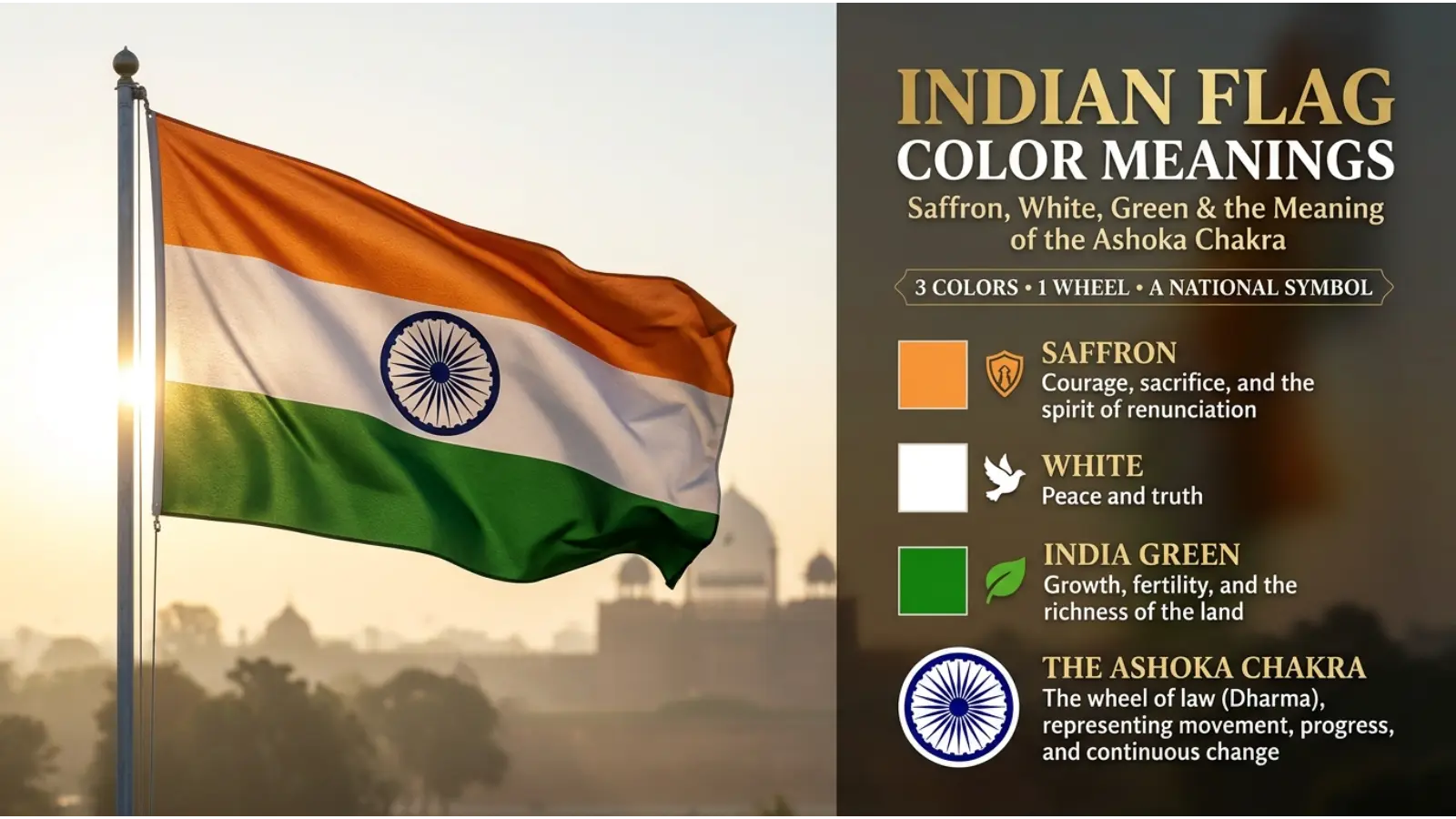
The Indian Flag Color Meanings is a powerful symbol of freedom, unity, and national pride. Known as the Tiranga, meaning “tricolor,” it features three horizontal bands of saffron, white, and green, with a navy-blue Ashoka Chakra in the center. Each element carries a meaning connected with India’s values, history, and national identity.
Understanding Indian flag color meanings helps explain why these colors appear during Independence Day, Republic Day, sporting events, and other national celebrations. The saffron band represents courage and sacrifice, white symbolizes peace and truth, and green represents fertility, growth, and prosperity. Meanwhile, the Ashoka Chakra represents dharma and continuous movement.
However, the flag’s meaning goes beyond its individual colors. Together, its elements express a vision of a nation guided by truth, strengthened by courage, and committed to progress.
Quick Answer: The Indian flag’s saffron color represents courage and sacrifice, white represents peace and truth, and green represents fertility, growth, and prosperity. The navy-blue Ashoka Chakra, with 24 spokes, symbolizes dharma, justice, and continuous progress.
Indian Flag Color MeaningsChart
The following colorful chart summarizes the symbolism of India’s national flag.
| Flag Element | Main Meaning | Symbolic Message |
|---|---|---|
| 🟠 Saffron | Courage and sacrifice | Serve with strength and selflessness |
| ⚪ White | Peace and truth | Follow honesty and righteousness |
| 🟢 Green | Fertility and growth | Value life, prosperity, and the land |
| 🔵 Ashoka Chakra | Dharma and movement | Keep moving forward through responsible action |
These meanings reflect the established interpretation of the Indian national flag. Some broader associations discussed in popular culture are interpretations rather than official definitions.
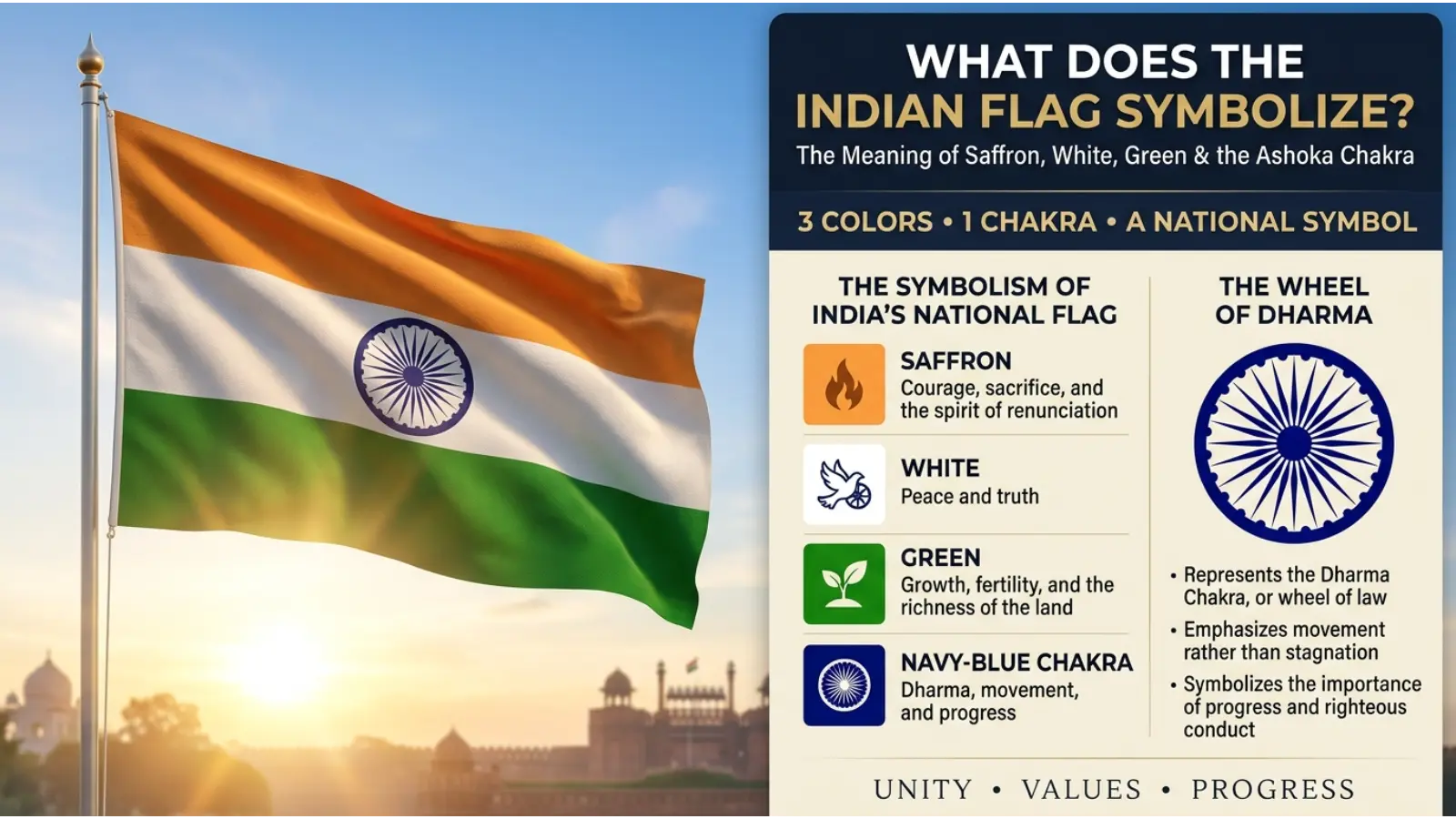
What Does the Indian Flag Color Meanings Symbolize?
The Indian national flag represents the country’s independence, unity, ideals, and aspirations. Its three bands and central wheel work together to express values that can guide individuals, communities, and public institutions.
Saffron emphasizes courage and selfless service. White highlights truth and peace, while green represents fertility and growth. The Ashoka Chakra adds the idea that a country must continue progressing through righteous conduct.
Therefore, the flag is not simply a combination of attractive colors. It communicates a set of national ideals that remain meaningful in everyday life.
The Overall Message of the Indian Tricolor
The flag’s elements can be understood as parts of a shared vision:
- Courage without selfishness: Strength should serve the common good.
- Peace guided by truth: Harmony becomes stronger when people act honestly.
- Growth with responsibility: Progress should support the well-being of people and the country.
- Continuous improvement: A strong nation must keep learning, developing, and acting responsibly.
Together, these ideas explain why the Indian flag is displayed at government buildings, schools, public celebrations, and international sporting events.
Saffron Color Meaning in the Indian Flag
Saffron is the top band of the Indian national flag. It represents courage, strength, sacrifice, and the spirit of selflessness.
The color has a warm orange tone that makes it visually prominent. Nevertheless, its importance comes primarily from its national symbolism rather than its appearance.
Why Does Saffron Represent Courage and Sacrifice?
Saffron reminds citizens and public leaders that serving the country may require personal effort, discipline, and sacrifice. Its meaning encourages people to act for the common good rather than focus entirely on personal rewards.
When India’s Constituent Assembly discussed the national flag, Dr. Sarvepalli Radhakrishnan explained saffron in terms of renunciation and selfless service. This interpretation connects the color with responsible leadership and dedication to others.
Saffron’s national meaning should not be confused with the beliefs of any single religious community. Although saffron has cultural and religious associations in India, its meaning in the national flag expresses broader ideals.
Positive Meanings of Saffron
Saffron is associated with several positive values:
- Courage: Facing challenges with determination.
- Sacrifice: Giving time and effort for a meaningful cause.
- Selflessness: Considering the needs of others.
- Strength: Remaining committed during difficult situations.
- Dedication: Taking responsibilities seriously.
For example, a teacher who works hard to educate students or a public servant who puts citizens’ needs first demonstrates the values associated with selfless service.
Saffron in Color Psychology
In general color perception, orange and orange-red shades are often associated with warmth, energy, visibility, and enthusiasm. Designers may use these colors to attract attention or make a visual design feel lively.
However, color psychology does not establish that seeing saffron automatically makes a person brave. The flag’s meaning is a cultural and historical interpretation, not a scientifically proven emotional effect.
Why Is Saffron at the Top of the Flag?
Saffron occupies the upper band, above white and green. Its strong color creates a clear visual starting point when people look at the flag.
The official design specifies the arrangement of the bands. The position should not be interpreted as proof that saffron is more important than the other elements. Each part contributes to the meaning of the complete flag.
White Color Meaning in the Indian Flag
White forms the middle band of the Indian flag. It represents peace and truth and is connected with the importance of following a righteous path.
Its light appearance creates a visual separation between the saffron and green bands. The white background also provides contrast for the navy-blue Ashoka Chakra.
Why Does White Represent Peace and Truth?
Peace is more than the absence of conflict. It also involves cooperation, mutual respect, and fair ways of resolving disagreements.
Truth supports these values because people need honesty to build trust. Similarly, righteousness encourages individuals to choose actions that respect justice and responsibility.
In the national flag, white connects these ideals with the broader message of courage, sacrifice, and progress.
Positive Meanings of White
White can represent:
- Peace: Encouraging harmony between people.
- Truth: Valuing honesty and facts.
- Righteousness: Acting according to fair and responsible principles.
- Clarity: Seeking understanding rather than confusion.
- Cooperation: Working together despite differences.
These ideas are relevant in classrooms, workplaces, public service, and family relationships. For example, resolving a disagreement through honest discussion reflects the connection between peace and truth.
White in Color Psychology
White is commonly associated with cleanliness, simplicity, openness, and spaciousness. In design, it can make a layout easier to read and help other colors stand out.
However, its cultural meaning is not universal. White represents mourning in some traditions and weddings or celebration in others. Lighting also affects its appearance: warm light can make white surfaces look cream-colored, while cool light can make them appear bluish.
The white band of India’s national flag has a specific national interpretation centered on peace and truth.
Green Color Meaning in the Indian Flag
Green is the bottom band of the Indian flag. It represents fertility, growth, prosperity, and the country’s connection with its land.
Its symbolism is especially easy to understand through the natural world. Green plants grow, crops provide food, and healthy vegetation supports ecosystems. These associations make green a fitting color for ideas about fertility and development.
Why Does Green Represent Growth and Prosperity?
Green reminds people of the natural resources that support life and economic activity. Agriculture, forests, gardens, and other green spaces are closely connected with the well-being of communities.
The color also suggests the possibility of continued development. A prosperous society depends on education, productive work, responsible resource use, and opportunities for people to improve their lives.
In the Indian flag, green is not simply a symbol of plants. Its meaning includes fertility, growth, and auspiciousness.
Positive Meanings of Green
Green can be associated with:
- Growth: Developing knowledge, skills, and opportunities.
- Fertility: Supporting life and productive land.
- Prosperity: Creating conditions for people and communities to flourish.
- Nature: Appreciating the environment and natural resources.
- Renewal: Recognizing the possibility of improvement and new beginnings.
For instance, a farmer growing healthy crops demonstrates the relationship between fertile land and prosperity. Likewise, protecting forests and water resources supports long-term development.
Green in Color Psychology
Green is often associated with nature, balance, freshness, and renewal. Natural environments can provide opportunities for relaxation and recreation, although responses vary among individuals and settings.
Designers frequently use green in environmental communication, gardening, wellness spaces, and products connected with nature. Nevertheless, a green logo alone does not prove that a company follows sustainable practices.
Why Is Green at the Bottom?
Green forms the lowest horizontal band of the flag. It visually anchors the design beneath the white and saffron bands.
Its position does not mean that nature or prosperity is less valuable than courage or peace. Rather, the three colors form one coordinated national symbol.
Indian Flag Color Meaningsand Symbolism
The navy-blue Ashoka Chakra is the wheel in the center of the white band. It has 24 equally spaced spokes and is based on the wheel represented in the Lion Capital of Ashoka at Sarnath.
The Chakra is one of the most recognizable parts of the Indian flag. Its circular form communicates movement, while its historical and philosophical associations connect it with dharma, or righteous conduct.
What Does the Ashoka Chakra Represent?
The wheel is commonly associated with:
- Dharma: Righteous conduct and duty.
- Justice: Acting according to fair principles.
- Movement: Avoiding stagnation.
- Progress: Continuing to improve.
- Responsibility: Taking action rather than remaining passive.
The Chakra adds an important dimension to the flag’s symbolism. Courage, peace, and prosperity are valuable ideals, but they also require responsible action to become meaningful in practice.
Why Does the Indian Flag Have 24 Spokes?
The official flag design specifies 24 spokes.
However, not every popular list of 24 separate virtues represents an official interpretation. For accurate educational writing, it is better to explain the Chakra’s established connection with dharma and movement without presenting disputed lists as historical facts.
Why Is the Ashoka Chakra Blue?
The flag uses navy blue for the wheel. Visually, this dark color stands out against the white band and makes the Chakra easy to recognize.
History of the Indian Flag Color Meanings
The Indian flag developed through the country’s struggle for independence. Earlier flag designs reflected changing political movements, public aspirations, and ideas about national identity.
Early Flag Designs
During the early twentieth century, several flags were used by Indian nationalists. These designs differed in their colors, symbols, and arrangements.
As the independence movement developed, the need for a widely recognized national flag became increasingly important. The designs evolved over time rather than appearing in their present form all at once.
The Tricolor and the Independence Movement
A significant stage in the flag’s development came in 1921, when Pingali Venkayya presented a proposed flag design to Mahatma Gandhi. The design underwent changes in the years that followed.
In 1931, a tricolor featuring saffron, white, and green with a spinning wheel was adopted by the Indian National Congress. This was an important step in the evolution of the flag, although it was not yet the national flag of independent India.
Adoption of the National Flag in 1947
On 22 July 1947, the Constituent Assembly of India adopted the present national flag shortly before independence.
India became independent on 15 August 1947, and the tricolor became the national flag of the newly independent country.
Why Was the Spinning Wheel Replaced?
The earlier spinning wheel was closely associated with Gandhi’s promotion of khadi, self-reliance, and the independence movement.
The Ashoka Chakra retained the circular form while providing a broader historical symbol for the national flag. Its inclusion connected modern India’s identity with an older Indian tradition and the principle of righteous conduct.
Important Historical Dates
| Year or Date | Historical Event |
|---|---|
| 1921 | Pingali Venkayya presented a proposed flag design to Gandhi. |
| 1931 | A saffron, white, and green tricolor with a spinning wheel was adopted by the Indian National Congress. |
| 22 July 1947 | The Constituent Assembly adopted the present national flag. |
| 15 August 1947 | India became independent. |
These milestones help explain how the Indian flag developed into its current form.
Cultural and National Significance of Indian Flag Color Meanings
The Indian tricolor has a specific national meaning, but it also appears in a country with many languages, communities, customs, and religious traditions.
Its significance therefore extends beyond the meanings of individual colors.
The Flag as a Symbol of National Unity
India’s population includes people with different cultural backgrounds and personal beliefs. The national flag represents the shared identity of the country rather than belonging exclusively to one community.
During national celebrations, the tricolor provides a common symbol around which people can gather. It is displayed at public institutions, educational events, and sporting competitions to express national pride.
The Indian Flag During Independence Day
Independence Day is observed on 15 August. The flag is an important part of official ceremonies, school celebrations, cultural programs, and public gatherings.
Its colors remind people of the struggle for independence and the responsibilities that come with freedom.
The Indian Flag During Republic Day
The national flag features prominently in Republic Day ceremonies. In this setting, its symbolism connects national independence with constitutional government, citizenship, and public responsibility.
The Flag in International Sports
Indian athletes and supporters often display the tricolor during international sporting events.
Here, the flag represents the country and its sporting community. Its appearance can express encouragement, pride, and a sense of shared participation.
These emotional responses come from the social importance of the flag, not simply from the psychological effects of its colors.
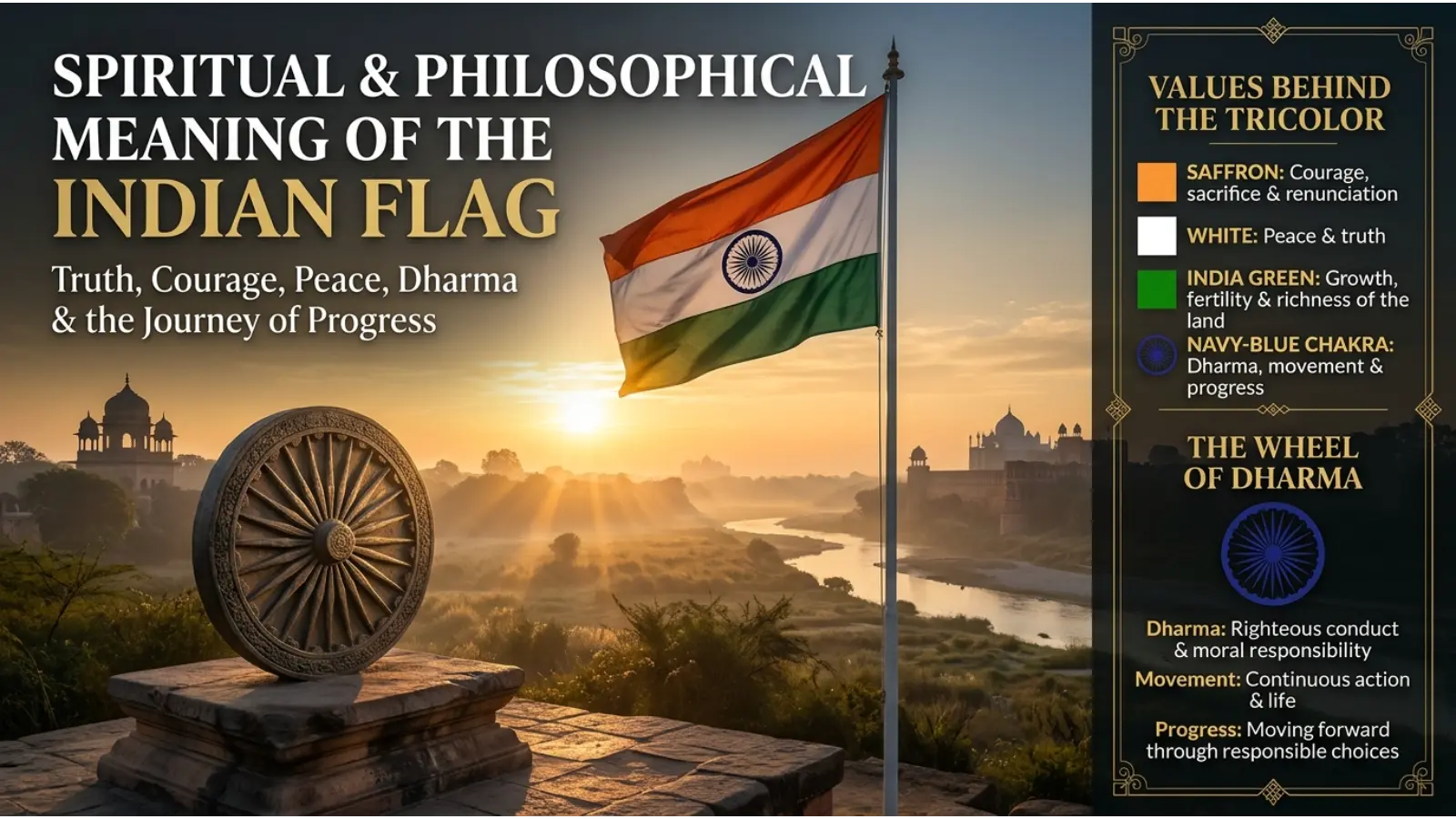
Spiritual and Philosophical Meaning of the Indian Flag Color Meanings
Saffron and Selfless Service
Saffron is connected with renunciation and selfless service in explanations of the flag’s symbolism. These ideas encourage people to consider responsibilities beyond personal advantage.
In everyday life, this principle can mean helping others, serving the public honestly, or making decisions that benefit a wider community.
White and Righteous Conduct
White represents peace and truth.
Honesty supports trust, while peaceful conduct helps people manage differences without unnecessary hostility.
Green and the Value of Growth
Green represents fertility and growth. From a philosophical perspective, these ideas can encourage respect for life, productive effort, and the conditions that allow communities to flourish.
This does not mean the color has one universal spiritual meaning.
The Ashoka Chakra and Dharma
Dharma is a concept with different meanings across Indian philosophical and religious traditions. In explanations of the flag, it is commonly understood in connection with righteousness, duty, and moral conduct.
The Chakra’s movement offers a useful reminder that ethical principles require continued action. Fairness and responsibility must be practiced rather than merely admired.
Psychology of the Indian Flag Color Meanings
Color psychology studies how people perceive and respond to colors. Researchers examine factors such as color preference, visual attention, context, and cultural learning.
However, the national flag’s symbolism is not the same as a laboratory finding about human emotion.
How Saffron Influences Visual Perception
Saffron is a warm, visually noticeable color. Warm colors can attract attention in many designs, although the exact response depends on brightness, saturation, surrounding colors, and individual preference.
In the flag, saffron’s prominence supports recognition. Its meaning of courage and sacrifice, however, comes from the flag’s established symbolism.
How White Affects Visual Balance
White creates a light central band between two stronger colors. It also provides contrast for the dark-blue Chakra.
In graphic design, light backgrounds can make symbols and text easier to distinguish. The exact effect depends on contrast, lighting, and the size of the elements.
How Green Creates Natural Associations
Green commonly reminds people of plants, forests, and growing landscapes. These learned associations help explain why designers often use green in environmental or agricultural communication.
Nevertheless, green does not automatically make every product appear healthy or environmentally responsible. Consumers also consider a brand’s reputation, evidence, and actual behavior.
How Blue Supports the Chakra’s Visibility
Navy blue contrasts strongly with the white background. This helps the wheel remain clear and recognizable.
Why Context Changes Color Meaning
The same color can communicate different things depending on where it appears.
For example, saffron on the Indian flag represents courage and selflessness, while an orange product package may be designed to attract attention. Similarly, white can symbolize truth on the flag but represent mourning in some cultural settings.
Consequently, the meaning of a color depends on its context, history, surrounding symbols, and the expectations of the people viewing it.
Indian Flag Color Meanings in Art and Design
The Indian tricolor can inspire artwork, educational displays, posters, and digital graphics. However, designers should preserve the flag’s recognizable arrangement and treat it respectfully.
Using the Tricolor in Educational Posters
Teachers can create a simple classroom poster explaining each band and the Ashoka Chakra. A short definition beside each color helps students understand the meaning without memorizing long passages.
A useful layout includes the three horizontal bands, the central Chakra, and a brief explanation of each element.
Using the Colors in Digital Design
Saffron, white, and green can inspire a design palette for educational material about India. For example, a presentation might use saffron headings, white backgrounds, and green accent elements.
The colors do not have to appear in every section. In fact, using them sparingly can improve readability and prevent the design from becoming visually overwhelming.
Why Accurate Proportions Matter
The Indian flag has an established design and proportions.
When reproducing the actual national flag, designers should follow the official specifications rather than inventing a different arrangement.
Indian Flag Color Meanings in Branding and Marketing
The colors of the Indian flag can inspire campaigns related to national celebrations, Indian heritage, public service, and cultural identity.
However, using the tricolor in branding requires care. The national flag is not simply a convenient color palette; it is an important national symbol with rules governing its display and use.
Saffron in Promotional Design
Saffron can create a warm and noticeable accent. In a campaign about Indian heritage or Independence Day, it may help establish a visual connection with the national celebration.
Nevertheless, a business should avoid using saffron alone to claim that a product represents courage, sacrifice, or national service.
White for Clarity
White can provide a clean background for information, allowing important text to stand out. It is useful in educational materials, presentation slides, and public information campaigns.
Green for Growth and Sustainability
Green is frequently used in marketing for gardening, agriculture, and environmental initiatives. Its natural associations can help communicate the subject of a campaign.
However, a company should not suggest that its products are sustainable merely because its packaging is green. Environmental claims should be supported by actual evidence.
Respectful Use of National Symbols
Businesses should understand the rules that apply to the national flag and avoid treating it as ordinary promotional decoration. A color palette inspired by the tricolor is not the same as reproducing the national flag itself.
Indian Flag Color Meanings in Fashion
The tricolor frequently appears in clothing, accessories, and decorations during Independence Day and Republic Day.
People may choose saffron, white, and green clothing to express national pride or participate in a celebration. However, the meaning of these colors in clothing is different from their official symbolism on the flag.
Saffron in Clothing
Saffron can create a warm and energetic appearance. It pairs well with neutral shades such as cream, white, beige, and navy.
White in Clothing
White offers a simple and versatile base.
Fabric, lighting, and surrounding colors affect how white appears. For example, warm indoor lighting may make a white garment look slightly yellow.
Green in Clothing
Green comes in many shades, from pale mint to deep forest green. These variations can create different visual impressions.
A deep green outfit paired with cream can appear understated, while a brighter green accent may create a more energetic look.
Combining the Tricolor in Outfits
For national celebrations, saffron, white, and green can be combined through clothing or accessories. A balanced approach usually works better than adding too many competing patterns.
Best Color Combinations Inspired by the Indian Flag Color Meanings
The Indian tricolor offers useful ideas for educational graphics and other designs inspired by national colors.
The following combinations are design suggestions, not alternative versions of the official flag.
| Color Combination | Visual Effect | Practical Use |
|---|---|---|
| 🟠 Saffron + White | Warm, clear, and bright | Educational headings and posters |
| 🟢 Green + White | Fresh and readable | Nature-related presentations |
| 🔵 Navy Blue + White | Strong contrast and clarity | Charts, labels, and text |
| 🟠 Saffron + Navy Blue | Bold and noticeable | Small graphic accents |
| 🟢 Green + Cream | Natural and gentle | Backgrounds and decorative layouts |
| 🟠 Saffron + Green | Energetic and colorful | Festival-themed graphics |
Why Do These Combinations Work?
Saffron and white create a clear difference between a warm accent and a light background. Green and white provide a similar contrast while maintaining a natural appearance.
Navy blue and white work particularly well when a design needs readable text or a clearly visible symbol. Meanwhile, saffron and green can create a strong visual impression when used in moderation.
For accessibility, designers should not rely on color alone to communicate information. Labels, shapes, and sufficient contrast help people understand a chart even if they have difficulty distinguishing certain colors.
Common Misconceptions About Indian Flag Color Meanings
Several popular explanations of the Indian flag oversimplify its symbolism. Understanding the difference between established meanings and personal interpretations helps prevent confusion.
Myth 1: Each Color Belongs to One Religious Community
Fact: The established interpretation connects saffron with courage and sacrifice, white with peace and truth, and green with fertility and growth.
Myth 2: The Colors Have Scientifically Proven Emotional Effects
Some explanations suggest that the flag’s colors automatically create courage, peace, or prosperity in everyone who sees them.
Fact: Color perception can influence attention and associations, but individual responses vary. The flag’s national meanings come from history and symbolism, not proof that each color produces a specific emotional response.
Myth 3: Every Popular Explanation of the 24 Spokes Is Official
Online articles sometimes assign a separate virtue to every spoke of the Ashoka Chakra.
Fact: The official design establishes 24 spokes, and the Chakra has a recognized connection with dharma and movement. Not every detailed list of 24 qualities is an official historical explanation.
Myth 4: Green Represents Only Agriculture
Fact: Its established meaning includes fertility, growth, prosperity, and auspiciousness.
Myth 5: The Indian Flag Has Always Had Its Present Design
The present flag developed through earlier designs associated with the independence movement.
Fact: The Constituent Assembly adopted the current design on 22 July 1947.
Myth 6: Any Arrangement of Saffron, White, and Green Is the Indian Flag
Using the same three colors does not automatically create the official national flag.
Fact: The national flag has a specific arrangement, proportions, and central Chakra. A design inspired by its colors can be different from the actual flag, but the distinction should remain clear.
How to Display the Indian Flag Respectfully
The Flag Code of India sets out rules concerning the display, use, and handling of the national flag. Anyone displaying the flag at school, at a public event, or at home should check the applicable requirements.
Important Points to Remember
- Preserve the correct arrangement of saffron, white, and green.
- Keep the Ashoka Chakra centered in the white band when reproducing the flag.
- Avoid displaying a damaged or dirty flag.
- Do not assume that every decorative use of the flag is automatically permitted.
- Follow the relevant rules when displaying or using the national flag in clothing, publications, advertisements, or public ceremonies.
These practices help preserve the dignity and meaning of the tricolor.
Real-World Applications of Indian Flag Symbolism
The flag’s symbolism can offer practical lessons in education, public service, art, and daily life.
In Education
Teachers can use the flag to explain national history, constitutional values, and the meaning of public responsibility.
A simple classroom activity is to ask students to connect each element with an example of responsible behavior.
In Public Service
Saffron’s connection with selflessness can encourage responsible leadership. White’s emphasis on truth can remind public servants to communicate honestly, while the Chakra’s association with duty highlights the importance of taking action.
These are practical applications of the flag’s symbolism rather than a claim that the colors automatically change behavior.
In Environmental Awareness
Green’s connection with fertility and growth can introduce discussions about agriculture, forests, water, and responsible resource use.
An environmental campaign can use this symbolism to encourage practical action, such as reducing waste or protecting local green spaces.
In Art and Photography
Artists can use the tricolor to communicate Indian identity, historical memory, or national celebrations. Photographers may capture the flag during official ceremonies, sporting events, and public gatherings.
When photographing or reproducing the actual flag, respectful presentation and the relevant rules remain important.
In Everyday Life
- Practice courage by speaking up against unfairness.
- Support peace by resolving disagreements respectfully.
- Value truth by checking information before sharing it.
- Encourage growth by learning new skills and helping others.
- Practice responsibility by fulfilling commitments.
In this way, the flag’s symbolism becomes more than a subject for memorization. It offers a framework for thinking about citizenship and personal conduct.

Frequently Asked Questions About Indian Flag Color Meanings
1. What do the three colors of the Indian flag mean?
Saffron represents courage, strength, and sacrifice. White represents peace and truth. Green represents fertility, growth, prosperity, and auspiciousness. Together, the colors express important ideals associated with India’s national identity.
2. Why is saffron used in the Indian national flag?
Saffron represents courage, sacrifice, and selfless service. It reminds citizens and public leaders of the importance of serving the country and considering the common good.
3. What does white symbolize in the Indian flag?
White represents peace and truth. It is associated with the importance of honesty, righteousness, and peaceful conduct.
4. What does green represent in the Indian flag?
Green represents fertility, growth, prosperity, and auspiciousness. It also creates a natural association with productive land and the conditions that support life.
5. What is the meaning of the Ashoka Chakra?
The Ashoka Chakra is a navy-blue wheel with 24 spokes. It is associated with dharma, righteous conduct, and continuous movement. Its central position makes it an essential part of the flag’s design.
6. Why does the Indian flag have 24 spokes?
The official design specifies 24 equally spaced spokes.
7. Who designed the Indian national flag?
Pingali Venkayya is widely associated with an important proposed flag design presented to Mahatma Gandhi in 1921. The flag evolved over time, and the Constituent Assembly of India formally adopted the present national flag on 22 July 1947.
8. When was the Indian national flag adopted?
The present Indian national flag was adopted by the Constituent Assembly on 22 July 1947, shortly before India became independent on 15 August 1947.
9. Why is the Indian flag called the Tiranga?
Tiranga is a Hindi word commonly translated as “tricolor.” It refers to the flag’s three horizontal color bands: saffron, white, and green. The Ashoka Chakra is an additional central symbol.
10. Do the Indian flag colors have religious meanings?
The colors have cultural and religious associations in different Indian traditions. However, the national flag’s established interpretation is not a division of the country into religious groups. Its colors represent courage and sacrifice, peace and truth, and fertility and growth.
11. What do the Indian flag colors mean in psychology?
In general color psychology, orange tones may attract attention, white can create a sense of openness, and green is often associated with nature. These are broad associations, not universal emotional effects. The official meanings of the Indian flag come from national symbolism and history.
12. Why is the Ashoka Chakra blue instead of another color?
The official design specifies a navy-blue Ashoka Chakra. This creates clear contrast against the white band and preserves the recognized appearance of the national flag. Its significance is connected with the historical wheel and its association with dharma and movement.
13. What is the difference between the Indian flag and earlier tricolor designs?
Earlier flags associated with the independence movement used different arrangements and symbols, including a spinning wheel. The present national flag was adopted in 1947, with the Ashoka Chakra replacing the spinning wheel in the central white band.
14. Why is the Indian flag important on Independence Day and Republic Day?
The flag represents national identity, freedom, unity, and shared responsibility. Independence Day marks India’s independence, while Republic Day commemorates the Constitution coming into effect on 26 January 1950.
Conclusion: The Deeper Meaning of India’s Tricolor
The Indian national flag brings together courage, truth, peace, growth, and continuous progress in one recognizable design. Saffron reminds people of selfless service, white highlights truth and peaceful conduct, and green represents fertility and prosperity. At the center, the Ashoka Chakra emphasizes dharma and the importance of continued action.
These meanings are rooted in national history and symbolism. Although the colors can also create different emotional associations in art, fashion, and design, those responses depend on context and culture.
Ultimately, the Tiranga is more than a flag displayed during national celebrations. It represents shared ideals that can guide everyday choices, from acting honestly and helping others to protecting resources and fulfilling responsibilities. Understanding its colors helps people appreciate not only the design of the national flag but also the values it represents.

Emma Wilson is a dedicated comparison writer and product researcher at ColorMystiic.com. She specializes in creating unbiased product comparisons, detailed reviews, and helpful buying guides. Her goal is to help readers make smarter purchasing decisions with confidence.