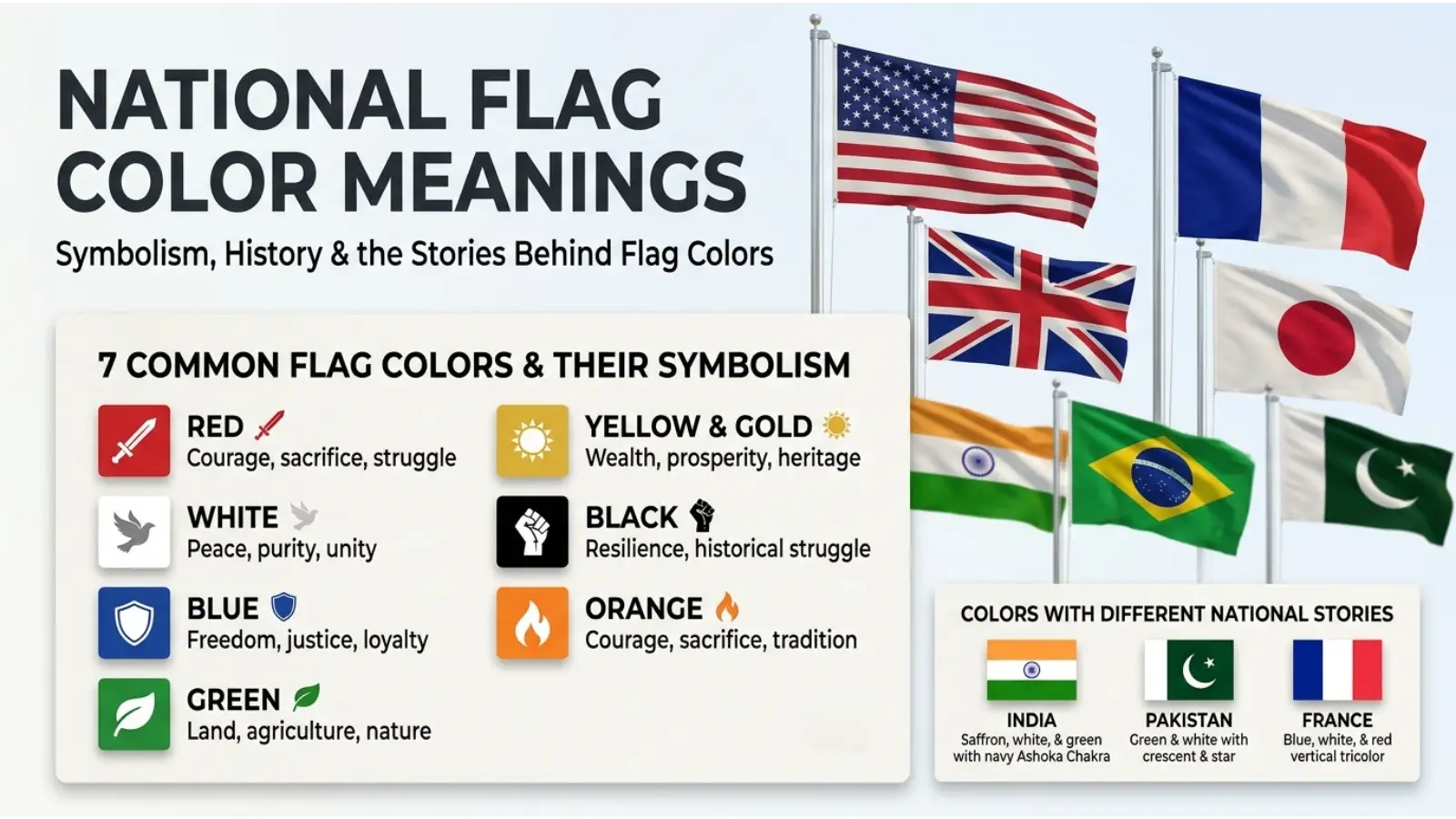
National flags are more than colorful pieces of fabric. They represent a country’s history, identity, values, struggles, and hopes for the future. A single color can honor people who fought for independence, express a connection to nature, represent peace, or reflect a nation’s cultural traditions. However, national flag color meanings are not universal. Red may represent courage or sacrifice in one country, while green may reflect the land, agriculture, or religious heritage in another.
So, how can we understand what each flag color means? The best approach is to examine the country’s history, official explanations, cultural background, and flag design together. In this guide, you will discover the symbolism of common flag colors, explore real examples from different regions, and learn why nations choose particular combinations.
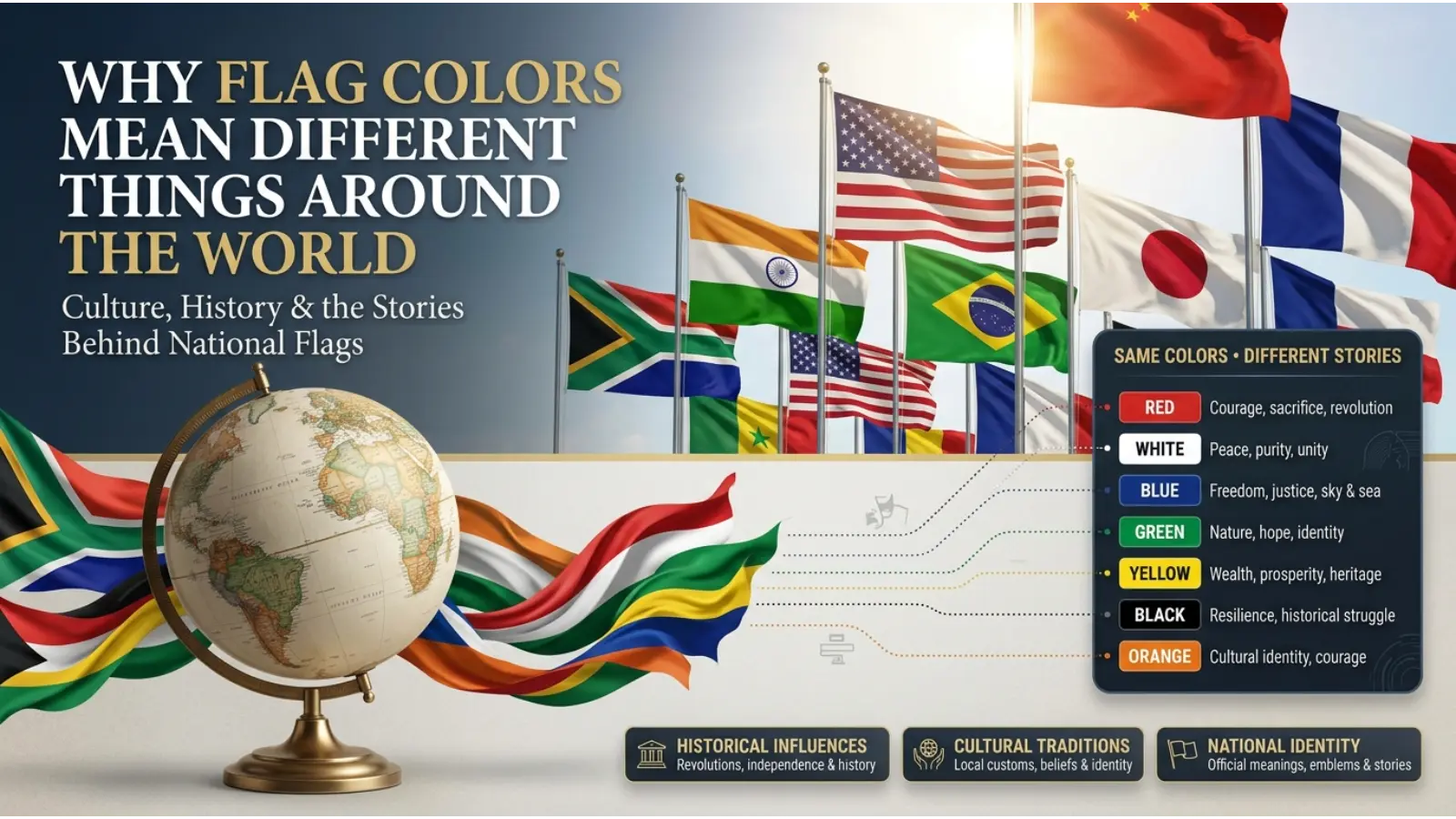
Quick Answer: National flag color meanings depend on a country’s history and traditions. Red often represents courage or sacrifice, white may symbolize peace, blue can represent the sky or sea, green may reflect nature or faith, and black can represent heritage, determination, or remembrance. However, each country’s official interpretation may differ.
Why Do Countries Use Different Colors in Their Flags?
A national flag gives a country a recognizable visual identity. Its colors and symbols can communicate ideas without using words. Consequently, flags appear at government buildings, sporting events, public celebrations, military ceremonies, and international gatherings.
Countries choose colors for several reasons:
- Historical events: A color may commemorate independence, a revolution, or a national struggle.
- Natural features: Mountains, rivers, oceans, forests, and fertile land can inspire flag designs.
- Cultural traditions: Traditional clothing, historical emblems, and established symbols may influence the palette.
- Political ideals: Colors can express freedom, unity, justice, or national sovereignty.
- Religious heritage: Some flags reflect religious traditions or symbols important to the country’s history.
- Shared identity: Colors can unite people around a common national story.
Moreover, a flag’s meaning often comes from its complete design rather than from an isolated color.
National Flag Color Meanings at a Glance
The following chart summarizes common interpretations. These are general associations, not universal definitions or official meanings for every country.
| Flag color | Common symbolic meanings | Possible national connection |
|---|---|---|
| 🔴 Red | Courage, sacrifice, strength, revolution | Independence struggles or national resilience |
| 🔵 Blue | Freedom, justice, loyalty, peace | Sky, oceans, unity, or national ideals |
| 🟢 Green | Nature, growth, hope, fertility | Agriculture, landscapes, or religious heritage |
| ⚪ White | Peace, purity, honesty, unity | Peaceful intentions or moral ideals |
| ⚫ Black | Determination, heritage, remembrance | Historical identity or resistance |
| 🟡 Yellow | Wealth, sunlight, prosperity, hope | Natural resources, sunlight, or optimism |
| 🟠 Orange | Courage, sacrifice, spirituality, energy | Cultural traditions or national history |
| 🟣 Purple | Dignity, royalty, independence, prestige | Historical authority or distinctive identity |
How to read this chart: Start with the general association, then check the particular country’s explanation. A color can carry a different meaning in another national, historical, or religious context.
Red: Courage, Sacrifice, and Revolution
Red is one of the most visually striking colors on national flags. Its strong contrast makes it easy to recognize from a distance.
However, red does not mean the same thing everywhere. In one country, it may honor people who died for independence. In another, it may represent strength, national unity, or a political tradition.
Examples of red in national flags
- United States: Red is commonly associated with valor and hardiness in traditional explanations of the flag’s symbolism.
- China: Red is associated with the revolution and the country’s revolutionary history.
- Turkey: Red forms a major part of the national flag, alongside the white crescent and star, which have important historical and national associations.
These examples show why context matters. Although all three flags feature red, their historical stories and accompanying symbols are different.
How red influences perception
Red attracts attention and can create impressions of energy, urgency, or power. Therefore, it is useful in flags that need to remain visible in busy public spaces.
Nevertheless, a red flag should not automatically be interpreted as a sign of aggression. Its meaning depends on the country’s history and the symbols surrounding it.
Blue: Freedom, Loyalty, and the Natural World
Blue frequently appears on national flags because it can represent the sky, oceans, rivers, freedom, justice, or loyalty. In countries with strong maritime traditions, blue may reflect the sea. Elsewhere, it may express political ideals or regional unity.
For example, the blue in the flag of Argentina is commonly associated with the sky, while blue in the United States flag is linked to vigilance, perseverance, and justice in traditional symbolic explanations.
Blue also appears in the flags of Greece, Finland, and many other countries, but its significance differs according to each nation’s story.
Why blue works well in flag design
Blue often creates an impression of stability and order. In visual communication, darker blues can appear formal and authoritative, whereas lighter blues may feel open and calm.
Additionally, blue can contrast effectively with white, red, yellow, and other colors. Designers must still consider visibility, fabric conditions, and the flag’s appearance at different distances.
Green: Nature, Hope, and Cultural Heritage
Green is often connected with forests, crops, fertile land, renewal, and growth. It can be particularly meaningful in countries where farming, natural resources, or landscapes play an important role in national identity.
However, green also carries religious and historical meanings in some countries. Therefore, it would be inaccurate to assume that every green national flag represents nature alone.
Countries with green flags
- Pakistan: Green is strongly associated with the country’s Muslim identity and national heritage.
- Nigeria: The green stripes are officially associated with the country’s agricultural wealth, while the white stripe represents peace.
- Brazil: Green is commonly associated with the country’s forests and natural wealth in popular explanations of its flag.
These examples reveal three different ways a similar color can communicate identity, agriculture, and natural resources.
Green in national identity
Green can suggest renewal and a connection to the land.
Still, a flag’s official meaning should take priority over a modern marketing interpretation. The same color can communicate several ideas at once.
White: Peace, Unity, and Honesty
White is commonly associated with peace, purity, sincerity, and peaceful intentions. In national flags, it may also represent unity, moral principles, or a country’s commitment to coexistence.
For example, white appears in the flags of Japan, Greece, Pakistan, and the United States. Yet these flags use white in different ways.
Japan’s white field surrounds a red disc representing the sun.
Why white is visually important
White creates a clear contrast with many darker colors. It can separate colored stripes, make symbols more visible, and give a flag a balanced appearance.
However, white fabric can show dirt more easily than darker fabric. This practical consideration affects maintenance, although it does not determine the symbolism of the color.
Black: Strength, Heritage, and Remembrance
Black can represent determination, historical identity, resistance, remembrance, or the people and communities that shaped a nation. Its meaning is particularly dependent on historical and political context.
For example, black appears in the flags of Germany, Estonia, Kenya, and several countries that use Pan-African colors.
In Kenya’s flag, black represents the people of Kenya. Red represents the struggle for freedom, while green represents the country’s natural wealth. White stripes symbolize peace and honesty.
The difference between symbolism and psychology
In everyday life, black may be associated with mourning, formality, or authority. However, these impressions should not be transferred automatically to national flags.
A black stripe may honor a population or historical struggle rather than communicate sadness. Understanding the national context prevents misleading interpretations.
Yellow and Gold: Prosperity, Sunlight, and Hope
Yellow and gold are visually bright colors that may represent sunlight, wealth, prosperity, natural resources, or optimism. Their meanings often depend on the other colors in the flag.
For example, gold appears in the flag of Spain and is commonly associated with historical heraldic traditions. In Brazil, yellow is widely associated with the country’s natural wealth, including mineral resources, in popular interpretations of the flag.
Gold can also communicate prestige because it resembles a valuable metal. Yellow, meanwhile, may appear brighter and more energetic.
Yellow versus gold in flags
Although people sometimes use the words interchangeably, official flag specifications may distinguish yellow from gold.
This distinction can matter in manufacturing and official reproduction.
Orange: Courage, Sacrifice, and Cultural Identity
The Orange is less common than red, white, or blue in national flags, but it has important meanings in particular national traditions.
Orange also appears in the flags of countries such as Ireland and Niger, although its symbolism differs between them.
Why orange stands out
Orange combines the visual energy often associated with red with the brightness of yellow. Consequently, it can make a flag look distinctive and easy to identify.
Still, the precise meaning of orange should be established from each country’s history. It may symbolize sacrifice in one setting and cultural identity in another.
Purple: Dignity, Royalty, and Distinction
Purple is relatively rare in national flags. Historically, purple dyes could be costly or difficult to produce, which contributed to their association with royalty and prestige in some societies.
Today, modern dye production has removed much of that practical barrier. Even so, purple remains uncommon in national flags, partly because many established flags use older color traditions and familiar combinations.
A notable example is Dominica, whose flag includes a purple Sisserou parrot. Purple is also present in Nicaragua’s coat of arms, which appears within the national flag.
Therefore, purple’s presence may come from an emblem or animal rather than a broad field of color.
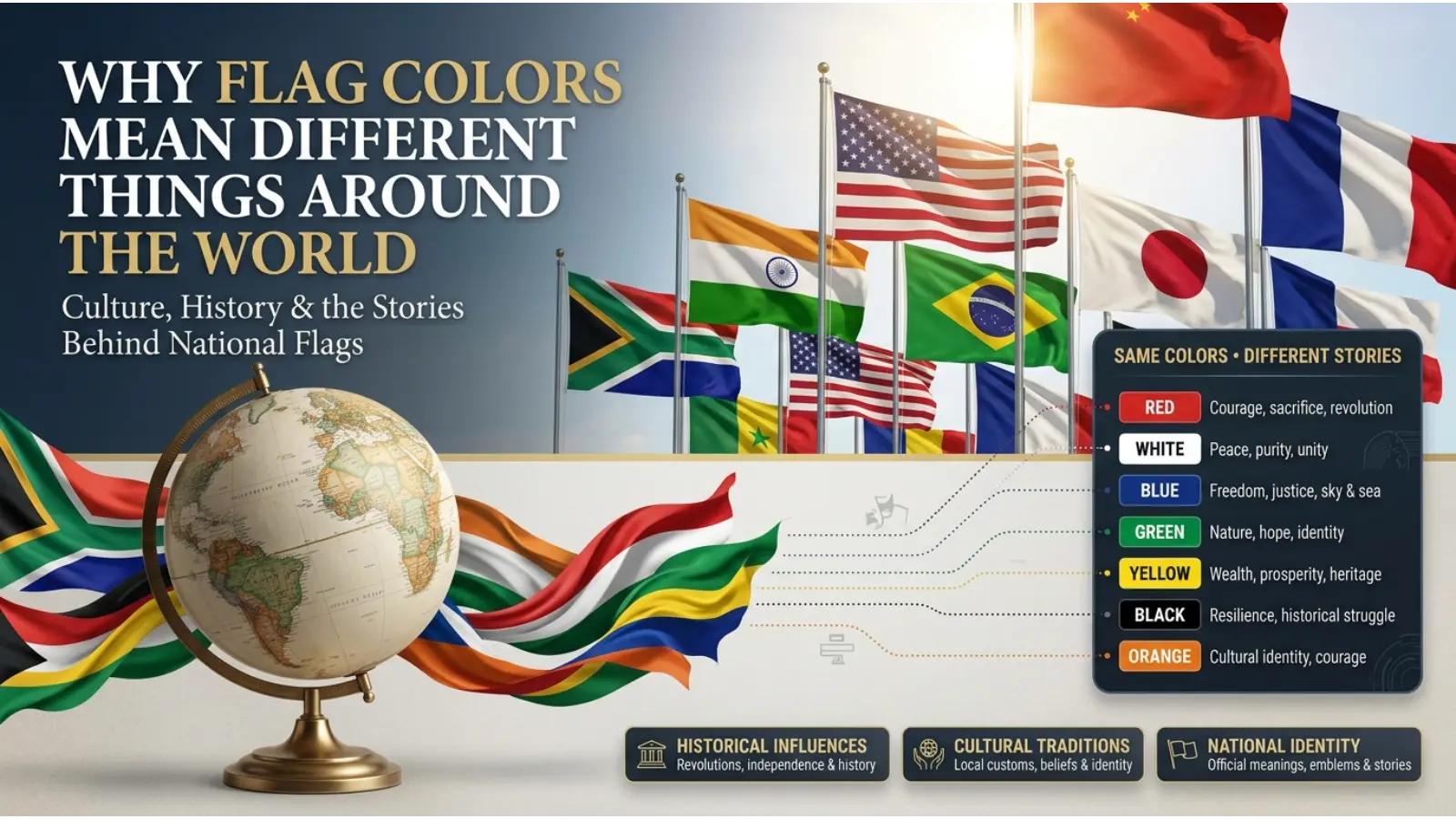
Why National Flag Color Meanings Different Things Around the World
A color does not carry one fixed meaning across all societies. Instead, its interpretation develops through history, religion, politics, language, and shared experiences.
Western interpretations
In some European and North American traditions, red is associated with courage, sacrifice, or revolution, while white may symbolize peace or purity. Blue is often linked with loyalty, justice, or the natural world.
However, these are broad patterns rather than rules followed by every Western country.
Asian interpretations
Across Asia, colors can carry meanings shaped by local histories, religious traditions, and political movements. Red has a major place in China’s national identity, while saffron and green have important associations in India and Pakistan.
Even within Asia, interpretations vary greatly. It is more accurate to study individual countries than to assign one meaning to an entire continent.
African interpretations
Some African national flags use red, yellow or gold, and green. In several cases, these colors are connected with historical struggles, natural wealth, and African identity.
The Pan-African color tradition influenced a number of national flags. Nevertheless, not every African flag uses the same palette, and the symbolism of each country remains distinct.
Middle Eastern interpretations
Flags in the Middle East may reflect national history, religious heritage, political movements, or older regional traditions. Green, white, red, and black appear in several flags, but their specific meanings differ.
For example, green has an important association with Islam in many contexts. However, the presence of green alone does not prove that a flag has a single religious meaning.
Latin American interpretations
Many Latin American flags reflect independence movements, national landscapes, political ideals, or older heraldic traditions. Blue may represent the sky or water, while white can be associated with peace.
Yellow, red, and green also appear in several national palettes, but each country’s history determines how those colors should be understood.
Indigenous traditions and local heritage
Some national flags incorporate symbols or color traditions connected with Indigenous communities and local heritage.
A country’s official flag may represent a modern state while also reflecting older cultural identities. Therefore, the full history can be more complex than a simple color chart suggests.
The History Behind National Flag Color Meanings
National flag colors often develop through several historical stages. A design may begin as a military banner, royal emblem, regional symbol, independence movement flag, or political standard before becoming the official flag of a modern country.
From royal banners to national symbols
In earlier periods, rulers, armies, and regions used distinctive colors and emblems to identify themselves. Over time, some of these designs became associated with broader populations and political communities.
As national states developed, flags became symbols of sovereignty, public unity, and international recognition.
Flags and independence movements
During independence struggles, a flag could unite people who shared a political goal. Its colors might represent resistance, sacrifice, hope, or a vision for a new country.
After independence, the same colors could gain additional meaning as they appeared at public ceremonies, schools, sporting events, and government institutions.
Why meanings sometimes change
A flag may remain unchanged even as its public interpretation evolves. Political events, national debates, and changes in society can influence how people understand its symbols.
In some countries, official explanations are clearly documented. In others, popular interpretations may differ from formal historical records. A trustworthy explanation should distinguish the two instead of presenting every traditional claim as established fact.
How Flag Designs Combine Colors and Symbols
Colors rarely work alone. Their placement and relationship with other elements can be just as important as their individual symbolism.
Stripes
Horizontal or vertical stripes can separate colors and create a balanced design. The order of the stripes may carry historical or official meaning, so rearranging them can change the flag’s identity.
Stars
Stars may represent states, provinces, islands, political ideals, or other national concepts. Their number and arrangement often matter more than the color alone.
Crescents and religious symbols
Crescents and other religiously associated symbols appear in several national flags. Their meanings depend on the country’s historical and cultural traditions, not simply on the color surrounding them.
Shields and coats of arms
Some flags contain detailed emblems featuring animals, plants, tools, or heraldic designs. These symbols may explain the flag’s purpose more directly than its colors.
For this reason, anyone studying national flag color meanings should examine the entire design rather than treating each color as an isolated message.
Psychology of National Flag Color Meanings
Color psychology examines how people perceive and respond to colors. However, national flag symbolism is not the same as psychological research.
Red may attract attention, blue may appear calm or formal, and yellow may seem bright and energetic. These are common perceptual associations, but the response depends on context, personal experience, culture, and the surrounding design.
Do flag colors influence emotions?
Yes, colors can influence visual impressions and emotional responses for some viewers. However, a color does not produce the same feeling in every person.
For example, someone may feel pride when seeing a national flag because it represents family, citizenship, history, or a major sporting victory. That response comes from the combination of visual design and personal or collective meaning.
What science can and cannot tell us
Research on color perception can help explain contrast, visibility, attention, and some emotional associations. It cannot establish that every person will interpret a particular national flag in the same way.
Similarly, there is no reliable universal rule that assigns one personality trait or emotion to every flag color. The National symbolism must be studied through historical evidence as well as visual perception.
National Flag Color Meanings in Branding and Marketing
National flags are powerful examples of visual branding. They help people recognize a country and distinguish its identity from others. Businesses also use national colors to communicate heritage, origin, quality, or a connection with a particular market.
How national colors influence brand identity
A company may use a country’s flag colors when promoting products associated with that country. For example, a business selling Italian-inspired food might use green, white, and red to suggest Italian heritage.
Similarly, a company may use national colors during international sporting events or national holidays. As a result, the design can create a sense of familiarity and shared identity.
However, businesses should avoid suggesting that a product is officially endorsed by a country when it is not. National symbols can have legal and cultural significance, so respectful use matters.
A colorful chart of branding impressions
| Color | Possible branding impression | Practical application |
|---|---|---|
| 🔴 Red | Energy and strength | Sports and promotional campaigns |
| 🔵 Blue | Stability and reliability | Corporate and technology branding |
| 🟢 Green | Nature and growth | Agriculture and environmental products |
| ⚪ White | Simplicity and openness | Clean, minimal packaging |
| ⚫ Black | Authority and sophistication | Premium product design |
| 🟡 Yellow | Brightness and optimism | Attention-grabbing displays |
| 🟠 Orange | Warmth and enthusiasm | Creative and energetic campaigns |
These impressions are design possibilities, not guarantees. A country’s established history can outweigh the general psychological associations of its colors.
National Flag Color Meanings in Interior Design
National flags can inspire room palettes, especially when people want to celebrate their heritage, decorate for a national holiday, or create a space connected to a favorite country.
However, copying an entire flag’s color scheme into a room can sometimes feel overwhelming. Instead, use one dominant color and support it with softer shades.
Living rooms
For a flag-inspired living room, choose one main color for walls or large furniture. Then add the remaining flag colors through cushions, rugs, artwork, or small decorative objects.
For example, a blue-and-white palette can create a clean, coastal impression. Red accents can add energy without dominating the room.
Bedrooms
Softer versions of national colors may work better in bedrooms. Pale blue, muted green, cream, and warm white can create a relaxed atmosphere.
Bright red or yellow can still be used, but smaller accents may feel more comfortable than covering every wall in a vivid shade.
Offices and study spaces
Blue, green, and neutral colors can provide a professional appearance. A framed national flag or a small flag-inspired design may add personal meaning without making the room visually busy.
A simple flag-inspired decorating chart
| Style | Suggested palette | Best use |
|---|---|---|
| 🌊 Coastal | Blue, white, sand | Living room or bedroom |
| 🌿 Natural | Green, cream, brown | Study or relaxing space |
| 🔥 Bold | Red, white, charcoal | Accent wall or creative studio |
| ☀️ Bright | Yellow, white, navy | Kitchen or dining area |
| 👑 Elegant | Black, gold, ivory | Formal living room |
Lighting also changes how these colors appear. Warm lighting can make white look creamier, while cool lighting may make blue appear sharper. Therefore, test paint samples under the room’s actual lighting before decorating.
National Flag Color Meanings in Fashion
Flag colors can express national pride, cultural identity, or a connection to a sporting event. People wear them during national celebrations, international competitions, festivals, and community gatherings.
Nevertheless, the meaning of an outfit depends on the occasion. Wearing a country’s colors at a sports match may communicate support, while wearing them at a formal national event may express respect or belonging.
Everyday outfits
You do not need to wear a complete flag design to use its colors. A shirt, scarf, jacket, or pair of shoes in one or two national colors can create a subtle connection.
For example, blue and white can produce a clean appearance, while green and white may create a fresh, balanced combination.
Formal and cultural occasions
During national celebrations, traditional clothing and flag colors may be combined to express heritage. However, customs differ between countries and communities, so local expectations should guide the choice.
Color combinations for clothing
- Red and white: A high-contrast combination that looks energetic and clear.
- Blue and white: A versatile pairing that can look classic or relaxed.
- Green and gold: A rich combination often used for celebratory or heritage-inspired outfits.
- Black and gold: A formal, dramatic pairing.
- Orange and white: A bright combination that feels lively and distinctive.
The best combination depends on shade, fabric, lighting, and the occasion. A muted green outfit, for instance, may look very different from one made with a highly saturated flag green.

Common Misconceptions About National Flag Color Meanings
Several misunderstandings can lead to incorrect explanations of national flags.
Every color has the same meaning everywhere
This is incorrect. Red may represent revolution in one country and courage or another national ideal in a different country. Historical context determines the interpretation.
All flag colors have official meanings
Not necessarily. Some countries publish detailed explanations of their flags, while others have documented histories without assigning a separate official meaning to every color.
In such cases, a traditional or popular interpretation should not automatically be presented as an official statement.
Color psychology explains every flag
Psychology can help explain visual attention and common color associations. However, it cannot replace historical research or explain every national symbol.
A color’s meaning may depend on political movements, religious traditions, or cultural events that have little to do with general psychological responses.
Green always represents Islam
Green has important associations with Islam in many contexts, but it also represents agriculture, landscapes, hope, and other ideas. The presence of green on a flag must be interpreted within that country’s history.
Black always represents mourning
Black can symbolize mourning in some traditions. Yet it can also represent a population, heritage, resistance, or national identity. Kenya’s flag provides a clear example of black representing the people of the country.
A flag’s colors tell the whole story
Colors are only part of a flag’s meaning. Symbols, stripe arrangements, historical origins, and official descriptions may be equally important.
How to Research the Meaning of Any National Flag
If you want to understand a flag accurately, follow a few simple steps.
- Identify the country. Make sure you are examining the current national flag rather than a historical, regional, military, or political flag.
- Check official explanations. Look for information published by the country’s government or official national institutions.
- Learn the historical background. Find out when the flag was adopted and which events influenced its design.
- Study the complete design. Examine the symbols, shapes, and arrangement of colors together.
- Compare cultural interpretations. Traditional explanations may differ from modern public understanding.
- Separate fact from interpretation. Present documented meanings as facts and uncertain or popular associations as interpretations.
This approach is especially useful when researching flags for educational articles, classroom projects, design work, or cultural studies.
Frequently Asked Questions About National Flag Color Meanings
1. What do national flag colors mean?
National flag colors can represent a country’s history, values, natural features, cultural traditions, religious heritage, or independence struggle. Their meanings vary by country, so there is no universal definition for every color.
2. What does red mean on a national flag?
Red often represents courage, sacrifice, strength, or revolution. However, the official meaning depends on the country. China, for example, connects its red flag with revolutionary history, while other countries have different national interpretations.
3. Why do many national flags contain blue and white?
Blue and white are visually distinct and can represent ideas such as the sky, water, peace, justice, or national ideals. Their popularity also reflects established historical and regional flag traditions.
4. What does green mean on national flags?
Green may symbolize agriculture, forests, fertile land, growth, hope, or religious heritage. Pakistan’s green field, for instance, is associated with the country’s Muslim identity and national heritage, while Nigeria connects its green stripes with agricultural wealth.
5. What does white represent on a flag?
White commonly symbolizes peace, purity, honesty, or unity. Nevertheless, a country’s historical circumstances and official explanations determine its particular meaning.
6. Why is black used in some national flags?
Black can represent a country’s people, historical identity, resistance, determination, or remembrance. In Kenya’s flag, black represents the people of Kenya rather than simply symbolizing mourning.
7. Which national flag colors represent peace?
White is commonly associated with peace, but it is not the only color that can carry this meaning. Blue and other colors may also express peaceful ideals, depending on the flag’s national history.
8. Do national flag colors have religious meanings?
Some do. Certain colors have connections with religious traditions, while others represent political history, geography, or national identity. A religious interpretation should be supported by the particular country’s history rather than assumed from the color alone.
9. Why do some national flags use the same colors?
Countries may share historical influences, regional traditions, political ideals, or similar natural features. Some also adopt colors associated with broader movements. However, using the same colors does not necessarily mean two countries share the same values or history.
10. Can national flag colors change their meaning over time?
Yes. Political events, independence movements, cultural changes, and new national experiences can influence how people interpret a flag. Even when the design stays the same, public understanding may develop over generations.
Conclusion: The Stories Behind National Flag Colors
National flag color meanings reveal how visual design connects with history, culture, politics, and identity. Red can honor sacrifice, blue can represent the sky or national ideals, green can reflect agriculture or heritage, and white can express peace. Yet these associations are only starting points.
The most accurate interpretation comes from understanding the country behind the flag. Its history, official explanations, symbols, and traditions give the colors their specific significance.
Next time you see a national flag, look beyond its appearance. Consider why its colors were chosen, what its symbols represent, and how its story reflects the people it represents. This deeper perspective turns a simple color combination into a meaningful lesson about national identity and cultural history.

Emma Wilson is a dedicated comparison writer and product researcher at ColorMystiic.com. She specializes in creating unbiased product comparisons, detailed reviews, and helpful buying guides. Her goal is to help readers make smarter purchasing decisions with confidence.