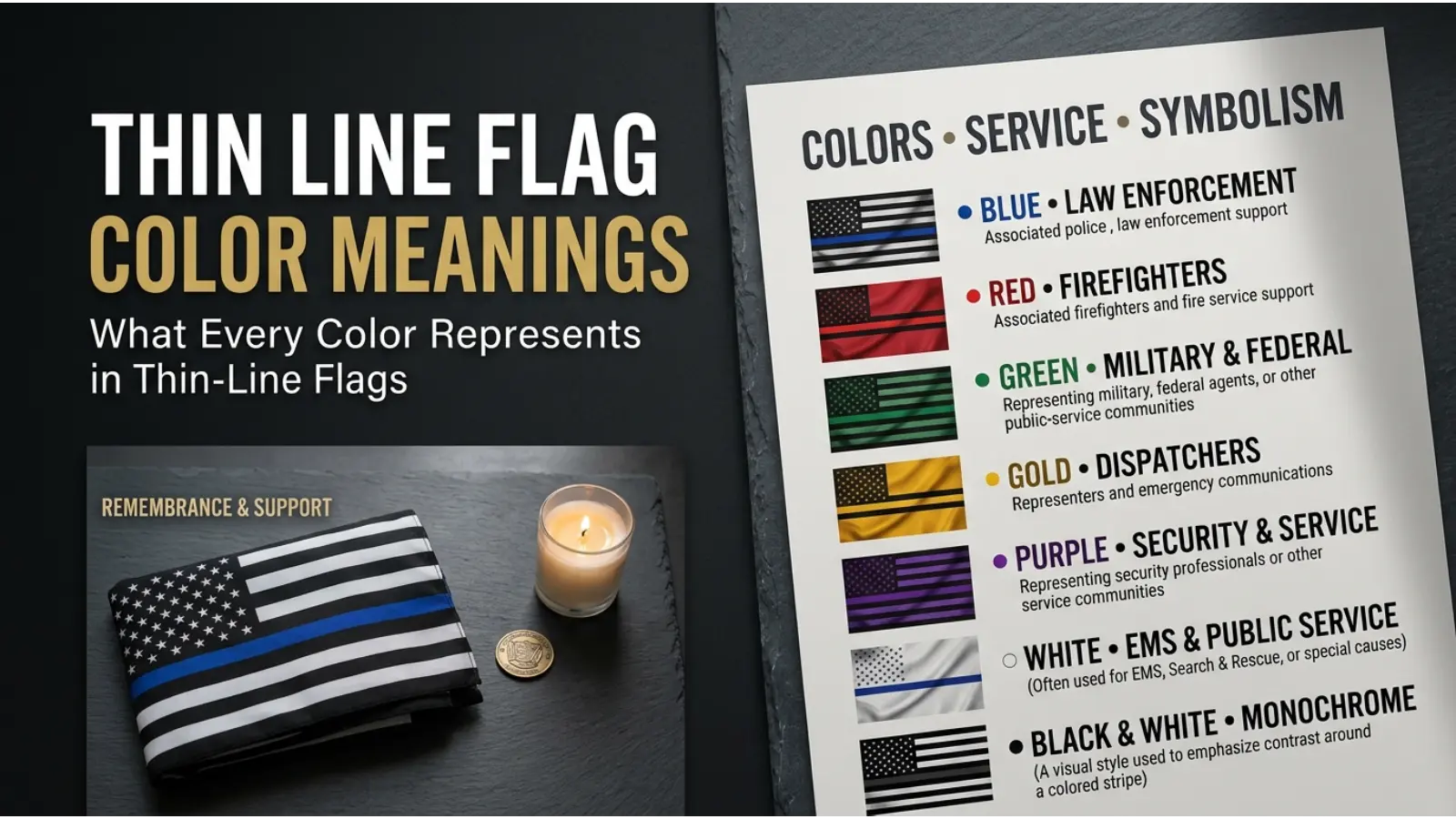
Thin Line Flag Color Meanings use a colored stripe to represent people who serve, protect, and support their communities. These flags are especially popular in the United States, where different colors are associated with professions such as police officers, firefighters, military personnel, and emergency dispatchers. However, each color can carry a different message depending on the flag’s design and the community displaying it.
Understanding thin line flag color meanings helps explain why people use these symbols to express gratitude, honor fallen service members, and show professional solidarity. At the same time, some flags have become part of wider political and social discussions. Therefore, their meaning depends on more than color alone.
This guide explores the most common thin line flag colors, their symbolism, their cultural significance, and how to interpret them correctly.
Quick Answer: Thin line flag colors represent different professions and service communities. Blue commonly represents law enforcement, red represents firefighters, and green is associated with military personnel in some designs. Purple, gold, white, and other colors may represent additional groups, but their meanings vary by organization and context.
What Are Thin Line Flags?
Thin line flags are symbolic flags featuring a narrow colored stripe, often placed across a black-and-white American flag. The stripe represents a particular profession, community, or cause.
The word line can symbolize the boundary between danger and safety, the people who respond to emergencies, or the connection shared by members of a profession.
For example, the Thin Blue Line flag is widely recognized as a symbol of support for law enforcement. Similarly, the Thin Red Line flag is commonly associated with firefighters.
Although these flags share a similar design, they do not follow one universal color system. Consequently, the same color may have different meanings in different communities.
Thin Line Flag Color Meanings Chart
The following colorful chart provides a quick overview of the most common associations.
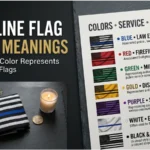
| Flag Color | Common Association | Main Symbolism |
|---|---|---|
| 🔵 Blue | Police and law enforcement | Duty, public safety, solidarity |
| 🔴 Red | Firefighters | Courage, sacrifice, service |
| 🟢 Green | Military personnel in some designs | Service, resilience, support |
| ⚪ White | Selected emergency or service groups | Care, hope, assistance |
| 🟡 Gold or yellow | Dispatchers in some designs | Communication, alertness |
| 🟣 Purple | Corrections officers in some designs | Professional solidarity, service |
| 🟠 Orange | Depends on the organization | Varies by specific design |
| ⚫ Black | Often the flag’s background | May convey mourning or remembrance |
Remember: These are common associations rather than a universal official code. Always consider the organization, emblem, and context before identifying an unfamiliar flag.
Thin Blue Line Flag Meaning
The Thin Blue Line flag is one of the most recognizable thin line flags. It is commonly associated with police officers and law enforcement communities.
What does the blue line symbolize?
The blue stripe often represents police service, professional responsibility, and solidarity among officers. Supporters also use the flag to honor officers who have died while performing their duties.
Blue is commonly associated with stability, authority, and trust. However, the flag’s meaning comes primarily from its connection with law enforcement rather than from color psychology alone.
For many people, displaying the Thin Blue Line flag is a way to express appreciation for police officers and their families.
Nevertheless, the symbol is also politically contested. Some people interpret it as a straightforward sign of support for police, while others associate it with debates about policing, racial justice, and accountability.
Therefore, its meaning can depend on the setting and the intentions of the person displaying it.
Thin Red Line Flag Meaning
The Thin Red Line flag is widely associated with firefighters and the risks they face while protecting people and property.
What does the red line represent?
Red can suggest fire, heat, energy, urgency, and courage. In this flag, the stripe commonly symbolizes the commitment and sacrifice of firefighters.
People may display it to:
- Honor firefighters who died in the line of duty.
- Recognize the dangers of firefighting.
- Show support for local fire departments.
- Express solidarity with firefighters and their families.
Furthermore, the red stripe can serve as a reminder that emergency workers often enter dangerous situations to help others.
Although red has many meanings in art and culture, the firefighting connection is the central association of the Thin Red Line flag.
Thin Green Line Flag Meaning
The Thin Green Line flag has several interpretations. It is associated with military personnel in some designs, while other green line symbols may represent border patrol, park rangers, conservation personnel, or other service groups.
Why is green used?
Green is commonly linked with nature, growth, renewal, and resilience. These associations can support the meaning of a particular flag, but the profession represented by the stripe remains the most reliable clue.
When used by military-support communities, the Thin Green Line flag may express respect for service members and veterans.
In other settings, green may refer to people who protect natural resources, manage public lands, or perform related duties.
As a result, you should not assume that every green line flag represents the same group.
Thin White Line Flag Meaning
White is often associated with peace, clarity, care, and hope. Some thin white line designs are connected with emergency medical or related service groups, although this association is not universal.
What does the white line represent?
Depending on the organization, a white stripe may symbolize medical assistance, emergency response, or another form of public service.
White can also create a visual impression of cleanliness and simplicity. However, those general meanings do not establish the official purpose of a specific flag.
If you see a white line flag, look for an accompanying emblem, name, or organizational description before deciding what it represents.
Thin Gold or Yellow Line Flag Meaning
Gold and yellow thin line designs are sometimes associated with emergency dispatchers and communications personnel.
What does the gold line symbolize?
Yellow is often used to attract attention, while gold can suggest honor and recognition. In some designs, these colors represent people who receive emergency calls and coordinate responses between the public and emergency services.
Dispatchers may not always be visible at an emergency scene. Nevertheless, their work can be essential to getting help to the right place.
A gold or yellow stripe may therefore recognize communication, coordination, and the people who help emergency services operate effectively.
Thin Purple Line Flag Meaning
The Thin Purple Line flag is associated with corrections officers and correctional staff in some communities.
What does purple represent?
Purple can suggest dignity, strength, individuality, and authority. In a thin line design, it may express appreciation for the people responsible for maintaining safety and security in correctional facilities.
The flag can also symbolize professional solidarity and recognition of the difficult responsibilities associated with corrections work.
However, purple has other meanings in religion, fashion, art, and popular culture.
What Do Other Thin Line Flag Color Meanings?
Not every thin line color has a widely recognized meaning.
For example, orange may appear in a flag created for a particular service group, while gray may be used in a specialized support or remembrance design. Black can serve as a background color, but it may also convey mourning in certain contexts.
The important distinction is between general color symbolism and the intended meaning of a specific flag.
A color may suggest courage, hope, or remembrance in a broad symbolic sense. However, the organization that uses the flag determines the meaning it intends to communicate.
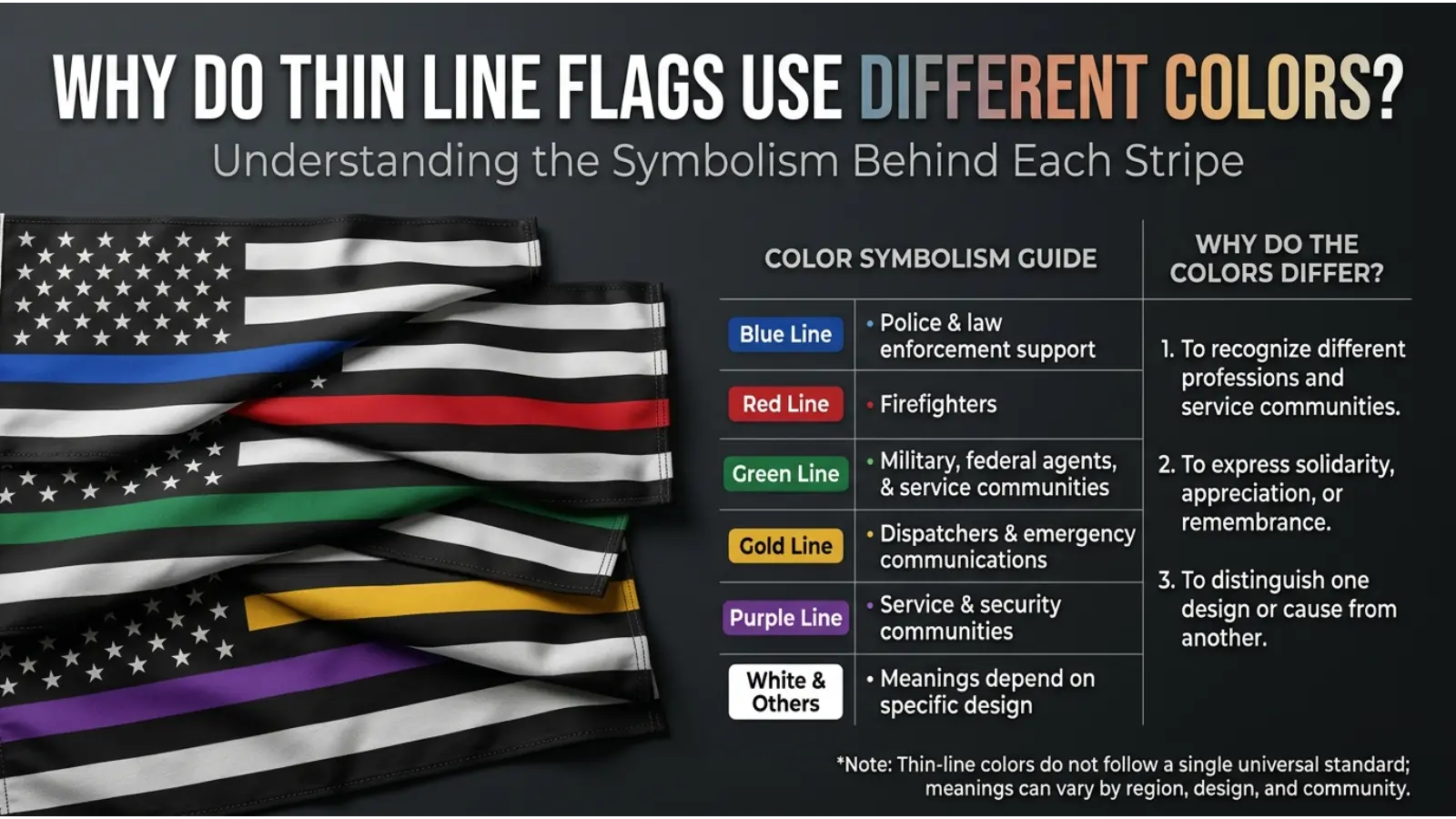
Why Do Thin Line Flags Use Different Colors?
Thin line flags use contrasting colors to make the stripe easy to recognize and to connect a design with a particular group.
1. Professional identity
A colored stripe can give members of a profession a shared symbol. Consequently, people can recognize a design and understand the community it represents.
2. Remembrance
Families, colleagues, and supporters may display these flags to honor people who died while serving. In this context, the flag becomes a visible expression of memory and respect.
3. Solidarity
A thin line flag can communicate that someone supports a particular profession or identifies with its members.
4. Visual recognition
A strong color contrast helps the stripe stand out. For example, a bright blue or red stripe against a dark background can be recognized from a distance.
Although these purposes overlap, they are not identical. One person may display a flag to honor a relative, while another may use the same design to express broader professional or political support.
History and Development of Thin Line Flag Color Meanings
The Thin Blue Line concept has historical connections with the idea of a protective boundary between order and disorder. In modern American usage, it became closely associated with law enforcement.
The spread of these designs through flags, patches, clothing, vehicle decals, and online communities has made them increasingly recognizable.
However, not every color has the same historical background.
Therefore, it is better to examine each flag separately rather than assume that all thin line designs originated together or follow an official historical system.
Thin Line Flags in American Culture
Thin line flags are particularly visible in American public life. They may appear outside homes, at memorial events, on emergency vehicles, or at gatherings that recognize public service workers.
For supporters, these flags can represent gratitude, sacrifice, and respect for people who accept dangerous responsibilities.
This does not mean that everyone who displays a particular flag has the same political beliefs. Rather, it shows that symbols can develop multiple meanings as different communities encounter them.
When interpreting a flag, consider who is displaying it, where it appears, and whether the person has explained its purpose.
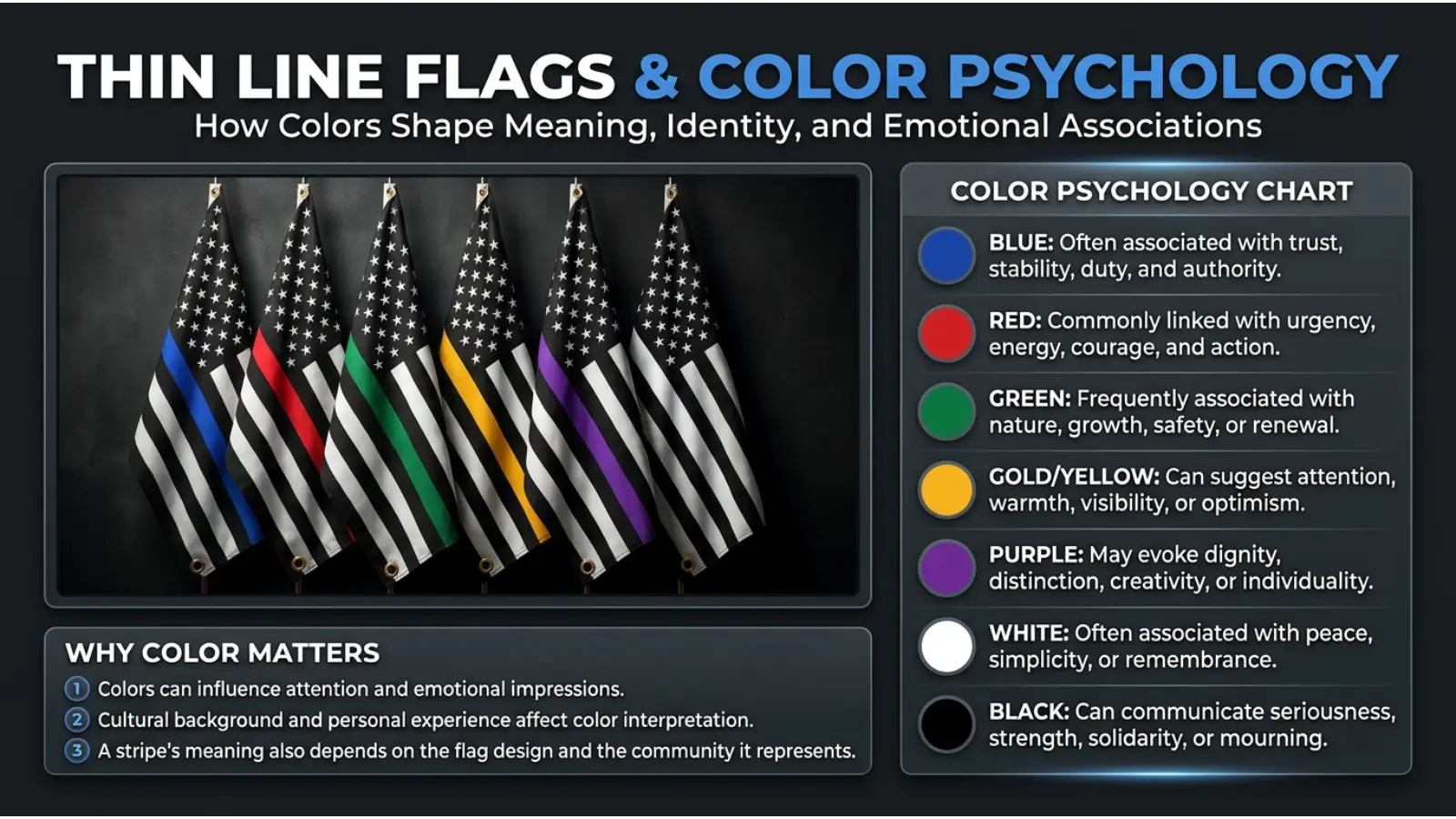
Thin Line Flags and Color Psychology
Color psychology examines how colors influence perception, emotion, and behavior. However, it does not provide a universal dictionary that can explain every symbol.
For example, blue may create impressions of stability or authority, while red can attract attention and suggest urgency. Green may evoke nature, and purple may suggest dignity or individuality.
These are broad associations, not guaranteed psychological responses. People can interpret the same color differently because of personal experiences, cultural background, and the surrounding design.
In thin line flags, the color’s connection with a profession is usually more important than its general psychological associations.
Consequently, it is misleading to claim that a blue line automatically creates trust or that a red line always produces feelings of courage. Context shapes interpretation.
Thin Line Flags in Everyday Life
Thin line flags appear in several everyday settings, and their meaning can change with their use.
At home
A person may display a flag to honor a family member who works in law enforcement, firefighting, or another public service profession.
On vehicles
Stickers and small flags can express professional pride or support for a particular service community.
At memorial events
Flags may be used to remember people who died while serving. In this setting, the design can become a symbol of grief, gratitude, and collective remembrance.
At workplaces
Organizations may display relevant flags to recognize employees, although they should make sure the design reflects their intended message.
In each situation, the flag communicates more than a color. Its location and the reason for displaying it also affect how people understand it.
Common Misconceptions About Thin Line Flag Colors
Misconception 1: Every thin line color has one official meaning
Reality: Some colors have widely recognized associations, but there is no universal code covering every thin line flag.
Misconception 2: The color alone identifies the profession
Reality: Similar colors may be used by different organizations. Emblems, labels, and context can help identify the intended group.
Misconception 3: Everyone interprets the flag in the same way
Reality: Personal experience, political views, local traditions, and public events can influence how a symbol is understood.
Misconception 4: Color psychology explains the entire meaning
Reality: General color associations provide only part of the picture. A flag’s history and intended purpose are equally important.
Misconception 5: Displaying a flag always communicates a political position
Reality: Some people use these flags to express personal gratitude or remember a loved one. Others may use them in political settings. The meaning depends on context and individual intent.
Frequently Asked Questions
1. What do thin line flag colors mean?
Thin line flag colors represent different professions, service communities, and causes. Other colors have varying associations.
2. What does the Thin Blue Line flag mean?
The Thin Blue Line flag commonly represents police officers, law enforcement solidarity, public safety, and remembrance of officers who died while serving. Some people also associate it with wider political debates about policing.
3. What does the Thin Red Line flag represent?
The Thin Red Line flag is commonly associated with firefighters. It can symbolize courage, sacrifice, professional service, and respect for firefighters who have died in the line of duty.
4. What does the Thin Green Line flag stand for?
The Thin Green Line flag has multiple uses. It may represent military personnel in some designs and other service groups in different contexts. The specific organization determines the intended meaning.
5. What does the Thin Purple Line flag mean?
The Thin Purple Line flag is associated with corrections officers in some communities. It can represent professional solidarity, service, and recognition of corrections personnel.
6. What does the Thin White Line flag represent?
The Thin White Line flag may represent emergency medical or related service groups in some designs.
7. What does the Thin Gold Line flag mean?
Gold or yellow line designs are sometimes associated with emergency dispatchers and communications personnel. Their exact meanings depend on the organization and flag design.
8. Are thin line flags only used in the United States?
No. Similar symbols may appear in other countries, especially among groups influenced by American public service symbols. However, their meanings and popularity vary by region.
9. Are thin line flag colors officially standardized?
No universal standard defines every thin line color. Some professions have widely recognized associations, but other colors are used differently by different organizations.
10. How can I identify an unfamiliar thin line flag?
Look for the stripe’s color, the flag’s background, any badge or emblem, and the organization displaying it. If those details do not establish the meaning, consult the group that uses the flag rather than relying on color alone.
Conclusion
Thin line flags use simple designs to communicate ideas about service, solidarity, remembrance, and professional identity. Green, purple, white, gold, and other colors may represent additional service communities, depending on the design.
However, no single color chart explains every flag. Cultural background, organizational traditions, historical developments, and political context all influence how people interpret these symbols.
The most reliable way to understand thin line flag color meanings is to consider both the color and the community it represents. By doing so, you can recognize the intended message more accurately and appreciate why these flags hold different meanings for different people.

Emma Wilson is a dedicated comparison writer and product researcher at ColorMystiic.com. She specializes in creating unbiased product comparisons, detailed reviews, and helpful buying guides. Her goal is to help readers make smarter purchasing decisions with confidence.