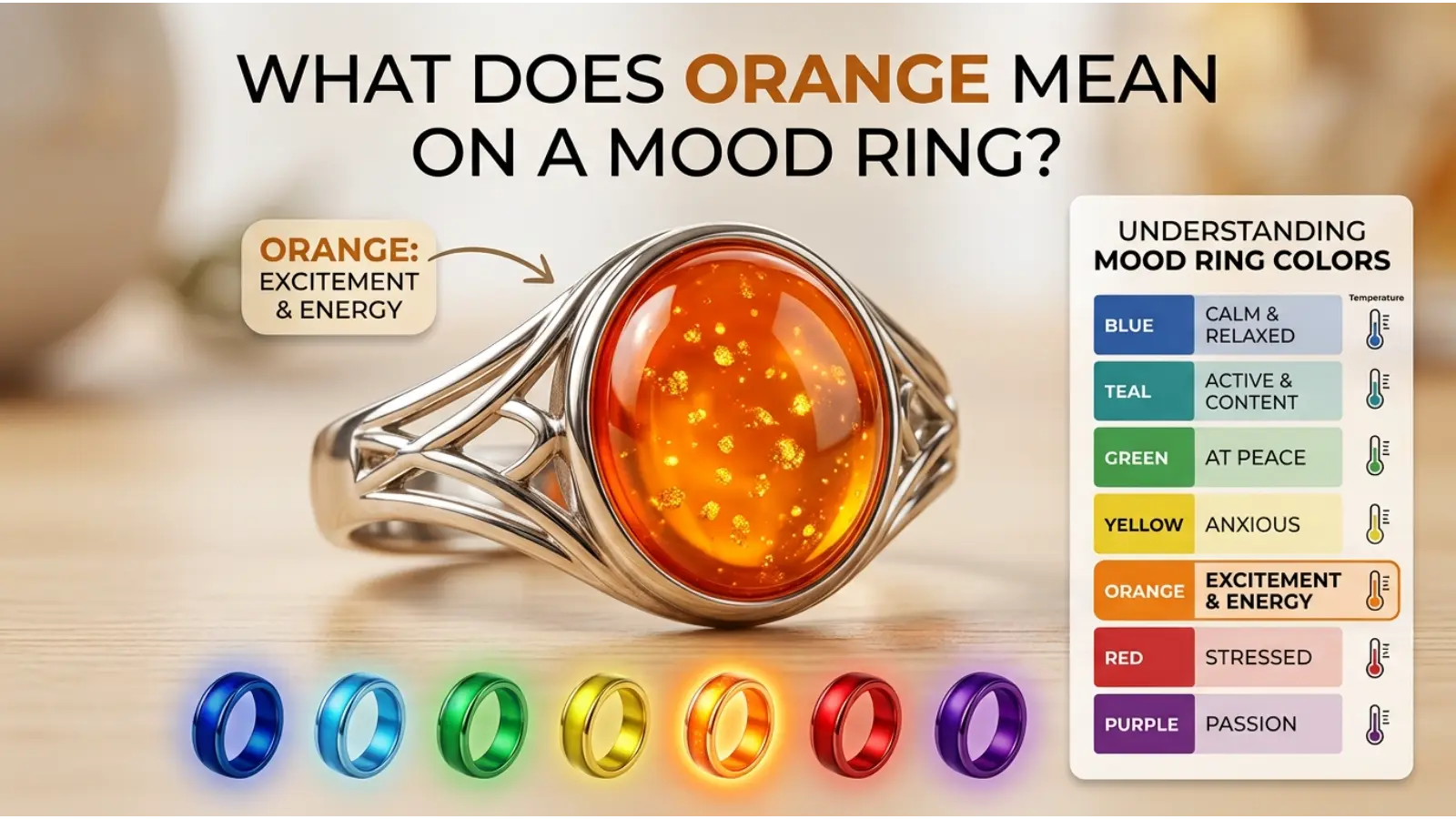
A mood ring can seem like a tiny window into your emotions. When the stone changes to orange, many people wonder what the color says about their mood, energy, or feelings. The mood ring color orange meanings commonly associated with orange include excitement, enthusiasm, warmth, energy, confidence, attraction, and emotional stimulation.
However, there is an important detail behind the color change: mood rings do not actually read emotions. Their color-changing material reacts mainly to temperature changes around the finger. Because body temperature can shift with activity, stress, environment, and circulation, the color may sometimes appear to match how you feel.
Orange is especially interesting because it sits between the emotional warmth of red and the cheerful brightness of yellow. As a result, orange is often interpreted as an energetic, social, expressive, and stimulating color.
Quick Answer
Orange on a mood ring is commonly associated with excitement, enthusiasm, energy, warmth, attraction, confidence, and emotional stimulation. In reality, the ring changes color because its thermochromic material responds to temperature, so orange should be treated as a symbolic interpretation rather than a scientific measurement of your emotions.
Mood Ring Color Orange Meanings at a Glance
| 🟠 Orange Shade | Common Mood-Ring Interpretation | Possible Emotional Association |
|---|---|---|
| 🟠 Bright Orange | Excitement and enthusiasm | High energy, eagerness |
| 🟠 Warm Orange | Warmth and friendliness | Comfort, openness |
| 🟠 Deep Orange | Strong emotion | Intensity, confidence |
| 🟠 Reddish Orange | Passion and stimulation | Attraction, excitement |
| 🟠 Yellowish Orange | Playfulness and optimism | Happiness, curiosity |
| 🟠 Brownish Orange | Tension or uncertainty | Stress, tiredness |
| 🟠 Pale Orange | Mild stimulation | Calm interest, gentle energy |
These interpretations are traditional or commercial mood-ring associations, not medical or psychological diagnoses.
What Does Mood Ring Color Orange Meanings?
Orange is usually described as a color of energy, excitement, enthusiasm, warmth, and emotional stimulation in mood-ring color charts.
If your mood ring turns orange, traditional interpretations may suggest that you are feeling energized, socially engaged, excited about something, or emotionally stimulated. In some charts, orange can also represent nervousness or mixed emotions because the color sits between the stronger intensity of red and the brighter optimism of yellow.
The exact interpretation depends on the mood-ring chart, manufacturer, and shade. There is no universal scientific standard saying that orange always means one particular emotion.
This distinction matters because the physical mechanism and the symbolic meaning are two different things.
A mood ring uses thermochromic material, which changes its appearance as temperature changes. Your finger may become warmer because of activity, environmental temperature, circulation, or other ordinary factors. Consequently, an orange color does not prove that you are excited, attracted to someone, or emotionally stressed.
🟠 Orange Mood Ring Color Chart
The following chart provides a practical way to understand the most common symbolic interpretations of orange.
| Color | Meaning | What It May Symbolize |
|---|---|---|
| 🟠 Orange | Excitement | Emotional stimulation and anticipation |
| 🟠 Bright Orange | Enthusiasm | Motivation and eagerness |
| 🟠 Red-Orange | Passion | Strong interest and attraction |
| 🟠 Yellow-Orange | Optimism | Playfulness and positive energy |
| 🟠 Dark Orange | Intensity | Strong feelings or determination |
| 🟤 Brown-Orange | Tension | Nervousness, fatigue, or uncertainty |
Remember that a mood ring may display intermediate shades. Lighting can also make the same shade look different.
How Does a Mood Ring Turn Orange?
The color change comes from a temperature-sensitive material rather than an emotion detector.
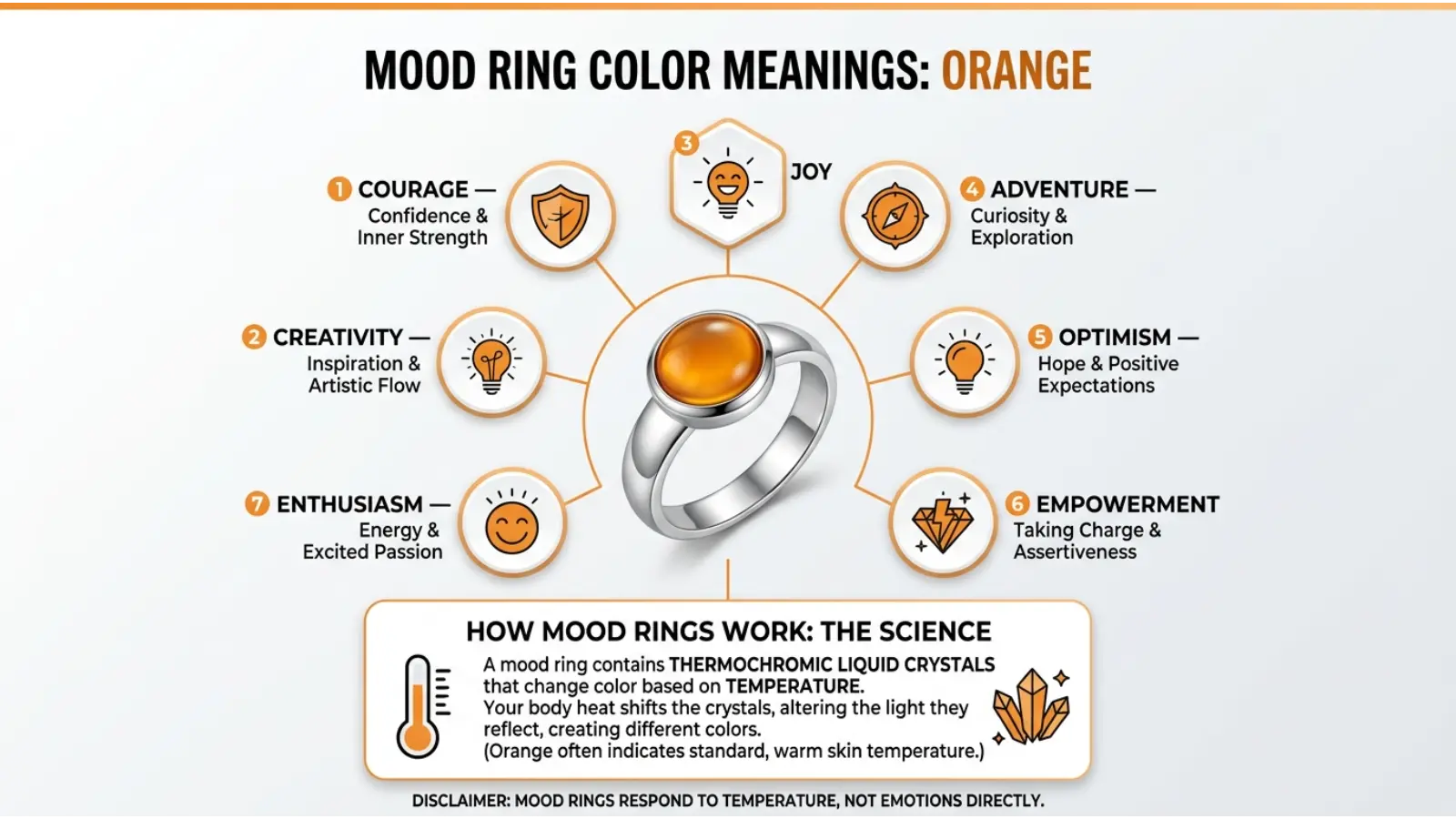
Most traditional mood rings contain thermochromic liquid crystals or a similar temperature-responsive material. These materials alter the way they reflect or transmit light when their temperature changes.
When you wear the ring, heat from your finger affects the material. As the temperature shifts, the reflected color can change.
That is why your mood ring may change color when you:
- Move from a cold room into a warm room
- Hold a hot drink
- Exercise
- Wash your hands
- Become physically active
- Sit still for a long period
- Experience changes in circulation
- Touch a cold surface
- Move outdoors in cold weather
Therefore, an orange ring can be interesting to observe, but it should not be used as a scientific tool for measuring emotions.
Why Can Temperature Affect the Color?
Your hands are constantly exchanging heat with the environment.
For example, if your fingers become warmer, the thermochromic material can move through its color-changing range. If your hands cool down, it can shift toward another color.
This explains why the same mood ring might appear orange at one moment and a completely different color later.
The change does not necessarily mean your feelings changed at exactly the same time.

🟠 Orange Mood Ring Meaning: Excitement
One of the strongest symbolic associations with orange is excitement.
Orange is visually energetic. It combines the warmth and intensity associated with red with the brightness traditionally connected with yellow. Because of this combination, orange is often used to represent enthusiasm and stimulation.
When a mood-ring chart labels orange as excitement, it usually suggests a state of heightened interest.
For example, someone might interpret orange as:
- Looking forward to an event
- Feeling energetic
- Being enthusiastic about an idea
- Experiencing anticipation
- Feeling socially stimulated
- Becoming more expressive
Still, the ring cannot determine which of these feelings you actually have.
🟠 Orange Meaning: Energy and Enthusiasm
Orange is frequently connected with energy and enthusiasm.
Unlike blue, which is often described as calm and reserved, orange has a more active visual character. It can attract attention without having quite the same visual intensity as pure red.
In a mood-ring context, orange may therefore symbolize a person who feels active, engaged, motivated, or ready to participate.
This interpretation can be especially appealing because orange is strongly associated with movement, warmth, sunlight, autumn leaves, firelight, and energetic environments.
🟠 Orange Meaning: Attraction and Passion
Some mood-ring charts associate orange or reddish-orange with attraction, romantic interest, or passion.
This interpretation comes partly from orange’s relationship with red. Red is widely used as a symbol of passion and romantic intensity, while orange can suggest a lighter, more playful form of emotional stimulation.
A reddish-orange mood ring may therefore be interpreted symbolically as:
- Attraction
- Strong interest
- Romantic excitement
- Playfulness
- Emotional intensity
- Physical warmth
However, a mood ring cannot tell whether someone is romantically attracted to another person. The color is caused by temperature rather than a hidden measurement of romantic feelings.
🟠 Orange Meaning: Happiness and Playfulness
Orange can also represent a lighter emotional state.
Bright orange is often associated with:
- Fun
- Playfulness
- Optimism
- Social energy
- Creativity
- Spontaneity
- Cheerfulness
This makes orange different from some darker colors that appear on traditional mood-ring charts.
A bright yellow-orange shade may feel particularly cheerful because it combines the brightness of yellow with the warmth of orange.
Orange vs. Yellow-Orange
The difference between orange and yellow-orange can change the symbolic impression.
Orange is usually more energetic and emotionally stimulating.
Yellow-orange often feels brighter, more playful, and more optimistic.
This is one reason exact shade matters when interpreting a mood ring.
🟠 Orange Meaning: Nervousness or Emotional Tension
Not every mood-ring chart gives orange a positive interpretation.
Some traditional charts associate orange with nervousness, anxiety, tension, or mixed emotions.
Why?
Orange can represent heightened emotional energy. That energy may feel positive when you are excited, but it can feel uncomfortable when you are nervous.
For example, the physical sensation of anticipation can resemble nervousness. Your heart may beat faster, your hands may become warmer or cooler, and your body may respond to the situation.
Because of this overlap, orange can be interpreted as emotional stimulation rather than one specific emotion.
A useful way to think about it is:
Orange may symbolize emotional activation, but the reason for that activation depends on the person and situation.
The Psychology of Mood Ring Color Orange Meanings
Color psychology examines how people perceive and respond to colors. However, color meanings are not fixed rules.
People can react differently to the same color depending on culture, personal experience, age, context, brightness, saturation, and surrounding colors.
Orange commonly creates visual impressions of:
- Warmth
- Energy
- Activity
- Friendliness
- Excitement
- Creativity
- Attention
- Informality
Because orange is visually warm and noticeable, designers often use it when they want an element to feel active or approachable.
Orange and Emotional Energy
Orange tends to have a more energetic appearance than many cool colors.
A strong orange can feel lively and attention-grabbing. A muted orange can feel earthy and comfortable. A peach-orange can appear soft and friendly.
Therefore, saying simply that “orange means excitement” misses an important point: shade changes perception.
A saturated orange can communicate energy, while a dusty orange may communicate warmth and nostalgia.
Is Orange a Good Mood Ring Color?
There is no objectively “good” or “bad” mood-ring color.
If your ring turns orange, there is no reason to assume that something is wrong.
Depending on the chart, orange can represent positive qualities such as:
- Energy
- Confidence
- Enthusiasm
- Creativity
- Warmth
- Attraction
- Happiness
Some charts may also associate it with nervousness or stress.
The best approach is to treat the color as a fun prompt for self-reflection rather than a diagnosis.
Instead of asking, “Does orange prove that I am stressed?” ask:
“How am I actually feeling right now, and what might be causing the color change?”
Why Your Mood Ring May Turn Orange When You Feel Fine
A mood ring can turn orange even when you feel completely calm.
Temperature is the key reason.
Your fingers can warm up because of:
- Exercise
- Warm weather
- Heated rooms
- Holding objects
- Physical activity
- Increased blood flow
- Wearing gloves
- Direct sunlight
Likewise, changes in your environment can affect the ring without changing your emotional state.
This is why mood-ring colors should never be treated as a reliable emotional test.
Why Your Mood Ring May Turn Orange When You Are Nervous
The opposite can happen as well.
You may feel nervous while the ring changes color because your body is responding to the situation. Stress and excitement can both involve physical changes, including changes in circulation and skin temperature.
However, the ring itself does not recognize “nervousness.”
It simply responds to the physical temperature conditions around the ring.
So the most accurate statement is:
Your emotions may influence body temperature indirectly, but the mood ring measures temperature, not emotion.
Spiritual Mood Ring Color Orange Meanings
Orange has symbolic spiritual meanings in many modern spiritual and wellness settings, although these interpretations vary widely.
It is often connected with ideas such as:
- 🟠 Creativity
- 🟠 Vitality
- 🟠 Confidence
- 🟠 Emotional expression
- 🟠 Personal growth
- 🟠 Passion
- 🟠 Social connection
- 🟠 Motivation
In some chakra-based systems, orange is associated with the sacral chakra, which is commonly linked with creativity, pleasure, emotions, relationships, and sensuality.
However, chakra interpretations belong to specific spiritual traditions and modern practices. They should not be presented as universal scientific facts.
Similarly, an orange mood ring does not prove that a particular chakra is “open,” “blocked,” or balanced.
Cultural Meaning of Orange
Orange does not have one universal meaning around the world.
In many Western contexts, orange can suggest warmth, energy, autumn, creativity, and enthusiasm.
In other cultural settings, orange may carry religious, ceremonial, political, seasonal, or national associations.
For example, saffron and orange tones have important symbolic roles in parts of South Asia, while orange clothing and objects can also have religious significance in particular traditions.
At the same time, the meaning of orange can change depending on the exact shade and context.
A bright orange sports uniform, an orange sunset, orange religious clothing, and orange warning equipment may all communicate completely different ideas.
This is why color symbolism should always be interpreted within context.
Historical Mood Ring Color Orange Meanings
Orange became a recognized color category relatively late in some European language traditions compared with basic colors such as red, black, white, and blue.
The name “orange” is connected to the fruit, and the fruit itself helped establish the familiar color name.
Historically, orange pigments and dyes have been used in art, clothing, decoration, and religious imagery. Earth-based orange and reddish pigments were also available long before modern synthetic colors.
Over time, orange developed associations with autumn, warmth, fire, harvest, visibility, and energy.
Modern advertising later expanded these associations by using orange for attention, friendliness, youthfulness, and action.
Orange Personality Meaning
People sometimes associate a preference for orange with personality traits such as:
- Sociability
- Enthusiasm
- Creativity
- Confidence
- Adventure
- Friendliness
- Spontaneity
- Optimism
However, liking orange does not scientifically determine personality.
A person may choose orange simply because it looks attractive, matches their clothing, reminds them of a favorite place, or fits their personal style.
Color preference can offer an interesting topic for self-reflection, but it should not be used to label someone’s personality.
Orange in Branding and Marketing
Orange is a useful branding color because it can combine visibility with warmth.
Brands may choose orange when they want to create an impression of:
- Energy
- Approachability
- Youthfulness
- Creativity
- Action
- Fun
- Accessibility
Orange can be especially effective when a business wants to appear less formal than a traditional dark blue or black brand.
However, orange is not automatically the best choice for every company.
A financial institution may need to communicate security and stability, while a children’s entertainment brand may want energy and playfulness. The same color can therefore perform differently depending on the industry.
Why Orange Attracts Attention
Orange has strong visual visibility, especially when placed against dark or cool backgrounds.
That makes it useful for:
- Buttons
- Calls to action
- Promotional graphics
- Sports branding
- Packaging
- Signs
- Digital interfaces
Still, contrast, typography, layout, and surrounding colors are just as important as the orange itself.
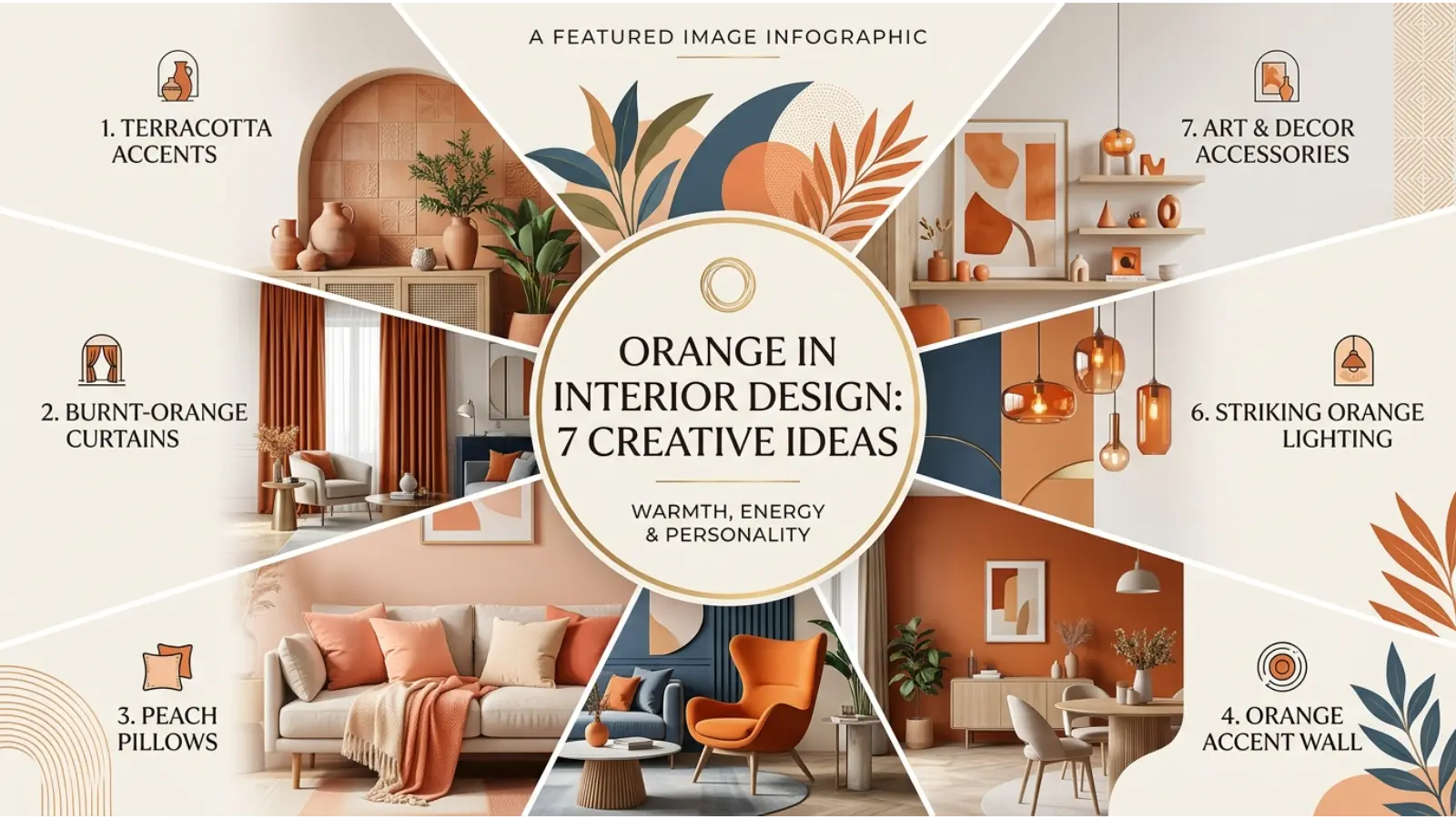
Orange in Interior Design
Orange can make a room feel warmer and more energetic.
However, using a large amount of highly saturated orange can make a space feel intense. For that reason, designers often use orange as an accent rather than covering every surface with it.
Living Room
Try orange cushions, artwork, rugs, or decorative objects against neutral walls.
Bedroom
Soft terracotta, peach, or muted orange can create warmth without making the room feel overly energetic.
Office
A small amount of orange can add visual energy to an otherwise neutral workspace.
Kitchen
Orange accents can create a warm and lively appearance, particularly when combined with wood, cream, white, or gray.
Lighting
Warm lighting can make orange surfaces appear deeper and richer. Cool lighting can change how orange looks and may reduce its warmth.
This demonstrates an important design principle: a color never exists alone. Lighting changes how we perceive it.
Mood Ring Color Orange Meanings in Fashion
Orange can make an outfit feel energetic, confident, and expressive.
Bright orange tends to attract attention, while muted shades such as rust, terracotta, burnt orange, and peach are easier to use in everyday outfits.
Formal Wear
Deep burnt orange and rust can work well in autumn or seasonal formal clothing.
Casual Wear
Bright orange can create a sporty, youthful appearance.
Accessories
Orange bags, shoes, scarves, watches, and jewelry can add color without dominating an entire outfit.
Professional Clothing
For conservative workplaces, muted orange or small orange accents are generally easier to integrate than highly saturated orange garments.
Best Colors to Pair With Orange
Orange works with many colors because it can be either bold or earthy depending on the shade.
| Combination | Overall Effect |
|---|---|
| 🟠 Orange + White | Clean and energetic |
| 🟠 Orange + Black | Bold and dramatic |
| 🟠 Orange + Navy | Balanced and professional |
| 🟠 Orange + Gray | Modern and controlled |
| 🟠 Orange + Beige | Warm and natural |
| 🟠 Orange + Brown | Earthy and comfortable |
| 🟠 Orange + Green | Natural and lively |
| 🟠 Orange + Purple | Creative and dramatic |
| 🟠 Orange + Blue | Strong complementary contrast |
| 🟠 Orange + Cream | Soft and welcoming |
For a calmer look, use muted orange with neutral colors. For a stronger visual statement, pair saturated orange with dark blue, black, or deep purple.
Orange in Art and Photography
Artists often use orange to create visual warmth.
An orange sunset can make a landscape appear peaceful and romantic. A bright orange object against a blue background can become an immediate focal point because orange and blue provide strong contrast.
Photographers also encounter orange through natural and artificial lighting.
Golden-hour sunlight can create warm orange and yellow tones across skin, buildings, landscapes, and objects.
This is another reason a mood ring may appear different under different lighting conditions: the ring’s actual color and the way your eyes perceive that color are not always identical.
Real-World Uses of Orange
Orange appears in many practical environments because it is highly noticeable.
You may see it in:
- Safety equipment
- Traffic-related objects
- Sports uniforms
- Construction clothing
- Outdoor gear
- Warning labels
- Advertising
- Packaging
- Children’s products
- Digital interfaces
- Entertainment design
Its visibility makes orange useful when an object needs to stand out.
Common Misconceptions About Orange Mood Rings
Myth 1: Orange Always Means Excitement
Not necessarily.
Orange is commonly associated with excitement, but different mood-ring charts use different interpretations.
Myth 2: Mood Rings Read Your Emotions
They do not directly measure emotions.
Traditional mood rings respond to temperature changes.
Myth 3: Orange Means You Are Attracted to Someone
Some symbolic charts associate orange with attraction, but the ring cannot detect romantic interest.
Myth 4: Every Orange Shade Has the Same Meaning
Shade matters.
Bright orange, reddish-orange, peach, burnt orange, and brownish orange can create very different visual impressions.
Myth 5: A Mood Ring Can Diagnose Stress
It cannot.
A color-changing ring is not a medical or psychological diagnostic device.
Why Lighting Changes Orange Mood Ring Colors
The color you see is affected by more than the material itself.
Lighting conditions can influence visual perception.
For example, under warm indoor lighting, orange may appear richer and more reddish. Under cool white lighting, it may appear lighter or slightly different.
Sunlight can also make a color appear more vivid.
Therefore, if your ring looks orange in one room and brownish-orange in another, the difference may partly come from illumination rather than a major change in the ring itself.
Orange vs. Red on a Mood Ring
Orange and red are closely related but usually create different symbolic impressions.
Red is commonly associated with passion, intensity, urgency, strength, and strong emotion.
Orange is generally softer and more playful, often suggesting enthusiasm, warmth, creativity, and social energy.
A reddish-orange shade sits between the two, so it may be interpreted as a mixture of passion and excitement.
Orange vs. Yellow on a Mood Ring
Yellow is commonly associated with brightness, optimism, curiosity, and mental stimulation.
Orange adds more warmth and physical energy.
Therefore:
Yellow → brightness and optimism
Orange → warmth and energetic enthusiasm
Yellow-orange → cheerful, playful energy
These are symbolic color associations rather than fixed emotional measurements.
Orange vs. Green on a Mood Ring
Green is often interpreted as balance, calmness, comfort, or normal emotional states in traditional mood-ring charts.
Orange tends to appear more activated and energetic.
This creates an interesting contrast:
Green = balance or calm
Orange = stimulation or excitement
Again, the actual ring is responding to temperature, so these descriptions should remain symbolic.
How Age and Culture Can Change Orange’s Meaning
Color perception develops through personal experience.
A child may associate orange with toys, cartoons, fruit, or school supplies. An adult may associate it with autumn, sports, branding, clothing, or a particular cultural tradition.
Culture also matters.
The same orange object can communicate celebration in one setting and religious or ceremonial meaning in another.
Consequently, there is no single emotional dictionary that applies to every person.
How to Read Your Orange Mood Ring More Thoughtfully
Instead of treating the ring as a direct emotional detector, use it as a conversation starter or self-reflection tool.
When it turns orange, ask yourself:
- Am I physically warm?
- Have I recently exercised?
- Is the environment warmer than before?
- Am I excited about something?
- Am I nervous or under pressure?
- Have my hands changed temperature?
- Could the lighting be affecting the appearance?
- What was happening immediately before the color changed?
This approach separates the physical explanation from the symbolic interpretation.
Frequently Asked Questions
What does orange mean on a mood ring?
Orange is commonly interpreted as excitement, enthusiasm, energy, warmth, attraction, confidence, or emotional stimulation. Some charts also associate it with nervousness or tension.
Is orange a good color on a mood ring?
Orange is not inherently good or bad. It is often given positive meanings such as energy, enthusiasm, confidence, and warmth, but interpretations vary by chart.
Does an orange mood ring mean I am excited?
It may symbolically be interpreted that way, but the ring cannot determine excitement. Its color changes in response to temperature.
What does bright orange mean on a mood ring?
Bright orange is often associated with high energy, enthusiasm, excitement, playfulness, and strong interest.
What does dark orange mean on a mood ring?
Dark orange may be interpreted as stronger or more intense emotion, determination, attraction, or tension, depending on the color chart.
What does reddish-orange mean on a mood ring?
Reddish-orange is sometimes associated with passion, attraction, emotional intensity, or strong excitement because it combines symbolic qualities commonly connected with red and orange.
Can a mood ring tell if you are stressed?
No. A mood ring cannot reliably identify stress. It responds primarily to temperature, although stress can sometimes affect physical temperature and circulation.
Why does my mood ring turn orange when I am calm?
Your finger temperature can change even when your emotional state stays the same. Room temperature, activity, circulation, and contact with warm objects can all affect the ring.
Does orange mean love on a mood ring?
Some traditional charts associate orange or reddish-orange with attraction and passion, but there is no scientific basis for using an orange mood ring to determine romantic feelings.
Why does my orange mood ring change color so quickly?
Mood rings use temperature-sensitive materials. Small changes in finger temperature or the surrounding environment can cause the color to shift rapidly.
Final Thoughts on Mood Ring Color Orange Meanings
The most common mood ring color orange meanings center on energy, excitement, enthusiasm, warmth, attraction, confidence, creativity, and emotional stimulation. Depending on the shade and the particular chart, orange may also symbolize nervousness or tension.
The fascinating part is that the symbolism and the science are not the same thing. A mood ring does not actually read your emotions. Its thermochromic material responds to temperature, which can change for many ordinary physical and environmental reasons.
That does not make the ring meaningless. Instead, it makes it more useful as a fun visual symbol and a prompt for self-reflection. If your ring turns orange, notice the color, consider what you are doing, and then check how you actually feel.
Ultimately, orange represents a range of energetic and warm associations rather than one fixed emotion. Its meaning depends on the shade, context, culture, personal experience, and the story you connect with it.
Emma Wilson is a dedicated comparison writer and product researcher at ColorMystiic.com. She specializes in creating unbiased product comparisons, detailed reviews, and helpful buying guides. Her goal is to help readers make smarter purchasing decisions with confidence.