A Mood Ring Necklace Color Meanings is a unique piece of jewelry that changes color in response to temperature. Each color is traditionally linked to a different feeling, such as calmness, excitement, love, or nervousness.
These necklaces have remained popular because they combine fashion with the curiosity of understanding emotions through color. But what does each shade really mean, and why does the pendant change color throughout the day? In this guide, you will discover mood ring necklace color meanings, explore a complete color chart, and learn how temperature affects the colors you see.
Quick Answer: What Do Mood Ring Necklace Colors Mean?
Mood ring necklace colors have traditional interpretations associated with different feelings. Blue often represents calmness, green suggests balance, purple is linked with passion, yellow may symbolize nervousness, and red is associated with intense emotions. Black and brown are sometimes connected with tension or uneasiness.
However, these meanings are not universal. A mood ring necklace responds mainly to temperature changes rather than directly measuring emotions. The exact color and its traditional interpretation depend on the necklace’s thermochromic material and the manufacturer’s color chart.
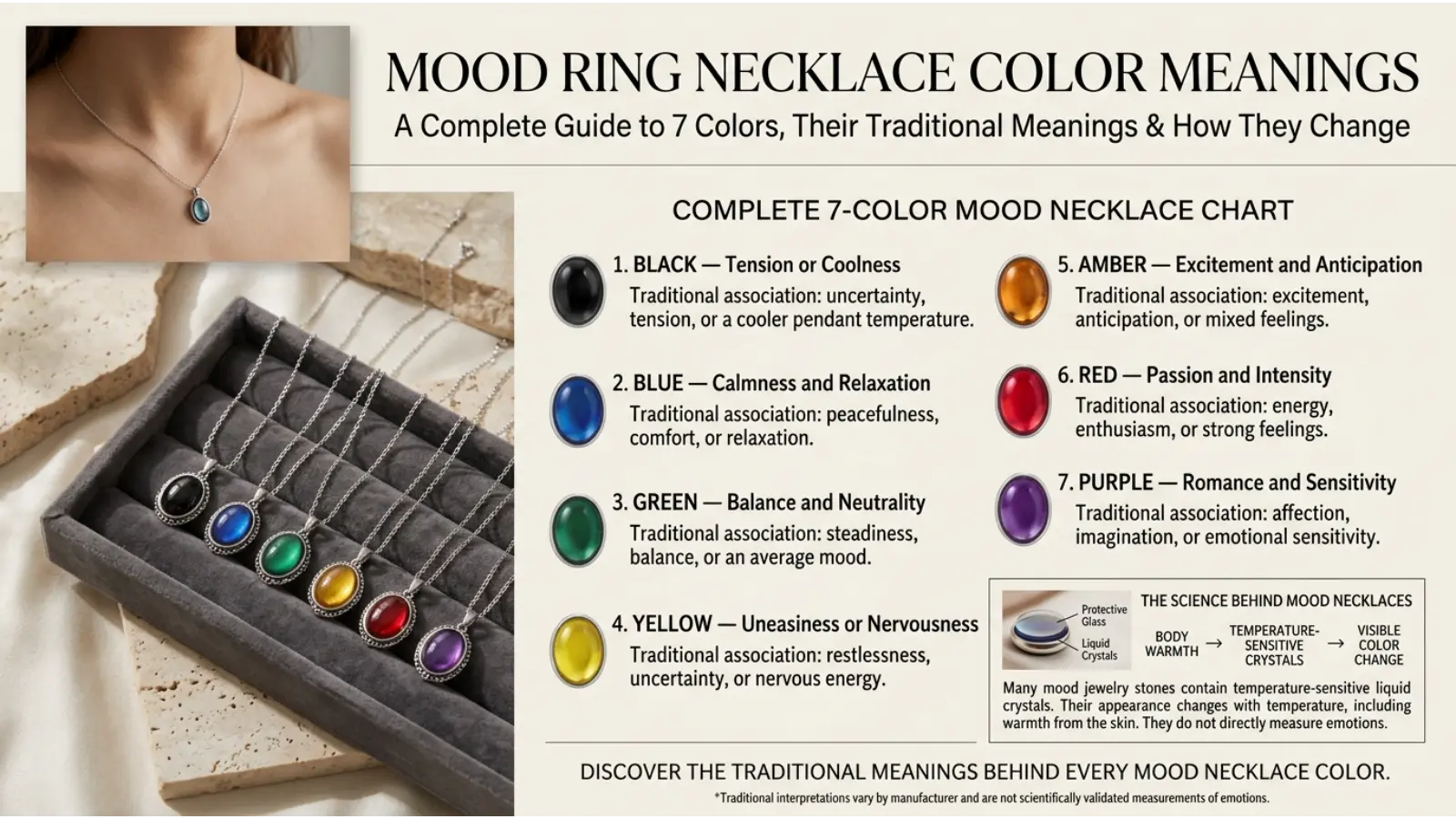
Mood Ring Necklace Color Meanings Chart
The chart below explains common traditional interpretations of mood necklace colors. Use it as a general guide rather than a scientific emotional assessment.
| Color | Traditional meaning | Common association |
|---|---|---|
| 🔵 Blue | Calm and relaxed | Peace, comfort, happiness |
| 🩵 Light blue | Peaceful and content | Friendliness, ease |
| 🟢 Green | Balanced or average mood | Stability, normal feelings |
| 🟣 Purple | Passionate or romantic | Affection, creativity |
| 🟡 Yellow | Nervous or uncertain | Alertness, mixed feelings |
| 🟠 Orange | Excited or restless | Energy, enthusiasm |
| 🔴 Red | Strong emotions | Passion, intensity |
| ⚫ Black | Tension or a cool pendant | Stress in some traditional charts |
| 🟤 Brown | Uneasy or nervous | Worry, restlessness |
| 🩶 Gray | Uncertainty or discomfort | Mixed feelings |
Remember: Not every necklace uses the same color scale. Check the chart provided with your jewelry if you want to understand its specific color meanings.
What Does Each Mood Ring Necklace Color Mean?
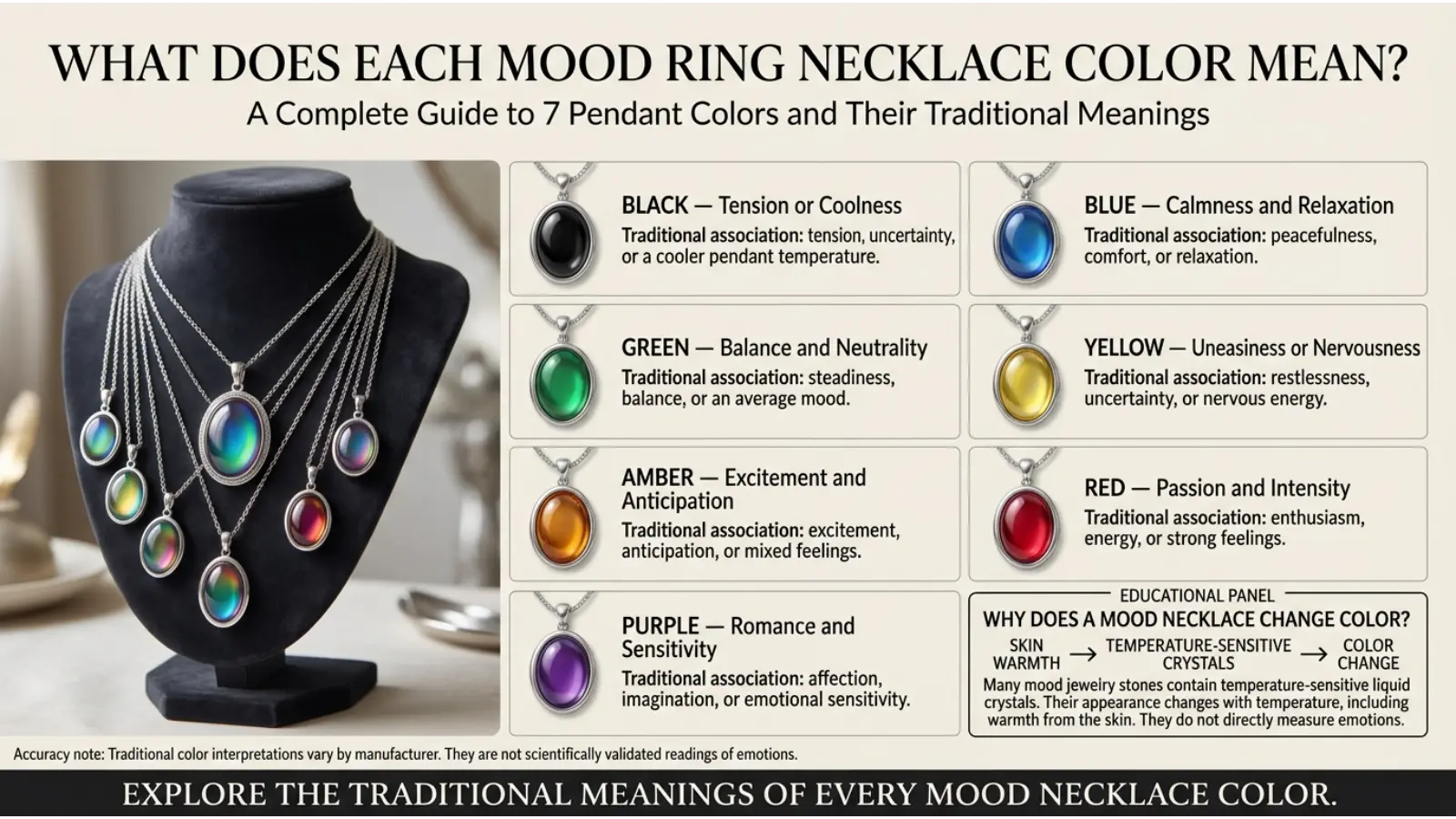
🔵 Blue: Calmness and Relaxation
Blue is one of the most recognizable colors associated with mood jewelry. Traditional mood ring charts often connect it with calmness, relaxation, and emotional comfort.
However, seeing blue does not prove that you are happy or relaxed. The color may simply indicate that the pendant has reached a particular temperature.
🩵 Light Blue: Peace and Contentment
Light blue is often associated with friendliness, comfort, and a peaceful state of mind. Some traditional charts describe it as a color of contentment or ease.
Its softer appearance also connects with ideas of openness, gentleness, and emotional balance. People may interpret light blue as a positive color because it resembles a clear sky or calm water.
The meaning depends on the necklace’s material and the color chart used by its manufacturer.
🟢 Green: Balance and an Ordinary Mood
Green commonly represents balance or an average emotional state in traditional mood jewelry charts. It is sometimes described as the neutral color of a mood necklace.
Green also has broader symbolic associations with nature, renewal, growth, and harmony. These associations can make it feel reassuring and balanced.
If your necklace turns green, it does not necessarily mean that your emotions are perfectly balanced. The pendant’s temperature is the more direct explanation for the color change.
🟣 Purple: Passion and Romance
Purple is often linked with passion, romance, creativity, and affection in traditional mood ring interpretations. Its rich appearance can also symbolize mystery, imagination, and individuality.
Some people enjoy wearing purple mood necklaces because the color feels expressive and distinctive. In personal style, purple can make a pendant stand out while adding a playful or romantic touch.
🟡 Yellow: Nervousness and Uncertainty
Yellow is sometimes associated with nervousness, uncertainty, or alertness in traditional mood jewelry charts. It may also be described as a color connected with curiosity and mental activity.
Because yellow is bright and noticeable, it can symbolize energy, attention, and excitement in general color symbolism.
If your pendant becomes yellow, you should not assume that you are anxious. Temperature, surrounding conditions, and the necklace’s color-changing material can all influence its appearance.
🟠 Orange: Excitement and Energy
Orange is traditionally associated with excitement, enthusiasm, restlessness, and energy. It combines the visual warmth of red with the brightness of yellow, making it a lively color in many symbolic systems.
In fashion, an orange mood necklace can create a cheerful, energetic look. Some traditional mood charts interpret orange as a sign of excitement or unsettled feelings.
These descriptions are symbolic interpretations, not reliable measurements of your emotional state.
🔴 Red: Passion and Strong Feelings
Red is commonly associated with passion, intensity, confidence, and strong emotions. In traditional mood ring charts, it may represent excitement or an emotionally charged state.
Red also carries different meanings in everyday life. It can suggest love and romance, but it may also represent energy, urgency, or anger depending on the situation.
A red mood necklace does not reveal which emotion you are experiencing. Its color depends on the temperature response of the material.
⚫ Black: Tension or a Cool Pendant
Black is sometimes interpreted as a sign of tension, stress, or discomfort in traditional mood jewelry charts. Some people associate it with a negative mood because of these conventional explanations.
However, black can also appear when the pendant is relatively cool or when the material is not displaying its usual range of colors. The exact explanation depends on the product.
If your necklace stays black, check whether the pendant is cold, whether the color-changing material is functioning, and whether the manufacturer identifies black as part of its normal color range.
🟤 Brown: Uneasiness and Restlessness
Brown is sometimes linked with nervousness, worry, or uneasiness in traditional mood ring interpretations. It may appear as a darker, earthy shade between other colors.
In broader color symbolism, brown can represent earthiness, reliability, warmth, and simplicity. Its meaning changes with context, so it does not always carry a negative association.
If your necklace turns brown, remember that the shade may reflect the pendant’s temperature rather than your feelings.
🩶 Gray: Uncertainty and Discomfort
Gray is often associated with uncertainty, mixed feelings, or discomfort in some traditional mood charts. It is a neutral shade that can appear between darker and lighter colors.
In design and fashion, gray also symbolizes simplicity, subtlety, and balance. Its appearance may vary depending on lighting and the material used in the pendant.
As with other mood necklace colors, gray cannot reliably identify a particular emotion.
Warm Colors vs. Cool Colors in Mood Necklaces
Mood necklace colors are often grouped into warm and cool shades. This grouping can help you understand their appearance, although it does not establish a universal emotional meaning.
| Color group | Examples | Common symbolic associations |
|---|---|---|
| 🔥 Warm colors | Red, orange, yellow | Energy, excitement, intensity |
| ❄️ Cool colors | Blue, light blue, purple | Calmness, comfort, reflection |
| 🌿 Natural colors | Green, brown | Balance, stability, earthiness |
| 🌑 Neutral colors | Black, gray | Neutrality, uncertainty, or a cooler pendant |
These are general color-symbolism associations. The temperature at which a particular necklace displays each shade depends on its thermochromic material.
Why Does a Mood Ring Necklace Change Color?
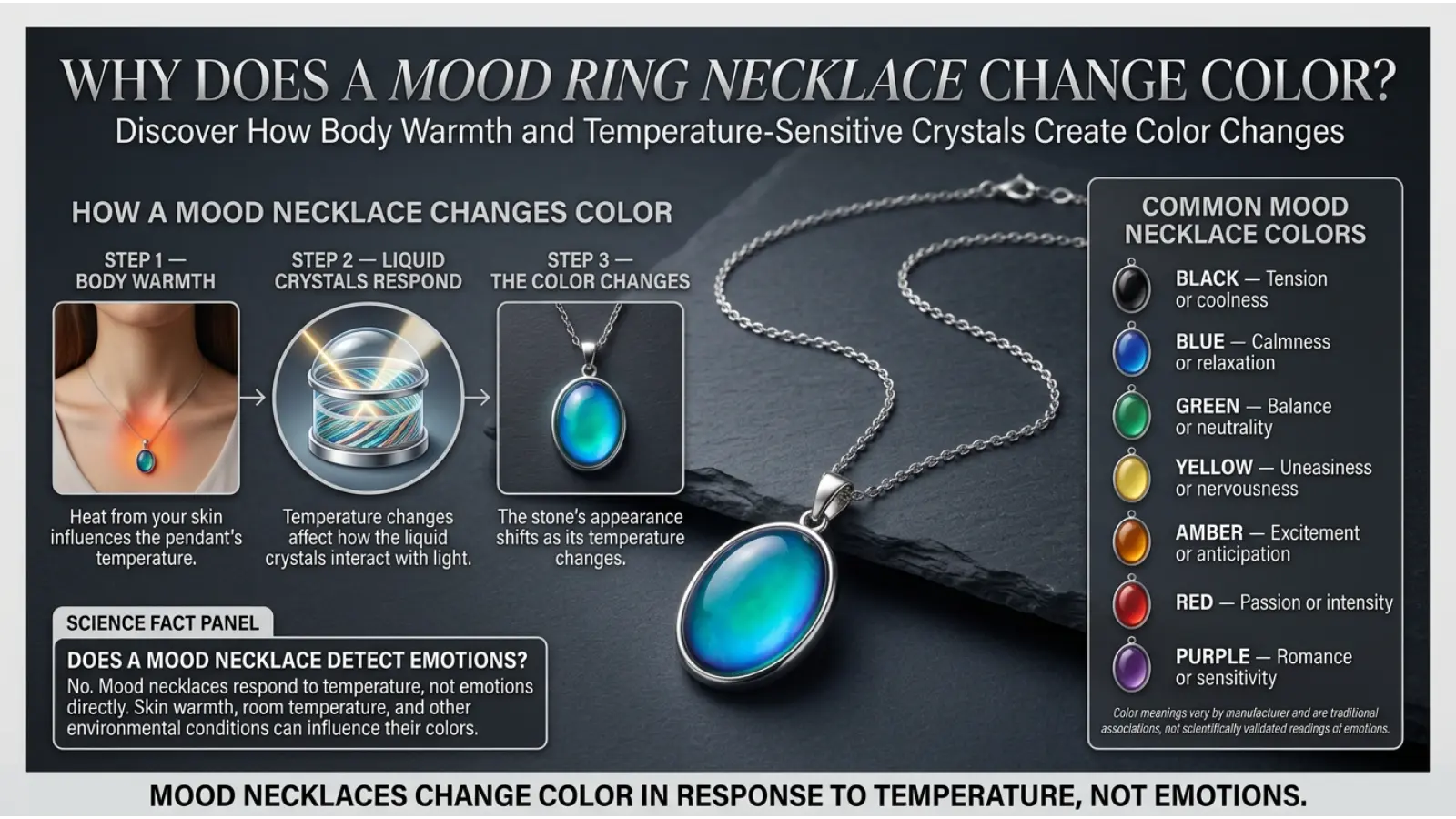
Most traditional mood necklaces use a temperature-sensitive material, often thermochromic liquid crystals. These materials change their appearance as their temperature changes.
Here are some factors that can affect the pendant’s color:
- Skin temperature: Contact with your skin can warm the pendant.
- Room temperature: A cold or warm environment can influence the material.
- Weather: Outdoor conditions may change how quickly the pendant warms or cools.
- Physical activity: Exercise can affect skin temperature and circulation.
- Pendant design: Different materials and products may display different colors at different temperatures.
The necklace does not directly detect thoughts, feelings, or emotions. Instead, people interpret its colors using traditional mood charts.
What If Your Mood Ring Necklace Changes Color Quickly?
A mood necklace may shift between colors when its temperature changes. For example, moving from a cold outdoor environment into a warm room may affect the pendant’s appearance.
Rapid changes do not necessarily indicate sudden emotional changes. They can occur because the pendant is adjusting to its surroundings.
If the necklace changes color frequently, consider the following:
- Check whether you have moved between warm and cool environments.
- Observe whether the pendant changes after touching your skin.
- Compare the displayed shade with the manufacturer’s color chart.
- Allow the necklace to reach a stable temperature before interpreting its color.
- Check the product instructions if the pendant behaves unexpectedly.
Why Does My Mood Ring Necklace Stay One Color?
A mood necklace may stay one color for several reasons. Its temperature may remain relatively stable, the room may be consistently warm or cool, or the pendant may have a limited color range.
Other possibilities include an aging or damaged color-changing material, a product that is decorative rather than temperature-sensitive, or lighting that makes subtle changes difficult to notice.
Try comparing the necklace under consistent lighting and checking the manufacturer’s instructions. Avoid heating the pendant with a flame or exposing it to extreme temperatures, as this could damage the jewelry.
Mood Ring Necklace vs. Mood Ring: Is There a Difference?
Mood ring necklaces and mood rings use a similar idea: a temperature-sensitive material displays different colors.
| Feature | Mood ring necklace | Mood ring |
|---|---|---|
| Where it is worn | Around the neck | On a finger |
| Temperature influence | Skin contact, pendant, and surroundings | Finger temperature and surroundings |
| Style | Pendant or decorative charm | Ring or band |
| Color interpretation | Traditional mood chart | Traditional mood chart |
| Measures emotions directly? | No | No |
Neither type of jewelry can reliably identify a person’s emotional state. Both respond to physical conditions, especially temperature.
Are Mood Ring Necklace Color Meanings Scientifically Accurate?
Mood necklace color meanings are best understood as traditions, symbolism, and entertainment. The color-changing effect can be real, but the emotional meanings attached to each shade are not scientifically established measurements.
Although emotional experiences may sometimes coincide with physical changes, a necklace cannot distinguish one emotion from another.
For example, a blue pendant does not prove happiness, and a black pendant does not prove stress. Use the color chart as a fun way to explore color symbolism rather than as a test of your feelings.
How to Choose a Mood Ring Necklace
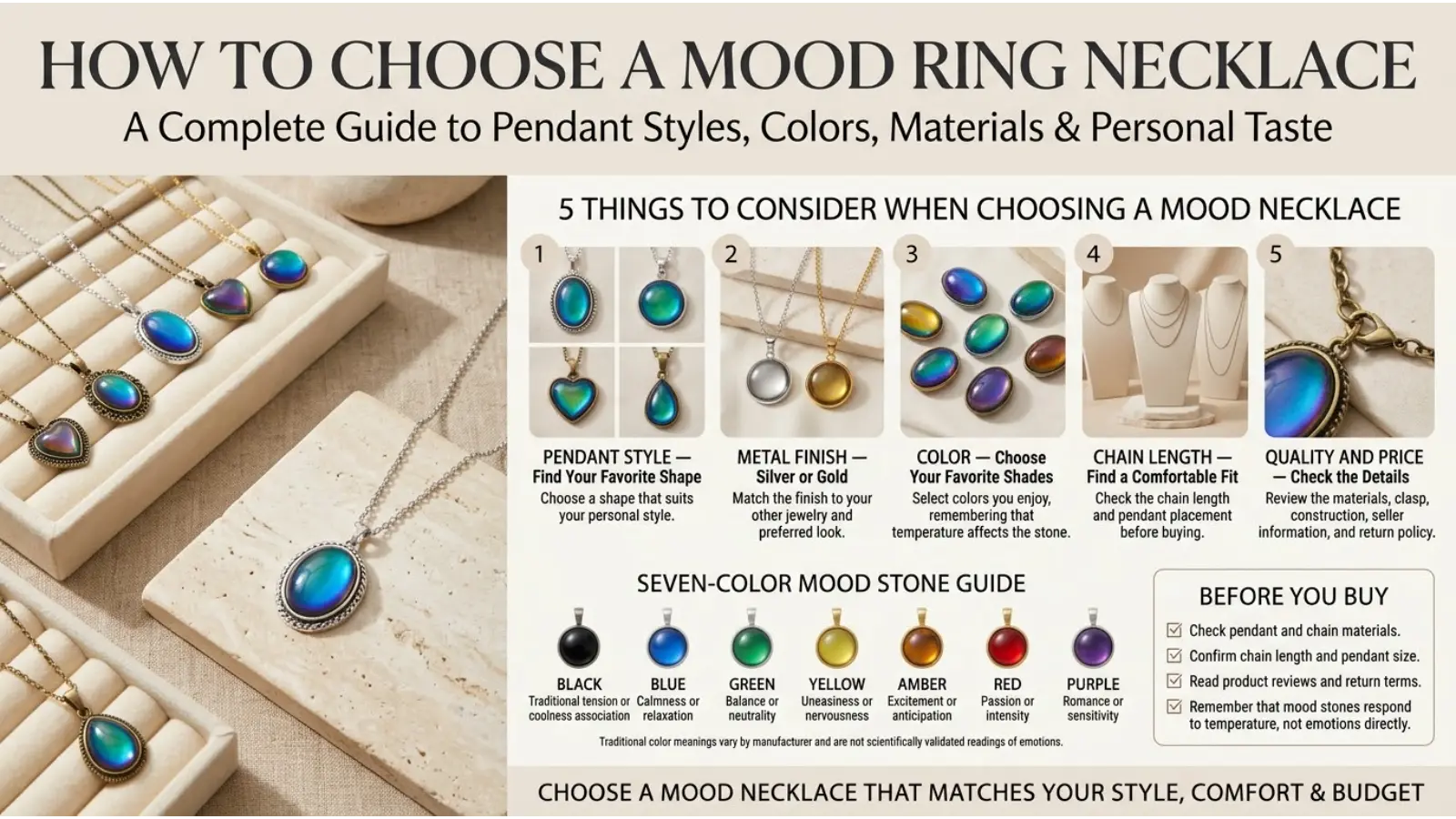
If you want to buy a mood necklace, consider more than its traditional color meanings.
- Material: Look for product information explaining what the pendant is made from.
- Color chart: Choose a necklace that comes with a clear guide to its color range.
- Design: Consider whether you prefer a heart pendant, a simple circle, a vintage design, or a colorful charm.
- Comfort: Check the chain length and whether the necklace feels comfortable against your skin.
- Care instructions: Follow the manufacturer’s advice to protect the color-changing material.
- Expectations: Treat the necklace as decorative jewelry, not an emotional or medical device.
A well-chosen mood necklace can be a personal accessory, a nostalgic gift, or a conversation starter.
Frequently Asked Questions
1. What does blue mean on a mood ring necklace?
Blue is traditionally associated with calmness, relaxation, and comfort. However, the color mainly reflects the temperature response of the necklace’s material, not a confirmed emotional state.
2. What does green mean on a mood necklace?
Green commonly represents balance or an average mood in traditional mood jewelry charts. The exact interpretation varies by product, and the color does not prove that someone feels emotionally balanced.
3. What does purple mean on a mood ring necklace?
Purple is often associated with passion, romance, affection, and creativity. These are symbolic meanings rather than scientifically verified emotional readings.
4. What does black mean on a mood necklace?
Black is sometimes linked with tension or stress in traditional charts. It may also appear because the pendant is cool or because of the specific material used in the jewelry.
5. What does red mean on a mood ring necklace?
Red is commonly connected with passion, intensity, excitement, or strong feelings. The necklace cannot determine which emotion, if any, you are experiencing.
6. Why does my mood necklace keep changing colors?
The pendant may be responding to changes in skin temperature, room temperature, weather, or physical activity. Color changes do not necessarily mean your mood is changing.
7. Can a mood necklace tell if someone is in love?
No. Purple and red are sometimes associated with romance or passion, but a mood necklace cannot determine whether someone is in love.
8. Do all mood necklaces have the same color meanings?
No. Manufacturers may use different materials, temperature ranges, and color charts. Always check the guide supplied with your particular necklace.
9. Why is my mood necklace always black?
The pendant may be too cool, the material may not be changing as expected, or the product may have a limited color range. Check its instructions and avoid using extreme heat to test it.
10. Can I trust mood necklace colors to understand my emotions?
No. Mood necklace colors are not a reliable way to measure emotions. They are best enjoyed as jewelry with interesting color symbolism.
Conclusion
Mood ring necklace color meanings make this jewelry fun because each shade has a traditional interpretation. Blue is commonly linked with calmness, green with balance, purple with passion, yellow with uncertainty, and red with intensity. Black, brown, and gray can have different meanings depending on the chart.
Still, a mood necklace responds primarily to temperature rather than directly measuring feelings. Because every product may use a different color range, its own chart is the best reference. Enjoy the colors as a form of personal expression and symbolism, not as a definitive explanation of your emotions.
Emma Wilson is a dedicated comparison writer and product researcher at ColorMystiic.com. She specializes in creating unbiased product comparisons, detailed reviews, and helpful buying guides. Her goal is to help readers make smarter purchasing decisions with confidence.