A bindi is a small decorative mark traditionally worn on the forehead, especially in South Asian cultures. While the red bindi is the best-known style, bindis today appear in many colors, shapes, materials, and designs. Because of this, bindi color meanings can range from cultural and religious symbolism to fashion, personal expression, and modern beauty trends.
The meaning of a bindi is not universal. Its interpretation can change according to region, community, age, occasion, family tradition, and personal choice. A red bindi may carry traditional associations in one setting, while a black, white, blue, or jeweled bindi may simply be a fashion choice in another.
This guide explores bindi colors in detail, including their cultural symbolism, spiritual associations, emotional impressions, historical background, fashion uses, and modern interpretations.
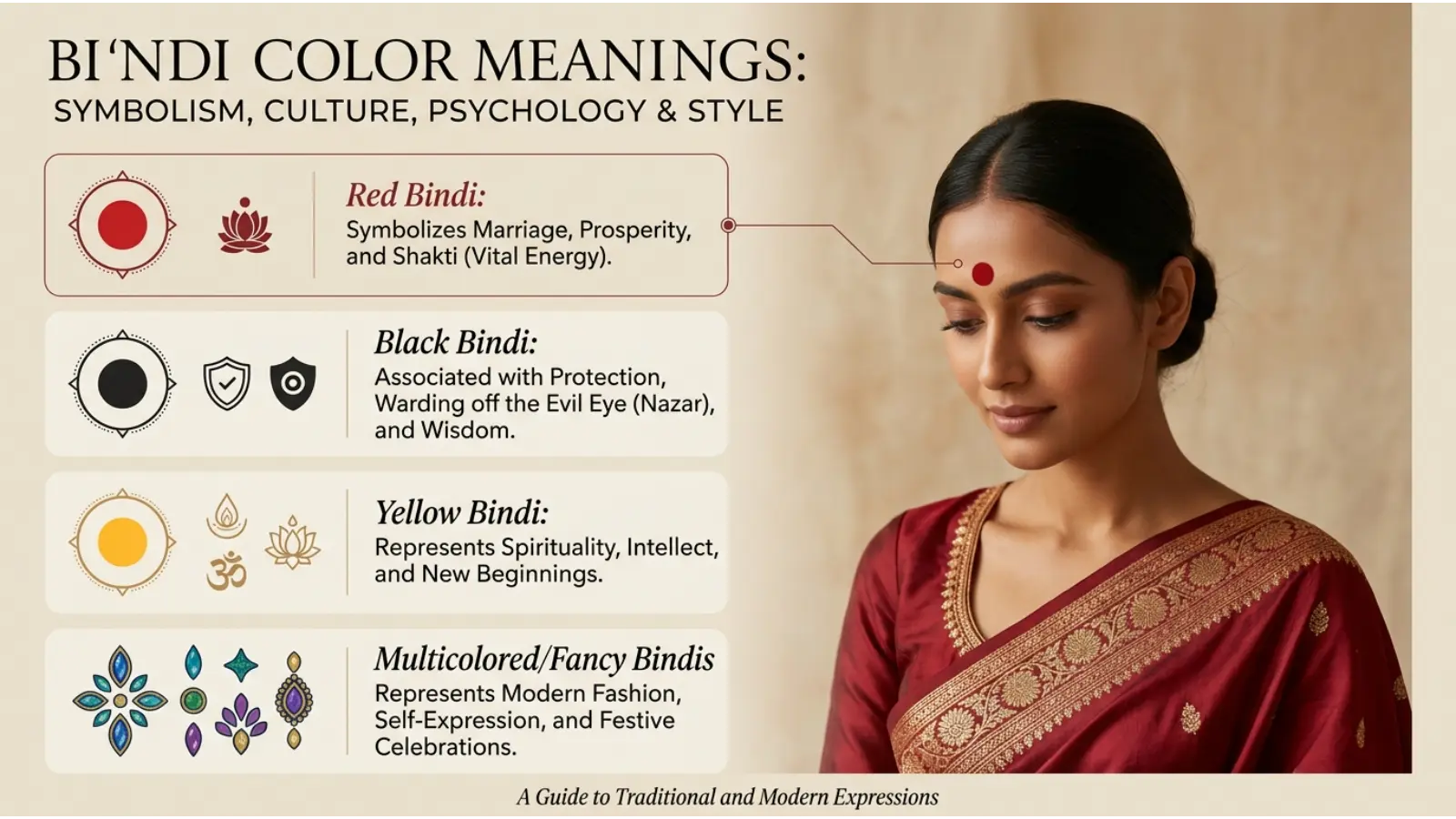
Quick Answer: Bindi color meanings vary by culture and context. Red is traditionally associated with auspiciousness, marriage, strength, and feminine energy in many South Asian traditions. Black can suggest protection or simply modern style, while white may represent peace or spirituality. Yellow, orange, green, blue, pink, and other colors often have regional, religious, festive, or fashion-related meanings. There is no single universal color code for bindis.
Bindi Color Meanings Chart
The following chart gives a practical overview. These meanings are common associations, not universal rules.
| Bindi Color | Common Symbolism | Modern Meaning | Common Uses |
|---|---|---|---|
| Red | Auspiciousness, energy, love, strength | Tradition, confidence, elegance | Weddings, festivals, everyday traditional wear |
| Black | Protection, strength, contrast | Boldness, modern style | Fashion, contemporary outfits |
| White | Peace, purity, simplicity | Minimalism, calmness | Spiritual or understated looks |
| Yellow | Knowledge, prosperity, positivity | Cheerfulness, warmth | Festivals and traditional dress |
| Orange/Saffron | Spirituality, devotion, energy | Confidence and vibrancy | Religious and festive settings |
| Green | Growth, fertility, renewal | Freshness, harmony | Festivals, regional traditions, fashion |
| Blue | Depth, calmness, wisdom | Creativity, individuality | Modern fashion and artistic styling |
| Pink | Affection, femininity, celebration | Softness and playfulness | Parties, weddings, casual fashion |
| Maroon | Maturity, richness, tradition | Sophistication | Formal and bridal clothing |
| Gold | Prosperity, celebration, luxury | Glamour and elegance | Weddings and special occasions |
| Silver | Modernity, refinement | Cool, contemporary style | Evening and fashion looks |
| Purple | Creativity, dignity, individuality | Artistic expression | Modern and festive fashion |
These associations should be treated as a guide rather than a fixed dictionary. The same bindi color can communicate something different when combined with clothing, jewelry, makeup, or a particular cultural setting.
What Does a Red Bindi Mean?
The red bindi meaning is one of the most widely discussed aspects of bindi symbolism. Red has strong cultural associations across South Asia, although its exact meaning differs between communities.
Traditionally, red can represent auspiciousness, vitality, love, strength, and feminine energy. In some Hindu traditions, red also has associations with marriage and the status or well-being of a married woman. However, it is inaccurate to assume that every woman wearing a red bindi is married.
A red bindi can also be worn by unmarried women, children, widows in some communities, performers, and people who simply enjoy the traditional appearance.
Red is visually powerful. Because it contrasts strongly with skin, hair, and many clothing colors, it naturally attracts attention to the center of the face. This helps explain why the red bindi remains visually important in traditional dress.
Red Bindi and Marriage
A common misconception is that a red bindi always means that a woman is married.
That interpretation is too simple.
In some communities, a red bindi may be connected with married womanhood, but the bindi itself does not provide a reliable universal indication of marital status. Sindoor, wedding jewelry, clothing, regional customs, and other signs can also carry marital associations.
Therefore, a person’s marital status should not be determined solely from bindi color.
Black Bindi Meaning
The black bindi can have several interpretations.
In traditional contexts, black has sometimes been associated with protection, the removal or prevention of negative influences, or the use of dark marks for symbolic and practical purposes. However, these beliefs are not shared equally across all South Asian communities.
Today, black bindis are also popular because they create a sharp visual contrast.
A small black bindi can make a simple outfit look classic, while a larger geometric black bindi can create a contemporary fashion statement.
The modern meaning is therefore often less religious and more aesthetic: confidence, simplicity, boldness, and individuality.
White Bindi Meaning
White is commonly associated with ideas such as peace, purity, simplicity, calmness, and spirituality.
However, white does not have one fixed meaning across South Asian traditions. Its interpretation can depend heavily on local customs and religious context.
From a design perspective, white bindis create a softer appearance than red or black. They work particularly well with pastel clothing, white garments, silver jewelry, and minimalist makeup.
A white bindi can therefore communicate quiet elegance without the visual intensity of a darker color.
Yellow Bindi Meaning
Yellow often carries positive associations such as knowledge, learning, prosperity, happiness, and celebration.
In Hindu cultural settings, yellow and turmeric have important ritual associations. Turmeric itself has long-standing cultural significance in South Asian ceremonies, food traditions, and religious practices.
Still, a yellow bindi should not automatically be interpreted as a specific religious symbol. In contemporary fashion, yellow may simply be selected because it complements a bright sari, lehenga, salwar kameez, or festive outfit.
Its visual effect is warm and cheerful, making it especially suitable for daytime celebrations.
Orange and Saffron Bindi Meaning
Orange and saffron have strong associations with spirituality, devotion, renunciation, sacred traditions, and religious symbolism in parts of South Asia.
Saffron is especially significant in several Indian religious and cultural contexts. However, the meaning depends on how and where the color is used.
An orange bindi can also represent energy and enthusiasm from a purely visual perspective.
Because orange is highly visible, it works particularly well with traditional clothing in warm colors such as red, yellow, gold, and maroon.
Green Bindi Meaning
Green is commonly connected with growth, renewal, fertility, nature, freshness, and prosperity in many cultural settings.
Its meaning is not limited to one religious tradition. Green appears widely in clothing, decoration, jewelry, and festivals throughout South Asia.
A green bindi can create a fresh appearance when paired with a green sari or contrasting colors such as pink, red, cream, or gold.
In modern styling, green can also communicate creativity and a connection with nature.
Blue Bindi Meaning
Blue bindis are less traditional in some settings than red bindis, but they have become increasingly visible in contemporary fashion.
The Blue commonly creates associations with calmness, depth, stability, creativity, and individuality. These are broad color associations rather than universal religious meanings.
A blue bindi can be especially effective with silver jewelry, blue clothing, white outfits, denim-inspired fashion, or contemporary ethnic wear.
Because blue is visually less expected than red, choosing it can make the bindi a deliberate fashion statement.
Pink Bindi Meaning
Pink often suggests affection, softness, celebration, romance, and femininity in modern color symbolism.
The Pink bindis are particularly suitable for festive and social occasions because they can create a playful appearance without the intensity of bright red.
A soft pink bindi works beautifully with pastel clothing, while a deep magenta or hot-pink bindi creates a stronger fashion effect.
Its meaning is usually more aesthetic and emotional than traditionally religious.
Maroon Bindi Meaning
Maroon is closely related visually to red, but its darker tone creates a more mature and sophisticated impression.
It can suggest tradition, depth, richness, elegance, and seriousness.
Maroon bindis are especially effective with bridal clothing, silk fabrics, gold jewelry, and darker traditional garments.
Because maroon is less visually intense than bright red, it can provide a refined alternative for formal occasions.
Gold and Metallic Bindi Meanings
Gold bindis are strongly associated with celebration, luxury, beauty, prosperity, and ceremonial dressing.
The Gold is particularly effective when used with traditional jewelry because it creates visual repetition. For example, a gold bindi paired with gold earrings and a gold necklace can make the entire outfit feel coordinated.
Silver bindis create a cooler, more modern effect. They often work well with white, blue, lavender, gray, and jewel-toned clothing.
Metallic bindis are usually better understood as decorative and fashion-oriented rather than having one fixed spiritual meaning.
The Spiritual Meaning of a Bindi
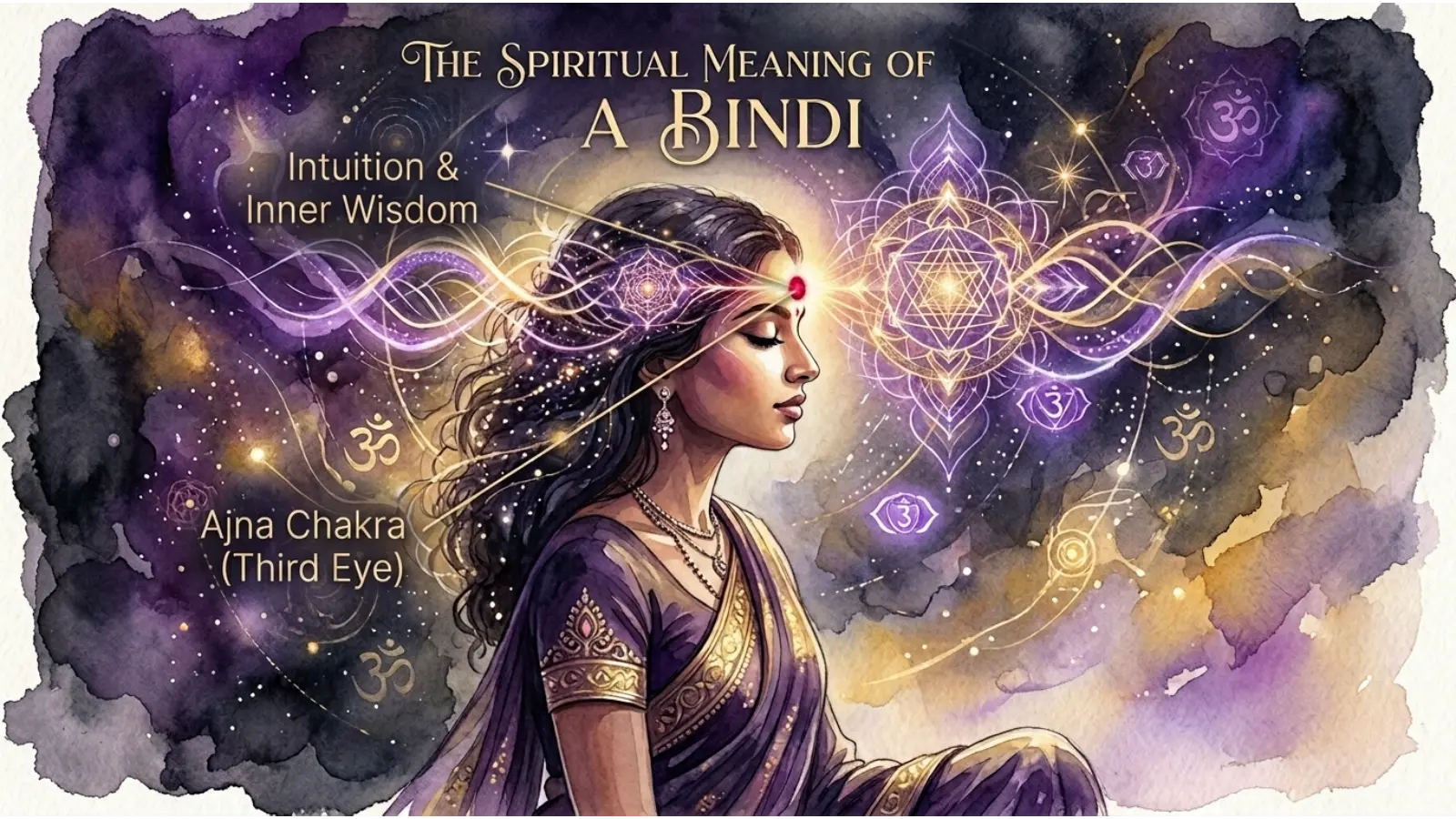
The bindi has a deeper spiritual dimension in some Hindu traditions.
The forehead area between the eyebrows is associated in yogic and spiritual traditions with the ajna chakra, often called the third-eye center. It is commonly connected with awareness, intuition, concentration, and inner perception.
However, the traditional bindi and the modern concept of a “third eye” should not be treated as exactly the same thing.
Not every bindi is worn as a spiritual symbol. Many people wear bindis for cultural, traditional, cosmetic, or fashion reasons.
This distinction matters because South Asian culture is diverse. A symbol can have religious significance in one context and primarily aesthetic significance in another.
Bindi Color Psychology
Color psychology can help explain why different bindi colors create different visual impressions, but it should not be confused with scientific proof that a color changes someone’s personality or behavior.
Red, for example, is visually stimulating and highly noticeable. Blue generally produces a cooler and calmer visual impression. Green is often perceived as natural and refreshing, while pink can appear softer and more playful.
These reactions are influenced by context, personal experience, culture, and surrounding colors.
Why Red Looks More Powerful
Red has high visual salience. In other words, the eye can notice it quickly, particularly when it contrasts with surrounding colors.
That makes a red bindi especially effective at drawing attention toward the forehead and face.
Why Blue Feels Different
Blue generally has a cooler visual quality. Consequently, a blue bindi may appear calmer, more unusual, or more contemporary than a traditional red bindi.
Yet the surrounding outfit matters. A blue bindi on a deep-blue sari creates a very different impression from the same bindi worn with a bright yellow outfit.
Bindi Color Meanings and Cultural Differences
There is no worldwide bindi color chart that applies equally to every South Asian community.
India alone contains enormous regional, linguistic, religious, and cultural diversity. Bindi traditions can differ between states, communities, families, generations, and occasions.
Nepal and other parts of South Asia also have their own traditions involving forehead marks and decorative adornment.
Western audiences sometimes interpret bindis through simplified explanations such as “red means married” or “black means protection.” These statements can contain a small element of truth in particular contexts, but they become misleading when presented as universal rules.
Western Interpretations
In Western fashion, bindis are often viewed as decorative accessories connected with Indian or South Asian aesthetics.
This has created both appreciation and controversy. Cultural symbols can be meaningful to the communities from which they originate, so wearing a bindi outside its cultural setting requires awareness and respect.
South Asian Interpretations
Within South Asia, the bindi can simultaneously be traditional, religious, personal, cosmetic, and fashionable.
A woman may wear one because her family traditionally does so. Another may wear it because it completes her sari. Someone else may choose a jeweled bindi for a wedding.
The object is the same, but the personal meaning can be completely different.
Historical Bindi Color Meanings
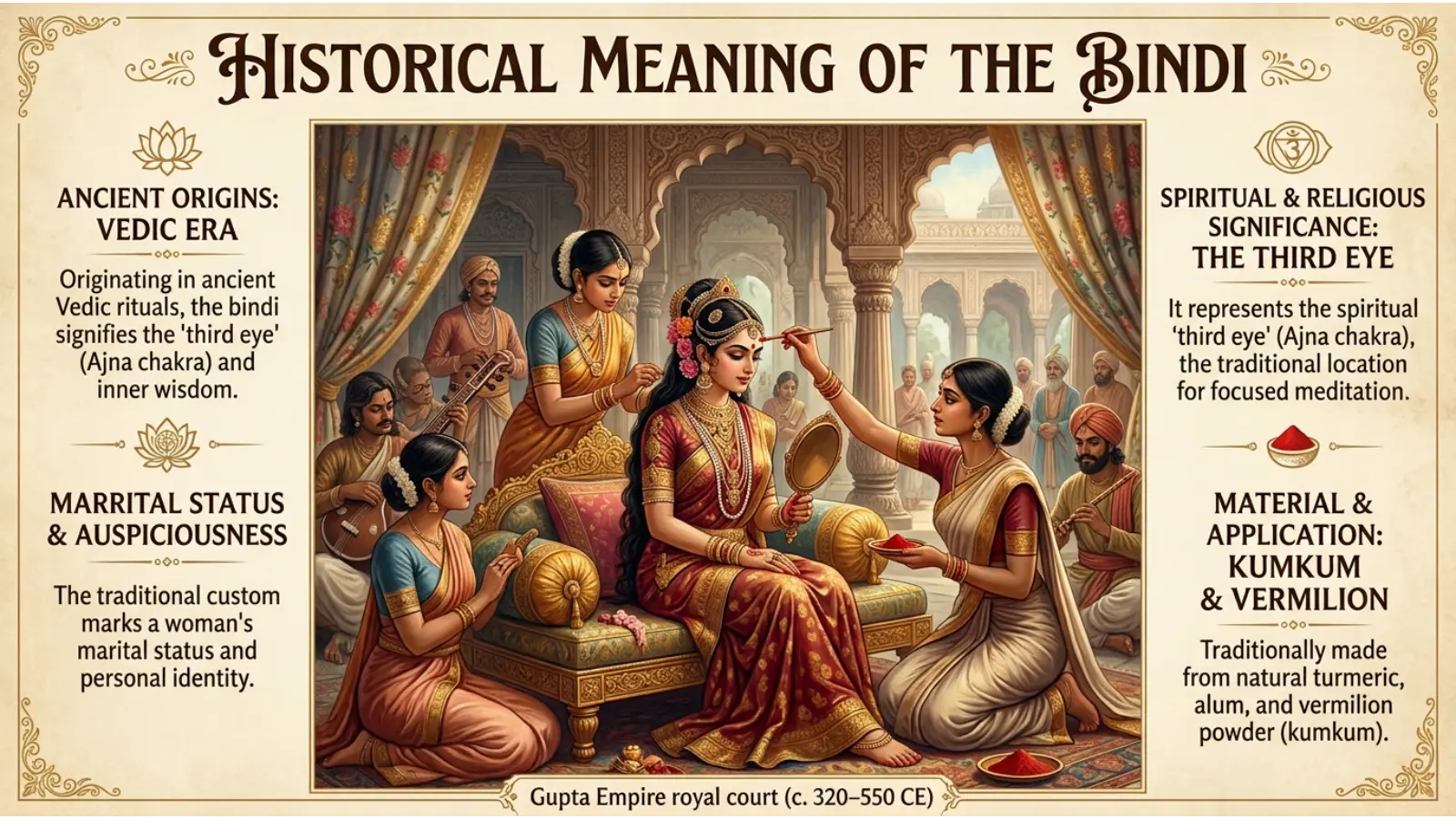
The history of forehead markings in South Asia is long and complex. Different forms of marks, including tilak and related forehead symbols, have appeared in religious, social, and cultural traditions.
The modern decorative bindi developed through changing cultural practices and fashion.
It is also useful to distinguish the bindi from the tilak. Although the two may look similar, they are not always used for the same purpose. Tilak markings can have specific religious or ritual meanings, while bindis are often decorative or cultural.
Over time, bindis have also changed in appearance. Traditional marks made with powders or pastes exist alongside modern adhesive bindis made from colored materials, stones, glitter, metal-like surfaces, and decorative patterns.
Bindi Color Meanings and Personality
People sometimes connect bindi colors with personality.
For example, a person who chooses red might be described as confident or energetic, while someone choosing blue may be perceived as calm or creative.
These are symbolic associations, not personality tests.
Color preference does not reliably determine character. People select colors because of culture, clothing, mood, trends, family traditions, availability, and personal taste.
Still, color choice can communicate something about the style a person wants to present.
A bright red bindi may create a traditional and confident impression, while a tiny silver bindi may communicate a minimalist fashion preference.
Bindi Color Meanings in Fashion
Modern bindi fashion is much broader than traditional red dots.
Designers and wearers now experiment with:
- Tiny minimalist bindis
- Oversized statement bindis
- Glitter bindis
- Jewel-studded designs
- Metallic bindis
- Geometric shapes
- Multicolor patterns
- Matching bindi-and-outfit combinations
The best choice often depends on balance.
If the clothing contains heavy embroidery and large jewelry, a simple bindi may prevent the face from looking visually crowded.
On the other hand, a plain outfit can support a larger or more decorative bindi.
Choosing a Bindi Color for Different Occasions
Weddings
Red, maroon, gold, and jewel-toned bindis can complement traditional bridal clothing.
The exact choice should follow the person’s cultural and family traditions rather than a universal rule.
Festivals
Bright colors such as red, yellow, orange, green, and pink can create a lively festive appearance.
Everyday Wear
Small red, black, maroon, or neutral bindis are often easier to coordinate with everyday traditional clothing.
Modern Fashion
Blue, purple, silver, metallic, geometric, and multicolored bindis can create a more contemporary look.
Bindi Color Combinations
Color pairing can dramatically change the appearance of a bindi.
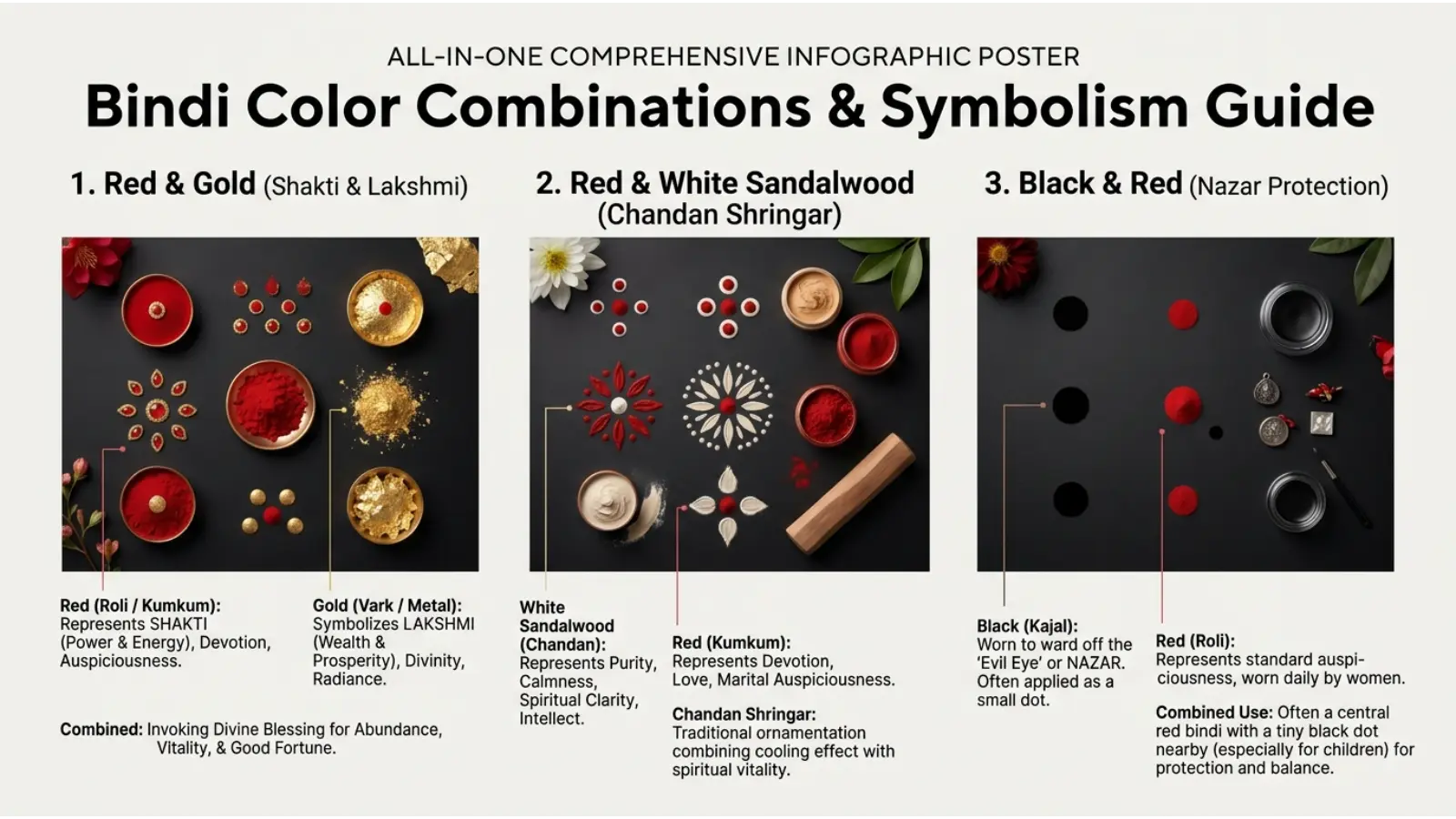
Red and Gold
This is a classic combination because both colors have a warm, rich visual character. It works especially well with traditional clothing and gold jewelry.
Green and Pink
Green provides a natural contrast to pink. Together, they create a lively and youthful appearance.
Blue and Silver
This combination creates a cooler, modern look and works particularly well for evening styling.
White and Gold
White provides visual simplicity, while gold adds warmth and richness. The result can feel elegant without being overly bright.
Maroon and Gold
Maroon’s deep tone gives gold a strong background. This pairing is particularly effective with formal ethnic clothing.
How Lighting Changes Bindi Color
A bindi can look surprisingly different under different lighting.
Natural daylight tends to show color more clearly. Warm indoor lighting can make red, orange, gold, and maroon appear richer, while cool LED lighting can make blue and silver appear stronger.
Photography creates another challenge.
A color that looks subtle in person may appear highly saturated under a camera flash or strong studio lighting.
Therefore, if you are selecting a bindi for photography, test it under the actual lighting where the photographs will be taken.
Bindi Color Meanings in Branding and Marketing
The bindi itself is not a standard corporate color system, but its visual language can influence branding connected with South Asian culture.
A beauty brand inspired by Indian fashion might use red and gold to suggest tradition, celebration, and luxury.
A modern jewelry company could use jewel tones, metallic colors, or minimalist forehead-inspired graphics to create a contemporary South Asian identity.
However, cultural imagery should be used carefully.
Good cultural branding combines visual appeal with genuine understanding.
Bindi Colors in Interior Design and Art
Bindis are not commonly used as an interior design color system, but their color relationships can inspire South Asian-inspired spaces.
Red and gold can create a warm, ceremonial atmosphere.
Green and yellow can produce a lively, natural feeling.
Blue and silver can create a cooler, contemporary mood.
Artists can also use the bindi as a visual focal point. Because the forehead sits near the center of a portrait, a bright bindi naturally attracts the viewer’s eye.
This is one reason bindi color can become an important storytelling element in photography and painting.
Real-Time Example: Choosing a Bindi for a 2026 Wedding
Imagine someone attending a South Asian wedding in August 2026 wearing a deep maroon outfit with gold embroidery and traditional gold jewelry.
A bright red bindi would reinforce the traditional warm palette. A maroon bindi would create a softer, coordinated appearance. A gold bindi would emphasize the jewelry and embroidery, while a blue bindi would introduce a deliberate contrast.
The best choice depends on the desired effect.
If the goal is traditional, red or maroon may work well.
If the goal is luxurious, gold can complement the jewelry.
The goal is modern and distinctive, blue or another contrasting jewel tone can create more visual interest.
This example shows why bindi color cannot be understood separately from clothing, occasion, lighting, and personal style.
Common Misconceptions About Bindi Colors
Myth: Red Bindis Always Mean a Woman Is Married
Not necessarily. Red can have marital associations in some communities, but it is also worn for cultural, religious, festive, and fashion reasons.
Myth: Every Bindi Has a Religious Meaning
No. Many bindis are worn primarily as decoration or cultural dress.
Myth: Each Bindi Color Has One Official Meaning
There is no universal official color dictionary for bindis. Meanings vary by community and context.
Myth: A Bindi and Tilak Are Always the Same
They can look similar, but their purposes and traditions may differ.
Myth: Color Determines Personality
Color preference may communicate style or create an impression, but it does not scientifically define someone’s personality.
Myth: Blue, Pink, or Purple Bindis Are Not Traditional
Color traditions vary by region and time. Modern bindi styles have expanded greatly, and non-red colors can have cultural, decorative, or personal uses.
How Age and Generation Influence Bindi Choices
Generational differences can strongly influence bindi style.
Older generations may prefer traditional shapes and colors associated with family or regional customs. Younger wearers may combine traditional bindis with contemporary clothing, makeup, and jewelry.
Social media and modern fashion have also made decorative bindis easier to experiment with.
As a result, the bindi can act as a bridge between heritage and personal style.
Why Designers Choose Different Bindi Colors
Designers often think about three things: contrast, harmony, and emphasis.
A contrasting bindi stands out from the outfit and face.
A harmonious bindi repeats a color already present in clothing or jewelry.
An emphasis color creates a deliberate focal point.
For example, a green bindi on a pink outfit creates contrast, while a maroon bindi on a maroon sari creates harmony.
Neither approach is automatically better. The desired visual message determines the choice.
Practical Guide to Choosing the Right Bindi Color
When selecting a bindi, consider these five questions:
- What is the occasion? A wedding may call for a different style than everyday wear.
- What are you wearing? Match or contrast the dominant clothing colors.
- What jewelry are you using? Gold, silver, and colored stones can influence the best choice.
- What mood do you want? Bright colors attract attention; softer colors create a quieter appearance.
- What feels culturally appropriate to you? Personal and family traditions should come before fashion rules.
A small bindi can sometimes look more sophisticated than a large one because it allows the face and clothing to remain the main focus.
Frequently Asked Questions About Bindi Color Meanings
What does a red bindi mean?
A red bindi can symbolize auspiciousness, vitality, love, strength, and feminine energy. In some communities, it can also have associations with marriage, but it does not universally indicate that the wearer is married.
What does a black bindi symbolize?
Black bindis may be associated with protection or traditional beliefs in certain settings. Today, they are also widely used as a bold and simple fashion choice.
What does a white bindi mean?
White can symbolize peace, purity, simplicity, or spirituality in some interpretations. However, its exact meaning depends on cultural and personal context.
What does a yellow bindi represent?
Yellow can be associated with knowledge, positivity, prosperity, celebration, and traditional uses of turmeric. It can also simply be a bright fashion color.
What does a green bindi symbolize?
Green is often associated with growth, renewal, fertility, nature, and freshness. Its specific meaning varies between communities.
What does a blue bindi mean?
Blue often creates associations with calmness, depth, creativity, and individuality. Modern wearers may choose blue mainly because it provides a distinctive fashion appearance.
Does bindi color indicate marital status?
Not reliably. Some communities connect particular bindi practices with marital status, but there is no universal rule that allows marital status to be determined from bindi color alone.
Is a bindi religious or cultural?
It can be either, or both, depending on the person and context. Some bindis have spiritual or cultural significance, while others are worn purely for decoration.
What is the difference between a bindi and a tilak?
A bindi is often a decorative or cultural forehead mark, while a tilak can have a more specific religious, ritual, or sectarian purpose. The exact distinction varies across traditions.
Which bindi color is best for a wedding?
There is no single best color. Red, maroon, gold, and other colors can work beautifully, but the choice should consider the wedding tradition, clothing, jewelry, and personal preference.
Conclusion: Understanding Bindi Color Meanings
Bindi color meanings are richer than a simple list of “red means this” and “blue means that.” The bindi exists at the intersection of culture, tradition, spirituality, fashion, identity, art, and personal expression.
Red remains one of the most recognizable bindi colors and carries strong associations with auspiciousness, vitality, and tradition in many South Asian contexts. Yet black, white, yellow, orange, green, blue, pink, maroon, gold, silver, and other colors can all create meaningful visual and cultural expressions.
The most important lesson is context. A bindi’s meaning can change with the person wearing it, the community they belong to, the occasion, the clothing, the design, and the reason it was chosen.
Rather than treating bindi colors as a rigid code, it is more accurate to see them as a flexible visual language. That approach respects traditional meanings while also recognizing how modern people use color to express beauty, heritage, creativity, and individuality.

Emma Wilson is a dedicated comparison writer and product researcher at ColorMystiic.com. She specializes in creating unbiased product comparisons, detailed reviews, and helpful buying guides. Her goal is to help readers make smarter purchasing decisions with confidence.