Colors appear throughout the Bible in clothing, worship, nature, visions, objects, and stories. Some colors clearly carry symbolic meaning, while others are simply used to describe something people saw. That difference matters when studying Bible color meanings.
For example, white is repeatedly connected with purity and righteousness, while purple is strongly associated with royalty and status. Red and scarlet can point to blood, sacrifice, sin, or judgment depending on the passage. Blue appears in priestly garments and Israelite tassels, while gold is closely connected with preciousness, glory, and the furnishings of sacred places.
However, the Bible does not give a single official chart saying that every color always has one fixed spiritual meaning. Biblical color symbolism depends on the passage, historical setting, object, and surrounding imagery.
Quick Answer
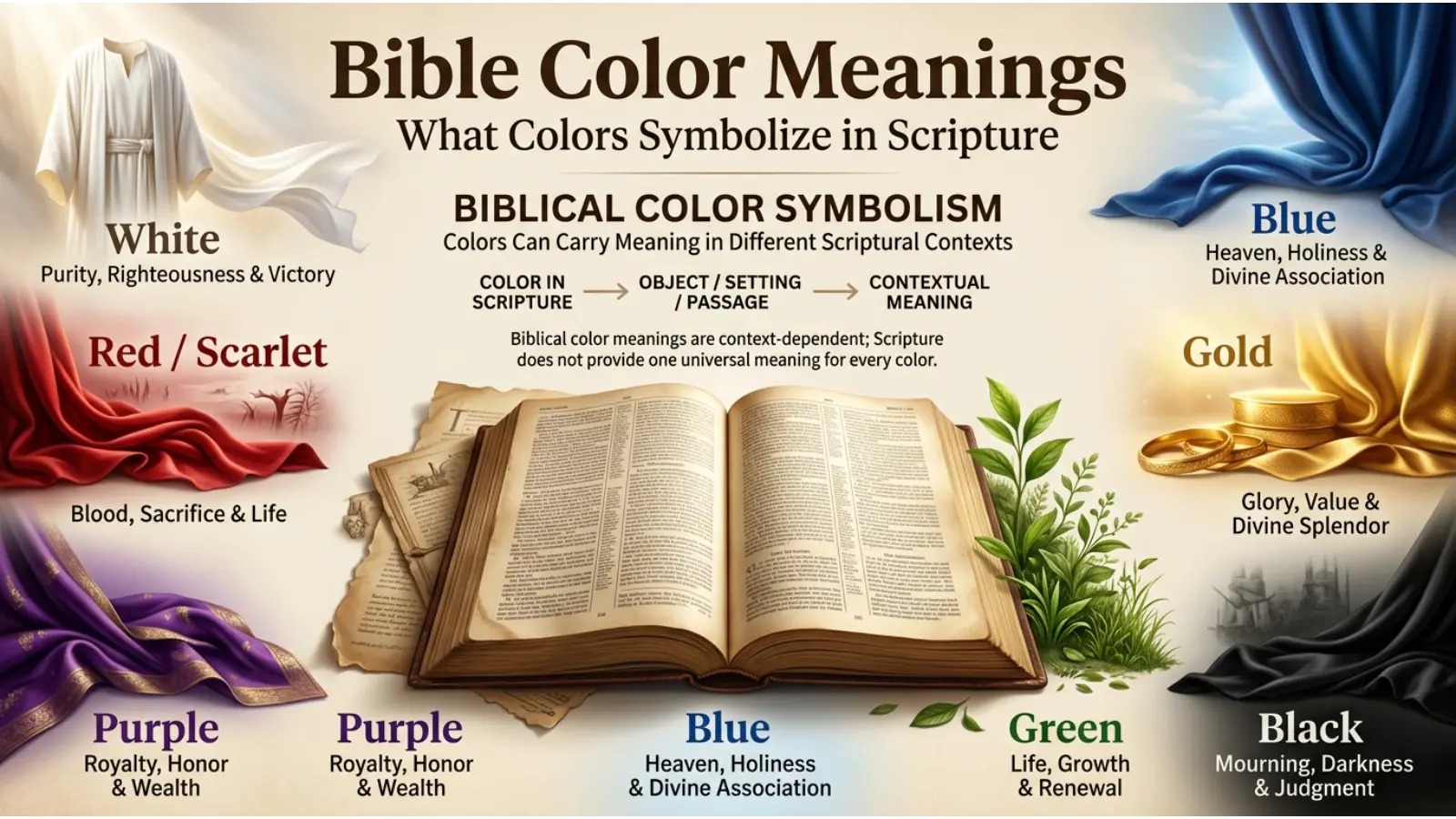
The most commonly discussed Bible color meanings are:
| Color | Common Biblical Associations | Key Idea |
|---|---|---|
| 🟥 Red | Blood, sacrifice, sin, judgment, life | Sacrifice and redemption |
| 🟦 Blue | Heaven, remembrance of God’s commands, sacred worship | Heavenly focus |
| 🟪 Purple | Royalty, wealth, authority, status | Kingship |
| ⬜ White | Purity, righteousness, holiness, victory | Cleansing and purity |
| 🟨 Gold | Glory, wealth, preciousness, royal splendor | Majesty |
| ⬛ Black | Mourning, suffering, famine, darkness | Grief and distress |
| 🟩 Green | Vegetation, life, flourishing, provision | Life and growth |
| 🟥 Scarlet/Crimson | Sin, blood, sacrifice, wealth | Moral and sacrificial imagery |
| 🩶 Silver | Preciousness, payment, redemption-related imagery | Value and redemption |
| 🟨 Yellow | Usually descriptive rather than a fixed spiritual symbol | Context matters |
These associations should be treated as interpretive patterns rather than universal rules. Scripture itself sometimes uses colors simply to describe an object, garment, animal, or natural scene.
How to Understand Color Symbolism in the Bible
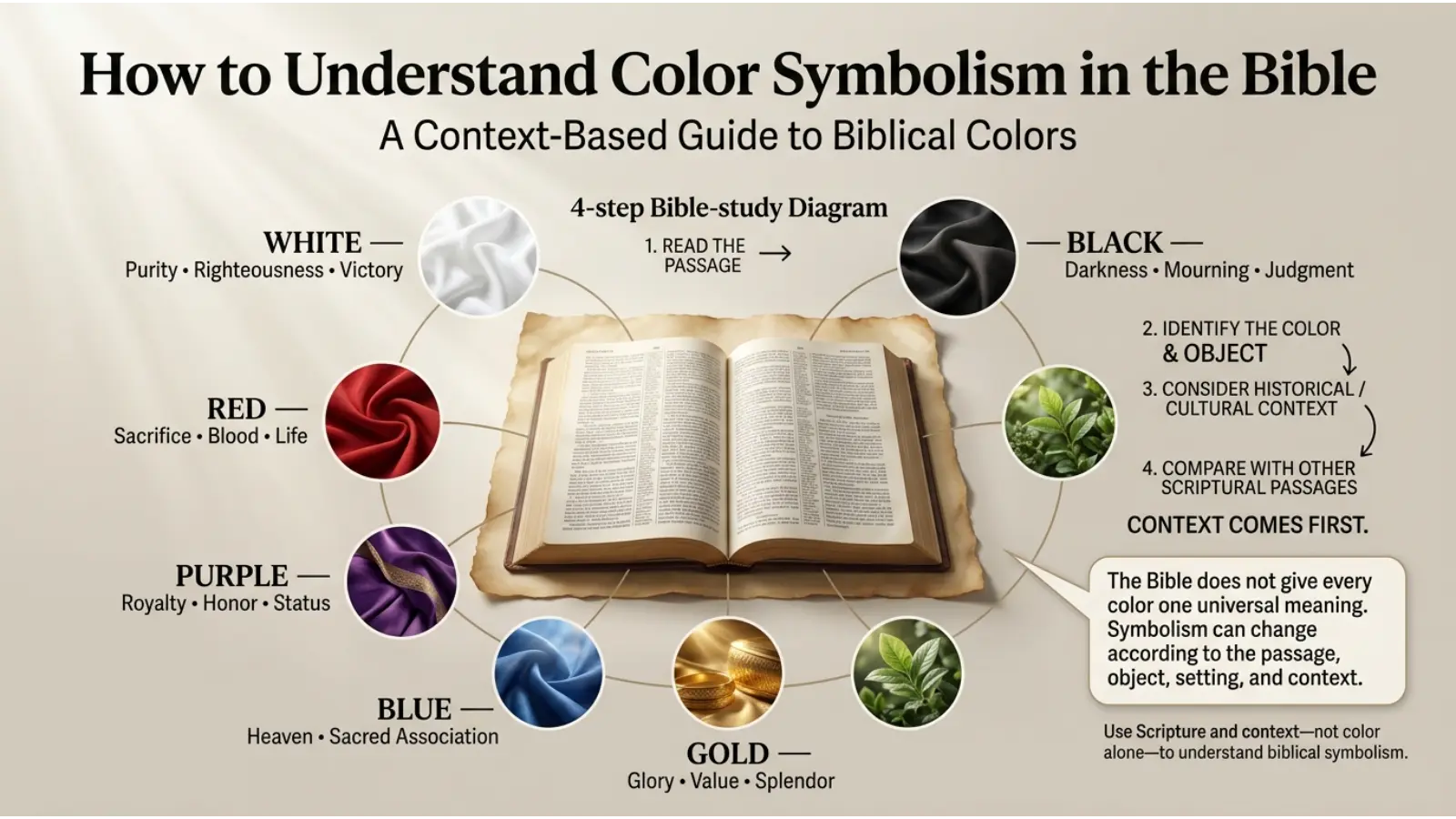
The safest way to study a biblical color is to begin with the passage rather than with a modern color chart.
Ask three questions:
- What object has the color?
- What is happening in the passage?
- Does the surrounding text give the color symbolic importance?
This approach prevents a common mistake: assigning a spiritual meaning to every color mentioned in Scripture.
For instance, green grass in Psalm 23 helps create an image of peaceful provision and rest. That does not mean every green object in the Bible automatically represents spiritual growth. Likewise, purple clothing often appears in royal or wealthy settings, making royalty a strong association, but purple is not a secret code that means “king” every time it appears.
The Bible’s use of color is therefore best understood as a combination of description, cultural association, literary imagery, and symbolism.
🟥 Red Bible Meaning
Red is one of the most powerful colors in biblical imagery because it naturally connects with blood, life, violence, sacrifice, and sin.
Scripture uses red in several different contexts. Red can describe blood, animals, food, wine, and horses, but it can also contribute to symbolic images involving warfare, bloodshed, sacrifice, or sin.
Red and Blood
Blood is central to many biblical stories and rituals. Because blood represents life in biblical thought, red can become closely connected with life and sacrifice.
This is particularly important in passages dealing with offerings and atonement.
Red and Sin
Isaiah 1:18 famously compares sins to scarlet and promises cleansing that makes them “white as snow.” The contrast is significant: red or scarlet represents the visible stain of wrongdoing, while white represents cleansing and restoration.
Red and Judgment
Red can also appear in scenes of violence and judgment. Revelation, for example, uses a red horse in an apocalyptic vision associated with conflict and bloodshed. Bible Gateway’s Bible Themes reference distinguishes the symbolic use of white, red, and pale horses in Revelation 6.
Red in Simple Terms
Biblical red can suggest:
- 🩸 Blood
- ❤️ Life
- ✝️ Sacrifice
- 🔥 Sin
- ⚔️ War or bloodshed
- ⚖️ Judgment
The exact meaning depends heavily on context.
🟦 Blue Bible Meaning
Blue has a special place in the Old Testament, particularly in the tabernacle, priestly clothing, and the tassels worn by Israelites.
Numbers 15:38–39 instructed the Israelites to place a blue cord on the tassels of their garments. The purpose was connected with remembering God’s commandments and living faithfully.
Blue also appears in descriptions of sacred furnishings and priestly garments.
Exodus describes blue alongside purple and scarlet in the construction of the tabernacle and sacred clothing. Exodus 39:1 specifically mentions blue, purple, and scarlet materials used for garments associated with service in the holy place.
What Does Blue Symbolize?
Because of these contexts, blue is often interpreted as pointing toward:
- Heaven
- God’s commandments
- Sacred worship
- Divine authority
- Remembrance of God
- Holiness
Still, the Bible does not explicitly state, “blue always means heaven.” The connection is an interpretation drawn from recurring contexts.
Why Blue Was Important
Blue was not simply chosen because people liked the color. Ancient dyes could require significant effort and resources, and certain colors had social and religious associations. The biblical use of blue therefore combines practical textile history with religious meaning.
🟪 Purple Bible Meaning
Purple is one of the clearest biblical examples of a color associated with social status.
In the ancient world, purple textiles could be expensive because producing high-quality purple dye was difficult. As a result, purple clothing became associated with wealthy and powerful people.
The Bible reflects this cultural reality.
Judges 8:26 describes purple garments among the possessions associated with Midianite kings. Esther 8:15 also describes royal clothing involving purple, along with blue, white, and gold.
Purple Represents Royalty
The strongest biblical association of purple is therefore:
Purple → royalty → wealth → authority → status
Purple also appears in the New Testament during the mocking of Jesus. Soldiers put a purple robe on Him as part of their mockery of His supposed kingship. The irony is important: they intended the garment as ridicule, while Christians understand Jesus as the true King.
Purple in the Tabernacle
Purple was also used with blue and scarlet in sacred textiles. Exodus 39 records these colors in the garments used for ministry in the sanctuary.
Thus, purple can communicate both royal status and sacred dignity, depending on context.
⬜ White Bible Meaning
White is among the strongest positive color symbols in Scripture.
It frequently appears in connection with purity, righteousness, cleansing, holiness, and victory. Revelation repeatedly uses white garments in scenes involving God’s people and heavenly worship. Bible Gateway’s thematic reference specifically identifies white with conquest, blessedness, purity, holiness, and victory in several Revelation passages.
White and Purity
The contrast between scarlet and white is especially powerful in Isaiah 1:18.
The imagery communicates a transformation:
Sin → Cleansing → Purity
The White therefore becomes a visual language for moral restoration.
White and Victory
White is not limited to moral purity. Revelation also uses white in images of conquest and triumph.
That makes white a richer biblical symbol than simply “being clean.”
It can suggest:
- Purity
- Righteousness
- Holiness
- Cleansing
- Victory
- Glory
- Heavenly hope
🟨 Gold Bible Meaning
The Gold is different from colors such as red or blue because Scripture frequently presents it as a precious material rather than simply as a color.
Gold appears extensively in the tabernacle and temple traditions.
Gold can therefore communicate:
- Preciousness
- Wealth
- Royal dignity
- Glory
- Beauty
- Sacred importance
The Ark of the Covenant, for example, was overlaid with gold according to Exodus 25. Gold’s presence in sacred objects contributes to the biblical picture of holiness, majesty, and extraordinary value.
Gold Is Not Simply “God’s Color”
A common modern claim is that gold always means God or divinity. That is too simplistic.
The better interpretation is preciousness and splendor, with divine glory becoming especially relevant when gold appears in a sacred setting.
⬛ Black Bible Meaning
Black often appears in darker emotional or physical contexts.
Biblical references associate blackness with mourning, suffering, famine, distress, or darkness.
For example, Lamentations uses dark imagery to describe severe suffering.
However, black does not function as a universal biblical symbol of evil.
That distinction is important.
Modern culture often treats black as a symbol of evil or death.
Black Can Suggest
- Mourning
- Suffering
- Famine
- Darkness
- Distress
- Death-related imagery
The surrounding passage determines the specific meaning.
🟩 Green Bible Meaning
Green is usually connected with living plants and vegetation rather than a formal color code.
Psalm 23’s “green pastures,” for example, form part of an image of God’s provision, rest, and care. Other biblical references to green vegetation describe natural life and seasonal growth. Bible Gateway notes that many references to green in Scripture simply concern plants or foliage.
Because of this, Christians often associate green with:
- Life
- Growth
- Renewal
- Provision
- Flourishing
- Hope
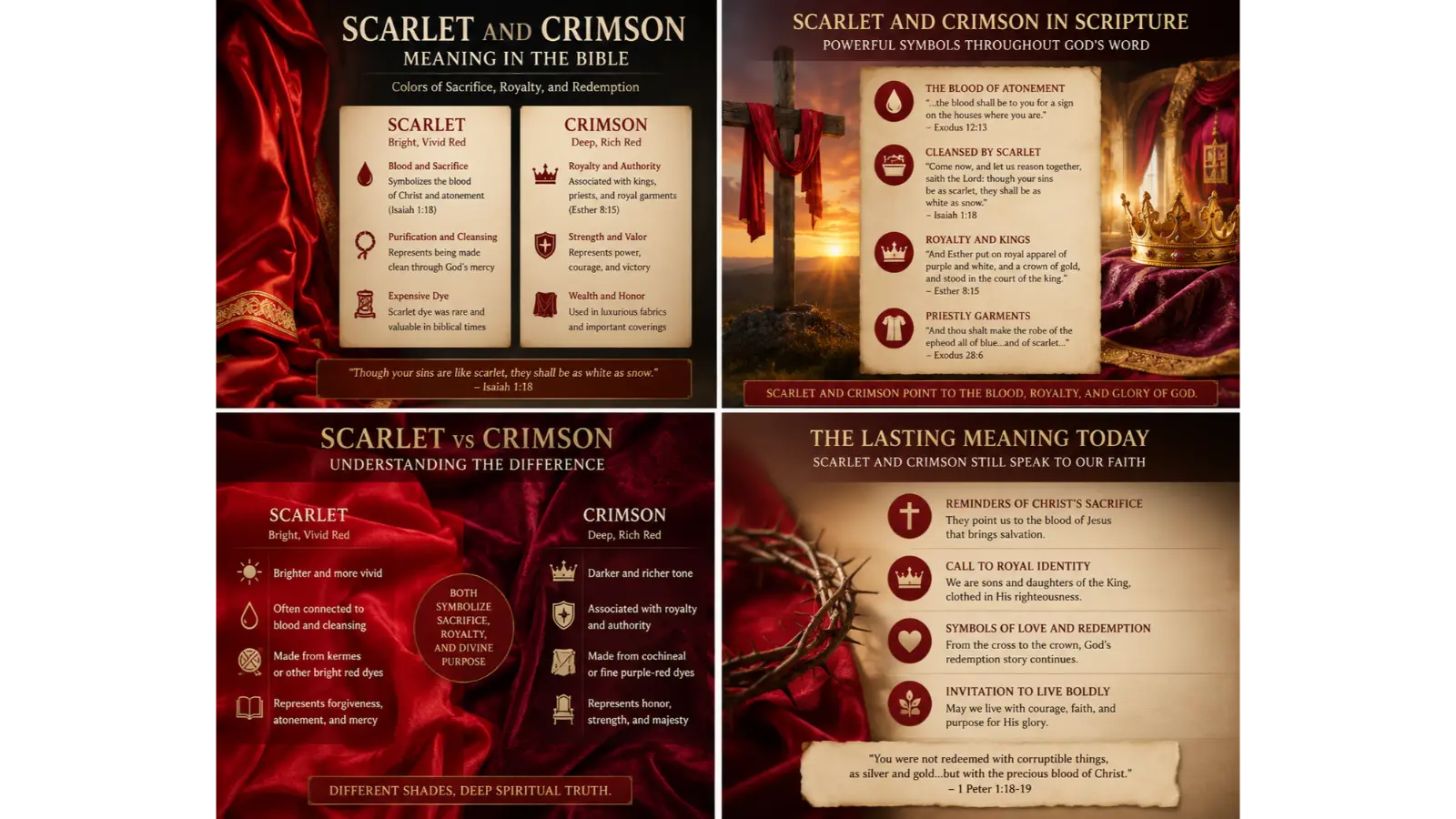
🟥 Scarlet and Crimson Meaning
Scarlet and crimson deserve separate attention because biblical translations use several related color terms.
Modern readers may treat red, crimson, and scarlet as completely separate colors. Ancient color terminology was not always organized according to modern color systems. Bible Gateway notes that purple, scarlet, crimson, and red can overlap or be closely related in biblical references.
Scarlet and Sin
Isaiah 1:18 provides one of the best-known examples:
Scarlet → sin → cleansing → white
Scarlet and Ritual
Scarlet-colored material also appears in purification and tabernacle-related instructions.
Therefore, scarlet can carry associations involving:
- Sin
- Blood
- Sacrifice
- Purification
- Wealth
- Judgment
Again, context is essential.
🩶 Silver Bible Color Meanings
Silver is more accurately understood as a precious metal than as a simple color symbol.
Silver appears in contexts involving money, value, payment, and religious objects. Some Christian interpretations connect silver with redemption because of biblical passages involving payment and atonement.
However, readers should be cautious about turning every appearance of silver into a hidden spiritual message.
Sometimes silver simply means silver.
That is an important principle for responsible Bible study.
🟨 Yellow Bible Color Meanings
Yellow is often included in modern “Bible color charts,” but it requires more caution than white, red, blue, or purple.
Scripture contains references to yellowish appearances, particularly in descriptions involving skin conditions and natural imagery. Bible Gateway’s thematic index lists yellow among colors mentioned in Scripture, but it does not assign one universal symbolic meaning to it.
The safer approach is:
Yellow has contextual meaning rather than one established biblical definition.
🌈 Does the Rainbow Have a Bible Color Meanings?
The rainbow is one of the Bible’s most recognizable uses of color.
In Genesis, the rainbow is connected with God’s covenant with Noah. In later biblical visions, rainbow imagery appears again around God’s throne.
The major biblical meaning is therefore not that each individual rainbow color has a separate hidden message.
Instead, the rainbow as a whole functions as a sign associated with God’s covenant and faithfulness.
🕊️ Colors in the Tabernacle
One of the most important places to study biblical color symbolism is the tabernacle.
Blue, purple, and scarlet appear repeatedly in descriptions of sacred fabrics and priestly garments. Exodus 39:1 directly identifies these colors in garments used for ministry in the holy place.
| Color | Tabernacle Context | Common Interpretation |
|---|---|---|
| 🟦 Blue | Sacred textiles and priestly garments | Heavenly or covenant associations |
| 🟪 Purple | Sacred textiles and garments | Royal dignity and authority |
| 🟥 Scarlet | Sacred textiles and ritual objects | Blood, sacrifice, purification |
The important lesson is that the colors work together.
Rather than treating each color as an isolated code, readers can see how the combination creates an atmosphere of sacredness, authority, beauty, and ritual importance.
👑 Colors and Royalty in the Bible
Color and social status were closely connected in the ancient world.
Purple is the clearest example. Royal garments in Esther include purple and gold, showing how color, clothing, and political authority could work together.
White could also appear in royal or celebratory clothing, while gold naturally communicated wealth and status.
This teaches an important lesson about biblical symbolism:
Color meaning is partly shaped by the culture that produced the text.
A modern reader may see purple as a relaxing or creative color. An ancient reader could also recognize it as expensive and prestigious.
🧠 Psychology vs. Bible Color Meanings
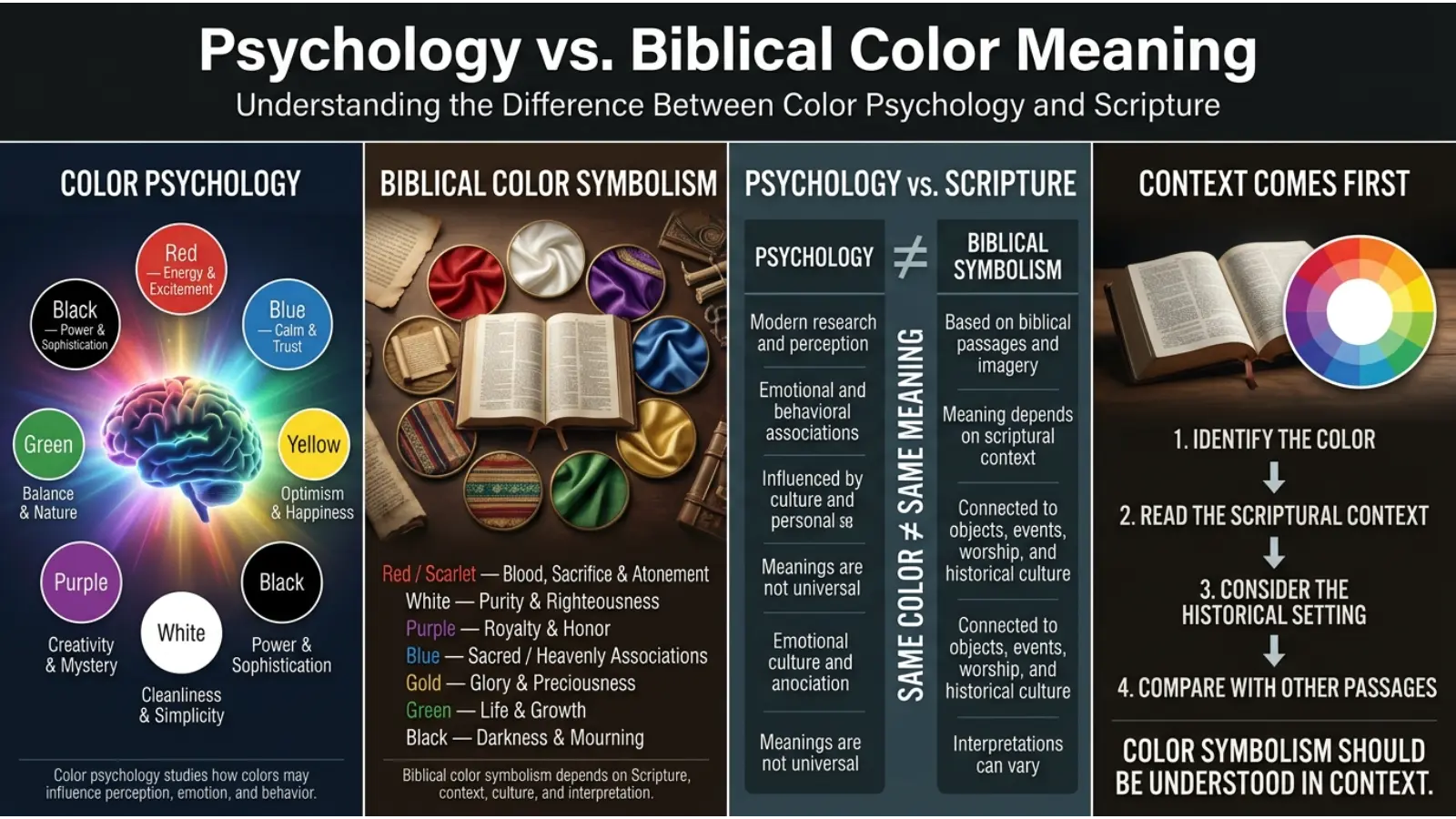
Modern color psychology and biblical symbolism should not be treated as the same subject.
Color psychology studies how colors may influence perception, emotion, attention, preference, or behavior. Biblical color symbolism, on the other hand, focuses on how colors function within Scripture, ancient culture, religious practice, and literary imagery.
For example:
- Modern psychology may associate blue with calmness.
- Biblical interpretation may connect blue with sacred garments and remembrance of God’s commands.
- Modern branding may use purple to suggest creativity or luxury.
- Biblical culture strongly connects purple with wealth and royalty.
These meanings can overlap, but one does not prove the other.
A color does not have one universal psychological or spiritual meaning.
✝️ Do Colors Have the Same Meaning Throughout the Bible?
No.
This is perhaps the most important point to remember.
The same color can communicate different ideas depending on the passage.
Red can relate to blood and sacrifice in one context and warfare in another.
White can communicate purity in one passage and conquest or victory in another.
Purple can describe expensive royal clothing, while its use in the mocking of Jesus creates an ironic statement about kingship.
Bible Gateway’s thematic reference specifically shows different symbolic uses of white, red, and other colors across different passages.
Therefore, context comes before color charts.
🏺 Historical Bible Color Meanings
Ancient color symbolism cannot be separated from the materials and technologies available at the time.
Some dyes were expensive to produce. Purple is a strong example because high-quality purple dye was historically associated with costly production and became linked with wealth and royalty.
This helps explain why purple appears in royal clothing.
Likewise, blue and purple textiles appear prominently in tabernacle instructions, showing that color was part of the visual design of sacred worship.
Understanding this historical background makes biblical color symbolism more meaningful because it shows that colors were not merely decorative choices.
🌍 Cultural Differences in Bible Color Meanings
Color meanings can change across cultures.
A modern Western audience may associate white strongly with weddings and purity.
Purple today may be associated with creativity, spirituality, or fashion. In biblical-era society, its expensive production made it strongly associated with status and royalty.
Therefore, readers should avoid assuming that a modern color meaning was automatically present in ancient Scripture.
Why Culture Matters
The meaning of a color comes from more than the color itself.
It can depend on:
Color + object + culture + historical period + situation = meaning
This is why a purple robe, purple cloth in a sanctuary, and purple paint in a modern bedroom can communicate very different ideas.
👤 Personality Associations With Biblical Colors
Some people enjoy using biblical colors to describe personality traits.
For example, modern interpretations may describe:
- Blue lovers as peaceful or thoughtful.
- Purple lovers as creative or ambitious.
- Red lovers as passionate or energetic.
- Green lovers as balanced or growth-oriented.
- White lovers as orderly or peaceful.
The Bible does not teach that choosing a particular color determines someone’s personality.
Color preference is influenced by many factors, including culture, memory, fashion, personal experience, environment, and individual taste.
🎨 Bible Colors in Modern Christian Design
Biblical colors are often used in church artwork, Bible study materials, devotional graphics, worship spaces, clothing, and Christian branding.
A designer might use:
Blue
Useful for themes involving:
- Heaven
- Faith
- Scripture
- Peace
- Worship
Purple
Useful for:
- Kingship
- Advent
- Lent
- Majesty
- Christ-centered royal themes
Red
Useful for:
- Sacrifice
- Passion
- Blood
- Martyrdom
- Pentecost in some Christian traditions
White
Useful for:
- Resurrection
- Purity
- Celebration
- Holiness
- New life
However, denominational traditions may use liturgical colors differently. A church color system should therefore not be confused with a universal biblical color code.
🏠 Bible Color Meanings in Interior Design
If you want to bring biblical color symbolism into a room, think about the atmosphere you want rather than trying to create a literal “Bible color room.”
Blue Room
Blue can create a calm, reflective setting suitable for prayer, reading, or study.
Pair it with:
- White
- Natural wood
- Soft beige
- Gold accents
Purple Room
Purple can create a rich and dignified appearance.
Use it in:
- Curtains
- Cushions
- Artwork
- Accent walls
Because strong purple can feel intense, smaller accents often work better than covering an entire room.
White Room
White creates a clean and peaceful visual environment.
Add:
- Natural wood
- Green plants
- Warm lighting
- Small gold details
Red Accents
Red works best as an accent when the goal is to highlight themes of passion, sacrifice, courage, or importance.
Too much bright red can become visually overwhelming, so balance it with neutral colors.
👗 Bible Colors in Fashion
Biblical color symbolism can also influence Christian fashion and event styling.
Purple can create a regal appearance, while white often communicates simplicity and celebration.
Blue can feel calm and traditional, while red creates a stronger and more dramatic impression.
For a balanced Christian-inspired outfit, consider:
| Main Color | Pair With | Overall Impression |
|---|---|---|
| 🟦 Blue | White + gold | Calm and dignified |
| 🟪 Purple | White + gold | Regal and formal |
| 🟥 Red | White + black | Strong and dramatic |
| ⬜ White | Gold + blue | Clean and elegant |
| 🟩 Green | Beige + brown | Natural and peaceful |
These are design choices, not biblical commandments.
🔗 Bible Color Combinations
Some of the most interesting biblical color meanings appear through combinations rather than individual colors.
Blue + Purple + Scarlet
This combination appears repeatedly in tabernacle and priestly contexts.
It brings together colors associated through biblical context with sacred service, royal dignity, and sacrificial imagery.
White + Scarlet
This is one of the strongest symbolic contrasts in Isaiah 1:18.
The movement is:
Scarlet → White
The image communicates the transformation from sin to cleansing.
Purple + Gold
These colors frequently create an impression of wealth, royalty, and high status, as seen in royal descriptions such as Esther 8:15.
⚠️ Common Misconceptions About Bible Color Meanings
Myth 1: Every color has one fixed biblical meaning
False.
Context changes meaning.
Myth 2: The Bible gives an official color chart
False.
Scripture contains color references and symbolic uses, but it does not provide a universal chart assigning one spiritual definition to every color.
Myth 3: Every color mentioned in Scripture is symbolic
False.
Some colors simply describe objects, clothing, plants, animals, or physical appearances. Bible Gateway’s color index demonstrates that many references are descriptive rather than symbolic.
Myth 4: Red always means sin
False.
Red can relate to blood, life, sacrifice, violence, or judgment depending on the passage.
Myth 5: Blue always means the Holy Spirit
Too strong.
Blue has important associations in biblical worship and Israelite practice, but Scripture does not establish a universal rule that blue always represents the Holy Spirit.
Myth 6: Gold always means God
Too simplistic.
Gold is strongly connected with sacred objects, wealth, beauty, and splendor, but not every appearance of gold is a direct symbol of God.
📖 How to Study a Biblical Color Correctly
If you encounter a color in your Bible reading, use this simple method.
Step 1: Read the Whole Passage
Do not interpret a color from one verse alone.
Step 2: Identify the Object
Is the color attached to:
- Clothing?
- Blood?
- An animal?
- A building?
- A plant?
- A heavenly vision?
- A precious metal?
The object can dramatically change the meaning.
Step 3: Check the Historical Setting
Ask what the color meant to the people who originally encountered it.
Step 4: Compare Related Passages
Look for other biblical uses of the same color.
Step 5: Separate Scripture From Tradition
A church tradition may assign a meaning to a color that is not explicitly stated in the Bible.
Both can be discussed, but they should not be presented as identical.
Step 6: Avoid Forced Symbolism
If the passage does not give the color symbolic importance, it is perfectly acceptable to say that the color is simply descriptive.
🌟 Bible Color Meanings at a Glance
| 🖍️ Color | Main Biblical Associations | Important Context |
|---|---|---|
| 🟥 Red | Blood, sacrifice, sin, judgment | Blood and symbolic visions |
| 🟦 Blue | Sacred service, remembrance, heavenly associations | Tabernacle and tassels |
| 🟪 Purple | Royalty, wealth, authority | Kings and expensive clothing |
| ⬜ White | Purity, righteousness, victory | Isaiah and Revelation |
| 🟨 Gold | Preciousness, glory, wealth | Tabernacle and royal imagery |
| ⬛ Black | Mourning, suffering, famine | Lamentations and prophetic imagery |
| 🟩 Green | Vegetation, life, provision | Psalms and nature |
| 🟥 Scarlet | Sin, blood, purification | Isaiah and ritual passages |
| 🟥 Crimson | Red-related imagery | Sin and blood-related contexts |
| 🩶 Silver | Value, money, preciousness | Payments and sacred objects |
| 🟨 Yellow | Mostly descriptive | Context-specific references |
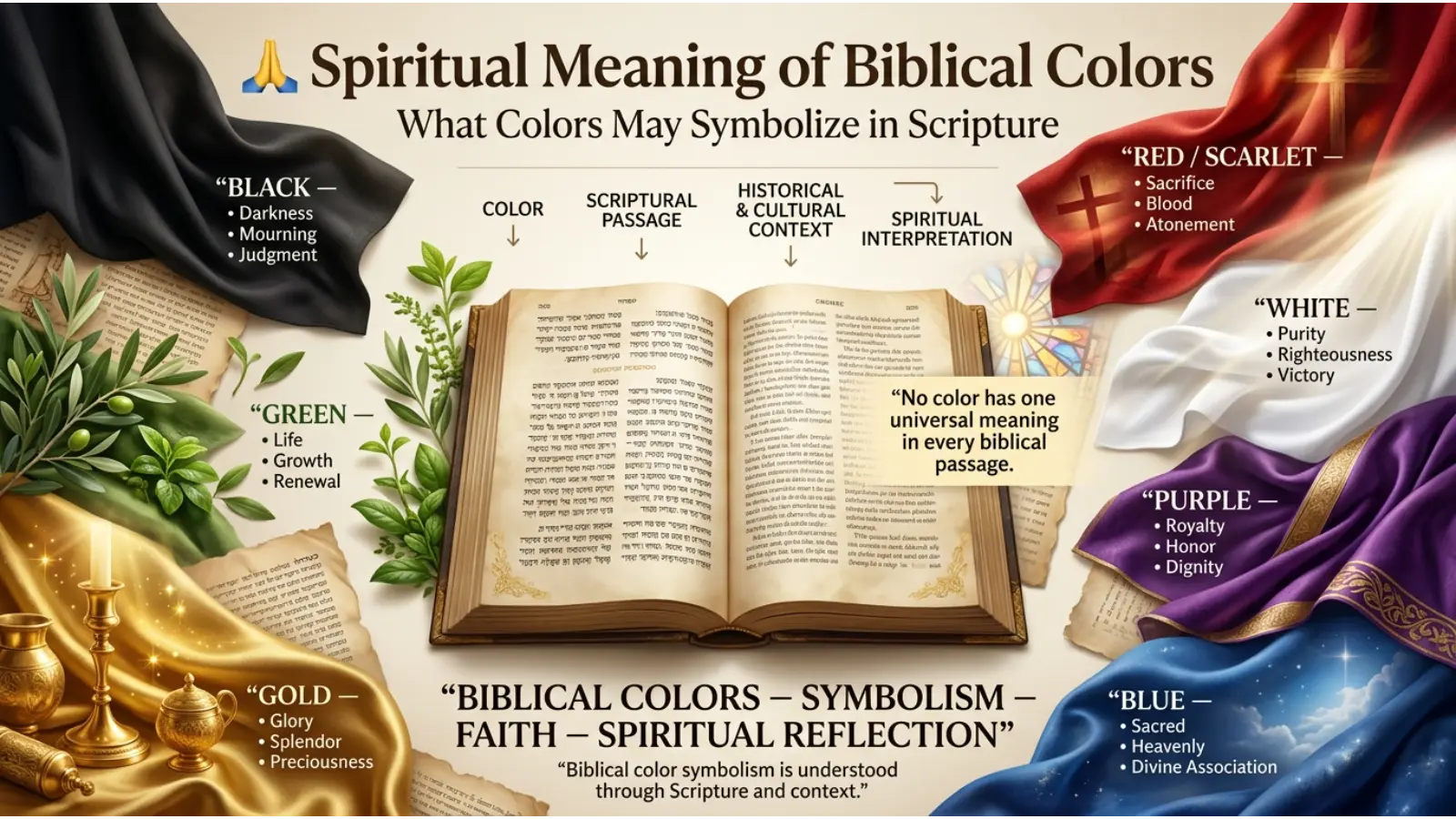
🙏 Spiritual Meaning of Biblical Colors
For Christians, color can make biblical imagery easier to visualize.
White can remind a believer of cleansing and righteousness.
Red can bring attention to blood, sacrifice, and the seriousness of sin.
Blue can point the reader toward God’s commands and sacred worship.
Purple can remind readers of kingship and authority.
Gold can suggest glory, beauty, and extraordinary value.
Green can evoke God’s provision through the natural world.
These reflections can enrich personal devotion, but they should remain connected to Scripture rather than becoming invented rules.
Different Christian traditions may also interpret colors differently. A devotional interpretation should therefore be presented as an interpretation, not as a command from Scripture.
Frequently Asked Questions About Bible Color Meanings
What is the most important color in the Bible?
There is no single officially designated “most important” color. White, red, blue, and purple are especially significant because they appear in important symbolic, ritual, royal, and theological contexts.
What color represents God in the Bible?
The Bible does not assign one universal color to God. Divine glory is described through many kinds of imagery, including light, brilliance, precious stones, fire, and rainbow-like visions. A specific color should not be treated as God’s official color.
What does red mean in the Bible?
Red can represent blood, life, sacrifice, sin, violence, or judgment. Its meaning depends on the passage.
What does blue mean in the Bible?
Blue appears prominently in sacred textiles and in the blue cord of Israelite tassels. It is commonly associated with heavenly or sacred ideas and remembrance of God’s commandments.
What does purple mean in the Bible?
Purple is strongly associated with royalty, wealth, authority, and high social status. It appears in royal clothing and sacred textiles.
What does white mean in the Bible?
White is commonly associated with purity, righteousness, holiness, cleansing, and victory. Revelation uses white clothing repeatedly in symbolic heavenly scenes.
What does black mean in the Bible?
Black can be associated with mourning, suffering, famine, darkness, and distress. It does not automatically mean evil every time it appears.
What does green mean in the Bible?
Green is usually connected with vegetation and living plants. Because biblical writers use green pastures and flourishing plants as positive images, green can reasonably suggest life, provision, and flourishing in certain contexts.
Does the Bible give every color a spiritual meaning?
No. Some colors are symbolic, while others are simply descriptive. The surrounding passage should always guide interpretation.
Are modern Bible color charts completely accurate?
Not necessarily. Many charts combine biblical references, Christian tradition, devotional interpretation, and modern symbolism. They can be useful study aids, but their meanings should not be treated as direct biblical teaching unless Scripture supports them.
Conclusion
Bible color meanings are best understood as patterns within Scripture rather than as a fixed spiritual code.
White frequently communicates purity, righteousness, cleansing, and victory. Red and scarlet bring powerful imagery of blood, sacrifice, sin, and judgment. Blue appears in sacred worship and in the command to remember God’s instructions. Purple reflects royalty, wealth, and authority. Gold communicates preciousness and splendor, especially in sacred and royal settings. Black can appear in imagery of mourning and suffering, while green is usually connected with living vegetation and God’s provision.
The deeper lesson is that context gives color its meaning.
A purple robe can communicate royalty. A red image can point toward blood or sacrifice. White clothing can symbolize purity or victory. The same color can take on another meaning when the object, situation, or biblical passage changes.
So when studying a color in Scripture, do not begin with a modern chart and force the verse to fit it. Start with the biblical text, examine the historical setting, compare related passages, and then consider the symbolism.
That approach makes biblical color study more accurate, more meaningful, and much closer to the way Scripture itself uses visual imagery.

Emma Wilson is a dedicated comparison writer and product researcher at ColorMystiic.com. She specializes in creating unbiased product comparisons, detailed reviews, and helpful buying guides. Her goal is to help readers make smarter purchasing decisions with confidence.