Mood rings are small pieces of jewelry with a surprisingly interesting science behind them. When the ring changes from blue to green, purple, yellow, or another shade, people often wonder what the color says about their emotions. This is why color meanings mood rings remains a popular topic for anyone curious about the symbolism behind these changing colors.
A mood ring does not actually read your thoughts or measure emotions directly. Instead, its color-changing material responds mainly to changes in temperature. Because body temperature can shift with the environment, activity level, stress, circulation, and other factors, people have traditionally connected different colors with particular moods.
The meanings printed on mood-ring charts are therefore best understood as symbolic interpretations, not medical or psychological diagnoses. The exact shade can also vary by ring, lighting, temperature, and the thermochromic material used.
Quick Answer: What Do Mood Ring Colors Mean?
Mood ring colors are commonly associated with emotional states, but the ring itself responds primarily to temperature changes.
| 🌈 Mood Ring Color | Common Traditional Meaning | What the Color May Suggest |
|---|---|---|
| 🔵 Blue | Calm, relaxed | Comfortable or peaceful |
| 🟢 Green | Balanced, normal | Neutral or steady mood |
| 🟣 Purple | Passion, excitement | Strong emotions or energy |
| 🟡 Yellow | Nervous, unsettled | Tension or uncertainty |
| 🟠 Orange | Anxious, emotional | Restlessness or stimulation |
| 🔴 Red | Excited, energetic | Increased emotional intensity |
| ⚫ Black | Stressed, cold, inactive | Low temperature or tension |
| 🟤 Brown | Nervous, uneasy | Emotional or temperature change |
| ⚪ White | Confused, unsettled | A very different temperature response |
These meanings are traditional mood-ring interpretations, not scientifically proven emotional readings. The same color can have different meanings depending on the manufacturer and the conditions around the wearer.
How Do Mood Rings Change Color?
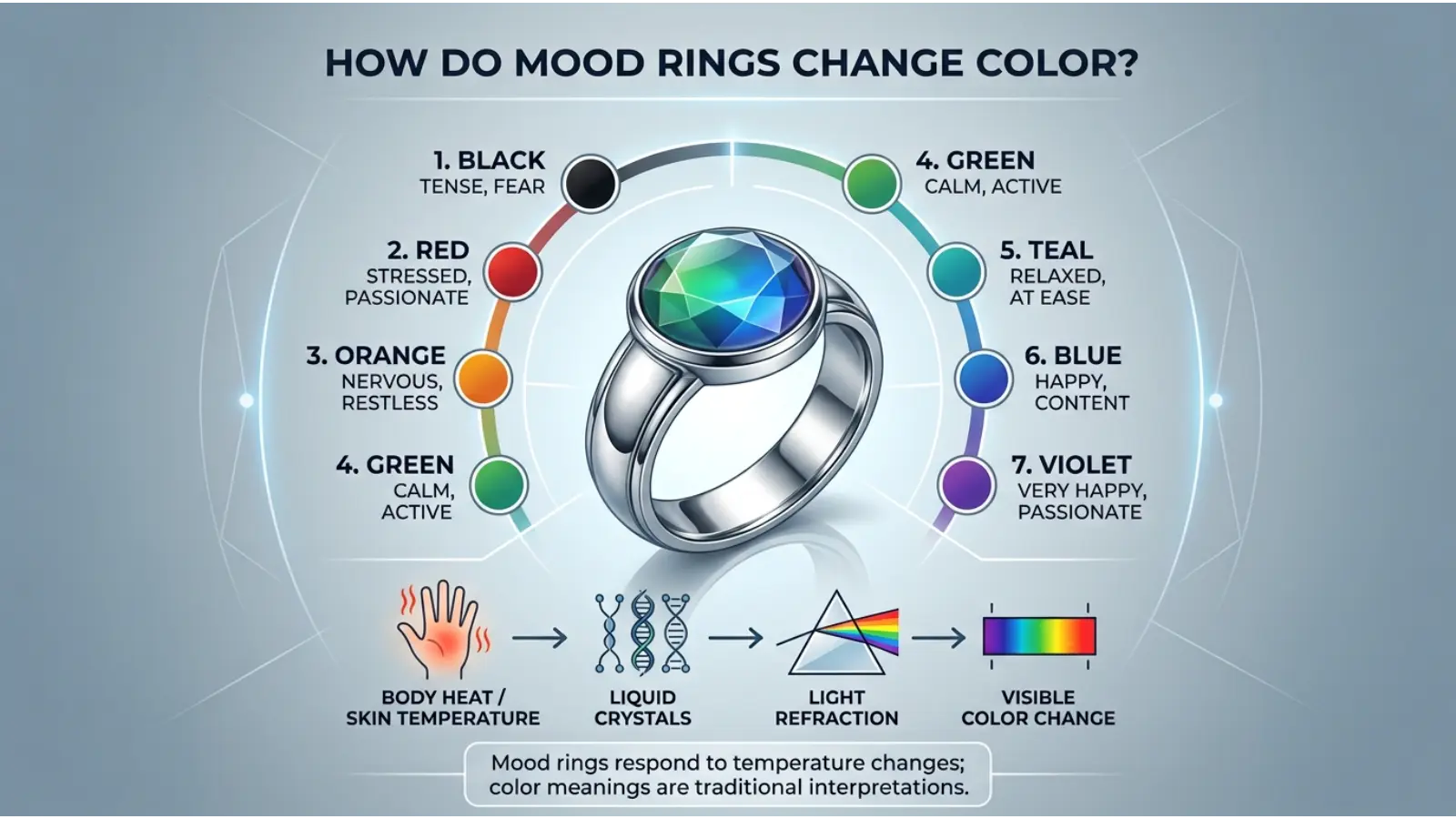
Mood rings contain a thermochromic material, meaning a material that changes its visible color when its temperature changes.
The ring’s stone or surface usually contains liquid crystals or another temperature-sensitive substance. As the temperature around the material changes, the structure of the material changes the way it reflects or absorbs light.
That produces a visible shift in color.
For example, a ring may appear:
Black → Brown → Orange → Yellow → Green → Blue → Purple
as its temperature moves through different ranges.
The important point is that the ring is responding to temperature, not directly detecting happiness, sadness, anger, love, or fear.
Why Can Emotions Affect the Color?
There is a reason the mood-ring idea can sometimes appear convincing.
Strong emotions can affect the body. Stress or excitement may influence heart rate, sweating, blood flow, and skin temperature. Cold weather can also make your fingers cooler, while physical activity may warm them.
However, many other factors affect finger temperature, including:
- Room temperature
- Outdoor weather
- Exercise
- Holding a cold or hot object
- Hand circulation
- Water temperature
- Wearing gloves
- How tightly the ring fits
- How long you have been wearing it
So a color change should not be treated as proof of a particular emotional state.
Color Meanings Mood Rings Chart
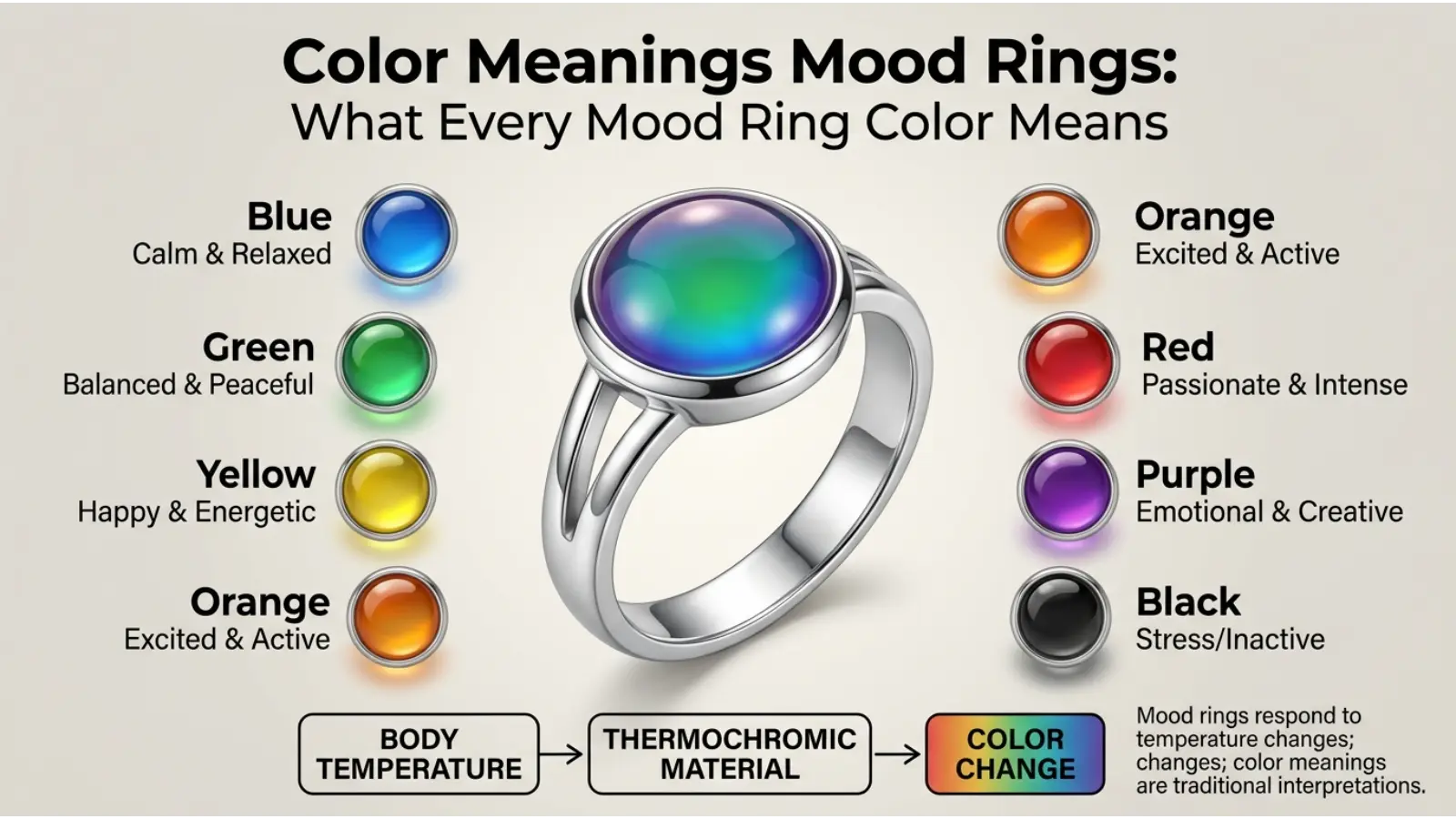
Here is a practical overview of the most commonly reported mood-ring colors.
| Color | Traditional Mood Meaning | Temperature/Context Clue | Symbolic Association |
|---|---|---|---|
| 🔵 Blue | Calm and relaxed | Warm, stable skin temperature | Peace, trust, stability |
| 🟢 Green | Balanced or normal | Moderate temperature | Balance, renewal, harmony |
| 🟣 Purple | Passionate or excited | Often associated with warmer response | Creativity, mystery, intensity |
| 🟡 Yellow | Nervous or uncertain | Transitional temperature | Caution, attention, tension |
| 🟠 Orange | Emotional or restless | Changing temperature | Energy, enthusiasm, stimulation |
| 🔴 Red | Excited or energized | Warmer response | Passion, action, strength |
| ⚫ Black | Stressed or cold | Often cooler conditions | Mystery, seriousness, protection |
| 🟤 Brown | Uneasy or tense | Variable response | Earthiness, uncertainty |
| ⚪ White | Confused or unsettled | Depends strongly on material | Clarity, change, uncertainty |
Not every mood ring contains all of these colors. Manufacturers use different thermochromic materials, so the color sequence and temperature ranges can differ.
What Does Blue Mean on a Mood Ring?
Blue is one of the most recognizable colors associated with mood rings.
Traditionally, blue represents calmness, relaxation, comfort, and emotional stability. A blue mood ring is often interpreted as suggesting that the wearer feels peaceful or at ease.
Blue also has broad symbolic associations with trust, communication, reliability, and tranquility. Those associations help explain why blue is frequently used in designs intended to feel calm or reassuring.
However, the scientific explanation is simpler: the thermochromic material has reached a temperature range that produces a blue appearance.
Dark Blue vs. Light Blue
The shade can matter visually.
Dark blue may traditionally be described as deep relaxation, while lighter blue may be associated with calmness and contentment.
These interpretations are not universal. One manufacturer’s dark blue may represent something completely different from another manufacturer’s color chart.
What Does Green Mean on a Mood Ring?
Green is often considered the balanced or neutral mood-ring color.
Traditional charts commonly associate green with feelings such as:
- Balance
- Calmness
- Normal emotional state
- Comfort
- Contentment
- Stability
Green also has strong symbolic connections with nature, renewal, growth, and harmony.
If your mood ring turns green, however, it does not prove that you are emotionally balanced. It simply means that the material is displaying green under the current temperature conditions.
Why Is Green Often Called the “Normal” Color?
Many mood-ring charts place green near the middle of their color scale.
That makes it convenient to describe green as a baseline or neutral state. The idea became part of the popular mood-ring tradition because the jewelry was marketed as a simple visual indicator of changing feelings.
In reality, there is no single universal “normal” temperature for every person or every mood ring.
What Does Purple Mean on a Mood Ring?
Purple is commonly associated with passion, excitement, creativity, romance, and strong emotional energy.
In color symbolism, purple has long been connected with imagination, mystery, luxury, spirituality, and individuality.
A purple mood ring may therefore be interpreted as showing an emotionally intense or expressive state.
Yet the actual color appears because of the temperature-sensitive material. Purple does not independently identify romantic attraction, love, or excitement.
What Does Yellow Mean on a Mood Ring?
Yellow is often given meanings such as:
- Nervousness
- Uncertainty
- Mental activity
- Tension
- Restlessness
- Caution
Yellow is naturally noticeable, so it often attracts attention in visual communication. In mood-ring symbolism, that makes it an easy color to connect with alertness or an unsettled state.
A yellow ring can also simply indicate that your finger temperature has reached the range associated with that shade.
What Does Orange Mean on a Mood Ring?
Orange is commonly linked with energy, stimulation, excitement, and restlessness.
Because orange sits between red and yellow, it can symbolically combine some of the qualities associated with both colors. It may represent heightened energy without necessarily suggesting extreme emotional intensity.
Traditional mood-ring charts sometimes describe orange as nervousness, emotional tension, or anticipation.
Again, these are symbolic interpretations rather than measurements of emotional health.
What Does Red Mean on a Mood Ring?
Red is one of the strongest colors in traditional color symbolism.
It can represent:
- Passion
- Energy
- Excitement
- Action
- Confidence
- Desire
- Intensity
Mood-ring charts often connect red with an energized or emotionally stimulated state.
From a color-psychology perspective, red is visually powerful and tends to attract attention. But a red mood ring does not prove that someone is angry, passionate, or in love.
The color comes from the thermochromic response of the ring.
What Does Black Mean on a Mood Ring?
Black is frequently described as the color of stress, tension, sadness, or emotional overload in traditional mood-ring charts.
That interpretation is one reason black has become one of the most recognizable mood-ring colors.
However, black is especially important to interpret carefully.
A mood ring may become black simply because it is cold. Cold air, cold water, poor contact with the skin, or a lower finger temperature can all affect the result.
So a black mood ring should never automatically be interpreted as “I am stressed.”
Why Does a Mood Ring Turn Black?
Possible reasons include:
- Your finger is cold.
- The surrounding temperature is low.
- The ring has not warmed against your skin.
- The thermochromic material has aged.
- The ring is reacting to a temperature outside its normal color range.
- The ring has been exposed to excessive heat or cold.
- The product’s color-changing material is no longer working properly.
Therefore, black is often more useful as a temperature clue than as an emotional diagnosis.
What Does Brown Mean on a Mood Ring?
Brown is less universal than blue, green, or black.
Where brown appears on traditional mood-ring charts, it may be associated with nervousness, uncertainty, tension, or emotional discomfort.
Brown also has natural associations with earth, warmth, stability, simplicity, and groundedness. This creates an interesting contrast between its traditional mood-ring interpretation and its broader color symbolism.
The exact meaning depends heavily on the specific ring.
What Does White Mean on a Mood Ring?
White is another color whose meaning varies greatly between mood-ring charts.
Some traditional interpretations associate white with confusion, stress, or uncertainty. In general color symbolism, however, white can represent purity, simplicity, openness, peace, or clarity.
That difference demonstrates an important rule:
A color does not have one universal meaning. Context changes interpretation.
The white appearance may also depend on the specific thermochromic material and lighting conditions.
Why Do Color Meanings Mood Rings Have Different Meanings?
Mood-ring meanings developed from a combination of temperature science, color symbolism, marketing, and popular culture.
The science explains why the ring changes color.
Color symbolism provides familiar emotional associations.
Marketing turns those associations into an easy-to-understand chart.
Popular culture then reinforces the idea that each shade represents a specific feeling.
That is why mood-ring charts can look much more precise than the underlying science actually is.
Mood Ring Colors vs. Real Emotions
| Mood Ring Idea | What Actually Happens |
|---|---|
| Blue means you are calm | The material is displaying a blue temperature response |
| Green means you are balanced | The ring has reached its green color range |
| Red means you are passionate | The material has changed to a red shade |
| Black means you are stressed | The ring may simply be cold |
| Purple means you are in love | Purple reflects the material’s temperature response |
| Yellow means you are nervous | Temperature and environment may explain the color |
This distinction makes mood rings more interesting rather than less meaningful. They combine simple materials science with human interest in color and emotion.
The Psychology Behind Color Meanings Mood Rings
Color psychology explores how people respond to colors and how color can influence perception, attention, preference, and emotional associations.
However, color psychology should not be confused with a system that can read someone’s internal emotional state.
For example, red is often perceived as attention-grabbing and energetic, while blue is frequently associated with calmness and trust. These associations can influence how people interpret a mood-ring chart.
But personal experience matters too.
Someone may associate blue with sadness because of personal memories, while another person may see blue as peaceful and comforting.
Context Changes Color Meaning
The same color can communicate very different ideas depending on where it appears.
A red mood ring may suggest excitement.
The red warning sign may signal danger.
A red dress may communicate confidence or glamour.
A red sports logo may suggest energy and competition.
The physical color is the same, but the surrounding context changes its meaning.
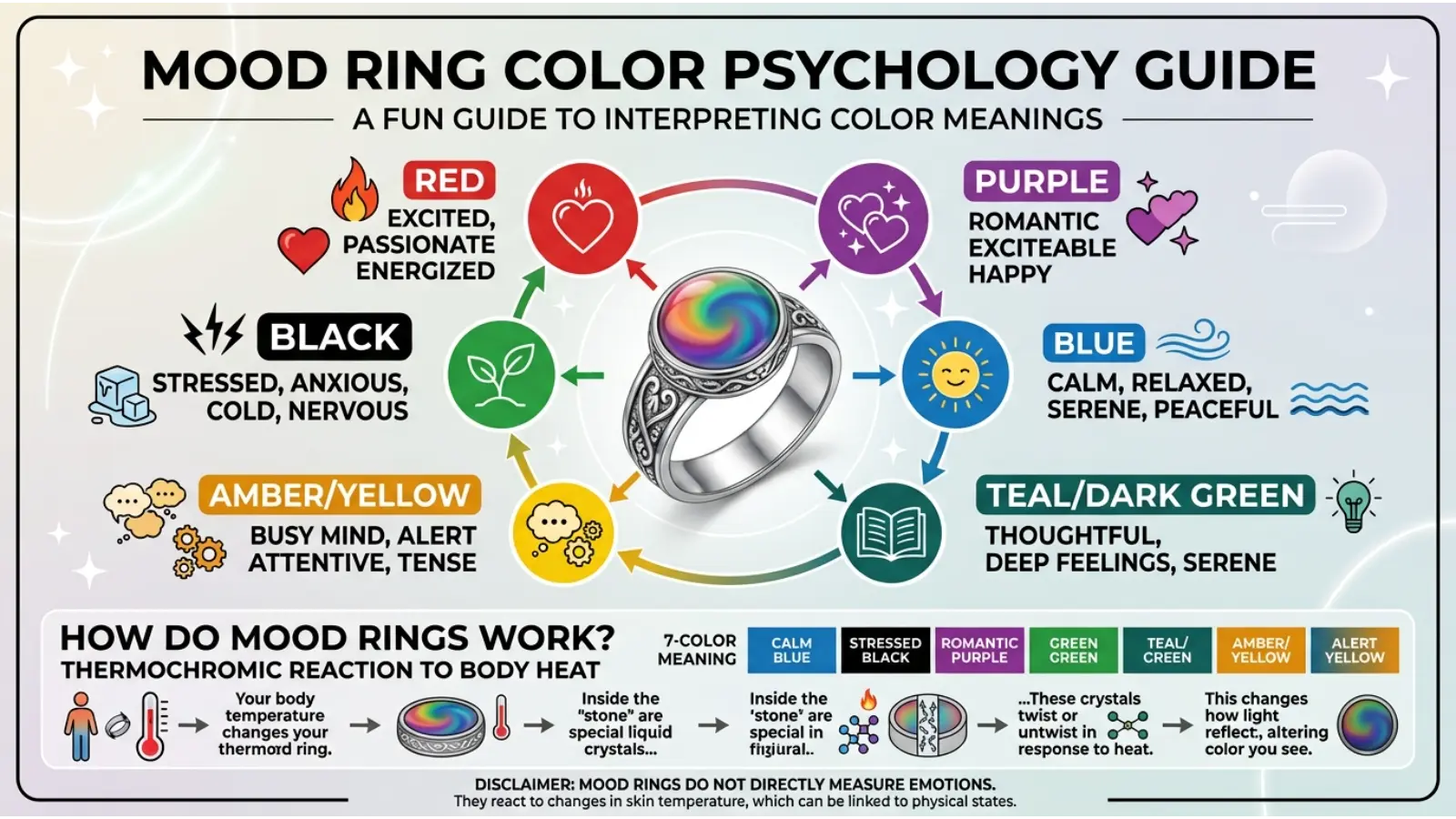
Do Mood Rings Really Detect Your Mood?
No. Mood rings do not directly detect emotions.
They primarily respond to temperature changes in the thermochromic material.
Because emotions can sometimes affect body temperature and circulation, a mood ring may occasionally appear to change in a way that seems connected to someone’s feelings. But that connection is indirect and unreliable.
A mood ring cannot determine whether you are:
- Happy
- Sad
- Angry
- In love
- Anxious
- Depressed
- Confident
What Affects a Mood Ring’s Color?
Several factors can change the color.
Body Temperature
Your fingers naturally vary in temperature. Physical activity, rest, and circulation can all influence this.
Weather
Cold outdoor temperatures can make your fingers cooler and change the ring’s appearance.
Room Temperature
A warm room can produce a different color than an air-conditioned room.
Physical Activity
Exercise increases heat production and can change skin temperature.
Water
Washing your hands with cold or warm water can temporarily affect the ring.
Ring Fit
A ring that sits loosely may not make the same skin contact as a properly fitting ring.
Lighting
The color you see can change under sunlight, fluorescent lighting, LEDs, or warm indoor bulbs.
Age of the Ring
Thermochromic materials can degrade over time, especially when exposed to unsuitable temperatures or prolonged sunlight.
Why Does My Mood Ring Change Color So Quickly?
Rapid changes usually indicate that the material is responding to temperature changes.
For example, moving from an air-conditioned room into warm sunlight can alter your finger temperature. Holding a cold drink can have the opposite effect.
The ring can therefore change color even when your emotional state has remained exactly the same.
Can Lighting Change How a Mood Ring Looks?
Yes.
A mood ring’s color is based on how light interacts with the material. Different light sources can make the same shade appear warmer, cooler, brighter, darker, or slightly different.
For the most consistent comparison, view your ring under similar lighting conditions.
A color that appears blue outdoors may look somewhat different under warm indoor lighting.
Spiritual Color Meanings Mood Rings
Mood rings sometimes receive spiritual interpretations because color symbolism is common in spiritual and personal practices.
However, these meanings are interpretive rather than scientific facts, and there is no universal spiritual system that assigns one fixed meaning to every mood-ring color.
Common symbolic associations include:
| Color | Common Spiritual Association |
|---|---|
| 🔵 Blue | Peace, communication, calm |
| 🟢 Green | Growth, balance, renewal |
| 🟣 Purple | Intuition, mystery, spirituality |
| 🔴 Red | Energy, courage, passion |
| 🟡 Yellow | Awareness, optimism, attention |
| 🟠 Orange | Creativity, vitality, enthusiasm |
| ⚫ Black | Protection, mystery, transformation |
| ⚪ White | Purity, clarity, peace |
Cultural Color Meanings Mood Rings
Color meanings are strongly influenced by culture.
A color that symbolizes celebration in one society may have a completely different association somewhere else. Historical traditions, religious practices, clothing customs, political symbolism, and local beliefs can all shape how colors are understood.
For that reason, there is no reliable worldwide dictionary in which every mood-ring color has one fixed meaning.
Western Color Associations
Modern Western popular culture often connects:
- Blue with calm and trust
- Green with nature and balance
- Red with passion and danger
- Purple with creativity and luxury
- Yellow with happiness or caution
- Black with sophistication or seriousness
- White with purity and simplicity
These are broad cultural patterns, not universal rules.
Eastern and Asian Contexts
Color meanings across Asian cultures vary considerably by country and tradition. Red, for example, can have strong associations with prosperity, celebration, luck, or happiness in some contexts.
White may carry associations with mourning in some cultural settings, while elsewhere it represents purity or peace.
Historical Color Meanings Mood Rings
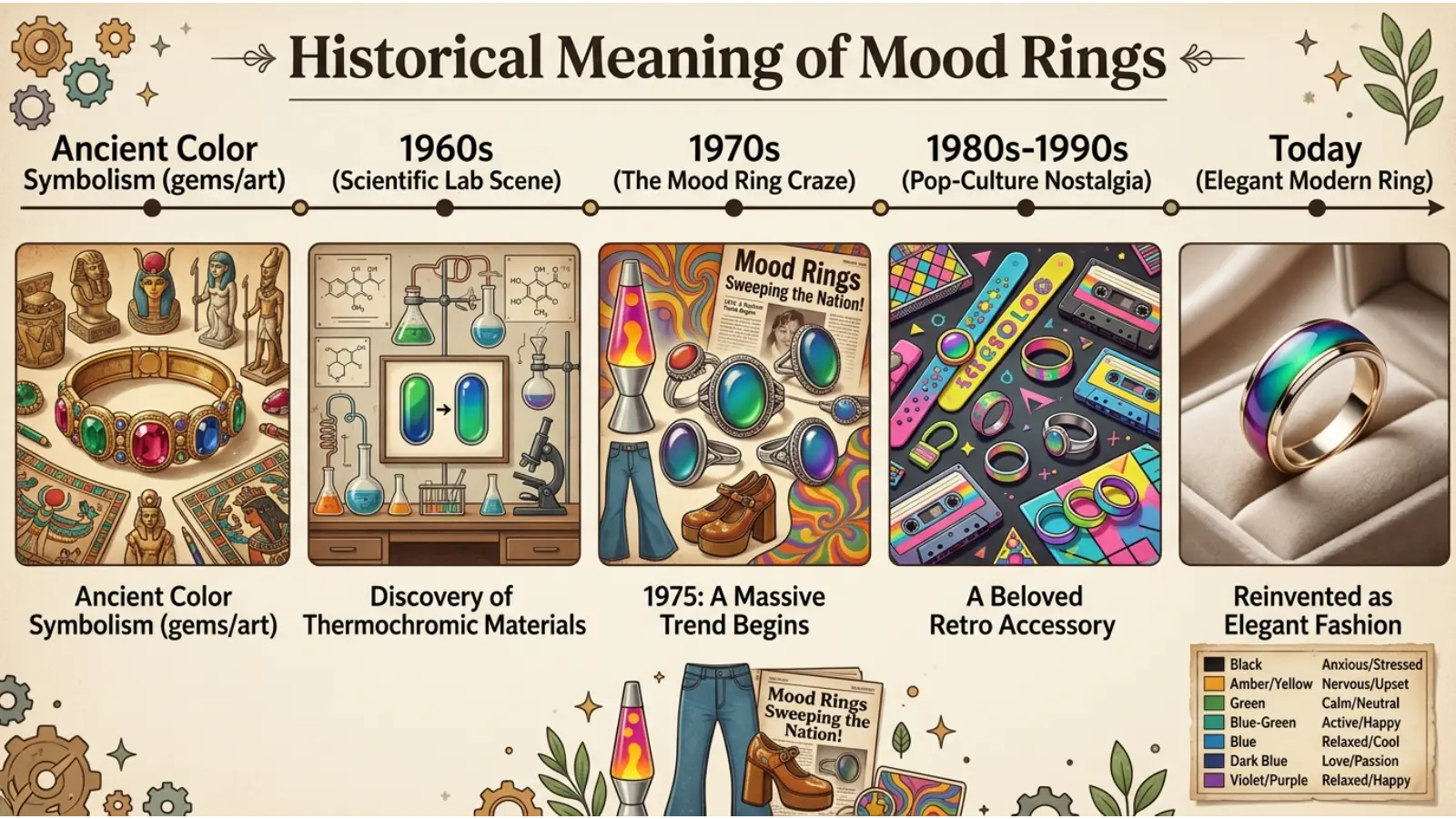
Mood rings became widely popular in the 1970s, during a period when colorful novelty products and interest in alternative self-expression were especially strong.
The basic idea was simple: a ring that appeared to respond to the wearer’s body could turn an ordinary accessory into a conversation piece.
The popularity of mood rings helped combine three ideas:
- Wearable technology
- Color symbolism
- Personality and emotion
Mood rings later returned as a nostalgic fashion item, particularly among people interested in retro design, novelty jewelry, and color symbolism.
Personality Associations of Mood Ring Colors
People often use color preferences to describe personality, but color preference does not determine personality.
Someone who loves blue is not automatically calm.
Someone who prefers red is not necessarily aggressive.
The Someone who likes purple is not automatically creative.
Personality develops through many factors, including biology, experiences, environment, relationships, culture, and individual choices.
Color Meanings Mood Rings in Fashion
Mood rings work particularly well as playful accessories because their appearance changes throughout the day.
They can add visual interest to:
- Casual outfits
- Retro looks
- Y2K-inspired fashion
- Festival clothing
- Layered jewelry
- Everyday accessories
- Gift collections
Because the ring changes color, it can also become a conversation starter.
How to Style a Mood Ring
For a subtle look, combine a mood ring with simple silver or gold jewelry.
A playful outfit, use it with colorful bracelets or layered rings.
For a retro aesthetic, pair it with denim, graphic clothing, or vintage-inspired accessories.
The changing color itself becomes part of the accessory rather than simply matching one fixed outfit.
Color Meanings Mood Rings in Interior and Design Ideas
Mood rings are jewelry, so interior design is not their primary application. Still, their color-changing concept can inspire playful design ideas.
The design principle is especially interesting for:
- Children’s creative spaces
- Interactive displays
- Art installations
- Novelty décor
- Science projects
- Educational demonstrations
The key idea is responsive color: the surface changes appearance when environmental conditions change.
Color Meanings Mood Rings Colors in Branding and Marketing
The concept behind mood rings also demonstrates why color is powerful in marketing.
Brands use color to create immediate visual impressions. Blue may suggest reliability, green may suggest nature, red may suggest energy, and purple may suggest creativity or premium positioning.
However, marketers rarely rely on color alone.
Typography, shape, imagery, product category, cultural expectations, and brand history all influence perception.
That is why a color that works well for a technology company may not communicate the same message for a children’s product.
Color Combinations for Mood Rings
Mood rings are already colorful, but their changing shades can be paired with different jewelry colors.
| Mood Ring Shade | Jewelry Pairing | Overall Effect |
|---|---|---|
| 🔵 Blue | Silver | Cool and clean |
| 🟢 Green | Gold | Natural and warm |
| 🟣 Purple | Silver | Modern and mysterious |
| 🔴 Red | Gold | Bold and dramatic |
| 🟡 Yellow | Silver | Bright and playful |
| 🟠 Orange | Gold | Warm and energetic |
| ⚫ Black | Silver | Minimal and edgy |
| ⚪ White | Gold | Soft and elegant |
The best combination depends on the style you want rather than a fixed color rule.
Common Misconceptions About Mood Rings
Myth 1: Mood Rings Read Your Emotions
They do not directly measure emotions. Their thermochromic material responds primarily to temperature.
Myth 2: Every Mood Ring Has the Same Color Chart
Different products can use different materials and temperature ranges.
Myth 3: Black Always Means You Are Angry or Stressed
Black can simply mean the ring or your finger is cold.
Myth 4: Purple Always Means Love
Purple has many symbolic meanings, and the exact mood-ring interpretation varies by product.
Myth 5: A Mood Ring Can Diagnose Anxiety
It cannot. A color-changing ring is not a medical or psychological diagnostic device.
Myth 6: The Color Is Always Accurate
Lighting, temperature, material quality, age, and environmental conditions can all influence what you see.
How to Read a Mood Ring More Accurately
If you want to experiment with your ring, focus on patterns rather than individual colors.
Wear it for several minutes in a comfortable room.
Then observe the color after sitting quietly.
Next, compare it after walking outside, exercising, washing your hands, or entering a cooler room.
You may notice that the color changes with physical conditions even when your emotional state stays the same.
This approach turns the mood ring into a fun demonstration of thermochromic materials rather than a supposed mind-reading device.
Real-World Uses of Mood Ring Color Ideas
Mood-ring technology and color-changing materials can be useful beyond novelty jewelry.
Education
Teachers can use thermochromic materials to demonstrate how temperature affects physical materials.
Art
Artists can create interactive works that respond to touch or environmental heat.
Product Design
Temperature-sensitive materials can create visual feedback in novelty products and interactive objects.
Fashion
Color-changing fabrics and accessories can produce dynamic visual effects.
Photography
Color-changing objects can add an unusual visual element to creative photography.
Entertainment
Interactive color effects can make costumes, props, and displays more engaging.
Why Context Matters More Than the Color Alone
Imagine a mood ring turning black.
If you are outside during winter, temperature is an obvious explanation.
You just washed your hands with cold water, that provides another explanation.
If you have been exercising in a warm room, the same ring might show a completely different shade.
The color cannot be interpreted properly without considering the surrounding conditions.
This is a broader lesson in color interpretation: meaning comes from color plus context.
How Age and Culture Affect Color Interpretation
Age can influence color preferences and associations. Children may enjoy highly saturated colors, while adults may develop preferences shaped by fashion, culture, memories, and social expectations.
Culture adds another layer.
A color associated with celebration in one community may have a very different meaning in another. Personal experiences can create even more variation.
Therefore, mood-ring color meanings are best treated as flexible symbolic language rather than universal emotional rules.
Why Mood Rings Remain Popular
Mood rings remain interesting because they combine science and symbolism in a simple object.
The wearer can see a color change immediately.
That creates curiosity.
The traditional chart then gives the color a story.
Even when the emotional interpretation is not scientifically precise, the experience can still be entertaining, personal, and visually engaging.
In that sense, the real appeal of a mood ring is not that it can secretly reveal your feelings. It is that it turns an invisible physical change—temperature—into something you can see.
Frequently Asked Questions
What is the most common mood ring color?
Green and blue are among the most commonly recognized colors in traditional mood-ring charts. Green is often presented as a balanced or neutral state, while blue is commonly associated with calmness.
What does blue mean on a mood ring?
Blue traditionally represents calmness, relaxation, comfort, or emotional stability. Scientifically, it means the thermochromic material is displaying a blue color at its current temperature.
What does green mean on a mood ring?
Green is often described as balanced, comfortable, or neutral. It commonly appears around the middle of traditional mood-ring color charts.
What does purple mean on a mood ring?
Purple is commonly associated with passion, excitement, creativity, romance, or strong emotional energy. The exact interpretation varies by manufacturer.
What does black mean on a mood ring?
Black is traditionally linked with stress, tension, or a cold emotional state. In practice, however, black often indicates that the thermochromic material is at a relatively cool temperature.
Can a mood ring really tell your mood?
No. Mood rings do not directly detect emotions. They respond primarily to temperature changes, which can sometimes be influenced indirectly by emotional or physical states.
Why does my mood ring change color when I go outside?
Outdoor temperature can change your finger temperature. Since mood rings use thermochromic materials, the change in temperature can cause the ring to display another color.
Why does my mood ring stay black?
The ring may remain black because it is cold, the material is outside its expected temperature range, the ring is not making good skin contact, or the thermochromic material has degraded.
Do all mood rings use the same colors?
No. Different mood rings can use different thermochromic materials, color sequences, and temperature ranges. Always check the chart supplied with your particular ring.
Are mood-ring color meanings scientifically proven?
The temperature-sensitive color change is based on real material science. However, assigning specific emotions to individual colors is largely a traditional or symbolic interpretation rather than a scientifically reliable way to measure mood.
Final Thoughts on Color Meanings Mood Rings
Color meanings mood rings are best understood as a combination of real temperature-sensitive technology and popular color symbolism. The ring can genuinely change color when its thermochromic material responds to temperature, but the traditional emotional labels attached to those colors should not be treated as precise psychological measurements.
Blue may suggest calmness, green balance, purple passion, yellow nervousness, red energy, and black stress on a traditional chart. Yet the same colors can mean something different depending on the manufacturer, culture, lighting, temperature, and personal interpretation.
That is what makes mood rings interesting. They show how easily people connect visible colors with invisible feelings. The next time your ring changes shade, look at the color chart—but also consider the room temperature, your activity, your hands, and the light around you. The color tells a story, but the story is not necessarily your mood.
Emma Wilson is a dedicated comparison writer and product researcher at ColorMystiic.com. She specializes in creating unbiased product comparisons, detailed reviews, and helpful buying guides. Her goal is to help readers make smarter purchasing decisions with confidence.