Catholic Color Meanings worship are more than decoration. They help communicate the character of the Church’s liturgical year and visually point worshippers toward the mystery being celebrated. The meaning of a color, however, should not be confused with modern color psychology or with a universal symbolic code. In Catholic liturgy, meanings come primarily from tradition, Scripture, the Church’s liturgical practice, and the particular celebration.
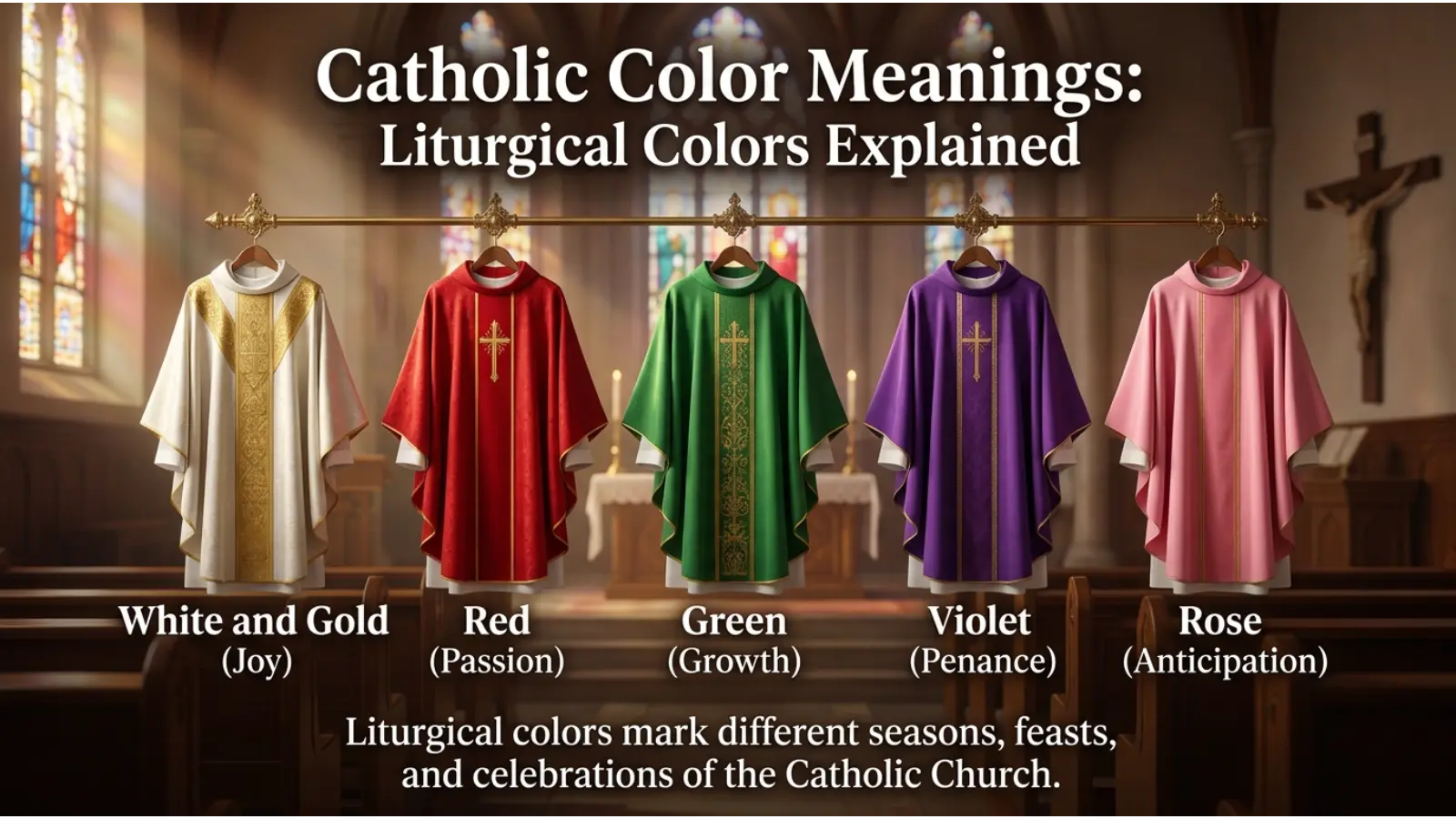
The most familiar Catholic liturgical colors are white, red, green, and violet (purple). Rose has a special place on two Sundays, while black may be used for Masses for the Dead in places where the practice is retained. In the United States, gold and silver may also be used on more solemn occasions.
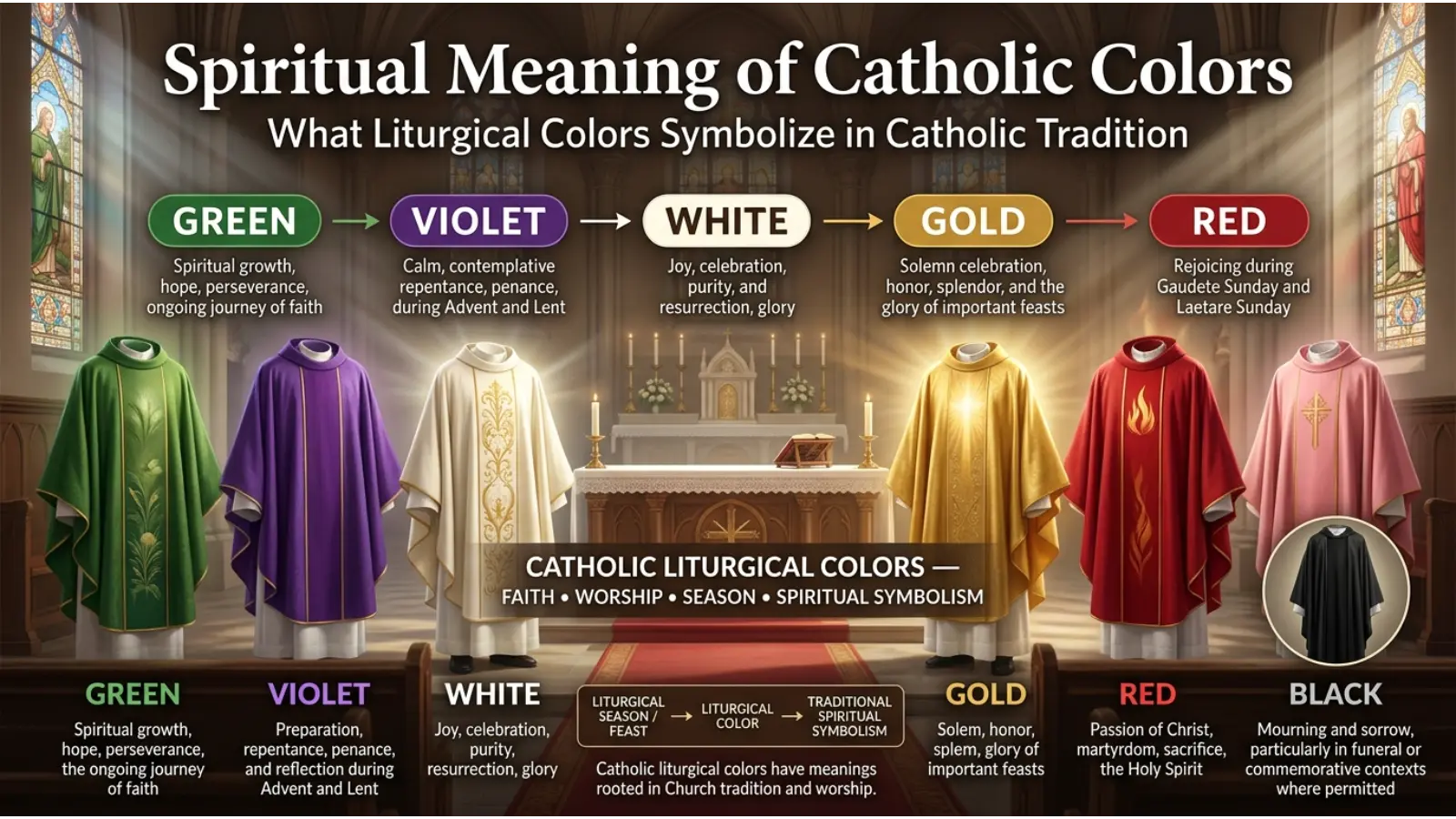
So, what do Catholic colors mean? White generally accompanies celebrations of Christ’s glory, resurrection, Christmas, Mary, angels, and saints who are not martyrs; red recalls the Passion of Christ, the Holy Spirit, and martyrdom; green marks Ordinary Time; violet expresses the penitential character of Advent and Lent; and rose signals joy within those penitential seasons. The exact use is determined by the liturgical calendar and the celebration.
Quick Answer: What Do Catholic Colors Mean?
| Liturgical Color | Common Catholic Meaning | Main Liturgical Use |
|---|---|---|
| ⚪ White | Joy, glory, resurrection, purity, celebration | Christmas, Easter, Mary, angels, non-martyr saints |
| 🔴 Red | Passion, sacrifice, fire, martyrdom, Holy Spirit | Palm Sunday, Good Friday, Pentecost, martyrs, Apostles and Evangelists |
| 🟢 Green | Growth, life, hope, ongoing Christian journey | Ordinary Time |
| 🟣 Violet/Purple | Penance, preparation, reflection | Advent and Lent; may also be used for the dead |
| 🌹 Rose | Joy and hope in the middle of penance | Gaudete Sunday and Laetare Sunday |
| ⚫ Black | Mourning and remembrance of the dead | May be used for funerals and Masses for the Dead |
| 🟡 Gold | Festivity and solemnity | Permitted on more solemn occasions in the United States |
| ⚪ Silver | Festivity and solemnity | Permitted on more solemn occasions in the United States |
The General Instruction of the Roman Missal explains that variation in vestment colors gives outward expression to the character of the mysteries celebrated and to the Christian journey through the liturgical year.
What Are Catholic Liturgical Colors?
Catholic liturgical colors are colors used especially for sacred vestments, such as the chasuble worn by a priest celebrating Mass. They change according to the liturgical season, feast, memorial, or particular celebration.
The purpose is not simply to make the church look different. The colors provide a visual rhythm. As the Church moves through Advent, Christmas, Lent, Easter, and Ordinary Time, the changing colors help worshippers recognize that the celebration has changed as well.
The Church’s official instructions describe this variety as a way of expressing outwardly the character of the mysteries of faith being celebrated.
That distinction matters. A website may describe purple as “mystical” or green as “healing,” but those descriptions are not automatically official Catholic meanings. Catholic liturgical symbolism needs to be grounded in actual liturgical practice.
White Catholic Color Meanings
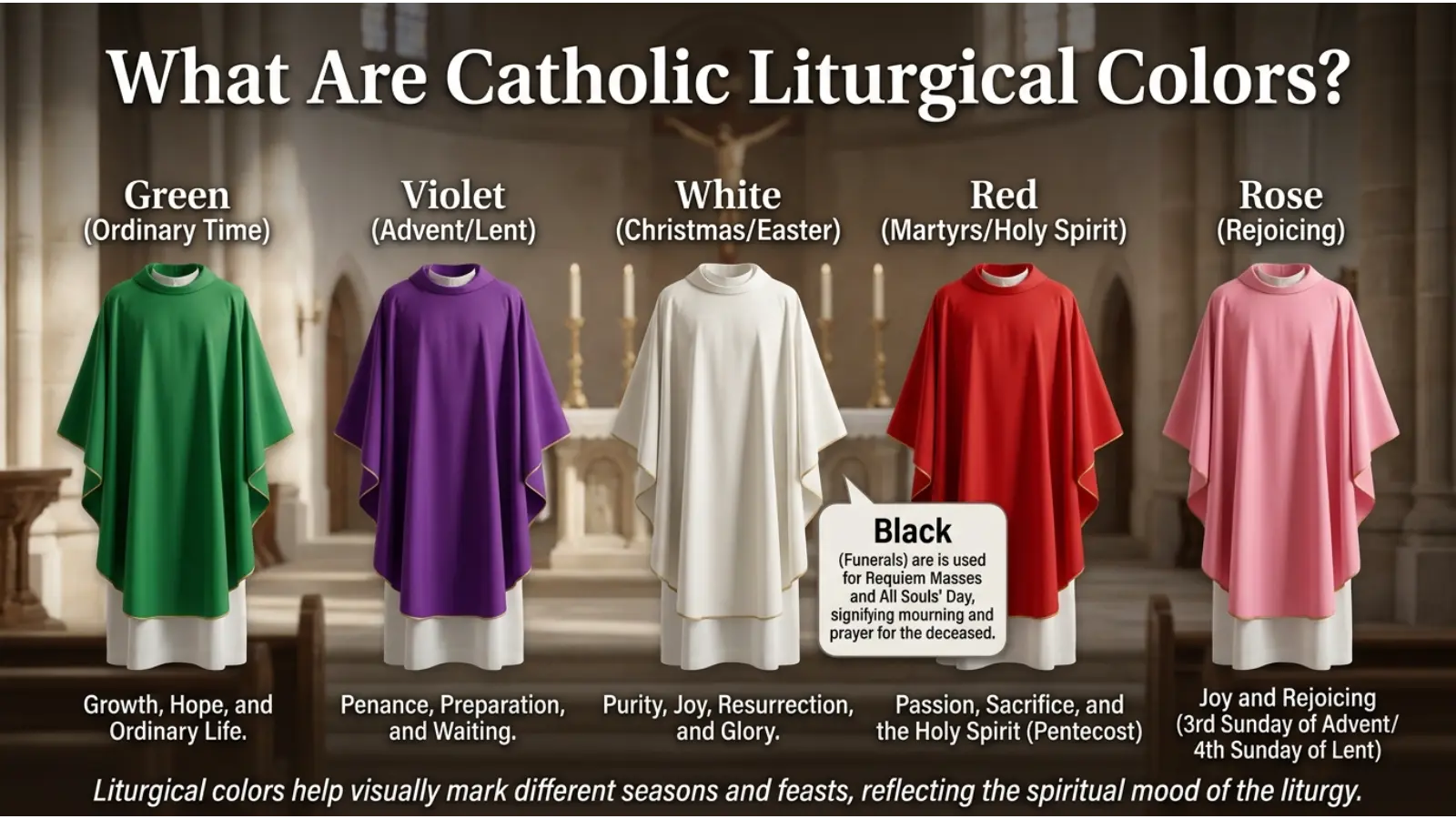
White is one of the most joyful and celebratory colors in the Catholic liturgical tradition.
It is used during Christmas Time and Easter Time and for celebrations of the Lord other than his Passion. It is also used for celebrations of the Blessed Virgin Mary, the angels, and saints who were not martyrs.
What Does White Represent in Catholicism?
In Catholic worship, white is strongly associated with:
- Joy
- Glory
- Celebration
- Resurrection
- New life
- Light
- Christ’s victory
- Festive worship
These associations make white especially fitting for Christmas and Easter.
White can also appear at celebrations of Mary and non-martyr saints. In these cases, the color helps create a joyful and festive atmosphere rather than emphasizing martyrdom or penitence.
White at Easter
Easter provides one of the clearest examples of white’s liturgical role.
The Church celebrates Christ’s Resurrection, so the liturgical color changes from the penitential character of Lent to the joyful character of Easter. The USCCB identifies white as the color used throughout Easter Time.
White therefore communicates celebration rather than simply “purity.”
Red Catholic Color Meaning
Red is one of the most visually powerful liturgical colors.
It is used on Palm Sunday, Good Friday, Pentecost Sunday, celebrations of the Lord’s Passion, celebrations of Apostles and Evangelists, and celebrations of martyr saints.
What Does Red Symbolize in Catholic Worship?
Red can point toward several connected ideas:
- Christ’s Passion
- Sacrifice
- Martyrdom
- The Holy Spirit
- Fire
- Witness to the faith
The meaning depends on the celebration.
On Good Friday, red is connected with the Passion of Christ. On Pentecost, it accompanies the celebration of the Holy Spirit. If On a martyr’s feast, it recalls the saint’s witness and death for the faith.
This is a good example of why color symbolism cannot be reduced to one simple definition.
Why Is Red Used for Pentecost?
Pentecost celebrates the coming of the Holy Spirit upon the apostles. Red is traditionally associated with the fire of the Holy Spirit and therefore fits the character of the celebration.
At the same time, red is not limited to Pentecost. Its other liturgical uses show how the same color can express different but related aspects of Catholic faith.
Green Catholic Color Meaning
What Does Green Represent?
Green is commonly associated with:
- Growth
- Life
- Hope
- Continuity
- The ordinary journey of Christian discipleship
However, the official rule is simpler than many symbolic explanations suggest: green is the liturgical color for Ordinary Time.
The idea of growth is a useful interpretive association because Ordinary Time is not a period when “nothing happens.” It is the extended part of the liturgical year in which Christians continue living and growing in faith.
Green therefore works visually as a steady color between the more distinctive seasons of Advent, Christmas, Lent, and Easter.
Violet or Purple Catholic Color Meaning
The General Instruction of the Roman Missal specifies violet or purple for these two seasons and also permits its use for Offices and Masses for the Dead.
What Does Purple Mean in Catholicism?
Violet commonly communicates:
- Penance
- Preparation
- Reflection
- Conversion
- Expectation
- Spiritual seriousness
Advent and Lent are different seasons, but both prepare Christians for major celebrations.
Advent looks toward the coming of Christ, while Lent prepares the faithful for the celebration of Easter.
Rose Catholic Color Meaning
Rose is one of the most distinctive Catholic liturgical colors because it appears only at particular moments.
It may be used on:
- Gaudete Sunday, the Third Sunday of Advent
- Laetare Sunday, the Fourth Sunday of Lent
The Church’s liturgical instructions describe rose as an optional color “where it is the practice.”
Why Is Rose Used During Advent and Lent?
Advent and Lent have penitential or preparatory qualities. Rose introduces a visual note of joy while those seasons are still underway.
The message is not that the penitential season has ended. Instead, the color provides a brief reminder of the joy toward which the season is moving.
That is why rose is often described as a color of joy, hope, and anticipation.
A 2026 Catholic News Service report also explains that the change to rose on Laetare Sunday creates a visual reminder that something joyful is approaching as Easter draws near.
Black Catholic Color Meaning
Black has a traditional association with mourning and death.
Does Black Mean Evil in Catholic Liturgy?
No.
Modern color symbolism sometimes connects black with evil, darkness, or danger. That should not be automatically transferred to Catholic liturgy.
It is therefore a good example of how context changes color symbolism.
Gold and Silver Catholic Color Meaning
Gold and silver are less common than the main liturgical colors.
These colors function as festive alternatives, emphasizing the solemn and celebratory character of an important occasion.
They should not be treated as additional seasons of the liturgical year. Instead, they can serve as especially festive colors where permitted.
Catholic Liturgical Colors by Season
The easiest way to understand Catholic color meanings is to connect them with the liturgical calendar.
| Season or Celebration | Typical Color |
|---|---|
| Advent | Violet |
| Christmas Time | White |
| Ordinary Time | Green |
| Lent | Violet |
| Palm Sunday | Red |
| Good Friday | Red |
| Easter Time | White |
| Pentecost | Red |
| Gaudete Sunday | Rose may be used |
| Laetare Sunday | Rose may be used |
| Masses for the Dead | Violet, white, or black depending on place and practice |
The exact color can sometimes depend on the particular celebration rather than simply the season. For example, an optional memorial may have a different liturgical color from the weekday color.
Catholic Color Meanings and the Liturgical Year
The colors make more sense when viewed as a visual journey.
Advent → Christmas → Ordinary Time → Lent → Easter → Ordinary Time
The colors change with that journey:
Violet → White → Green → Violet → White → Green
Red appears at particular celebrations such as Palm Sunday, Good Friday, Pentecost, and feasts of martyrs, Apostles, and Evangelists.
Rose provides a brief visual change during Advent and Lent.
This creates a kind of visual calendar inside the church. Even before hearing the readings, worshippers can often recognize the character of the day from the vestments and other liturgical elements.
Why Do Catholic Priests Wear Different Colors?
The color of the priest’s vestments helps express the character of the celebration.
So the vestment is not simply a fashion choice.
The color becomes part of the visual language of worship. It works alongside Scripture readings, music, prayers, architecture, gestures, candles, and other signs used during the liturgy.
Catholic Color Meanings vs. Color Psychology
Catholic liturgical symbolism should not be confused with modern color psychology.
Color psychology studies how people may respond to colors in different situations. Catholic liturgical colors belong to a religious and historical system.
For example, psychology might describe white as clean or calming. Catholic worship may use white during Easter because it is appropriate to the celebration of Christ’s Resurrection.
Those ideas can overlap, but they are not the same thing.
The context determines the meaning.
Spiritual Catholic Color Meanings
Catholic colors can invite reflection, but personal spiritual interpretations should not be presented as official Church doctrine.
A worshipper might associate:
- White with resurrection and joy
- Red with sacrifice and the Holy Spirit
- Green with continued spiritual growth
- Violet with repentance and preparation
- Rose with hope and approaching joy
- Black with mourning and remembrance
That distinction keeps Catholic color symbolism accurate.
Historical Development of Catholic Liturgical Colors
The use of liturgical colors developed over time rather than appearing as one complete system from the beginning of Christianity.
Different Christian communities used colors and vestments in different ways. Eventually, Western Catholic practice developed a more established system connected to the liturgical calendar.
The modern Roman Rite retains traditional usage while also allowing certain regional adaptations. The General Instruction notes that episcopal conferences can propose adaptations concerning liturgical colors when appropriate to local needs and cultures.
This explains why practices can differ somewhat between countries without making every local variation incorrect.
Catholic Color Meanings in Different Cultures
Catholic liturgical colors belong to a worldwide Church, but cultural traditions can influence how colors are perceived.
A color that feels joyful in one culture may have a stronger association with mourning in another. Local customs, architecture, flowers, clothing, art, and community traditions can all influence perception.
However, liturgical rules provide an important framework.
For example, a community might decorate a church with different local flowers, but that does not necessarily change the prescribed liturgical color of the day.
The Roman Missal provides the liturgical structure, while local culture can influence legitimate forms of expression within that structure.
Catholic Color Meanings in Church Decoration
Liturgical color is most clearly seen in vestments, but color also affects the visual atmosphere of a church.
The altar itself has specific requirements. In the United States, when additional altar cloths are used, they may have other colors with Christian or festive significance according to longstanding local usage, but the uppermost altar cloth covering the altar table must remain white.
Church decoration should therefore support the liturgy rather than compete with it.
During Lent
Lenten decoration is generally more restrained. A 2026 Catholic News Service report notes that flowers are normally absent during Lent, with limited exceptions and a more joyful visual character on Laetare Sunday.
During Easter
Easter brings a much more festive atmosphere. White, gold, flowers, and other bright elements can visually reinforce the celebration of new life and resurrection.
Catholic Colors in Art
Artists have long used color to communicate religious ideas.
A painting may use red to draw attention to sacrifice, white to emphasize holiness or resurrection, or blue in connection with the Virgin Mary. However, artistic symbolism and official liturgical color rules are not identical systems.
This distinction matters when interpreting religious artwork.
A blue garment in a painting does not mean that blue is one of the standard Roman Rite liturgical colors. Likewise, an artist may use gold for visual glory even when the Church’s liturgical color for the celebration is another color.
Art allows greater symbolic freedom than the prescribed liturgical calendar.
Catholic Colors and Marian Symbolism
Mary is an important example of why Catholic color symbolism needs context.
The liturgical color for celebrations of the Blessed Virgin Mary is generally white, according to the Roman Missal.
Yet Christian art often portrays Mary in blue.
These facts are not contradictory.
Blue has a long artistic and cultural association with Mary, while white is the prescribed liturgical color for celebrations of the Blessed Virgin Mary in the Roman Rite.
The distinction between artistic symbolism and liturgical regulation prevents a common misunderstanding.
Catholic Colors and Personality
People sometimes ask whether their favorite Catholic color says something about their personality.
There is no reliable Catholic teaching that assigns a personality type to someone based on their preferred liturgical color.
Someone who loves green is not automatically more peaceful. Someone who prefers red is not necessarily more courageous. The Someone attracted to violet is not automatically more spiritual.
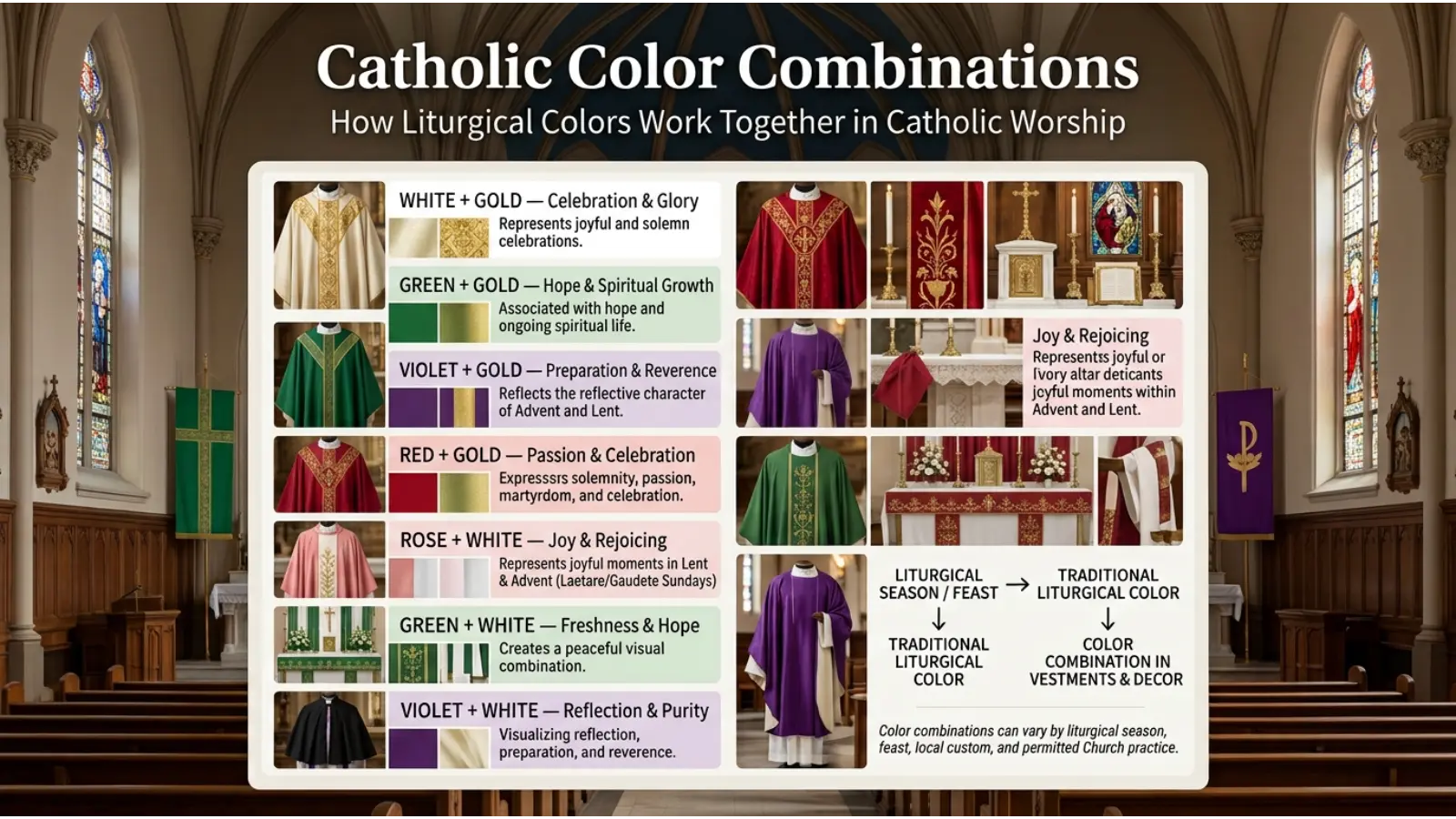
Catholic Color Combinations
Catholic churches often use several colors together, especially in flowers, banners, architecture, artwork, and seasonal decoration.
White and Gold
This combination creates a strongly festive appearance and works naturally with celebrations such as Christmas and Easter.
Red and White
Red and white create a strong visual contrast and can be especially striking for celebrations associated with Christ’s Passion or martyrs.
Violet and White
Violet with white can create a restrained but hopeful appearance during Advent or Lent.
Green and White
Green with white can soften the appearance of Ordinary Time and connect the color of the season with festive elements.
Rose and Violet
These colors create the distinctive visual contrast associated with Gaudete and Laetare Sundays.
The goal should not be to create a decorative color scheme merely because it looks attractive. Liturgical decoration should serve the celebration.
Common Misconceptions About Catholic Color Meanings
“Every Catholic color has one fixed spiritual meaning.”
Not exactly.
“Purple means sadness.”
Purple or violet is primarily associated with Advent and Lent. Those seasons involve preparation and penitential reflection, but purple does not simply mean sadness.
“Black means evil.”
In Catholic funerary use, black is associated with mourning and the dead. Its meaning is contextual.
“Rose replaces purple for the whole season.”
No. Rose may be used only on Gaudete Sunday and Laetare Sunday where that practice is followed.
Real-World Uses of Catholic Color Meanings
Catholic color symbolism can be useful beyond simply identifying a priest’s vestments.
For Church Visitors
Understanding the colors can help visitors recognize where the Church is within the liturgical year.
For Religious Education
Teachers can use the colors as visual memory tools when explaining Advent, Christmas, Lent, Easter, and Ordinary Time.
For Church Decoration
Parish decorators can coordinate flowers, banners, and other appropriate visual elements with the liturgical season while respecting Church guidelines.
For Catholic Art
Artists can distinguish between formal liturgical colors and broader artistic symbolism.
For Photography
Photographers documenting Catholic worship can use the changing colors to visually distinguish different seasons and celebrations.
For Families
Parents can teach children the liturgical calendar through simple color associations: purple for preparation, white for major celebrations, green for Ordinary Time, and red for particular celebrations such as Pentecost and martyr feasts.
How Lighting Changes Catholic Colors
The same vestment can look surprisingly different under different lighting.
Warm church lighting can make white appear cream or ivory. Strong daylight may make it appear brighter. Violet can shift toward blue or red depending on the light source.
Photography introduces another layer. Camera white balance, exposure, surrounding colors, and editing can all change how a liturgical color appears in an image.
The liturgical calendar and official instructions are more reliable than visual appearance.
Why Context Changes Catholic Color Meaning
A red vestment on Good Friday and a red vestment on Pentecost have different immediate associations.
The color remains red, but the celebration changes.
Likewise, white at Easter emphasizes the Resurrection, while white at a celebration of a non-martyr saint belongs to a different liturgical context.
This is one of the most important lessons in Catholic color symbolism:
Color does not work alone. The feast, season, Scripture, prayers, and traditions surrounding it complete the meaning.
Catholic Liturgical Colors at a Glance
| Color | Main Idea | Common Uses |
|---|---|---|
| ⚪ White | Celebration and glory | Christmas, Easter, Mary, angels, non-martyr saints |
| 🔴 Red | Passion, Holy Spirit, martyrdom | Good Friday, Palm Sunday, Pentecost, martyrs |
| 🟢 Green | Ordinary Christian life | Ordinary Time |
| 🟣 Violet | Preparation and penance | Advent, Lent |
| 🌹 Rose | Joy within preparation | Gaudete and Laetare Sundays |
| ⚫ Black | Mourning | Masses for the Dead where used |
| 🟡 Gold | Festive solemnity | More solemn occasions in the U.S. |
| ⚪ Silver | Festive solemnity | More solemn occasions in the U.S. |
The official Roman Rite rules provide the foundation for this chart.
Frequently Asked Questions
What are the four main Catholic liturgical colors?
The four main colors are white, red, green, and violet. The USCCB identifies these as the primary colors used throughout the liturgical calendar
What does green mean in Catholicism?
Green is the liturgical color for Ordinary Time. It is often associated with ongoing Christian growth and hope, although the formal liturgical rule is simply its use during Ordinary Time.
Why does the Catholic Church use purple?
Violet or purple is used during Advent and Lent. It visually marks seasons of preparation and penitential reflection. It may also be used for Masses for the Dead.
Why is rose used in Catholic Mass?
Rose may be used on Gaudete Sunday in Advent and Laetare Sunday in Lent. It introduces a visual expression of joy within these seasons of preparation.
Can Catholic priests wear black?
Yes. Black may be used for funerals and Masses for the Dead where the local practice permits it. In the United States, black is explicitly permitted for these celebrations.
Is blue a Catholic liturgical color?
Blue is not one of the standard Roman Rite liturgical colors listed in the General Instruction of the Roman Missal. It does, however, have important associations in Catholic art and devotion, particularly in representations of Mary.
Can gold replace the normal liturgical color?
In the dioceses of the United States, gold or silver-colored vestments may be used on more solemn occasions.
Why do Catholic colors change during the year?
The colors change because the Church’s liturgical year moves through different seasons and celebrations. The visual changes help express the character of those celebrations and make the passage of the liturgical year visible.
Final Thoughts on Catholic Color Meanings
Catholic color meanings are best understood as part of a larger visual language of worship. White, red, green, violet, rose, and black each appear within particular liturgical contexts, while gold and silver can add festivity on especially solemn occasions where permitted.
The deeper lesson is that Catholic color symbolism is contextual rather than simplistic. Red can point toward Christ’s Passion, the Holy Spirit, or martyrdom. White can accompany Easter, Christmas, Mary, angels, or non-martyr saints. Violet can mark both Advent and Lent. Rose offers a brief visual expression of joy within those preparatory seasons.
These colors do not replace the words and actions of the liturgy. Instead, they support them.
Once you understand the system, the changing colors of the Catholic Church become a visual guide to the story being celebrated—from preparation and expectation, through Christ’s Passion and Resurrection, to the ordinary work of growing in Christian faith.

Emma Wilson is a dedicated comparison writer and product researcher at ColorMystiic.com. She specializes in creating unbiased product comparisons, detailed reviews, and helpful buying guides. Her goal is to help readers make smarter purchasing decisions with confidence.