Wristbands are small, but their colors can communicate surprisingly large ideas. A blue wristband may suggest calm or trust, while red can feel energetic, urgent, or passionate. Purple may suggest creativity or spirituality, and green often connects with nature, growth, or health. However, wristband color meanings are not universal rules. The same color can communicate something different depending on the event, organization, culture, material, and surrounding design.
People search for wristband colors because they see them at concerts, hospitals, schools, festivals, workplaces, sports events, awareness campaigns, and everyday fashion. Sometimes a color has an official meaning. In other situations, it is simply decorative or chosen for branding.
This guide explains the symbolism, psychology, cultural context, fashion value, branding uses, and practical meanings behind common wristband colors. It also separates widely recognized associations from meanings that depend on context.
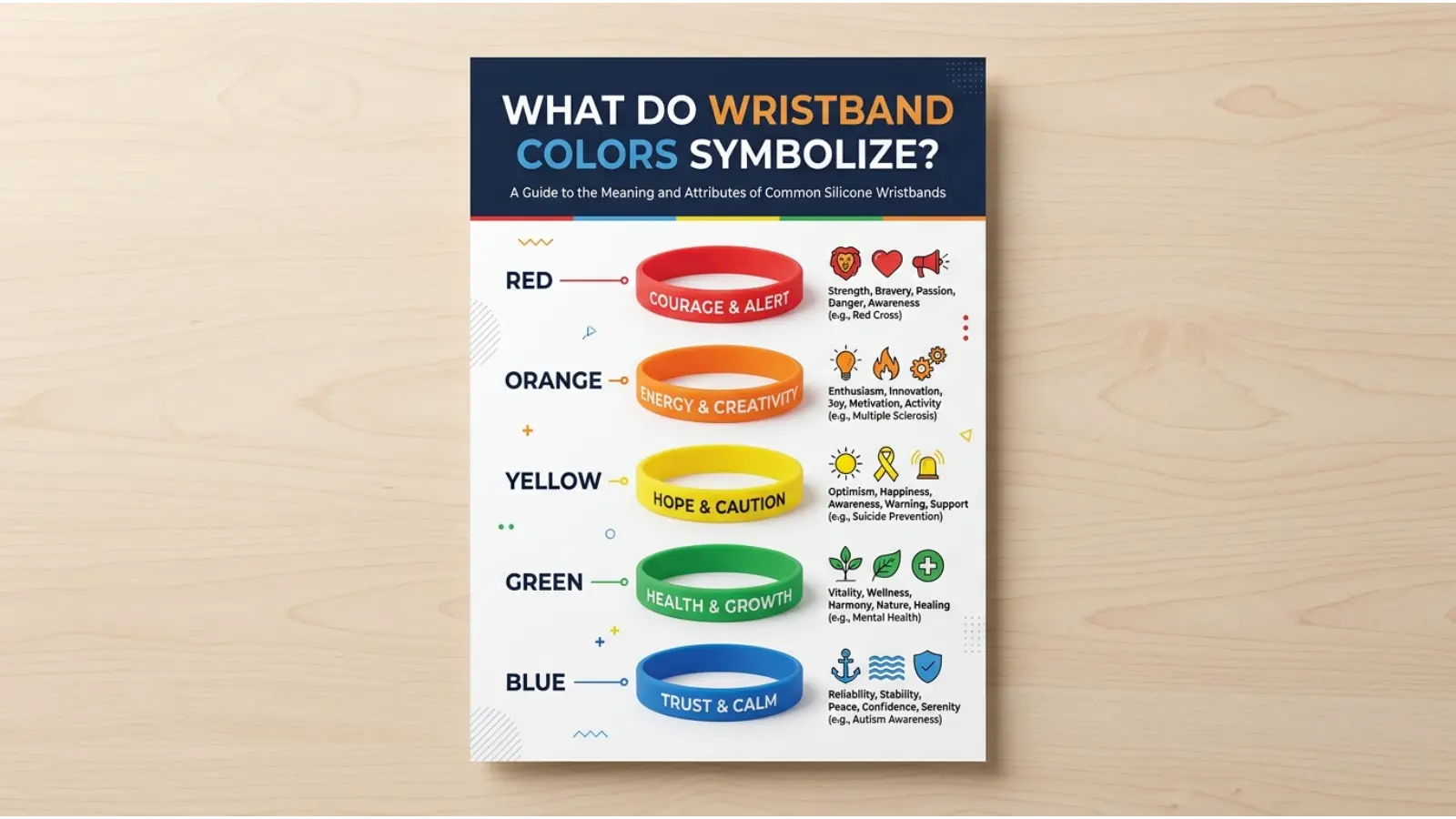
Quick Answer: Wristband colors can symbolize emotions, causes, identification, safety, membership, status, or personal style. Red often suggests energy or urgency, blue trust or calm, green nature or growth, yellow optimism, orange enthusiasm, purple creativity or spirituality, pink compassion, black strength or formality, and white simplicity or peace. However, there is no universal wristband color code, so the organization or event using the wristband should always be considered first.
Wristband Color Meanings at a Glance
The easiest way to understand wristband colors is to compare their common associations while remembering that context changes the message.
| Wristband Color | Common Associations | Typical Impression | Common Uses |
|---|---|---|---|
| Red | Energy, passion, urgency, courage | Strong and attention-grabbing | Events, causes, sports, fashion |
| Blue | Trust, calm, reliability, stability | Peaceful and dependable | Organizations, events, awareness |
| Green | Nature, growth, renewal, health | Fresh and balanced | Environmental campaigns, wellness |
| Yellow | Happiness, optimism, attention | Bright and cheerful | Events, youth activities, promotions |
| Orange | Enthusiasm, creativity, action | Energetic and friendly | Festivals, sports, campaigns |
| Purple | Creativity, imagination, spirituality | Distinctive and expressive | Causes, fashion, artistic events |
| Pink | Compassion, affection, care | Warm and gentle | Awareness, charity, fashion |
| Black | Power, sophistication, mystery | Bold and modern | Fashion, VIP events, branding |
| White | Peace, simplicity, cleanliness | Minimal and calm | Ceremonies, fashion, identification |
| Gold | Success, achievement, prestige | Premium and celebratory | Awards, VIP access, luxury branding |
| Silver | Modernity, technology, elegance | Sleek and refined | Events, fashion, technology |
| Brown | Earth, stability, natural warmth | Grounded and practical | Outdoor events, natural brands |
| Gray | Neutrality, balance, restraint | Professional and understated | Corporate or modern designs |
These are general color associations, not a universal code. A red wristband at one event could mean VIP access, while at another it could identify a participant group.
What Do Wristband Colors Symbolize?
A wristband can communicate meaning through two different systems: official meaning and visual symbolism.
Official meaning comes from the organization using the wristband. For example, an event may assign different colors to guests, staff, backstage workers, or age groups. In that situation, the event’s own rules matter more than general color psychology.
Visual symbolism is different. It comes from cultural associations and the way people tend to perceive colors. Red often feels more intense than blue, while green commonly feels more natural than black.
Therefore, a wristband’s meaning should never be judged by color alone. Look at the setting, text, logo, symbols, and purpose alongside the color.
Why Wristbands Are So Effective
Wristbands are highly visible because they remain on the body throughout an activity. Consequently, they can work as both identification tools and communication devices.
At a crowded event, for example, staff can recognize a particular color from a distance. At the same time, the wearer may see the wristband as a souvenir, fashion accessory, or symbol of participation.
This combination makes wristbands useful for both practical and emotional communication.
Red Wristband Meaning
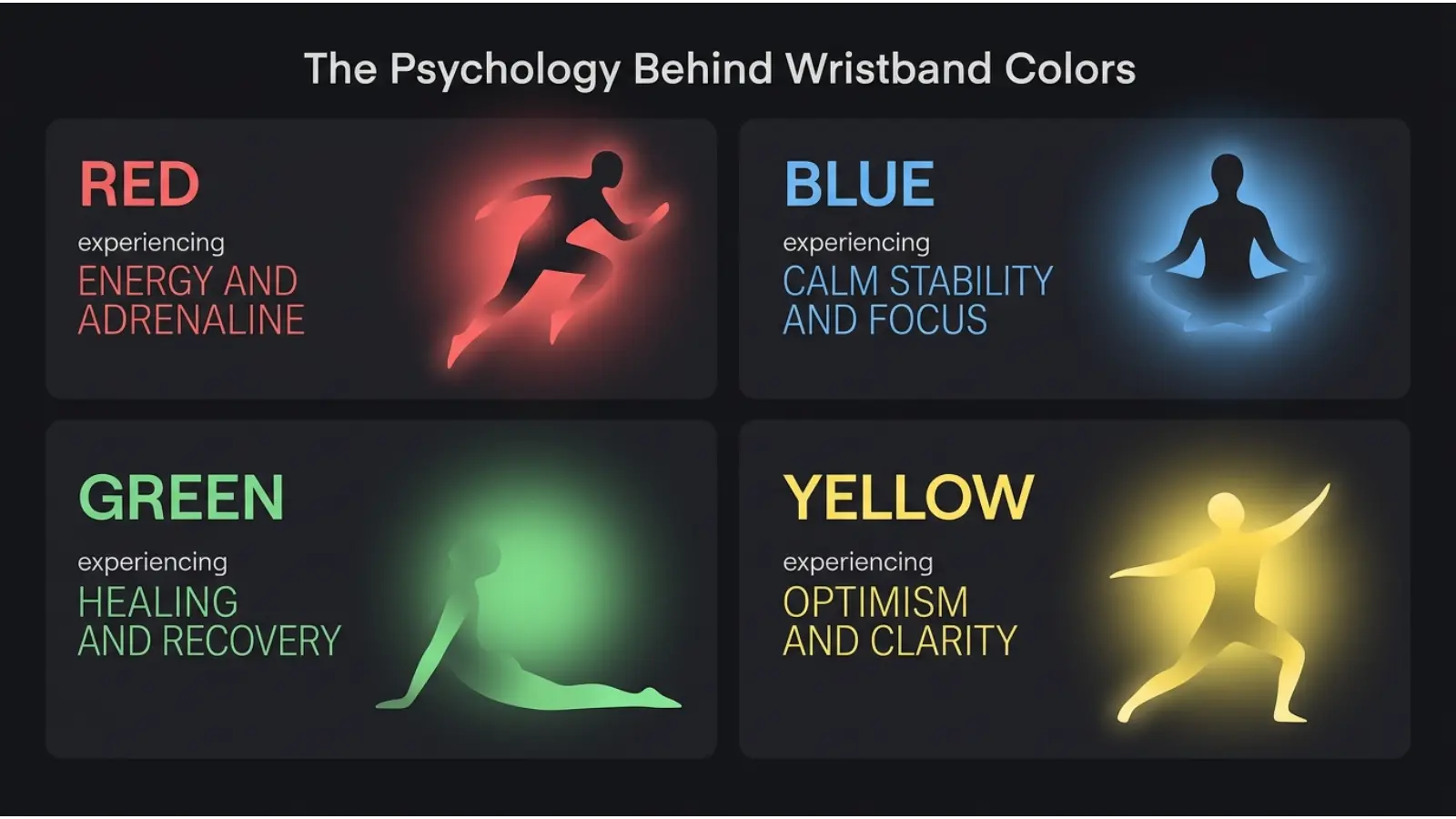
Red is one of the strongest visual colors. It commonly represents energy, passion, courage, excitement, urgency, and action.
Because red attracts attention, it can make a wristband easy to notice in a busy environment. That makes it useful when visibility matters.
However, red can also suggest danger, warning, anger, or aggression. The surrounding message determines which interpretation becomes stronger.
Red Wristbands in Real Life
A red wristband at a music event may create an energetic atmosphere. At a charity campaign, the same color may be connected with a specific cause. In fashion, a red bracelet can simply communicate confidence and bold personal style.
Therefore, red is best understood as a high-energy color rather than a single fixed symbol.
Blue Wristband Meaning
Blue commonly communicates calmness, trust, reliability, stability, and confidence.
It is often perceived as less aggressive than red. As a result, organizations that want to appear dependable may find blue visually useful.
A light-blue wristband can feel softer and more relaxed, whereas navy or dark blue can appear more formal and authoritative.
When Blue Works Best
Blue wristbands suit conferences, professional events, sports teams, community programs, and designs that need a calm visual identity.
Still, blue does not automatically mean trust. The design, shade, typography, and cultural setting all contribute to the final impression.
Green Wristband Meaning
Green is strongly associated with nature, growth, renewal, freshness, balance, and environmental awareness.
Its connection with plants and natural landscapes gives green a powerful visual relationship with the environment. Consequently, green wristbands are often attractive for outdoor activities and sustainability-themed designs.
Green can also have different meanings. Dark green may feel traditional or luxurious, while bright green can feel youthful and energetic.
Green in Wellness and Nature
A green wristband can visually support messages about healthy living, environmental protection, outdoor activities, or personal renewal.
However, a green wristband should not automatically be interpreted as a medical or health code unless the organization explicitly defines it that way.
Yellow Wristband Meaning
Yellow commonly suggests optimism, happiness, warmth, friendliness, and attention.
Because yellow is bright, it can be highly visible. Consequently, yellow wristbands can work particularly well at children’s events, festivals, school activities, and cheerful promotional campaigns.
There is another side to yellow. In some situations, very bright yellow can feel cautionary or intense because of its use in warning systems.
Therefore, yellow can move between cheerful and cautionary depending on context.
Orange Wristband Meaning
Orange combines some of the energy associated with red with the friendliness often associated with yellow.
It commonly represents enthusiasm, creativity, confidence, warmth, movement, and adventure.
Orange is especially useful when a design needs to feel active rather than formal. Sports events, festivals, youth programs, and recreational activities can benefit from its energetic appearance.
Muted orange, however, creates a different impression. Terracotta and burnt orange can feel earthy, mature, and autumnal.
Purple Wristband Meaning
Purple is frequently associated with creativity, imagination, individuality, luxury, mystery, and spirituality.
Historically, purple has also been associated with status and prestige in several societies because some purple dyes were difficult or expensive to produce. However, modern meanings are broader than status alone.
A bright purple wristband can feel playful and artistic. In contrast, deep purple can feel sophisticated or dramatic.
Because purple has a distinctive visual identity, it can help a wristband stand out without using an extremely bright color.
Pink Wristband Meaning
Pink often communicates care, affection, compassion, softness, playfulness, and emotional warmth.
Its meaning has also changed over time. Modern Western culture often connects pink with femininity, but that association is cultural rather than a universal psychological rule.
Different shades produce different impressions. Pale pink may appear gentle, while hot pink can feel energetic, fashionable, and confident.
Therefore, pink wristbands can range from subtle and caring to bold and expressive.
Black Wristband Meaning
The Black commonly represents strength, sophistication, authority, mystery, seriousness, and modern style.
Black silicone wristbands are especially popular because the material and color create a clean, durable appearance.
In fashion, black can feel elegant and versatile. In symbolic contexts, however, it can also represent grief, mourning, rebellion, or resistance.
That contrast makes black one of the most context-dependent wristband colors.
White Wristband Meaning
White is often connected with peace, simplicity, cleanliness, openness, innocence, and minimalism.
Its meaning varies significantly across cultures. In some settings, white is strongly associated with weddings and celebration, while in other cultural traditions it can have connections with mourning.
For design, white creates a clean appearance and works especially well with simple typography or colorful logos.
Gold Wristband Meaning
Gold suggests achievement, celebration, success, prestige, wealth, and premium quality.
A gold wristband can make an event category feel special. For example, a gold-colored design might be used for an award, anniversary, premium package, or celebratory occasion.
However, gold is visually powerful. Too much gold can make a design appear excessive, while a restrained metallic accent can create a more sophisticated effect.
Silver Wristband Meaning
Silver commonly suggests technology, modernity, elegance, precision, and sophistication.
It can work especially well with futuristic, technological, sports, or corporate themes.
Silver also has a practical advantage in design: it pairs easily with black, white, blue, purple, and other cool colors.
Brown Wristband Meaning
Brown is associated with earth, reliability, warmth, simplicity, and natural materials.
It is less common than brighter wristband colors, which can make it useful for brands or events seeking a natural or understated identity.
Brown works particularly well with outdoor, handmade, craft, camping, environmental, and rustic themes.
Gray Wristband Meaning
Gray is generally neutral and understated. It can communicate balance, professionalism, restraint, practicality, and modern simplicity.
Because gray does not demand attention in the same way as red or yellow, it can be useful when the wristband needs to look professional rather than highly expressive.
Dark charcoal gray can also provide a sophisticated alternative to black.
The Psychology Behind Wristband Colors
Color psychology is useful, but it should not be treated as a system of guaranteed emotional reactions.
People do not automatically experience one emotion whenever they see a specific color. Instead, perception is influenced by context, personal experience, culture, brightness, saturation, surrounding colors, and even the object’s purpose.
Warm Colors Feel More Energetic
Red, orange, and yellow are generally considered warm colors. They can create a stronger sense of visual activity and attention than many cool colors.
For example, an orange wristband may feel more energetic at a sports event than a gray one.
Cool Colors Can Feel Calmer
Blue, green, and some purples are often described as cooler colors. They can create impressions of calmness, freshness, or stability.
Nevertheless, shade matters. A neon green can feel extremely energetic, while a deep forest green may feel quiet and natural.
Brightness Changes the Message
A color’s lightness can dramatically change how it feels.
Bright red may look playful or energetic. Deep burgundy can appear mature and luxurious. Pale blue can feel peaceful, while navy blue can feel formal.
Thus, saying simply that “blue means calm” misses an important part of color perception.
Spiritual Wristband Color Meanings
Color symbolism appears in many spiritual and religious traditions, but meanings are not universal.
Blue may be used symbolically for peace, protection, devotion, or transcendence in particular traditions. Green can represent life, renewal, or nature. Purple can be connected with spirituality, contemplation, or sacred status in some contexts.
However, these interpretations should not be presented as universal spiritual facts. Religious symbolism develops within specific traditions, texts, rituals, and communities.
A spiritual wristband therefore gains meaning from the belief system surrounding it, not from color alone.
Cultural Differences in Wristband Color Meanings
Color meanings change across cultures because people learn associations through history, religion, ceremonies, politics, fashion, and everyday life.
Western Cultural Contexts
In many Western settings, black can communicate formality or mourning, white can suggest simplicity or peace, and red can indicate passion or urgency.
Yet even within Western societies, these associations are not fixed.
Asian Cultural Contexts
Color symbolism varies widely across Asian cultures. Red, for example, can carry strong associations with celebration, prosperity, good fortune, or happiness in some Chinese cultural contexts.
White can also have very different associations depending on the country and ceremony.
African Cultural Contexts
Africa contains hundreds of cultures and traditions, so it is inaccurate to describe one universal “African color meaning.”
Colors may carry specific meanings within particular ethnic groups, nations, ceremonies, textiles, flags, and religious practices. Therefore, local context should always be considered.
Latin American Cultural Contexts
Color symbolism across Latin America is equally diverse. Religious celebrations, national traditions, festivals, Indigenous heritage, and modern popular culture can all influence color meanings.
Consequently, a wristband used for a community event may communicate something very different from a fashion bracelet using the same color.
Historical Development of Wristband Symbolism
Wristbands themselves have long existed as decorative and functional objects, but the modern use of colored wristbands expanded strongly through organized events, awareness campaigns, entertainment, fundraising, and identification systems.
Silicone charity wristbands became especially visible in the early 2000s. Their low cost, durability, and ability to carry short messages made them effective campaign tools.
As a result, color became part of a broader visual language. People began recognizing certain wristband designs as symbols of causes, communities, events, or personal support.
The important lesson is that many modern wristband meanings come from specific campaigns, rather than from ancient universal color codes.
Wristband Colors in Branding and Marketing
Wristbands can function like miniature brand assets.
A company may choose blue to support a dependable corporate identity, orange to create an energetic event atmosphere, or black to communicate a premium experience.
However, successful branding depends on more than choosing a psychologically appealing color.
The logo, typography, material, finish, audience, and surrounding environment all influence perception. A bright yellow wristband with playful lettering sends a very different message from a matte black wristband with minimalist silver text.
Why Marketers Use Color
Color helps people recognize visual information quickly.
At a crowded conference, for example, color-coded wristbands can separate attendees into categories. At a promotional event, a distinctive color can make merchandise more memorable.
Furthermore, a wristband remains visible while people move through an event. That gives it both identification value and advertising potential.
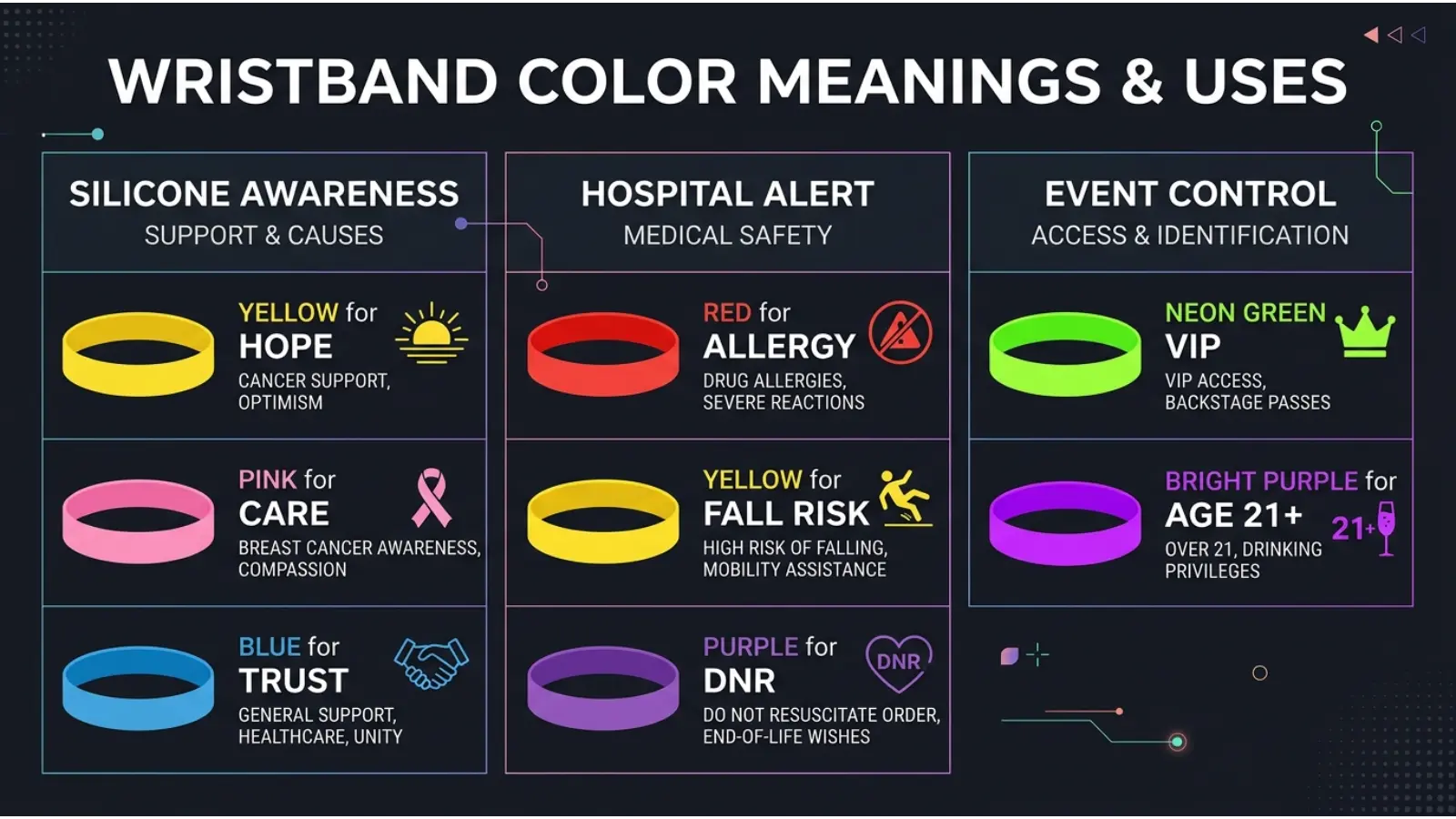
Wristband Colors for Events and Access
One of the most practical uses of wristband colors is access control.
A venue might use different colors for:
- General admission
- VIP guests
- Staff
- Performers
- Media
- Children
- Specific event days
- Special activities
In this situation, the event’s official system overrides general color symbolism.
For example, a black wristband may mean VIP at one festival and general admission at another. There is no universal rule that black equals VIP.
A Real-Time Example: A Concert Tonight
Imagine you arrive at a concert this evening and receive a bright orange wristband.
You might naturally associate orange with excitement and energy. However, suppose the event organizer says orange identifies guests with access to a specific activity area.
The official meaning is therefore activity access, while the psychological impression of orange remains energetic and friendly.
This example shows why wristband color meanings have two layers: the assigned practical meaning and the visual meaning people bring to the color.
Wristband Color Meanings in Fashion
Fashion wristbands allow people to use color as personal expression without needing an official symbolic meaning.
A red wristband can become a bold accent against neutral clothing. A black wristband can provide a minimalist look. Gold can add a luxury touch, while green can create a natural or relaxed appearance.
The material matters too. Silicone feels sporty and casual, leather feels classic, metal can feel refined, and woven fabric often feels youthful or informal.
Choosing a Wristband for an Outfit
For a subtle appearance, choose a wristband that matches one of the colors already present in your outfit.
A stronger statement, use a contrasting color.
For example:
- Navy clothing + orange wristband = energetic contrast
- Black clothing + red wristband = bold accent
- White clothing + blue wristband = clean and calm
- Earth tones + green wristband = natural combination
- Gray clothing + purple wristband = creative contrast
Wristbands in Interior and Event Design
Although wristbands are worn on the body, their colors can also become part of an event’s wider visual environment.
A conference using blue wristbands may repeat blue in signage, stage lighting, badges, and digital screens. Similarly, a festival using orange wristbands might use warm colors throughout its promotional materials.
This creates visual consistency.
Lighting, however, can change the appearance of the wristband. A blue silicone band under blue stage lighting may appear much darker or more saturated than it does outdoors.
Therefore, event designers should test wristband colors under the actual lighting conditions where they will be used.
How Age Changes Color Interpretation
Age can influence color preference and perception.
Children may respond strongly to bright, high-saturation colors because these colors are visually noticeable and commonly used in children’s products. Adults may prefer more muted or sophisticated shades in professional or fashion settings.
However, there is no rule that says one color belongs to one age group.
A person’s environment, personality, culture, fashion preferences, and experience can matter more than age alone.
How Personal Experience Changes Meaning
Color can become connected to memories.
Someone may associate blue with a favorite sports team, green with a childhood place, or purple with a meaningful event. As a result, personal symbolism can override general color associations.
This is one reason color psychology should be used carefully. Population-level associations do not predict exactly how one individual will respond.
Common Misconceptions About Wristband Color Meanings
Myth: Every Wristband Color Has One Official Meaning
False.
Organizations can assign colors however they choose. Always check the event, campaign, or manufacturer before assuming a meaning.
Myth: Color Determines Personality
Not reliably.
Color preferences can be interesting indicators of taste or cultural association, but they cannot diagnose personality or predict behavior by themselves.
Myth: Red Always Means Love
Not necessarily.
Red can communicate love and passion, but it can also represent danger, urgency, strength, celebration, anger, or energy.
Myth: White Always Means Peace
Not everywhere.
White has multiple cultural and religious associations, including meanings connected with mourning in some traditions.
Myth: Darker Colors Always Mean Negative Emotions
No.
Dark colors can communicate elegance, seriousness, authority, luxury, mystery, or strength. Their meaning depends heavily on context.
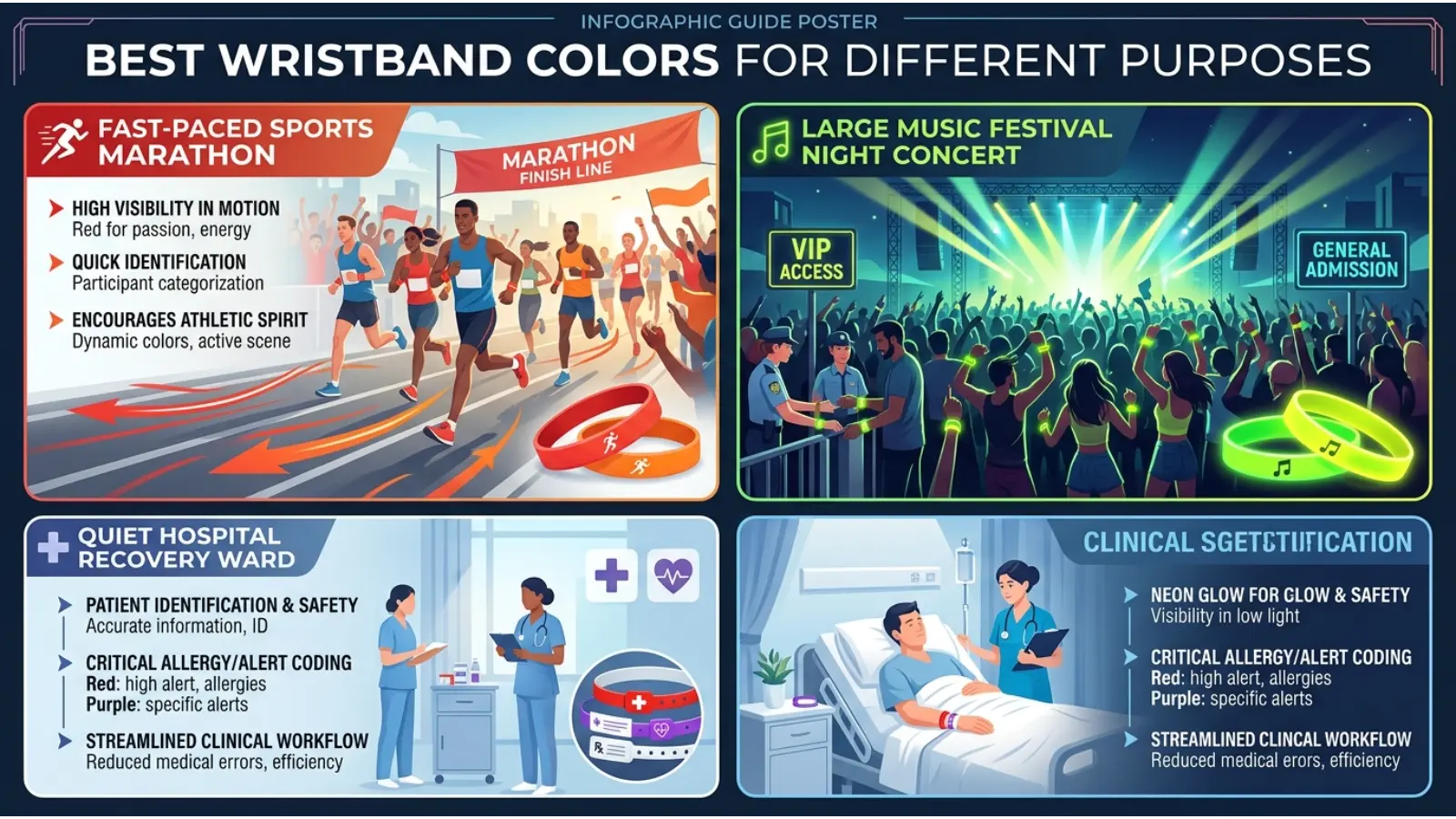
Best Wristband Colors for Different Purposes
For a Charity Campaign
Choose a color that already has a recognized relationship with the campaign when one exists. Otherwise, select a color that fits the campaign’s emotional message and visual identity.
For a Sports Event
Strong, energetic colors such as red, orange, yellow, or bright green can create an active atmosphere.
For a Professional Conference
Blue, navy, gray, white, or restrained purple can create a more professional appearance.
For a Children’s Event
Bright, cheerful colors can make the experience feel playful and easy to identify visually.
For a Luxury Event
Black, gold, silver, deep purple, or dark blue can create a more premium impression.
For an Environmental Event
Green and earth-inspired colors naturally support themes related to nature and sustainability.
Color Combinations for Wristbands
Color combinations can communicate more than a single color because contrast changes visual attention.
Blue and White
This combination feels clean, calm, and professional. It works well for conferences, community programs, and minimalist designs.
Red and Black
The contrast is dramatic and powerful. It suits sports, entertainment, and bold promotional designs.
Green and Brown
These colors reinforce natural and earthy associations. They are useful for outdoor events and environmental themes.
Purple and Gold
The combination can feel celebratory, creative, and luxurious.
Orange and Yellow
Together, they create a bright and energetic visual identity. They work especially well for festivals and youth-oriented events.
Pink and White
This pairing creates a soft, friendly appearance and can suit charitable or fashion-oriented designs.
How Artists Use Wristband Color Meanings Symbolism
Artists can use a wristband as a small but meaningful visual detail.
A red wristband on a character might suggest energy or emotional intensity. A black wristband could reinforce a rebellious or mysterious character. A white wristband might visually support innocence or simplicity.
However, good visual storytelling does not rely on one color alone.
Artists combine color with facial expression, lighting, clothing, composition, setting, and narrative. The result is a layered meaning rather than a simple color code.
Wristband Colors in Photography and Film
Photographers and filmmakers can use wristbands as visual anchors.
A brightly colored wristband can draw attention to a person’s hands, movement, or interaction. In a muted scene, a single red or yellow accessory can become a focal point.
Lighting is especially important. Warm lighting can make orange and red appear stronger, while cool lighting can emphasize blue and violet.
Therefore, photographers should evaluate the actual color under the final lighting rather than relying only on a digital color sample.
How Material Changes Wristband Color
The same color can look completely different depending on the material.
Matte silicone absorbs more light and usually looks softer. Glossy silicone reflects highlights and can appear brighter. Metallic finishes create reflective effects that change as the wrist moves.
Fabric can produce a softer appearance, while transparent materials allow background colors and light to influence the wristband.
Consequently, choosing the right color is only part of the design process. Finish and material are equally important.
Practical Tips for Choosing a Wristband Color
Before selecting a wristband color, ask five simple questions:
- Does the color have an official meaning?
- Who will wear it?
- Where will it be seen?
- What emotion or identity should the design suggest?
- Will people be able to distinguish it easily?
Also consider accessibility. Colors should not be the only way to communicate important information. Add text, symbols, patterns, or clear labels when a color distinction affects safety or access.
This is especially important for people with color-vision deficiencies.
Frequently Asked Questions
What is the most common wristband color meaning?
There is no single universal meaning. Blue, red, green, yellow, black, and other colors may represent different things depending on the event or organization.
What does a red wristband usually mean?
Red commonly suggests energy, passion, urgency, courage, or strong emotion. At organized events, however, red may have a completely different assigned meaning.
What does a blue wristband symbolize?
Blue often suggests calmness, trust, stability, reliability, and professionalism. Its exact meaning depends on the setting.
What does a green wristband represent?
Green is commonly associated with nature, growth, renewal, freshness, and balance. It is frequently useful for environmental and wellness-themed designs.
Does a black wristband mean VIP?
Not automatically. Some events use black for VIP access, but others may use it for staff, general admission, merchandise, or simple fashion.
What does a purple wristband mean?
Purple can suggest creativity, individuality, imagination, luxury, mystery, or spirituality. Specific meanings depend on the organization and cultural context.
Can wristband colors have medical meanings?
Sometimes organizations use wristband colors for identification or communication in healthcare settings. However, meanings can vary between institutions, so a medical wristband should never be interpreted from color alone.
Do wristband colors have spiritual meanings?
They can within particular spiritual or religious traditions. However, there is no universal spiritual color dictionary. Meanings should be connected to the specific tradition being discussed.
Can wristband color affect emotions?
Color can influence visual impressions and emotional associations, but reactions are not identical for everyone. Culture, personal experience, context, lighting, and color intensity all matter.
How do I know what a wristband color means at an event?
Check the event’s official instructions, signage, ticket information, or ask event staff. The organizer’s assigned meaning takes priority over general color symbolism.
Final Thoughts on Wristband Color Meanings
Wristband color meanings are best understood as a flexible visual language rather than a universal dictionary. Red can feel powerful, blue dependable, green natural, yellow cheerful, purple imaginative, black sophisticated, and white simple. Yet the same color can communicate something entirely different when an organization gives it an official purpose.
The most useful approach is to consider three layers at once: the color itself, the context surrounding it, and the purpose of the wristband.
For designers and marketers, this means choosing colors intentionally. For event guests, it means checking the official rules before making assumptions. The fashion lovers, it means using color as a personal form of expression.
Ultimately, a wristband may be only a small strip around the wrist, but its color can help identify people, express identity, support a cause, create atmosphere, strengthen a brand, or simply complete an outfit. Its meaning comes from the relationship between color, culture, context, and the person wearing it.

Emma Wilson is a dedicated comparison writer and product researcher at ColorMystiic.com. She specializes in creating unbiased product comparisons, detailed reviews, and helpful buying guides. Her goal is to help readers make smarter purchasing decisions with confidence.