People often use collar color meanings to describe types of jobs, workers, industries, and social roles. Terms such as blue-collar, white-collar, pink-collar, and green-collar have become part of everyday language. They do not describe the literal color of a shirt collar. Instead, the colors act as shorthand for different kinds of work.
The meanings have also changed over time. For example, blue-collar work was once strongly associated with manual labor, while white-collar work usually referred to office and professional jobs. Today, technology, remote work, healthcare, skilled trades, and environmental careers have created newer categories and more flexible meanings.
This guide explains the most common collar color meanings, where these terms came from, what they suggest about work and social identity, and how the labels are used today. It also looks at psychology, culture, history, personality, branding, fashion, and real-world examples.
Quick Answer: What Do Collar Colors Mean?
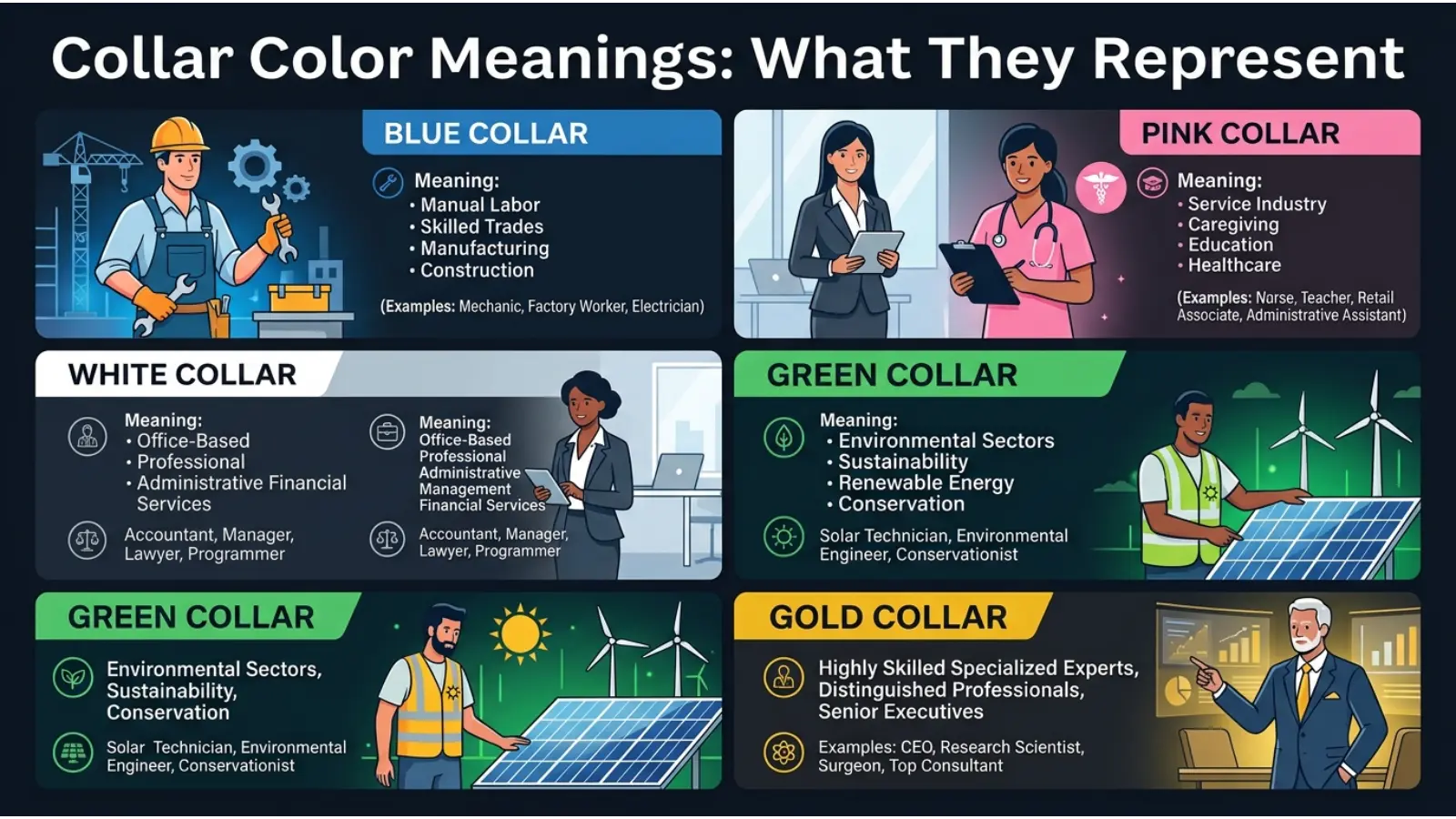
Collar color meanings are informal labels used to classify occupations and types of workers. Blue collar usually refers to manual or skilled trade work, while white collar generally describes office, professional, or administrative work. Pink collar traditionally refers to service and care occupations, and green collar is commonly connected with environmental and sustainability-related work.
Collar Color Meanings Chart
| Collar Color | Common Meaning | Typical Examples | Main Association |
|---|---|---|---|
| Blue Collar | Manual and skilled trade work | Construction, mechanics, manufacturing | Physical or technical labor |
| White Collar | Professional and office work | Lawyers, managers, accountants | Professional knowledge |
| Pink Collar | Service and care work | Nursing, childcare, customer service | Care and service |
| Green Collar | Environmental work | Renewable energy, conservation | Sustainability |
| Gold Collar | Highly skilled professional work | Doctors, engineers, specialists | Advanced expertise |
| Gray Collar | Skilled technical work between traditional categories | Technicians, IT support | Technical expertise |
| Black Collar | Term with several meanings | Mining, manual trades, creative workers | Context-dependent |
| Red Collar | Government or public-sector work in some uses | Government employees | Public service |
| No Collar | Independent or unconventional work | Entrepreneurs, freelancers | Independence |
These definitions are broad rather than official occupational classifications. A single person may fit more than one category.
What Are Collar Color Meanings?
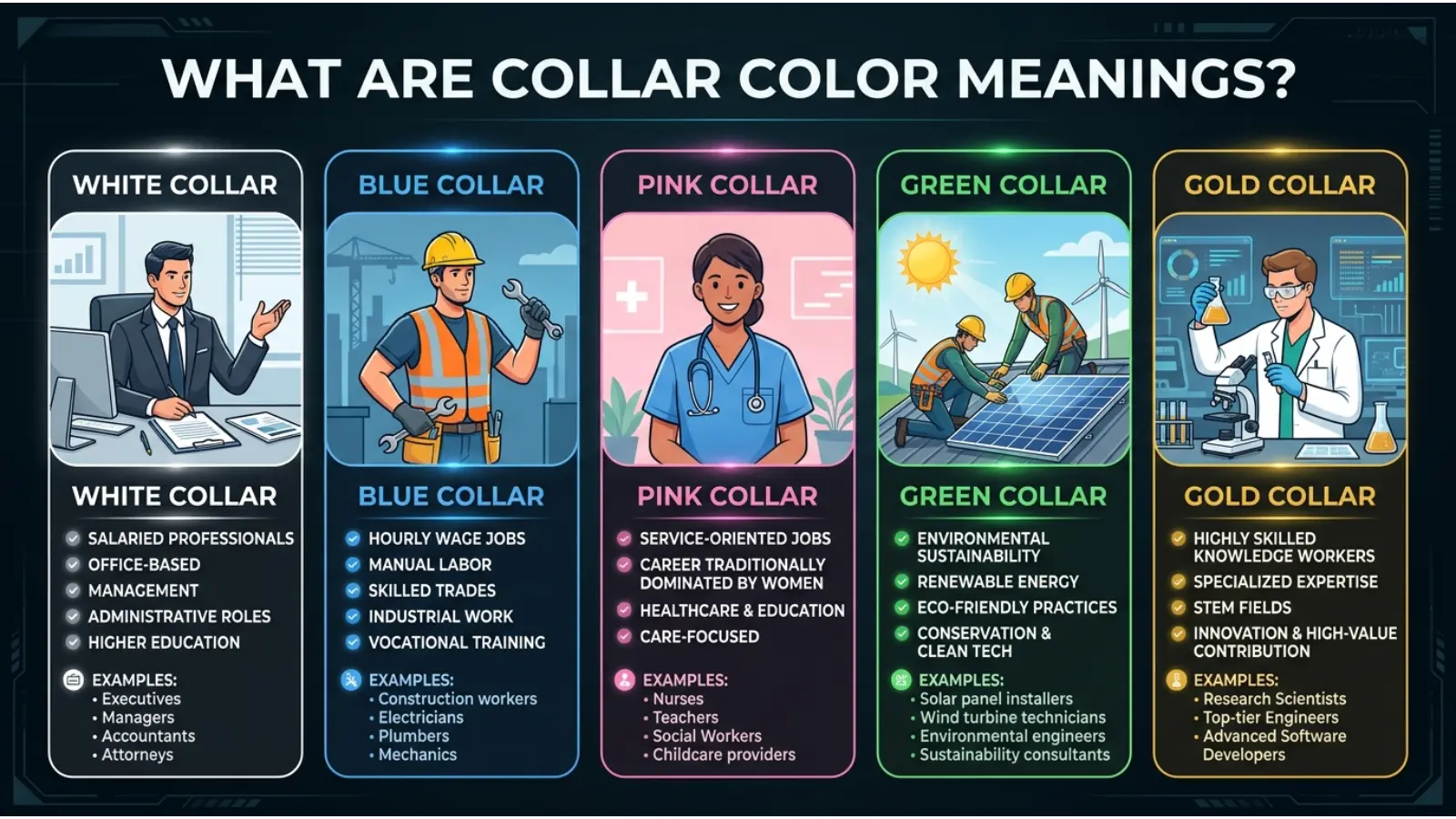
Collar color meanings are a form of social and occupational shorthand. Instead of describing a person’s exact job, the label gives a quick idea about the type of work they perform.
For instance, calling someone a blue-collar worker usually suggests hands-on work, while calling someone white-collar suggests professional, administrative, or office-based work.
However, these categories are not strict boxes. A skilled electrician may run a business, manage employees, and perform highly technical work. Likewise, a software engineer may work remotely and spend much of the day away from a traditional office.
Therefore, collar colors are best understood as cultural labels, not precise job classifications.
Why Are Jobs Called “Collar” Colors?
The word collar comes from an older visual association with clothing.
Historically, many office workers wore relatively formal white shirts. Manual workers often wore darker or blue-colored work clothing because it was practical and less likely to show dirt.
Over time, these clothing differences became symbols of different types of employment.
Eventually, the colors stopped referring mainly to clothing and became shorthand for occupational groups.
Blue Collar Meaning
Blue collar traditionally represents manual labor, skilled trades, industrial work, construction, transportation, and other hands-on occupations.
The term is strongly associated with workers who use physical skills, tools, machinery, or practical technical knowledge.
Common Blue-Collar Jobs
Examples include:
- Electricians
- Plumbers
- Mechanics
- Welders
- Construction workers
- Machine operators
- Carpenters
- Factory workers
- Truck drivers
- Maintenance workers
However, blue-collar work is not necessarily unskilled work. Many trades require years of training, apprenticeships, licenses, safety knowledge, and technical expertise.
Blue Collar Symbolism
Blue often suggests:
- Practicality
- Reliability
- Strength
- Hard work
- Skill
- Physical effort
- Dependability
The traditional image of blue-collar work therefore combines practical skill with hands-on experience.
White Collar Meaning
White collar generally describes professional, administrative, managerial, and office-based work.
The phrase developed from the traditional image of office employees wearing white-collar shirts.
Typical examples include:
- Accountants
- Lawyers
- Managers
- Financial professionals
- Consultants
- Office administrators
- Business executives
- Analysts
- Many corporate employees
White-collar work is often associated with education, decision-making, communication, planning, and specialized knowledge.
White Collar Symbolism
White can suggest:
- Professionalism
- Cleanliness
- Formality
- Organization
- Authority
- Knowledge
- Corporate identity
Yet the modern meaning is broader than simply “office worker.” Many professionals now work remotely, wear casual clothing, and perform highly technical tasks.
Pink Collar Meaning
Pink collar traditionally refers to occupations associated with service, care, administrative support, and other jobs historically dominated by women.
Examples can include:
- Nursing
- Childcare
- Reception work
- Administrative assistance
- Personal care
- Customer service
- Some hospitality occupations
The term developed from historical patterns in the labor market and gender roles.
Today, however, the label should be used carefully. Many occupations once described as pink collar are performed by people of all genders.
Why Is Pink Used?
Pink became associated with traditionally feminine employment because of historical social expectations around women’s work.
As workplace roles changed, the meaning became less rigid. Today, the term is often used in discussions of occupational history, gender, wages, and labor patterns rather than as a simple description of who performs a job.
Green Collar Meaning
Green collar generally refers to employment connected with environmental protection, sustainability, clean energy, and resource conservation.
Examples include:
- Solar energy technicians
- Wind-energy workers
- Environmental consultants
- Conservation workers
- Recycling specialists
- Sustainable construction professionals
- Environmental engineers
Green-collar work has grown alongside interest in renewable energy and environmental responsibility.
Green Collar Symbolism
Green naturally connects with:
- Nature
- Growth
- Renewal
- Sustainability
- Conservation
- Environmental responsibility
Consequently, businesses may also use the phrase green jobs when discussing careers that contribute to environmental goals.
Gold Collar Meaning
Gold collar is commonly used for highly skilled professionals whose work requires advanced education, specialized expertise, or exceptional technical knowledge.
Depending on the context, the term may describe:
- Doctors
- Engineers
- Scientists
- Highly specialized technicians
- Advanced technology professionals
- Certain financial specialists
The word “gold” suggests that the worker’s knowledge and specialized abilities have high economic value.
Gold Collar Symbolism
Gold can represent:
- Excellence
- Expertise
- Prestige
- Achievement
- High value
- Specialized knowledge
Unlike blue and white collar, gold collar is less standardized and can vary significantly by industry.
Gray Collar Meaning
Gray collar is often used for workers whose jobs combine characteristics of blue-collar and white-collar employment.
The term can be useful for technical occupations that require both practical skills and specialized knowledge.
Examples may include:
- IT technicians
- Telecommunications technicians
- Medical technicians
- Skilled technical specialists
- Certain engineering support roles
Gray therefore represents the space between traditional categories.
This is particularly useful today because many modern jobs cannot be neatly classified as either manual or office work.
Black Collar Meaning
Black collar does not have one universally accepted definition.
In some contexts, it has been used for certain forms of manual or industrial labor. In other contexts, it has been applied to creative professionals or particular occupational groups.
Because its meaning changes by source, industry, and region, it should not be treated as a standardized occupational category.
Black Collar Symbolism
Black commonly communicates:
- Power
- Seriousness
- Authority
- Strength
- Mystery
- Professional sophistication
However, the symbolic meaning of black does not automatically determine what “black collar” means occupationally.
Red Collar Meaning
Red collar is another flexible term that can refer to government or public-sector workers in some classifications.
The expression is not as standardized as blue collar or white collar.
Depending on the context, red collar may describe:
- Government employees
- Public-sector workers
- Certain specialized occupational groups
Therefore, readers should always check how the term is being defined in a particular discussion.
The color red itself can symbolize energy, urgency, authority, or action, but those symbolic meanings should not be confused with the occupational definition.
No Collar Meaning
No collar is sometimes used to describe people who work outside traditional employment structures.
This can include:
- Entrepreneurs
- Freelancers
- Independent creators
- Self-employed professionals
- Some gig workers
- People with unconventional careers
The idea challenges the traditional division between manual and office workers.
A freelancer, for example, may perform professional work without belonging to a traditional corporate workplace.
Psychology Behind Collar Color Meanings
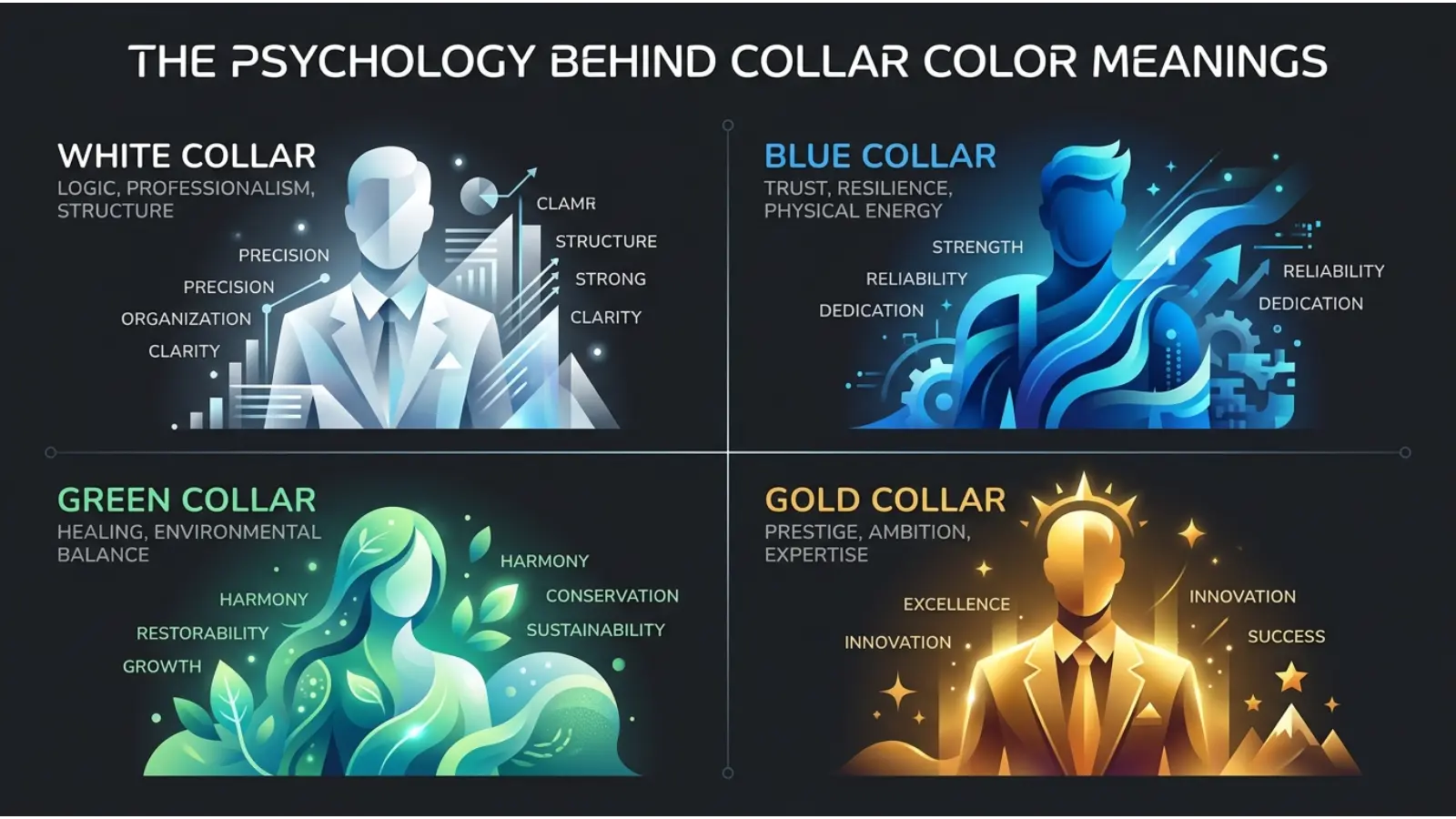
The colors used in occupational labels also carry psychological associations, but the psychology of the color itself should not be confused with scientific evidence about occupations.
For example, blue is commonly associated with calmness and reliability in color symbolism. However, calling someone blue collar does not mean the person is psychologically calm or dependable.
Likewise, white may symbolize cleanliness or professionalism, but being a white-collar worker does not create a particular personality.
The occupational meaning comes mainly from historical and cultural usage, not from a proven psychological effect of the color.
This distinction matters because color psychology is often presented too confidently.
How Collar Color Meanings Changed Over Time
Collar terminology developed from older divisions in the workplace.
Industrialization created large groups of factory and trade workers, while expanding businesses created larger populations of clerical and professional employees.
Consequently, blue-collar and white-collar became useful social shorthand.
Later, new categories appeared as economies changed.
Healthcare, environmental work, technology, specialized professions, and independent employment made the old two-color system less complete.
Today, a worker may move between categories during the same career.
For example, someone could begin as a blue-collar apprentice, become a technical specialist, move into management, and eventually own a business.
Cultural Differences in Collar Color Meanings
Collar terminology is especially common in English-speaking discussions of employment, but its exact meaning can differ across countries.
In the United States, blue-collar and white-collar are widely understood. Other terms may be much less familiar outside specific industries.
In other countries, occupational class may be described using different social, educational, or economic categories.
Therefore, collar colors should not be treated as universal cultural definitions.
The same job can also carry different social status depending on local attitudes, wages, education requirements, and economic conditions.
Do Collar Colors Affect Personality?
Not directly.
A person’s occupation may influence lifestyle, schedule, social environment, and daily experiences, but a collar color does not determine personality.
For example, two blue-collar workers may have completely different personalities. One may be outgoing and adventurous, while another may be quiet and analytical.
Similarly, white-collar workers can have widely different values and temperaments.
Why Do People Associate Traits With Collar Colors?
These associations often come from stereotypes.
Blue-collar workers may be described as:
- Practical
- Tough
- Independent
- Hands-on
White-collar workers may be described as:
- Analytical
- Professional
- Ambitious
- Organized
These are cultural impressions, not personality tests.
Collar Colors in Branding and Marketing
Businesses sometimes use collar terminology to identify target audiences or communicate workplace identity.
For example, a company selling industrial tools may focus its messaging on reliability, durability, and practical performance.
A technology company may emphasize expertise, efficiency, innovation, and technical knowledge.
However, marketers should avoid assuming that all members of an occupational group think alike.
A modern construction professional may care deeply about technology, sustainability, design, and premium products.
Real-Time Example
Imagine a construction-equipment company launching a new battery-powered tool in August 2026.
Instead of advertising it simply as a “blue-collar product,” the company could highlight:
Longer battery life → less downtime → easier job-site work → lower operating costs.
This approach works better because it speaks to a real workplace need rather than relying on an occupational stereotype.
Collar Colors in Fashion
The original connection between collar colors and workwear makes fashion an interesting part of the story.
Blue work shirts became practical because darker fabrics could hide dirt and wear better than very light fabrics.
White shirts became connected with formal office clothing because they created a clean, polished appearance.
Today, those boundaries have weakened.
Workwear has become a fashion category of its own, while office clothing has become increasingly casual.
As a result, wearing a blue work jacket does not necessarily indicate that someone works in a trade.
Collar Colors and Social Identity
Occupational labels can become part of a person’s identity.
Someone may proudly describe themselves as a tradesperson, healthcare worker, engineer, technician, entrepreneur, or professional.
Therefore, collar terminology can carry emotional meaning beyond the job itself.
Blue collar, for instance, may be used positively to express pride in skilled labor and practical expertise.
At the same time, these labels can reinforce stereotypes when people assume that one type of worker is more intelligent, valuable, or successful than another.
A healthier interpretation recognizes that modern economies depend on many different forms of expertise.
Collar Color Meanings in Everyday Life
You may encounter these terms in:
- News articles
- Employment reports
- Business discussions
- Political commentary
- Workplace conversations
- Advertising
- Career advice
- Social media
- Movies and television
- Fashion marketing
The surrounding context usually tells you how the term is being used.
For example, “blue-collar community” may refer to a community with many manufacturing and trade workers, while “white-collar district” may describe an area dominated by corporate offices.
How Age Changes the Meaning of Collar Colors
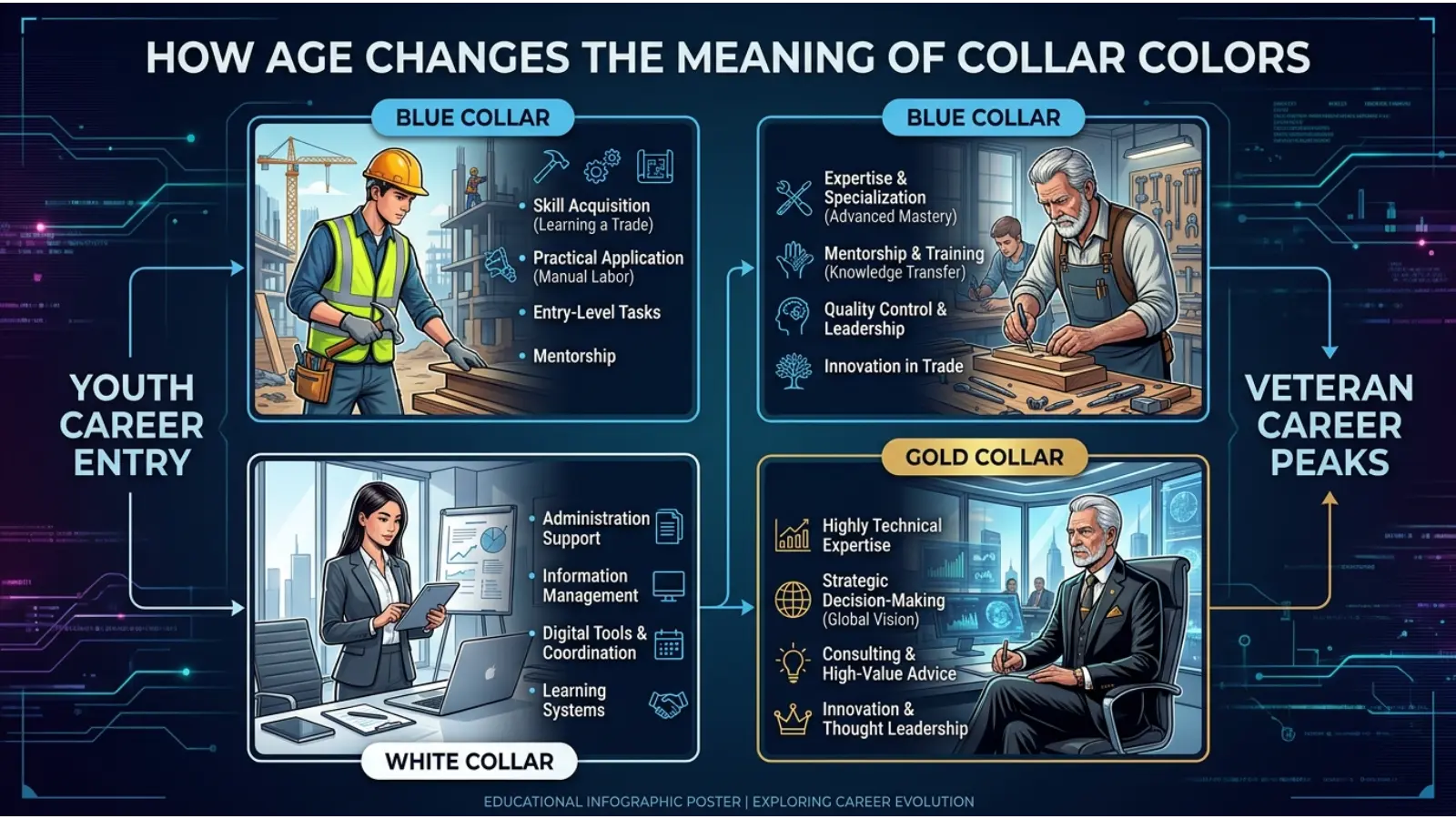
Different generations may understand these labels differently.
Older workers may associate blue collar strongly with factories and physical labor.
Younger workers may see blue-collar careers as including advanced technical trades, electrical systems, robotics maintenance, and specialized construction.
Similarly, white-collar work once suggested a physical office. Remote work has weakened that connection.
Therefore, collar terminology continues to evolve as technology changes how people work.
Why Collar Color Meanings Can Be Misleading
The biggest problem with collar labels is that they simplify complex careers.
Consider an industrial automation technician.
The person may:
- Work with machinery
- Use advanced software
- Analyze technical data
- Repair equipment
- Communicate with management
- Train other employees
Which collar is that?
There may not be a perfect answer.
Modern work increasingly combines physical skills, digital knowledge, communication, creativity, and management.
That is why collar colors are useful as general descriptions, but poor substitutes for detailed job information.
Common Misconceptions About Collar Color Meanings
Blue Collar Means Unskilled
Not necessarily.
Many blue-collar occupations require extensive technical training, certification, licensing, and experience.
White Collar Means Higher Intelligence
No.
White-collar work often requires academic or professional training, but intelligence exists across every occupational category.
Pink Collar Jobs Are Only For Women
Historically, the term was connected with occupations dominated by women. Modern workplaces are much more diverse.
Green Collar Only Means Recycling
Green-collar work covers a much wider range of environmental and clean-energy occupations.
Collar Colors Are Official Job Categories
Generally, they are informal social and occupational labels rather than a universal classification system.
Every Collar Color Has One Fixed Definition
No.
Some terms have widely recognized meanings, while others vary considerably by source and context.
Best Way to Understand Collar Color Meanings
A useful approach is to ask three questions:
What type of work is being described?
Is it physical, professional, technical, service-based, environmental, or independent?
Where is the term being used?
A newspaper, employer, academic study, or social media post may use the same collar term differently.
What does the speaker mean by the color?
Not every collar color has a universally accepted definition.
This simple method prevents most misunderstandings.
FAQ About Collar Color Meanings
What does blue collar mean?
Blue collar usually describes manual, industrial, trade, construction, transportation, maintenance, and other hands-on occupations.
What does white collar mean?
White collar generally refers to professional, administrative, managerial, and office-based employment.
What does pink collar mean?
Pink collar traditionally refers to service, care, and administrative occupations that historically employed large numbers of women.
What does green collar mean?
Green collar commonly describes jobs related to environmental protection, renewable energy, sustainability, conservation, and clean technology.
What does gold collar mean?
Gold collar generally refers to highly skilled professionals with advanced education, specialized expertise, or valuable technical knowledge.
What is a gray-collar worker?
A gray-collar worker usually performs technical or skilled work that combines characteristics traditionally associated with blue-collar and white-collar employment.
Are collar colors based on personality?
No. Collar colors describe occupational categories and cultural associations. They do not scientifically determine someone’s personality.
Why is blue associated with manual labor?
Historically, darker blue work clothing was practical for industrial and manual workers because it could better conceal dirt and wear.
Why is white associated with office workers?
White shirts became associated with formal office and professional clothing, helping create the traditional distinction between white-collar and blue-collar work.
Are collar color meanings still relevant?
Yes, but they are less precise than they once were. Modern careers frequently combine physical, technical, digital, creative, and managerial skills.
Final Thoughts on Collar Color Meanings
Collar color meanings reveal more than simple differences between jobs. They show how clothing, history, economics, culture, and social identity can combine to create everyday language.
Blue collar became linked with practical and industrial labor. White collar became associated with professional and administrative work. Pink collar developed around service and care occupations, while green collar emerged alongside environmental and sustainability-focused careers. Newer terms attempt to describe an economy that is becoming increasingly technical and diverse.
Still, no color can fully describe a worker.
A modern electrician may also be an entrepreneur. A technician may be a software expert. A nurse may be a manager. A construction professional may specialize in advanced sustainable technology.
That is why collar colors are most useful when treated as starting points rather than strict labels. Understanding their history and context helps us talk about work more accurately—and reminds us that every occupation can involve valuable knowledge, skill, and experience.

Emma Wilson is a dedicated comparison writer and product researcher at ColorMystiic.com. She specializes in creating unbiased product comparisons, detailed reviews, and helpful buying guides. Her goal is to help readers make smarter purchasing decisions with confidence.