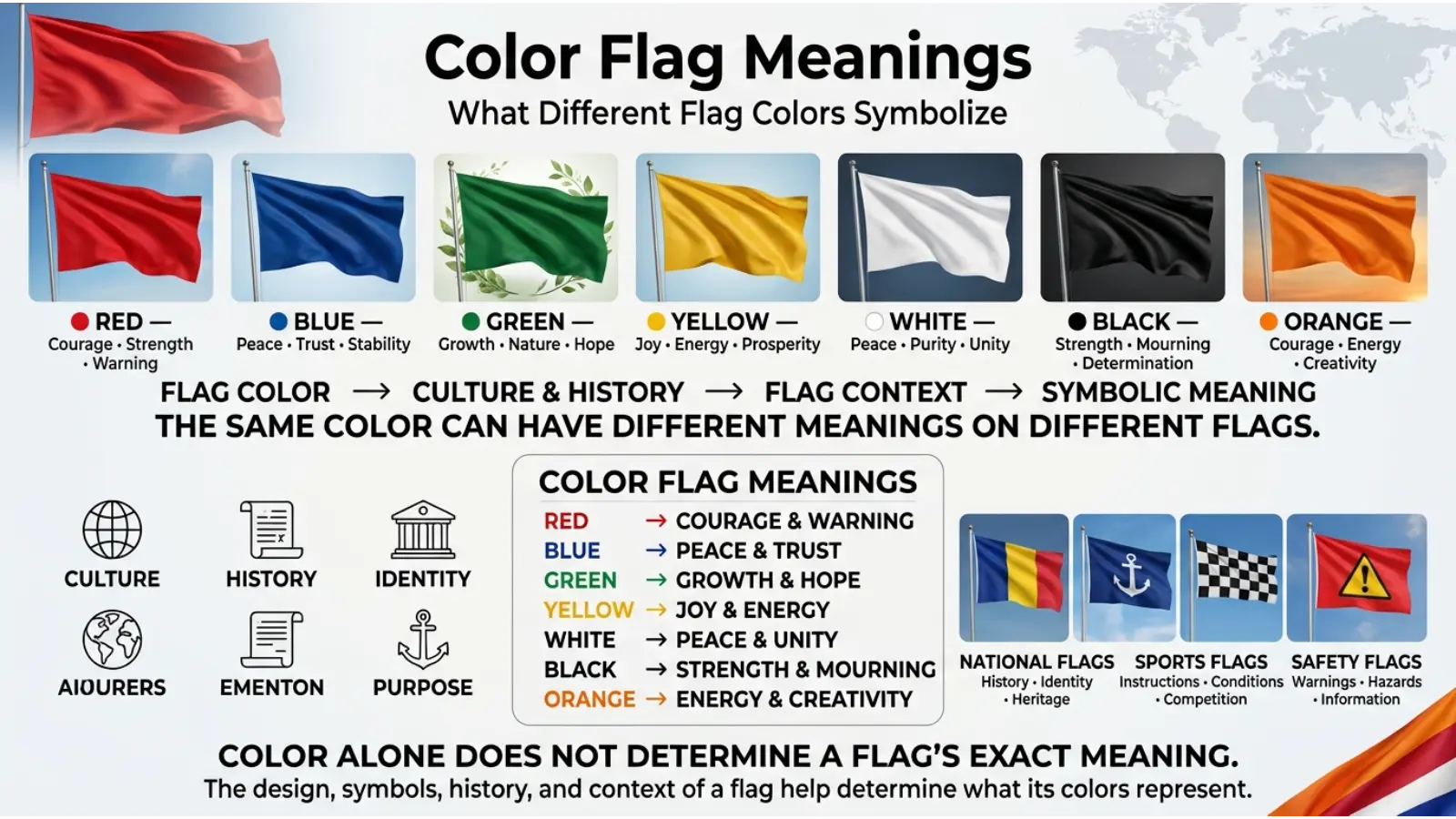
Flags communicate powerful messages without using words. A single color can represent courage, peace, religion, nature, political history, identity, or national pride. However, color flag meanings are not universal. The same color may symbolize freedom in one country and revolution, mourning, or spiritual belief in another.
People often search for flag color meanings to better understand national flags, cultural symbols, sports flags, military banners, and historical designs. While colors can carry common associations, the true meaning of a flag usually depends on its history and the people who created it.
This guide explores the symbolism, psychology, cultural interpretations, historical importance, and practical use of different flag colors.
Quick Answer: Flag colors often symbolize ideas such as courage, peace, freedom, nature, faith, unity, wealth, and remembrance. Red commonly represents sacrifice or courage, blue may suggest loyalty or peace, green often connects with nature or hope, and white frequently represents peace or purity. However, the meaning of a flag color always depends on its cultural and historical context.
What Do Flag Colors Symbolize?
Flag colors work as visual symbols. Unlike ordinary decoration, colors on flags are usually chosen to communicate identity, values, history, or shared beliefs.
For example, a country may use red to honor people who fought for independence. Another nation may use the same red color because it represents revolution or cultural tradition. Therefore, understanding a flag requires looking beyond general color psychology.
| Flag Color | Common Symbolic Meanings | Possible Alternative Meanings |
|---|---|---|
| 🔴 Red | Courage, sacrifice, strength | Revolution, danger, struggle |
| 🔵 Blue | Peace, loyalty, stability | Freedom, spirituality, authority |
| 🟢 Green | Nature, hope, growth | Agriculture, prosperity, faith |
| ⚪ White | Peace, purity, unity | Surrender, mourning in some cultures |
| ⚫ Black | Strength, determination, remembrance | Mourning, resistance, rebellion |
| 🟡 Yellow | Wealth, sunlight, optimism | Power, warning, royalty |
| 🟠 Orange | Energy, courage, enthusiasm | Cultural identity, spiritual traditions |
| 🟣 Purple | Royalty, dignity, ambition | Spirituality, luxury |
| 🟤 Brown | Land, heritage, stability | Earth, resilience |
The meaning becomes clearer when the color is studied alongside symbols, shapes, historical events, and cultural traditions.
Red Flag Meaning
Red is one of the most powerful colors used in flags. Because it is highly visible, red naturally attracts attention from a distance.
Common Meanings of Red on Flags
Red may represent:
- Courage
- Military strength
- Sacrifice
- Bloodshed during independence struggles
- Revolution
- Passion
- Unity
- Determination
Historically, red has appeared on many flags because red dyes and pigments have long been available in different parts of the world. As a result, its meaning developed differently across societies.
From a psychological perspective, red is often associated with energy and intensity. Therefore, it can make a flag appear bold, active, and powerful.
However, red does not automatically mean blood or danger. The official meaning depends on the specific flag.
Blue Flag Meaning
Blue is commonly associated with calmness, stability, and trust. On flags, it may also represent the sky, water, freedom, or national loyalty.
Common Symbolism of Blue
Blue can represent:
- Peace
- Loyalty
- Trust
- Freedom
- Stability
- Justice
- The sky
- Rivers and oceans
Lighter blues often create a peaceful or open feeling. In contrast, darker blues may appear more formal and authoritative.
Because blue is frequently associated with dependability in modern design, it can also make a flag appear stable and united.
Still, blue symbolism is shaped by history. A blue stripe does not have the same meaning on every national or regional flag.
Green Flag Meaning
Green has strong connections with nature. It often represents land, agriculture, forests, renewal, and growth.
Common Green Flag Meanings
Green may symbolize:
- Nature
- Fertility
- Hope
- Growth
- Agriculture
- Prosperity
- Renewal
In some cultural and religious traditions, green also carries spiritual significance. However, religious meanings should always be understood within their specific historical traditions rather than applied universally.
Green is visually connected with the natural world, which explains why it is often used by countries with strong agricultural identities or landscapes.
White Flag Meaning
White is widely associated with peace, honesty, and unity. On many flags, it can create visual balance between stronger colors.
Common Symbolism of White
White may represent:
- Peace
- Unity
- Purity
- Honesty
- Harmony
- Hope
A completely white flag also has a widely recognized historical association with surrender or a request to negotiate during conflict.
However, white does not always mean peace. In some cultures, white is associated with mourning and remembrance. Therefore, cultural context remains essential.
Black Flag Meaning
Black creates one of the strongest visual contrasts when placed beside lighter colors. Historically, black flags have appeared in many different movements and traditions.
Common Meanings of Black
Black can symbolize:
- Strength
- Determination
- Mourning
- Remembrance
- Resistance
- Authority
- Mystery
The meaning of black can change dramatically depending on the flag’s design. A black stripe may represent the struggles of a community, while another flag may use black to represent historical heritage.
Black is also popular in sports and modern branding because it creates a bold and powerful appearance.
Yellow and Gold Flag Meaning
Yellow and gold often represent sunlight, wealth, prosperity, and energy. Gold has traditionally been connected with royalty and valuable resources.
Common Yellow and Gold Meanings
These colors may symbolize:
- Sunshine
- Wealth
- Prosperity
- Energy
- Optimism
- Royalty
- Natural resources
Although yellow and gold can look similar from a distance, they may carry different meanings in official flag designs.
Gold often suggests dignity and value, while bright yellow can create a more energetic and optimistic impression.
Orange Flag Meaning
The Orange is less common than red, blue, or green on national flags, but it has a strong visual identity.
Orange can represent:
- Courage
- Energy
- Enthusiasm
- Warmth
- Cultural heritage
- Spiritual traditions
Because orange sits between red and yellow on the color spectrum, it combines some of their visual qualities. It can appear energetic without carrying the same intensity as deep red.
Orange also has strong cultural importance in certain regions and traditions, meaning its symbolism should not be generalized.
Purple Flag Meaning
Purple is one of the rarest colors in traditional national flags. Historically, purple pigments were difficult and expensive to produce, which limited their use.
Purple commonly symbolizes:
- Royalty
- Dignity
- Ambition
- Wisdom
- Luxury
- Spiritual reflection
Modern printing technology has made purple easier to use. As a result, it is now more common in organizational, community, and event flags.
Brown Flag Meaning
The Brown is uncommon in major national flags, yet it can have meaningful uses.
Brown may represent:
- Land
- Soil
- Agriculture
- Heritage
- Stability
- Connection with nature
Because brown is strongly associated with the earth, it can be useful in Indigenous symbolism, environmental imagery, and community designs when appropriate to the specific cultural context.
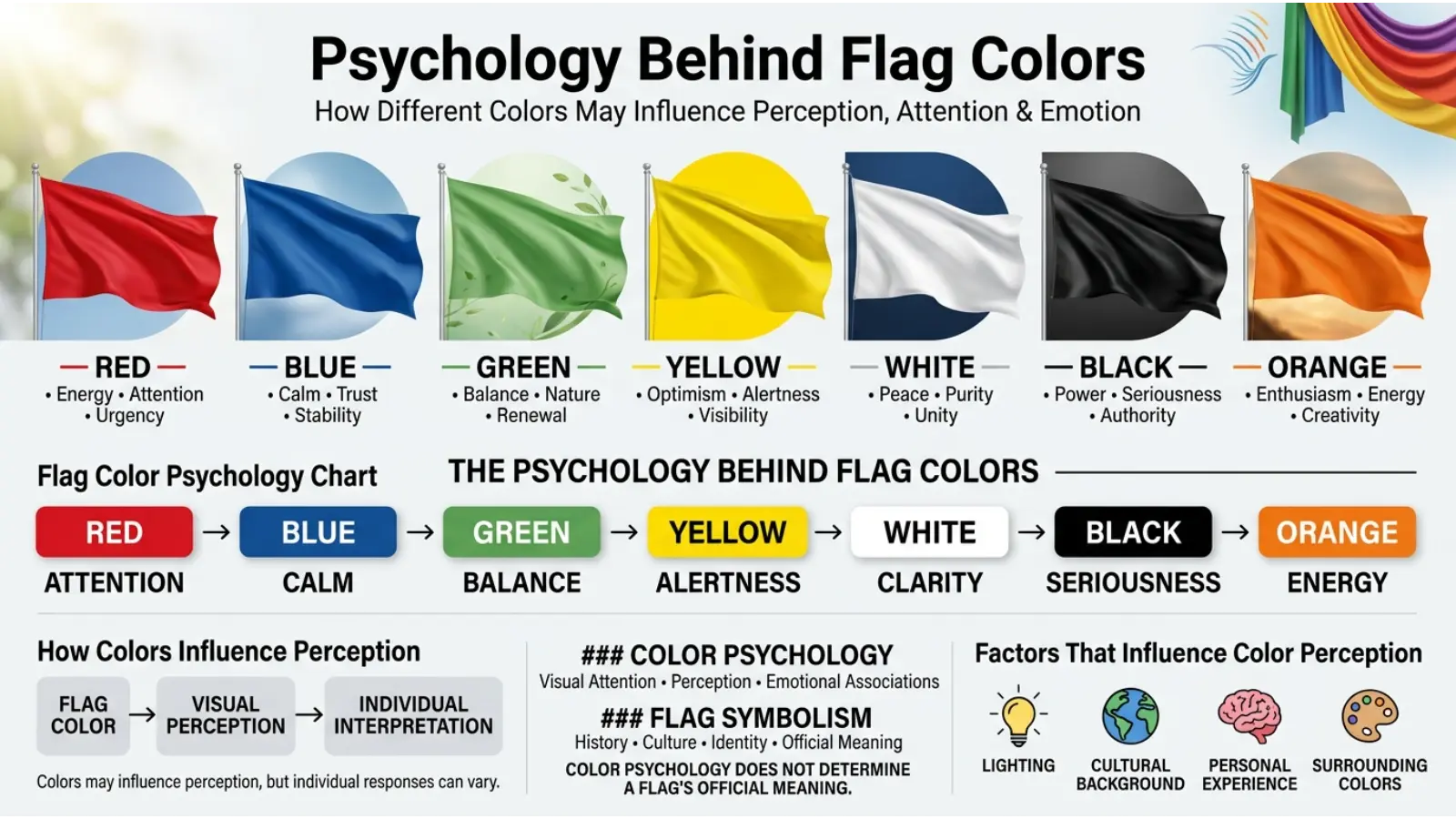
Psychology Behind Color Flag Meanings
Color psychology helps explain how people may emotionally respond to colors, but it does not prove that every person reacts in exactly the same way.
A bright red flag may feel energetic because red is highly noticeable. Meanwhile, a large blue area may create a calmer visual impression. Strong black-and-white contrast can make symbols easier to recognize.
How Flag Colors Affect Perception
Colors can influence:
- Visibility
- Emotional response
- Recognition
- Visual balance
- Group identity
- Perceived strength
For example, highly contrasting colors make a flag easier to identify from a distance. This practical purpose has been important throughout history.
Therefore, flag design is not only about symbolism. Visibility and recognition also matter.
Why Flag Color Meanings Change Across Cultures
Color meanings are learned through culture, history, religion, politics, and personal experience.
A person growing up in one country may associate a color with national pride. Someone from another culture may connect the same color with mourning or celebration.
Factors That Change Flag Color Meaning
Several factors influence interpretation:
| Factor | How It Changes Meaning |
|---|---|
| Culture | Traditions create different associations |
| History | Wars and independence movements shape symbolism |
| Religion | Some colors hold importance within specific traditions |
| Geography | Colors may represent oceans, forests, deserts, or mountains |
| Politics | Colors may become linked with movements or ideologies |
| Age | Younger and older generations may interpret symbols differently |
| Personal Experience | Individuals can form their own emotional associations |
For this reason, general color meanings should never replace a flag’s official historical explanation.
Historical Importance of Colors in Flags
Flags originally served practical purposes, including identifying armies, ships, rulers, and communities.
Over time, colors became connected with major historical events.
A color could honor soldiers, represent a royal family, identify a region, or celebrate independence. Consequently, colors became part of national storytelling.
The availability of dyes also influenced historical flag design. Some pigments were expensive, while others were easier to produce. Therefore, practical limitations sometimes shaped which colors appeared on historical banners.
Modern flag meanings often combine historical symbolism with newer national interpretations.
Cultural Meanings of Flag Colors
Western Interpretations
In many Western societies, red may be associated with courage or sacrifice, while blue can suggest loyalty and freedom.
White is often connected with peace and unity, although its meaning varies according to national history.
Eastern Interpretations
Color symbolism across Asia is highly diverse. Red may represent celebration or good fortune in some traditions, while white can have associations with mourning in certain cultures.
Therefore, Western color meanings should not automatically be applied to Asian flags.
Middle Eastern Interpretations
Colors may have connections with regional history, cultural identity, and religious traditions.
Green, for example, holds important associations in some Islamic traditions. However, its meaning on a particular flag may also relate to land, hope, or national history.
African Interpretations
Many African flags use colors connected with independence, African unity, natural resources, land, and shared history.
However, each country has its own explanation. Similar color combinations do not necessarily carry identical meanings.
Latin American Interpretations
Flag colors throughout Latin America often connect with independence movements, geography, natural resources, and historical identity.
Blue may represent water or the sky, while green can represent fertile land. Yet the meaning depends on each nation’s historical development.
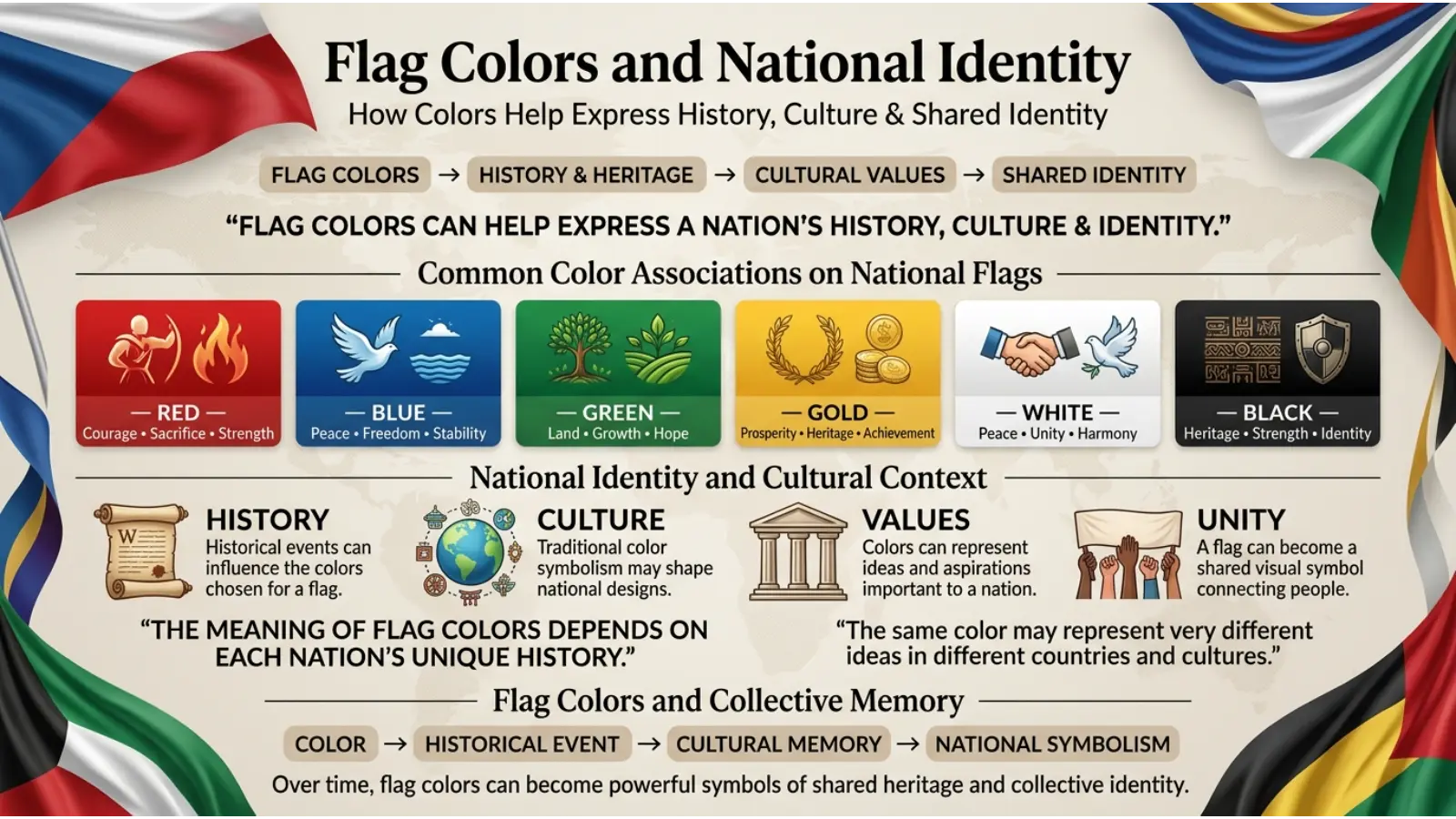
Flag Colors and National Identity
A flag becomes powerful because people attach shared memories to it.
The colors themselves may have symbolic meanings, but national identity adds another layer. People may associate the flag with:
- Family history
- Independence
- Sporting events
- Military service
- Cultural celebrations
- National achievements
This emotional connection can become stronger than general color symbolism.
Therefore, two people may look at the same flag and experience different emotions depending on their background.
Color Flag Meanings in Sports
Sports teams frequently use flag-inspired colors to build identity and unity.
Red can create a feeling of energy and competition. Blue may suggest confidence and professionalism. Green can connect teams with local landscapes or heritage.
Sports supporters also use flags because colors make group membership easy to recognize.
Why Sports Flags Use Strong Colors
Strong colors help with:
- Stadium visibility
- Team recognition
- Fan identity
- Merchandise
- Television appearance
As a result, practical design decisions often work alongside symbolic meanings.
Color Flag Meanings in Political and Social Movements
Throughout history, colors have been used to represent movements, causes, and social groups.
However, political color meanings can change over time and vary between countries. A color associated with one political idea in one region may represent something completely different elsewhere.
For this reason, it is risky to interpret political flags using color alone.
The symbol, historical period, location, and movement must all be considered.
Flag Colors in Branding and Marketing
Businesses and organizations sometimes use flag-like color combinations to communicate identity.
Blue can suggest reliability. Red may communicate energy and urgency. Green often connects with sustainability or natural products.
However, marketers should avoid assuming that one color creates the same reaction everywhere.
Why Organizations Use Flag Colors
Colors can help create:
- Recognition
- Emotional connection
- Cultural relevance
- Visual consistency
- Stronger identity
A successful design considers audience expectations, cultural background, and the overall message.
Color alone cannot build trust, but it can support a recognizable visual identity.
Flag Colors in Design
Flag design requires a balance between symbolism and function.
A beautiful color combination may fail if it becomes difficult to recognize from a distance.
Good Flag Color Design Usually Considers
- Contrast
- Visibility
- Simplicity
- Cultural meaning
- Reproduction costs
- Recognition
High contrast helps symbols remain visible. For example, dark and light colors placed together are generally easier to distinguish.
Too many similar shades can make a design difficult to identify, especially from far away.
How Lighting Changes the Appearance of Flag Colors
Flag colors do not always look the same in different environments.
Sunlight, cloudy weather, indoor lighting, cameras, and fabric texture can all affect appearance.
A dark blue flag may appear almost black in low light. Bright red can look deeper or lighter depending on sunlight. Metallic gold may look yellow when printed on fabric.
Therefore, designers often test flags under different conditions.
Factors That Change Color Appearance
- Natural sunlight
- Artificial lighting
- Fabric material
- Weather
- Camera settings
- Screen displays
- Distance
This explains why a flag photographed online may look different from the actual physical flag.
Flag Colors in Fashion
Flag colors often inspire clothing, accessories, and cultural fashion.
People may wear flag colors during:
- National celebrations
- Sporting events
- Cultural festivals
- Parades
- Community gatherings
How to Use Flag Colors in Fashion
A subtle approach can be more versatile than wearing every color equally.
For example:
- Use one flag color as the main clothing item.
- Add another color through accessories.
- Use neutral colors to balance bright combinations.
- Consider the cultural importance of national symbols.
Flag-inspired fashion can express pride, but the context matters. Some flags and symbols have deep cultural or political significance.
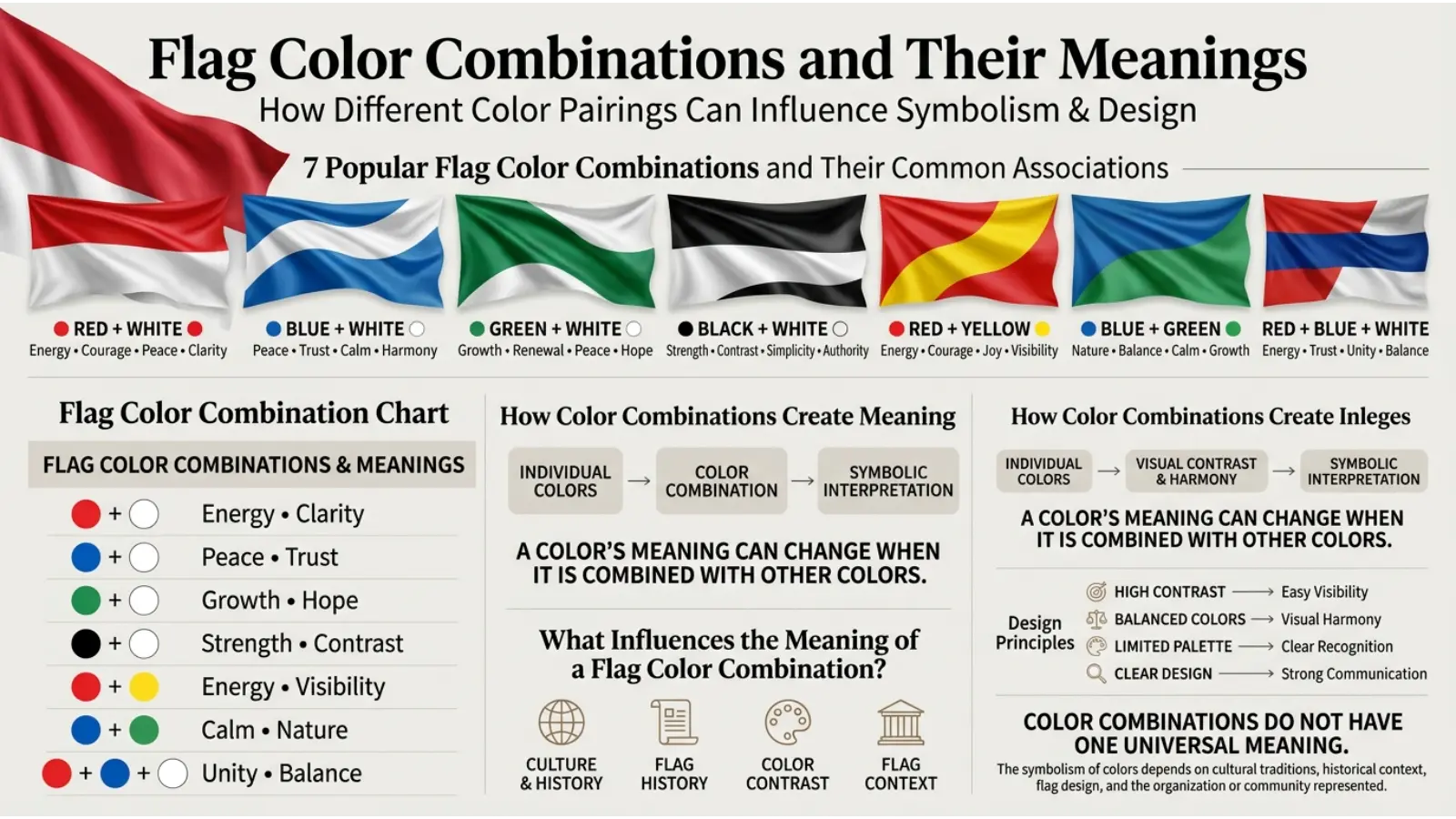
Flag Color Combinations and Their Meanings
Colors can create new impressions when combined.
Red and White
🔴 ⚪
This combination creates strong contrast.
It may communicate:
- Energy and clarity
- Courage and peace
- Strength and simplicity
The exact meaning depends on the flag’s history.
Blue and White
🔵 ⚪
Blue and white often create a clean and calm appearance.
Possible associations include:
- Peace
- Stability
- Trust
- Sky and water
Green and White
🟢 ⚪
This combination can suggest:
- Nature
- Hope
- Growth
- Peace
However, cultural and religious context may also influence interpretation.
Red, White, and Blue
🔴 ⚪ 🔵
This combination is widely used across different flags and can appear:
- Patriotic
- Strong
- Balanced
- Highly recognizable
Despite the similar colors, countries using this combination may have completely different historical meanings.
Red, Yellow, and Green
🔴 🟡 🟢
These warm and natural colors can create a strong visual connection with:
- Land
- Energy
- Growth
- Cultural identity
Again, the specific interpretation depends on the flag and its history.
Common Misconceptions About Flag Colors
Every Red Flag Represents Blood
This is false. Red can represent courage, revolution, strength, cultural identity, or many other ideas.
Every White Flag Means Peace
A completely white flag has a recognized historical connection with surrender or negotiation. However, white used as one part of a national flag can have many different meanings.
Green Always Represents Religion
Green may have religious importance in some traditions, but it can also represent agriculture, forests, fertility, or hope.
Flag Colors Have Universal Meanings
Colors do not have fixed meanings that apply everywhere.
Culture and history matter.
Color Psychology Explains Every Flag
Modern color psychology can help explain visual perception, but many historical flags were created long before modern psychological theories developed.
Historical context is usually more important when interpreting a national flag.
Real-World Applications of Flag Color Meanings
In Daily Life
Understanding flag colors can help people recognize cultural symbols and appreciate the history behind national designs.
In Business
Businesses can study flag colors when creating culturally relevant marketing campaigns. However, copying national symbolism without understanding it can create misunderstandings.
In Art
Artists use flag colors to explore identity, history, protest, memory, and belonging.
In Photography
Photographers use color contrast to make flags stand out against skies, buildings, and landscapes.
In Home Decoration
Flag-inspired colors can create themed spaces, especially for sports rooms, cultural events, or celebrations.
In Fashion
Color combinations from flags can inspire outfits without requiring the full flag design.
In Entertainment
Movies, games, and television use flag colors to quickly communicate fictional nations, teams, and groups.
How Age and Experience Affect Flag Color Interpretation
Children may first recognize flags through bright colors and simple shapes.
Adults, on the other hand, may connect the same colors with historical events, politics, travel, or personal memories.
As people gain experience, flag colors can develop deeper meanings.
For example, a red stripe might initially appear as a simple design element. Later, someone may learn that it represents a historical struggle or national event.
Therefore, symbolism is partly learned through education and shared cultural memory.
Why Designers Carefully Choose Flag Colors
A flag must communicate quickly.
People often see flags:
- From far away
- Moving in the wind
- Under changing weather
- On small screens
- In printed materials
Designers therefore consider more than symbolism.
They also think about:
- Contrast
- Recognition
- Simplicity
- Reproduction
- Cultural relevance
The best flag colors combine practical visibility with meaningful identity.
Personality Associations With Flag Colors
People sometimes connect favorite colors with personality traits. For example, someone who prefers blue may be described as calm, while someone who prefers red may be seen as energetic.
However, color preference does not scientifically determine personality.
Personal preferences can change based on age, culture, memories, trends, and environment.
Therefore, it is better to view personality associations as interesting cultural ideas rather than fixed psychological facts.
Frequently Asked Questions About Color Flag Meanings
What do the colors on a flag mean?
Flag colors can represent history, courage, peace, nature, religion, unity, freedom, or cultural identity. The exact meaning depends on the specific flag.
What does red mean on a flag?
Red often symbolizes courage, sacrifice, strength, or revolution. However, its official meaning varies between flags.
What does blue mean on a flag?
Blue commonly represents loyalty, peace, stability, freedom, the sky, or water.
What does green mean on a flag?
Green often represents nature, agriculture, growth, hope, prosperity, or religious traditions.
What does white mean on a flag?
White can symbolize peace, unity, purity, and harmony. In some contexts, a white flag is also associated with surrender or negotiation.
What does black mean on a flag?
Black may represent strength, determination, mourning, remembrance, resistance, or historical identity.
Why do different countries use the same flag colors?
Many colors have strong historical availability and visual value. Countries may also share cultural traditions, geography, or historical influences.
Do flag colors have universal meanings?
No. Some general associations are common, but the true meaning depends on culture, history, and official symbolism.
Which flag color represents peace?
White is commonly associated with peace, although blue and other colors may also represent peace depending on the specific flag.
Why are some colors rare on national flags?
Historically, certain pigments were expensive or difficult to produce. Purple, for example, was traditionally less common because purple dyes were costly.
Final Thoughts
Understanding color flag meanings requires more than memorizing a list of colors. Red is not always sacrifice, green is not always religion, and white is not always peace.
A flag’s colors gain meaning through history, culture, geography, shared experiences, and the people who identify with them.
Color psychology can help explain why certain combinations feel bold, calm, powerful, or balanced. However, historical and cultural context provides the deeper story.
The next time you see a flag, look beyond its colors. Notice how the shades work together, consider the symbols surrounding them, and explore the history that gave those colors their meaning. A flag may use only a few colors, yet those colors can carry generations of memory, identity, and human experience.

Emma Wilson is a dedicated comparison writer and product researcher at ColorMystiic.com. She specializes in creating unbiased product comparisons, detailed reviews, and helpful buying guides. Her goal is to help readers make smarter purchasing decisions with confidence.