The lesbian flag is more than a colorful symbol. For many people, it represents identity, visibility, community, love, and shared experiences among lesbians. However, the meaning of the lesbian flag colors can sometimes be confusing because several lesbian flags have existed throughout history, and different versions use different colors and interpretations. People searching for lesbian flag color meanings often want to understand what each stripe represents and why these particular colors became connected with lesbian identity.
This article explores the symbolism, history, cultural context, emotional associations, design meaning, and practical use of the lesbian flag.
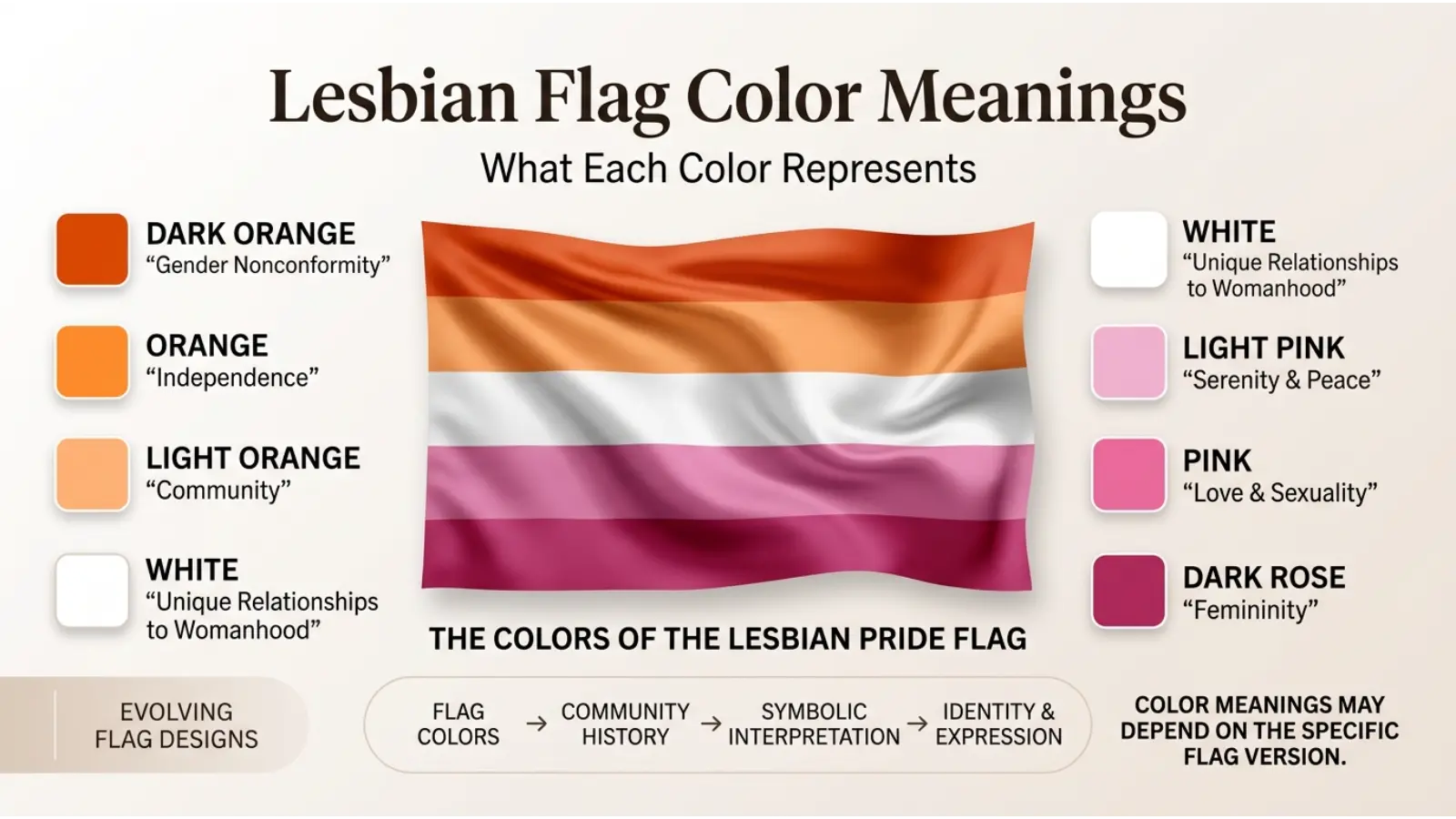
Quick Answer: The most widely recognized modern lesbian flag uses orange, white, and pink shades to symbolize gender nonconformity, independence, community, unique relationships with womanhood, serenity, love, and femininity. Meanings can vary depending on the specific version of the flag.
What Does the Lesbian Flag Symbolize?
The lesbian flag symbolizes lesbian identity and provides a visual representation of community and visibility.
Unlike a single traditional national flag with one universally fixed meaning, lesbian flags have changed over time. Therefore, understanding the flag requires looking at the specific design being discussed.
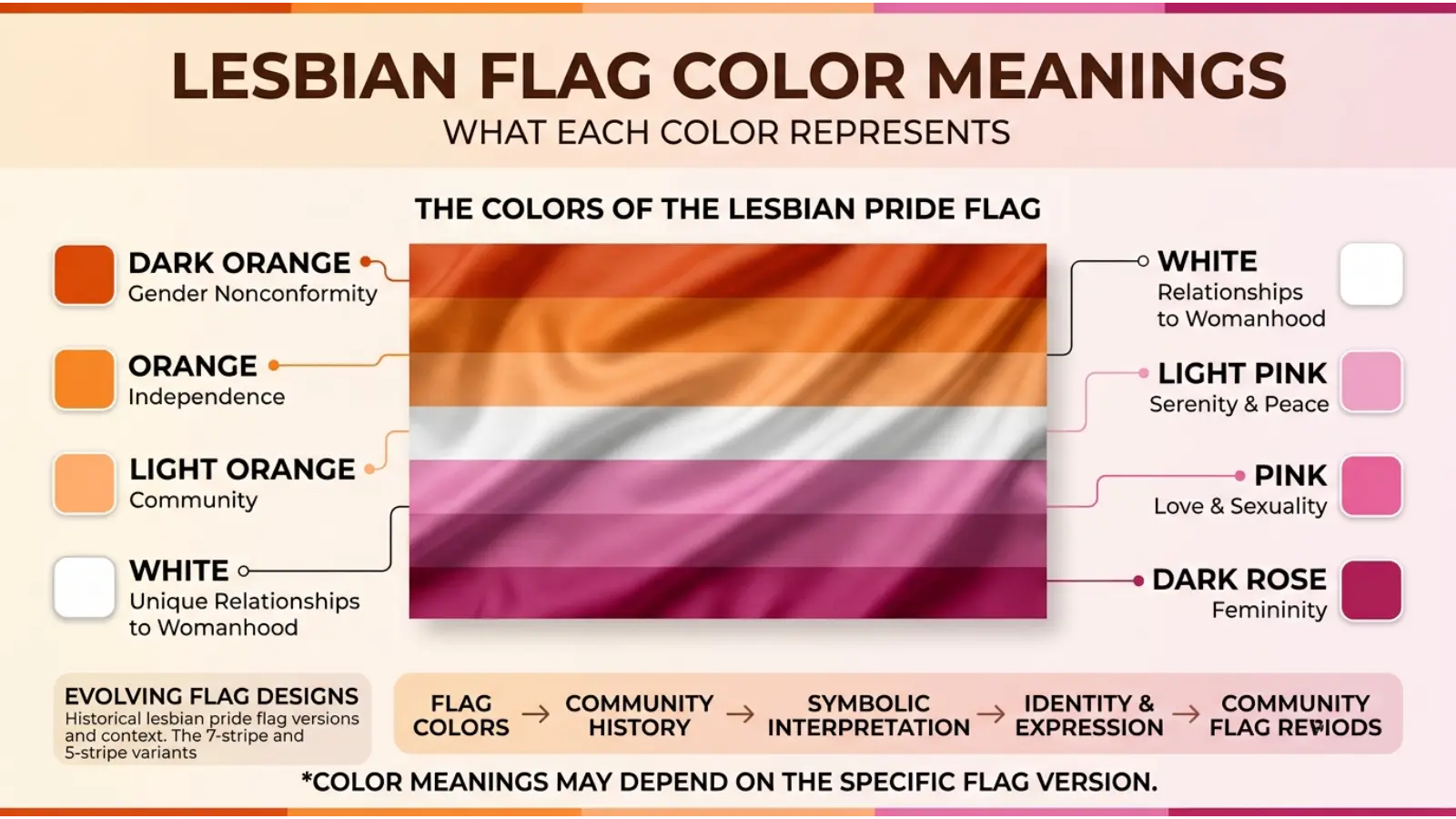
The widely recognized modern design often features horizontal stripes in shades of dark orange, orange, light orange, white, light pink, pink, and dark rose or magenta-pink.
| Flag Color Area | Commonly Associated Meaning |
|---|---|
| Dark Orange | Gender nonconformity |
| Orange | Independence |
| Light Orange | Community and connection |
| White | Unique relationships with womanhood |
| Light Pink | Serenity and peace |
| Pink | Love and intimacy |
| Dark Pink | Femininity |
These meanings are commonly circulated with the modern seven-stripe design. However, not every lesbian uses or interprets the flag in exactly the same way.
The Meaning of Each Lesbian Flag Color
🟧 Dark Orange: Gender Nonconformity
The darkest orange stripe is commonly associated with gender nonconformity.
For example, a person may prefer masculine clothing, feminine clothing, or a mixture of different styles. Therefore, this stripe can represent freedom from narrow gender expectations.
The orange shade is also visually strong and energetic. In design, warm orange tones often attract attention and create a feeling of movement and confidence. As a result, the color works well as a symbol of self-expression.
🟠 Orange: Independence
The orange stripe is commonly linked with independence.
This meaning can represent emotional independence, personal freedom, and the ability to define one’s own identity.
For many LGBTQ+ communities, independence also has a broader symbolic meaning. It can represent the freedom to live openly rather than allowing social expectations to determine personal relationships or identity.
Orange naturally sits between red and yellow on the color spectrum. Because of this visual position, it can feel energetic without appearing as intense as pure red.
🟧 Light Orange: Community
Human identity is rarely experienced entirely alone. Communities can provide friendship, shared language, support, history, and visibility.
Therefore, this stripe represents the connections formed between people with similar experiences.
From a color psychology perspective, warm colors can create a sense of closeness and social energy. However, this does not mean orange scientifically causes community feelings. Instead, designers and viewers often culturally associate warm colors with warmth, friendliness, and connection.
⬜ White: Unique Relationships With Womanhood
The white stripe has one of the more complex meanings in the lesbian flag.
Womanhood is not experienced in exactly the same way by every person. Gender expression, culture, personality, sexuality, and personal history can all influence how someone understands their relationship with being a woman.
The white stripe creates a visual pause between the warm orange and pink sections. Therefore, it also gives the flag balance and contrast.
In design, white often creates space and clarity. However, its symbolic meaning depends heavily on cultural context, which is why white should not automatically be assigned one universal meaning.
🌸 Light Pink: Serenity and Peace
The light pink stripe is commonly associated with serenity and peace.
This color introduces a softer visual transition after the white center stripe. Pale pink shades often appear gentle because they have lower visual intensity than darker reds or magentas.
Symbolically, serenity can represent emotional comfort, acceptance, and the desire for peaceful relationships and communities.
However, softness should not be confused with weakness. A gentle color can still represent resilience, strength, and emotional depth.
💗 Pink: Love and Intimacy
The stronger pink stripe is commonly connected with love and intimacy.
Within the lesbian flag, the color can represent romantic relationships, emotional connection, attraction, and love between women.
Its placement alongside other shades also matters. A single pink color might communicate something different, while several pink tones together create greater emotional depth.
🌺 Dark Pink: Femininity
The darkest pink stripe is commonly associated with femininity.
Femininity does not have only one appearance. Some people express femininity through clothing, makeup, behavior, art, or other personal choices, while others may have a different relationship with feminine expression.
Therefore, the stripe should not be understood as defining how lesbians must look or behave.
Instead, it recognizes femininity as one possible and meaningful form of gender expression within lesbian communities.
Why Does the Lesbian Flag Use Orange and Pink?
The combination of orange and pink creates a warm visual spectrum.
The white center creates contrast and separates the two color families.
🎨 Visual Structure of the Flag
🟧 → 🟠 → 🟧 → ⬜ → 🌸 → 💗 → 🌺
Gender Expression → Independence → Community → Womanhood → Serenity → Love → Femininity
This color progression gives the flag a balanced appearance. The warm colors also make the design visually distinctive compared with flags that rely primarily on rainbow combinations.
The History of Lesbian Flag Color Meanings
Lesbian visual symbols have changed over time, and there has never been only one design accepted by every lesbian community.
Earlier symbols associated with lesbian identity included the labrys, a double-headed axe connected with ancient imagery and later feminist symbolism. Violet colors and symbols such as violets have also been associated with lesbian identity through historical and literary references.
Different versions of lesbian flags have appeared online and within LGBTQ+ communities. Some have included lipstick marks, while others have used variations of orange, pink, white, and red tones.
Because these designs developed through community use rather than through one official governing organization, acceptance can vary.
Are There Different Lesbian Flags?
Yes. Multiple flags have been associated with lesbian identity.
The existence of several designs is one reason people sometimes find lesbian flag color meanings confusing.
The Orange and Pink Lesbian Flag
The orange, white, and pink striped flag is among the most recognizable modern designs.
It exists in versions with different numbers of stripes. The seven-stripe version is often connected with detailed symbolic meanings for individual colors.
The Five-Stripe Lesbian Flag
A simplified version commonly uses five horizontal stripes instead of seven.
The colors generally maintain the overall visual concept of orange shades, white, and pink shades.
However, the simplified design does not always assign a separate meaning to every individual stripe.
The Lipstick Lesbian Flag
Another historical design included shades of red and pink and sometimes featured a lipstick kiss mark.
Because communities contain people with many different gender expressions, the design did not become universally accepted as a symbol for every lesbian.
Lesbian Flag Color Meanings and Identity
Flags can help people communicate identity without using words.
For someone attending a Pride event, wearing a small flag pin or displaying a color combination may create a sense of recognition.
At the same time, no flag can fully describe every person’s individual experience.
Identity includes many layers, including culture, relationships, personality, gender expression, age, family experiences, and personal history.
A person does not need to match the personality or symbolism traditionally connected with a color to identify with the community represented by the flag.
The Psychology Behind the Lesbian Flag Color Meanings
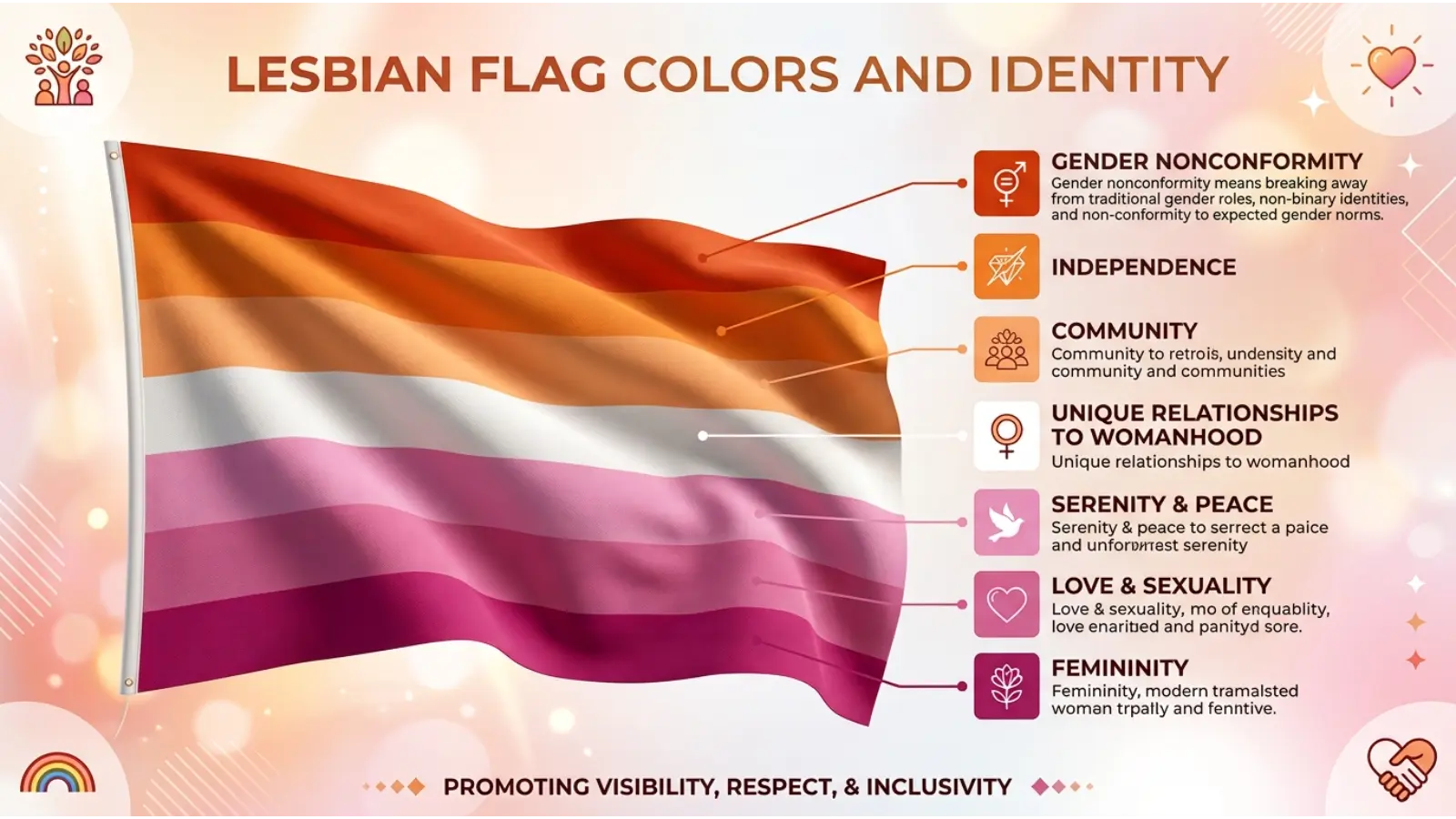
Color psychology can help explain why certain colors feel emotionally meaningful, but it cannot prove that a particular flag color produces a specific emotion in every person.
People respond to colors through a combination of biology, culture, personal experiences, and visual context.
Warm Colors Create Visual Energy
Orange and pink belong to the warmer side of common color perception.
Warm colors often appear visually active and noticeable. Consequently, they can make a design feel energetic and emotionally expressive.
This helps the lesbian flag stand out in posters, Pride events, social media graphics, and fashion.
Pink Can Carry Different Emotional Associations
In many contemporary cultures, pink is associated with affection, romance, softness, and femininity.
However, these associations are learned and culturally influenced.
Pink has not always carried the same gender associations throughout history. Therefore, interpreting pink only as a “female color” oversimplifies its cultural history.
Within the lesbian flag, pink becomes meaningful partly because of its relationship with the other colors surrounding it.
White Creates Balance
White provides strong contrast between the orange and pink sections.
From a visual design perspective, this prevents the flag from appearing overly heavy with warm tones.
In some cultures, white can represent mourning or other traditions. Context always matters.
Emotional Meaning of the Lesbian Flag
The emotional importance of the lesbian flag may be different for each person.
For some people, the flag represents pride.
For others, it represents belonging.
Someone who previously felt isolated may see the flag as a reminder that a larger community exists.
Meanwhile, another person may simply appreciate the design as a symbol of visibility and equality.
The same flag can therefore hold both collective and personal meaning.
That flexibility is common in symbols. A symbol develops meaning not only from its original design but also from how communities use it over time.
Cultural Meaning of the Lesbian Flag
The lesbian flag is primarily a modern LGBTQ+ cultural symbol.
Western LGBTQ+ Culture
It may appear at parades, educational events, festivals, online communities, and personal celebrations.
Global LGBTQ+ Communities
As the flag has become more visible online, it has also reached communities around the world.
However, local cultural experiences can differ significantly.
In some places, displaying an LGBTQ+ flag may be widely accepted. In others, people may use symbols more privately because of social or legal concerns.
Therefore, the meaning of visibility can be much stronger in environments where openly expressing LGBTQ+ identity is difficult.
Digital Culture
Social media has played an important role in spreading modern identity flags.
Profile pictures, digital artwork, emojis, banners, and Pride-themed graphics have made flag colors easier to recognize internationally.
As a result, younger generations may encounter the lesbian flag online before seeing it at an in-person event.
Does the Lesbian Flag Have a Spiritual Meaning?
The lesbian flag does not have one official spiritual meaning.
However, individual people may personally connect the flag with spiritual ideas such as authenticity, self-acceptance, love, healing, or belonging.
These interpretations are personal rather than universal religious teachings.
Different faith traditions and spiritual communities have their own views about sexuality, identity, colors, and symbolism. Therefore, it would be inaccurate to claim that the lesbian flag has one established spiritual interpretation across all religions.
Lesbian Flag Color Meanings in Art and Design
Artists use the lesbian flag colors in many ways.
Instead of always reproducing the exact flag, they may use orange, white, and pink palettes to suggest identity or community.
Creating Balance
A design can use the warm orange tones for visual energy and the pink tones for emotional warmth.
White can provide breathing space.
This combination is especially effective in posters and digital graphics because the color groups create natural separation.
Creating Emotional Depth
Using several shades instead of only one orange and one pink adds complexity.
Dark shades can create visual weight, while lighter shades create softness.
Therefore, designers can communicate multiple emotional qualities without changing the overall color identity.
Photography and Lighting
Lighting can significantly change how lesbian flag colors appear.
Warm indoor lighting may make orange tones appear stronger or more yellow.
Cool lighting may make pink appear more purple or muted.
For accurate photography, neutral lighting and correct color settings are useful when the goal is to reproduce the flag faithfully.
How to Use Lesbian Flag Colors in Branding
Businesses and organizations should use LGBTQ+ colors thoughtfully.
Using a lesbian flag palette can communicate support, visibility, or Pride-related messaging. However, colors alone do not prove that an organization genuinely supports LGBTQ+ communities.
Authenticity matters.
Good Uses of Lesbian Flag Colors
The palette can work well for:
- Pride event graphics
- LGBTQ+ community campaigns
- Inclusive educational materials
- Social media awareness posts
- Event decorations
- Community artwork
Design Considerations
Because orange and pink are both warm colors, designers should check contrast carefully.
Text may become difficult to read when placed directly over bright orange or medium pink backgrounds.
Dark text, white space, and strong contrast can improve accessibility.
Lesbian Flag Colors in Fashion
Fashion allows people to use flag symbolism openly or subtly.
Some people wear the complete flag design during Pride events.
Others prefer small accessories or clothing that combines orange, white, and pink.
Bold Fashion Choices
A full striped shirt, jacket, scarf, or dress can create an immediate visual connection with the lesbian flag.
This approach works especially well at celebrations, festivals, and community events.
Subtle Color Styling
A person may combine:
🟧 Orange top + ⬜ White accessory + 🌸 Pink shoes
or:
🌺 Pink jacket + 🟠 Orange bag + ⬜ White shirt
These combinations can reference the palette without directly reproducing the flag.
Professional Styling
For workplaces or formal settings, muted versions of the colors may feel easier to wear.
For example, soft coral, blush pink, cream, and terracotta can create a sophisticated interpretation of the palette.
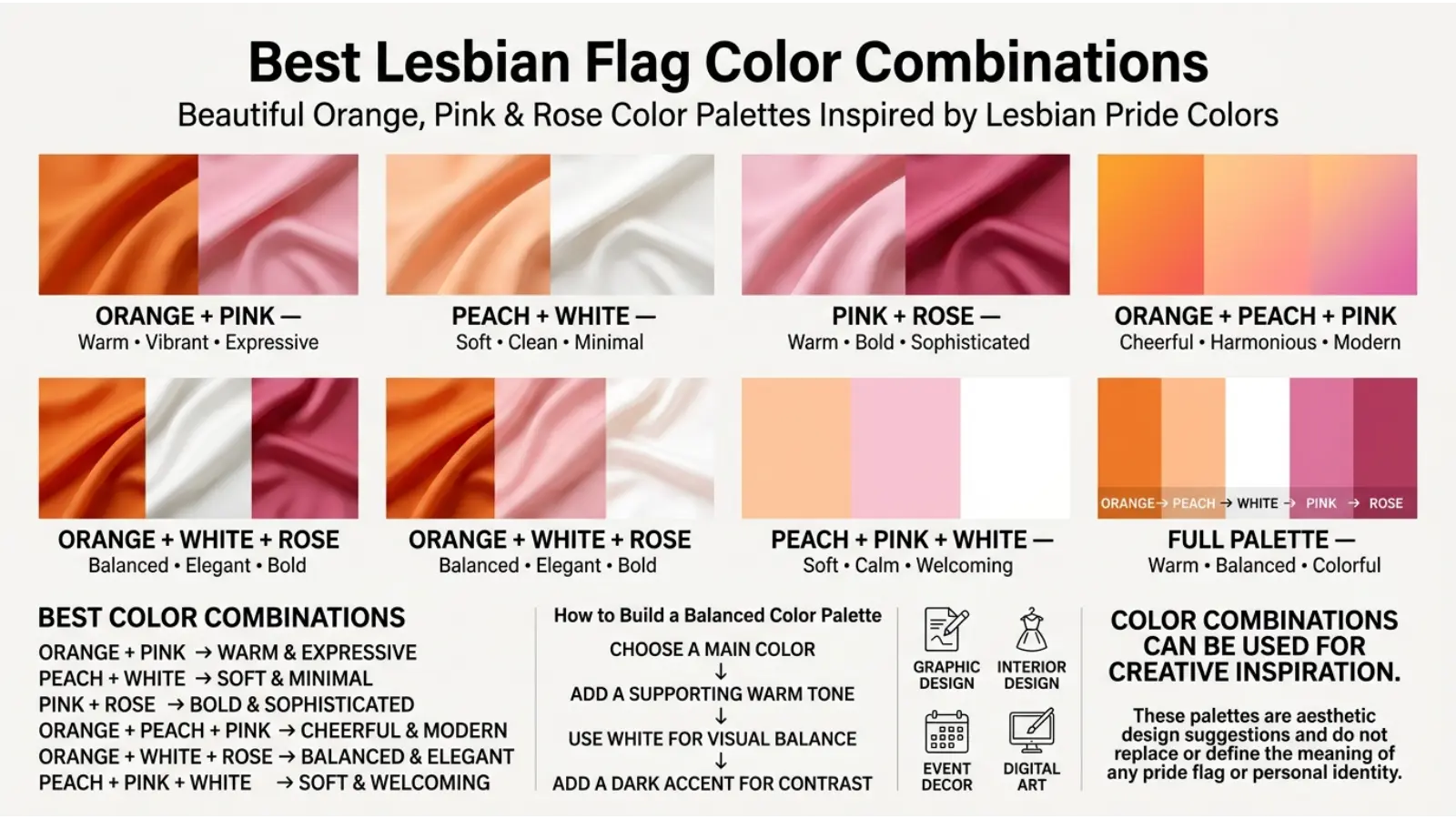
Best Lesbian Flag Color Combinations
The flag colors naturally work together because they share warm undertones.
Orange and White
🟧 + ⬜
This combination feels clean and energetic.
It works well in posters, clothing, websites, and room decorations.
White prevents orange from becoming visually overwhelming.
Pink and White
🌸 + ⬜
This combination creates a softer appearance.
It is often used in fashion, stationery, bedroom décor, and digital designs.
Orange and Pink
🟠 + 💗
Orange and pink can create a bold, playful combination.
A softer pink or muted orange can create a more refined result.
Full Lesbian Flag Palette
🟧 🟠 🟧 ⬜ 🌸 💗 🌺
Using the complete palette creates the strongest connection with lesbian flag symbolism.
This approach is especially useful for Pride graphics, community events, and identity-focused artwork.
Lesbian Flag Colors in Interior Design
The lesbian flag palette can inspire warm and welcoming spaces.
However, using every stripe at full intensity may make a room feel visually busy.
A better approach is to select one or two dominant colors and use the others as accents.
Living Rooms
Terracotta or warm orange can create an energetic focal point.
Pink cushions or artwork can add softness.
White walls can keep the space balanced.
Bedrooms
Blush pink and soft peach may create a calmer atmosphere.
Offices and Creative Spaces
Warm orange accents can make a workspace feel energetic.
However, extremely bright colors can become distracting when used across large surfaces.
Using the colors in smaller decorative elements may provide a better balance.
How Context Changes Lesbian Flag Color Meanings
Colors never exist in isolation.
The meaning of the lesbian flag changes depending on where and how it appears.
A flag at a Pride parade may represent public visibility.
The same colors in a private bedroom may represent personal identity.
A digital profile image may signal community connection.
Meanwhile, an artist may use the palette to explore themes of love, gender, history, or belonging.
Therefore, context often matters as much as the color itself.
How Age and Generation Can Influence Interpretation
Different generations may recognize different lesbian symbols.
Someone familiar with older LGBTQ+ activism may associate lesbian identity with symbols such as violets or the labrys.
Younger internet users may be more familiar with the orange-and-pink striped flag.
Neither experience automatically replaces the other.
Symbols can evolve while older symbols remain historically meaningful.
This evolution shows how communities create new visual languages as social experiences and communication methods change.
Common Misconceptions About Lesbian Flag Color Meanings
Misconception: Every Lesbian Uses the Same Flag
There is no single symbol used identically by every lesbian.
Different flags and symbols have existed, and personal preferences vary.
Therefore, descriptions may vary slightly between sources and communities.
Misconception: Pink Automatically Means All Lesbians Are Feminine
The lesbian community includes many different styles of gender expression.
Pink symbolism does not require anyone to look, dress, or behave in a particular way.
Misconception: Color Preference Determines Sexuality
There is no scientific evidence that liking orange, pink, or any other color determines a person’s sexual orientation.
Color preferences are personal and influenced by many factors.
Misconception: The Flag Has One Fixed Meaning Forever
Symbols can develop new meanings as communities use them.
Real-World Uses of Lesbian Flag Colors
Lesbian flag colors appear in many areas of everyday life.
Community Events
The colors are commonly used in banners, decorations, Pride events, and awareness campaigns.
Art
Artists may use the palette to explore themes of identity, romance, community, or personal experience.
Fashion
Clothing, jewelry, nail art, bags, and accessories can incorporate the flag colors.
Social Media
Users may include the flag in profile graphics, digital artwork, celebration posts, and awareness campaigns.
Home Decoration
Small items such as pillows, wall art, blankets, candles, and flowers can incorporate the color palette.
Entertainment
The colors may appear in fan art, character designs, Pride-themed content, and LGBTQ+ community media.
Why the Lesbian Flag Matters to Visibility
Visibility can help people recognize that LGBTQ+ communities exist in many parts of society.
For someone who feels alone, seeing a familiar symbol can create a sense of recognition.
Flags can also help communities communicate shared identity during large events where individual conversations may not be possible.
At the same time, visibility is personal.
Not everyone feels safe or comfortable displaying identity symbols publicly.
Therefore, the decision to use the lesbian flag should always remain personal and dependent on an individual’s circumstances.
Frequently Asked Questions About Lesbian Flag Color Meanings
What does the orange color mean on the lesbian flag?
Orange shades are commonly associated with gender nonconformity, independence, and community, depending on the stripe and version of the flag.
What does the white stripe on the lesbian flag mean?
The white stripe is commonly associated with unique relationships with womanhood. It also creates visual balance between the orange and pink sections.
What does pink mean on the lesbian flag?
Pink shades are generally associated with serenity, love, intimacy, and femininity in the commonly circulated meanings of the seven-stripe design.
How many lesbian flags are there?
Several flags and symbols have been associated with lesbian identity over time. The orange, white, and pink striped flag is one of the most widely recognized modern designs.
Is there an official lesbian flag?
There is no single global authority that officially controls lesbian community symbols. As a result, different flag designs and interpretations exist.
Why are there different versions of the lesbian flag?
Different versions developed at different times and within different communities. Some designs were created to represent particular experiences or forms of expression, while others aimed for broader representation.
Does every lesbian use the lesbian flag?
No. Some lesbians strongly identify with the flag, while others prefer different symbols or do not use identity flags at all.
Do lesbian flag colors have scientific psychological meanings?
No specific scientific evidence proves that the flag colors produce the exact symbolic meanings assigned to each stripe. Color psychology can explain general emotional associations, but flag symbolism is primarily cultural and community-based.
Can anyone use lesbian flag colors in art or fashion?
People can use the orange, white, and pink palette creatively. However, when reproducing the actual flag as an identity symbol, understanding its cultural significance helps ensure respectful use.
Conclusion
The lesbian flag color meanings reflect more than simple color symbolism. The orange, white, and pink stripes represent ideas connected with gender expression, independence, community, womanhood, peace, love, and femininity in the commonly recognized modern interpretation.
However, the deeper meaning of the flag comes from the people and communities who use it. Different lesbian flags have existed throughout history, and individual relationships with these symbols can vary.
The colors also demonstrate an important truth about symbolism: meaning depends on context. Orange can suggest independence in one setting, warmth in another, and energy in a design. Pink can represent romance, femininity, affection, or something entirely personal.
Understanding the lesbian flag therefore means looking beyond individual stripes. Together, the colors create a visual language of identity, visibility, connection, and self-expression. Like many community symbols, its greatest significance often comes from the stories and experiences people attach to it.

Emma Wilson is a dedicated comparison writer and product researcher at ColorMystiic.com. She specializes in creating unbiased product comparisons, detailed reviews, and helpful buying guides. Her goal is to help readers make smarter purchasing decisions with confidence.