Color has always carried meaning. People use it to express emotions, mark important occasions, create sacred spaces, and communicate ideas without words. In modern witchcraft and other magical traditions, color is also used as a symbolic tool.Color magick meanings describe the symbolic associations practitioners give to different colors when choosing candles, crystals, altar cloths, clothing, herbs, spell papers, or other ritual objects.
Red may represent passion and courage, green may suggest prosperity and growth, while blue is often associated with peace, communication, and emotional balance.
However, there is no single universal color-magick dictionary. Meanings can change between traditions, cultures, personal practices, and magical systems. A color that represents protection in one tradition may represent something different in another.
This guide explains the most common color magick meanings while separating traditional symbolism from personal interpretation. You will also learn how color psychology, culture, lighting, intention, and practical design can change the way a color feels and functions.
Quick Answer: What Do Colors Mean in Magick?
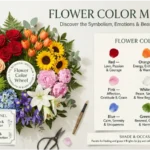
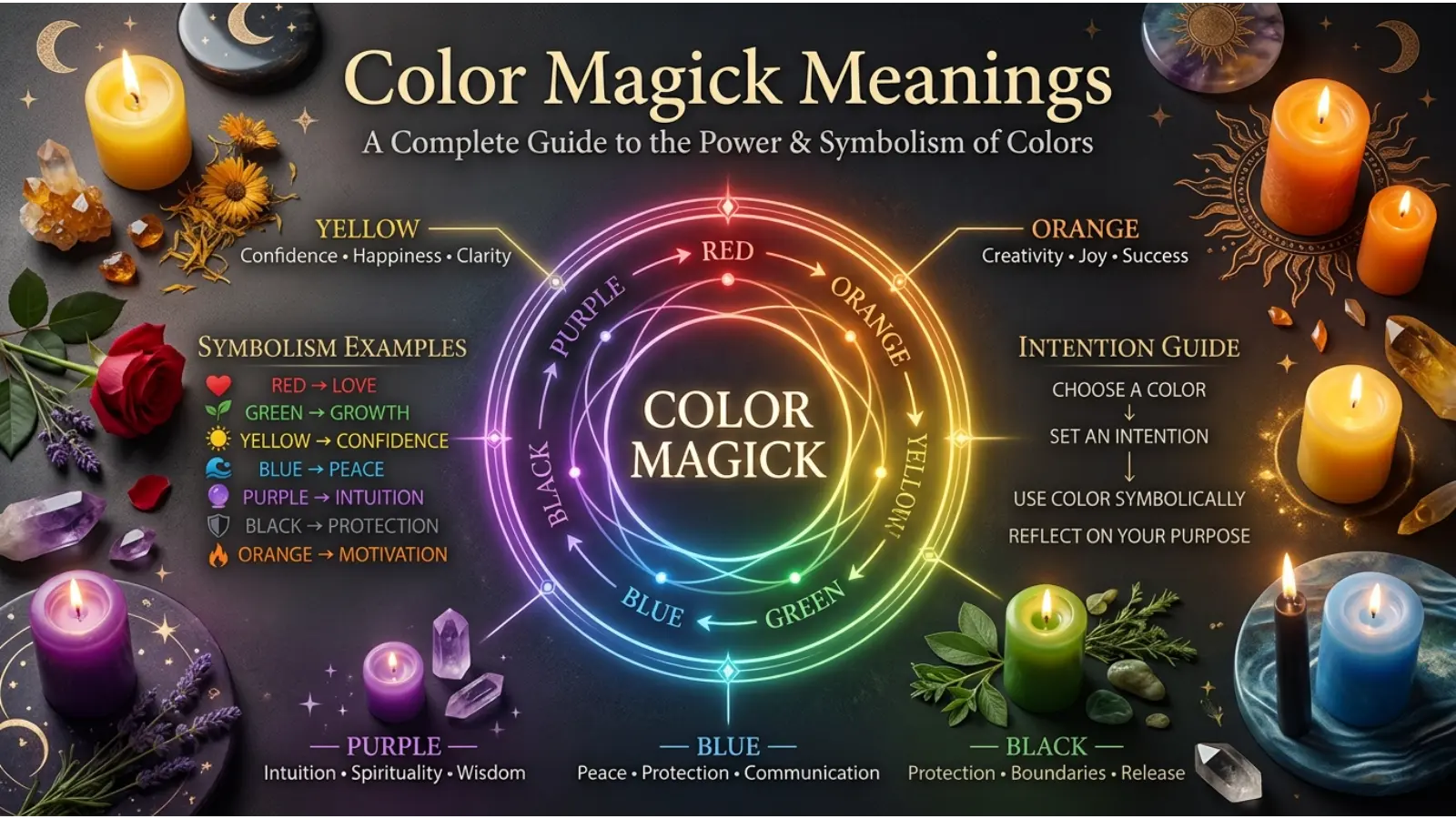
In color magick, colors are commonly used as symbols that help focus intention. Common associations include:
| Color | Common Magick Meaning | Often Used For |
|---|---|---|
| 🔴 Red | Passion, courage, energy | Love, strength, motivation |
| 🟠 Orange | Creativity, confidence, movement | Success, ambition, communication |
| 🟡 Yellow | Intellect, joy, clarity | Learning, confidence, focus |
| 🟢 Green | Growth, prosperity, healing | Money, nature, abundance |
| 🔵 Blue | Peace, truth, communication | Calm, wisdom, emotional balance |
| 🟣 Purple | Spirituality, intuition, power | Meditation, psychic work, wisdom |
| 🩷 Pink | Love, kindness, affection | Friendship, self-love, harmony |
| ⚫ Black | Protection, boundaries, endings | Banishing, grounding, protection |
| ⚪ White | Purity, cleansing, clarity | Healing, purification, general rituals |
| 🟤 Brown | Stability, grounding, practicality | Home, security, nature |
| 🩶 Gray | Neutrality, balance, transition | Uncertainty, reflection, neutral intentions |
| 🩵 Light Blue | Serenity, openness, gentle communication | Peace and emotional calm |
| 🟦 Indigo | Intuition, perception, inner knowledge | Meditation and spiritual reflection |
| 🟨 Gold | Success, achievement, vitality | Prosperity, recognition, confidence |
| 🩶 Silver | Intuition, reflection, lunar symbolism | Dreams, meditation, inner work |
These are symbolic correspondences rather than scientifically proven magical effects. The meaning becomes more useful when the color clearly matches the intention behind the practice.
What Is Color Magick?
Color magick is a form of symbolic practice in which colors are deliberately selected to represent a desired intention.
The basic idea is simple: choose a color whose traditional or personal symbolism matches your goal.
For example, someone focusing on financial growth might choose green because green is widely connected with vegetation, renewal, abundance, and prosperity. Someone seeking calm might choose blue because blue is commonly associated with sky, water, tranquility, and openness.
The color itself does not need to be viewed as a scientifically proven force. Instead, it can act as a visual anchor that helps a person concentrate on an intention.
This distinction matters.
Color psychology studies how colors can influence perception, emotion, attention, and behavior in certain contexts. Color magick, by contrast, belongs to symbolic and spiritual practice. The two can overlap in people’s experiences, but they should not be presented as the same thing.
The Most Common Color Magick Meanings
🔴 Red Color Magick Meaning
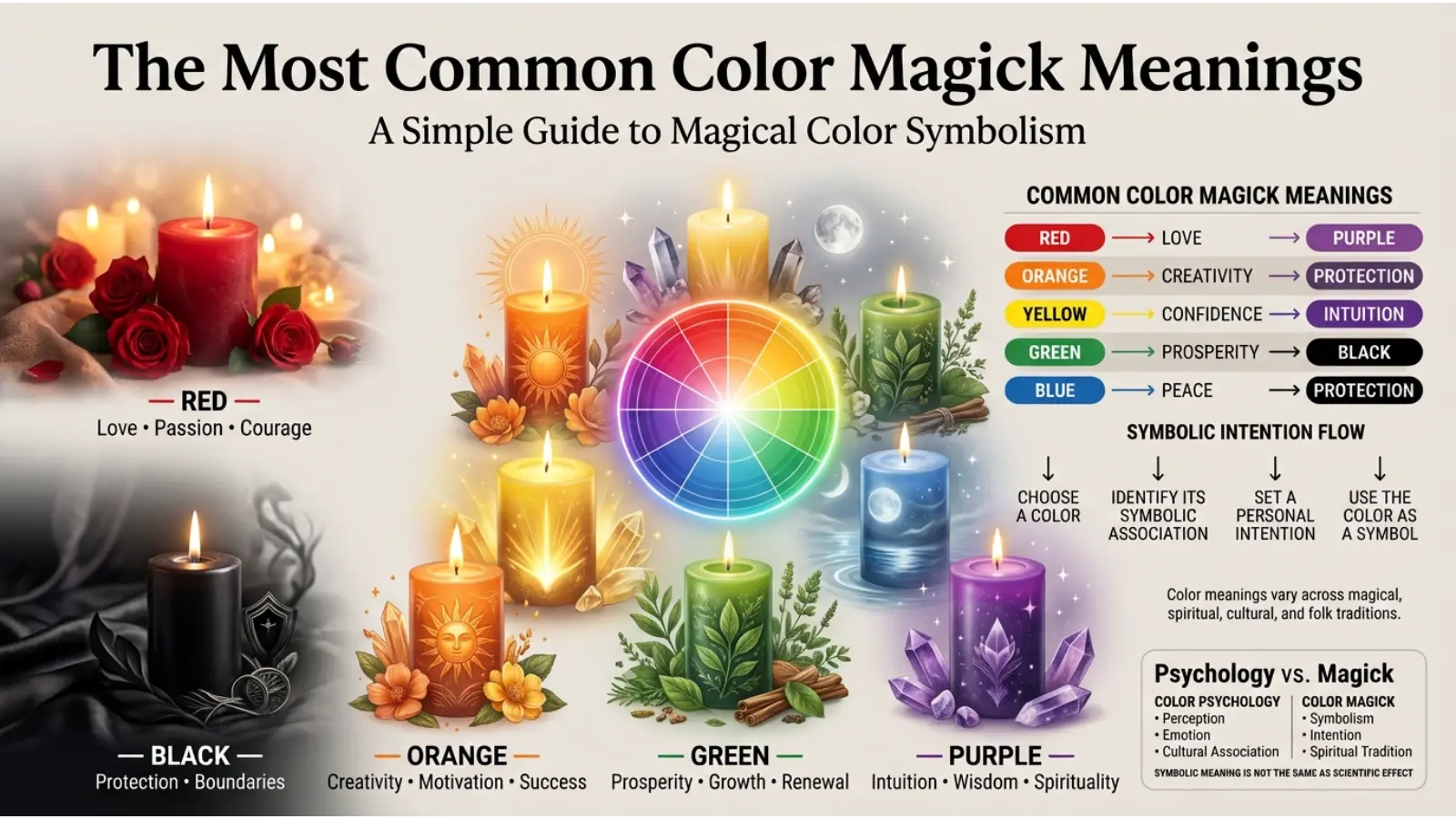
Red represents passion, vitality, courage, desire, action, strength, and physical energy.
Red is one of the strongest colors symbolically because it is visually intense and closely associated with blood, fire, heat, and physical activity.
In color magick, red is often chosen when someone wants to symbolize:
- Courage
- Passion
- Romantic desire
- Motivation
- Physical energy
- Strength
- Determination
- Confidence
- Action
When to Use Red
Red can suit rituals or personal practices focused on taking action rather than waiting.
For example, a red candle may symbolically represent the determination to begin a difficult project. Red clothing can also be used as a personal reminder of confidence and energy.
However, red can also suggest anger, aggression, impatience, or danger. Therefore, it may feel too intense for intentions centered on peace or emotional rest.
🟠 Orange Color Magick Meaning
Orange is commonly associated with creativity, enthusiasm, confidence, attraction, ambition, and movement.
It sits between red and yellow, combining some of red’s energetic quality with yellow’s association with intellect and brightness.
Orange can symbolize:
- Creativity
- Social energy
- Confidence
- Motivation
- Opportunity
- Enthusiasm
- Personal attraction
- Success
- Change
Orange can be particularly useful when the intention involves getting something moving.
For example, an artist might use orange as a symbolic reminder to overcome creative hesitation and start producing work.
🟡 Yellow Color Magick Meaning
Yellow commonly represents intellect, learning, communication, optimism, clarity, confidence, and happiness.
Because yellow resembles sunlight, it often carries associations with brightness and awareness.
In magical symbolism, yellow may be connected with:
- Mental clarity
- Studying
- Learning
- Memory
- Communication
- Confidence
- Happiness
- Creativity
- Optimism
Yellow can be a natural choice for intentions involving school, writing, public speaking, planning, or intellectual work.
At the same time, very bright yellow can feel visually stimulating. In a meditation space, softer yellow may be easier to live with than an extremely saturated shade.
🟢 Green Color Magick Meaning
Green is one of the most widely recognized colors for growth, prosperity, nature, abundance, balance, and renewal.
Its connection with leaves and living plants makes green especially strong as a symbol of natural growth.
Green can represent:
- Money
- Prosperity
- Abundance
- Growth
- Fertility
- Renewal
- Nature
- Balance
- Healing
- Patience
Green is often selected for intentions involving steady development rather than sudden change.
A darker forest green can feel grounded and serious, while mint or light green may communicate freshness and renewal.
🔵 Blue Color Magick Meaning
Blue commonly symbolizes peace, truth, communication, wisdom, patience, emotional calm, and spiritual reflection.
The symbolism of blue is often connected with the sky and water, both of which can create associations with openness, depth, and tranquility.
Blue may be used symbolically for:
- Peace
- Calm
- Truth
- Communication
- Wisdom
- Patience
- Emotional balance
- Reflection
- Protection
Different shades can create different impressions.
Light blue often feels gentle and peaceful, while dark blue can suggest depth, seriousness, authority, or wisdom.
🟣 Purple Color Magick Meaning
Purple is commonly associated with spirituality, intuition, mystery, wisdom, imagination, and transformation.
Historically, purple has also been connected with status and royalty in several societies because some purple dyes were difficult or expensive to produce.
In color magick, purple may symbolize:
- Intuition
- Spiritual awareness
- Wisdom
- Meditation
- Mystery
- Imagination
- Transformation
- Personal power
Purple is particularly suitable when the intention is less physical and more reflective or spiritual.
Lavender creates a softer interpretation, while deep violet can feel much more dramatic and mysterious.
Pink Color Magick Meaning
Pink commonly represents affection, compassion, tenderness, friendship, kindness, emotional healing, and gentle love.
Unlike red, which can symbolize intense passion, pink often represents a softer form of affection.
Pink can be associated with:
- Love
- Friendship
- Compassion
- Self-love
- Kindness
- Emotional comfort
- Romance
- Forgiveness
- Harmony
This makes pink useful when an intention calls for gentleness rather than intensity.
⚫ Black Color Magick Meaning
Black has one of the most misunderstood positions in color magick.
Black is not automatically a symbol of evil. In many symbolic systems, it can represent protection, boundaries, mystery, endings, absorption, and the unknown.
Common associations include:
- Protection
- Grounding
- Boundaries
- Banishing
- Endings
- Release
- Mystery
- Hidden knowledge
- Transformation
Its meaning depends heavily on context.
For example, black may represent the end of an unwanted habit, the closing of a chapter, or the creation of psychological boundaries.
Because black is visually absorbing and associated with darkness, it can also create a serious or heavy atmosphere.
⚪ White Color Magick Meaning
White commonly represents purity, cleansing, peace, clarity, innocence, openness, and spiritual renewal.
It is frequently treated as a versatile color because it can symbolize a clean beginning or neutral intention.
White may represent:
- Purification
- Peace
- Clarity
- Protection
- Healing symbolism
- New beginnings
- Simplicity
- Spiritual awareness
In some modern magical practices, white is also treated as a substitute when a specific candle color is unavailable. That is a practice-specific correspondence, not a universal magical rule.
🟤 Brown Color Magick Meaning
Brown represents grounding, stability, home, practicality, nature, reliability, and physical security.
Brown is strongly connected with soil, wood, earth, and natural materials.
It can symbolize:
- Grounding
- Stability
- Home
- Security
- Practicality
- Patience
- Nature
- Work
- Reliability
Brown is useful when an intention needs to feel steady, realistic, and connected to everyday life.
Gray Color Magick Meaning
Gray is often associated with neutrality, balance, uncertainty, transition, and reflection.
Because gray sits between black and white, it can symbolically represent situations that are not clearly one thing or another.
It may be chosen for:
- Neutrality
- Balance
- Transition
- Reflection
- Uncertainty
- Detachment
- Patience
Gray can be particularly meaningful when someone is trying to pause before making a decision.
Gold and Silver in Color Magick
Gold and silver are often treated differently from ordinary colors because they are also associated with metals, light, wealth, and celestial symbolism.
🟨 Gold Meaning
Gold commonly represents:
- Achievement
- Wealth
- Success
- Recognition
- Confidence
- Vitality
- Prestige
- Abundance
Its connection with precious metal gives gold a strong association with value and status.
🩶 Silver Meaning
Silver is frequently associated with:
- Intuition
- Reflection
- Dreams
- Mystery
- Femininity in some traditions
- Lunar symbolism
- Emotional awareness
Silver’s reflective surface makes it especially suitable as a metaphor for reflection and inner awareness.
Color Magick Meanings Chart
Here is a quick visual reference for common correspondences:
| 🌈 Color | ✨ Core Meaning | 🎯 Useful Symbolic Intentions |
|---|---|---|
| 🔴 Red | Energy | Courage, passion, action |
| 🟠 Orange | Creativity | Confidence, movement, success |
| 🟡 Yellow | Mind | Learning, clarity, communication |
| 🟢 Green | Growth | Money, abundance, nature |
| 🔵 Blue | Peace | Calm, truth, communication |
| 🟣 Purple | Spirit | Intuition, wisdom, transformation |
| 🩷 Pink | Affection | Love, kindness, friendship |
| ⚫ Black | Boundaries | Protection, release, endings |
| ⚪ White | Purity | Cleansing, peace, new beginnings |
| 🟤 Brown | Stability | Grounding, home, security |
| 🩶 Gray | Neutrality | Balance, transition, reflection |
| 🟨 Gold | Achievement | Success, wealth, recognition |
| 🩶 Silver | Reflection | Dreams, intuition, inner work |
How Color Psychology Relates to Color Magick Meanings
Color magick and color psychology are related through human perception, but they are not identical.
A person may select blue during a calming ritual because blue already feels peaceful to them. That emotional association can make the ritual more personally meaningful.
Likewise, someone may choose green for a prosperity practice because green is culturally associated with money and naturally associated with plants and growth.
Psychological responses to color can also depend on:
- Personal experience
- Culture
- Context
- Brightness
- Saturation
- Surrounding colors
- Lighting
- Age
- Environment
Therefore, there is no reliable rule saying that every person will experience a particular color in exactly the same way.
Does Color Magick Actually Work?
This question deserves a careful answer.
There is no established scientific evidence showing that a particular color has a supernatural ability to produce a specific magical outcome.
However, using color as a symbolic tool can still have practical value.
A ritual color can help a person:
- Define an intention.
- Create a focused environment.
- Build a meaningful routine.
- Direct attention toward a goal.
- Create an emotional association.
- Make an abstract idea visually memorable.
For example, if someone chooses green every time they work on a savings goal, green can become a personal visual reminder of financial discipline.
The benefit in that situation does not require a supernatural explanation. The color functions as a symbolic cue.
Spiritual Color Magick Meanings
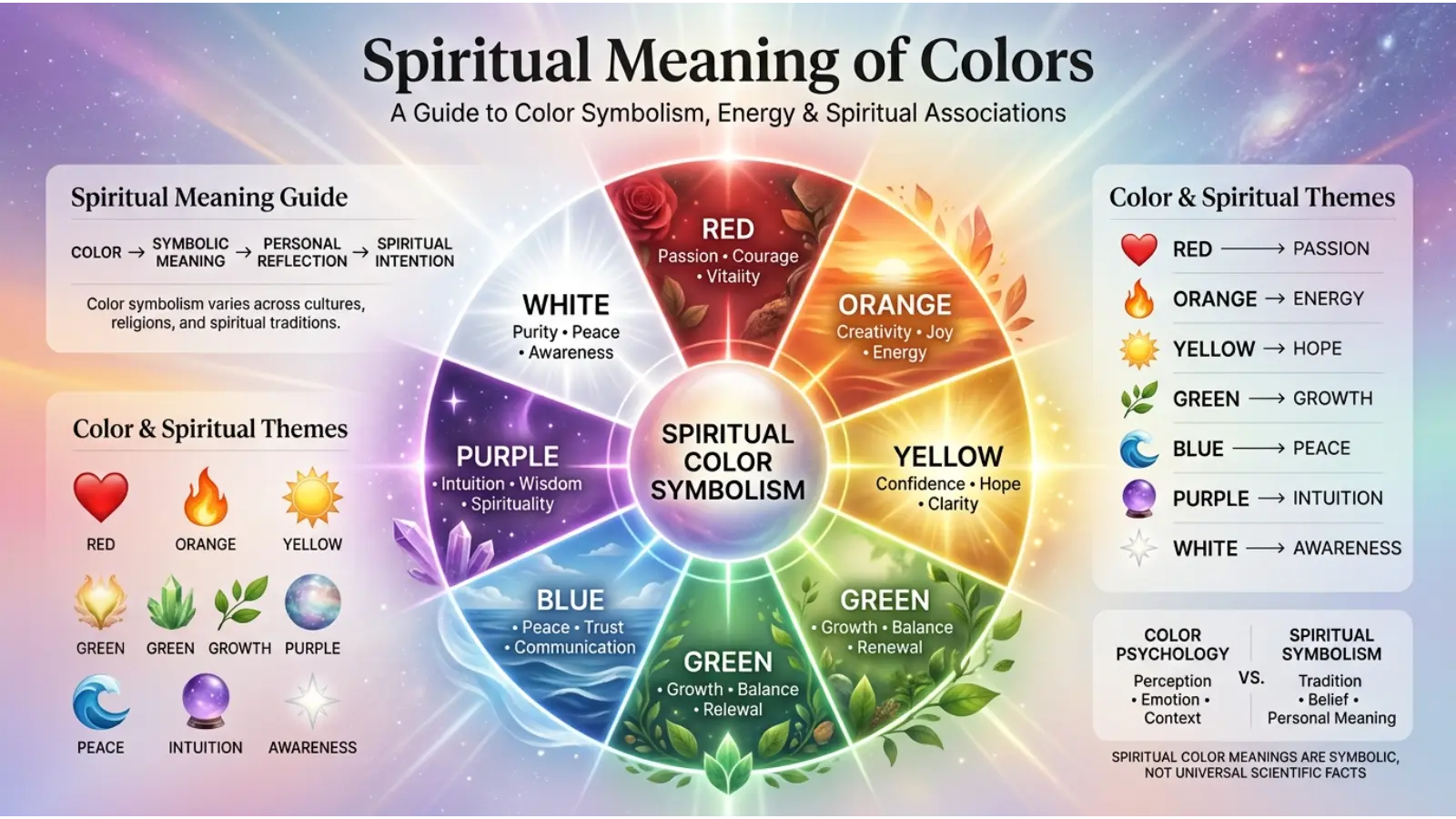
Color symbolism appears in many spiritual and religious settings, but meanings are not universal.
A color can carry different meanings depending on the tradition, historical period, region, and specific ritual.
For example, white may symbolize purity or peace in one setting while having associations with mourning in another. Red can represent celebration in one culture and danger or warning in another.
For this reason, it is better to say:
“This color is commonly associated with…”
rather than:
“This color always means…”
That small distinction makes color symbolism much more accurate.
Historical Roots of Color Symbolism
Humans have assigned meaning to color for thousands of years.
Some associations developed from the physical world. Red can resemble blood and fire. Green appears throughout vegetation. Blue is strongly connected with sky and water. Black relates to darkness and night.
Other meanings developed from technology and economics.
Purple is a famous example. Certain purple dyes were historically difficult to produce, helping the color become associated with wealth, status, and authority in some societies.
Religious traditions, political systems, clothing customs, art, and trade also influenced color symbolism.
Modern color magick draws from a mixture of sources, including folk practices, ceremonial magic, occult literature, contemporary witchcraft, personal symbolism, and popular culture.
Consequently, modern correspondence charts should not be treated as if they came from one ancient universal system.
Cultural Differences in Color Meaning
Color meanings change dramatically across cultures.
Western Cultural Associations
Modern Western symbolism often connects:
- Red with love, danger, and urgency
- Green with nature and money
- Blue with trust and calm
- White with purity
- Black with mourning, elegance, or mystery
- Purple with royalty and spirituality
These associations are common, but they are not universal.
East Asian Contexts
Color symbolism across East Asian societies is diverse and should never be reduced to a single rule.
Red, for example, can have strong associations with celebration, prosperity, luck, and happiness in some Chinese cultural contexts.
White can have different associations from those common in many Western settings, including connections with mourning in some East Asian traditions.
Middle Eastern and Other Regional Contexts
Color symbolism also varies throughout the Middle East, North Africa, South Asia, and other regions.
Religious traditions, national history, local customs, clothing, festivals, and political symbolism can all influence interpretation.
The lesson is simple: never assume that a color has one worldwide meaning.
Personality Associations With Color Magick
People sometimes wonder whether their favorite color reveals their personality.
Color preference can provide interesting clues about personal taste and emotional associations, but it cannot reliably determine someone’s personality.
Someone who loves purple might enjoy creativity or simply like the way purple looks.
Someone who prefers black might appreciate minimalist fashion rather than being mysterious or rebellious.
The Someone who chooses green might enjoy nature, or they may simply like the color.
Color can communicate an impression, but personality is much more complex.
Color Magick and Intentions
One of the easiest ways to use color symbolism is to begin with the intention rather than the color.
Ask:
What am I trying to represent?
Then select a color.
For Love
Possible symbolic choices include:
- ❤️ Red for passion
- 🩷 Pink for affection
- 🟢 Green for emotional growth
- ⚪ White for peaceful relationships
For Money and Prosperity
Common choices include:
- 🟢 Green for growth and abundance
- 🟨 Gold for wealth and achievement
- 🟡 Yellow for confidence and opportunity
For Protection
Common symbolic choices include:
- ⚫ Black for boundaries and protection
- 🔵 Blue for peace and safety
- ⚪ White for cleansing and protective symbolism
For Studying
Consider:
- 🟡 Yellow for mental focus
- 🔵 Blue for calm concentration
- 🟣 Purple for reflective thinking
These combinations are symbolic rather than guaranteed formulas.
Can You Combine Color Magick Meanings?
Yes. Combining colors can create a more specific symbolic message.
For example:
Green + Gold can represent prosperity and achievement.
Red + Pink can represent passionate and affectionate love.
Blue + White can suggest peace, clarity, and cleansing.
Purple + Silver can create associations with intuition, mystery, and reflection.
Green + Brown can emphasize nature, grounding, and steady growth.
The key is to consider the combined story of the colors rather than searching for a single fixed definition.
How Lighting Changes Color Magick Meanings
Lighting can completely change how a color appears.
A red candle under warm yellow lighting may look deeper and more orange. Under cool white lighting, it can appear sharper and brighter.
Likewise:
- Dark blue can appear almost black in low light.
- Purple can shift toward blue or red depending on lighting.
- Green can become dull under poor lighting.
- White can appear yellow under warm bulbs.
- Silver can lose its reflective quality in flat lighting.
This matters when choosing colors for altars, rooms, photography, clothing, or visual content.
Always judge the color in the environment where it will actually be used.
Color Magick Meanings in Interior Design
You do not need to create a traditional ritual space to use color symbolism.
Color can influence the atmosphere of an ordinary room.
Bedroom
Soft blue, lavender, cream, or muted green can create a quieter visual environment.
Living Room
Warm earth tones, green, terracotta, or soft orange can create a welcoming feeling.
Office
Blue can suggest calm professionalism, while yellow accents can add visual energy.
Meditation Space
Purple, indigo, white, blue, and natural green can support a reflective visual theme.
The best approach is usually to use a main color plus smaller accents rather than covering an entire room in one intense shade.

Color Magick in Fashion
Clothing allows people to carry color symbolism with them.
A person wearing red may want to communicate confidence or energy. Green can create a natural or grounded impression. Purple can appear creative or dramatic, while black can communicate simplicity, formality, or mystery.
However, fashion meaning depends on:
- Shade
- Fabric
- Cut
- Occasion
- Culture
- Accessories
- Personal style
A black suit and a black gothic outfit use the same basic color but communicate very different messages.
That is why context matters as much as the color itself.
Color Magick Meanings in Art and Creative Work
Artists have long used color to create emotional and symbolic meaning.
A painting dominated by blue may feel distant, peaceful, cold, or reflective. Red may increase tension and visual energy. Green can connect a scene with nature or renewal.
In magical or spiritual artwork, colors can become part of the visual language.
For example, an artist might deliberately place purple around a character associated with mystery and use gold around objects representing achievement.
The viewer does not need to share the artist’s belief system to understand the emotional message.
Color Magick and Branding
Color symbolism is also powerful in branding.
Companies carefully select colors because customers form visual impressions quickly.
Green is frequently useful for brands wanting associations with nature, freshness, or growth. Blue often communicates qualities such as reliability and professionalism. Black can create a premium or sophisticated appearance. Orange can feel energetic and approachable.
However, color alone does not create a brand identity.
Typography, imagery, packaging, language, product quality, and cultural context all influence perception.
A color that feels luxurious in one market may feel ordinary in another.
Color Combinations for Different Intentions
Here is a practical symbolic chart:
| Intention | Color Combination | Symbolic Idea |
|---|---|---|
| ❤️ Love | Red + Pink | Passion + affection |
| 💰 Prosperity | Green + Gold | Growth + achievement |
| 🛡️ Protection | Black + White | Boundaries + cleansing |
| 🧘 Peace | Blue + White | Calm + clarity |
| 🌱 Growth | Green + Brown | Renewal + grounding |
| 🔮 Intuition | Purple + Silver | Spiritual reflection |
| 📚 Learning | Yellow + Blue | Focus + calm |
| 🎨 Creativity | Orange + Purple | Energy + imagination |
| 💪 Confidence | Red + Gold | Courage + achievement |
| 🌙 Reflection | Indigo + Silver | Inner awareness |
Common Misconceptions About Color Magick
“Every color has one universal meaning.”
Not true.
Color correspondences differ between magical traditions and cultures. Even within one tradition, individual practitioners may use colors differently.
“Black always means evil.”
No.
Black can symbolize protection, endings, mystery, boundaries, grounding, or the unknown.
“Color magick is scientifically proven.”
There is no strong scientific basis for claiming that colors possess supernatural powers that produce specific outcomes.
Color can still have psychological and symbolic effects.
“You must use the exact color listed in a spell.”
Not necessarily.
Different systems give different correspondences. Personal intention and consistency may matter more to a practitioner than following a single chart.
“Favorite colors reveal your personality.”
Not reliably.
Color preference can reflect taste, memories, culture, fashion, environment, and personal associations.
“Brighter colors are always stronger.”
Brightness and saturation change perception, but they do not automatically make a symbolic intention more powerful.
How to Choose a Color for Your Own Practice
If you want to use color symbolism personally, start with these five questions:
1. What is my intention?
Be specific.
“Success” is broad. “Confidence before an important presentation” is more precise.
2. What color naturally represents that idea to me?
Your personal association can be meaningful.
3. What does the color traditionally represent?
Check whether your chosen color has an established correspondence within the tradition you follow.
4. Does the color create the right emotional atmosphere?
A color can technically match an intention but still feel wrong to you.
5. Does the context change the meaning?
Consider culture, location, clothing, lighting, season, and surrounding colors.
This approach produces a more thoughtful practice than blindly following a correspondence chart.
A Simple Color Magick Framework
You can create your own symbolic system using three layers:
Traditional meaning → Personal meaning → Practical intention
For example:
Green
Traditional symbolism: growth and abundance.
Personal meaning: memories of gardens and nature.
Practical intention: building better financial habits.
The final symbolism becomes more personal and specific.
This method also explains why two people can use the same color for completely different purposes without either person necessarily being “wrong.”
Color Magick by Goal
Love
Red, pink, green
Friendship
Pink, yellow, light blue
Confidence
Red, orange, gold
Money
Green, gold
Success
Gold, orange, yellow
Protection
Black, white, blue
Peace
Blue, white, lavender
Healing Symbolism
Green, blue, white
Creativity
Orange, purple, yellow
Wisdom
Purple, blue, indigo
Intuition
Purple, indigo, silver
Grounding
Brown, green, black
New Beginnings
White, green, yellow
Transformation
Purple, black, green
Communication
Blue, yellow
These are common symbolic associations, not guaranteed magical outcomes.
Why Context Changes Color Meaning
A color does not communicate in isolation.
Imagine a red rose, a red warning sign, a red wedding decoration, and a red sports jersey.
They all use red, yet they communicate completely different ideas.
The same principle applies to color magick.
A red candle used for courage can have a different personal meaning from red clothing worn for romance.
The object, setting, intention, and surrounding symbols all contribute to interpretation.
Age and Personal Experience Can Change Color Meaning
People do not experience colors in exactly the same way throughout life.
A child may associate yellow with a favorite toy. An adult may associate the same color with work, school, or a particular memory.
Personal experiences can become stronger than general color symbolism.
This is why a supposedly “peaceful” color may feel uncomfortable to one person while another finds it deeply calming.
Personal meaning should therefore be considered alongside traditional correspondence.
The Difference Between Symbolism and Supernatural Claims
This is perhaps the most important point when discussing color magick.
Symbolism is not the same as scientific evidence.
Saying:
“Green symbolizes growth and abundance in many modern magical practices.”
is a statement about symbolism.
Saying:
“Green magically causes financial wealth.”
is a supernatural claim that requires evidence.
Keeping these ideas separate makes color-magick discussions more honest and useful.
Color can be meaningful without needing to be presented as a scientifically established force.
Frequently Asked Questions About Color Magick Meanings
What is the strongest color in color magick?
There is no universally strongest color. The answer depends on the magical tradition and the intention. Red may be considered especially energetic, while purple may be treated as spiritually significant, but neither is objectively the “most powerful.”
What color is best for protection?
Black, white, and blue are commonly associated with protection in modern color-magick practices. Their meanings vary by tradition, so choose the one that best matches your intention.
What color represents money in magick?
Green is the most familiar modern association with money and prosperity. Gold is also commonly connected with wealth, success, value, and achievement.
What color represents love?
Red commonly symbolizes passion and romantic desire, while pink often represents affection, tenderness, friendship, and gentle love.
What color represents healing?
Green and blue are frequently used symbolically for healing, balance, peace, and renewal. White may also represent cleansing or restoration.
What color is used for spiritual work?
Purple, violet, indigo, silver, and white are commonly associated with spirituality, intuition, reflection, or higher awareness in modern symbolic systems.
Can I use more than one color in a spell?
Yes. Combining colors can create a more detailed symbolic intention. For example, green and gold can represent growth combined with achievement.
Does the shade of a color matter?
Yes. Shade, brightness, saturation, and lighting can change how a color feels. Dark blue and pale blue, for example, may create very different impressions.
Do color-magick meanings work for everyone?
No universal system works identically for everyone. Meanings depend on tradition, culture, personal experience, context, and intention.
Is color magick scientifically proven?
Color symbolism itself is real as a cultural and psychological phenomenon, but there is no established scientific evidence that specific colors have supernatural powers that directly cause magical outcomes.
Final Thoughts on Color Magick Meanings
Color magick meanings are best understood as a symbolic language. Each color can carry layers of cultural history, psychological association, spiritual interpretation, personal memory, and visual emotion.
Red can suggest courage or passion. Green can represent growth and abundance. Blue can encourage thoughts of peace and communication. Purple can evoke spirituality and mystery. Black can symbolize protection and endings, while white can suggest cleansing and new beginnings.
Yet no color has only one meaning.
The most useful approach is to look at tradition, intention, context, and personal association together. A color chart can provide a starting point, but your own reason for choosing a color gives the symbolism its strongest personal meaning.
Whether you use color in spiritual practice, artwork, fashion, meditation, home decoration, branding, or simply everyday life, paying attention to color can reveal how much meaning we attach to what we see.

Emma Wilson is a dedicated comparison writer and product researcher at ColorMystiic.com. She specializes in creating unbiased product comparisons, detailed reviews, and helpful buying guides. Her goal is to help readers make smarter purchasing decisions with confidence.