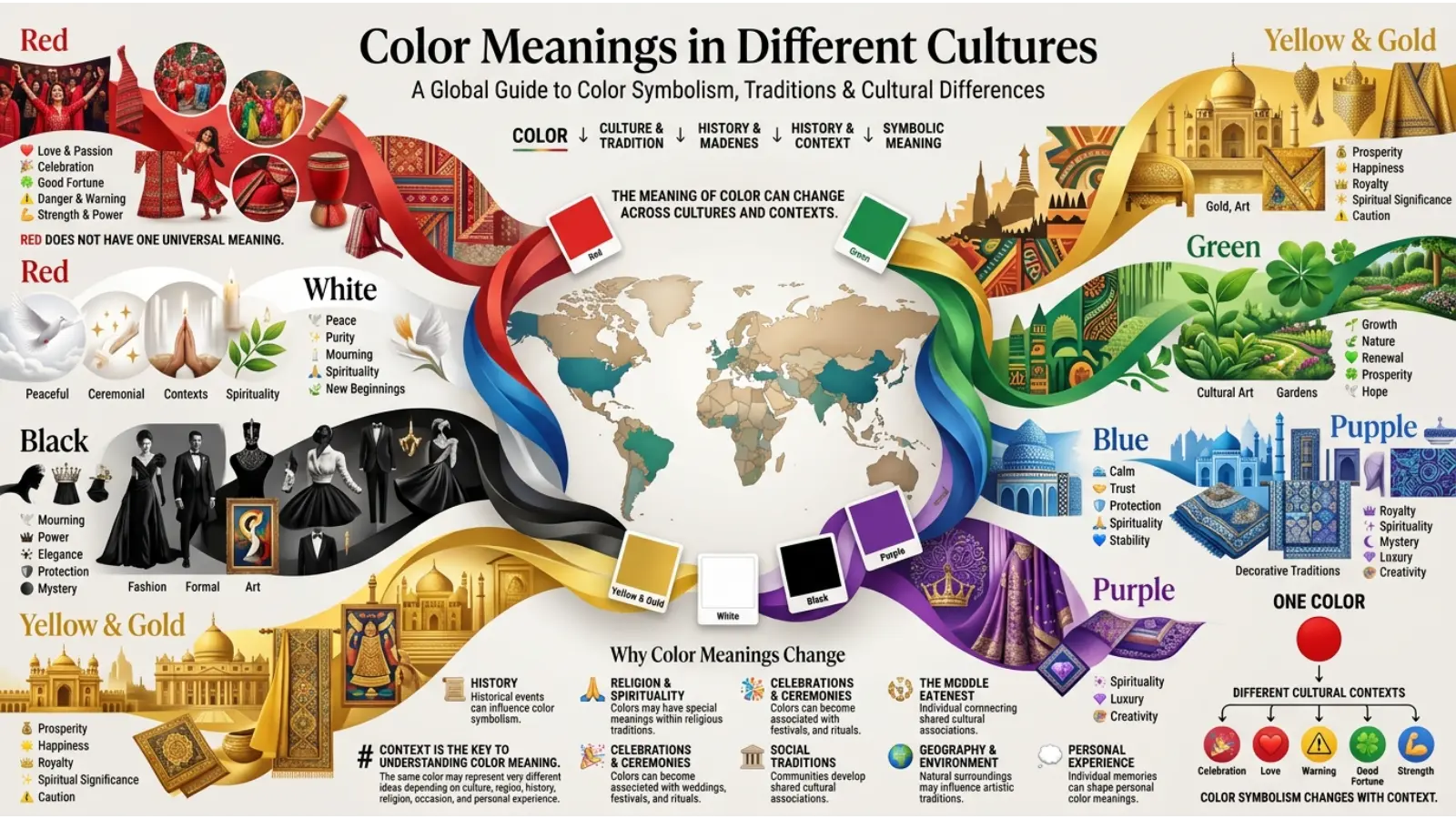
Color surrounds human life, yet the same color can communicate very different ideas depending on where you are in the world. A color associated with celebration in one culture may represent mourning in another. Red can suggest love, danger, luck, power, or prosperity. White may represent purity, peace, spirituality, or grief. These differences make color meanings in different cultures a fascinating subject.
Color symbolism develops through history, religion, geography, politics, art, nature, and shared traditions. Therefore, there is no single universal dictionary that explains what every color means everywhere. Context matters just as much as the color itself.
Quick Answer: Color meanings differ between cultures because traditions, religion, history, and social experiences shape how people interpret colors. For example, red can symbolize luck in China and love in Western cultures, while white often represents purity in the West but may be connected with mourning in parts of Asia.
Why Do Color Meanings Differ Between Cultures?
People do not experience colors only through their eyes. They also learn what colors mean through family traditions, religious practices, celebrations, clothing, art, and social customs.
For example, the color of wedding clothing can reveal major cultural differences. In many Western societies, white wedding dresses became strongly connected with marriage traditions. Meanwhile, red has historically been important in wedding celebrations across several Asian cultures because of its association with happiness, prosperity, and good fortune.
Geography can also influence color symbolism. Communities living close to deserts, forests, oceans, or mountains may develop different relationships with colors found in their environment.
History adds another layer. Purple became associated with wealth and status in several ancient societies partly because certain purple dyes were difficult and expensive to produce. Consequently, the meaning of a color can sometimes begin with practical economics and later become symbolic.
Modern globalization has also changed color meanings. Movies, social media, international brands, fashion, and technology now spread visual associations across borders. Even so, local traditions remain powerful.
The Psychology Behind Color Meanings in Different Cultures
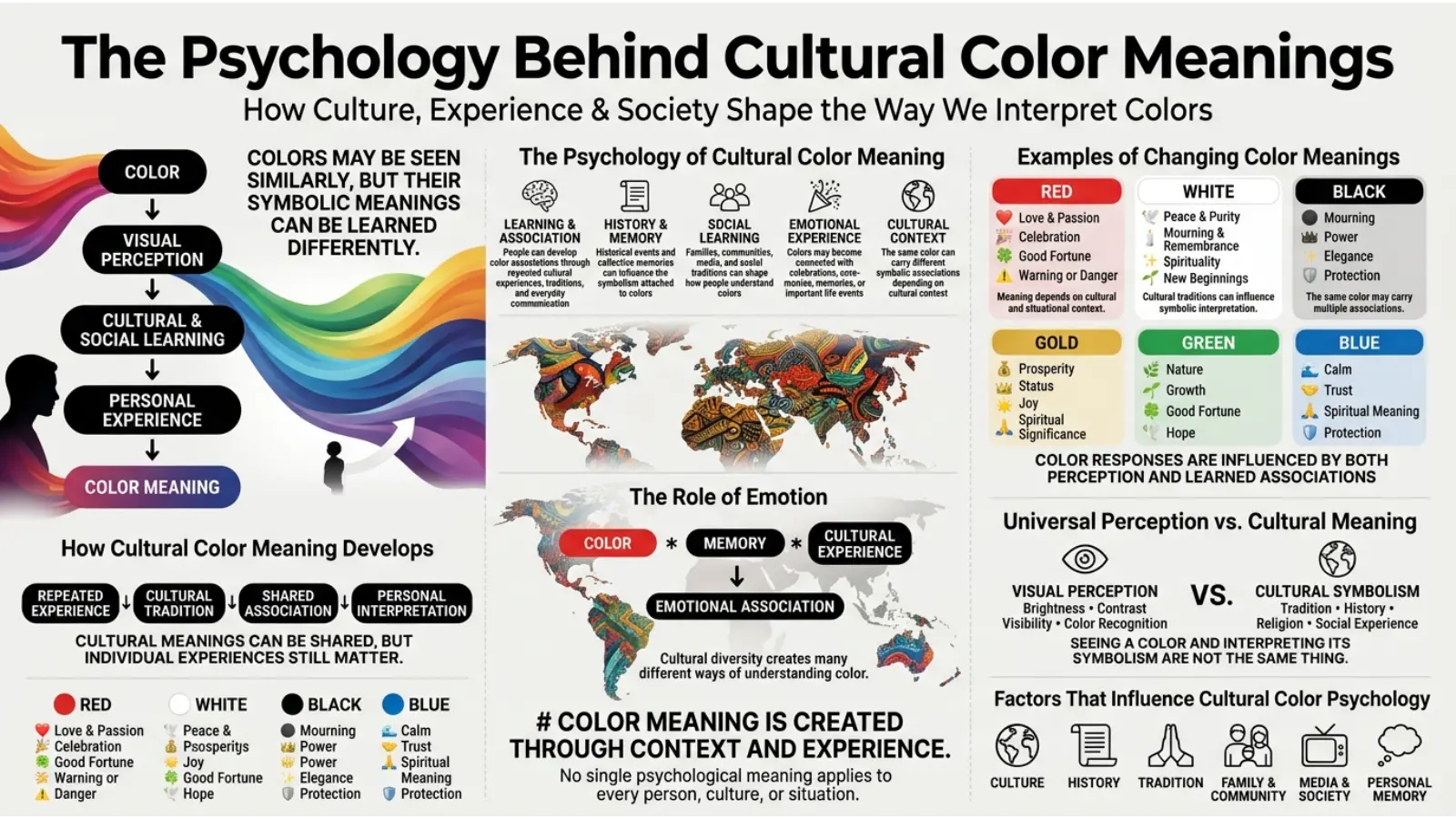
Color psychology examines how people respond emotionally and mentally to colors. However, researchers generally recognize that color responses depend heavily on context, personal experience, culture, and individual preference.
A bright red warning sign may create urgency because people have learned to connect red with danger. At the same time, red decorations at a celebration can create excitement and happiness.
Therefore, colors do not automatically control human behavior. Instead, they can influence perception and expectations when combined with context.
Several factors affect how people interpret color:
| Factor | How It Changes Color Meaning |
|---|---|
| Culture | Traditions teach people symbolic associations |
| Religion | Colors may appear in rituals and sacred art |
| History | Political and historical events create new meanings |
| Personal Experience | Memories can create individual associations |
| Lighting | The same color may look warmer or cooler |
| Age | Generational trends can influence preferences |
| Context | Clothing, packaging, art, and signs change interpretation |
For this reason, understanding color requires more than memorizing simple meanings.
Red Color Meaning in Different Cultures
Red is one of the most emotionally powerful colors. It is often connected with strong feelings, energy, passion, danger, and celebration.
Red in Chinese Culture
Red is widely associated with good fortune, happiness, prosperity, and celebration in Chinese cultural traditions. It is especially visible during festivals and important celebrations.
Red decorations, envelopes, and clothing may therefore carry positive symbolic meaning.
However, meaning can still depend on the situation. No color has exactly the same interpretation in every context.
Red in Western Cultures
In many Western societies, red is strongly connected with love, romance, passion, and excitement. It is commonly used for Valentine’s Day imagery.
At the same time, red can communicate danger, warning, anger, or emergency. Stop signs and warning signals often use red because it attracts attention.
Red in South Asian Cultures
Red has an important place in many South Asian traditions. It may be associated with celebration, marriage, strength, and spiritual significance.
In wedding fashion, red and related warm shades have traditionally been popular in many communities.
Red in Branding
Brands often use red when they want to create a feeling of energy, excitement, appetite, urgency, or boldness.
However, successful branding depends on more than color alone. Typography, product category, culture, and brand reputation also influence consumer perception.
Blue Color Meaning Across Cultures
Blue often creates associations with the sky and water. As a result, many people connect it with calmness, openness, stability, and trust.
Blue in Western Culture
Blue is frequently associated with trust, professionalism, stability, and calmness. This helps explain why blue is common in corporate identity and technology branding.
Dark blue can appear serious and authoritative, while lighter blue may feel more peaceful or friendly.
Blue in Middle Eastern Traditions
Blue has appeared in architecture, decorative arts, and protective symbolism in different Middle Eastern communities. Certain blue objects and designs have traditionally been connected with protection against harmful attention or misfortune.
Blue in East Asian Culture
Blue can carry associations with nature, youth, healing, or stability depending on the country and historical context.
Modern meanings are also influenced by global fashion and technology.
Blue in Everyday Design
Blue works especially well in spaces designed for concentration or relaxation. Soft blue shades can create a calm atmosphere, while deep navy can add formality and visual structure.
White Color Symbolism Around the World
The White is often described as a symbol of purity, but its cultural meaning is far more complex.
White in Many Western Societies
White is commonly associated with cleanliness, peace, simplicity, innocence, and formal ceremonies.
It is often used in healthcare environments because people may associate it with cleanliness and order.
White and Mourning in Parts of Asia
In several Asian cultural traditions, white has historically been connected with mourning and funeral practices.
A Western visitor may see white as a wedding color, while another cultural tradition may connect the same color with remembrance and grief.
White in Modern Design
Minimalist design often uses white space to create clarity and visual breathing room. In digital design, white can make content easier to scan when combined with good typography and contrast.
Black Color Meaning in Different Cultures
The Black often carries powerful associations because it is visually connected with darkness and the absence of visible light.
Black in Western Culture
Black can symbolize mourning, death, mystery, seriousness, and formality.
However, it can also represent sophistication and luxury. A black formal suit, for example, may communicate elegance rather than sadness.
Black in African Cultural Contexts
Africa contains thousands of cultural traditions, so there is no single African interpretation of black.
In different communities, black may appear in ceremonial clothing, art, identity, spirituality, ancestry, or historical symbolism. Therefore, African color meanings should always be discussed with regional context rather than broad stereotypes.
Black in Fashion
Black remains one of the most versatile fashion colors. It can create a clean, formal, powerful, or minimalist appearance.
The meaning changes with fabric, styling, accessories, and occasion.
Yellow Color Meaning Around the World
Yellow is visually connected with sunlight, warmth, and brightness. Therefore, it often attracts attention quickly.
Positive Meanings of Yellow
Yellow may symbolize:
- Happiness
- Optimism
- Energy
- Warmth
- Creativity
- Hope
Negative Meanings of Yellow
Depending on cultural context, yellow can also suggest:
- Warning
- Caution
- Jealousy
- Illness
- Betrayal
Yellow in Chinese History and Culture
Yellow has held historical importance in Chinese culture and has been associated with authority and imperial symbolism during certain periods of history.
Its meaning today depends greatly on context, generation, and use.
Yellow in Marketing
Marketers may use yellow to create an energetic and cheerful appearance. Because bright yellow attracts attention, it can be useful for packaging and advertising.
Nevertheless, excessive yellow can become visually tiring. Designers often balance it with darker or neutral colors.
Green Color Meaning in Different Cultures
Green has a strong connection with nature. For that reason, growth, renewal, agriculture, and environmental awareness are common associations.
Green in Western Culture
Green often represents:
- Nature
- Growth
- Freshness
- Environmental awareness
- Renewal
However, expressions such as “green with envy” also connect the color with jealousy in English-speaking cultures.
Green in Islamic Cultural Contexts
Green has significant historical and symbolic importance in Islamic traditions. It appears in religious art, architecture, and cultural symbolism.
However, interpretations and uses differ across countries and communities.
Green in Modern Branding
Companies frequently use green to suggest natural products, sustainability, freshness, health-related themes, or environmental responsibility.
Still, a green logo does not automatically make a company environmentally responsible. Consumers should evaluate actual practices rather than color-based impressions.
Purple Color Meaning Across Cultures
Purple has long been connected with wealth and prestige in several historical societies.
One reason involves the historical difficulty of producing certain purple dyes. Rare and expensive pigments helped make purple clothing a symbol of social status in particular periods and regions.
Today, purple may represent:
- Luxury
- Creativity
- Mystery
- Spiritual reflection
- Imagination
Light purple shades, such as lavender, often create a softer impression. Dark purple may appear more dramatic or luxurious.
Orange Color Meaning in Different Cultures
Orange combines some visual qualities associated with red and yellow. As a result, it often feels energetic and warm.
Orange may suggest:
- Enthusiasm
- Creativity
- Warmth
- Harvest
- Celebration
In some religious and cultural traditions, saffron and orange-colored clothing carry spiritual significance.
In modern design, orange is often used to create a friendly and energetic appearance.
Pink Color Meaning Around the World
Modern Western culture often connects pink with romance, softness, affection, and femininity. However, these associations are not fixed throughout history or across all societies.
Fashion history shows that color associations can change over time.
Today, pink can also communicate:
- Playfulness
- Care
- Sweetness
- Confidence
- Modern style
A pale pink and a vivid magenta can create completely different emotional impressions.
Therefore, shade matters as much as the basic color category.
Gold and Yellow-Gold Symbolism
Gold-colored objects often suggest wealth because real gold has historically been valuable across many societies.
Gold may symbolize:
- Wealth
- Achievement
- Celebration
- Success
- Divine or sacred imagery
- Prestige
However, designers must consider cultural context. A luxurious gold package may communicate prestige in one market but feel excessive in another.
Silver Color Meaning in Different Cultures
Silver is often associated with the moon, technology, modernity, and elegance.
Unlike gold, silver may feel cooler and more understated.
Common modern associations include:
- Innovation
- Sophistication
- Technology
- Precision
- Modern luxury
Silver is popular in automotive design, electronics, jewelry, and contemporary interiors.
Brown Color Meaning Across Cultures
Brown is strongly connected with earth, wood, soil, and natural materials.
As a result, it often suggests:
- Stability
- Reliability
- Simplicity
- Nature
- Warmth
Brown is commonly used in rustic interior design and natural product packaging.
However, darker brown can sometimes appear heavy when used excessively in small spaces.
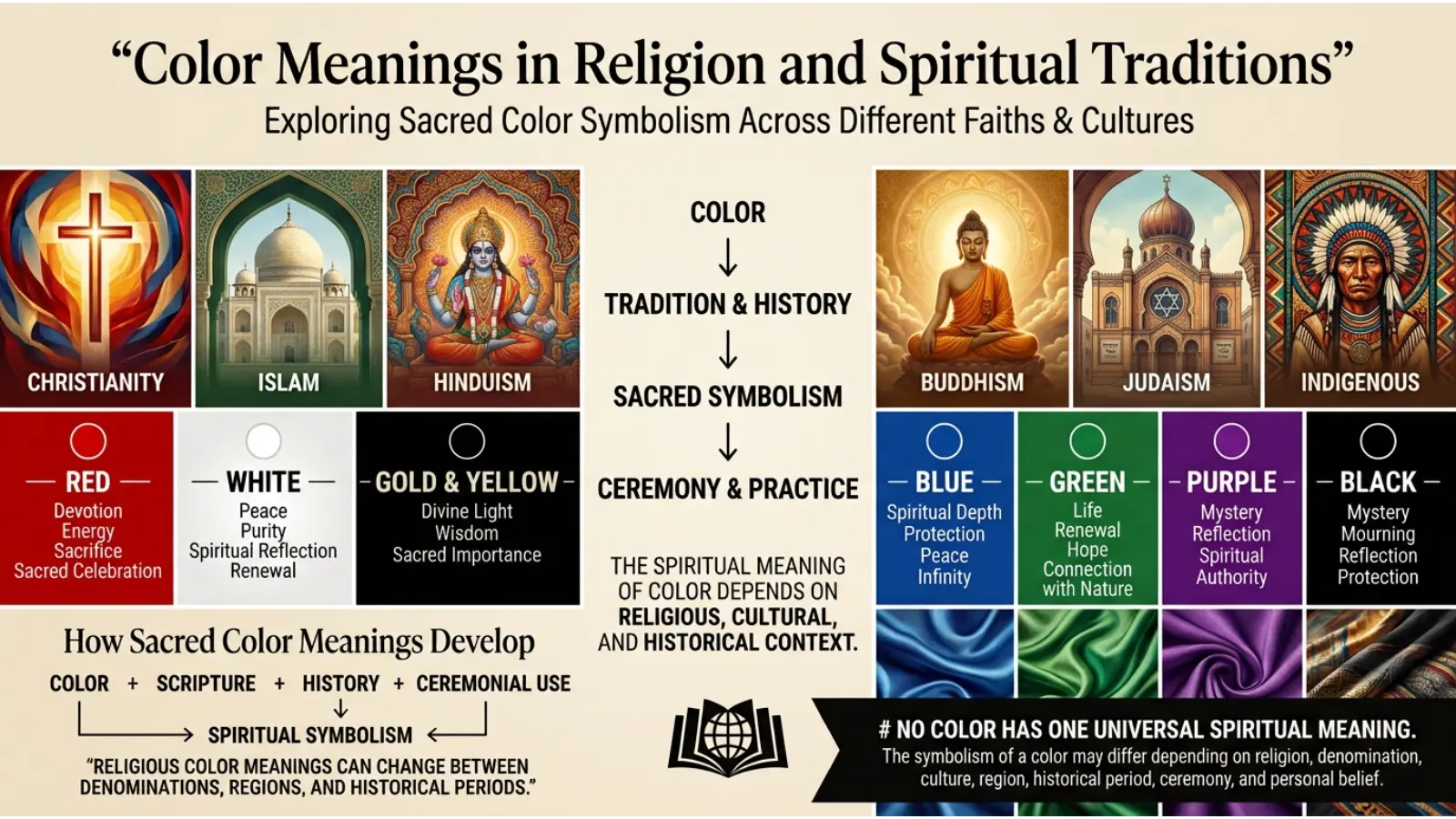
Color Meanings in Religion and Spiritual Traditions
Colors appear in religious clothing, sacred architecture, ceremonies, paintings, and symbolic objects around the world.
However, spiritual color meanings should always be treated carefully.
A color does not have one universal religious meaning. Different traditions may interpret the same color differently, and individual believers may also understand symbolism in personal ways.
For example, green, white, saffron, blue, red, and gold have all appeared in important religious and spiritual contexts.
The safest approach is to understand the specific tradition rather than assuming that a general “spiritual color meaning” applies everywhere.
How History Changed the Meaning of Colors
Color meanings constantly evolve.
Purple provides a useful example. Historical access to rare dyes helped create associations between purple and wealth in certain societies.
Similarly, political movements have used colors to represent national identity, social causes, and political ideas.
Fashion has also transformed color meanings. A color considered suitable for one gender or age group during one period may be interpreted differently decades later.
Therefore, cultural color symbolism is not frozen in time.
How Culture Changes Color Meaning in Fashion
Clothing provides one of the most visible examples of cultural color symbolism.
The color of clothing can communicate:
- Celebration
- Mourning
- Social status
- Religious identity
- Formality
- National identity
- Personal style
A color that feels appropriate for a wedding in one culture may be unsuitable for the same occasion elsewhere.
Fashion also changes meaning through trends. Young people may adopt colors in new ways that differ from older traditions.
Consequently, modern fashion often mixes cultural symbolism with personal expression.
Color Meanings in Different Cultures in Branding and Marketing
Color can influence the first impression people receive from a brand.
For example:
| Color | Common Branding Associations |
|---|---|
| Blue | Trust, stability, technology |
| Red | Energy, excitement, urgency |
| Green | Nature, freshness, growth |
| Black | Luxury, power, sophistication |
| Yellow | Optimism, attention, energy |
| Purple | Creativity, imagination, luxury |
| Orange | Friendliness, enthusiasm |
| White | Simplicity, cleanliness |
These associations are not guaranteed consumer reactions. Cultural background can change how customers interpret a color.
For international brands, cultural research is essential before launching packaging or advertising in a new market.
A color strategy that succeeds in one country may communicate an unintended message somewhere else.
How Designers Use Cultural Color Meanings
Designers use color to guide attention and create emotional atmosphere.
However, professional design requires more than symbolic meaning.
Designers must also consider:
Contrast
A beautiful color combination can fail if text is difficult to read.
Lighting
Natural sunlight, warm indoor bulbs, and digital screens can make the same color appear different.
Material
Red fabric, red paint, and red digital graphics do not reflect light in exactly the same way.
Audience
Children, older adults, local communities, and international customers may respond differently to the same visual design.
Context
A black package for luxury perfume may look elegant. The same black color in a medical warning label may communicate something entirely different.
Color Meanings in Interior Design
Cultural awareness can improve interior design, especially in homes, hotels, restaurants, and international workplaces.
Blue for Calm Spaces
Soft blue shades can help create a peaceful appearance in bedrooms and bathrooms.
Green for Natural Interiors
Green works well with plants, wood, and natural materials.
Red for Energy
Red can create a strong focal point, although too much intense red may make a room feel visually overwhelming.
White for Space and Simplicity
White can make rooms appear brighter and more open. However, adding texture and warmer materials can prevent a space from feeling cold.
Black for Contrast
Black furniture or accents can add depth and sophistication when balanced with lighter colors.
The best interior color choice depends on lighting, room size, cultural expectations, and personal preference.
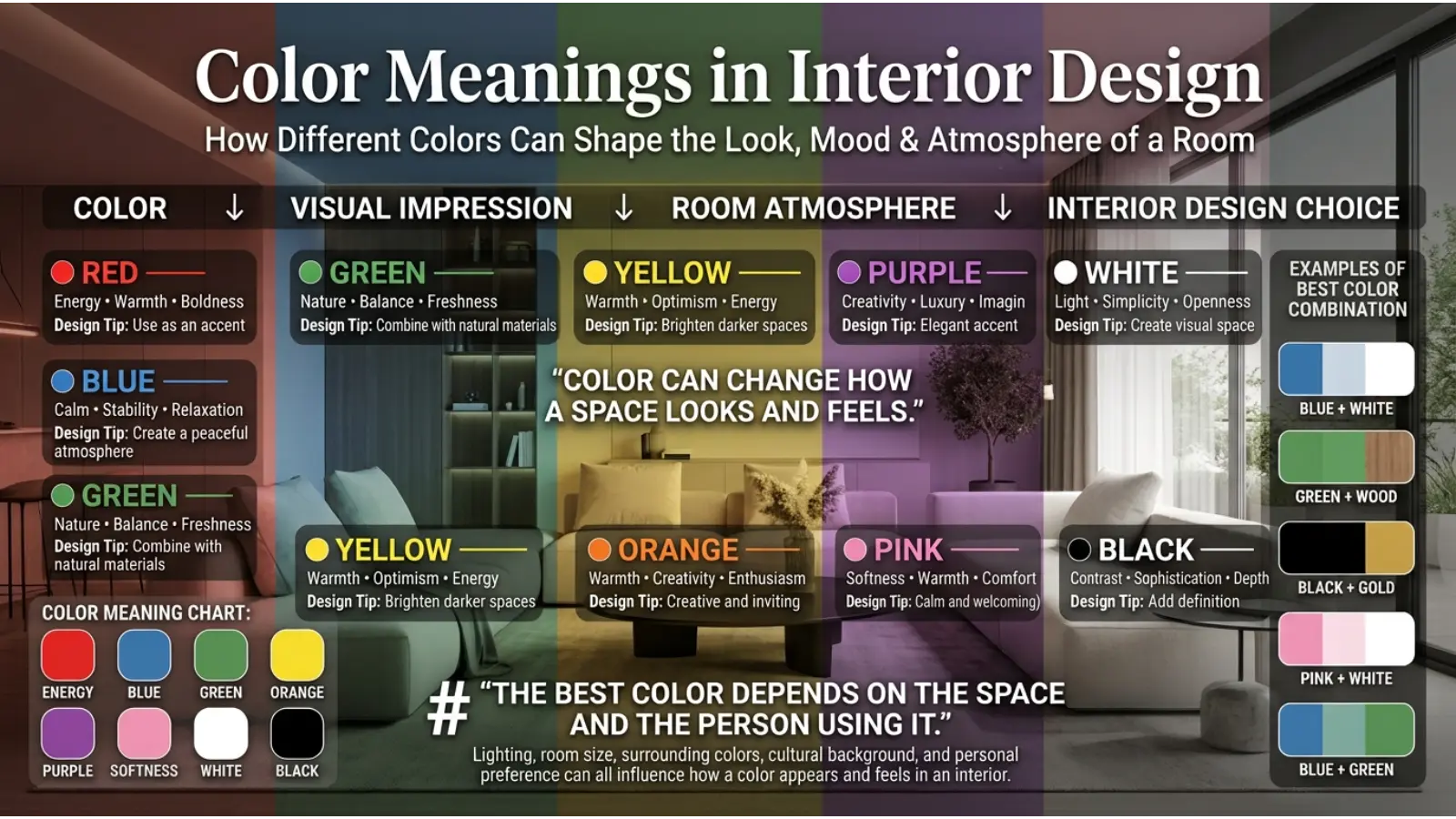
Color Combinations That Work Across Many Contexts
Some combinations are visually flexible because they create useful contrast or harmony.
Blue and White
This combination often feels clean, calm, and organized.
Green and Brown
These colors connect naturally with forests, plants, and earth.
Black and Gold
The combination often creates a luxurious and dramatic appearance.
Red and White
This pairing creates strong visual contrast and can feel energetic or celebratory depending on cultural context.
Purple and Gold
Purple and gold can create a rich, formal appearance because both colors have historical associations with prestige.
Still, cultural meaning should always be considered before using these combinations in international communication.
How Lighting Changes the Color Meanings in Different Cultures
Color is not experienced in isolation.
A white wall under warm lighting may look cream. A red dress under blue lighting may appear darker and cooler.
Digital screens also display colors differently depending on brightness and display settings.
Therefore, designers and photographers should test important colors under the actual conditions where people will see them.
Lighting can change:
- Brightness
- Warmth
- Saturation
- Contrast
- Emotional atmosphere
This is especially important in fashion, interior design, product photography, and retail spaces.
Does Age Affect Color Meanings in Different Cultures?
Age can influence color preferences and associations, although no color belongs to one age group.
Children may learn color meanings through toys, books, schools, and media.
Older generations may connect certain colors with historical events, fashion trends, or traditions that younger people have not experienced.
Meanwhile, younger generations can create new meanings through online culture and social media.
As a result, color symbolism changes across generations.
Common Misconceptions About Color Meanings
Every Color Has One Universal Meaning
This is false. Culture and context can significantly change interpretation.
Color Psychology Can Predict Personality
Color preference does not determine a person’s personality.
Someone who likes blue is not automatically calm, trustworthy, or introverted.
Brands Can Control Customers Through Color
Color can influence first impressions, but customers make decisions based on price, quality, reputation, experience, and many other factors.
Traditional Meanings Never Change
Color meanings evolve with history, fashion, technology, and globalization.
All People From One Country Interpret Colors the Same Way
Countries contain diverse regions, communities, religions, generations, and personal experiences.
Broad cultural statements should therefore be treated as general patterns rather than rules for every individual.
Real-World Applications of Color Meanings in Different Cultures
Understanding cultural color symbolism has practical value.
Business
International companies can research local color associations before designing advertisements and packaging.
Marketing
Marketers can avoid relying on assumptions and instead test how audiences respond to visual campaigns.
Fashion
Designers can combine traditional symbolism with modern style while respecting cultural context.
Home Decoration
Homeowners can choose colors based on personal comfort while considering family traditions and cultural preferences.
Photography
Photographers can use color to create mood and symbolism, but they should understand how viewers may interpret those choices.
Art
Artists can use cultural color meanings to communicate deeper ideas or deliberately challenge traditional symbolism.
Entertainment
Movies and video games often use color to identify characters, locations, emotions, and fictional worlds.
Sports
Teams use color to build identity, encourage recognition, and create emotional connections with supporters.
Why Context Matters More Than a Simple Color Chart
A color chart may say that blue means calm or red means passion, but real life is more complicated.
Imagine red in three different situations:
- A red emergency light
- A red wedding decoration
- A red luxury sports car
The color is the same, yet the meaning changes immediately.
The same principle applies to every color.
Context includes:
- Culture
- Location
- Occasion
- Religion
- History
- Lighting
- Design
- Personal experience
Understanding context is therefore the key to understanding color.
FAQ About Color Meanings in Different Cultures
What are color meanings in different cultures?
Color meanings in different cultures describe how societies interpret colors through traditions, religion, history, art, and social customs. The same color may have different meanings in different regions.
Why does red mean different things in different cultures?
Red has different meanings because cultures developed unique traditions and symbolic systems. It can represent love, danger, luck, celebration, power, or passion depending on the context.
Why is white associated with mourning in some cultures?
In several Asian traditions, white has historically been connected with mourning and funeral customs. This differs from many Western traditions, where white is commonly associated with purity and weddings.
What color means good luck in Chinese culture?
Red is widely associated with good fortune, happiness, and celebration in Chinese cultural traditions.
Does blue mean trust in every culture?
No. Blue is commonly used to suggest trust and stability in modern Western branding, but cultural meanings vary across regions and contexts.
What color represents mourning around the world?
Black is commonly associated with mourning in many Western societies, while white has historically been connected with mourning in several Asian traditions. Funeral customs vary significantly between cultures.
Do colors have universal meanings?
Some associations may be common because of shared experiences with nature, such as green and plants. However, most symbolic meanings are influenced by culture and context rather than being completely universal.
Can color affect people’s emotions?
Color can influence perception and emotional responses, but reactions depend on personal experiences, cultural background, context, and the environment.
Does your favorite color reveal your personality?
Not reliably. Color preference may reflect mood, experience, fashion, or personal taste, but it cannot accurately determine personality.
Why should businesses understand cultural color meanings?
Businesses working internationally need to understand local associations because colors used in logos, packaging, and advertising may communicate different messages to different audiences.
Conclusion
The study of color meanings in different cultures shows that colors are more than visual decoration. They carry memories, traditions, beliefs, history, and emotional associations.
Red can represent celebration in one setting and danger in another. White may suggest purity or mourning depending on cultural tradition. Black can communicate grief, authority, luxury, or mystery. Even familiar colors can change meaning when placed in a different environment.
The most useful lesson is to avoid treating color symbolism as a fixed rulebook. Culture, history, religion, lighting, fashion, age, and personal experience all shape interpretation.
By paying closer attention to how colors appear in clothing, art, branding, homes, celebrations, and everyday objects, we can better understand both visual communication and the cultures around us.

Emma Wilson is a dedicated comparison writer and product researcher at ColorMystiic.com. She specializes in creating unbiased product comparisons, detailed reviews, and helpful buying guides. Her goal is to help readers make smarter purchasing decisions with confidence.