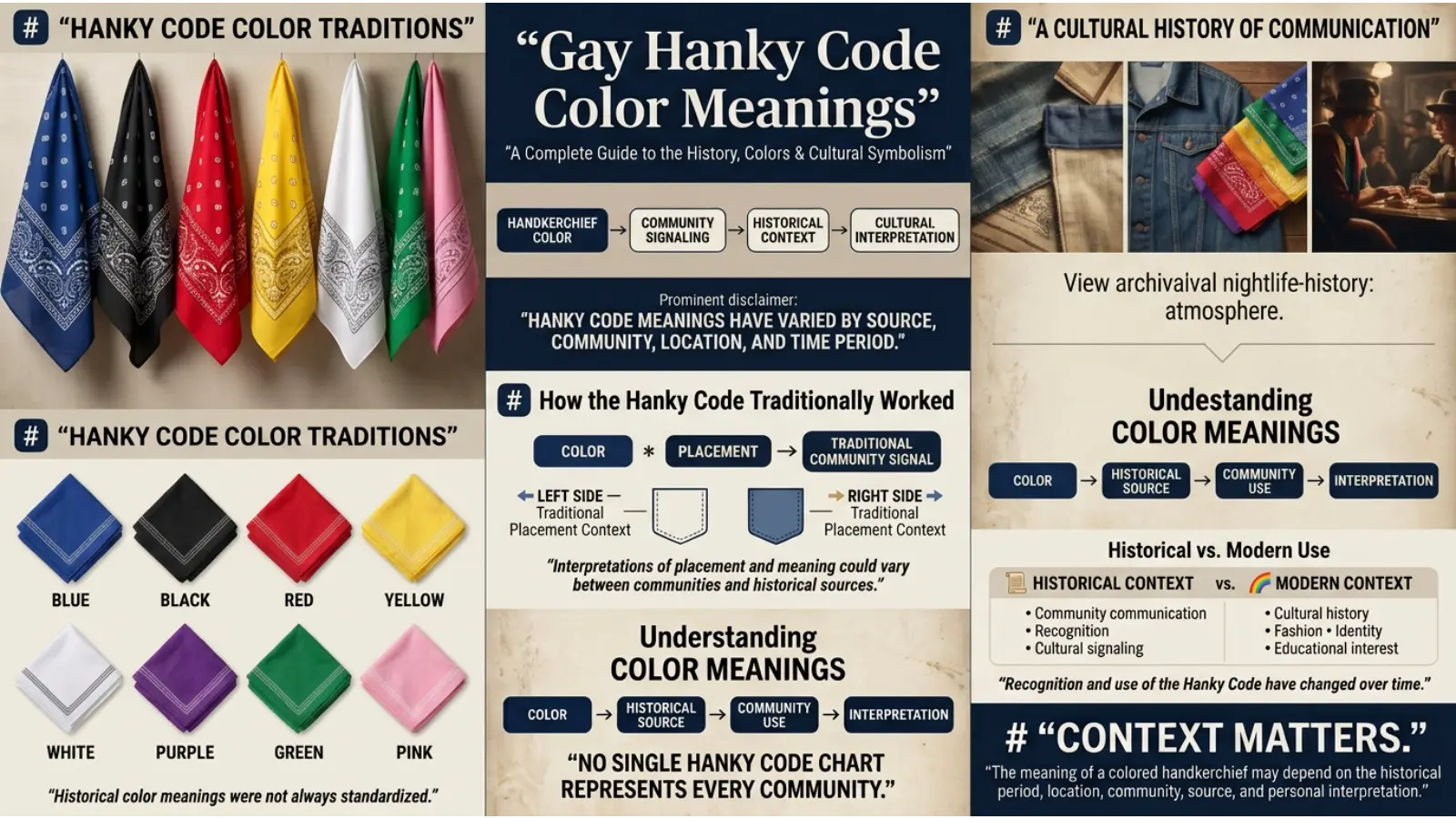
The gay hanky code is a historical system in which colored handkerchiefs can communicate interests, preferences, or social signals within parts of gay and LGBTQ+ culture. Also called the hanky code or bandana code, it became especially associated with gay male communities in the United States during the late 20th century. Today, people search for gay hanky code color meanings because the system has a fascinating connection to LGBTQ+ history, fashion, identity, communication, and symbolism.
Unlike ordinary color symbolism, however, hanky code meanings are not universal psychological meanings. A blue handkerchief does not automatically mean the same thing in every culture or situation. Instead, its meaning depends on the historical code, the specific community, the shade or pattern used, and sometimes the side of the body where it is worn.
The hanky code also shows how color can become a practical language. Colors that normally represent calmness, power, nature, or luxury can take on completely different meanings when a community creates its own shared system.
Quick Answer: The gay hanky code uses colored handkerchiefs to communicate particular interests or preferences within parts of gay culture. Meanings can vary by time, place, community, and source, so a color chart should be treated as historical or cultural guidance rather than a universal rule.
What Is the Gay Hanky Code?
The gay hanky code is a color-based signaling system traditionally associated with gay male communities, particularly leather, fetish, and cruising subcultures. A person could wear a colored handkerchief in a back pocket to communicate a particular interest without needing to say it directly.
This form of communication became useful during periods when openly discussing sexuality could be difficult, unsafe, or socially restricted. Therefore, clothing and accessories sometimes became discreet forms of identification and communication.
The system also demonstrates an interesting feature of human culture: colors can function as symbols because people collectively agree on their meaning. The meaning does not come naturally from the color itself. Instead, the community creates and recognizes the code.
Today, the hanky code is less commonly used as an everyday communication system than it was in some earlier LGBTQ+ spaces. Nevertheless, it remains an important part of queer cultural history and is still recognized in certain communities, events, and fashion contexts.
How Did the Hanky Code Begin?
The exact origin of the hanky code is difficult to trace because several stories and theories surround its development. Historical accounts often connect its wider use with gay communities in the United States during the 1970s.
Some explanations suggest that earlier traditions involving colored bandanas and handkerchiefs influenced the practice. Others connect it to clothing customs associated with Western fashion, dance culture, leather communities, and urban gay subcultures.
Because informal community practices are not always recorded in official historical documents, historians cannot always identify one single moment when the code began.
What is clearer is that the system became recognizable within particular gay communities and expanded through social networks, magazines, nightlife, leather culture, and community events.
Therefore, the hanky code should not be viewed as a perfectly organized system created by one person. It developed culturally and changed as communities adopted new colors and interpretations.
Why Were Colors Used as a Secret Language?
Colors are highly visible, yet they can also be subtle.
A handkerchief placed in a pocket might look like an ordinary fashion accessory to someone unfamiliar with the code. However, another person within the community could recognize the signal.
This made color particularly useful for coded communication.
The practice reflects a broader history of marginalized communities creating symbols, language, clothing styles, and cultural signs to recognize one another.
In this way, the gay hanky code was not simply about fashion. It could also represent:
- Community recognition
- Private communication
- Shared identity
- Personal expression
- Subcultural belonging
- Social connection
At the same time, the code was never guaranteed to work everywhere. Recognition depended on shared knowledge.
Gay Hanky Code Color Meanings: Why Charts Can Differ
One of the biggest challenges when researching gay hanky code color meanings is that different charts may show different interpretations.
There is no single worldwide authority that permanently controls every color meaning.
Several factors can cause differences:
| Factor | Why It Changes the Meaning |
|---|---|
| Time period | Meanings have changed over decades |
| Location | Different communities may use different traditions |
| Subculture | Leather, club, and regional communities may vary |
| Color shade | Similar shades may be interpreted differently |
| Modern usage | New meanings can appear over time |
| Source | Historical lists may not always agree |
Therefore, an online chart should not automatically be treated as a universal rulebook.
Context matters more than simply memorizing colors.
The Role of Left and Right Placement
One of the best-known features associated with the hanky code is the placement of the handkerchief.
Traditionally, the side on which the hanky was worn could add another layer of meaning. In many versions of the code, the left and right sides were associated with different social roles or preferences.
However, this convention has also varied over time and between communities.
Today, someone wearing a colored bandana may simply be making a fashion choice. Therefore, it is not appropriate to assume that every colored handkerchief is automatically a personal signal.
The most respectful approach is simple: avoid making assumptions about another person’s interests, identity, or boundaries based only on clothing.
The Meaning of Color in the Hanky Code
The hanky code is especially interesting because it shows how colors can gain meanings that are completely separate from traditional color psychology.
For example, blue is commonly associated with calmness and trust in mainstream color symbolism. Within a cultural code, however, blue can receive a community-specific meaning that has little connection to those traditional associations.
This difference teaches an important lesson about symbolism:
Colors do not have one permanent meaning. Context creates meaning.
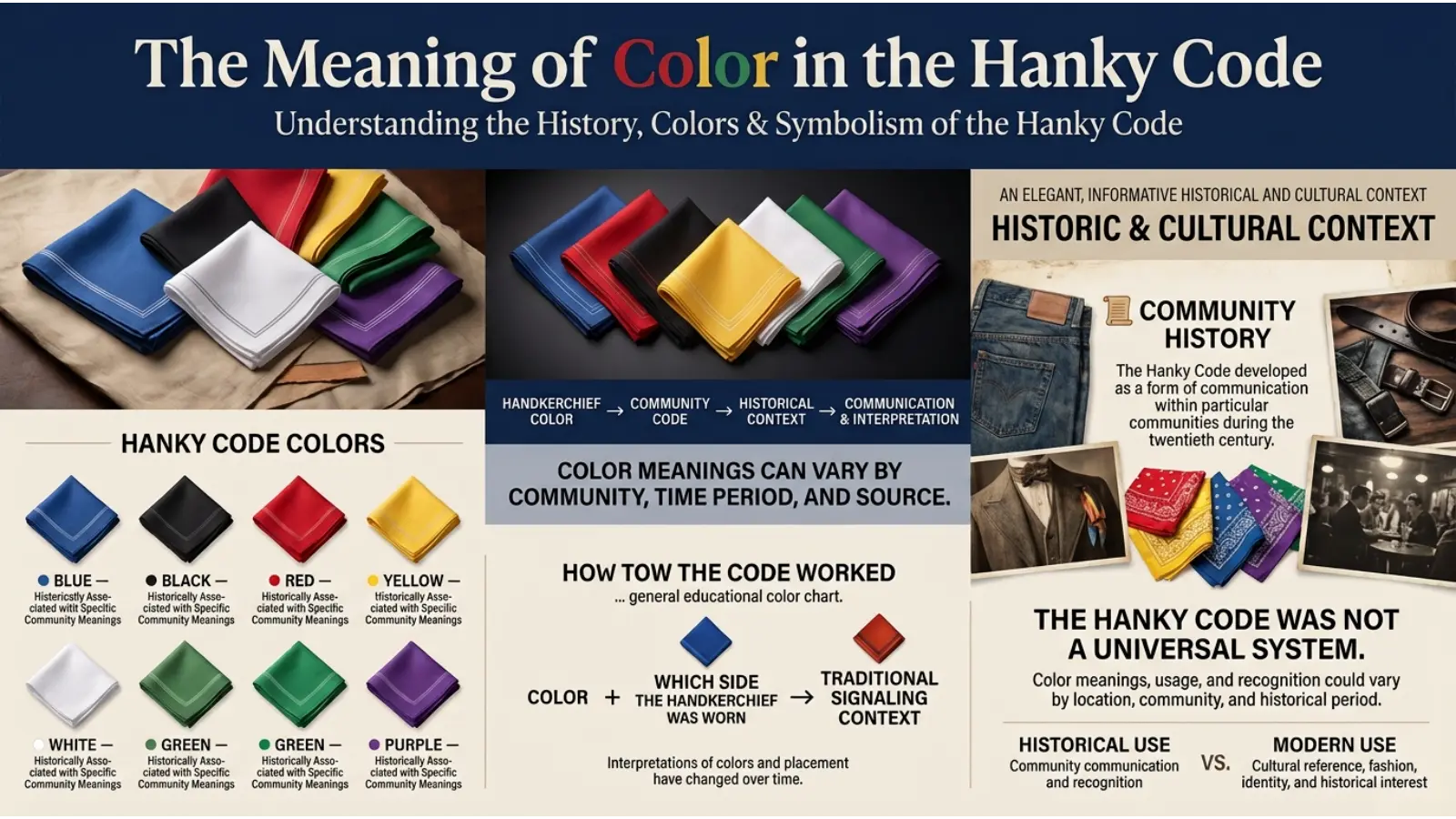
A color may represent one idea in religion, another in advertising, another in national flags, and something entirely different in a subculture.
Blue in the Hanky Code
Blue is one of the colors frequently discussed in gay hanky code charts.
However, the interpretation can depend on the specific shade and the historical chart being used. Dark blue, light blue, and other blue tones may appear differently in various versions of the system.
This makes blue a good example of why people should avoid relying on a single chart without understanding its historical context.
Red in the Hanky Code
Red often carries strong emotional associations in mainstream culture, including passion, energy, danger, and intensity.
Within the hanky code, however, its meaning is based on community tradition rather than general color psychology.
Therefore, understanding a red hanky requires knowledge of the specific version of the code being referenced.
Black in the Hanky Code
Black has long been important in leather fashion and alternative subcultures.
Traditionally, black can symbolize power, mystery, authority, rebellion, elegance, or mourning depending on the cultural setting.
Within gay leather culture, black clothing and accessories have also developed strong connections with community identity and style.
Yet a black handkerchief alone should never be used to make assumptions about someone’s personal preferences.
Yellow in the Hanky Code
Yellow is usually associated with brightness, visibility, optimism, and energy.
In a coded system, though, its meaning can become completely different from traditional color symbolism.
This difference highlights how social groups can transform familiar colors into specialized forms of communication.
Green in the Hanky Code
Green traditionally connects with nature, growth, renewal, and balance.
However, historical hanky code meanings are not based primarily on these psychological or natural associations.
Instead, green received meanings through cultural usage.
As a result, someone studying the hanky code should separate general color symbolism from the specific meanings assigned by a particular community.
A Simplified Color Context Chart
| Color Family | Common Traditional Associations | Hanky Code Context |
|---|---|---|
| 🔵 Blue | Trust, calm, stability | Meaning depends on the specific historical code |
| 🔴 Red | Passion, energy, intensity | Community-specific interpretation |
| 🟢 Green | Nature, growth, balance | Meaning varies by chart and tradition |
| 🟡 Yellow | Energy, optimism, visibility | Cultural code may differ from general symbolism |
| ⚫ Black | Power, mystery, elegance | Strong historical links with leather fashion and identity |
| ⚪ White | Simplicity, purity, neutrality | Interpretation depends on the particular code |
| 🟣 Purple | Creativity, individuality, luxury | May carry specialized meanings in different communities |
Important: This chart explains color context rather than assigning universal personal meanings. Historical hanky code charts differ, and interpretations should not be used to make assumptions about individuals.
Psychologists generally do not treat favorite colors as reliable tests of personality. While people can form emotional associations with colors, individual experiences, culture, age, and environment all influence those preferences.
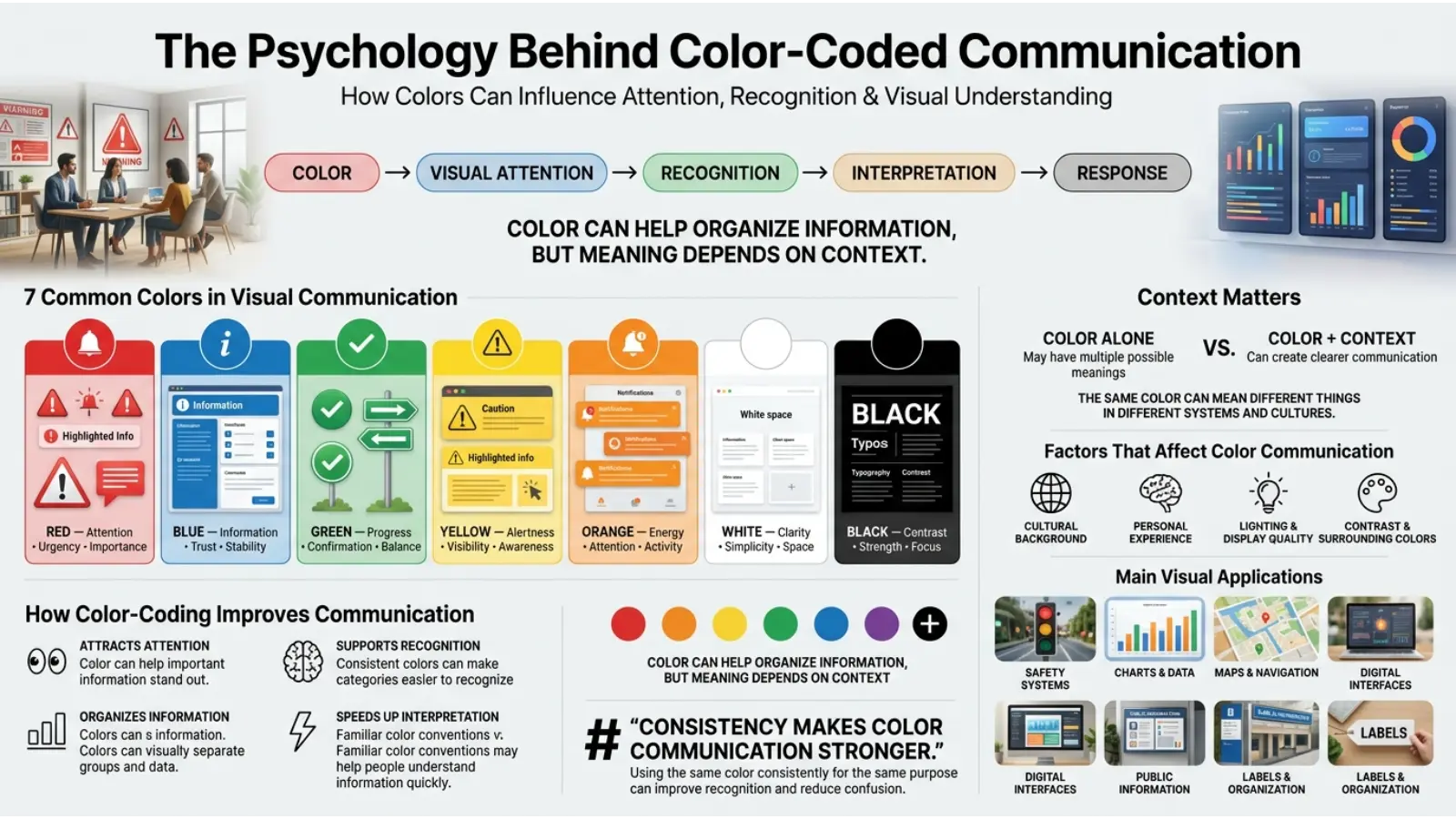
The Psychology Behind Color-Coded Communication
There is limited scientific evidence suggesting that a specific hanky code color produces a specific psychological effect.
However, psychology can help explain why color works well as a communication tool.
Humans quickly notice visual differences. Color helps people categorize objects, remember information, and recognize patterns.
For example, traffic systems use red, yellow, and green because visual differences can communicate information quickly. Similarly, a coded color system allows people who understand the system to recognize a signal without a long conversation.
The psychological power comes largely from:
- Visual recognition
- Learned associations
- Memory
- Group identity
- Social context
Therefore, the effectiveness of the hanky code comes more from shared cultural knowledge than from any natural psychological power of a particular color.
The Hanky Code as LGBTQ+ Cultural History
The gay hanky code has historical value because it represents creativity in LGBTQ+ communication.
For many LGBTQ+ people in earlier decades, openly expressing identity or discussing personal relationships could involve serious social risks.
As a result, communities sometimes developed coded language.
The hanky code can therefore be understood alongside other forms of queer communication, including:
- Slang
- Fashion
- Symbols
- Music
- Hairstyles
- Jewelry
- Social gathering places
These cultural tools helped create a sense of recognition and belonging.
However, LGBTQ+ history is diverse. Not every gay person used the hanky code, knew the code, or participated in the communities where it became popular.
Cultural Meaning and Community Identity
The meaning of the hanky code is strongly connected to culture rather than universal symbolism.
A person outside LGBTQ+ communities may see a colored bandana as a simple accessory. Someone familiar with a historical hanky code may interpret it differently.
Meanwhile, younger generations may recognize the code primarily as part of queer history.
This creates multiple layers of meaning:
Fashion meaning: A bandana can simply be decorative.
Historical meaning: It can reference LGBTQ+ cultural history.
Community meaning: In certain spaces, colors may still carry recognized signals.
Personal meaning: An individual may wear a color because they simply like it.
Because of these layers, context is essential.
How the Meaning Has Changed Over Time
The hanky code did not remain completely unchanged.
Like language, fashion, and slang, cultural codes evolve.
Some colors gained new interpretations. Some meanings became less widely recognized. In addition, the growth of the internet allowed people to publish large charts, compare regional traditions, and debate historical accuracy.
Today, the code may appear in:
- LGBTQ+ history discussions
- Pride events
- Museums and archives
- Leather community gatherings
- Fashion
- Art
- Educational content
For many people, the hanky code is now more symbolic of queer history than an active everyday communication system.
Fashion and the Gay Hanky Code
Fashion has always been connected with identity.
A handkerchief is a particularly interesting accessory because it can be both practical and symbolic.
Historically, wearing a hanky could allow someone to communicate while still appearing relatively ordinary to people unfamiliar with the system.
Today, bandanas remain popular in fashion because they can be worn:
- In a pocket
- Around the neck
- On the wrist
- In the hair
- Attached to a bag
- As part of a costume or themed outfit
However, fashion trends can also change how people interpret colors.
A person wearing a colorful bandana today may simply be following a style trend. Consequently, modern observers should avoid assuming that an accessory automatically communicates a private message.
Color, Identity, and Personal Expression
Colors often help people express identity.
Someone may choose a color because it represents:
- Confidence
- Creativity
- Individuality
- Community
- Memory
- Fashion taste
- Cultural belonging
The hanky code demonstrates how identity and color can interact.
Still, color preference does not determine personality or sexual identity.
Psychologists generally do not treat favorite colors as reliable tests of personality. While people can form emotional associations with colors, individual experiences, culture, age, and environment all influence those preferences.
Therefore, color can express personality without scientifically defining it.
How Context Changes the Meaning of a gay hanky code color meanings
The same colored handkerchief can mean different things depending on where it appears.
At a Pride Event
A colorful hanky may be part of celebration, historical recognition, or personal fashion.
In Everyday Clothing
It may simply be an accessory with no coded meaning.
At a Leather Community Event
Historical color traditions may be more widely recognized.
In a Historical Display
The color may be presented as part of LGBTQ+ cultural education.
Online
A chart may represent one historical version of the code but not every community’s interpretation.
This is why context is more important than color alone.
Common Misconceptions About Gay Hanky Code Color Meanings
Myth: Every gay person knows the hanky code
This is false.
The code has historical importance, but knowledge and use vary greatly across generations, countries, and LGBTQ+ communities.
Myth: Every colored bandana sends a message
Not necessarily.
Modern fashion uses bandanas in countless ways. Clothing alone cannot reliably reveal someone’s identity or preferences.
Myth: There is one official color chart
There is no single universally accepted chart covering every place and period.
Historical sources and community traditions can differ.
Myth: Color meanings are based on psychology
Most hanky code meanings come from cultural convention rather than scientific color psychology.
Myth: The code is completely outdated
Although it is less common as an everyday communication system in many places, it remains culturally meaningful and may still be recognized in specific communities.
The Importance of Consent and Respect
One of the most important modern lessons surrounding the hanky code is that symbols are never a replacement for communication and consent.
Personal boundaries remain important in every social environment.
The respectful approach is to:
- Avoid making assumptions
- Respect personal boundaries
- Communicate clearly
- Understand that symbols can have multiple meanings
- Remember that fashion does not equal consent
This is especially important when discussing historical codes online, where people may misunderstand old symbols or use outdated charts without context.
How Designers Can Learn From the Hanky Code
The hanky code offers useful lessons for branding, design, and communication.
Colors Need Shared Meaning
A color becomes a strong signal when people understand what it represents.
For example, warning signs work because communities learn the meaning of visual signals.
Similarly, brand colors become powerful through repeated use.
Context Creates Meaning
A red color in a luxury package may suggest something different from red in a warning label.
Designers should always consider:
- Audience
- Culture
- Location
- Industry
- Age group
- Historical associations
One of the most important modern lessons surrounding the hanky code is that symbols are never a replacement for communication and consent.
Simple Visual Signals Can Be Powerful
The hanky code used a small accessory to communicate complex information.
Modern designers can apply the same principle by creating visual systems that are easy to recognize.
Lessons for Branding and Marketing
Although the gay hanky code itself is not a traditional branding system, it demonstrates several principles used in marketing.
Recognition
Repeated visual signals become easier to recognize.
Community
Shared symbols can strengthen a sense of belonging.
Identity
Colors can help distinguish one group, product, or organization from another.
Consistency
A symbol becomes more meaningful when people encounter it repeatedly in a consistent context.
However, marketers should avoid borrowing LGBTQ+ cultural symbols without understanding their history.
Respectful representation requires research and genuine awareness rather than simply using colorful imagery for attention.
Color in LGBTQ+ Fashion and Symbolism
LGBTQ+ communities have used many visual symbols throughout history.
Colors can represent:
- Visibility
- Pride
- Community
- Resistance
- Celebration
- Individual identity
The gay hanky code differs from broad symbols such as rainbow imagery because it developed as a more specialized cultural communication system.
Not every LGBTQ+ symbol has the same purpose. Some represent collective pride, while others developed as private or community-specific forms of recognition.One of the most important modern lessons surrounding the hanky code is that symbols are never a replacement for communication and consent.
Why Younger Generations May Interpret the Code Differently
Generational change affects symbolism.
Older LGBTQ+ community members may remember periods when coded communication was more useful or familiar. Younger people may encounter the hanky code through:
- Social media
- Historical articles
- Films
- Museums
- Pride education
- Fashion
As a result, the same symbol can carry different emotional meaning for different generations.
For one person, it may represent lived community history.
For another, it may be an interesting piece of cultural history.
Someone else, it may simply be an unfamiliar fashion accessory.
One of the most important modern lessons surrounding the hanky code is that symbols are never a replacement for communication and consent.
Real-World Applications of Color-Coded Systems
The gay hanky code is one example of a larger human habit: using colors to communicate.
Color-coded systems appear in many areas of life.
Business
Companies use colors to distinguish products, departments, and services.
Marketing
Brand colors help customers recognize companies quickly.
Sports
Team colors create identity and group loyalty.
Healthcare
Colors can help organize information and identify equipment, although systems vary by country and institution.
Transportation
Traffic lights and warning signs use color to communicate rapidly.
Art
Artists use color to create mood, symbolism, contrast, and storytelling.
Fashion
Clothing colors can communicate mood, cultural identity, profession, or personal taste.
The key lesson is that color rarely communicates meaning alone. People learn meaning through culture and context.
One of the most important modern lessons surrounding the hanky code is that symbols are never a replacement for communication and consent.
How Lighting Can Change the Appearance of Hanky Colors
Lighting can change how a color looks.
A dark blue bandana may appear nearly black under dim lighting. Meanwhile, bright sunlight can make colors appear more intense.
Color appearance can also change because of:
- Indoor lighting
- Camera filters
- Fabric texture
- Shadows
- Digital screens
- Aging material
This matters when studying historical color charts because printed shades and modern digital colors may not match perfectly.
Therefore, identifying a color from a photograph can sometimes be difficult.
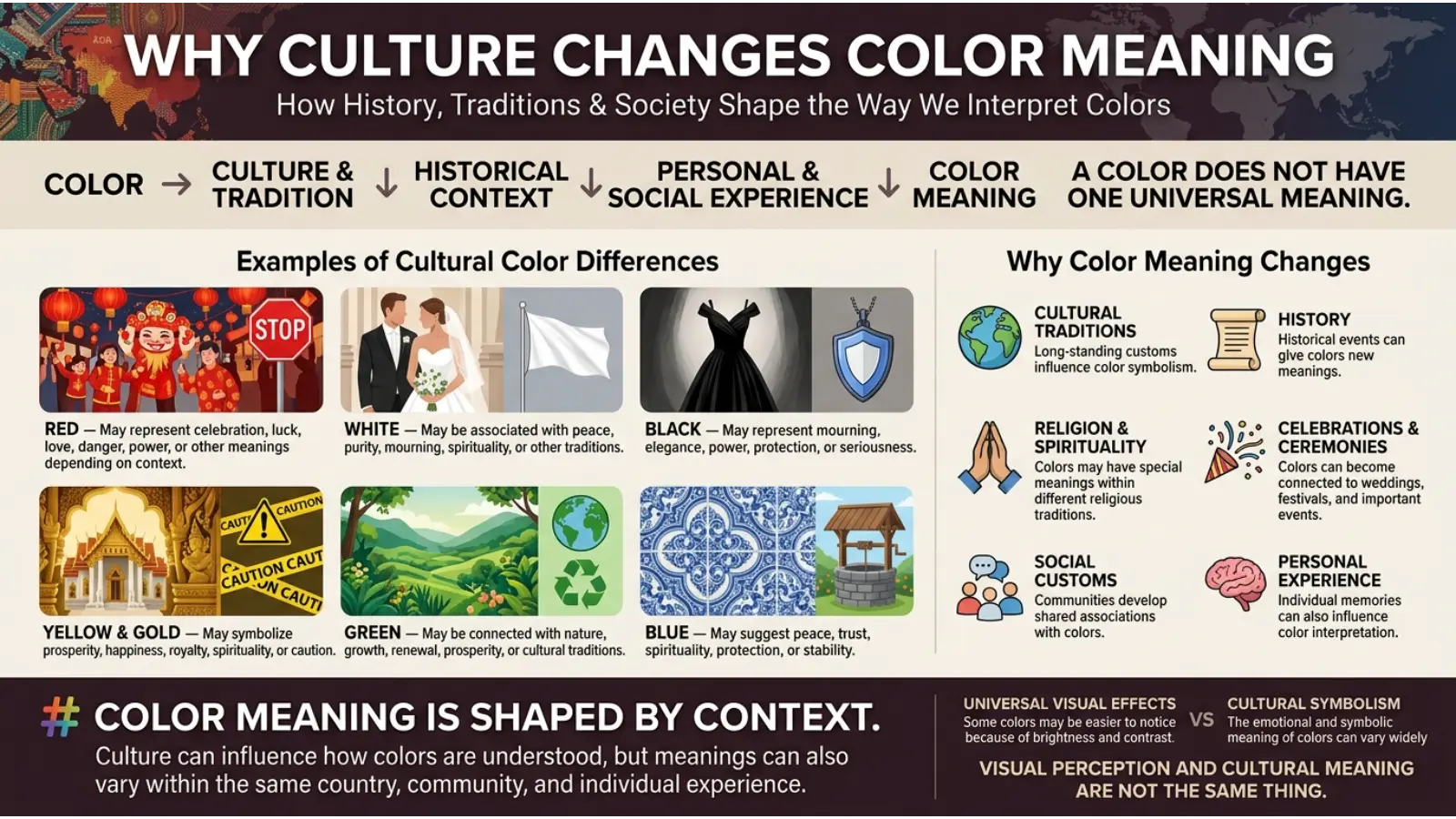
Why Culture Changes Color Meaning
Color meanings are learned through experience.
For example, a color can represent celebration in one culture and mourning in another.
The same principle applies to community-specific systems such as the hanky code.
A symbol only works when enough people understand the shared meaning.
This is why cultural knowledge is essential when interpreting any color.
Rather than asking, “What does this color always mean?” a better question is:
“What does this color mean in this particular context?”
That question leads to more accurate interpretations.
A Practical Guide to Reading Hanky Code Information
If you are researching gay hanky code color meanings, use these principles:
Check the Historical Period
A chart from one decade may not represent another.
Consider the Community
Regional and subcultural differences may exist.
Compare Multiple Historical Sources
One chart may not provide the complete picture.
Avoid Making Assumptions About People
A colored accessory does not automatically reveal personal information.
Understand the Difference Between History and Modern Fashion
A historical symbol can become a fashion trend over time.
Respect Privacy
Someone’s clothing should not be treated as an invitation to ask intrusive personal questions.
Gay Hanky Code Color Meanings and Modern LGBTQ+ Culture
The modern meaning of the hanky code is broader than its original function.
Today, it can represent:
🌈 LGBTQ+ history
🧵 Fashion and self-expression
📚 Cultural education
🏳️🌈 Community memory
🎨 The creative use of color as language
Its lasting significance comes partly from the creativity behind the system.
A simple piece of fabric became a visual language understood by people within particular social spaces.
That transformation demonstrates the power of shared symbols.
Frequently Asked Questions
What is the gay hanky code?
The gay hanky code is a historical color-coded system in which handkerchiefs could communicate particular interests or preferences within parts of gay and LGBTQ+ culture.
When did the hanky code become popular?
It became widely associated with gay communities in the United States during the late 20th century, especially from the 1970s onward. However, its exact origins are difficult to establish.
Do all gay people know the hanky code?
No. Knowledge of the code varies by age, country, community, and personal experience.
Is there one official gay hanky code chart?
No. Different historical charts and communities may use different meanings, so there is no single universal version.
Does wearing a colored bandana always have a coded meaning?
No. Many people wear colored bandanas simply as fashion accessories.
Why was the hanky code important?
The code provided a form of visual communication and community recognition during periods when openly discussing LGBTQ+ identity or personal interests could be more difficult or unsafe.
What does the left or right side mean in the hanky code?
In traditional versions of the code, placement could add information about a person’s preferred role or interaction style. However, meanings varied, and modern clothing choices should not be interpreted automatically.
Is the hanky code still used today?
It is less commonly used as an everyday communication system in many places, but it remains historically important and may still be recognized in specific LGBTQ+ and leather communities.
Are hanky code meanings based on color psychology?
Generally, no. Most meanings developed through community traditions and shared cultural conventions rather than scientific color psychology.
Can you identify someone’s preferences from a hanky color?
No. It is not appropriate to make assumptions about a person’s identity, interests, boundaries, or consent based solely on clothing or accessories.
Final Thoughts
The gay hanky code color meanings are a powerful example of how communities can turn color into language. The system developed within specific historical and cultural circumstances, giving ordinary handkerchiefs a role in communication, recognition, and identity.
Its history also teaches a larger lesson about color symbolism. No color has one permanent meaning. Blue, red, black, yellow, or green can mean different things depending on culture, time, community, fashion, and personal experience.
Today, the hanky code is best understood with historical awareness and respect for individual privacy. Some people may recognize its original cultural meanings, while others may simply see a colorful fashion accessory.
Looking closely at the hanky code reveals something larger than a list of colors. It shows how people create meaning together—and how even a small piece of fabric can become part of a community’s history, identity, and visual language.

Emma Wilson is a dedicated comparison writer and product researcher at ColorMystiic.com. She specializes in creating unbiased product comparisons, detailed reviews, and helpful buying guides. Her goal is to help readers make smarter purchasing decisions with confidence.