Candles have been used in spiritual practices, ceremonies, meditation, and symbolic rituals for centuries. Their flame can represent focus, intention, transformation, or devotion, while the color of the candle adds another layer of meaning.When people search for candle color meanings for spells, they are usually looking for a simple way to match a candle with a particular intention.
Red may be associated with passion and courage, green with prosperity and growth, and white with purification or peace. However, these meanings are not universal rules. They can change between magical traditions, cultures, personal practices, and modern interpretations.
This guide explains the symbolism behind common spell candle colors while separating traditional associations from modern spiritual beliefs. You will also learn how candle colors are used, which colors work well together, how lighting affects their appearance, and what misconceptions to avoid.
Quick Answer: What Do Candle Colors Mean in Spells?
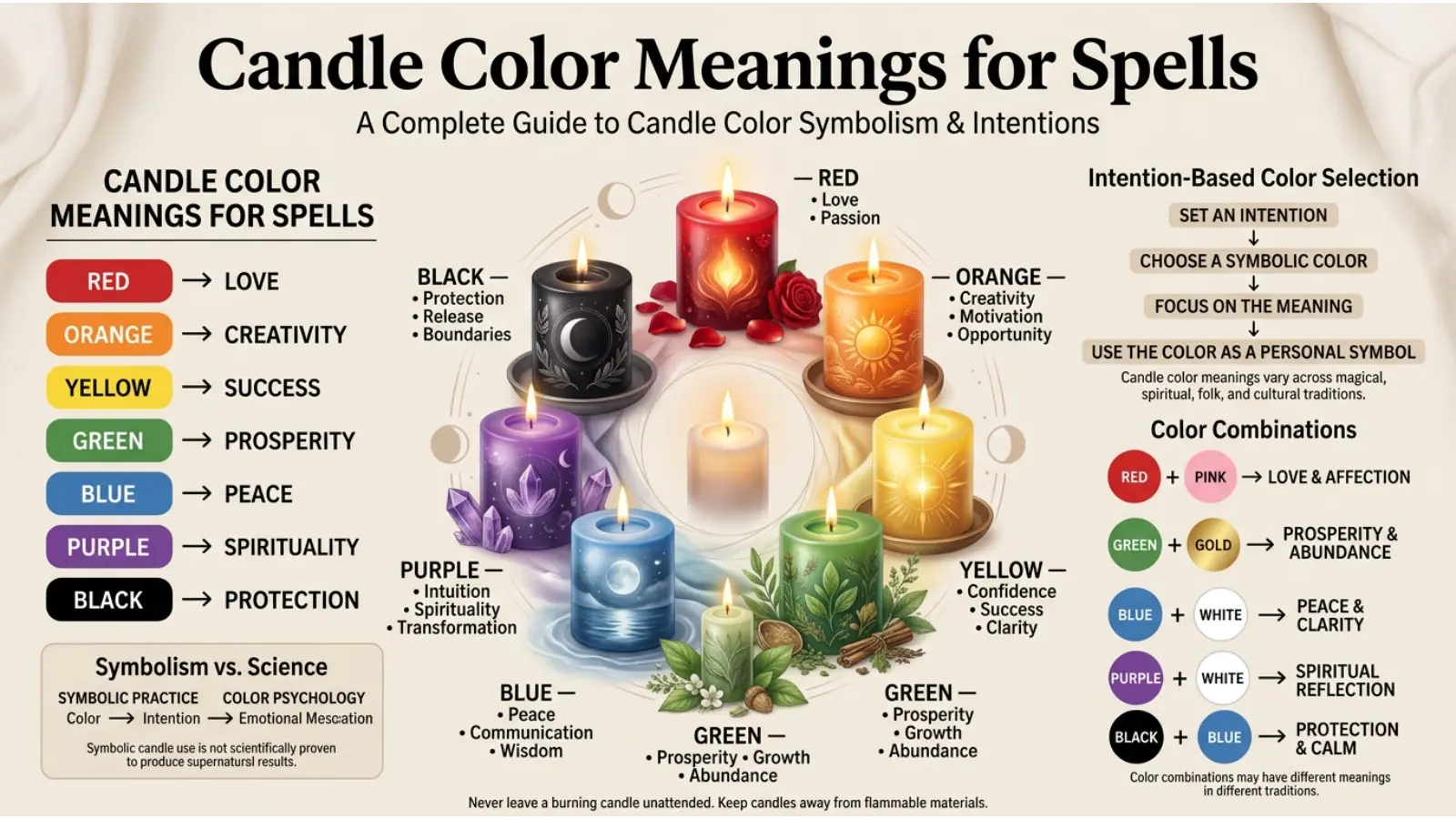
Candle colors are commonly chosen according to the intention of a ritual. White is often associated with purification and peace, red with passion and courage, pink with affection, orange with creativity and motivation, yellow with confidence and communication, green with prosperity and growth, blue with calm and wisdom, purple with spirituality and intuition, black with protection or banishing, and brown with grounding and stability.
These meanings are symbolic rather than scientifically proven effects. Different traditions may assign different meanings to the same color.
Candle Color Meanings for Spells at a Glance
| Candle Color | Common Symbolic Associations | Typical Spell Intention |
|---|---|---|
| 🔴 Red | Passion, courage, vitality | Love, confidence, motivation |
| 🩷 Pink | Affection, kindness, harmony | Friendship, emotional healing |
| 🟠 Orange | Creativity, energy, opportunity | Success, motivation, change |
| 🟡 Yellow | Confidence, learning, communication | Focus, study, clarity |
| 🟢 Green | Growth, prosperity, renewal | Money, abundance, health symbolism |
| 🔵 Blue | Peace, wisdom, communication | Calm, reflection, truth |
| 🟣 Purple | Intuition, spirituality, transformation | Meditation, insight, spiritual work |
| ⚪ White | Purity, peace, cleansing | Protection, blessings, new beginnings |
| ⚫ Black | Protection, endings, release | Banishing, boundaries, letting go |
| 🟤 Brown | Stability, grounding, practicality | Home, security, grounding |
| 🩶 Gray | Neutrality, balance, uncertainty | Neutralizing or clearing symbolism |
| 🟢 Dark Green | Ambition, wealth, endurance | Prosperity and long-term goals |
How Candle Colors Are Used in Spellwork
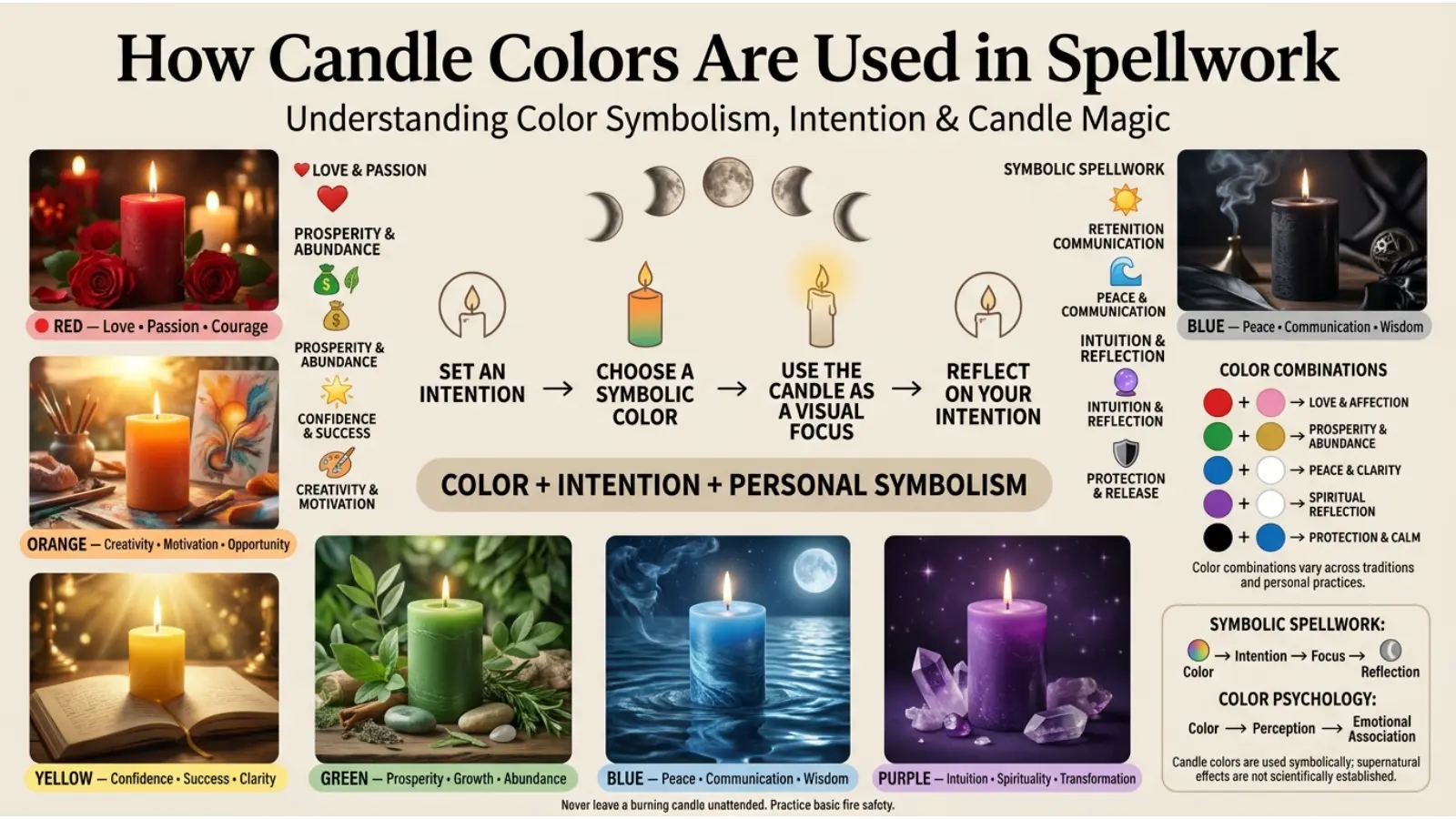
Candle magic is generally based on symbolic intention. The candle gives a physical object to an idea that might otherwise remain abstract.
For example, someone focusing on personal confidence may select a yellow or red candle because those colors symbolize energy, courage, or self-expression within their chosen tradition.
The process is less about the candle having a scientifically measurable magical power and more about creating a focused ritual environment. Choosing a color, lighting the candle, and concentrating on an intention can make a ritual feel deliberate and meaningful.
Different practitioners may also combine color with words, meditation, written intentions, herbs, crystals, or other symbolic objects.
Does the Color Actually Cause the Spell to Work?
There is no reliable scientific evidence showing that a particular candle color produces supernatural results.
Color can, however, influence human perception and emotion. People develop associations with colors through culture, personal experience, advertising, nature, and repeated exposure. A color may therefore help someone enter a particular emotional or reflective state.
That distinction matters: symbolic usefulness is not the same as scientifically demonstrated magical power.
Red Candle Color Meanings for Spells
Red is one of the strongest and most emotionally intense candle colors.
It is commonly associated with passion, courage, physical energy, determination, strength, and desire. In spell traditions that use color correspondence, red may therefore be selected for rituals involving motivation, confidence, romantic passion, or personal power.
Red can also represent urgency and action. Someone who wants to stop procrastinating may choose red as a symbolic reminder to move forward rather than remain passive.
Positive Red Associations
- Passion
- Courage
- Vitality
- Confidence
- Determination
- Strength
- Action
When Red May Feel Too Intense
Because red is visually powerful, it can also suggest anger, aggression, conflict, or danger. Therefore, it may not be the best symbolic choice when the goal is peaceful reflection.
For calm relationship work, pink may communicate gentleness more effectively.
Pink Candle Meaning for Spells
Pink softens many of the intense qualities associated with red.
It commonly symbolizes love, affection, compassion, friendship, kindness, emotional balance, and tenderness.
A pink candle can therefore represent self-love, forgiveness, friendship, emotional comfort, or harmonious relationships.
Pink vs. Red Candles
The difference is mainly symbolic:
Red: passion, desire, intensity, courage
Pink: affection, compassion, tenderness, harmony
Neither interpretation is universal, so personal meaning can be equally important.
Orange Candle Meaning for Spells
Orange is energetic, warm, and attention-grabbing.
It is often associated with creativity, enthusiasm, opportunity, confidence, ambition, and change. Practitioners may choose orange when they want to symbolize forward movement or a fresh burst of energy.
For example, an orange candle might represent a creative project, a new opportunity, motivation to begin something difficult, or a desire to become more socially confident.
Orange sits symbolically between the intensity of red and the mental qualities often associated with yellow.
Yellow Candle Meaning for Spells
Yellow commonly represents intellect, communication, optimism, learning, confidence, and mental clarity
People may choose yellow candles for intentions involving:
- Studying
- Communication
- Creativity
- Confidence
- Decision-making
- Mental focus
- Positive thinking
Yellow can also be useful as a visual reminder to approach a problem with curiosity rather than fear.
Green Candle Meaning for Spells
Green is closely connected with nature, growth, renewal, prosperity, fertility, balance, and abundance.
Its association with money is particularly common in modern symbolic practices because many currencies use green, while its connection with growth also comes naturally from plants and vegetation.
Green Does Not Always Mean Money
One common mistake is treating green as purely a “money color.”
Its broader symbolism includes growth and restoration. A person could use green to represent learning a new skill, developing healthier habits, building a business, or creating greater balance.
Blue Candle Meaning for Spells
Blue is commonly associated with peace, calmness, wisdom, communication, truth, patience, and emotional stability.
Its connection with water and sky has helped reinforce associations with openness and tranquility in many modern color systems.
A blue candle may therefore be chosen for symbolic intentions involving:
- Peace
- Honest communication
- Patience
- Reflection
- Wisdom
- Emotional calm
- Truth
Light blue and dark blue can also create different impressions. Pale blue often feels softer and more peaceful, while navy or deep blue can appear more serious and contemplative.
Purple Candle Meaning for Spells
Purple has long carried associations with spirituality, mystery, intuition, transformation, imagination, and wisdom.
Historically, purple dyes were difficult and expensive to produce in many societies, which contributed to connections between purple and status or royalty. Modern spiritual practices have added further associations with meditation, intuition, and inner exploration.
A purple candle may therefore be used symbolically for:
- Meditation
- Introspection
- Spiritual exploration
- Personal transformation
- Creativity
- Intuition
- Wisdom
These associations vary considerably between traditions.
White Candle Meaning for Spells
White is one of the most versatile candle colors.
It commonly symbolizes purity, peace, clarity, cleansing, innocence, protection, and new beginnings. Because white is visually neutral, many practitioners also use it when they do not have the preferred color available.
In symbolic rituals, a white candle can represent a clean beginning or a desire to create a peaceful environment.
Can a White Candle Replace Other Colors?
In some modern candle-magic traditions, yes. White is sometimes treated as a flexible or universal color.
However, this is a tradition-specific practice rather than a universal rule. If your spiritual tradition has its own established correspondences, those should take priority.
Black Candle Meaning for Spells
Black often has a more complex meaning than simply “negative.”
It can symbolize protection, boundaries, endings, release, mystery, absorption, and letting go.
The symbolism depends heavily on context.
For example, a black candle used to represent the end of an unhealthy habit is different from using black imagery simply to represent fear or darkness.
Black can also provide visual contrast when paired with white, silver, red, or purple.
Brown Candle Meaning for Spells
Brown is an earthy, understated color.
It is commonly associated with grounding, stability, home, practicality, reliability, and connection with nature.
Because brown resembles soil, wood, and natural materials, it can work well as a symbolic color for intentions involving home life, stability, patience, and practical goals.
It is generally less dramatic than red or purple, making it useful when the focus is steady progress rather than sudden change.
Gray Candle Meaning for Spells
Gray is often connected with neutrality, balance, uncertainty, transition, and compromise.
Because it sits between black and white, some modern symbolic systems use gray when the intention involves finding middle ground or reducing extremes.
Gray can also represent a transitional period when an old situation has ended but the next stage has not yet become clear.
Silver Candle Meaning for Spells
Silver is often associated with intuition, reflection, mystery, receptivity, and lunar symbolism in modern spiritual practices.
Its metallic appearance can also suggest refinement and protection.
Gold Candle Meaning for Spells
Gold naturally suggests success, achievement, confidence, prosperity, recognition, and abundance.
Its historical connection with wealth and precious metals makes these associations easy to understand.
Gold can also work as an accent color when combined with other candles.
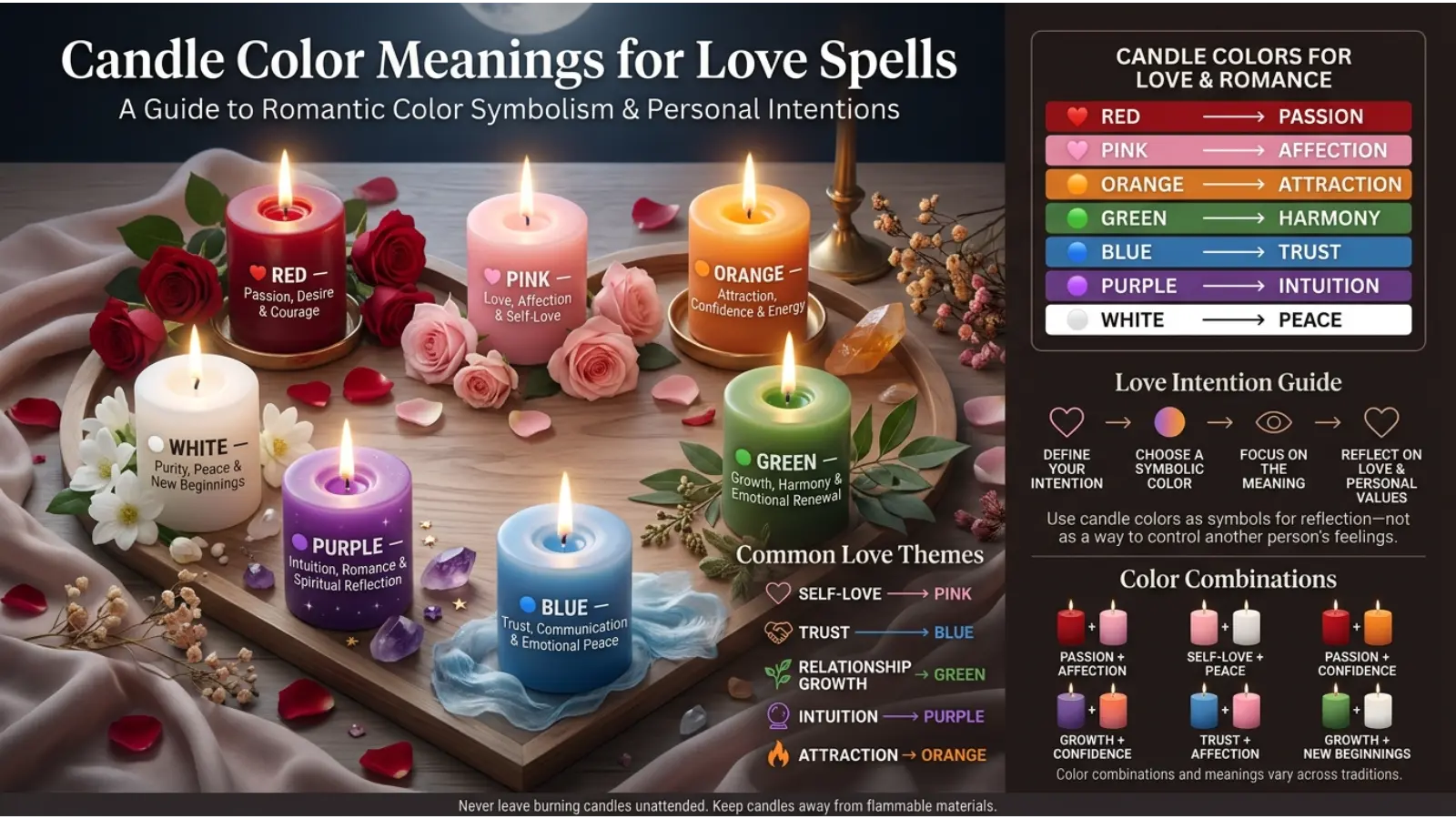
Candle Color Meanings for Love Spells
Love-related candle colors are not limited to red.
Different shades can communicate different emotional ideas:
- Red: passion and romantic intensity
- Pink: affection and emotional warmth
- White: peace and sincere intentions
- Orange: attraction and enthusiasm
- Purple: mystery and emotional depth
The most appropriate choice depends on what “love” means in the ritual.
For example, someone seeking greater compassion may prefer pink, while someone symbolically focusing on passion may choose red.
Candle Colors for Money and Prosperity Spells
Green is the most familiar symbolic choice for prosperity.
Green can represent growth and financial abundance.
Gold can symbolize success, achievement, and wealth.
Orange can represent opportunity, ambition, and energetic action.
Rather than treating these colors as guarantees of financial results, it is more useful to view them as visual symbols for goals such as saving money, starting a business, improving skills, or pursuing new opportunities.
Candle Colors for Protection Spells
Protection symbolism varies widely between traditions.
White is often associated with peace and protective intentions, while black may represent boundaries, banishing, or the ending of unwanted influences.
The meaning comes from the tradition and intention—not from an inherent supernatural property of the pigment.
Candle Colors for Healing and Renewal
Green, blue, white, and pink are commonly associated with healing-related symbolism.
Green can represent renewal and natural growth.
Blue can symbolize calm and emotional peace.
White can represent cleansing and fresh beginnings.
Pink can symbolize compassion and emotional care.
These are symbolic meanings, not medical claims. A candle ritual should never replace appropriate medical or mental-health care.
Can You Use More Than One Candle Color?
Yes. Many symbolic candle practices use multiple colors to represent different parts of an intention.
For example:
Green + Gold: prosperity and achievement
Red + Pink: passion combined with affection
Blue + White: peace and clarity
Purple + White: spiritual reflection and renewal
Green + Brown: growth and grounding
Using multiple colors can make a ritual more personally meaningful because each candle can represent a different part of the desired outcome.
How to Choose Multiple Candle Color Meanings for Spells
Start with the main intention.
Then ask:
- What is the primary goal?
- What emotion supports that goal?
- What obstacle needs to be released?
- What quality do I want to strengthen?
Choose one color for the central intention and additional colors only when they add a clear symbolic purpose.
This prevents the ritual from becoming visually complicated without adding meaning.
Candle Color Meanings for Spells Across Different Traditions
There is no single worldwide dictionary of magical candle colors.
Color symbolism develops through religion, folklore, local customs, historical events, artistic traditions, personal experience, and modern spiritual movements.
A color that represents mourning in one cultural setting may represent celebration somewhere else. Similarly, a color used for prosperity in one magical tradition may have a different correspondence in another.
Western and Modern Spiritual Practices
Many modern Western candle-magic systems use color correspondences such as red for passion, green for prosperity, blue for peace, and purple for spirituality.
However, these systems are not identical. Different books, practitioners, and traditions can assign different meanings.
Eastern Cultural Associations
Color meanings across Asian cultures can differ significantly from common Western interpretations.
For example, red has important associations with celebration, prosperity, good fortune, and cultural identity in several East Asian contexts. White may have mourning associations in some Asian cultures that differ from common Western associations of purity.
Middle Eastern and African Contexts
Color symbolism also varies widely throughout Middle Eastern and African cultures.
There is no single “African” or “Middle Eastern” interpretation of any candle color. Regional traditions, religions, languages, and local histories all influence meaning.
Broad claims about an entire continent or region should therefore be avoided.
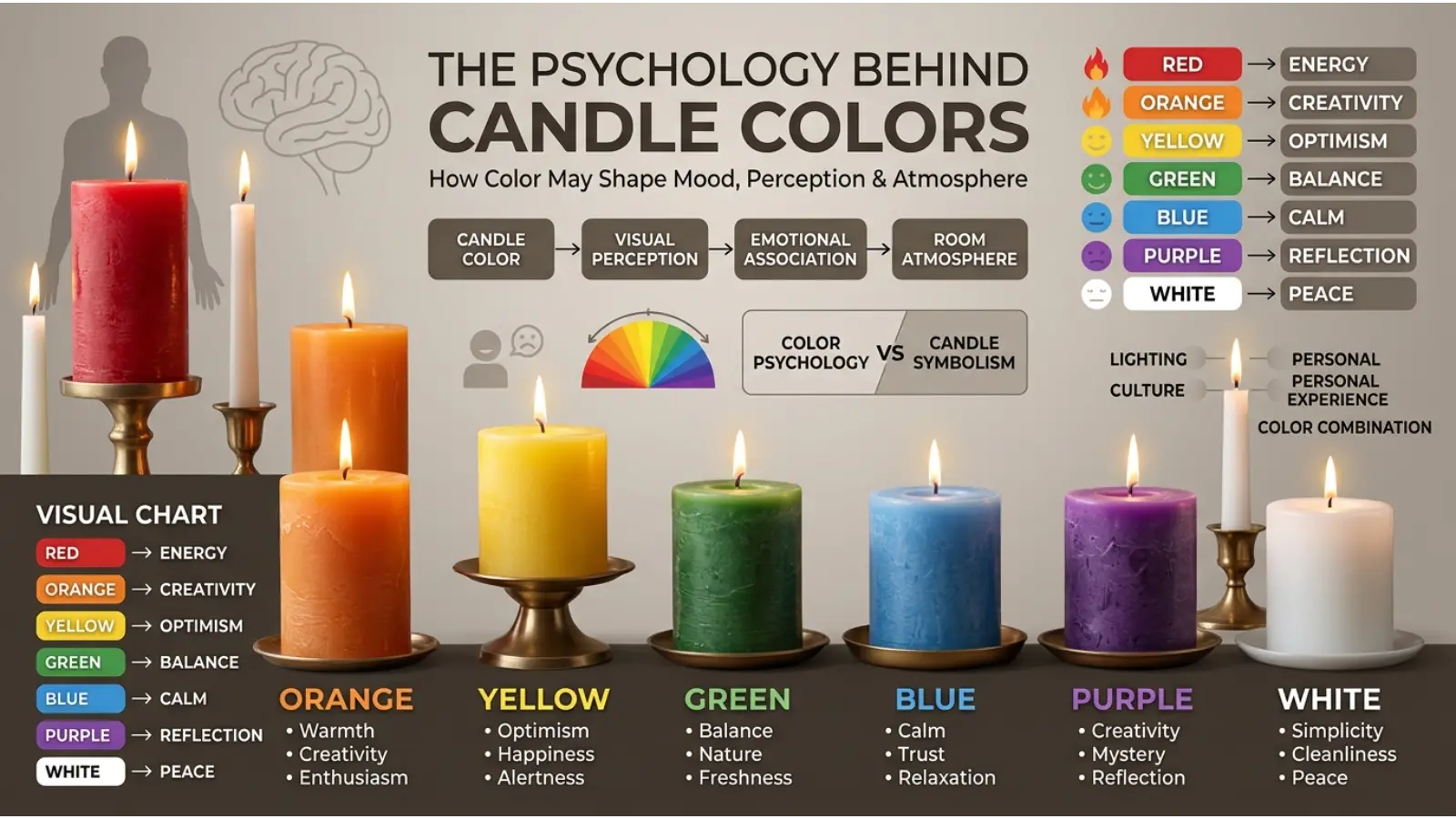
The Psychology Candle Color Meanings for Spells
Color psychology can help explain why candle colors may affect perception, but it should not be confused with magical claims.
For example, a red candle in a romantic setting may communicate passion, while the same red in a warning context may communicate danger.
This is why color does not have one fixed psychological meaning.
Why Candlelight Changes Color
A candle is unusual because the light source itself is warm.
The flame produces a yellow-orange glow that changes how nearby colors appear. A blue candle may look less saturated under warm candlelight, while red, orange, and gold can appear especially intense.
Photography creates another complication. Camera white balance can shift the appearance of candle colors significantly.
So if an online image shows a particular candle shade, the real candle may look different in person.
Historical Roots of Candle Symbolism
Before modern electric lighting, candles served an obvious function: they produced light. Over time, their use became connected with religious ceremonies, remembrance, festivals, prayer, meditation, and symbolic rituals.
Color became an additional layer of meaning.
However, it would be misleading to claim that today’s popular candle color charts represent one ancient universal system. Many modern correspondences have developed through combinations of older symbolism, occult traditions, folklore, contemporary spirituality, and personal practice.
Personality Associations With Candle Colors
People sometimes connect color preferences with personality traits.
These associations can be interesting, but color preference cannot reliably determine someone’s personality.
A person’s favorite candle color may simply reflect fashion, mood, cultural background, childhood experiences, or aesthetic taste.
Use personality-color associations as a form of reflection rather than psychological diagnosis.
Candle Color Meanings for Spells in Interior Design
Candle color also matters outside spellwork.
Because candles are decorative objects, their colors influence the atmosphere of a room.
Living Room
Warm shades such as red, orange, gold, and brown can create a cozy appearance.
Bedroom
Pink, lavender, white, and soft blue can create a gentler visual mood.
Office
Blue, green, gray, and white can create a cleaner, more restrained appearance.
Meditation Space
Purple, white, blue, and natural earth tones often work well for a quiet setting.
The best choice depends on the room’s existing colors, lighting, furniture, and personal taste.
Candle Color Meanings for Spells in Fashion and Personal Style
Candle symbolism can even inspire clothing and accessories.
Someone who wants to communicate energy might wear red. Green may suggest a connection with nature, while purple can create a creative or dramatic impression.
A red formal dress, a red sports uniform, and a red warning sign do not communicate the same thing because their environments change the meaning.
Best Candle Color Combinations
Color combinations can create more nuanced symbolism than a single color.
| Combination | Common Symbolic Impression |
|---|---|
| Red + Pink | Passion and affection |
| Green + Gold | Growth and achievement |
| Blue + White | Peace and clarity |
| Purple + White | Spiritual reflection |
| Green + Brown | Growth and stability |
| Black + White | Release and renewal |
| Orange + Yellow | Creativity and confidence |
| Red + Gold | Power and achievement |
These combinations are symbolic suggestions rather than fixed magical formulas.
How Lighting Changes Candle Color Meaning
Lighting does more than change appearance—it can change perception.
A candle displayed in bright daylight may appear crisp and saturated. Under warm candlelight, nearby colors can become softer and more golden.
The same candle can therefore produce different visual impressions depending on:
- Room lighting
- Flame size
- Wall color
- Camera settings
- Candle wax
- Container color
- Surrounding objects
This matters especially when selecting candles online.
Common Misconceptions About Spell Candle Colors
Myth: Every Color Has One Universal Meaning
It does not.
Color symbolism changes between cultures, spiritual traditions, historical periods, and individuals.
Myth: A Candle Color Guarantees a Result
There is no scientific evidence that candle color can magically guarantee an outcome.
A ritual can still have personal, reflective, or symbolic value.
Myth: Black Candles Are Always Evil
Black has many symbolic interpretations, including protection, boundaries, endings, mystery, and release.
Its meaning depends on context.
Myth: White Always Means Purity Everywhere
White has strong associations with purity and peace in many Western settings, but cultural meanings vary.
Myth: You Must Always Use the “Correct” Color
Many modern practitioners choose colors based on personal symbolism.
If a certain color has a meaningful connection for you, that personal association can be more useful than following a generic chart blindly.
Practical Tips for Choosing a Candle Color Meanings for Spells
Before selecting a candle, define the intention in one sentence.
For example:
“I want to focus on building confidence.”
Then choose a color that represents the quality you want to emphasize.
You might choose yellow for confidence and communication, red for courage and action, or orange for motivation.
If no color feels appropriate, white can serve as a simple neutral choice in traditions that allow flexible correspondences.
Most importantly, don’t confuse complexity with effectiveness. A thoughtful ritual with one meaningful candle can be more personally useful than a collection of ten colors with no clear purpose.
Safe Candle Practices
Symbolic candlework should always be paired with basic fire safety.
Keep candles on a stable, heat-resistant surface and away from curtains, paper, clothing, children, pets, and other flammable materials. Never leave a burning candle unattended.
Avoid placing candles near drafts or where they can easily be knocked over.
If you want the symbolic experience without an open flame, an LED candle can provide a similar visual atmosphere while removing many fire-related risks.
Frequently Asked Questions
What is the most powerful candle color for spells?
There is no scientifically established “most powerful” candle color. In symbolic practices, the best color is usually the one that matches the intention and tradition being followed.
What color candle is used for money spells?
Green is the most common symbolic choice for prosperity and money. Gold may also represent wealth, achievement, and success.
What candle color is best for protection?
White and black are commonly used in modern symbolic practices, although their meanings vary. White may represent peace and protective intentions, while black can symbolize boundaries, release, or banishing.
What does a blue candle mean in spellwork?
Blue is often associated with peace, wisdom, communication, truth, patience, and emotional calm.
What does a purple candle mean spiritually?
Purple commonly represents spirituality, intuition, mystery, wisdom, creativity, and transformation. Its exact meaning depends on the tradition.
Can I use a white candle instead of another color?
Some modern candle traditions allow white to substitute for other colors because it is viewed as versatile. However, practices differ, so follow the correspondence system you are using.
Can I use two different candle colors together?
Yes. Combining colors can represent multiple aspects of one intention. For example, green and gold can symbolize growth and achievement.
Do candle colors have scientific magical powers?
There is no reliable scientific evidence that candle colors produce supernatural effects. Their value may instead come from symbolism, personal meaning, attention, ritual structure, and the psychological atmosphere they create.
Does the meaning of a candle color change by culture?
Yes.
Final Thoughts
Candle color meanings for spells provide a simple symbolic language for expressing intentions. Red can represent passion and courage, green can suggest growth and prosperity, blue can evoke peace and wisdom, purple can represent spiritual exploration, and white can symbolize clarity and new beginnings.
Yet color meanings are not universal formulas. Their interpretation changes with tradition, culture, context, lighting, and personal experience. The most useful approach is therefore to understand the common symbolism while leaving room for your own meaning.
A candle cannot guarantee a magical outcome, but choosing a color intentionally can make a ritual more focused and memorable. Whether you use candles for spiritual practice, meditation, decoration, or personal reflection, the color becomes most meaningful when it connects clearly with the intention behind it.

Emma Wilson is a dedicated comparison writer and product researcher at ColorMystiic.com. She specializes in creating unbiased product comparisons, detailed reviews, and helpful buying guides. Her goal is to help readers make smarter purchasing decisions with confidence.