Holi is one of the world’s most colorful celebrations, but the bright powders and painted faces represent much more than visual beauty. Holi color meanings are connected with joy, love, renewal, nature, spirituality, relationships, and cultural traditions. During the festival, colors temporarily remove visible social boundaries and create a shared space for celebration.
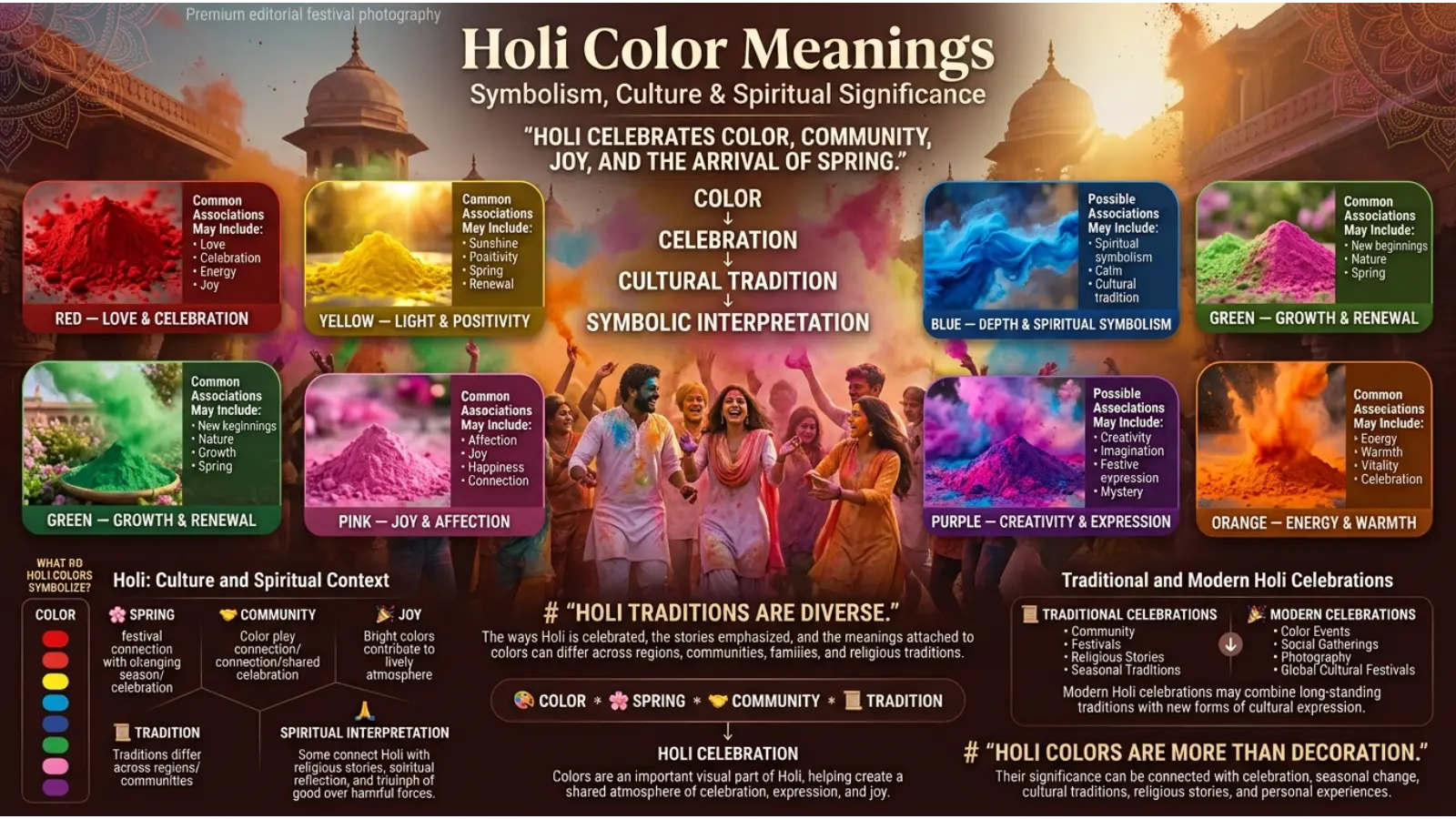
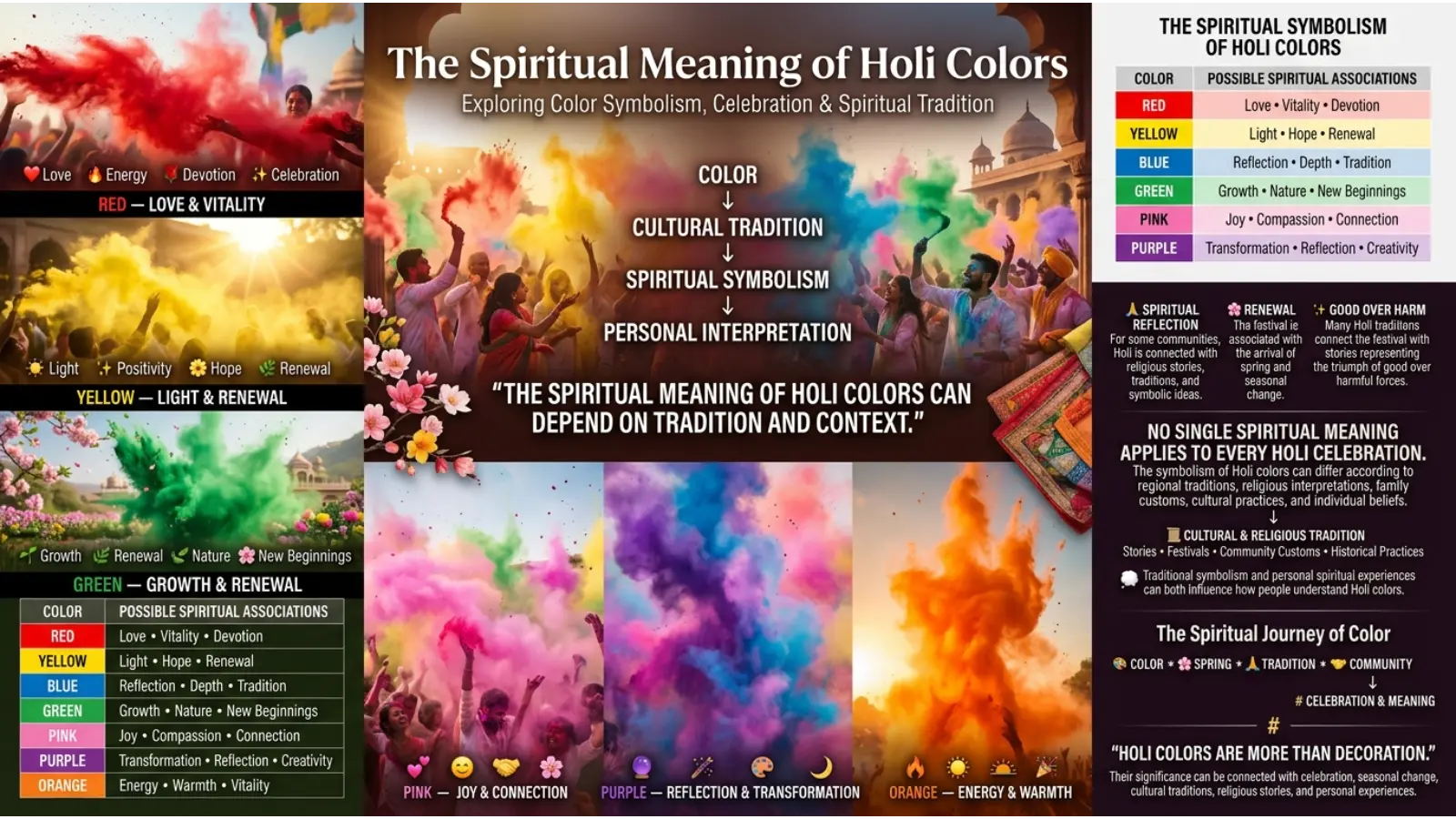
People often search for Holi color meanings because each shade can carry a different symbolic message. Red may suggest love and energy, yellow can represent happiness and knowledge, green often reflects new beginnings, while blue may connect with Krishna and divine symbolism. However, these meanings are not fixed rules. They can change depending on religion, region, family traditions, historical context, and personal interpretation.
The colors of Holi also show how strongly humans respond to visual experiences. Bright shades can create excitement, encourage playfulness, and make a celebration feel emotionally powerful. At the same time, the meaning of Holi colors comes primarily from cultural and symbolic traditions rather than scientific color psychology alone.
Quick Answer: Holi colors commonly symbolize joy, love, spring, renewal, spirituality, friendship, and the victory of positive forces. Red often represents love and energy, yellow happiness and prosperity, green renewal, blue divine associations, and pink friendship and celebration.
What Do Holi Colors Symbolize?
The central symbolism of Holi is transformation. The festival is associated with the arrival of spring and the movement from one season into another. For many participants, throwing colors represents leaving behind negativity and welcoming joy, connection, and renewal.
Unlike a flag or traffic signal, Holi colors do not have one official meaning that applies everywhere. Their symbolism comes from a combination of Indian cultural traditions, Hindu associations, seasonal imagery, mythology, and modern celebration.
The beauty of Holi is that colors are experienced together. A person covered in red, yellow, green, and blue powder is not necessarily displaying separate messages. Instead, the mixture creates a visual expression of abundance, freedom, and shared celebration.
🌈 Quick Holi Color Meanings Chart
| Holi Color | Common Symbolic Meaning | Emotional Association | Cultural Connection |
|---|---|---|---|
| 🔴 Red | Love, energy, passion | Excitement and warmth | Celebration and auspicious occasions |
| 🟡 Yellow | Happiness, knowledge, prosperity | Optimism and joy | Turmeric and spring traditions |
| 🟢 Green | Renewal, nature, growth | Freshness and hope | Spring and new beginnings |
| 🔵 Blue | Divine energy, calm, depth | Trust and reflection | Strong associations with Krishna |
| 🩷 Pink | Friendship, affection, celebration | Playfulness and warmth | Modern festive expression |
| 🟠 Orange | Energy, enthusiasm, spirituality | Confidence and vitality | Sacred and cultural symbolism |
| 🟣 Purple | Creativity, imagination, mystery | Wonder and individuality | Often used in modern celebrations |
| ⚪ White | Peace and balance | Calmness and simplicity | Creates visual contrast with bright colors |
🔴 Red Holi Color Meaning
Red is one of the strongest and most emotionally intense colors used during Holi. In Indian cultural traditions, red has long been associated with love, celebration, marriage, vitality, and auspicious occasions.
During Holi, red can represent the energetic side of life. It adds visual intensity to the celebration and naturally attracts attention. Because Holi is a highly social festival, red also fits the atmosphere of excitement and emotional connection.
From a psychological perspective, red is often associated with high energy and increased visual attention. However, this does not mean that every person experiences red in exactly the same way. Cultural background and personal experiences strongly influence emotional reactions.
Red Holi symbolism: ❤️ Love • 🔥 Energy • 🌹 Passion • 🎉 Celebration • 💪 Vitality
🟡 Yellow Holi Color Meaning
Yellow is closely connected with sunshine, warmth, optimism, and the natural brightness of spring. Its presence during Holi makes the celebration feel energetic and welcoming.
Yellow also has important cultural associations in India. Turmeric, which has a naturally yellow color, has been used in food, cultural practices, and traditional celebrations. Because of these connections, yellow may symbolize prosperity, happiness, learning, and positive energy.
Visually, yellow is highly noticeable, especially when surrounded by darker colors. Artists and designers often use it to create a feeling of brightness and movement.
Yellow Holi symbolism: ☀️ Happiness • 🌻 Optimism • 📚 Knowledge • 💰 Prosperity • 🌼 Spring
🟢 Green Holi Color Meaning
Green represents one of Holi’s clearest seasonal messages: renewal.
Holi takes place around the transition into spring, a period associated with new growth and changing landscapes. Green therefore naturally reflects plants, fertility, freshness, and the return of life after winter.
Emotionally, green can create associations with balance and nature. Yet the shade matters. Bright lime green feels playful and energetic, while deeper green may feel more stable and traditional.
During Holi, green can symbolize the excitement of starting again.
Green Holi symbolism: 🌱 Renewal • 🌿 Nature • 💚 Growth • 🌍 Harmony • ✨ New beginnings
🔵 Blue Holi Color Meaning
Blue holds special importance within Hindu cultural imagery because of its strong association with Krishna, who is traditionally depicted with blue skin in artistic representations.
This connection gives blue a spiritual and cultural depth that differs from its common modern associations with trust or professionalism.
Blue can also visually balance the warmer colors of Holi. Red, orange, and yellow create warmth and intensity, while blue introduces a cooler feeling.
Different shades can change the emotional impression. Light blue may appear peaceful and open, whereas deep blue can suggest mystery, depth, and strength.
Blue Holi symbolism: 🦚 Divine association • 🌊 Depth • 💙 Calmness • 🌌 Spiritual reflection • 🎨 Cultural tradition
🩷 Pink Holi Color Meaning
Pink brings a softer and more playful mood to Holi celebrations. It is commonly associated with affection, friendship, warmth, and joy.
Unlike red, which often feels intense and powerful, pink can make a celebration appear approachable and lighthearted. For this reason, it works naturally in colorful social gatherings.
Modern Holi photography and fashion often feature bright pink powders because the color creates strong visual contrast and photographs beautifully.
Pink Holi symbolism: 💕 Friendship • 😊 Joy • 🌸 Affection • 🎊 Playfulness • 🤝 Connection
🟠 Orange Holi Color Meaning
Orange combines the visual energy of red with the brightness of yellow. As a result, it naturally feels enthusiastic, warm, and lively.
In Indian cultural and spiritual contexts, shades related to saffron can hold significant symbolic importance. Therefore, orange should not always be treated as simply another decorative festival color.
During Holi, orange can represent energy, courage, warmth, and celebration.
Orange Holi symbolism: 🔥 Enthusiasm • 🧡 Warmth • ⚡ Energy • 🌅 Transformation • 🙏 Spiritual associations
🟣 Purple Holi Color Meaning
Purple is especially striking because it is less common in nature than green or yellow. This can make it appear imaginative and visually distinctive.
In modern Holi celebrations, purple powders can symbolize creativity, individuality, and artistic expression. However, its exact meaning is less traditionally standardized than colors such as red or yellow.
Purple also changes dramatically depending on its shade. Lavender feels gentle and dreamy, while deep violet can appear dramatic and mysterious.
Purple Holi symbolism: 🔮 Creativity • 🎭 Imagination • ✨ Individuality • 🌌 Mystery • 🎨 Artistic expression
⚪ White and the Meaning of Contrast During Holi
White has a unique role in Holi celebrations because it often acts as a visual background for the festival’s bright colors.
A white outfit can begin the day looking simple and neutral. After participating in Holi, however, it becomes covered with multiple colors. This transformation visually represents the central spirit of the festival: change, participation, and shared experience.
White can symbolize peace, simplicity, and openness. Yet its most powerful role during Holi may be its ability to highlight every other color.
🎨 Holi Color Symbolism at a Glance
| Symbol | Colors Commonly Associated With It |
|---|---|
| ❤️ Love | Red, Pink |
| 😊 Happiness | Yellow, Pink, Orange |
| 🌱 Renewal | Green |
| 🌸 Spring | Green, Yellow, Pink |
| 🙏 Spiritual symbolism | Blue, Orange, Yellow |
| 🔥 Energy | Red, Orange |
| 🤝 Friendship | Pink and mixed colors |
| 🌈 Diversity | The combination of all Holi colors |
| ☮️ Peace | White and softer shades |
The Cultural Meaning of Holi Colors
Holi color meanings cannot be separated completely from Indian culture and the traditions surrounding the festival.
The celebration is widely recognized for its use of colored powders, often called gulal. Historically, natural materials and plant-based ingredients influenced many traditional color practices. Flowers, spices, leaves, and other natural sources could produce different shades.
Over time, Holi celebrations have also changed. Commercial color powders, global festivals, tourism, photography, and social media have expanded the visual language of Holi.
Therefore, a modern purple or neon pink powder may not carry exactly the same historical associations as traditional colors.
The strongest cultural meaning of Holi colors is collective participation. When people play with colors together, visual differences become less important than the shared experience.
Holi Colors and the Arrival of Spring
Spring is one of the most important natural influences behind Holi’s colorful appearance.
After the quieter and cooler period of winter, spring introduces flowers, new leaves, warmer weather, and stronger natural colors. Holi reflects this seasonal transformation through bright visual expression.
Yellow may remind people of flowers and sunlight. Green reflects fresh vegetation. Pink and red can recall blooming plants. Together, these shades create a celebration that visually resembles the changing landscape.
This seasonal connection explains why Holi colors feel meaningful even outside religious interpretations. They communicate renewal through a language people can immediately see.
The Spiritual Meaning of Holi Colors
For many people, Holi has spiritual significance connected with Hindu traditions and religious stories. However, the meaning of individual colors is not always formally defined in religious texts as a fixed color chart.
Instead, symbolic interpretations often developed through cultural practices, artistic traditions, and associations with particular deities or ceremonies.
Blue, for example, is strongly connected with artistic depictions of Krishna. Saffron and orange shades may have spiritual associations in Indian traditions. Yellow can connect with turmeric and ceremonial practices.
It is best to understand these meanings with context rather than assuming every Holi participant gives every powder the same religious interpretation.
For some people, the spiritual meaning of Holi is found less in one specific color and more in the act of celebrating renewal, connection, forgiveness, and positive change.
The Psychology Behind Holi Colors
Color psychology can help explain why Holi feels emotionally powerful, but it cannot fully explain the cultural meaning of the festival.
Bright colors naturally attract visual attention. High contrast can make an environment feel active and stimulating. Multiple colors appearing together can create sensory richness and excitement.
However, scientific research does not support the idea that a specific color automatically causes one identical emotion in every person.
Context matters greatly.
Red powder at Holi may feel joyful because of the celebration around it. The same red color in a warning sign communicates something completely different.
This is one of the most important lessons about Holi color meanings: color does not carry meaning alone. People, culture, setting, memories, and purpose all influence interpretation.
🧠 Color and Emotional Perception Chart
| Color | Common Emotional Impression | Why Context Matters |
|---|---|---|
| 🔴 Red | Energy and excitement | Can also signal warning or danger |
| 🟡 Yellow | Cheerfulness and brightness | Can feel overwhelming in excess |
| 🟢 Green | Freshness and balance | Shade and cultural meaning change interpretation |
| 🔵 Blue | Calmness or depth | Can also feel formal or distant |
| 🩷 Pink | Warmth and playfulness | Different cultures may interpret it differently |
| 🟠 Orange | Enthusiasm and warmth | Can appear intense when highly saturated |
| 🟣 Purple | Creativity and mystery | Historical meanings vary widely |
Why Holi Uses So Many Colors
The use of many colors is itself symbolic.
A single-color celebration would create a completely different experience. Holi’s visual identity comes from mixing shades, creating unpredictability, and allowing people to become part of the artwork.
Multiple colors can represent diversity, abundance, and the complexity of life.
The mixing process also matters. When powders overlap, original colors become difficult to separate. This creates a visual experience of unity rather than strict categories.
That is why the meaning of Holi is often broader than asking, “What does blue mean?” or “What does red mean?”
The full spectrum represents the celebration.
How Holi Color Meanings Change by Region and Tradition
India contains many languages, regional traditions, communities, and local customs. Therefore, Holi is not celebrated in exactly the same way everywhere.
Some communities may emphasize religious ceremonies, while others focus strongly on music, dance, food, family gatherings, or playful color celebrations.
Local ingredients and available natural materials may also influence which colors appear more frequently.
Because of these differences, online color charts should be treated as general guides rather than universal rules.
The most accurate approach is to understand Holi colors through three levels:
Traditional associations: Meanings connected with long-standing cultural practices.
Regional traditions: Meanings shaped by local customs.
Personal interpretation: Meanings created through memories and individual experiences.
Natural Holi Colors and Their Traditional Appeal
Historically, natural materials influenced the colors used in festive celebrations.
Flowers can provide yellow, orange, and red tones. Leaves and plants can contribute green shades. Spices and natural ingredients have also been associated with colorful traditions.
Today, commercially produced powders are widely available. However, there is growing interest in safer, skin-friendly, and environmentally responsible colors.
When choosing Holi powders, symbolism should never be more important than safety. Products intended for the skin should be used according to their instructions, and people should be careful around the eyes and mouth.
Holi Colors in Fashion

Holi has influenced fashion because its colors are bold, expressive, and visually memorable.
White clothing is especially popular because colorful powders create dramatic contrast against it. The transformation of a plain outfit into a multicolored surface becomes part of the experience.
However, clothing choices depend on the event.
Before Playing Holi
Light colors and simple clothing create a strong visual contrast with powders.
During Holi
Comfortable clothing is usually more practical because colors may stain fabrics.
After Holi
The mixture of colors often creates unpredictable patterns. This is why Holi photography frequently focuses on spontaneous rather than perfectly styled fashion.
🌈 Popular Holi Fashion Color Combinations
| Combination | Visual Effect |
|---|---|
| ⚪ White + Rainbow Colors | Maximum contrast and celebration |
| 🟡 Yellow + Pink | Bright, playful, and spring-like |
| 🔵 Blue + Orange | Strong warm and cool contrast |
| 🟢 Green + Yellow | Fresh and natural |
| 🔴 Red + Gold | Warm and festive |
| 🩷 Pink + Purple | Creative and expressive |
Holi Colors in Photography and Art
Artists and photographers use Holi colors because they create movement even in still images.
Powder suspended in the air creates texture and visual drama. Bright colors against dark backgrounds can appear intense, while colors against white backgrounds look fresh and energetic.
Artists also understand that the emotional effect of a Holi photograph depends on more than color.
Lighting changes everything.
Strong sunlight can make powders appear brighter. Soft light may reveal subtle tones. Shadows can deepen red, blue, and purple colors.
This means the same Holi powder can appear different in photographs than it does in real life.
How Lighting Changes Holi Color Appearance
Color is not a completely fixed visual experience. Light affects what the human eye sees.
Warm sunlight may make yellow and orange powders appear richer. Cooler lighting can emphasize blue and purple shades.
Indoor lighting may also distort colors.
For example, a bright pink powder might appear warmer under yellow-toned lighting but cooler under certain LED lights.
Photographers and event designers should therefore test colors under the actual lighting conditions of the celebration.
Holi Colors in Branding and Marketing
The colors of Holi offer useful lessons for branding, although companies should use cultural symbols respectfully.
Brands often use Holi-inspired color palettes in seasonal campaigns because bright colors immediately communicate celebration, energy, and creativity.
However, simply placing rainbow colors on a product does not automatically create an authentic connection with Holi.
Effective cultural marketing requires context.
A respectful campaign considers:
- The history of the celebration.
- The audience’s cultural understanding.
- The purpose of the campaign.
- Whether religious or cultural imagery is being used appropriately.
- Whether the design supports the celebration rather than exploiting it.
From a design perspective, Holi palettes are useful because they demonstrate the power of contrast and saturation.
Using Holi-Inspired Colors in Design
A Holi-inspired design works best when it has balance.
Using every bright color at maximum intensity can create visual confusion. Designers often need a neutral background, clear typography, and controlled color placement.
Practical Design Approach
Use white for breathing space: White backgrounds allow bright colors to stand out.
Choose one dominant color: This gives the design a visual starting point.
Add contrasting accents: Blue and orange, for example, create strong visual energy.
Control saturation: Extremely bright colors should be balanced with softer shades.
Think about readability: Color should never make important text difficult to read.
The lesson from Holi design is not “use as many colors as possible.” It is about creating energy while maintaining harmony.
Holi Colors and Personality Associations
People sometimes believe that their favorite Holi color reveals their personality.
These descriptions can be interesting, but they should not be treated as scientific personality tests.
Color preference does not determine intelligence, behavior, values, or future success.
Preferences also change.
A person may choose yellow during a festival because it matches the atmosphere but prefer blue in clothing and green in home decoration.
The most useful interpretation is that color preference can reflect mood, memories, cultural experiences, and aesthetic taste at a particular moment.
Holi Color Meanings in Modern Global Culture
Holi has become internationally recognized, and color-themed events inspired by its visual energy now take place in many countries.
As the celebration travels across cultures, meanings can change.
For some people outside India, colorful powder primarily represents fun and self-expression. For others, it remains deeply connected with cultural heritage and religious traditions.
This creates an important difference between Holi-inspired color events and the traditional celebration of Holi.
Understanding the cultural roots of Holi helps people appreciate the festival more respectfully.
Common Misconceptions About Holi Color Meanings
Myth: Every Holi Color Has One Official Meaning
There is no universal chart that every participant follows. Meanings vary according to culture, tradition, region, and personal interpretation.
Myth: Holi Is Only About Throwing Colored Powder
Colors are a famous part of Holi, but the festival also includes cultural traditions, social gatherings, food, music, and religious significance.
Myth: Every Color Meaning Comes From Ancient Religious Texts
Some modern color interpretations are simplified or recently popularized. Not every online meaning has a direct historical source.
Myth: Colors Affect Everyone’s Brain in Exactly the Same Way
People respond differently to color depending on culture, memories, environment, and individual experiences.
Myth: Brighter Colors Always Mean Happiness
Bright colors can create energy, but excessive saturation may also feel overwhelming depending on the setting.
Myth: All Holi Powders Are Safe
The appearance or symbolism of a color says nothing about product safety. Ingredients and intended use matter.
Real-World Applications of Holi Color Meanings
Holi colors provide practical lessons that extend beyond the festival.
🎨 In Art
Artists can use mixed colors to represent freedom, celebration, diversity, and emotional movement.
📸 In Photography
Bright powder creates texture, contrast, and action. Neutral backgrounds help the colors remain visually dominant.
🏠 In Home Decoration
A Holi-inspired palette can add energy through cushions, artwork, rugs, and decorative accents without overwhelming an entire room.
👗 In Fashion
Bold combinations can create playful seasonal looks. White clothing with colorful accessories can produce a festival-inspired style.
📢 In Marketing
Bright colors can attract attention, but cultural context should guide campaign decisions.
🎉 In Events
Color palettes can influence the atmosphere. Warm shades create excitement, while cooler shades can provide visual balance.
🧒 In Education
Holi colors can help teach children about culture, art, seasonal change, and the importance of understanding traditions respectfully.
The Deeper Meaning of Mixing Colors During Holi
Perhaps the most meaningful aspect of Holi is not the symbolism of one individual color.
It is the act of mixing them.
When colors overlap, individual shades become part of something larger. This creates a powerful visual metaphor for diversity and shared experience.
A celebration filled with only one color would communicate something very different.
The mixture represents unpredictability, creativity, and participation.
Each person contributes to the changing visual landscape.
That idea gives Holi colors their greatest symbolic strength.
Holi Color Meanings FAQ
What do Holi colors represent?
Holi colors commonly represent joy, love, spring, renewal, friendship, spirituality, and celebration. Individual meanings vary across traditions and regions.
What does red mean in Holi?
Red is commonly associated with love, energy, passion, celebration, and vitality.
What does yellow symbolize during Holi?
Yellow often represents happiness, optimism, prosperity, warmth, and spring. It also has cultural connections with turmeric.
What does green mean in Holi?
Green commonly symbolizes nature, renewal, growth, freshness, and the arrival of spring.
Why is blue important in Holi?
Blue has important cultural associations with Krishna in Hindu artistic traditions. It may also symbolize depth, calmness, and spiritual reflection.
What does pink mean in Holi?
Pink is commonly associated with friendship, affection, joy, playfulness, and social celebration.
Do all Holi colors have official meanings?
No. There is no single universal meaning chart for every Holi color. Interpretations can differ by region, tradition, and personal experience.
Are Holi color meanings religious?
Some colors have religious or spiritual associations, while others are connected more strongly with nature, culture, modern celebration, and personal symbolism.
Why do people wear white during Holi?
White provides a strong visual background for colorful powders. As the clothing becomes covered in colors, the transformation becomes part of the celebration.
Do Holi colors have psychological effects?
Colors can influence visual attention and emotional perception, but responses are not identical for everyone. Culture, context, memories, and surroundings affect how people experience color.
Final Thoughts on Holi Color Meanings
Holi colors represent far more than decoration. They bring together cultural tradition, seasonal change, spiritual associations, emotional expression, and human connection.
Red can express energy and love. Yellow reflects brightness and optimism. Green celebrates renewal, while blue carries powerful cultural associations. Pink adds warmth, orange brings intensity, and the complete mixture of colors represents the festival’s most memorable visual message.
Still, the meaning of Holi colors should never be reduced to a simple chart. Context changes everything. A color gains meaning through the traditions surrounding it, the people using it, the place where it appears, and the memories connected with it.
That is what makes Holi so visually powerful. The festival turns color into a shared experience. Each shade may have its own associations, yet together they create a larger message of celebration, renewal, diversity, and human connection.

Emma Wilson is a dedicated comparison writer and product researcher at ColorMystiic.com. She specializes in creating unbiased product comparisons, detailed reviews, and helpful buying guides. Her goal is to help readers make smarter purchasing decisions with confidence.